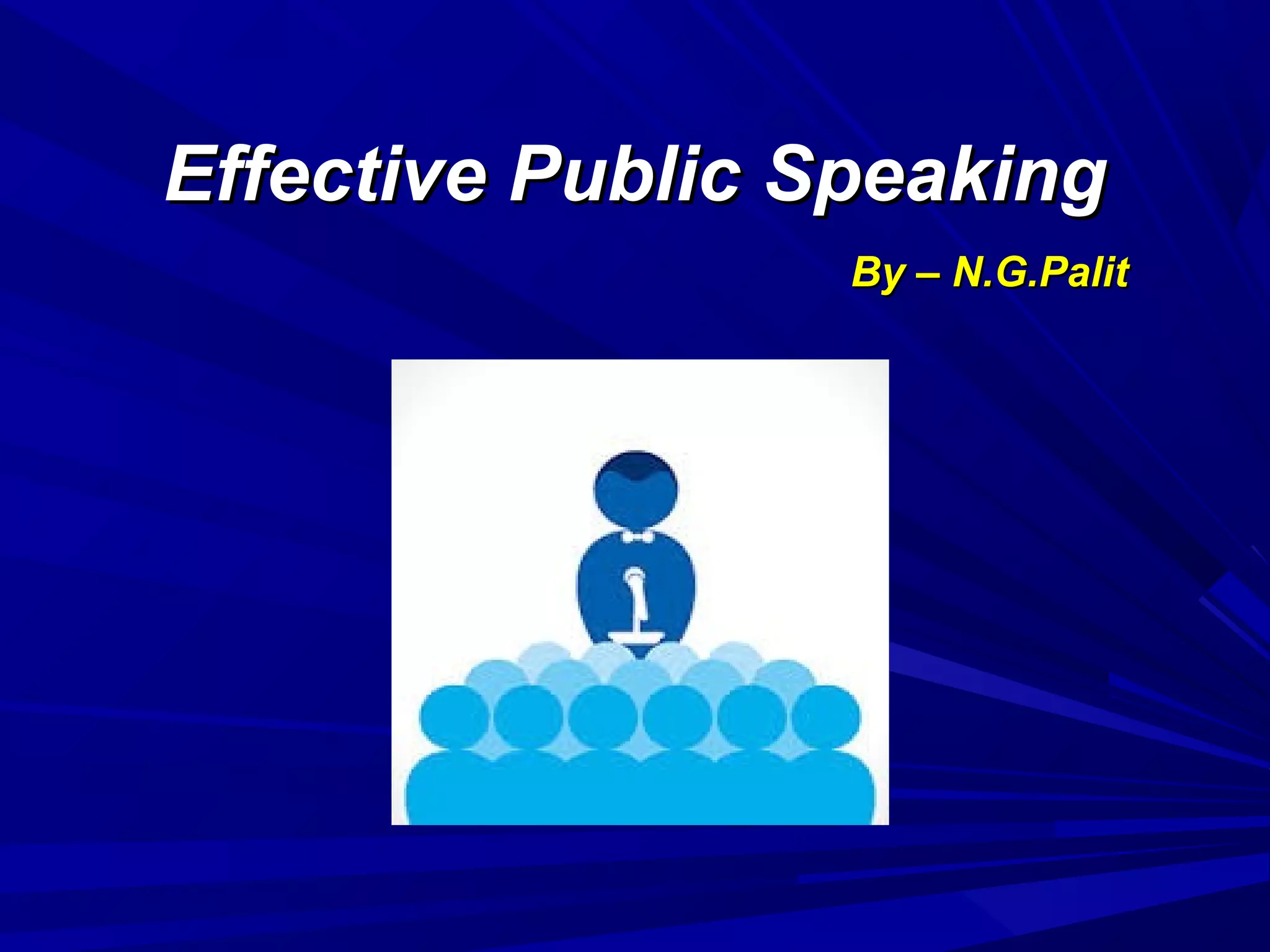
Effective Public SpeakingEffective Public Speaking
By – N.G.PalitBy – N.G.Palit
What is Public Speaking?What is Public Speaking?
Public speaking is thePublic speaking is the
process of speakingprocess of speaking
to a group of peopleto a group of people in ain a
structured and deliberatestructured and deliberate
mannermanner to inform, influence orto inform, influence or
entertain the listenersentertain the listeners..
””Great speakers are not born,Great speakers are not born,
they are trained.”they are trained.”
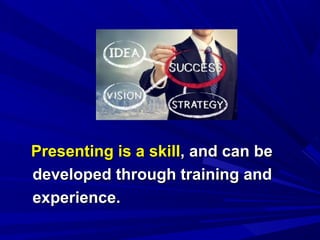
Presenting is a skillPresenting is a skill, and can be, and can be
developed through training anddeveloped through training and
experience.experience.
Presentation SkillsPresentation Skills
””A good presentationA good presentation
is the single mostis the single most
effective tool anyeffective tool any
organization canorganization can
have.”have.”
- John Detz- John Detz
WhyWhy
Public Speaking?Public Speaking?
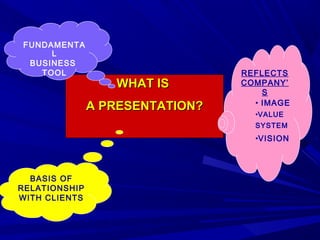
WHAT ISWHAT IS
A PRESENTATION?A PRESENTATION?
FUNDAMENTA
L
BUSINESS
TOOL REFLECTS
COMPANY’
S
• IMAGE
•VALUE
SYSTEM
•VISION
BASIS OF
RELATIONSHIP
WITH CLIENTS
Aim of PresentationAim of Presentation??
1. To inform1. To inform
2. Inspire or persuade2. Inspire or persuade
3. To communicate views3. To communicate views
4. To educate4. To educate
1. To Inform1. To Inform
Presentations offer ideal opportunities toPresentations offer ideal opportunities to
inform others about any progress, newinform others about any progress, new
developments, announcements, newdevelopments, announcements, new
products or market opportunities etc.products or market opportunities etc.
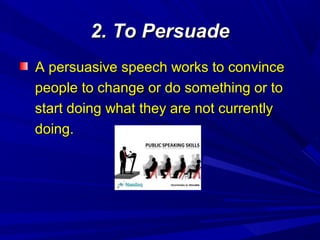
2. To Persuade2. To Persuade
A persuasive speech works to convinceA persuasive speech works to convince
people to change or do something or topeople to change or do something or to
start doing what they are not currentlystart doing what they are not currently
doing.doing.
3. To communicate views3. To communicate views
Emphasis is not on transmissionEmphasis is not on transmission
but on reception andbut on reception and
understanding by audience,understanding by audience,
so that: -so that: -
YOUR MESSAGE IS UNDERSTOOD,
REMEMBERED AND ACTED UPON!
YOUR MESSAGE IS UNDERSTOOD,
REMEMBERED AND ACTED UPON!
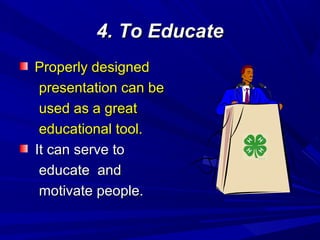
4. To Educate4. To Educate
Properly designedProperly designed
presentation can bepresentation can be
used as a greatused as a great
educational tool.educational tool.
It can serve toIt can serve to
educate andeducate and
motivate people.motivate people.
Effective public speaking is
INFLUENCE.
Influence is
LEADERSHIP.
Leadership is
BEING DIFFERENT AND
SUCCESSFUL.
Being different and successful is
MAKING A POSITIVE
CONTRUBUTION.
Making a positive contribution is
CREATING AN IMPACT.
Because --Because --
A smallA small STEPSTEP
can makecan make
AA BIGBIG
DIFFERENCEDIFFERENCE
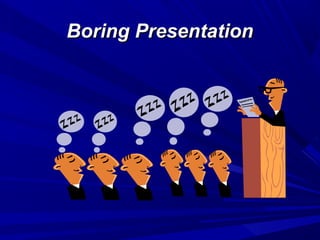
Boring PresentationBoring Presentation
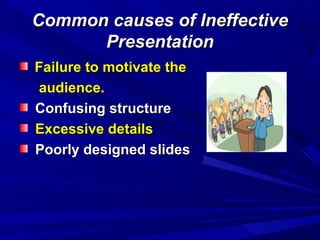
Common causes of IneffectiveCommon causes of Ineffective
PresentationPresentation
Failure to motivate theFailure to motivate the
audience.audience.
Confusing structureConfusing structure
Excessive detailsExcessive details
Poorly designed slidesPoorly designed slides
Effective PresentationEffective Presentation
Effective presentation involves four keyEffective presentation involves four key
components:components:
1.1. The SituationThe Situation
It involves finding the purpose, occasion,It involves finding the purpose, occasion,
and environment in which theand environment in which the
presentation is made.presentation is made.
Effective PresentationEffective Presentation
2.2. The AudienceThe Audience
IdentifyIdentify
Who will be my audience, what are theirWho will be my audience, what are their
needs and expectations.needs and expectations.
What is their knowledge about the topic?What is their knowledge about the topic?
Then, try to exceed their expectations.Then, try to exceed their expectations.
Effective PresentationEffective Presentation
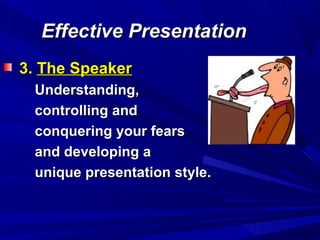
3.3. The SpeakerThe Speaker
Understanding,Understanding,
controlling andcontrolling and
conquering your fearsconquering your fears
and developing aand developing a
unique presentation style.unique presentation style.
Effective PresentationEffective Presentation
44.. The PresentationThe Presentation
a) Deciding its goals and objectives.a) Deciding its goals and objectives.
b) Then, planning and preparing.b) Then, planning and preparing.
c) Finally, developing an impressivec) Finally, developing an impressive
presentation.presentation.
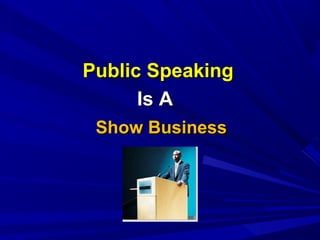
Public SpeakingPublic Speaking
Is AIs A
Show BusinessShow Business
Maxim No - 1Maxim No - 1
FollowFollow ”The Jolson Principle”,”The Jolson Principle”, which is:which is:
1. Give the audience what they want.1. Give the audience what they want.
2. Give them something more.2. Give them something more.
3. Leave them wanting more.3. Leave them wanting more.
Maxim No -2Maxim No -2
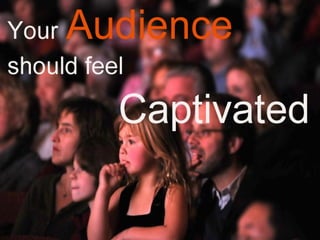
”” Your Audience Don’t Care --- ”Your Audience Don’t Care --- ”
It is true that your audience don’t careIt is true that your audience don’t care
about you.about you.
They care only about themselves.They care only about themselves.
So, remember to give themSo, remember to give them
what they wantwhat they want..
Phases of PresentationPhases of Presentation
Three components of a good presentationThree components of a good presentation
are:are:
1.1. The Planning PhaseThe Planning Phase::
Develop main pointsDevelop main points
22. The Preparation Phase. The Preparation Phase::
Structure your presentationStructure your presentation
3.3. The Delivery PhaseThe Delivery Phase::
This involves your personal styThis involves your personal stylele
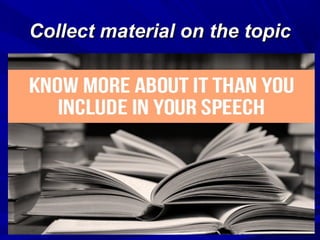
Collect material on the topicCollect material on the topic
PlanningPlanning
Decide in advanceDecide in advance::
Purpose of the presentation?Purpose of the presentation?
Who will be attending?Who will be attending?
Audience’s knowledge about the topic?Audience’s knowledge about the topic?
What is the venue?What is the venue?
What is the total time allotted?What is the total time allotted?
PreparationPreparation
AA) Subject of presentation:) Subject of presentation:
Decide in advance yourDecide in advance your
message or subject ofmessage or subject of
talktalk
Have a strong convictionHave a strong conviction
on what you want to talk.on what you want to talk.
PreparationPreparation
BB).). Organize your points logically:Organize your points logically:
Structure your outline into aStructure your outline into a
”presentable”presentable” format.” format.
FollowFollow ” The Universal Speaker’s Law”” The Universal Speaker’s Law”
which says:which says:
1.1. Tell them what you are going to tellTell them what you are going to tell
2.2. ThenThen, Tell them., Tell them.
3.3. At the end,At the end, Tell them what you haveTell them what you have
told them.told them.
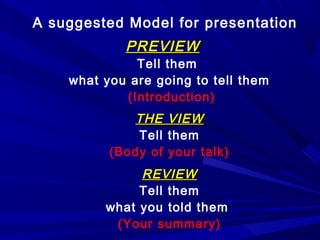
A suggested Model for presentation
PREVIEWPREVIEW
Tell them
what you are going to tell them
(Introduction)
THE VIEWTHE VIEW
Tell them
(Body of your talk)
REVIEWREVIEW
Tell them
what you told them
(Your summary)
PresentationPresentation
Every presentation should have:Every presentation should have:
1.1. An introductionAn introduction::
A good attention gettingA good attention getting
opener.opener.
2.2. A bodyA body::
A brief summary of the topic.A brief summary of the topic.
PresentationPresentation
3.3. A conclution:A conclution:
The conclution should include aThe conclution should include a
dynamite, thought-provokingdynamite, thought-provoking
closureclosure following a brief summary offollowing a brief summary of
what you told them.what you told them.
Rehearse in privateRehearse in private
Follow the principle ofFollow the principle of three Psthree Ps::
Practice, Practice, PracticePractice, Practice, Practice..
BecauseBecause practice makes apractice makes a
person perfect.person perfect.
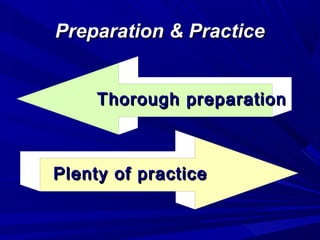
Preparation & PracticePreparation & Practice
Thorough preparationThorough preparation
Plenty of practicePlenty of practice
PracticePractice
Do this in front of a mirrorDo this in front of a mirror
or in front of a friendor in front of a friend
or get a video recordingor get a video recording
andand view itview it criticallycritically
Things that needThings that need PracticePractice
Your SmileYour Smile
GesturesGestures
Head & EyesHead & Eyes
SinceritySincerity
Keep notes to a minimumKeep notes to a minimum
If necessary, useIf necessary, use ’Index Cards.’’Index Cards.’
Jot down main points on a set ofJot down main points on a set of
””Index Cards”Index Cards”
It will serve as aIt will serve as a memory joggmemory joggerer for thefor the
actual presentation.actual presentation.
WhyWhy
FearFear
Public Speaking?Public Speaking?
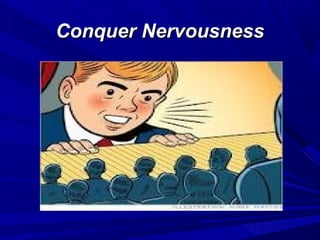
Conquer NervousnessConquer Nervousness
Try to conquer nervousnessTry to conquer nervousness
Try to minimize your stageTry to minimize your stage
fear.fear.
Take deep breath and try toTake deep breath and try to
relax. If required, sip a littlerelax. If required, sip a little
water.water.
Before going to the stage, remind yourselfBefore going to the stage, remind yourself
””I can do it.”I can do it.”
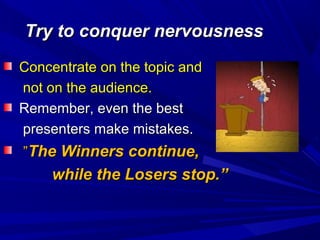
Try to conquer nervousnessTry to conquer nervousness
Concentrate on the topic andConcentrate on the topic and
not on the audience.not on the audience.
Remember, even the bestRemember, even the best
presenters make mistakes.presenters make mistakes.
””The Winners continue,The Winners continue,
while the Losers stop.”while the Losers stop.”
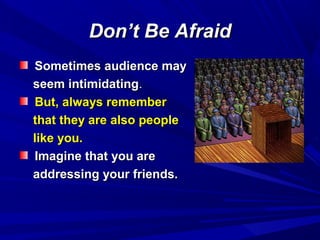
Don’t Be AfraidDon’t Be Afraid
Sometimes audience maySometimes audience may
seem intimidatingseem intimidating..
But, always rememberBut, always remember
that they are also peoplethat they are also people
like you.like you.
Imagine that you areImagine that you are
addressing your friends.addressing your friends.
The DeliveryThe Delivery
Here are a fewHere are a few
guidelines forguidelines for
an effectivean effective
delivery of presentation.delivery of presentation.
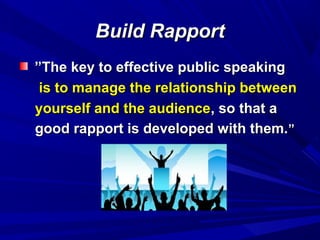
Build RapportBuild Rapport
””The key to effective public speakingThe key to effective public speaking
is to manage the relationship betweenis to manage the relationship between
yourself and the audienceyourself and the audience, so that a, so that a
good rapport is developed with them.good rapport is developed with them.””
Build RapportBuild Rapport
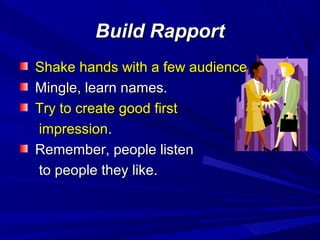
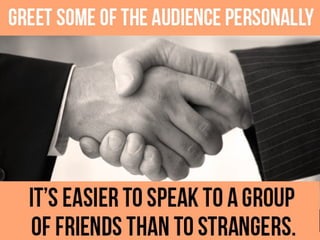
Shake hands with a few audienceShake hands with a few audience
Mingle, learn names.Mingle, learn names.
Try to create good firstTry to create good first
impressionimpression..
Remember, people listenRemember, people listen
to people they like.to people they like.
Delivering Speech - BeginningDelivering Speech - Beginning
Walk Calmly with ConfidenceWalk Calmly with Confidence
Establish Eye Contact.Establish Eye Contact.
Smile NaturallySmile Naturally
Deliver IntroductionDeliver Introduction
IntroductionIntroduction
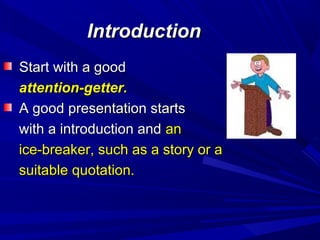
Start with a goodStart with a good
attention-getter.attention-getter.
A good presentation startsA good presentation starts
with a introduction andwith a introduction and anan
ice-breaker, such as a story or aice-breaker, such as a story or a
suitable quotation.suitable quotation.
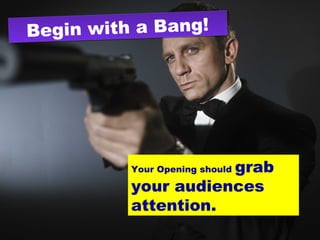
Begin with a Bang!Begin with a Bang!
Your Opening should grab
your audiences
attention.
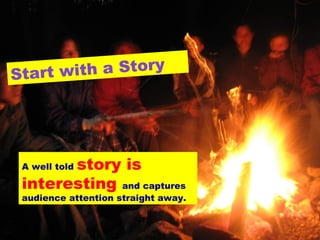
Start with a Story
A well told story is
interesting and captures
audience attention straight away.
Body of PresentationBody of Presentation
Cover the subject in logical order.Cover the subject in logical order.
Use ’KISS’ methodUse ’KISS’ method (Keep It Short &(Keep It Short &
Simple)Simple)
Use short and simple words & sentences.Use short and simple words & sentences.
Repeat important points for better clarity.Repeat important points for better clarity.
Use visuals/ graphs/ charts, whereverUse visuals/ graphs/ charts, wherever
possible.possible.
Body of PresentationBody of Presentation
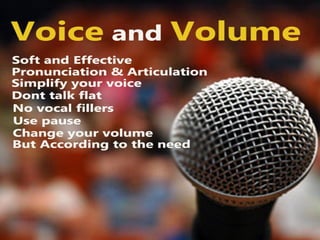
The Voice:The Voice:
The voice is probably theThe voice is probably the
most valuable tool of themost valuable tool of the
presenter.presenter.
The voice should not be too fast or tooThe voice should not be too fast or too
high or too soft.high or too soft.
PresentationPresentation
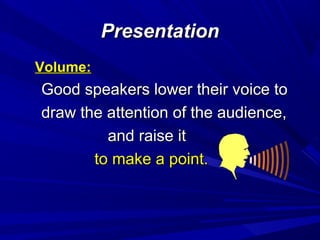
Volume:Volume:
Good speakers lower their voice toGood speakers lower their voice to
draw the attention of the audience,draw the attention of the audience,
and raise itand raise it
to make a point.to make a point.
Vocal QualitiesVocal Qualities
2. Tone:2. Tone:
The tone of voice gives evidence of yourThe tone of voice gives evidence of your
feelings.feelings.
Modulate your tone to avoid monotonyModulate your tone to avoid monotony..
3. Pace3. Pace::
Vary your voice, to maintain audience’sVary your voice, to maintain audience’s
interest.interest.
* Emphasize a point by slowing down* Emphasize a point by slowing down..
PresentationPresentation
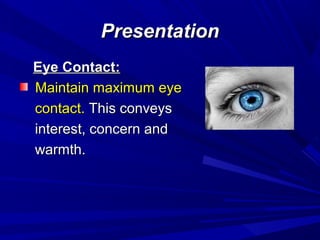
Eye Contact:Eye Contact:
Maintain maximum eyeMaintain maximum eye
contact.contact. This conveysThis conveys
interest, concern andinterest, concern and
warmth.warmth.
PresentationPresentation
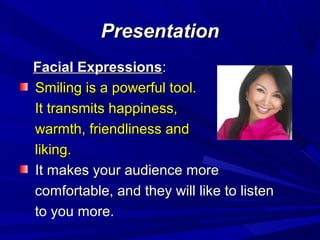
Facial ExpressionsFacial Expressions::
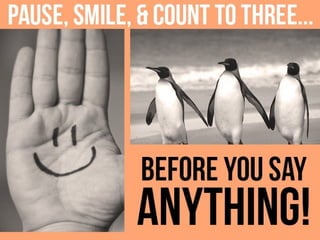
Smiling is a powerful tool.Smiling is a powerful tool.
It transmits happiness,It transmits happiness,
warmth, friendliness andwarmth, friendliness and
liking.liking.
It makes your audience moreIt makes your audience more
comfortable, and they will like to listencomfortable, and they will like to listen
to you more.to you more.
PresentationPresentation
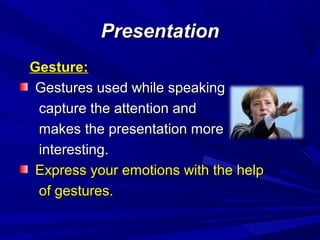
Gesture:Gesture:
Gestures used while speakingGestures used while speaking
capture the attention andcapture the attention and
makes the presentation moremakes the presentation more
interesting.interesting.
Express your emotions with the helpExpress your emotions with the help
of gestures.of gestures.
PresentationPresentation
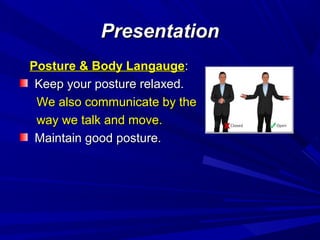
Posture & Body LangaugePosture & Body Langauge::
Keep your posture relaxed.Keep your posture relaxed.
We also communicate by theWe also communicate by the
way we talk and move.way we talk and move.
Maintain good posture.Maintain good posture.
Enhance Body ImageEnhance Body Image
Analyze your stance.Analyze your stance.
Improve your stance.Improve your stance.
PRACTICAL TIPSPRACTICAL TIPS
•Make sure your body language reflects whatMake sure your body language reflects what
you are saying.you are saying.
•Learn to relax your facial muscles and smile.Learn to relax your facial muscles and smile.
•Always wear comfortable shoes whenAlways wear comfortable shoes when
presenting.presenting.
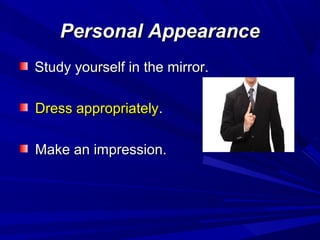
Personal AppearancePersonal Appearance
Study yourself in the mirror.Study yourself in the mirror.
Dress appropriatelyDress appropriately..
Make an impression.Make an impression.
Summarize & ConcludeSummarize & Conclude
At the end:At the end:
Summarize, what you have told.Summarize, what you have told.
Finish with a flourish & on a positiveFinish with a flourish & on a positive
note.note.
Close on a positive note.Close on a positive note.
Call for action pointsCall for action points
Summarize & ConcludeSummarize & Conclude
Do a quick summary, thenDo a quick summary, then
have a closure ready to wraphave a closure ready to wrap
up things.up things.
At the end, thank the audienceAt the end, thank the audience
for being attentive.for being attentive.
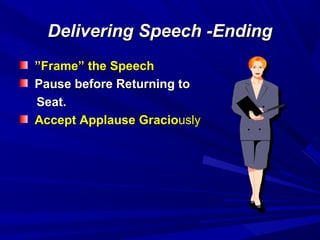
Delivering Speech -EndingDelivering Speech -Ending
””Frame” the SpeechFrame” the Speech
Pause before Returning toPause before Returning to
Seat.Seat.
Accept Applause GracioAccept Applause Graciouslyusly
The golden rule for speakersThe golden rule for speakers
1. Keep the presentation1. Keep the presentation
short enough to createshort enough to create
interest and longinterest and long
enough to cover theenough to cover the
subject.subject.
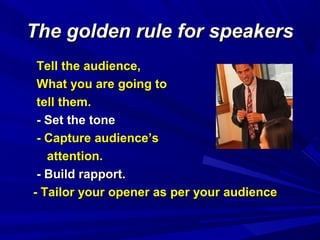
The golden rule for speakersThe golden rule for speakers
Tell the audience,Tell the audience,
What you are going toWhat you are going to
tell them.tell them.
- Set the tone- Set the tone
- Capture audience’s- Capture audience’s
attention.attention.
- Build rapport.- Build rapport.
- Tailor your opener as per your audience- Tailor your opener as per your audience
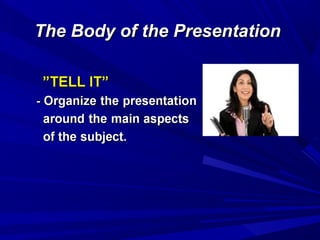
The Body of the PresentationThe Body of the Presentation
TellTell (Body of presentation)(Body of presentation)
Now is the time to deliverNow is the time to deliver
your whole presentationyour whole presentation,,
to the group, using all theto the group, using all the
techniques we havetechniques we have
discussed.discussed.
Organizing - The CloseOrganizing - The Close
””Tell them what youTell them what you
have told them”have told them”
- Summarize message.- Summarize message.
- Repeat key points- Repeat key points
- Ask for action.- Ask for action.
- End with a positive note- End with a positive note
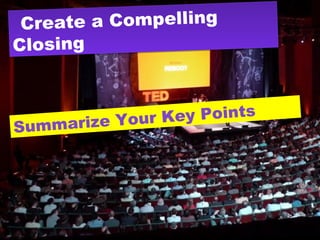
Create a Compelling
Closing
Create a Compelling
Closing
Summarize Your Key Points
The Three Presentation EssentialThe Three Presentation Essential
1. Use Visual Aid, wherever possible.1. Use Visual Aid, wherever possible.
2. Rehearse, Rehearse & Rehearse2. Rehearse, Rehearse & Rehearse
”” If you fail to prepare, you areIf you fail to prepare, you are
prepared to fail.”prepared to fail.”
3. Rehearse against clock.3. Rehearse against clock.
4. Memorize your script.4. Memorize your script.
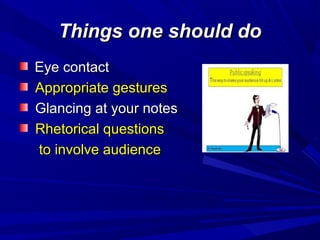
Things one should doThings one should do
Eye contactEye contact
Appropriate gesturesAppropriate gestures
Glancing at your notesGlancing at your notes
Rhetorical questionsRhetorical questions
to involve audienceto involve audience
Things one shouldn’t doThings one shouldn’t do
Read directly from notesRead directly from notes..
Read directly from screen.Read directly from screen.
Turn back on the audience.Turn back on the audience.
Keeping hands in the pocketKeeping hands in the pocket
for a long time.for a long time.
No nervous gestures.No nervous gestures.
No ’um’, ’ah’, ’you know’ etc.No ’um’, ’ah’, ’you know’ etc.
Talk too fastTalk too fast
Talk too quietlyTalk too quietly
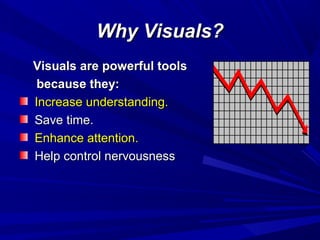
Why Visuals?Why Visuals?
Visuals are powerful toolsVisuals are powerful tools
because they:because they:
Increase understanding.Increase understanding.
Save time.Save time.
Enhance attention.Enhance attention.
Help control nervousnessHelp control nervousness
Creating Effective Visual AidsCreating Effective Visual Aids
Content:Content:
If it does not add value, don’t use it.If it does not add value, don’t use it.
UnveilingUnveiling::
ThinkThink, is it useful or necessary?, is it useful or necessary?
Colour:Colour:
Know your room and lightingKnow your room and lighting
Dark roomDark room – use light font on dark background– use light font on dark background
Bright roomBright room –– use dark font on light backgrounduse dark font on light background
Visual AidsVisual Aids
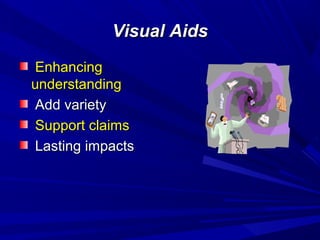
EnhancingEnhancing
understandingunderstanding
Add varietyAdd variety
Support claimsSupport claims
Lasting impactsLasting impacts
Visual AidsVisual Aids
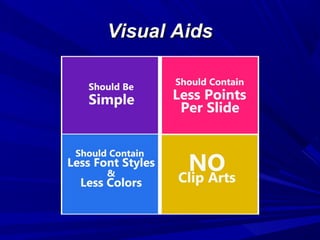
Visual Aid ShouldVisual Aid Should
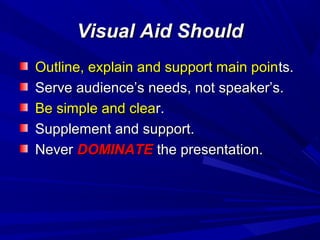
Outline, explain and support main poinOutline, explain and support main points.ts.
Serve audience’s needs, not speaker’s.Serve audience’s needs, not speaker’s.
Be simple and cleaBe simple and clear.r.
Supplement and support.Supplement and support.
NeverNever DOMINATEDOMINATE the presentation.the presentation.
Tips on Visual AidsTips on Visual Aids
Are visual aids easy to read and easyAre visual aids easy to read and easy
to understand?to understand?
Can they be easily seen from all areasCan they be easily seen from all areas
of the room?of the room?
Design the ’Look’ of yourDesign the ’Look’ of your
presentationpresentation
Do not use more than 7 lines on anyDo not use more than 7 lines on any
page and not more than 7 words perpage and not more than 7 words per
line. ( This is called Rule – 77).line. ( This is called Rule – 77).
Use bright and bold colours, but not red.Use bright and bold colours, but not red.
Red colour should be used to highlightRed colour should be used to highlight
any important poinany important point.t.
How to Get BetterHow to Get Better
Keep practicing and getting feedback
about your performance.
The more you practice, the more
confident and comfortable you’ll be on
stage.
Tips & Techniques for a goodTips & Techniques for a good
presentationpresentation
Speak clearly and loudly enough for allSpeak clearly and loudly enough for all
to hearto hear..
Don’t speak in monotone voice.Don’t speak in monotone voice.
Speak to the audience, not to the charts.Speak to the audience, not to the charts.
Don’t stand between the audience andDon’t stand between the audience and
the visuals.the visuals.
Don’t lean on the podium or the table forDon’t lean on the podium or the table for
periods.periods.
Tips & Techniques for aTips & Techniques for a
good presentationgood presentation
Don’t put both your hands in pocket. ThisDon’t put both your hands in pocket. This
makes you look unprofessional.makes you look unprofessional.
Circulate around the room as you speak.Circulate around the room as you speak.
This movement brings physical closenessThis movement brings physical closeness
to the audience.to the audience.
It is better to finish slightly early than toIt is better to finish slightly early than to
over run.over run.
Tips & TechniquesTips & Techniques
Do not leave visual aids on, too longDo not leave visual aids on, too long..
Do not rush through, as if you are in aDo not rush through, as if you are in a
hurry.hurry.
Involve members by asking themInvolve members by asking them
questions.questions.
Be honest with the audience.Be honest with the audience.
Handle questions at the endHandle questions at the end..
We heartily welcome
We heartily welcome
your views, Queries and
applause!!!applause!!!
Any Question?Any Question?
At The EndAt The End
Please send your valuable feed-backPlease send your valuable feed-back
to the following address:to the following address:
nandapalit@yahoo.co.innandapalit@yahoo.co.in
OROR
Call: 91 9949118910Call: 91 9949118910

Effective public speaking

  • 1.
    Effective Public SpeakingEffectivePublic Speaking By – N.G.PalitBy – N.G.Palit
  • 2.
    What is PublicSpeaking?What is Public Speaking? Public speaking is thePublic speaking is the process of speakingprocess of speaking to a group of peopleto a group of people in ain a structured and deliberatestructured and deliberate mannermanner to inform, influence orto inform, influence or entertain the listenersentertain the listeners..
  • 3.
    ””Great speakers arenot born,Great speakers are not born, they are trained.”they are trained.”
  • 4.
    Presenting is askillPresenting is a skill, and can be, and can be developed through training anddeveloped through training and experience.experience.
  • 5.
    Presentation SkillsPresentation Skills ””Agood presentationA good presentation is the single mostis the single most effective tool anyeffective tool any organization canorganization can have.”have.” - John Detz- John Detz
  • 6.
  • 7.
    WHAT ISWHAT IS APRESENTATION?A PRESENTATION? FUNDAMENTA L BUSINESS TOOL REFLECTS COMPANY’ S • IMAGE •VALUE SYSTEM •VISION BASIS OF RELATIONSHIP WITH CLIENTS
  • 8.
    Aim of PresentationAimof Presentation?? 1. To inform1. To inform 2. Inspire or persuade2. Inspire or persuade 3. To communicate views3. To communicate views 4. To educate4. To educate
  • 9.
    1. To Inform1.To Inform Presentations offer ideal opportunities toPresentations offer ideal opportunities to inform others about any progress, newinform others about any progress, new developments, announcements, newdevelopments, announcements, new products or market opportunities etc.products or market opportunities etc.
  • 10.
    2. To Persuade2.To Persuade A persuasive speech works to convinceA persuasive speech works to convince people to change or do something or topeople to change or do something or to start doing what they are not currentlystart doing what they are not currently doing.doing.
  • 11.
    3. To communicateviews3. To communicate views Emphasis is not on transmissionEmphasis is not on transmission but on reception andbut on reception and understanding by audience,understanding by audience, so that: -so that: - YOUR MESSAGE IS UNDERSTOOD, REMEMBERED AND ACTED UPON! YOUR MESSAGE IS UNDERSTOOD, REMEMBERED AND ACTED UPON!
  • 12.
    4. To Educate4.To Educate Properly designedProperly designed presentation can bepresentation can be used as a greatused as a great educational tool.educational tool. It can serve toIt can serve to educate andeducate and motivate people.motivate people.
  • 14.
    Effective public speakingis INFLUENCE. Influence is LEADERSHIP. Leadership is BEING DIFFERENT AND SUCCESSFUL. Being different and successful is MAKING A POSITIVE CONTRUBUTION. Making a positive contribution is CREATING AN IMPACT.
  • 15.
    Because --Because -- AsmallA small STEPSTEP can makecan make AA BIGBIG DIFFERENCEDIFFERENCE
  • 16.
  • 17.
    Common causes ofIneffectiveCommon causes of Ineffective PresentationPresentation Failure to motivate theFailure to motivate the audience.audience. Confusing structureConfusing structure Excessive detailsExcessive details Poorly designed slidesPoorly designed slides
  • 18.
    Effective PresentationEffective Presentation Effectivepresentation involves four keyEffective presentation involves four key components:components: 1.1. The SituationThe Situation It involves finding the purpose, occasion,It involves finding the purpose, occasion, and environment in which theand environment in which the presentation is made.presentation is made.
  • 19.
    Effective PresentationEffective Presentation 2.2.The AudienceThe Audience IdentifyIdentify Who will be my audience, what are theirWho will be my audience, what are their needs and expectations.needs and expectations. What is their knowledge about the topic?What is their knowledge about the topic? Then, try to exceed their expectations.Then, try to exceed their expectations.
  • 22.
    Effective PresentationEffective Presentation 3.3.The SpeakerThe Speaker Understanding,Understanding, controlling andcontrolling and conquering your fearsconquering your fears and developing aand developing a unique presentation style.unique presentation style.
  • 23.
    Effective PresentationEffective Presentation 44..The PresentationThe Presentation a) Deciding its goals and objectives.a) Deciding its goals and objectives. b) Then, planning and preparing.b) Then, planning and preparing. c) Finally, developing an impressivec) Finally, developing an impressive presentation.presentation.
  • 24.
    Public SpeakingPublic Speaking IsAIs A Show BusinessShow Business
  • 25.
    Maxim No -1Maxim No - 1 FollowFollow ”The Jolson Principle”,”The Jolson Principle”, which is:which is: 1. Give the audience what they want.1. Give the audience what they want. 2. Give them something more.2. Give them something more. 3. Leave them wanting more.3. Leave them wanting more.
  • 26.
    Maxim No -2MaximNo -2 ”” Your Audience Don’t Care --- ”Your Audience Don’t Care --- ” It is true that your audience don’t careIt is true that your audience don’t care about you.about you. They care only about themselves.They care only about themselves. So, remember to give themSo, remember to give them what they wantwhat they want..
  • 28.
    Phases of PresentationPhasesof Presentation Three components of a good presentationThree components of a good presentation are:are: 1.1. The Planning PhaseThe Planning Phase:: Develop main pointsDevelop main points 22. The Preparation Phase. The Preparation Phase:: Structure your presentationStructure your presentation 3.3. The Delivery PhaseThe Delivery Phase:: This involves your personal styThis involves your personal stylele
  • 29.
    Collect material onthe topicCollect material on the topic
  • 30.
    PlanningPlanning Decide in advanceDecidein advance:: Purpose of the presentation?Purpose of the presentation? Who will be attending?Who will be attending? Audience’s knowledge about the topic?Audience’s knowledge about the topic? What is the venue?What is the venue? What is the total time allotted?What is the total time allotted?
  • 31.
    PreparationPreparation AA) Subject ofpresentation:) Subject of presentation: Decide in advance yourDecide in advance your message or subject ofmessage or subject of talktalk Have a strong convictionHave a strong conviction on what you want to talk.on what you want to talk.
  • 32.
    PreparationPreparation BB).). Organize yourpoints logically:Organize your points logically: Structure your outline into aStructure your outline into a ”presentable”presentable” format.” format. FollowFollow ” The Universal Speaker’s Law”” The Universal Speaker’s Law” which says:which says: 1.1. Tell them what you are going to tellTell them what you are going to tell 2.2. ThenThen, Tell them., Tell them. 3.3. At the end,At the end, Tell them what you haveTell them what you have told them.told them.
  • 33.
    A suggested Modelfor presentation PREVIEWPREVIEW Tell them what you are going to tell them (Introduction) THE VIEWTHE VIEW Tell them (Body of your talk) REVIEWREVIEW Tell them what you told them (Your summary)
  • 34.
    PresentationPresentation Every presentation shouldhave:Every presentation should have: 1.1. An introductionAn introduction:: A good attention gettingA good attention getting opener.opener. 2.2. A bodyA body:: A brief summary of the topic.A brief summary of the topic.
  • 35.
    PresentationPresentation 3.3. A conclution:Aconclution: The conclution should include aThe conclution should include a dynamite, thought-provokingdynamite, thought-provoking closureclosure following a brief summary offollowing a brief summary of what you told them.what you told them.
  • 37.
    Rehearse in privateRehearsein private Follow the principle ofFollow the principle of three Psthree Ps:: Practice, Practice, PracticePractice, Practice, Practice.. BecauseBecause practice makes apractice makes a person perfect.person perfect.
  • 39.
    Preparation & PracticePreparation& Practice Thorough preparationThorough preparation Plenty of practicePlenty of practice
  • 40.
    PracticePractice Do this infront of a mirrorDo this in front of a mirror or in front of a friendor in front of a friend or get a video recordingor get a video recording andand view itview it criticallycritically
  • 41.
    Things that needThingsthat need PracticePractice Your SmileYour Smile GesturesGestures Head & EyesHead & Eyes SinceritySincerity
  • 43.
    Keep notes toa minimumKeep notes to a minimum If necessary, useIf necessary, use ’Index Cards.’’Index Cards.’ Jot down main points on a set ofJot down main points on a set of ””Index Cards”Index Cards” It will serve as aIt will serve as a memory joggmemory joggerer for thefor the actual presentation.actual presentation.
  • 44.
  • 45.
  • 47.
    Try to conquernervousnessTry to conquer nervousness Try to minimize your stageTry to minimize your stage fear.fear. Take deep breath and try toTake deep breath and try to relax. If required, sip a littlerelax. If required, sip a little water.water. Before going to the stage, remind yourselfBefore going to the stage, remind yourself ””I can do it.”I can do it.”
  • 49.
    Try to conquernervousnessTry to conquer nervousness Concentrate on the topic andConcentrate on the topic and not on the audience.not on the audience. Remember, even the bestRemember, even the best presenters make mistakes.presenters make mistakes. ””The Winners continue,The Winners continue, while the Losers stop.”while the Losers stop.”
  • 50.
    Don’t Be AfraidDon’tBe Afraid Sometimes audience maySometimes audience may seem intimidatingseem intimidating.. But, always rememberBut, always remember that they are also peoplethat they are also people like you.like you. Imagine that you areImagine that you are addressing your friends.addressing your friends.
  • 51.
    The DeliveryThe Delivery Hereare a fewHere are a few guidelines forguidelines for an effectivean effective delivery of presentation.delivery of presentation.
  • 52.
    Build RapportBuild Rapport ””Thekey to effective public speakingThe key to effective public speaking is to manage the relationship betweenis to manage the relationship between yourself and the audienceyourself and the audience, so that a, so that a good rapport is developed with them.good rapport is developed with them.””
  • 53.
    Build RapportBuild Rapport Shakehands with a few audienceShake hands with a few audience Mingle, learn names.Mingle, learn names. Try to create good firstTry to create good first impressionimpression.. Remember, people listenRemember, people listen to people they like.to people they like.
  • 55.
    Delivering Speech -BeginningDelivering Speech - Beginning Walk Calmly with ConfidenceWalk Calmly with Confidence Establish Eye Contact.Establish Eye Contact. Smile NaturallySmile Naturally Deliver IntroductionDeliver Introduction
  • 56.
    IntroductionIntroduction Start with agoodStart with a good attention-getter.attention-getter. A good presentation startsA good presentation starts with a introduction andwith a introduction and anan ice-breaker, such as a story or aice-breaker, such as a story or a suitable quotation.suitable quotation.
  • 57.
    Begin with aBang!Begin with a Bang! Your Opening should grab your audiences attention.
  • 58.
    Start with aStory A well told story is interesting and captures audience attention straight away.
  • 59.
    Body of PresentationBodyof Presentation Cover the subject in logical order.Cover the subject in logical order. Use ’KISS’ methodUse ’KISS’ method (Keep It Short &(Keep It Short & Simple)Simple) Use short and simple words & sentences.Use short and simple words & sentences. Repeat important points for better clarity.Repeat important points for better clarity. Use visuals/ graphs/ charts, whereverUse visuals/ graphs/ charts, wherever possible.possible.
  • 61.
    Body of PresentationBodyof Presentation The Voice:The Voice: The voice is probably theThe voice is probably the most valuable tool of themost valuable tool of the presenter.presenter. The voice should not be too fast or tooThe voice should not be too fast or too high or too soft.high or too soft.
  • 62.
    PresentationPresentation Volume:Volume: Good speakers lowertheir voice toGood speakers lower their voice to draw the attention of the audience,draw the attention of the audience, and raise itand raise it to make a point.to make a point.
  • 64.
    Vocal QualitiesVocal Qualities 2.Tone:2. Tone: The tone of voice gives evidence of yourThe tone of voice gives evidence of your feelings.feelings. Modulate your tone to avoid monotonyModulate your tone to avoid monotony.. 3. Pace3. Pace:: Vary your voice, to maintain audience’sVary your voice, to maintain audience’s interest.interest. * Emphasize a point by slowing down* Emphasize a point by slowing down..
  • 67.
    PresentationPresentation Eye Contact:Eye Contact: Maintainmaximum eyeMaintain maximum eye contact.contact. This conveysThis conveys interest, concern andinterest, concern and warmth.warmth.
  • 68.
    PresentationPresentation Facial ExpressionsFacial Expressions:: Smilingis a powerful tool.Smiling is a powerful tool. It transmits happiness,It transmits happiness, warmth, friendliness andwarmth, friendliness and liking.liking. It makes your audience moreIt makes your audience more comfortable, and they will like to listencomfortable, and they will like to listen to you more.to you more.
  • 69.
    PresentationPresentation Gesture:Gesture: Gestures used whilespeakingGestures used while speaking capture the attention andcapture the attention and makes the presentation moremakes the presentation more interesting.interesting. Express your emotions with the helpExpress your emotions with the help of gestures.of gestures.
  • 70.
    PresentationPresentation Posture & BodyLangaugePosture & Body Langauge:: Keep your posture relaxed.Keep your posture relaxed. We also communicate by theWe also communicate by the way we talk and move.way we talk and move. Maintain good posture.Maintain good posture.
  • 71.
    Enhance Body ImageEnhanceBody Image Analyze your stance.Analyze your stance. Improve your stance.Improve your stance. PRACTICAL TIPSPRACTICAL TIPS •Make sure your body language reflects whatMake sure your body language reflects what you are saying.you are saying. •Learn to relax your facial muscles and smile.Learn to relax your facial muscles and smile. •Always wear comfortable shoes whenAlways wear comfortable shoes when presenting.presenting.
  • 72.
    Personal AppearancePersonal Appearance Studyyourself in the mirror.Study yourself in the mirror. Dress appropriatelyDress appropriately.. Make an impression.Make an impression.
  • 74.
    Summarize & ConcludeSummarize& Conclude At the end:At the end: Summarize, what you have told.Summarize, what you have told. Finish with a flourish & on a positiveFinish with a flourish & on a positive note.note. Close on a positive note.Close on a positive note. Call for action pointsCall for action points
  • 75.
    Summarize & ConcludeSummarize& Conclude Do a quick summary, thenDo a quick summary, then have a closure ready to wraphave a closure ready to wrap up things.up things. At the end, thank the audienceAt the end, thank the audience for being attentive.for being attentive.
  • 76.
    Delivering Speech -EndingDeliveringSpeech -Ending ””Frame” the SpeechFrame” the Speech Pause before Returning toPause before Returning to Seat.Seat. Accept Applause GracioAccept Applause Graciouslyusly
  • 77.
    The golden rulefor speakersThe golden rule for speakers 1. Keep the presentation1. Keep the presentation short enough to createshort enough to create interest and longinterest and long enough to cover theenough to cover the subject.subject.
  • 78.
    The golden rulefor speakersThe golden rule for speakers Tell the audience,Tell the audience, What you are going toWhat you are going to tell them.tell them. - Set the tone- Set the tone - Capture audience’s- Capture audience’s attention.attention. - Build rapport.- Build rapport. - Tailor your opener as per your audience- Tailor your opener as per your audience
  • 79.
    The Body ofthe PresentationThe Body of the Presentation
  • 80.
    TellTell (Body ofpresentation)(Body of presentation) Now is the time to deliverNow is the time to deliver your whole presentationyour whole presentation,, to the group, using all theto the group, using all the techniques we havetechniques we have discussed.discussed.
  • 81.
    Organizing - TheCloseOrganizing - The Close ””Tell them what youTell them what you have told them”have told them” - Summarize message.- Summarize message. - Repeat key points- Repeat key points - Ask for action.- Ask for action. - End with a positive note- End with a positive note
  • 82.
    Create a Compelling Closing Createa Compelling Closing Summarize Your Key Points
  • 83.
    The Three PresentationEssentialThe Three Presentation Essential 1. Use Visual Aid, wherever possible.1. Use Visual Aid, wherever possible. 2. Rehearse, Rehearse & Rehearse2. Rehearse, Rehearse & Rehearse ”” If you fail to prepare, you areIf you fail to prepare, you are prepared to fail.”prepared to fail.” 3. Rehearse against clock.3. Rehearse against clock. 4. Memorize your script.4. Memorize your script.
  • 84.
    Things one shoulddoThings one should do Eye contactEye contact Appropriate gesturesAppropriate gestures Glancing at your notesGlancing at your notes Rhetorical questionsRhetorical questions to involve audienceto involve audience
  • 85.
    Things one shouldn’tdoThings one shouldn’t do Read directly from notesRead directly from notes.. Read directly from screen.Read directly from screen. Turn back on the audience.Turn back on the audience. Keeping hands in the pocketKeeping hands in the pocket for a long time.for a long time. No nervous gestures.No nervous gestures. No ’um’, ’ah’, ’you know’ etc.No ’um’, ’ah’, ’you know’ etc. Talk too fastTalk too fast Talk too quietlyTalk too quietly
  • 86.
    Why Visuals?Why Visuals? Visualsare powerful toolsVisuals are powerful tools because they:because they: Increase understanding.Increase understanding. Save time.Save time. Enhance attention.Enhance attention. Help control nervousnessHelp control nervousness
  • 87.
    Creating Effective VisualAidsCreating Effective Visual Aids Content:Content: If it does not add value, don’t use it.If it does not add value, don’t use it. UnveilingUnveiling:: ThinkThink, is it useful or necessary?, is it useful or necessary? Colour:Colour: Know your room and lightingKnow your room and lighting Dark roomDark room – use light font on dark background– use light font on dark background Bright roomBright room –– use dark font on light backgrounduse dark font on light background
  • 88.
    Visual AidsVisual Aids EnhancingEnhancing understandingunderstanding AddvarietyAdd variety Support claimsSupport claims Lasting impactsLasting impacts
  • 89.
  • 90.
    Visual Aid ShouldVisualAid Should Outline, explain and support main poinOutline, explain and support main points.ts. Serve audience’s needs, not speaker’s.Serve audience’s needs, not speaker’s. Be simple and cleaBe simple and clear.r. Supplement and support.Supplement and support. NeverNever DOMINATEDOMINATE the presentation.the presentation.
  • 92.
    Tips on VisualAidsTips on Visual Aids Are visual aids easy to read and easyAre visual aids easy to read and easy to understand?to understand? Can they be easily seen from all areasCan they be easily seen from all areas of the room?of the room?
  • 93.
    Design the ’Look’of yourDesign the ’Look’ of your presentationpresentation Do not use more than 7 lines on anyDo not use more than 7 lines on any page and not more than 7 words perpage and not more than 7 words per line. ( This is called Rule – 77).line. ( This is called Rule – 77). Use bright and bold colours, but not red.Use bright and bold colours, but not red. Red colour should be used to highlightRed colour should be used to highlight any important poinany important point.t.
  • 95.
    How to GetBetterHow to Get Better Keep practicing and getting feedback about your performance. The more you practice, the more confident and comfortable you’ll be on stage.
  • 96.
    Tips & Techniquesfor a goodTips & Techniques for a good presentationpresentation Speak clearly and loudly enough for allSpeak clearly and loudly enough for all to hearto hear.. Don’t speak in monotone voice.Don’t speak in monotone voice. Speak to the audience, not to the charts.Speak to the audience, not to the charts. Don’t stand between the audience andDon’t stand between the audience and the visuals.the visuals. Don’t lean on the podium or the table forDon’t lean on the podium or the table for periods.periods.
  • 97.
    Tips & Techniquesfor aTips & Techniques for a good presentationgood presentation Don’t put both your hands in pocket. ThisDon’t put both your hands in pocket. This makes you look unprofessional.makes you look unprofessional. Circulate around the room as you speak.Circulate around the room as you speak. This movement brings physical closenessThis movement brings physical closeness to the audience.to the audience. It is better to finish slightly early than toIt is better to finish slightly early than to over run.over run.
  • 98.
    Tips & TechniquesTips& Techniques Do not leave visual aids on, too longDo not leave visual aids on, too long.. Do not rush through, as if you are in aDo not rush through, as if you are in a hurry.hurry. Involve members by asking themInvolve members by asking them questions.questions. Be honest with the audience.Be honest with the audience. Handle questions at the endHandle questions at the end..
  • 99.
    We heartily welcome Weheartily welcome your views, Queries and your views, Queries and applause!!!applause!!!
  • 101.
  • 102.
    At The EndAtThe End Please send your valuable feed-backPlease send your valuable feed-back to the following address:to the following address: nandapalit@yahoo.co.innandapalit@yahoo.co.in OROR Call: 91 9949118910Call: 91 9949118910