Art of Public Speaking
R. Ravindra Kumar
Secretary (Audit)
LIC OF INDIA
AHMEDABAD
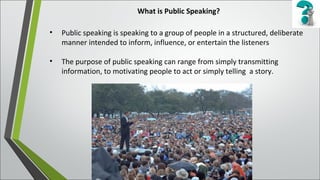
What is Public Speaking?
• Public speaking is speaking to a group of people in a structured, deliberate
manner intended to inform, influence, or entertain the listeners
• The purpose of public speaking can range from simply transmitting
information, to motivating people to act or simply telling a story.
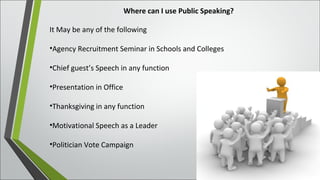
Where can I use Public Speaking?
It May be any of the following
•Agency Recruitment Seminar in Schools and Colleges
•Chief guest’s Speech in any function
•Presentation in Office
•Thanksgiving in any function
•Motivational Speech as a Leader
•Politician Vote Campaign
Benefits of Public Speaking
Because of Public Speaking, you can
 Improve Self Confidence
 Make yourself more comfortable around other people
 Effectively get your message across
 Make a difference in your Life, Business, Career and Community
 Demonstrate your Knowledge
 Create your own supporters
 Fine-tune your verbal and Non verbal communication skills
Types of Public Speaking
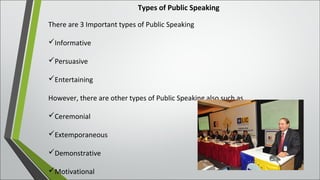
There are 3 Important types of Public Speaking
Informative
Persuasive
Entertaining
However, there are other types of Public Speaking also such as
Ceremonial
Extemporaneous
Demonstrative
Motivational
Informative Public Speaking
Informative:
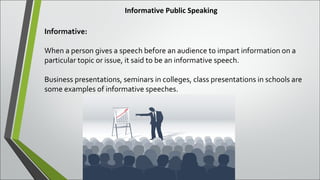
When a person gives a speech before an audience to impart information on a
particular topic or issue, it said to be an informative speech.
Business presentations, seminars in colleges, class presentations in schools are
some examples of informative speeches.
Persuasive Public Speaking
Persuasive:
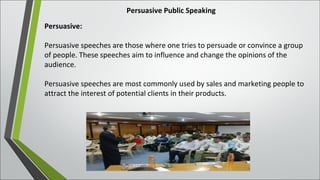
Persuasive speeches are those where one tries to persuade or convince a group
of people. These speeches aim to influence and change the opinions of the
audience.
Persuasive speeches are most commonly used by sales and marketing people to
attract the interest of potential clients in their products.
Entertaining Public Speaking
Entertaining
Entertaining Speeches are those where one tries to commemorate or humor the
listeners. The Speaker make them happy through Jokes and Short Stories.
Standup comedy shows are examples of Entertaining Public Speech
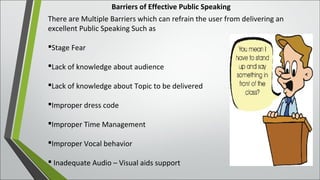
Barriers of Effective Public Speaking
There are Multiple Barriers which can refrain the user from delivering an
excellent Public Speaking Such as
Stage Fear
Lack of knowledge about audience
Lack of knowledge about Topic to be delivered
Improper dress code
Improper Time Management
Improper Vocal behavior
 Inadequate Audio – Visual aids support
Guidelines for Effective Public Speaking
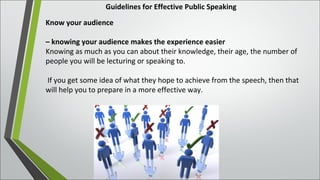
Know your audience
– knowing your audience makes the experience easier
Knowing as much as you can about their knowledge, their age, the number of
people you will be lecturing or speaking to.
If you get some idea of what they hope to achieve from the speech, then that
will help you to prepare in a more effective way.
Guidelines for Effective Public Speaking
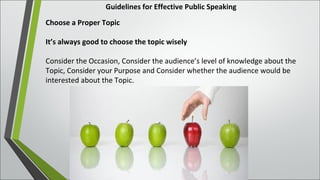
Choose a Proper Topic
It’s always good to choose the topic wisely
Consider the Occasion, Consider the audience’s level of knowledge about the
Topic, Consider your Purpose and Consider whether the audience would be
interested about the Topic.
Guidelines for Effective Public Speaking
Do enough Research over the Topic
The better prepared you are for your speech or lecture, the better the speech
will be
It is better to be over prepared than under
Write everything down that I wanted to say, including jokes and Examples
Guidelines for Effective Public Speaking
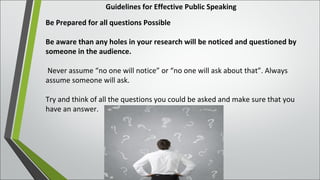
Be Prepared for all questions Possible
Be aware than any holes in your research will be noticed and questioned by
someone in the audience.
Never assume “no one will notice” or “no one will ask about that”. Always
assume someone will ask.
Try and think of all the questions you could be asked and make sure that you
have an answer.
Guidelines for Effective Public Speaking
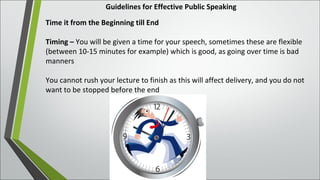
Time it from the Beginning till End
Timing – You will be given a time for your speech, sometimes these are flexible
(between 10-15 minutes for example) which is good, as going over time is bad
manners
You cannot rush your lecture to finish as this will affect delivery, and you do not
want to be stopped before the end
Guidelines for Effective Public Speaking
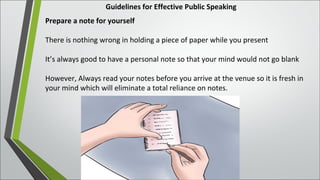
Prepare a note for yourself
There is nothing wrong in holding a piece of paper while you present
It’s always good to have a personal note so that your mind would not go blank
However, Always read your notes before you arrive at the venue so it is fresh in
your mind which will eliminate a total reliance on notes.
Guidelines for Effective Public Speaking
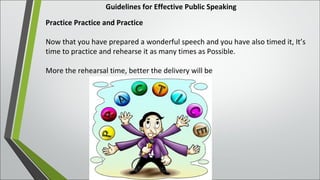
Practice Practice and Practice
Now that you have prepared a wonderful speech and you have also timed it, It’s
time to practice and rehearse it as many times as Possible.
More the rehearsal time, better the delivery will be
Guidelines for Effective Public Speaking
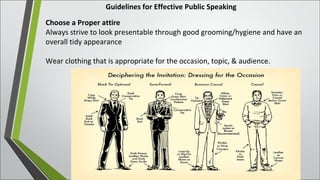
Choose a Proper attire
Always strive to look presentable through good grooming/hygiene and have an
overall tidy appearance
Wear clothing that is appropriate for the occasion, topic, & audience.
Guidelines for Effective Public Speaking
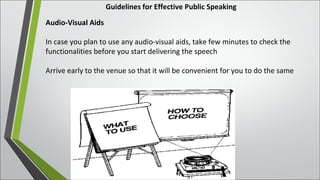
Audio-Visual Aids
In case you plan to use any audio-visual aids, take few minutes to check the
functionalities before you start delivering the speech
Arrive early to the venue so that it will be convenient for you to do the same
Guidelines for Effective Public Speaking
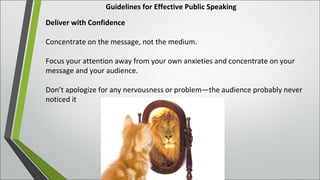
Deliver with Confidence
Concentrate on the message, not the medium.
Focus your attention away from your own anxieties and concentrate on your
message and your audience.
Don’t apologize for any nervousness or problem—the audience probably never
noticed it
Guidelines for Effective Public Speaking
Give enough time for Questions (If Necessary)
Allocate necessary time for audience to question you
Don’t be too defensive when you face questions that you did not anticipate
Handle all the questions in a relaxed and effective manner
Guidelines for Effective Public Speaking
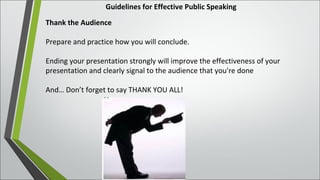
Thank the Audience
Prepare and practice how you will conclude.
Ending your presentation strongly will improve the effectiveness of your
presentation and clearly signal to the audience that you're done
And… Don’t forget to say THANK YOU ALL!
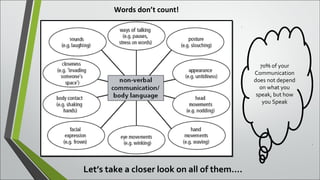
Words don’t count!
70% of your
Communication
does not depend
on what you
speak, but how
you Speak
Let’s take a closer look on all of them….
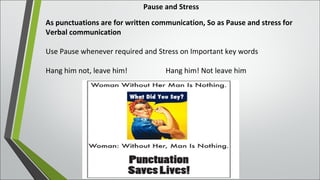
Pause and Stress
As punctuations are for written communication, So as Pause and stress for
Verbal communication
Use Pause whenever required and Stress on Important key words
Hang him not, leave him! Hang him! Not leave him
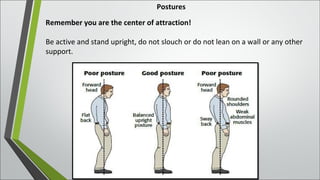
Postures
Remember you are the center of attraction!
Be active and stand upright, do not slouch or do not lean on a wall or any other
support.
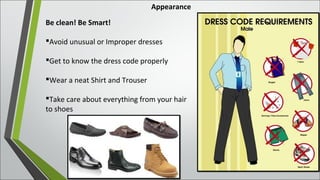
Appearance
Be clean! Be Smart!
Avoid unusual or Improper dresses
Get to know the dress code properly
Wear a neat Shirt and Trouser
Take care about everything from your hair
to shoes
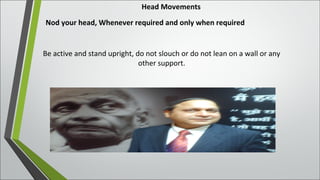
Head Movements
Nod your head, Whenever required and only when required
Be active and stand upright, do not slouch or do not lean on a wall or any
other support.
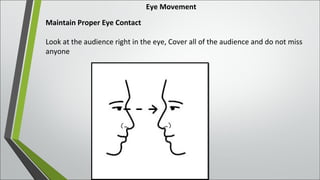
Eye Movement
Maintain Proper Eye Contact
Look at the audience right in the eye, Cover all of the audience and do not miss
anyone
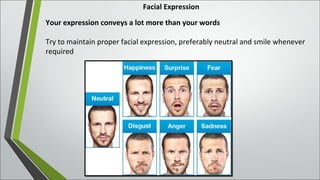
Facial Expression
Your expression conveys a lot more than your words
Try to maintain proper facial expression, preferably neutral and smile whenever
required
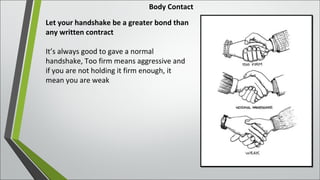
Body Contact
Let your handshake be a greater bond than
any written contract
It’s always good to gave a normal
handshake, Too firm means aggressive and
if you are not holding it firm enough, it
mean you are weak
30
R. Ravindra KumarR. Ravindra Kumar
Secretary
LIC OF INDIA
Ahmadabad Audit Centre
rravindrakumar
rravindrakumar
rravindrakumar.mop
+91 9726351246 Only Or
send TEXT ON +919427960310
Email ME@ rravindrakumar@hotmail.com
rravindrakumar@gmail.com
rravindrakumar@yahoo.com
rravindrakumar@rediffmail.com
Join me @
http://www.ca.linkedin.com/pub/r-ravindra-kumar-chief-mentor/0/670/107
Tweet your comments on http://www.twitter.com/#!/rravindrakumar
https://www.facebook.com/rravindrakumar.mop

Public Speaking for Salesman

  • 1.
    Art of PublicSpeaking R. Ravindra Kumar Secretary (Audit) LIC OF INDIA AHMEDABAD
  • 2.
    What is PublicSpeaking? • Public speaking is speaking to a group of people in a structured, deliberate manner intended to inform, influence, or entertain the listeners • The purpose of public speaking can range from simply transmitting information, to motivating people to act or simply telling a story.
  • 3.
    Where can Iuse Public Speaking? It May be any of the following •Agency Recruitment Seminar in Schools and Colleges •Chief guest’s Speech in any function •Presentation in Office •Thanksgiving in any function •Motivational Speech as a Leader •Politician Vote Campaign
  • 4.
    Benefits of PublicSpeaking Because of Public Speaking, you can  Improve Self Confidence  Make yourself more comfortable around other people  Effectively get your message across  Make a difference in your Life, Business, Career and Community  Demonstrate your Knowledge  Create your own supporters  Fine-tune your verbal and Non verbal communication skills
  • 5.
    Types of PublicSpeaking There are 3 Important types of Public Speaking Informative Persuasive Entertaining However, there are other types of Public Speaking also such as Ceremonial Extemporaneous Demonstrative Motivational
  • 6.
    Informative Public Speaking Informative: Whena person gives a speech before an audience to impart information on a particular topic or issue, it said to be an informative speech. Business presentations, seminars in colleges, class presentations in schools are some examples of informative speeches.
  • 7.
    Persuasive Public Speaking Persuasive: Persuasivespeeches are those where one tries to persuade or convince a group of people. These speeches aim to influence and change the opinions of the audience. Persuasive speeches are most commonly used by sales and marketing people to attract the interest of potential clients in their products.
  • 8.
    Entertaining Public Speaking Entertaining EntertainingSpeeches are those where one tries to commemorate or humor the listeners. The Speaker make them happy through Jokes and Short Stories. Standup comedy shows are examples of Entertaining Public Speech
  • 9.
    Barriers of EffectivePublic Speaking There are Multiple Barriers which can refrain the user from delivering an excellent Public Speaking Such as Stage Fear Lack of knowledge about audience Lack of knowledge about Topic to be delivered Improper dress code Improper Time Management Improper Vocal behavior  Inadequate Audio – Visual aids support
  • 10.
    Guidelines for EffectivePublic Speaking Know your audience – knowing your audience makes the experience easier Knowing as much as you can about their knowledge, their age, the number of people you will be lecturing or speaking to. If you get some idea of what they hope to achieve from the speech, then that will help you to prepare in a more effective way.
  • 11.
    Guidelines for EffectivePublic Speaking Choose a Proper Topic It’s always good to choose the topic wisely Consider the Occasion, Consider the audience’s level of knowledge about the Topic, Consider your Purpose and Consider whether the audience would be interested about the Topic.
  • 12.
    Guidelines for EffectivePublic Speaking Do enough Research over the Topic The better prepared you are for your speech or lecture, the better the speech will be It is better to be over prepared than under Write everything down that I wanted to say, including jokes and Examples
  • 13.
    Guidelines for EffectivePublic Speaking Be Prepared for all questions Possible Be aware than any holes in your research will be noticed and questioned by someone in the audience. Never assume “no one will notice” or “no one will ask about that”. Always assume someone will ask. Try and think of all the questions you could be asked and make sure that you have an answer.
  • 14.
    Guidelines for EffectivePublic Speaking Time it from the Beginning till End Timing – You will be given a time for your speech, sometimes these are flexible (between 10-15 minutes for example) which is good, as going over time is bad manners You cannot rush your lecture to finish as this will affect delivery, and you do not want to be stopped before the end
  • 15.
    Guidelines for EffectivePublic Speaking Prepare a note for yourself There is nothing wrong in holding a piece of paper while you present It’s always good to have a personal note so that your mind would not go blank However, Always read your notes before you arrive at the venue so it is fresh in your mind which will eliminate a total reliance on notes.
  • 16.
    Guidelines for EffectivePublic Speaking Practice Practice and Practice Now that you have prepared a wonderful speech and you have also timed it, It’s time to practice and rehearse it as many times as Possible. More the rehearsal time, better the delivery will be
  • 17.
    Guidelines for EffectivePublic Speaking Choose a Proper attire Always strive to look presentable through good grooming/hygiene and have an overall tidy appearance Wear clothing that is appropriate for the occasion, topic, & audience.
  • 18.
    Guidelines for EffectivePublic Speaking Audio-Visual Aids In case you plan to use any audio-visual aids, take few minutes to check the functionalities before you start delivering the speech Arrive early to the venue so that it will be convenient for you to do the same
  • 19.
    Guidelines for EffectivePublic Speaking Deliver with Confidence Concentrate on the message, not the medium. Focus your attention away from your own anxieties and concentrate on your message and your audience. Don’t apologize for any nervousness or problem—the audience probably never noticed it
  • 20.
    Guidelines for EffectivePublic Speaking Give enough time for Questions (If Necessary) Allocate necessary time for audience to question you Don’t be too defensive when you face questions that you did not anticipate Handle all the questions in a relaxed and effective manner
  • 21.
    Guidelines for EffectivePublic Speaking Thank the Audience Prepare and practice how you will conclude. Ending your presentation strongly will improve the effectiveness of your presentation and clearly signal to the audience that you're done And… Don’t forget to say THANK YOU ALL!
  • 22.
    Words don’t count! 70%of your Communication does not depend on what you speak, but how you Speak Let’s take a closer look on all of them….
  • 23.
    Pause and Stress Aspunctuations are for written communication, So as Pause and stress for Verbal communication Use Pause whenever required and Stress on Important key words Hang him not, leave him! Hang him! Not leave him
  • 24.
    Postures Remember you arethe center of attraction! Be active and stand upright, do not slouch or do not lean on a wall or any other support.
  • 25.
    Appearance Be clean! BeSmart! Avoid unusual or Improper dresses Get to know the dress code properly Wear a neat Shirt and Trouser Take care about everything from your hair to shoes
  • 26.
    Head Movements Nod yourhead, Whenever required and only when required Be active and stand upright, do not slouch or do not lean on a wall or any other support.
  • 27.
    Eye Movement Maintain ProperEye Contact Look at the audience right in the eye, Cover all of the audience and do not miss anyone
  • 28.
    Facial Expression Your expressionconveys a lot more than your words Try to maintain proper facial expression, preferably neutral and smile whenever required
  • 29.
    Body Contact Let yourhandshake be a greater bond than any written contract It’s always good to gave a normal handshake, Too firm means aggressive and if you are not holding it firm enough, it mean you are weak
  • 30.
    30 R. Ravindra KumarR.Ravindra Kumar Secretary LIC OF INDIA Ahmadabad Audit Centre rravindrakumar rravindrakumar rravindrakumar.mop +91 9726351246 Only Or send TEXT ON +919427960310 Email ME@ rravindrakumar@hotmail.com rravindrakumar@gmail.com rravindrakumar@yahoo.com rravindrakumar@rediffmail.com Join me @ http://www.ca.linkedin.com/pub/r-ravindra-kumar-chief-mentor/0/670/107 Tweet your comments on http://www.twitter.com/#!/rravindrakumar https://www.facebook.com/rravindrakumar.mop