Immunoglobulins
Namrata Chhabra
Learning objectives
To understand :
• General Structure of Immunoglobulin
• Types of Immunoglobulins
• Structural variations of different immunoglobulins
• Function of different immunoglobulins
• Clinical significance of Immunoglobulins
• Immunology = study of structure
and function of the immune
system
• Immune system = cells, tissues,
and molecules that mediate
resistance to infections
• Latin Word immunis=“exempt”
Immunity
• Immunity =
resistance of a
host to pathogens
and their toxic
effects
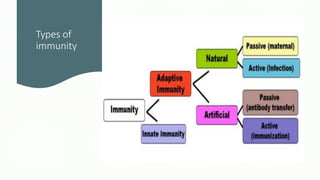
Types of
immunity
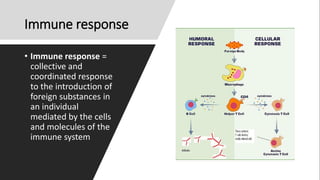
Immune response
• Immune response =
collective and
coordinated response
to the introduction of
foreign substances in
an individual
mediated by the cells
and molecules of the
immune system
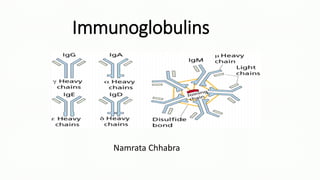
Immunoglobulins
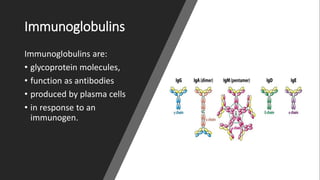
Immunoglobulins are:
• glycoprotein molecules,
• function as antibodies
• produced by plasma cells
• in response to an
immunogen.
Immunoglobulins
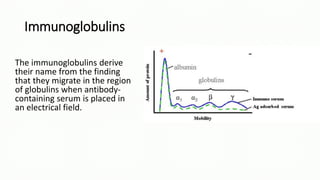
The immunoglobulins derive
their name from the finding
that they migrate in the region
of globulins when antibody-
containing serum is placed in
an electrical field.
Structural characteristics
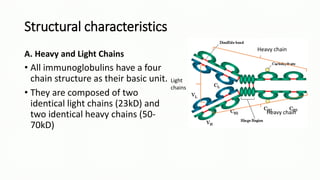
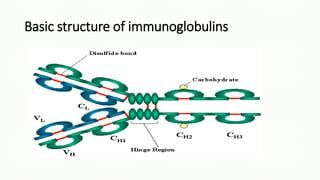
A. Heavy and Light Chains
• All immunoglobulins have a four
chain structure as their basic unit.
• They are composed of two
identical light chains (23kD) and
two identical heavy chains (50-
70kD)
Light
chains
Heavy chain
Heavy chain
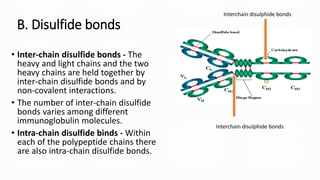
B. Disulfide bonds
• Inter-chain disulfide bonds - The
heavy and light chains and the two
heavy chains are held together by
inter-chain disulfide bonds and by
non-covalent interactions.
• The number of inter-chain disulfide
bonds varies among different
immunoglobulin molecules.
• Intra-chain disulfide binds - Within
each of the polypeptide chains there
are also intra-chain disulfide bonds.
Interchain disulphide bonds
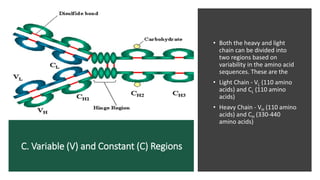
C. Variable (V) and Constant (C) Regions
• Both the heavy and light
chain can be divided into
two regions based on
variability in the amino acid
sequences. These are the
• Light Chain - VL (110 amino
acids) and CL (110 amino
acids)
• Heavy Chain - VH (110 amino
acids) and CH (330-440
amino acids)
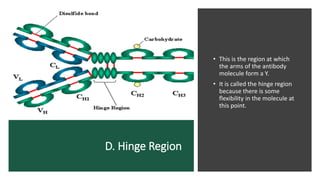
D. Hinge Region
• This is the region at which
the arms of the antibody
molecule form a Y.
• It is called the hinge region
because there is some
flexibility in the molecule at
this point.
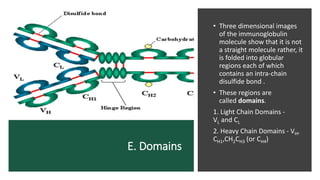
E. Domains
• Three dimensional images
of the immunoglobulin
molecule show that it is not
a straight molecule rather, it
is folded into globular
regions each of which
contains an intra-chain
disulfide bond .
• These regions are
called domains.
1. Light Chain Domains -
VL and CL
2. Heavy Chain Domains - VH,
CH1,CH2CH3 (or CH4)
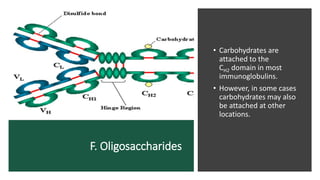
F. Oligosaccharides
• Carbohydrates are
attached to the
CH2 domain in most
immunoglobulins.
• However, in some cases
carbohydrates may also
be attached at other
locations.
Basic structure of immunoglobulins
Immunoglobulin
fragments:
structure/function
relationships
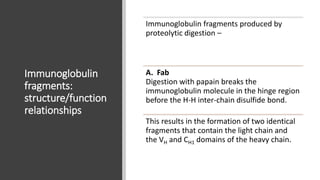
Immunoglobulin fragments produced by
proteolytic digestion –
A. Fab
Digestion with papain breaks the
immunoglobulin molecule in the hinge region
before the H-H inter-chain disulfide bond.
This results in the formation of two identical
fragments that contain the light chain and
the VH and CH1 domains of the heavy chain.
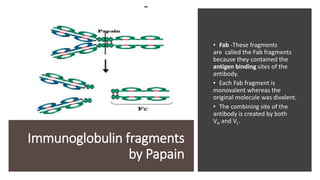
Immunoglobulin fragments
by Papain
• Fab -These fragments
are called the Fab fragments
because they contained the
antigen binding sites of the
antibody.
• Each Fab fragment is
monovalent whereas the
original molecule was divalent.
• The combining site of the
antibody is created by both
VH and VL.
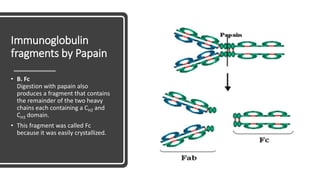
Immunoglobulin
fragments by Papain
• B. Fc
Digestion with papain also
produces a fragment that contains
the remainder of the two heavy
chains each containing a CH2 and
CH3 domain.
• This fragment was called Fc
because it was easily crystallized.
Structure-
function
relationship
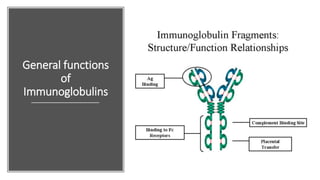
Antigen binding function of
Immunoglobulins is carried out
by Fab part,
Effector functions -The effector
functions are mediated by Fc
part of the molecule.
Different functions are
mediated by the different
domains in this fragment.
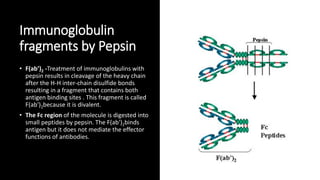
Immunoglobulin
fragments by Pepsin
• F(ab’)2 -Treatment of immunoglobulins with
pepsin results in cleavage of the heavy chain
after the H-H inter-chain disulfide bonds
resulting in a fragment that contains both
antigen binding sites . This fragment is called
F(ab')2because it is divalent.
• The Fc region of the molecule is digested into
small peptides by pepsin. The F(ab')2binds
antigen but it does not mediate the effector
functions of antibodies.
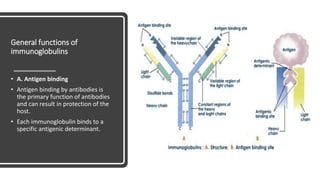
General functions of
immunoglobulins
• A. Antigen binding
• Antigen binding by antibodies is
the primary function of antibodies
and can result in protection of the
host.
• Each immunoglobulin binds to a
specific antigenic determinant.
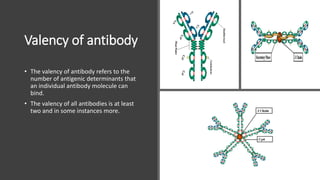
Valency of antibody
• The valency of antibody refers to the
number of antigenic determinants that
an individual antibody molecule can
bind.
• The valency of all antibodies is at least
two and in some instances more.
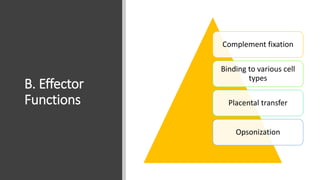
B. Effector
Functions
Complement fixation
Binding to various cell
types
Placental transfer
Opsonization
General functions
of
Immunoglobulins
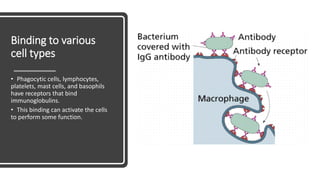
Binding to various
cell types
• Phagocytic cells, lymphocytes,
platelets, mast cells, and basophils
have receptors that bind
immunoglobulins.
• This binding can activate the cells
to perform some function.
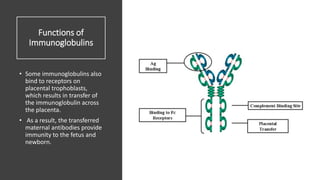
Functions of
Immunoglobulins
• Some immunoglobulins also
bind to receptors on
placental trophoblasts,
which results in transfer of
the immunoglobulin across
the placenta.
• As a result, the transferred
maternal antibodies provide
immunity to the fetus and
newborn.
Immunoglobulin classes
• The immunoglobulins can be divided
into five different classes, based on
differences in the amino acid sequences
in the constant region of the heavy
chains.
1. IgG - Gamma heavy chains
2. IgM - Mu heavy chains
3. IgA - Alpha heavy chains
4. IgD - Delta heavy chains
5. IgE - Epsilon heavy chains
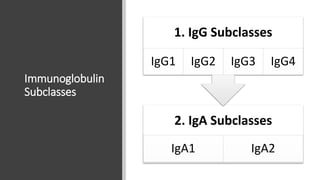
Immunoglobulin
Subclasses
2. IgA Subclasses
IgA1 IgA2
1. IgG Subclasses
IgG1 IgG2 IgG3 IgG4
Immunoglobulin
Types
• Immunoglobulins can also be classified
by the type of light chain that they have.
• Light chain types are based on
differences in the amino acid sequence
in the constant region of the light chain.
1. Kappa light chains
2. Lambda light chains
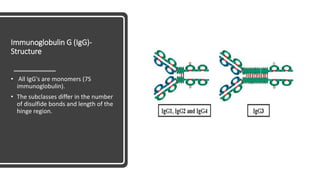
Immunoglobulin G (IgG)-
Structure
• All IgG's are monomers (7S
immunoglobulin).
• The subclasses differ in the number
of disulfide bonds and length of the
hinge region.
Immunoglobulin G
(IgG)-Properties
Major Ig in serum
Major Ig in extravascular spaces
Only Ig that crosses placenta
Complement fixation
Opsonization
Opsonization
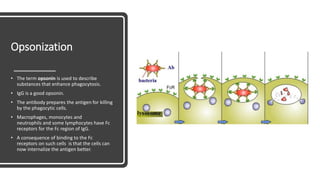
• The term opsonin is used to describe
substances that enhance phagocytosis.
• IgG is a good opsonin.
• The antibody prepares the antigen for killing
by the phagocytic cells.
• Macrophages, monocytes and
neutrophils and some lymphocytes have Fc
receptors for the Fc region of IgG.
• A consequence of binding to the Fc
receptors on such cells is that the cells can
now internalize the antigen better.
IgG- Function
• Secreted in high quantities in secondary exposures
• Cross the placenta
• Major functions / applications
• neutralize microbes and toxins
• opsonize antigens for phagocytosis
• activate the complement
• protect the newborn
• 4-fold rise or fall indicates
active infection
• A single positive sample
indicates past exposure
IgM- Structure
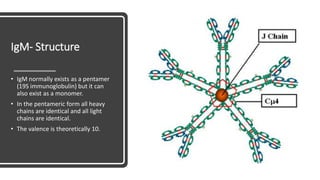
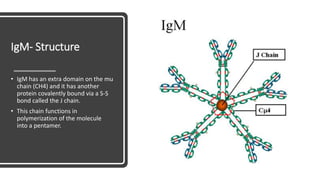
• IgM normally exists as a pentamer
(19S immunoglobulin) but it can
also exist as a monomer.
• In the pentameric form all heavy
chains are identical and all light
chains are identical.
• The valence is theoretically 10.
IgM- Structure
• IgM has an extra domain on the mu
chain (CH4) and it has another
protein covalently bound via a S-S
bond called the J chain.
• This chain functions in
polymerization of the molecule
into a pentamer.
IgM-
Properties
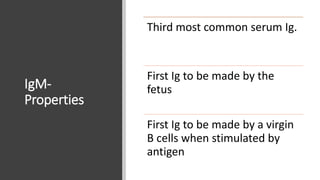
Third most common serum Ig.
First Ig to be made by the
fetus
First Ig to be made by a virgin
B cells when stimulated by
antigen
IgM-
Properties
(contd.)
A good complement fixing
Ig.
Very efficient in leading to
the lysis of microorganisms.
A good agglutinating Ig.
IgM- Properties (contd.)
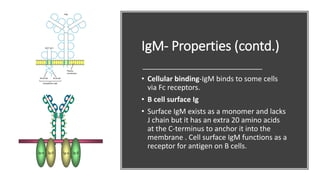
• Cellular binding-IgM binds to some cells
via Fc receptors.
• B cell surface Ig
• Surface IgM exists as a monomer and lacks
J chain but it has an extra 20 amino acids
at the C-terminus to anchor it into the
membrane . Cell surface IgM functions as a
receptor for antigen on B cells.
IgM
• Secreted initially during primary infection
• Cannot cross the placenta
• Major functions / applications
• secreted first during primary
exposure
• activates the complement
• used as a marker of recent infection
•Presence in newborn
means infection
•Single positive sample in
serum or CSF indicates
recent or active infection
•Used to detect early
phase of infection
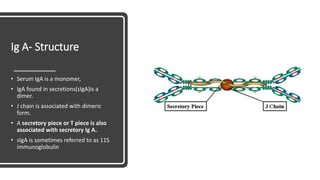
Ig A- Structure
• Serum IgA is a monomer,
• IgA found in secretions(sIgA)is a
dimer.
• J chain is associated with dimeric
form.
• A secretory piece or T piece is also
associated with secretory Ig A.
• sIgA is sometimes referred to as 11S
immunoglobulin
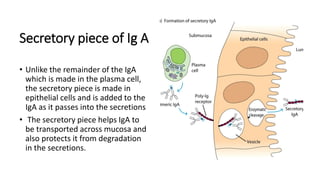
Secretory piece of Ig A
• Unlike the remainder of the IgA
which is made in the plasma cell,
the secretory piece is made in
epithelial cells and is added to the
IgA as it passes into the secretions
• The secretory piece helps IgA to
be transported across mucosa and
also protects it from degradation
in the secretions.
IgA-Properties
a) 2nd most common serum Ig.
b) IgA is the major class of Ig in secretions
- tears, saliva, colostrum, mucus. Since it
is found in secretions secretory IgA is
important in local (mucosal) immunity.
c) Normally IgA does not fix complement,
unless aggregated.
d) IgA can bind to some cells - PMN's and
some lymphocytes.
IgA
• Monomeric in serum
• Dimeric with secretory component in the lumen of the
gastro-intestinal tract and in the respiratory tract
• Major function / application
• neutralizes microbes and toxins
•Sero-diagnosis of
tuberculosis
•Respiratory syncytial
virus tests
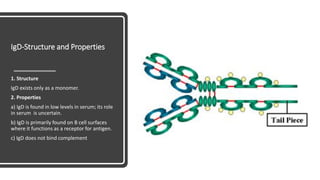
IgD-Structure and Properties
1. Structure
IgD exists only as a monomer.
2. Properties
a) IgD is found in low levels in serum; its role
in serum is uncertain.
b) IgD is primarily found on B cell surfaces
where it functions as a receptor for antigen.
c) IgD does not bind complement
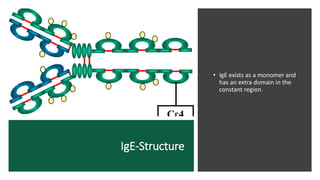
IgE-Structure
• IgE exists as a monomer and
has an extra domain in the
constant region.
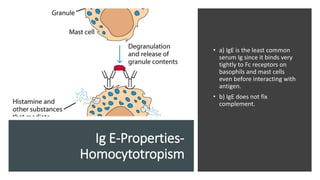
Ig E-Properties-
Homocytotropism
• a) IgE is the least common
serum Ig since it binds very
tightly to Fc receptors on
basophils and mast cells
even before interacting with
antigen.
• b) IgE does not fix
complement.
Ig E and
allergic
reactions
c) Involved in allergic reactions
As a consequence of its binding to
basophils and mast cells, IgE is
involved in allergic reactions.
Binding of the allergen to the IgE on
the cells results in the release of
various pharmacological mediators
that result in allergic symptoms.
Ig E and
parasitic
helminth
diseases
IgE also plays a role in parasitic helminth
diseases.
Since serum IgE levels rise in parasitic
diseases, measuring IgE levels is helpful in
diagnosing parasitic infections.
Eosinophils have Fc receptors for IgE and
binding of eosinophils to IgE-coated
helminths results in killing of the parasite.
Serodiagnosis of infectious and
non infectious allergies
(e.g., allergic bronchopulmonary
aspergillosis, parasitic diseases)
IgE
• Mediates type I hypersensitivity
• Monomeric
• Major functions / applications
• associated with anaphylaxis
• plays a role in immunity to
helminthic parasites
Summary
• Immunoglobulins are glycoproteins
• There are five immunoglobulins based on variations in the heavy
chain.
• IgG is the only antibody for placental transfer of immunity.
• Ig M is the most potent agglutinating antibody.
• Ig A acts as a mucosal barrier.
• IgE is the antibody for allergies.
• IgD and IgM are present on the surface of B lymphocytes.
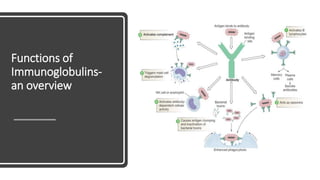
Functions of
Immunoglobulins-
an overview
Thank you

Immunoglobulins- Structure and function

  • 1.
  • 2.
    Learning objectives To understand: • General Structure of Immunoglobulin • Types of Immunoglobulins • Structural variations of different immunoglobulins • Function of different immunoglobulins • Clinical significance of Immunoglobulins
  • 3.
    • Immunology =study of structure and function of the immune system • Immune system = cells, tissues, and molecules that mediate resistance to infections • Latin Word immunis=“exempt”
  • 4.
    Immunity • Immunity = resistanceof a host to pathogens and their toxic effects
  • 5.
  • 6.
    Immune response • Immuneresponse = collective and coordinated response to the introduction of foreign substances in an individual mediated by the cells and molecules of the immune system
  • 7.
    Immunoglobulins Immunoglobulins are: • glycoproteinmolecules, • function as antibodies • produced by plasma cells • in response to an immunogen.
  • 8.
    Immunoglobulins The immunoglobulins derive theirname from the finding that they migrate in the region of globulins when antibody- containing serum is placed in an electrical field.
  • 9.
    Structural characteristics A. Heavyand Light Chains • All immunoglobulins have a four chain structure as their basic unit. • They are composed of two identical light chains (23kD) and two identical heavy chains (50- 70kD) Light chains Heavy chain Heavy chain
  • 10.
    B. Disulfide bonds •Inter-chain disulfide bonds - The heavy and light chains and the two heavy chains are held together by inter-chain disulfide bonds and by non-covalent interactions. • The number of inter-chain disulfide bonds varies among different immunoglobulin molecules. • Intra-chain disulfide binds - Within each of the polypeptide chains there are also intra-chain disulfide bonds. Interchain disulphide bonds Interchain disulphide bonds
  • 11.
    C. Variable (V)and Constant (C) Regions • Both the heavy and light chain can be divided into two regions based on variability in the amino acid sequences. These are the • Light Chain - VL (110 amino acids) and CL (110 amino acids) • Heavy Chain - VH (110 amino acids) and CH (330-440 amino acids)
  • 12.
    D. Hinge Region •This is the region at which the arms of the antibody molecule form a Y. • It is called the hinge region because there is some flexibility in the molecule at this point.
  • 13.
    E. Domains • Threedimensional images of the immunoglobulin molecule show that it is not a straight molecule rather, it is folded into globular regions each of which contains an intra-chain disulfide bond . • These regions are called domains. 1. Light Chain Domains - VL and CL 2. Heavy Chain Domains - VH, CH1,CH2CH3 (or CH4)
  • 14.
    F. Oligosaccharides • Carbohydratesare attached to the CH2 domain in most immunoglobulins. • However, in some cases carbohydrates may also be attached at other locations.
  • 15.
    Basic structure ofimmunoglobulins
  • 16.
    Immunoglobulin fragments: structure/function relationships Immunoglobulin fragments producedby proteolytic digestion – A. Fab Digestion with papain breaks the immunoglobulin molecule in the hinge region before the H-H inter-chain disulfide bond. This results in the formation of two identical fragments that contain the light chain and the VH and CH1 domains of the heavy chain.
  • 17.
    Immunoglobulin fragments by Papain •Fab -These fragments are called the Fab fragments because they contained the antigen binding sites of the antibody. • Each Fab fragment is monovalent whereas the original molecule was divalent. • The combining site of the antibody is created by both VH and VL.
  • 18.
    Immunoglobulin fragments by Papain •B. Fc Digestion with papain also produces a fragment that contains the remainder of the two heavy chains each containing a CH2 and CH3 domain. • This fragment was called Fc because it was easily crystallized.
  • 19.
    Structure- function relationship Antigen binding functionof Immunoglobulins is carried out by Fab part, Effector functions -The effector functions are mediated by Fc part of the molecule. Different functions are mediated by the different domains in this fragment.
  • 20.
    Immunoglobulin fragments by Pepsin •F(ab’)2 -Treatment of immunoglobulins with pepsin results in cleavage of the heavy chain after the H-H inter-chain disulfide bonds resulting in a fragment that contains both antigen binding sites . This fragment is called F(ab')2because it is divalent. • The Fc region of the molecule is digested into small peptides by pepsin. The F(ab')2binds antigen but it does not mediate the effector functions of antibodies.
  • 21.
    General functions of immunoglobulins •A. Antigen binding • Antigen binding by antibodies is the primary function of antibodies and can result in protection of the host. • Each immunoglobulin binds to a specific antigenic determinant.
  • 22.
    Valency of antibody •The valency of antibody refers to the number of antigenic determinants that an individual antibody molecule can bind. • The valency of all antibodies is at least two and in some instances more.
  • 23.
    B. Effector Functions Complement fixation Bindingto various cell types Placental transfer Opsonization
  • 24.
  • 25.
    Binding to various celltypes • Phagocytic cells, lymphocytes, platelets, mast cells, and basophils have receptors that bind immunoglobulins. • This binding can activate the cells to perform some function.
  • 26.
    Functions of Immunoglobulins • Someimmunoglobulins also bind to receptors on placental trophoblasts, which results in transfer of the immunoglobulin across the placenta. • As a result, the transferred maternal antibodies provide immunity to the fetus and newborn.
  • 27.
    Immunoglobulin classes • Theimmunoglobulins can be divided into five different classes, based on differences in the amino acid sequences in the constant region of the heavy chains. 1. IgG - Gamma heavy chains 2. IgM - Mu heavy chains 3. IgA - Alpha heavy chains 4. IgD - Delta heavy chains 5. IgE - Epsilon heavy chains
  • 28.
    Immunoglobulin Subclasses 2. IgA Subclasses IgA1IgA2 1. IgG Subclasses IgG1 IgG2 IgG3 IgG4
  • 29.
    Immunoglobulin Types • Immunoglobulins canalso be classified by the type of light chain that they have. • Light chain types are based on differences in the amino acid sequence in the constant region of the light chain. 1. Kappa light chains 2. Lambda light chains
  • 30.
    Immunoglobulin G (IgG)- Structure •All IgG's are monomers (7S immunoglobulin). • The subclasses differ in the number of disulfide bonds and length of the hinge region.
  • 31.
    Immunoglobulin G (IgG)-Properties Major Igin serum Major Ig in extravascular spaces Only Ig that crosses placenta Complement fixation Opsonization
  • 32.
    Opsonization • The termopsonin is used to describe substances that enhance phagocytosis. • IgG is a good opsonin. • The antibody prepares the antigen for killing by the phagocytic cells. • Macrophages, monocytes and neutrophils and some lymphocytes have Fc receptors for the Fc region of IgG. • A consequence of binding to the Fc receptors on such cells is that the cells can now internalize the antigen better.
  • 33.
    IgG- Function • Secretedin high quantities in secondary exposures • Cross the placenta • Major functions / applications • neutralize microbes and toxins • opsonize antigens for phagocytosis • activate the complement • protect the newborn • 4-fold rise or fall indicates active infection • A single positive sample indicates past exposure
  • 34.
    IgM- Structure • IgMnormally exists as a pentamer (19S immunoglobulin) but it can also exist as a monomer. • In the pentameric form all heavy chains are identical and all light chains are identical. • The valence is theoretically 10.
  • 35.
    IgM- Structure • IgMhas an extra domain on the mu chain (CH4) and it has another protein covalently bound via a S-S bond called the J chain. • This chain functions in polymerization of the molecule into a pentamer.
  • 36.
    IgM- Properties Third most commonserum Ig. First Ig to be made by the fetus First Ig to be made by a virgin B cells when stimulated by antigen
  • 37.
    IgM- Properties (contd.) A good complementfixing Ig. Very efficient in leading to the lysis of microorganisms. A good agglutinating Ig.
  • 38.
    IgM- Properties (contd.) •Cellular binding-IgM binds to some cells via Fc receptors. • B cell surface Ig • Surface IgM exists as a monomer and lacks J chain but it has an extra 20 amino acids at the C-terminus to anchor it into the membrane . Cell surface IgM functions as a receptor for antigen on B cells.
  • 39.
    IgM • Secreted initiallyduring primary infection • Cannot cross the placenta • Major functions / applications • secreted first during primary exposure • activates the complement • used as a marker of recent infection •Presence in newborn means infection •Single positive sample in serum or CSF indicates recent or active infection •Used to detect early phase of infection
  • 40.
    Ig A- Structure •Serum IgA is a monomer, • IgA found in secretions(sIgA)is a dimer. • J chain is associated with dimeric form. • A secretory piece or T piece is also associated with secretory Ig A. • sIgA is sometimes referred to as 11S immunoglobulin
  • 41.
    Secretory piece ofIg A • Unlike the remainder of the IgA which is made in the plasma cell, the secretory piece is made in epithelial cells and is added to the IgA as it passes into the secretions • The secretory piece helps IgA to be transported across mucosa and also protects it from degradation in the secretions.

  • 42.
    IgA-Properties a) 2nd mostcommon serum Ig. b) IgA is the major class of Ig in secretions - tears, saliva, colostrum, mucus. Since it is found in secretions secretory IgA is important in local (mucosal) immunity. c) Normally IgA does not fix complement, unless aggregated. d) IgA can bind to some cells - PMN's and some lymphocytes.
  • 43.
    IgA • Monomeric inserum • Dimeric with secretory component in the lumen of the gastro-intestinal tract and in the respiratory tract • Major function / application • neutralizes microbes and toxins •Sero-diagnosis of tuberculosis •Respiratory syncytial virus tests
  • 44.
    IgD-Structure and Properties 1.Structure IgD exists only as a monomer. 2. Properties a) IgD is found in low levels in serum; its role in serum is uncertain. b) IgD is primarily found on B cell surfaces where it functions as a receptor for antigen. c) IgD does not bind complement
  • 45.
    IgE-Structure • IgE existsas a monomer and has an extra domain in the constant region.
  • 46.
    Ig E-Properties- Homocytotropism • a)IgE is the least common serum Ig since it binds very tightly to Fc receptors on basophils and mast cells even before interacting with antigen. • b) IgE does not fix complement.
  • 47.
    Ig E and allergic reactions c)Involved in allergic reactions As a consequence of its binding to basophils and mast cells, IgE is involved in allergic reactions. Binding of the allergen to the IgE on the cells results in the release of various pharmacological mediators that result in allergic symptoms.
  • 48.
    Ig E and parasitic helminth diseases IgEalso plays a role in parasitic helminth diseases. Since serum IgE levels rise in parasitic diseases, measuring IgE levels is helpful in diagnosing parasitic infections. Eosinophils have Fc receptors for IgE and binding of eosinophils to IgE-coated helminths results in killing of the parasite.
  • 49.
    Serodiagnosis of infectiousand non infectious allergies (e.g., allergic bronchopulmonary aspergillosis, parasitic diseases) IgE • Mediates type I hypersensitivity • Monomeric • Major functions / applications • associated with anaphylaxis • plays a role in immunity to helminthic parasites
  • 50.
    Summary • Immunoglobulins areglycoproteins • There are five immunoglobulins based on variations in the heavy chain. • IgG is the only antibody for placental transfer of immunity. • Ig M is the most potent agglutinating antibody. • Ig A acts as a mucosal barrier. • IgE is the antibody for allergies. • IgD and IgM are present on the surface of B lymphocytes.
  • 51.
  • 52.