Isotopes and Nuclear
Reactions
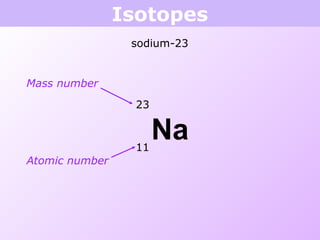
Isotopes
Na
23
11
sodium-23
Mass number
Atomic number
Isotopes
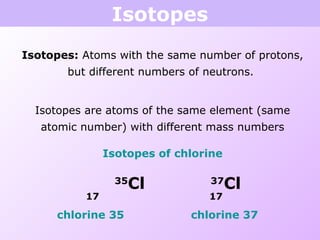
Isotopes: Atoms with the same number of protons,
but different numbers of neutrons.
Isotopes are atoms of the same element (same
atomic number) with different mass numbers
Isotopes of chlorine
35
Cl 37
Cl
17 17
chlorine 35 chlorine 37
Isotopes
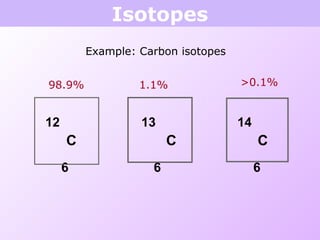
Example: Carbon isotopes
12 13 14
C C C
6 6 6
98.9% 1.1% >0.1%
Isotopes
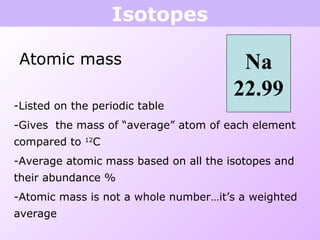
Atomic mass
-Listed on the periodic table
-Gives the mass of “average” atom of each element
compared to 12
C
-Average atomic mass based on all the isotopes and
their abundance %
-Atomic mass is not a whole number…it’s a weighted
average
Na
22.99
Isotopes
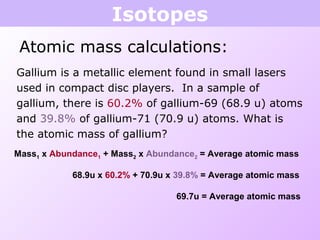
Atomic mass calculations:
Gallium is a metallic element found in small lasers
used in compact disc players. In a sample of
gallium, there is 60.2% of gallium-69 (68.9 u) atoms
and 39.8% of gallium-71 (70.9 u) atoms. What is
the atomic mass of gallium?
Mass1 x Abundance1 + Mass2 x Abundance2 = Average atomic mass
69.7u = Average atomic mass
68.9u x 60.2% + 70.9u x 39.8% = Average atomic mass
Isotopes
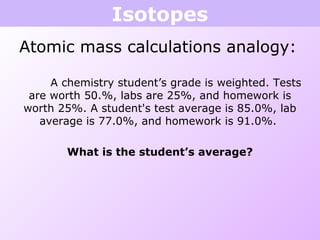
Atomic mass calculations analogy:
A chemistry student’s grade is weighted. Tests
are worth 50.%, labs are 25%, and homework is
worth 25%. A student's test average is 85.0%, lab
average is 77.0%, and homework is 91.0%.
What is the student’s average?
Isotopes
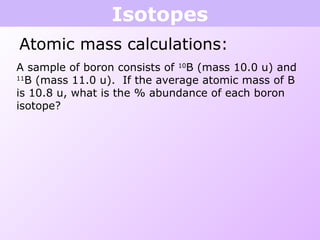
Atomic mass calculations:
A sample of boron consists of 10
B (mass 10.0 u) and
11
B (mass 11.0 u). If the average atomic mass of B
is 10.8 u, what is the % abundance of each boron
isotope?
Isotopes
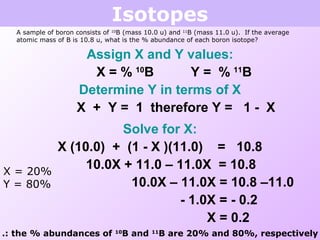
A sample of boron consists of 10
B (mass 10.0 u) and 11
B (mass 11.0 u). If the average
atomic mass of B is 10.8 u, what is the % abundance of each boron isotope?
Assign X and Y values:
X = % 10
B Y = % 11
B
Determine Y in terms of X
X + Y = 1 therefore Y = 1 - X
Solve for X:
X (10.0) + (1 - X )(11.0) = 10.8
10.0X + 11.0 – 11.0X = 10.8
10.0X – 11.0X = 10.8 –11.0
- 1.0X = - 0.2
X = 0.2
X = 20%
Y = 80%
.: the % abundances of 10
B and 11
B are 20% and 80%, respectively
NUCLEAR REACTIONS
NUCLEAR REACTIONS
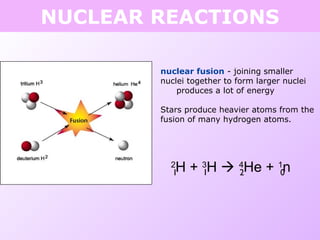
2
H + 3
H  4
He + 1
n1 1 2 0
nuclear fusion - joining smaller
nuclei together to form larger nuclei
produces a lot of energy
Stars produce heavier atoms from the
fusion of many hydrogen atoms.
NUCLEAR REACTIONS
235
U + 1
n  139
Ba + 94
Kr + 3 1
n
235
U + 1
n  146
La + 87
Br + 2 1
n
235
U + 1
n  144
Cs + 90
Rb + 2 1
n
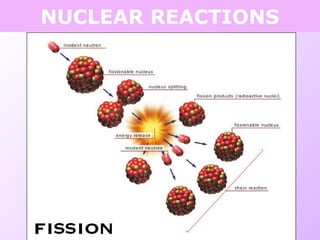
Nuclear fission
-large nuclei are broken in to smaller
nuclei by bombardment with a low
energy neutron
-often triggers a chain reaction of
events
-large amounts of energy
released
-Also known as radioactive
decay
92
92
92
0
0
0
0
0
0
56
57
55
36
35
37
NUCLEAR REACTIONS
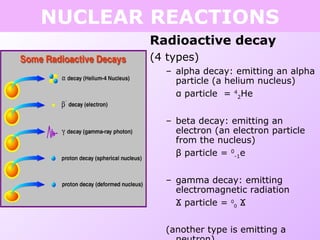
Radioactive decay
(4 types)
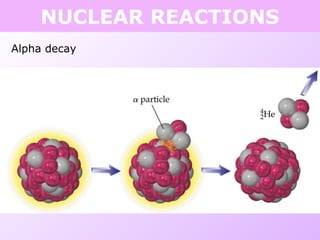
– alpha decay: emitting an alpha
particle (a helium nucleus)
α particle = 4
2He
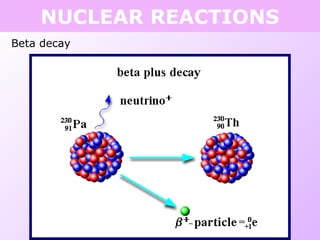
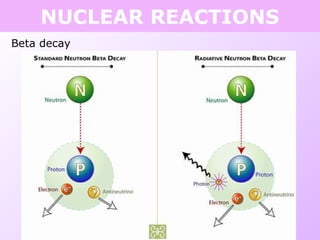
– beta decay: emitting an
electron (an electron particle
from the nucleus)
β particle = 0
-1e
– gamma decay: emitting
electromagnetic radiation
Ϫ particle = 0
0 Ϫ
(another type is emitting a
NUCLEAR REACTIONS
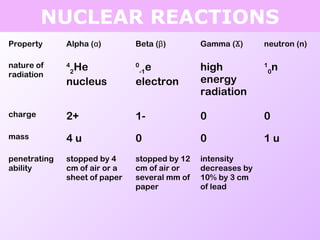
Property Alpha (α) Beta (β) Gamma (Ϫ) neutron (n)
nature of
radiation
4
2
He
nucleus
0
-1
e
electron
high
energy
radiation
1
0
n
charge 2+ 1- 0 0
mass 4 u 0 0 1 u
penetrating
ability
stopped by 4
cm of air or a
sheet of paper
stopped by 12
cm of air or
several mm of
paper
intensity
decreases by
10% by 3 cm
of lead
NUCLEAR REACTIONS
Alpha decay
NUCLEAR REACTIONS
Beta decay
NUCLEAR REACTIONS
Beta decay
NUCLEAR REACTIONS
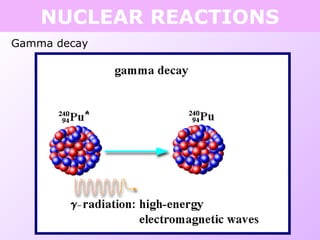
Gamma decay
NUCLEAR REACTIONS
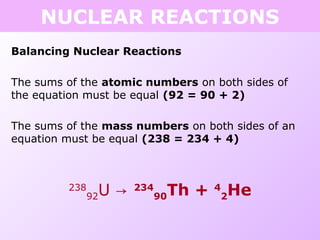
Balancing Nuclear Reactions
The sums of the atomic numbers on both sides of
the equation must be equal (92 = 90 + 2)
The sums of the mass numbers on both sides of an
equation must be equal (238 = 234 + 4)
238
92U → 234
90Th + 4
2He
NUCLEAR REACTIONS
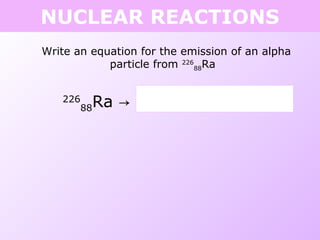
Write an equation for the emission of an alpha
particle from 226
88Ra
226
88Ra → 4
2He + 222
86 ___Rn
NUCLEAR REACTIONS
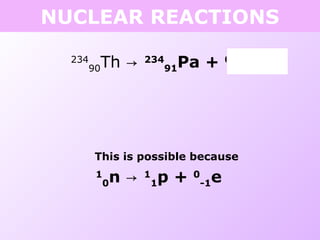
234
90Th → 234
91Pa + 0
-1e
This is possible because
1
0n → 1
1p + 0
-1e
Bi
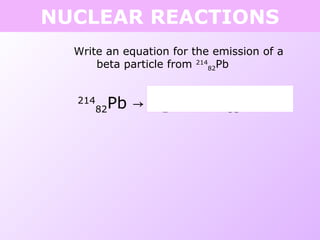
Write an equation for the emission of a
beta particle from 214
82Pb
214
82Pb → 0
-1 e + 214
83 ___
NUCLEAR REACTIONS
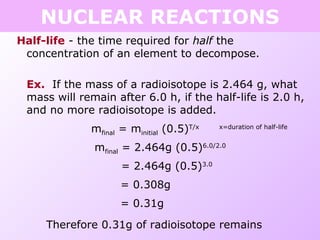
Half-life - the time required for half the
concentration of an element to decompose.
Ex. If the mass of a radioisotope is 2.464 g, what
mass will remain after 6.0 h, if the half-life is 2.0 h,
and no more radioisotope is added.
mfinal = minitial (0.5)T/x x=duration of half-life
mfinal = 2.464g (0.5)6.0/2.0
= 2.464g (0.5)3.0
= 0.308g
= 0.31g
Therefore 0.31g of radioisotope remains
NUCLEAR REACTIONS
NUCLEAR REACTIONS
Artificial Transmutation
Alchemists never did turn lead into gold, but along the
way made many other discoveries about elements and
compounds. This was the origin of the science of
chemistry!
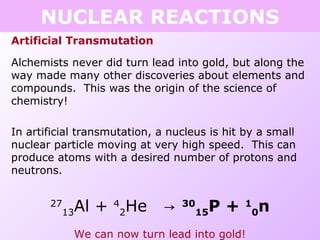
In artificial transmutation, a nucleus is hit by a small
nuclear particle moving at very high speed. This can
produce atoms with a desired number of protons and
neutrons.
27
13Al + 4
2He → 30
15P + 1
0n
We can now turn lead into gold!
NUCLEAR REACTIONS
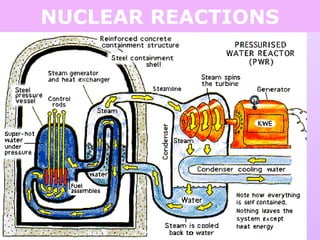
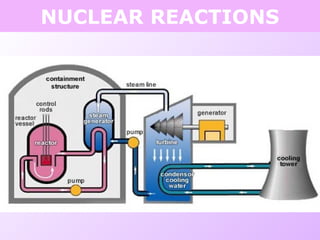
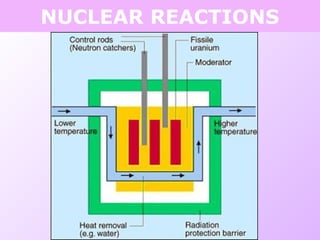
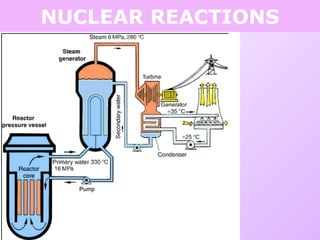
Nuclear reactors
convert the enormous
energy released from
fission to electrical
energy.
NUCLEAR REACTIONS
NUCLEAR REACTIONS
NUCLEAR REACTIONS
NUCLEAR REACTIONS
NUCLEAR REACTIONS
NUCLEAR REACTIONS
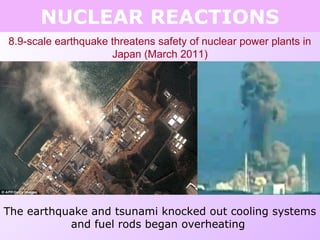
8.9-scale earthquake threatens safety of nuclear power plants in
Japan (March 2011)
The earthquake and tsunami knocked out cooling systems
and fuel rods began overheating
NUCLEAR REACTIONS
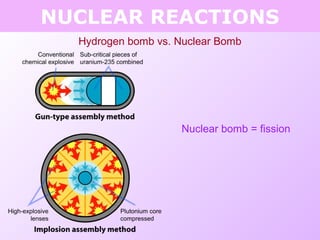
Hydrogen bomb vs. Nuclear Bomb
Nuclear bomb = fission
NUCLEAR REACTIONS
Hydrogen bomb vs. Nuclear Bomb
Nuclear bomb = fission
NUCLEAR REACTIONS
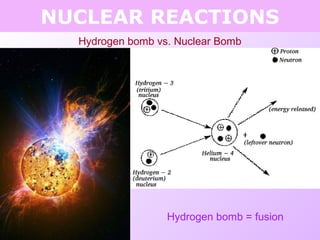
Hydrogen bomb vs. Nuclear Bomb
Hydrogen bomb = fusion
NUCLEAR REACTIONS
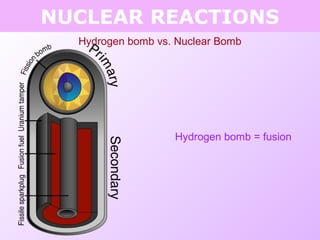
Hydrogen bomb vs. Nuclear Bomb
Hydrogen bomb = fusion

13 nuclear reactions

  • 1.
  • 2.
  • 3.
    Isotopes Isotopes: Atoms withthe same number of protons, but different numbers of neutrons. Isotopes are atoms of the same element (same atomic number) with different mass numbers Isotopes of chlorine 35 Cl 37 Cl 17 17 chlorine 35 chlorine 37
  • 4.
    Isotopes Example: Carbon isotopes 1213 14 C C C 6 6 6 98.9% 1.1% >0.1%
  • 5.
    Isotopes Atomic mass -Listed onthe periodic table -Gives the mass of “average” atom of each element compared to 12 C -Average atomic mass based on all the isotopes and their abundance % -Atomic mass is not a whole number…it’s a weighted average Na 22.99
  • 6.
    Isotopes Atomic mass calculations: Galliumis a metallic element found in small lasers used in compact disc players. In a sample of gallium, there is 60.2% of gallium-69 (68.9 u) atoms and 39.8% of gallium-71 (70.9 u) atoms. What is the atomic mass of gallium? Mass1 x Abundance1 + Mass2 x Abundance2 = Average atomic mass 69.7u = Average atomic mass 68.9u x 60.2% + 70.9u x 39.8% = Average atomic mass
  • 7.
    Isotopes Atomic mass calculationsanalogy: A chemistry student’s grade is weighted. Tests are worth 50.%, labs are 25%, and homework is worth 25%. A student's test average is 85.0%, lab average is 77.0%, and homework is 91.0%. What is the student’s average?
  • 8.
    Isotopes Atomic mass calculations: Asample of boron consists of 10 B (mass 10.0 u) and 11 B (mass 11.0 u). If the average atomic mass of B is 10.8 u, what is the % abundance of each boron isotope?
  • 9.
    Isotopes A sample ofboron consists of 10 B (mass 10.0 u) and 11 B (mass 11.0 u). If the average atomic mass of B is 10.8 u, what is the % abundance of each boron isotope? Assign X and Y values: X = % 10 B Y = % 11 B Determine Y in terms of X X + Y = 1 therefore Y = 1 - X Solve for X: X (10.0) + (1 - X )(11.0) = 10.8 10.0X + 11.0 – 11.0X = 10.8 10.0X – 11.0X = 10.8 –11.0 - 1.0X = - 0.2 X = 0.2 X = 20% Y = 80% .: the % abundances of 10 B and 11 B are 20% and 80%, respectively
  • 10.
  • 11.
    NUCLEAR REACTIONS 2 H +3 H  4 He + 1 n1 1 2 0 nuclear fusion - joining smaller nuclei together to form larger nuclei produces a lot of energy Stars produce heavier atoms from the fusion of many hydrogen atoms.
  • 12.
    NUCLEAR REACTIONS 235 U +1 n  139 Ba + 94 Kr + 3 1 n 235 U + 1 n  146 La + 87 Br + 2 1 n 235 U + 1 n  144 Cs + 90 Rb + 2 1 n Nuclear fission -large nuclei are broken in to smaller nuclei by bombardment with a low energy neutron -often triggers a chain reaction of events -large amounts of energy released -Also known as radioactive decay 92 92 92 0 0 0 0 0 0 56 57 55 36 35 37
  • 13.
    NUCLEAR REACTIONS Radioactive decay (4types) – alpha decay: emitting an alpha particle (a helium nucleus) α particle = 4 2He – beta decay: emitting an electron (an electron particle from the nucleus) β particle = 0 -1e – gamma decay: emitting electromagnetic radiation Ϫ particle = 0 0 Ϫ (another type is emitting a
  • 14.
    NUCLEAR REACTIONS Property Alpha(α) Beta (β) Gamma (Ϫ) neutron (n) nature of radiation 4 2 He nucleus 0 -1 e electron high energy radiation 1 0 n charge 2+ 1- 0 0 mass 4 u 0 0 1 u penetrating ability stopped by 4 cm of air or a sheet of paper stopped by 12 cm of air or several mm of paper intensity decreases by 10% by 3 cm of lead
  • 15.
  • 16.
  • 17.
  • 18.
  • 19.
    NUCLEAR REACTIONS Balancing NuclearReactions The sums of the atomic numbers on both sides of the equation must be equal (92 = 90 + 2) The sums of the mass numbers on both sides of an equation must be equal (238 = 234 + 4) 238 92U → 234 90Th + 4 2He
  • 20.
    NUCLEAR REACTIONS Write anequation for the emission of an alpha particle from 226 88Ra 226 88Ra → 4 2He + 222 86 ___Rn
  • 21.
    NUCLEAR REACTIONS 234 90Th →234 91Pa + 0 -1e This is possible because 1 0n → 1 1p + 0 -1e
  • 22.
    Bi Write an equationfor the emission of a beta particle from 214 82Pb 214 82Pb → 0 -1 e + 214 83 ___ NUCLEAR REACTIONS
  • 23.
    Half-life - thetime required for half the concentration of an element to decompose. Ex. If the mass of a radioisotope is 2.464 g, what mass will remain after 6.0 h, if the half-life is 2.0 h, and no more radioisotope is added. mfinal = minitial (0.5)T/x x=duration of half-life mfinal = 2.464g (0.5)6.0/2.0 = 2.464g (0.5)3.0 = 0.308g = 0.31g Therefore 0.31g of radioisotope remains NUCLEAR REACTIONS
  • 24.
    NUCLEAR REACTIONS Artificial Transmutation Alchemistsnever did turn lead into gold, but along the way made many other discoveries about elements and compounds. This was the origin of the science of chemistry! In artificial transmutation, a nucleus is hit by a small nuclear particle moving at very high speed. This can produce atoms with a desired number of protons and neutrons. 27 13Al + 4 2He → 30 15P + 1 0n We can now turn lead into gold!
  • 25.
    NUCLEAR REACTIONS Nuclear reactors convertthe enormous energy released from fission to electrical energy.
  • 26.
  • 27.
  • 28.
  • 29.
  • 30.
  • 31.
    NUCLEAR REACTIONS 8.9-scale earthquakethreatens safety of nuclear power plants in Japan (March 2011) The earthquake and tsunami knocked out cooling systems and fuel rods began overheating
  • 32.
    NUCLEAR REACTIONS Hydrogen bombvs. Nuclear Bomb Nuclear bomb = fission
  • 33.
    NUCLEAR REACTIONS Hydrogen bombvs. Nuclear Bomb Nuclear bomb = fission
  • 34.
    NUCLEAR REACTIONS Hydrogen bombvs. Nuclear Bomb Hydrogen bomb = fusion
  • 35.
    NUCLEAR REACTIONS Hydrogen bombvs. Nuclear Bomb Hydrogen bomb = fusion

Editor's Notes

  • #26 http://www.youtube.com/watch?v=kjx-JlwYtyE&feature=related
  • #27 Cadmium metal rods absorb neutrons
  • #28 Cadmium metal rods absorb neutrons
  • #29 http://www.youtube.com/watch?v=b4Q9O1vICWs&feature=related http://www.youtube.com/watch?v=0v8i4v1mieU
  • #30 http://science.howstuffworks.com/nuclear-bomb7.htm
  • #31 Cadmium metal rods absorb neutrons
  • #32 http://www.youtube.com/watch?v=kjx-JlwYtyE&feature=related
  • #33 http://www.youtube.com/watch?v=kjx-JlwYtyE&feature=related
  • #34 In fission weapons, a mass of fissile material (enriched uranium or plutonium) is assembled into a supercritical mass—the amount of material needed to start an exponentially growing nuclear chain reaction—either by shooting one piece of sub-critical material into another (the "gun" method) or by compressing a sub-critical sphere of material using chemical explosives to many times its original density (the "implosion" method). The latter approach is considered more sophisticated than the former and only the latter approach can be used if the fissile material is plutonium.
  • #36 http://www.youtube.com/watch?v=0v8i4v1mieU