Nuclear Chemistry
Chapter 23
Copyright © The McGraw-Hill Companies, Inc. Permission required for reproduction or display.
X
A
Z
Mass Number
Atomic Number
Element Symbol
Atomic number (Z) = number of protons in nucleus
Mass number (A) = number of protons + number of neutrons
= atomic number (Z) + number of neutrons
A
Z
1p
1
1H
1
or
proton
1n
0
neutron
0e
-1
0b
-1
or
electron
0e
+1
0b
+1
or
positron
4He
2
4a
2
or
a particle
1
1
1
0
0
-1
0
+1
4
2
23.1
Balancing Nuclear Equations
1. Conserve mass number (A).
The sum of protons plus neutrons in the products must equal
the sum of protons plus neutrons in the reactants.
1n
0
U
235
92 + Cs
138
55 Rb
96
37
1n
0
+ + 2
235 + 1 = 138 + 96 + 2x1
2. Conserve atomic number (Z) or nuclear charge.
The sum of nuclear charges in the products must equal the
sum of nuclear charges in the reactants.
1n
0
U
235
92 + Cs
138
55 Rb
96
37
1n
0
+ + 2
92 + 0 = 55 + 37 + 2x0
23.1
212Po decays by alpha emission. Write the balanced
nuclear equation for the decay of 212Po.
4He
2
4a
2
or
alpha particle -
212Po 4He + AX
84 2 Z
212 = 4 + A A = 208
84 = 2 + Z Z = 82
212Po 4He + 208Pb
84 2 82
23.1
23.1
Nuclear Stability and Radioactive Decay
Beta decay
14C 14N + 0b + n
6 7 -1
40K 40Ca + 0b + n
19 20 -1
1n 1p + 0b + n
0 1 -1
Decrease # of neutrons by 1
Increase # of protons by 1
Positron decay
11C 11B + 0b + n
6 5 +1
38K 38Ar + 0b + n
19 18 +1
1p 1n + 0b + n
1 0 +1
Increase # of neutrons by 1
Decrease # of protons by 1
n and n have A = 0 and Z = 0
23.2
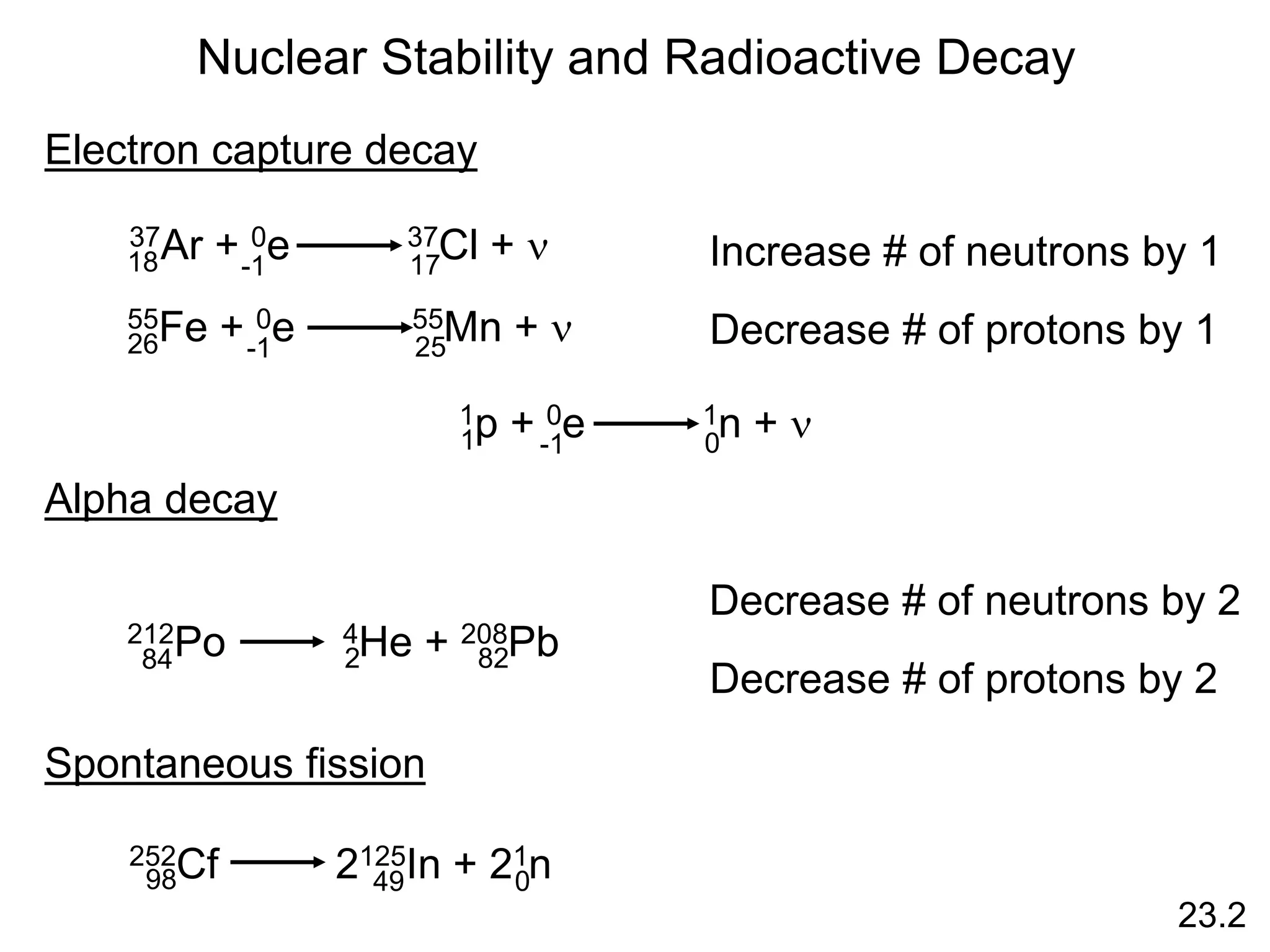
Electron capture decay
Increase # of neutrons by 1
Decrease # of protons by 1
Nuclear Stability and Radioactive Decay
37Ar + 0e 37Cl + n
18 17
-1
55Fe + 0e 55Mn + n
26 25
-1
1p + 0e 1n + n
1 0
-1
Alpha decay
Decrease # of neutrons by 2
Decrease # of protons by 2
212Po 4He + 208Pb
84 2 82
Spontaneous fission
252Cf 2125In + 21n
98 49 0
23.2
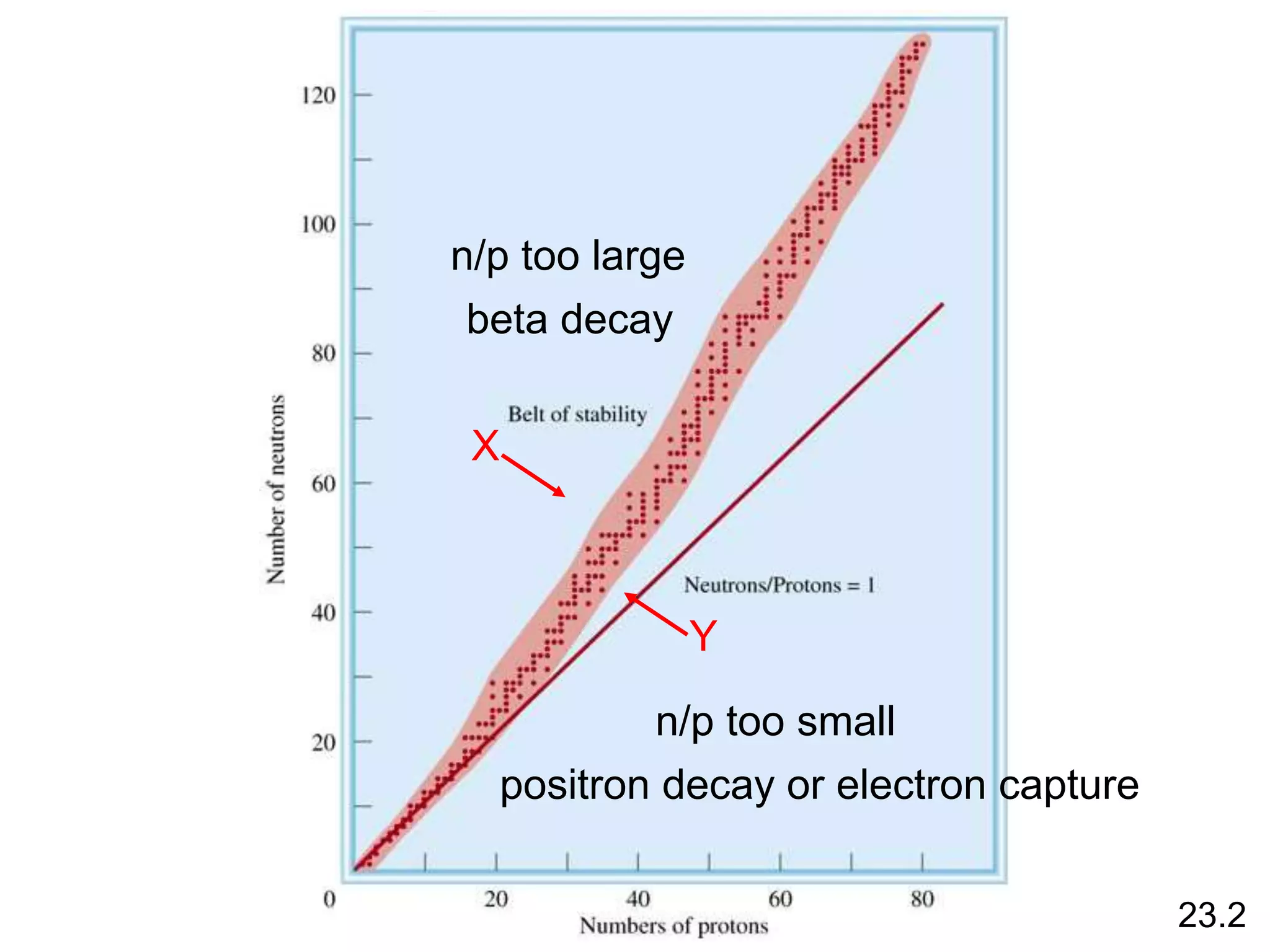
n/p too large
beta decay
X
n/p too small
positron decay or electron capture
Y
23.2
Nuclear Stability
• Certain numbers of neutrons and protons are extra stable
• n or p = 2, 8, 20, 50, 82 and 126
• Like extra stable numbers of electrons in noble gases
(e- = 2, 10, 18, 36, 54 and 86)
• Nuclei with even numbers of both protons and neutrons
are more stable than those with odd numbers of neutron
and protons
• All isotopes of the elements with atomic numbers higher
than 83 are radioactive
• All isotopes of Tc and Pm are radioactive
23.2
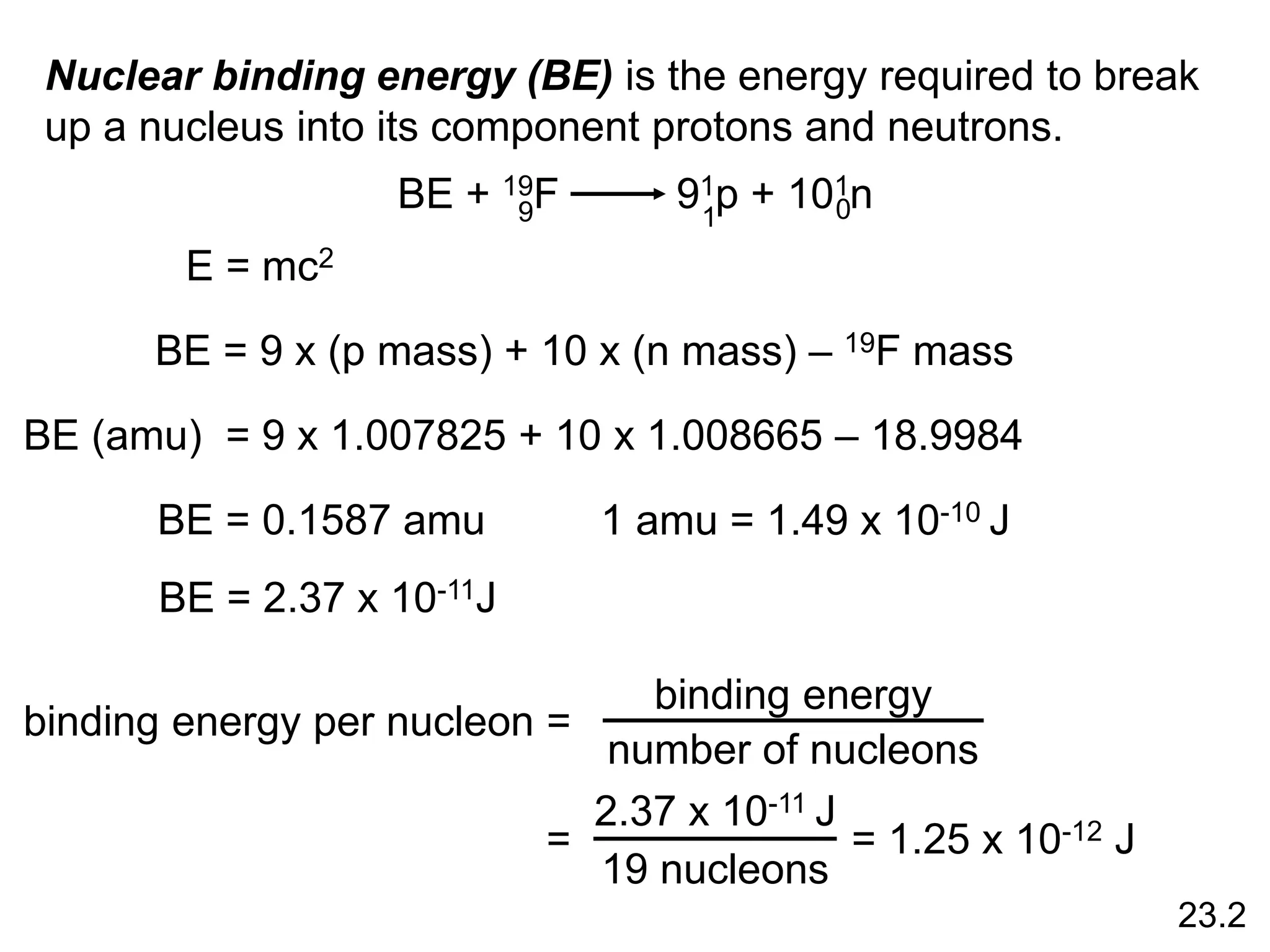
Nuclear binding energy (BE) is the energy required to break
up a nucleus into its component protons and neutrons.
BE + 19F 91p + 101n
9 1 0
BE = 9 x (p mass) + 10 x (n mass) – 19F mass
E = mc2
BE (amu) = 9 x 1.007825 + 10 x 1.008665 – 18.9984
BE = 0.1587 amu 1 amu = 1.49 x 10⁻¹⁰ J
BE = 2.37 x 10⁻¹¹J
binding energy per nucleon =
binding energy
number of nucleons
=
2.37 x 10⁻¹¹ J
19 nucleons
= 1.25 x 10⁻¹² J
23.2
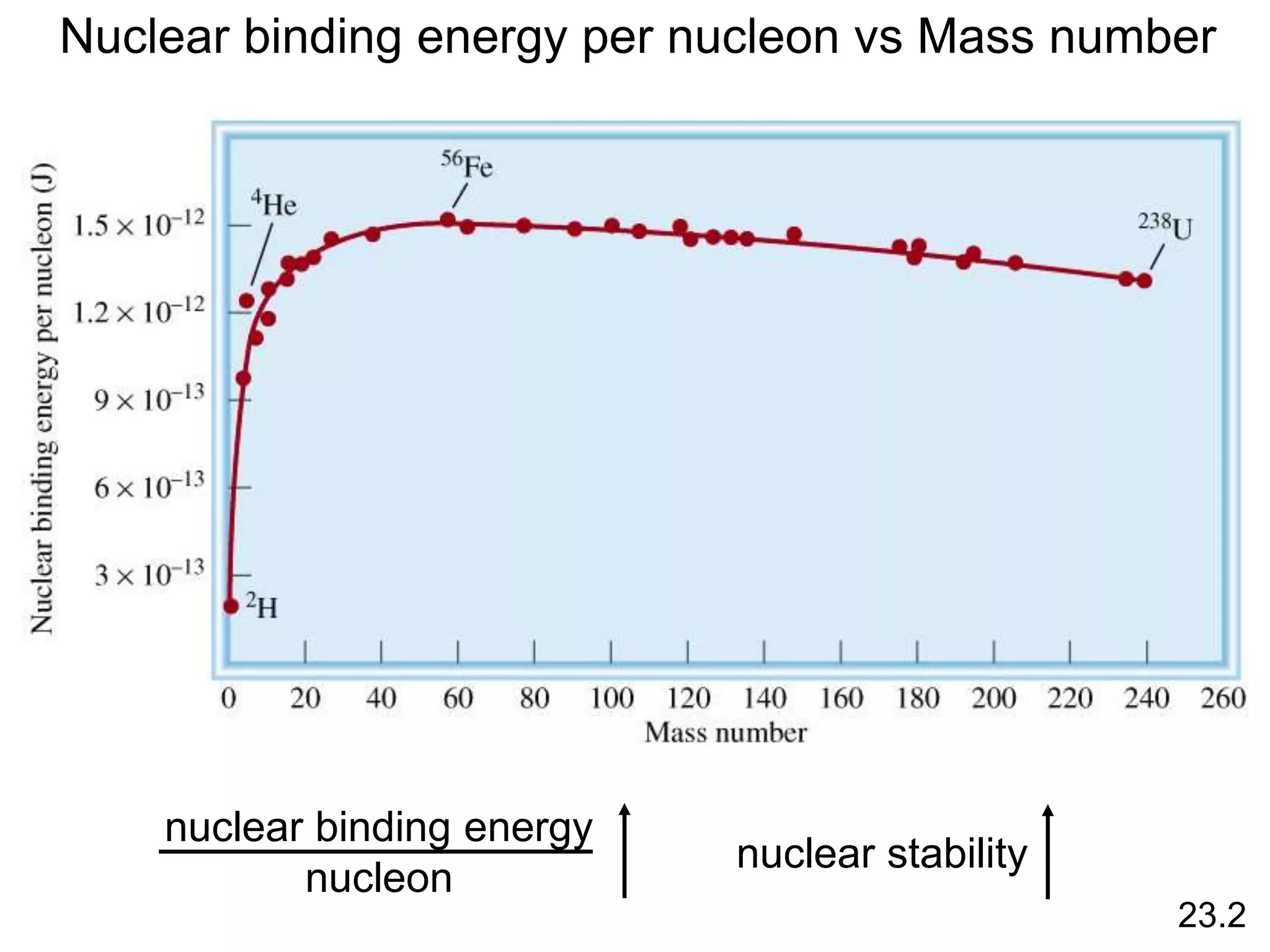
Nuclear binding energy per nucleon vs Mass number
nuclear stability
23.2
nuclear binding energy
nucleon
Kinetics of Radioactive Decay
N daughter
rate = -
DN
Dt
rate = lN
DN
Dt
= lN
-
N = N0exp(-lt) lnN = lnN0 - lt
N = the number of atoms at time t
N0 = the number of atoms at time t = 0
l is the decay constant
ln2
=
t½
l
23.3
Kinetics of Radioactive Decay
[N] = [N]0exp(-lt) ln[N] = ln[N]0 - lt
[N]
ln
[N]
23.3
Radiocarbon Dating
14N + 1n 14C + 1H
7 1
6
0
14C 14N + 0b + n
6 7 -1 t½ = 5730 years
Uranium-238 Dating
238U 206Pb + 8 4a + 6 0b
92 -1
82 2 t½ = 4.51 x 10⁹ years
23.3
Nuclear Transmutation
Cyclotron Particle Accelerator
14N + 4a 17O + 1p
7 2 8 1
27Al + 4a 30P + 1n
13 2 15 0
14N + 1p 11C + 4a
7 1 6 2
23.4
Nuclear Transmutation
23.4
Nuclear Fission
23.5
235U + 1n 90Sr + 143Xe + 31n + Energy
92 54
38
0 0
Energy = [mass 235U + mass n – (mass 90Sr + mass 143Xe + 3 x mass n )] x c2
Energy = 3.3 x 10⁻¹¹J per 235U
= 2.0 x 10¹³ J per mole 235U
Combustion of 1 ton of coal = 5 x 10⁷ J
Nuclear Fission
23.5
235U + 1n 90Sr + 143Xe + 31n + Energy
92 54
38
0 0
Representative fission reaction
Nuclear Fission
23.5
Nuclear chain reaction is a self-sustaining sequence of
nuclear fission reactions.
The minimum mass of fissionable material required to
generate a self-sustaining nuclear chain reaction is the
critical mass.
Non-critical
Critical
Schematic Diagram of a Nuclear Reactor
23.5
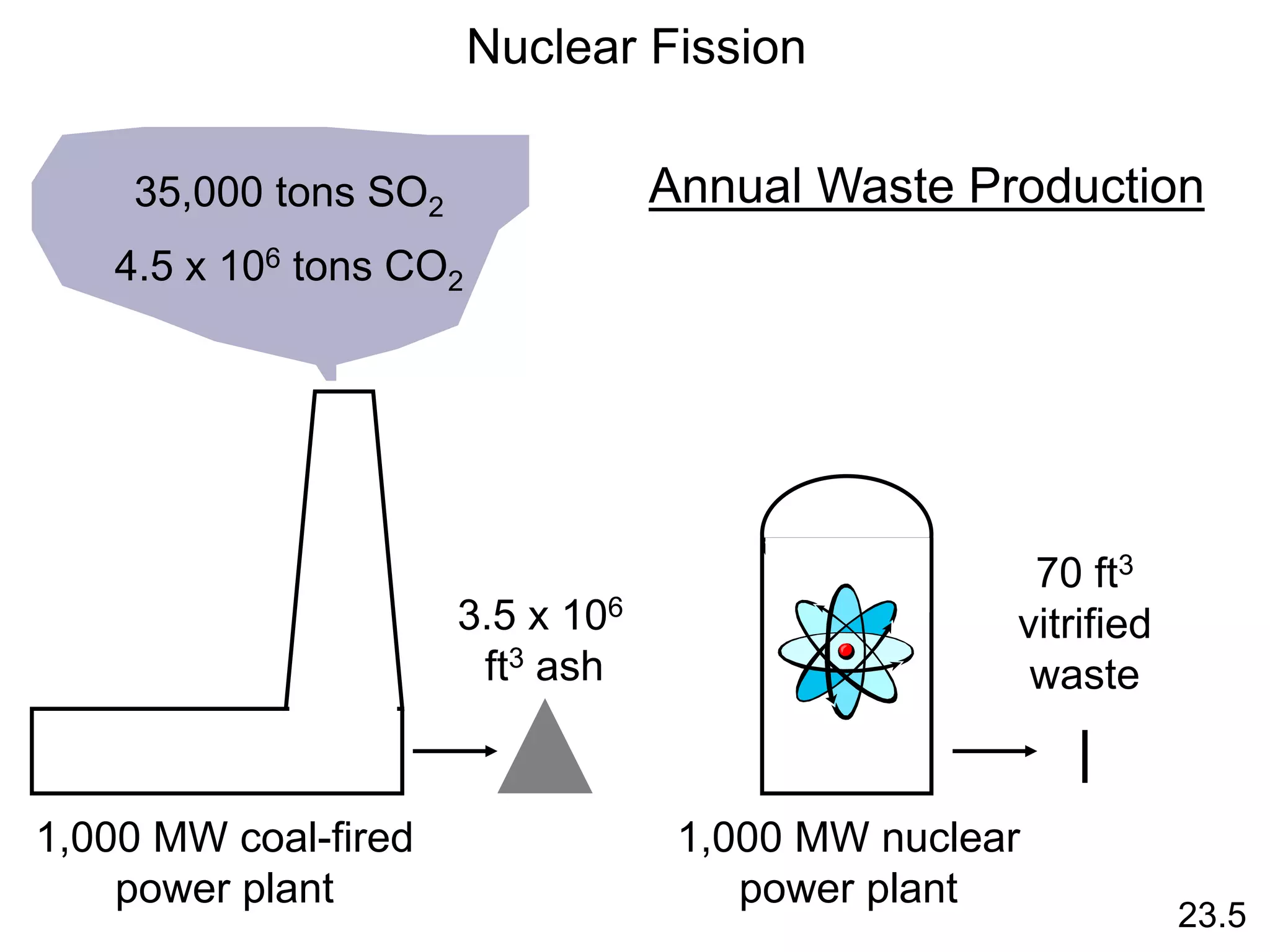
Annual Waste Production
23.5
35,000 tons SO2
4.5 x 10⁶ tons CO2
1,000 MW coal-fired
power plant
3.5 x 10⁶
ft3 ash
1,000 MW nuclear
power plant
70 ft3
vitrified
waste
Nuclear Fission
23.5
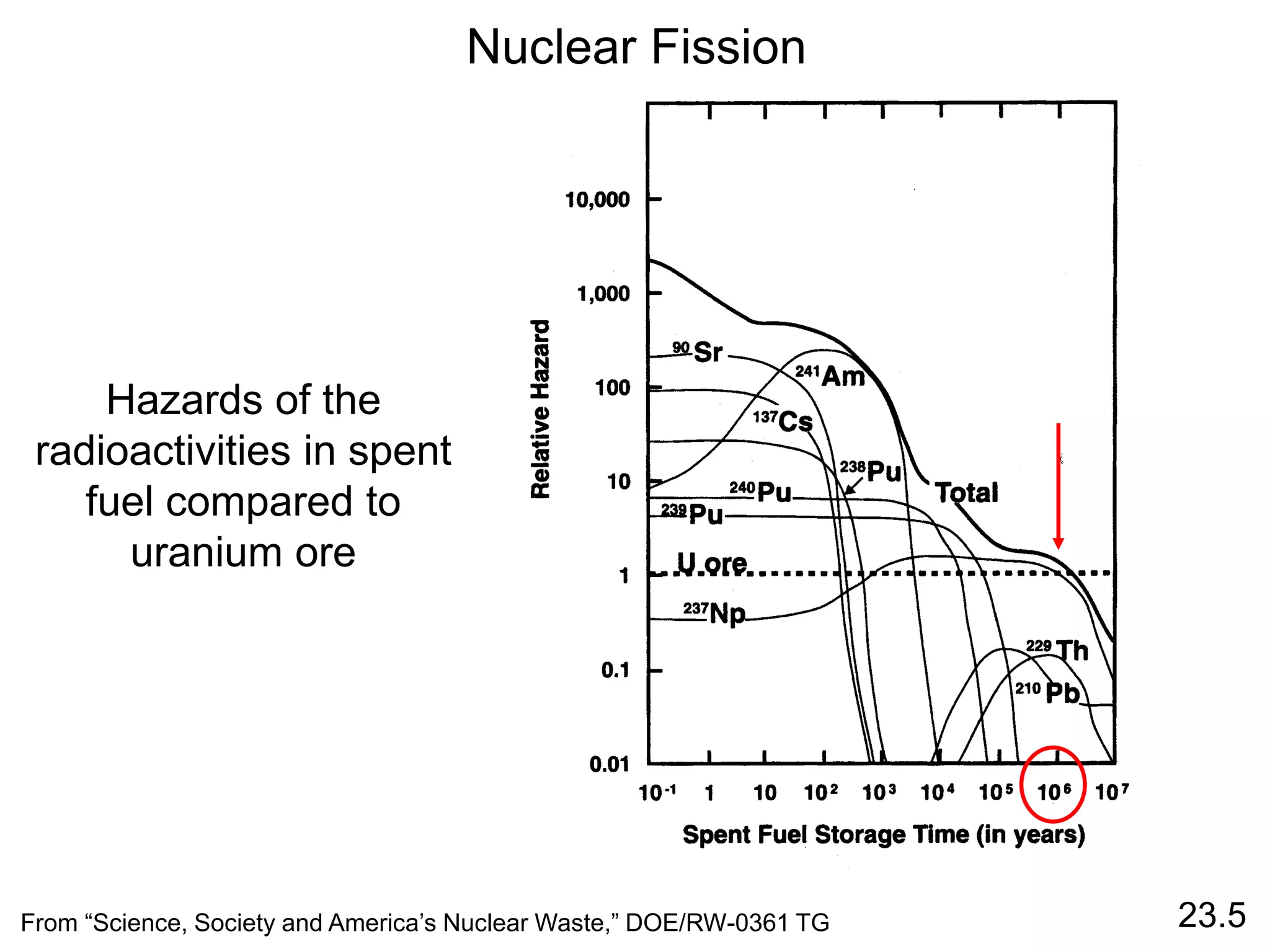
Nuclear Fission
Hazards of the
radioactivities in spent
fuel compared to
uranium ore
From “Science, Society and America’s Nuclear Waste,” DOE/RW-0361 TG
Chemistry In Action: Nature’s Own Fission Reactor
Natural Uranium
0.7202 % U-235 99.2798% U-238
Measured at Oklo
0.7171 % U-235
23.6
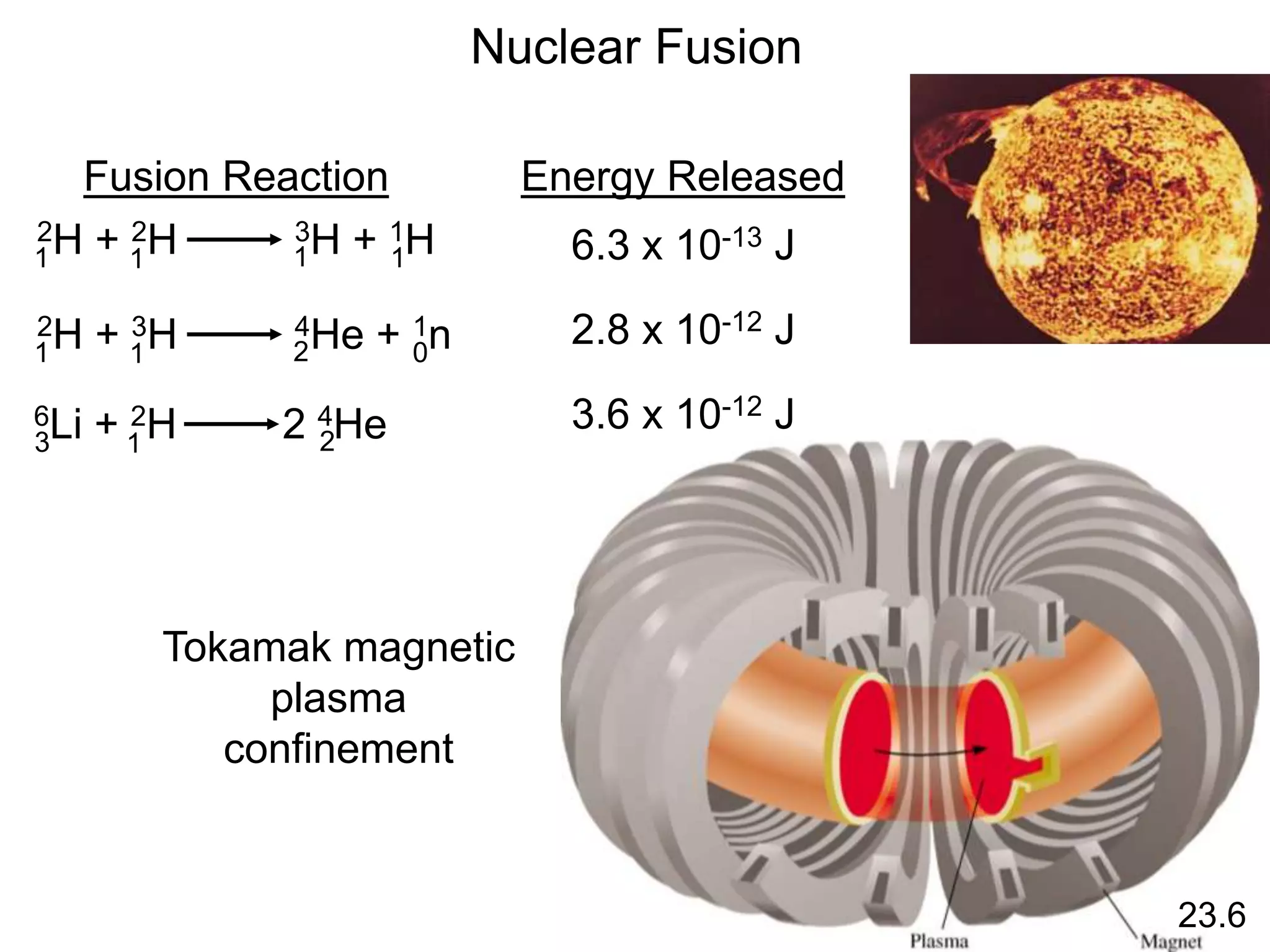
Nuclear Fusion
2H + 2H 3H + 1H
1 1 1 1
Fusion Reaction Energy Released
2H + 3H 4He + 1n
1 1 2 0
6Li + 2H 2 4He
3 1 2
6.3 x 10⁻¹³ J
2.8 x 10⁻¹² J
3.6 x 10⁻¹² J
Tokamak magnetic
plasma
confinement
23.7
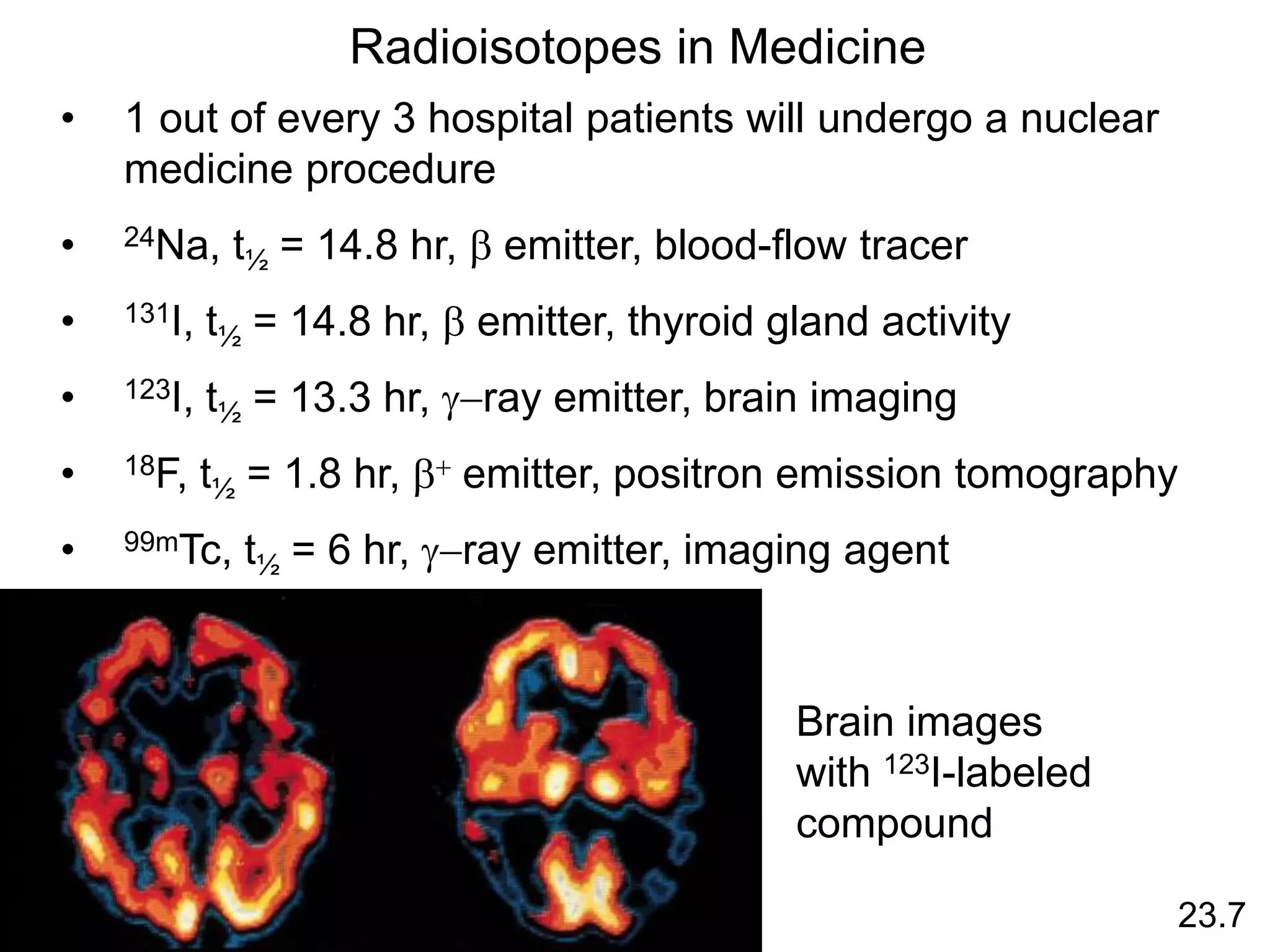
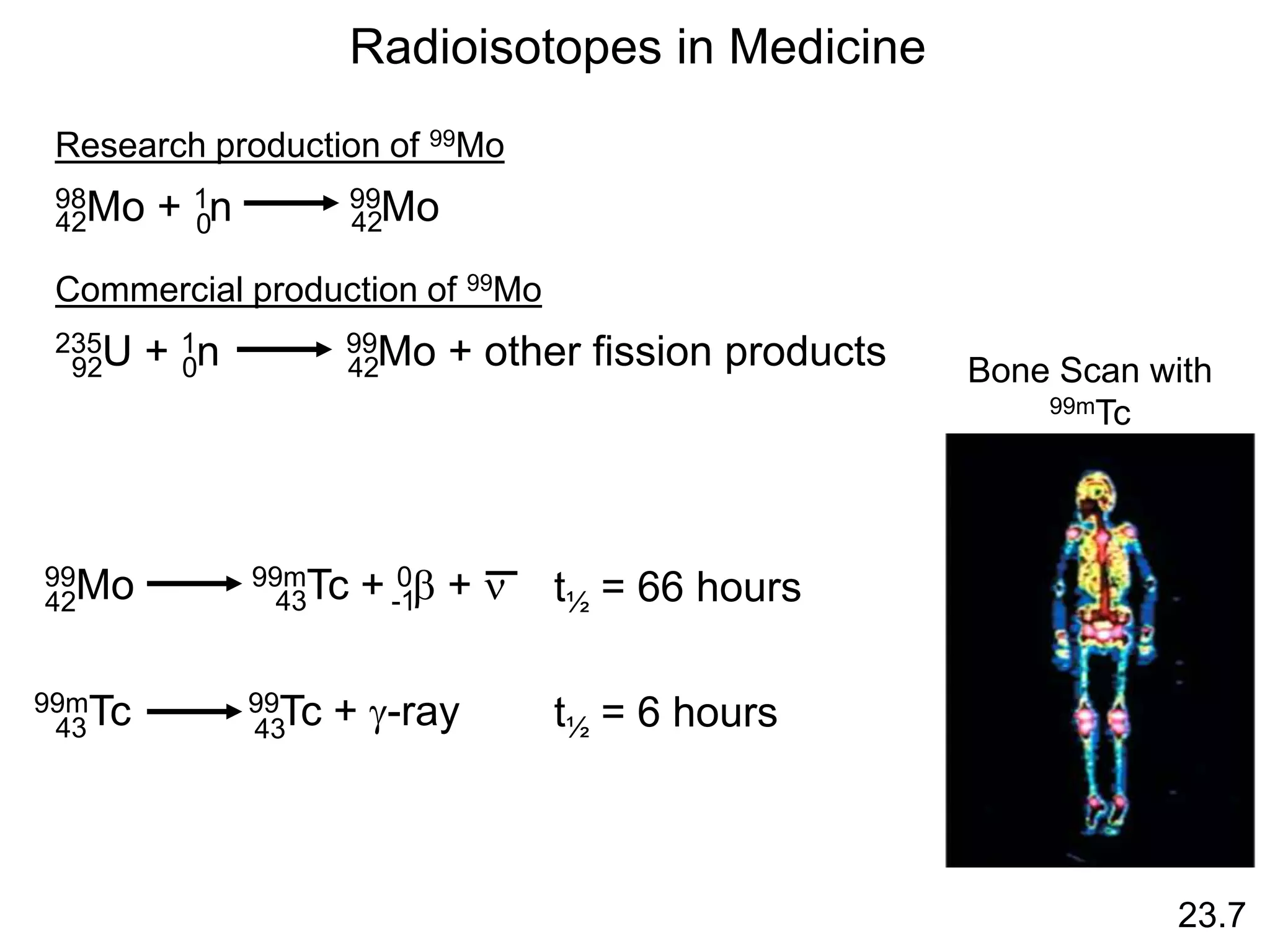
Radioisotopes in Medicine
• 1 out of every 3 hospital patients will undergo a nuclear
medicine procedure
• 24Na, t½ = 14.8 hr, b emitter, blood-flow tracer
• 131I, t½ = 14.8 hr, b emitter, thyroid gland activity
• 123I, t½ = 13.3 hr, g-ray emitter, brain imaging
• 18F, t½ = 1.8 hr, b+ emitter, positron emission tomography
• 99mTc, t½ = 6 hr, g-ray emitter, imaging agent
Brain images
with 123I-labeled
compound
23.7
Radioisotopes in Medicine
98Mo + 1n 99Mo
42 0 42
235U + 1n 99Mo + other fission products
92 0 42
99mTc 99Tc + g-ray
43 43
99Mo 99mTc + 0b + n
42 43 -1
Research production of 99Mo
Commercial production of 99Mo
t½ = 66 hours
t½ = 6 hours
Bone Scan with
99mTc
Geiger-Müller Counter
23.7
23.8
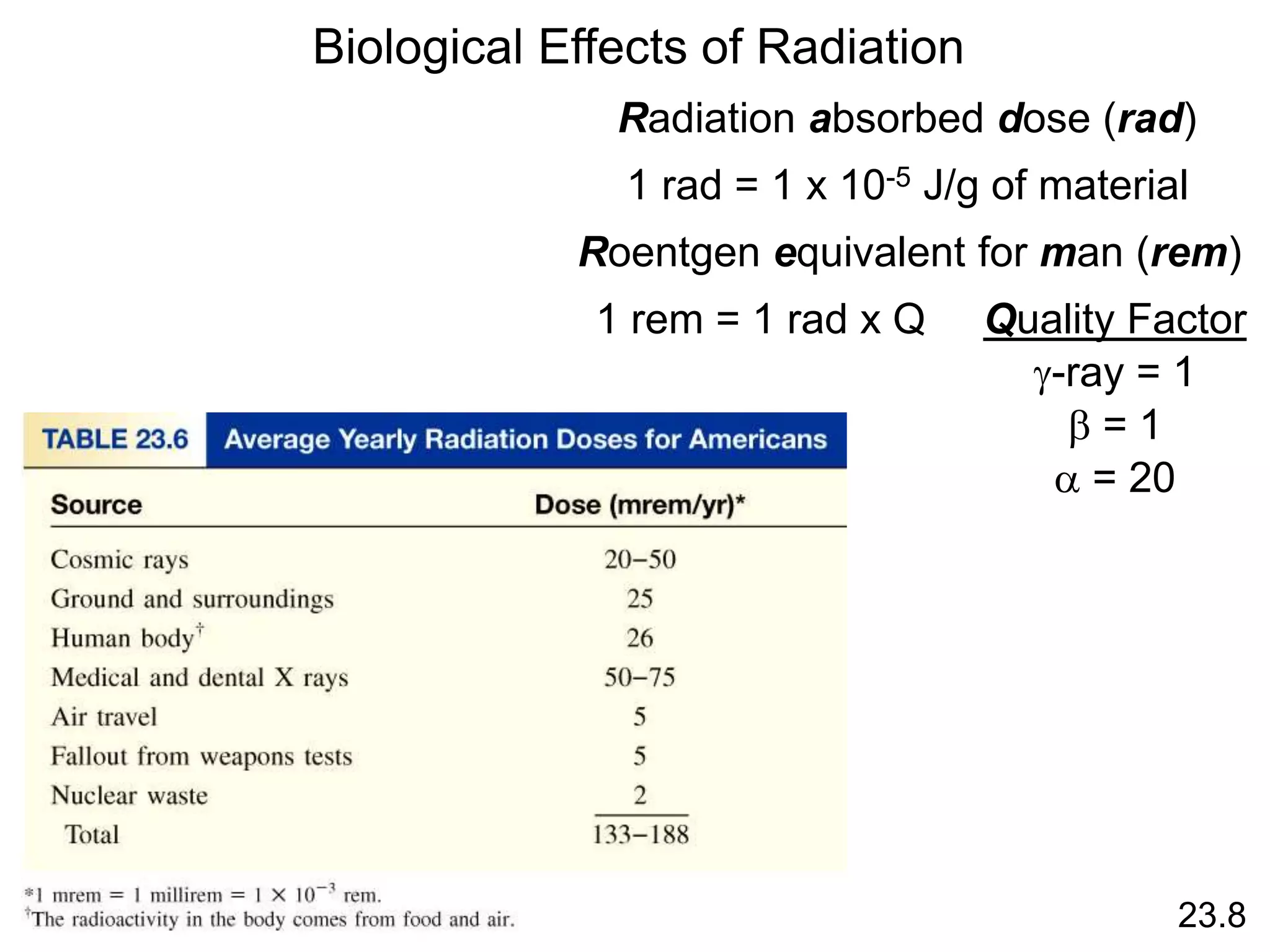
Biological Effects of Radiation
Radiation absorbed dose (rad)
1 rad = 1 x 10⁻⁵ J/g of material
Roentgen equivalent for man (rem)
1 rem = 1 rad x Q Quality Factor
g-ray = 1
b = 1
a = 20
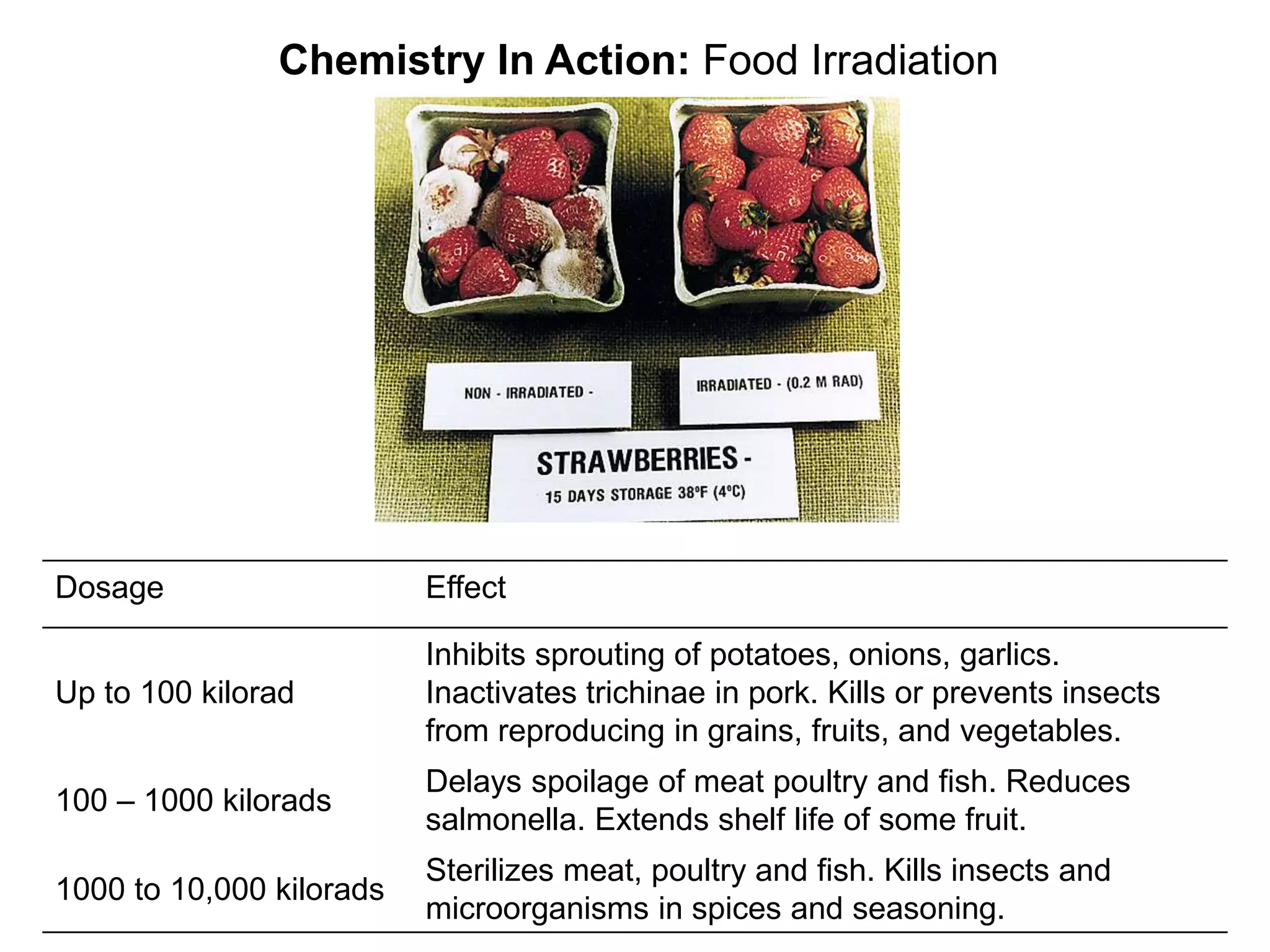
Chemistry In Action: Food Irradiation
Dosage Effect
Up to 100 kilorad
Inhibits sprouting of potatoes, onions, garlics.
Inactivates trichinae in pork. Kills or prevents insects
from reproducing in grains, fruits, and vegetables.
100 – 1000 kilorads
Delays spoilage of meat poultry and fish. Reduces
salmonella. Extends shelf life of some fruit.
1000 to 10,000 kilorads
Sterilizes meat, poultry and fish. Kills insects and
microorganisms in spices and seasoning.

Chapter_23_Nuclear_Chemistry.ppt

  • 1.
    Nuclear Chemistry Chapter 23 Copyright© The McGraw-Hill Companies, Inc. Permission required for reproduction or display.
  • 2.
    X A Z Mass Number Atomic Number ElementSymbol Atomic number (Z) = number of protons in nucleus Mass number (A) = number of protons + number of neutrons = atomic number (Z) + number of neutrons A Z 1p 1 1H 1 or proton 1n 0 neutron 0e -1 0b -1 or electron 0e +1 0b +1 or positron 4He 2 4a 2 or a particle 1 1 1 0 0 -1 0 +1 4 2 23.1
  • 3.
    Balancing Nuclear Equations 1.Conserve mass number (A). The sum of protons plus neutrons in the products must equal the sum of protons plus neutrons in the reactants. 1n 0 U 235 92 + Cs 138 55 Rb 96 37 1n 0 + + 2 235 + 1 = 138 + 96 + 2x1 2. Conserve atomic number (Z) or nuclear charge. The sum of nuclear charges in the products must equal the sum of nuclear charges in the reactants. 1n 0 U 235 92 + Cs 138 55 Rb 96 37 1n 0 + + 2 92 + 0 = 55 + 37 + 2x0 23.1
  • 4.
    212Po decays byalpha emission. Write the balanced nuclear equation for the decay of 212Po. 4He 2 4a 2 or alpha particle - 212Po 4He + AX 84 2 Z 212 = 4 + A A = 208 84 = 2 + Z Z = 82 212Po 4He + 208Pb 84 2 82 23.1
  • 5.
  • 6.
    Nuclear Stability andRadioactive Decay Beta decay 14C 14N + 0b + n 6 7 -1 40K 40Ca + 0b + n 19 20 -1 1n 1p + 0b + n 0 1 -1 Decrease # of neutrons by 1 Increase # of protons by 1 Positron decay 11C 11B + 0b + n 6 5 +1 38K 38Ar + 0b + n 19 18 +1 1p 1n + 0b + n 1 0 +1 Increase # of neutrons by 1 Decrease # of protons by 1 n and n have A = 0 and Z = 0 23.2
  • 7.
    Electron capture decay Increase# of neutrons by 1 Decrease # of protons by 1 Nuclear Stability and Radioactive Decay 37Ar + 0e 37Cl + n 18 17 -1 55Fe + 0e 55Mn + n 26 25 -1 1p + 0e 1n + n 1 0 -1 Alpha decay Decrease # of neutrons by 2 Decrease # of protons by 2 212Po 4He + 208Pb 84 2 82 Spontaneous fission 252Cf 2125In + 21n 98 49 0 23.2
  • 8.
    n/p too large betadecay X n/p too small positron decay or electron capture Y 23.2
  • 9.
    Nuclear Stability • Certainnumbers of neutrons and protons are extra stable • n or p = 2, 8, 20, 50, 82 and 126 • Like extra stable numbers of electrons in noble gases (e- = 2, 10, 18, 36, 54 and 86) • Nuclei with even numbers of both protons and neutrons are more stable than those with odd numbers of neutron and protons • All isotopes of the elements with atomic numbers higher than 83 are radioactive • All isotopes of Tc and Pm are radioactive 23.2
  • 10.
    Nuclear binding energy(BE) is the energy required to break up a nucleus into its component protons and neutrons. BE + 19F 91p + 101n 9 1 0 BE = 9 x (p mass) + 10 x (n mass) – 19F mass E = mc2 BE (amu) = 9 x 1.007825 + 10 x 1.008665 – 18.9984 BE = 0.1587 amu 1 amu = 1.49 x 10⁻¹⁰ J BE = 2.37 x 10⁻¹¹J binding energy per nucleon = binding energy number of nucleons = 2.37 x 10⁻¹¹ J 19 nucleons = 1.25 x 10⁻¹² J 23.2
  • 11.
    Nuclear binding energyper nucleon vs Mass number nuclear stability 23.2 nuclear binding energy nucleon
  • 12.
    Kinetics of RadioactiveDecay N daughter rate = - DN Dt rate = lN DN Dt = lN - N = N0exp(-lt) lnN = lnN0 - lt N = the number of atoms at time t N0 = the number of atoms at time t = 0 l is the decay constant ln2 = t½ l 23.3
  • 13.
    Kinetics of RadioactiveDecay [N] = [N]0exp(-lt) ln[N] = ln[N]0 - lt [N] ln [N] 23.3
  • 14.
    Radiocarbon Dating 14N +1n 14C + 1H 7 1 6 0 14C 14N + 0b + n 6 7 -1 t½ = 5730 years Uranium-238 Dating 238U 206Pb + 8 4a + 6 0b 92 -1 82 2 t½ = 4.51 x 10⁹ years 23.3
  • 15.
    Nuclear Transmutation Cyclotron ParticleAccelerator 14N + 4a 17O + 1p 7 2 8 1 27Al + 4a 30P + 1n 13 2 15 0 14N + 1p 11C + 4a 7 1 6 2 23.4
  • 16.
  • 17.
    Nuclear Fission 23.5 235U +1n 90Sr + 143Xe + 31n + Energy 92 54 38 0 0 Energy = [mass 235U + mass n – (mass 90Sr + mass 143Xe + 3 x mass n )] x c2 Energy = 3.3 x 10⁻¹¹J per 235U = 2.0 x 10¹³ J per mole 235U Combustion of 1 ton of coal = 5 x 10⁷ J
  • 18.
    Nuclear Fission 23.5 235U +1n 90Sr + 143Xe + 31n + Energy 92 54 38 0 0 Representative fission reaction
  • 19.
    Nuclear Fission 23.5 Nuclear chainreaction is a self-sustaining sequence of nuclear fission reactions. The minimum mass of fissionable material required to generate a self-sustaining nuclear chain reaction is the critical mass. Non-critical Critical
  • 20.
    Schematic Diagram ofa Nuclear Reactor 23.5
  • 21.
    Annual Waste Production 23.5 35,000tons SO2 4.5 x 10⁶ tons CO2 1,000 MW coal-fired power plant 3.5 x 106 ft3 ash 1,000 MW nuclear power plant 70 ft3 vitrified waste Nuclear Fission
  • 22.
    23.5 Nuclear Fission Hazards ofthe radioactivities in spent fuel compared to uranium ore From “Science, Society and America’s Nuclear Waste,” DOE/RW-0361 TG
  • 23.
    Chemistry In Action:Nature’s Own Fission Reactor Natural Uranium 0.7202 % U-235 99.2798% U-238 Measured at Oklo 0.7171 % U-235
  • 24.
    23.6 Nuclear Fusion 2H +2H 3H + 1H 1 1 1 1 Fusion Reaction Energy Released 2H + 3H 4He + 1n 1 1 2 0 6Li + 2H 2 4He 3 1 2 6.3 x 10⁻¹³ J 2.8 x 10⁻¹² J 3.6 x 10⁻¹² J Tokamak magnetic plasma confinement
  • 25.
    23.7 Radioisotopes in Medicine •1 out of every 3 hospital patients will undergo a nuclear medicine procedure • 24Na, t½ = 14.8 hr, b emitter, blood-flow tracer • 131I, t½ = 14.8 hr, b emitter, thyroid gland activity • 123I, t½ = 13.3 hr, g-ray emitter, brain imaging • 18F, t½ = 1.8 hr, b+ emitter, positron emission tomography • 99mTc, t½ = 6 hr, g-ray emitter, imaging agent Brain images with 123I-labeled compound
  • 26.
    23.7 Radioisotopes in Medicine 98Mo+ 1n 99Mo 42 0 42 235U + 1n 99Mo + other fission products 92 0 42 99mTc 99Tc + g-ray 43 43 99Mo 99mTc + 0b + n 42 43 -1 Research production of 99Mo Commercial production of 99Mo t½ = 66 hours t½ = 6 hours Bone Scan with 99mTc
  • 27.
  • 28.
    23.8 Biological Effects ofRadiation Radiation absorbed dose (rad) 1 rad = 1 x 10⁻⁵ J/g of material Roentgen equivalent for man (rem) 1 rem = 1 rad x Q Quality Factor g-ray = 1 b = 1 a = 20
  • 29.
    Chemistry In Action:Food Irradiation Dosage Effect Up to 100 kilorad Inhibits sprouting of potatoes, onions, garlics. Inactivates trichinae in pork. Kills or prevents insects from reproducing in grains, fruits, and vegetables. 100 – 1000 kilorads Delays spoilage of meat poultry and fish. Reduces salmonella. Extends shelf life of some fruit. 1000 to 10,000 kilorads Sterilizes meat, poultry and fish. Kills insects and microorganisms in spices and seasoning.