NUCLEAR REACTIONS
NEXT
INDEX
 INTRODUCTION
 ENERGY FROM NUCLEUS
 NUCLEAR FISSION
 NUCLEAR REACTOR
 NUCLEAR FUSION
 CONTROLLED THERMONUCLEAR
FUSION
INTRODUCTION
In 1919 it occurred to Rutherford that it
ought to be possible to penetrate a
nucleus with a massive high-speed
particle such as alpha-particles and
thereby producing a nucleus with
greater mass number or induce an
artificial disintegration.Rutherford was
successful in bombarding nitrogen with
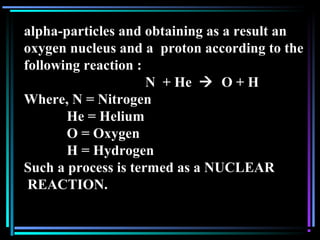
alpha-particles and obtaining as a result an
oxygen nucleus and a proton according to the
following reaction :
N + He  O + H
Where, N = Nitrogen
He = Helium
O = Oxygen
H = Hydrogen
Such a process is termed as a NUCLEAR
REACTION.
Nuclear Reaction Energy
In a nuclear reaction,the sum of the initial
atomic numbers is equal to the sum of the
final atomic numbers,by the conservation
of charge.The sum of the initial mass
numbers is also equal to the sum of the
final mass numbers,but the initial rest
masses not equal to the final rest mass. The
difference between the rest masses is equal
to the NUCLEAR REACTION ENERGY.
ENERGY FROM NUCLEUS
When we get energy from coal by burning
the fuel ,we are doing so by tinkering with
atoms of carbon and oxygen,rearranging
their outer electrons into more stable combi-
nations.When we get energy from uranium(
a highly radioactive element)in the nuclear
reactor ,we are again burning a fuel,but then
we are tinkering with its nucleus,rearranging
Its nucleons into more stable configuration.
In both atomic and nuclear burning,the
release of energy is accompanied by a
decrease in mass according to the equation:
Q = - mc^2
Thus,for the same energy release,a much
larger fraction of the available mass(by a
factor of few millions)is consumed in a
chemical fuel than in a nuclear fuel.
NUCLEAR FISSION
After the discovery of neutron by Chadwick,
Enrico Fermi found that when neutrons are
bombarded on various elements,new radio-
active elements are produced. He predicted
that the neutron,being uncharged,would be
a useful nuclear projectile;unlike the protons
or alpha-particle,it experiences no repulsive
Coulomb force when it nears a nuclear
surface.
In late 1930’s ,the physicist Lise Meitner and
Chemists Otto Hann and Fritz Strassman,
Bombarded solutions of uranium salts with
The (slow moving neutrons
In thermal equilibrium with the surrounding
Matter at room temperature,with a mean
Kinetic energy of only about 0.04 eV,and are
Useful projectiles in nuclear studies).They
Found that after the bombardment a number
Of new radionuclides were produced.
thermal neutrons
For Hann & Strassmann,it was rather a
mystery as to how this middle-mass element
(Z=56)could be produced by the bombardem-
ent of uranium(Z=92)with neutrons.Meitner
& her nephew Otto Frisch solved this puzzle.
They suggested the mechanism by which a
uranium nucleus,having absorbed a thermal
neutron,could split,with the release of energy,
into roghly two equal parts,one of which might
well be barium.Frisch named it as FISSION.
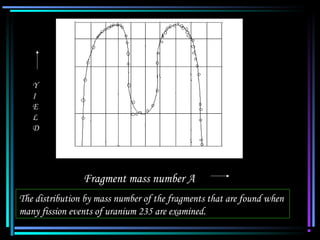
Fragment mass number A
Y
I
E
L
D
The distribution by mass number of the fragments that are found when
many fission events of uranium 235 are examined.

Nuclear reaction

  • 1.
  • 2.
    INDEX  INTRODUCTION  ENERGYFROM NUCLEUS  NUCLEAR FISSION  NUCLEAR REACTOR  NUCLEAR FUSION  CONTROLLED THERMONUCLEAR FUSION
  • 3.
    INTRODUCTION In 1919 itoccurred to Rutherford that it ought to be possible to penetrate a nucleus with a massive high-speed particle such as alpha-particles and thereby producing a nucleus with greater mass number or induce an artificial disintegration.Rutherford was successful in bombarding nitrogen with
  • 4.
    alpha-particles and obtainingas a result an oxygen nucleus and a proton according to the following reaction : N + He  O + H Where, N = Nitrogen He = Helium O = Oxygen H = Hydrogen Such a process is termed as a NUCLEAR REACTION.
  • 5.
    Nuclear Reaction Energy Ina nuclear reaction,the sum of the initial atomic numbers is equal to the sum of the final atomic numbers,by the conservation of charge.The sum of the initial mass numbers is also equal to the sum of the final mass numbers,but the initial rest masses not equal to the final rest mass. The difference between the rest masses is equal to the NUCLEAR REACTION ENERGY.
  • 6.
    ENERGY FROM NUCLEUS Whenwe get energy from coal by burning the fuel ,we are doing so by tinkering with atoms of carbon and oxygen,rearranging their outer electrons into more stable combi- nations.When we get energy from uranium( a highly radioactive element)in the nuclear reactor ,we are again burning a fuel,but then we are tinkering with its nucleus,rearranging Its nucleons into more stable configuration.
  • 7.
    In both atomicand nuclear burning,the release of energy is accompanied by a decrease in mass according to the equation: Q = - mc^2 Thus,for the same energy release,a much larger fraction of the available mass(by a factor of few millions)is consumed in a chemical fuel than in a nuclear fuel.
  • 8.
    NUCLEAR FISSION After thediscovery of neutron by Chadwick, Enrico Fermi found that when neutrons are bombarded on various elements,new radio- active elements are produced. He predicted that the neutron,being uncharged,would be a useful nuclear projectile;unlike the protons or alpha-particle,it experiences no repulsive Coulomb force when it nears a nuclear surface.
  • 9.
    In late 1930’s,the physicist Lise Meitner and Chemists Otto Hann and Fritz Strassman, Bombarded solutions of uranium salts with The (slow moving neutrons In thermal equilibrium with the surrounding Matter at room temperature,with a mean Kinetic energy of only about 0.04 eV,and are Useful projectiles in nuclear studies).They Found that after the bombardment a number Of new radionuclides were produced. thermal neutrons
  • 10.
    For Hann &Strassmann,it was rather a mystery as to how this middle-mass element (Z=56)could be produced by the bombardem- ent of uranium(Z=92)with neutrons.Meitner & her nephew Otto Frisch solved this puzzle. They suggested the mechanism by which a uranium nucleus,having absorbed a thermal neutron,could split,with the release of energy, into roghly two equal parts,one of which might well be barium.Frisch named it as FISSION.
  • 11.
    Fragment mass numberA Y I E L D The distribution by mass number of the fragments that are found when many fission events of uranium 235 are examined.