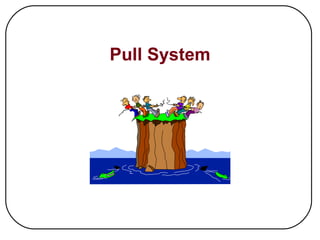
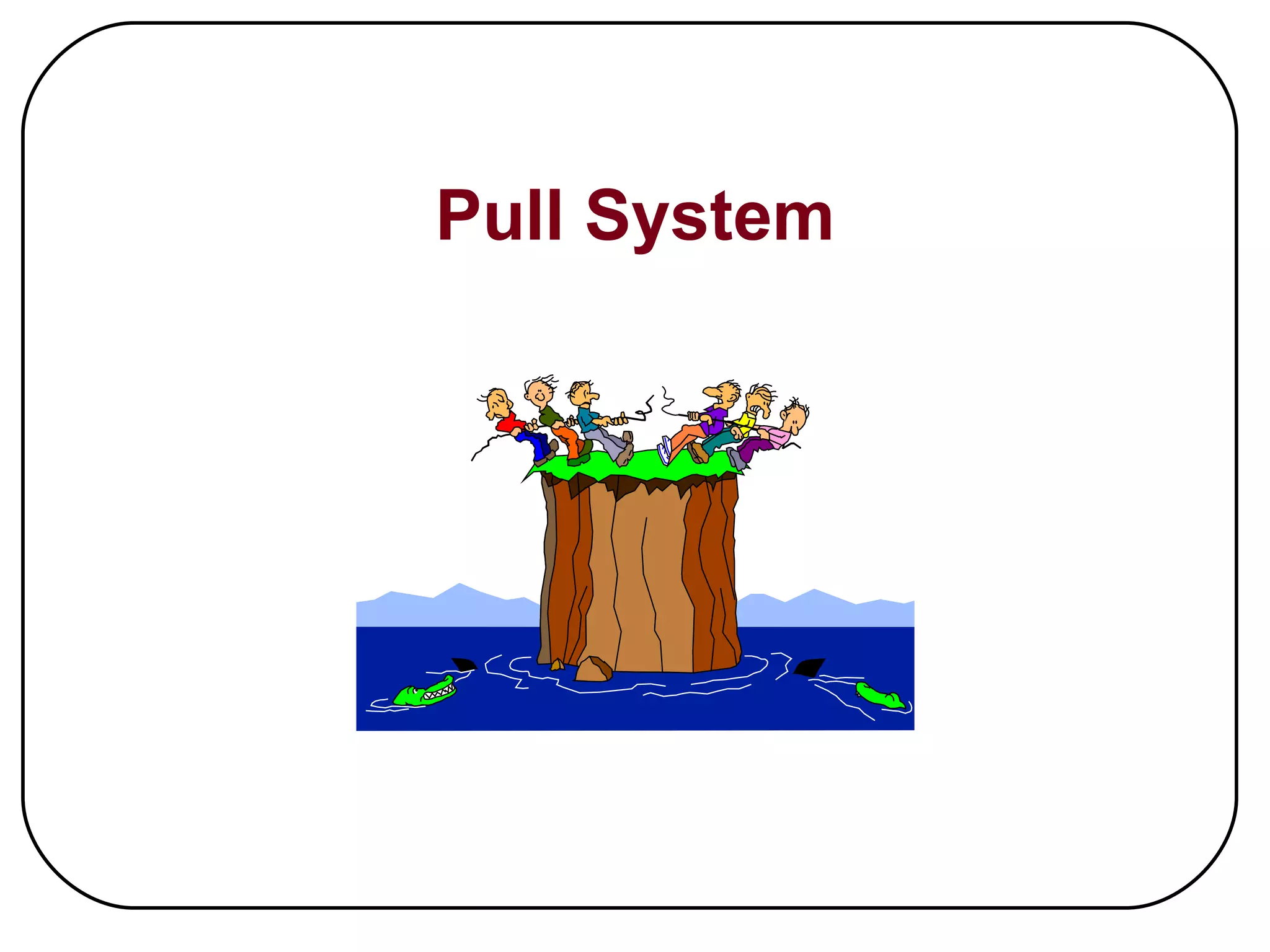
Pull System
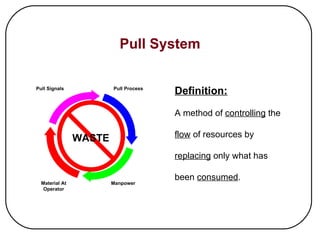
Pull System Definition: A method of  controlling  the flow  of resources by  replacing  only what has  been  consumed . Pull Signals Pull Process Material At Operator Manpower WASTE
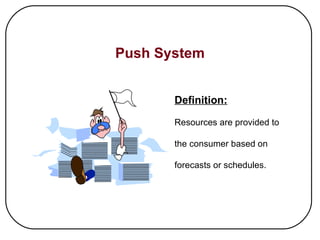
Push System Definition: Resources are provided to  the consumer based on  forecasts or schedules.
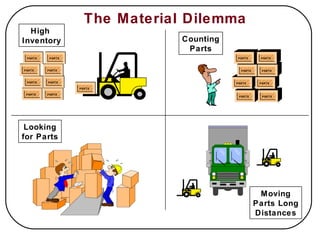
The Material Dilemma Looking for Parts High  Inventory Counting Parts Moving Parts Long Distances PARTS PARTS PARTS PARTS PARTS PARTS PARTS PARTS PARTS PARTS PARTS PARTS PARTS PARTS PARTS PARTS PARTS
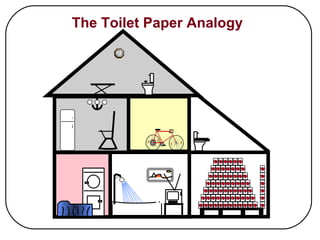
The Toilet Paper Analogy TP TP TP TP TP TP TP TP TP TP TP TP TP TP TP TP TP TP TP TP TP TP TP TP TP TP TP TP TP TP TP TP TP TP TP TP TP TP TP TP TP TP TP TP TP TP TP TP TP TP TP TP TP TP TP TP TP TP TP TP TP TP TP TP TP TP TP TP TP
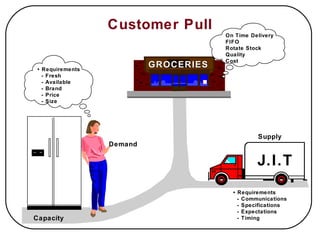
Customer Pull •  Requirements - Fresh - Available - Brand - Price - Size Capacity Demand Supply •  Requirements - Communications - Specifications - Expectations - Timing GROCERIES J.I.T On Time Delivery FIFO Rotate Stock Quality Cost
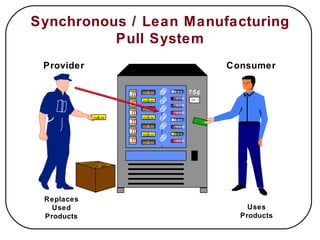
Synchronous / Lean Manufacturing Pull System 75¢ m m m m m m&m m&m m&m m&m m&m m&m m&m m E M P T Y mmmn mmmn mmmn mmmn mmmn mmmn mmmn mmmn Provider Consumer Replaces Used Products Uses Products m&m
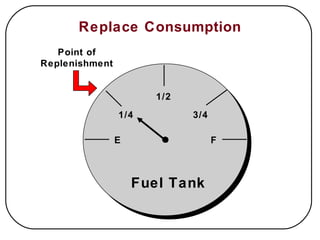
Replace Consumption 1/4 1/2 3/4 F E Fuel Tank Point of Replenishment
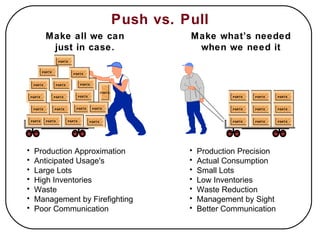
Push vs. Pull Make all we can just in case. Make what’s needed when we need it Production Approximation Anticipated Usage's Large Lots High Inventories Waste Management by Firefighting Poor Communication Production Precision Actual Consumption Small Lots Low Inventories Waste Reduction Management by Sight Better Communication PARTS PARTS PARTS PARTS PARTS PARTS PARTS PARTS PARTS PARTS PARTS PARTS PARTS PARTS PARTS PARTS PARTS PARTS PARTS PARTS PARTS PARTS PARTS PARTS PARTS PARTS PARTS
A Pull System Is Flexible and Simple Objectives: Methods of  controlling  and  balancing  the flow Of resources. Eliminating waste  of handling, storage, expediting, Obsolescence, repair, rework, facilities, equipment, Excess inventory (work-in-process & finished). Manufacture and ship only  what has been Consumed . Provides  visual control  of all resources.
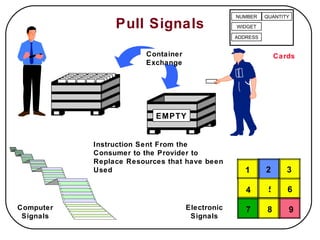
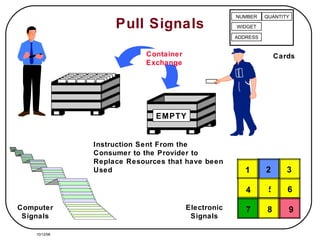
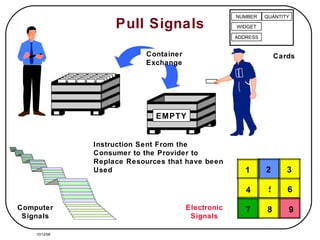
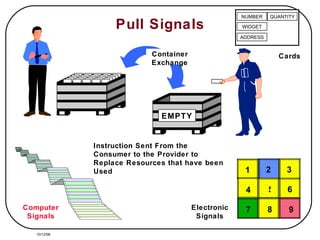
Pull Signals Electronic Signals Instruction Sent From the Consumer to the Provider to Replace Resources that have been Used Computer Signals Cards Container Exchange NUMBER QUANTITY WIDGET ADDRESS 1 2 3 4 5 6 7 8 9 EMPTY
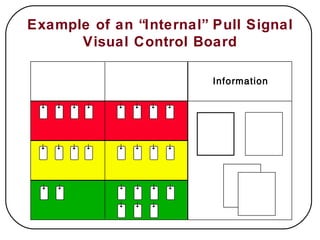
Example of an “Internal” Pull Signal Visual Control Board Information
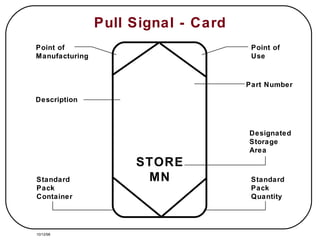
Pull Signal - Card Point of Manufacturing Point of Use Standard Pack Container Standard Pack Quantity Description Part Number Designated Storage Area STORE MN 10/12/98
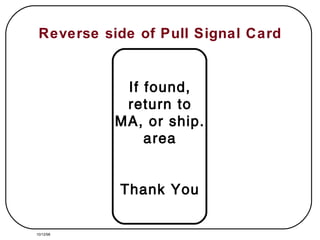
Reverse side of Pull Signal Card 10/12/98 If found, return to MA, or ship. area Thank You
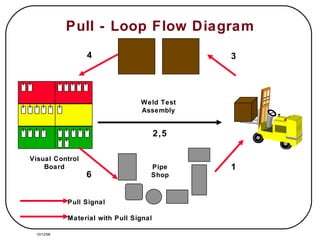
Pull - Loop Flow Diagram 10/12/98 Pull Signal Material with Pull Signal Visual Control Board Weld Test Assembly Pipe Shop 4 3 1 2,5 6
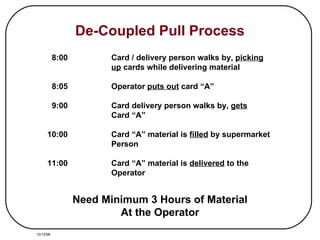
De-Coupled Pull Process 8:00 Card / delivery person walks by,  picking up  cards while delivering material 8:05 Operator  puts out  card “A” 9:00 Card delivery person walks by,  gets Card “A” 10:00 Card “A” material is  filled  by supermarket Person 11:00 Card “A” material is  delivered  to the  Operator Need Minimum 3 Hours of Material At the Operator 10/12/98
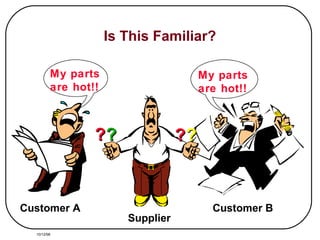
Is This Familiar? 10/12/98 My parts are hot!! My parts are hot!! ? ? ? ? Customer A Customer B Supplier
Pull Signals Electronic Signals Instruction Sent From the Consumer to the Provider to Replace Resources that have been Used Computer Signals Cards Container Exchange 10/12/98 NUMBER QUANTITY WIDGET ADDRESS EMPTY 1 2 3 4 5 6 7 8 9
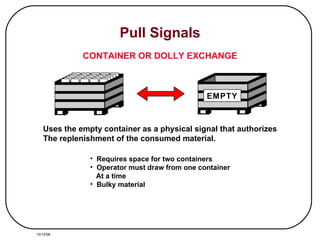
Pull Signals CONTAINER OR DOLLY EXCHANGE 10/12/98 Uses the empty container as a physical signal that authorizes The replenishment of the consumed material. Requires space for two containers Operator must draw from one container At a time Bulky material EMPTY
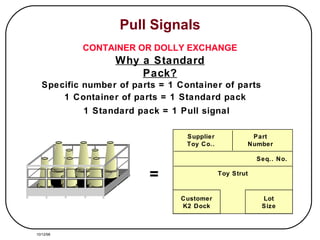
Why a Standard Pack? = Pull Signals CONTAINER OR DOLLY EXCHANGE 10/12/98 Specific number of parts = 1 Container of parts 1 Standard pack = 1 Pull signal 1 Container of parts = 1 Standard pack Supplier Toy Co.. Part Number Toy Strut Customer K2 Dock Lot Size Seq.. No.
Pull Signals Electronic Signals Instruction Sent From the Consumer to the Provider to Replace Resources that have been Used Computer Signals Cards Container Exchange 10/12/98 NUMBER QUANTITY WIDGET ADDRESS EMPTY 1 2 3 4 5 6 7 8 9
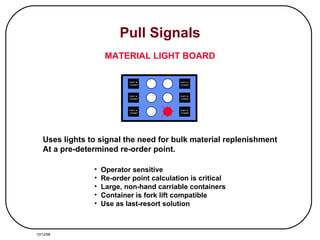
Pull Signals MATERIAL LIGHT BOARD Uses lights to signal the need for bulk material replenishment At a pre-determined re-order point. Operator sensitive Re-order point calculation is critical Large, non-hand carriable containers Container is fork lift compatible Use as last-resort solution 10/12/98 PART # 1234567 PART # 1234567 PART # 1234567 PART # 1234567 PART # 1234567 PART # 1234567
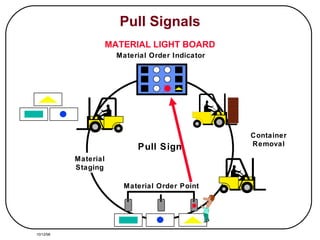
Material Order Indicator Material Staging Container Removal Material Order Point Pull Sign Pull Signals MATERIAL LIGHT BOARD 10/12/98
Pull Signals Electronic Signals Instruction Sent From the Consumer to the Provider to Replace Resources that have been Used Computer Signals Cards Container Exchange 10/12/98 NUMBER QUANTITY WIDGET ADDRESS EMPTY 1 2 3 4 5 6 7 8 9
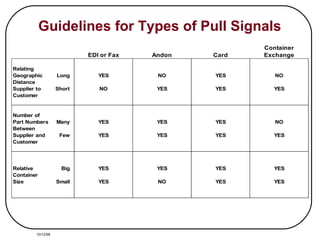
Guidelines for Types of Pull Signals 10/12/98
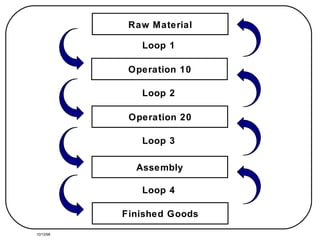
Loop 1 Loop 2 Loop 3 Loop 4 10/12/98 Assembly Operation 20 Operation 10 Raw Material Finished Goods
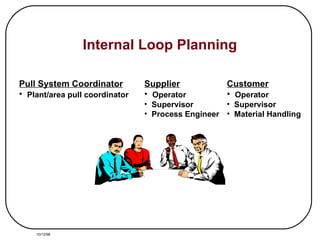
Internal Loop Planning 10/12/98 Pull System Coordinator Plant/area pull coordinator Supplier Operator Supervisor Process Engineer Customer Operator Supervisor Material Handling
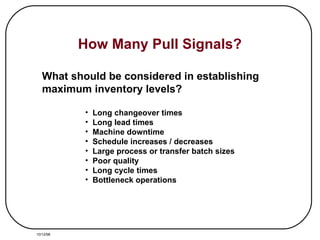
How Many Pull Signals? What should be considered in establishing maximum inventory levels? Long changeover times Long lead times Machine downtime Schedule increases / decreases Large process or transfer batch sizes Poor quality Long cycle times Bottleneck operations 10/12/98
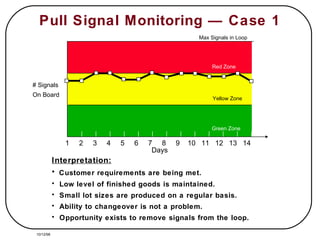
Pull Signal Monitoring — Case 1 10/12/98 Interpretation: Customer requirements are being met. Low level of finished goods is maintained. Small lot sizes are produced on a regular basis. Ability to changeover is not a problem. Opportunity exists to remove signals from the loop. Max Signals in Loop Red Zone Yellow Zone Green Zone # Signals On Board 1  2  3  4  5  6  7  8  9  10  11  12  13  14 Days
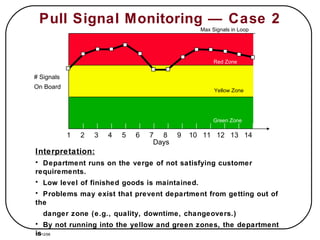
Pull Signal Monitoring — Case 2 10/12/98 Interpretation: Department runs on the verge of not satisfying customer requirements. Low level of finished goods is maintained. Problems may exist that prevent department from getting out of the danger zone (e.g., quality, downtime, changeovers.) By not running into the yellow and green zones, the department is unable to maintain the desired amount of safety stock. Max Signals in Loop Red Zone Yellow Zone Green Zone # Signals On Board 1  2  3  4  5  6  7  8  9  10  11  12  13  14 Days
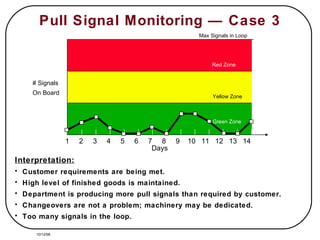
Pull Signal Monitoring — Case 3 10/12/98 Interpretation: Customer requirements are being met. High level of finished goods is maintained. Department is producing more pull signals than required by customer. Changeovers are not a problem; machinery may be dedicated. Too many signals in the loop. Max Signals in Loop Red Zone Yellow Zone Green Zone # Signals On Board 1  2  3  4  5  6  7  8  9  10  11  12  13  14 Days
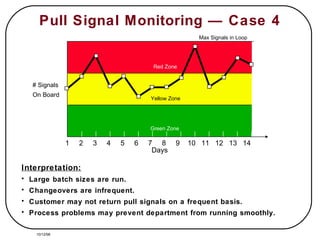
Pull Signal Monitoring — Case 4 10/12/98 Interpretation: Large batch sizes are run. Changeovers are infrequent. Customer may not return pull signals on a frequent basis. Process problems may prevent department from running smoothly. Max Signals in Loop Red Zone Yellow Zone Green Zone # Signals On Board 1  2  3  4  5  6  7  8  9  10  11  12  13  14 Days
How Will Pull System Change Your Job? Preventative maintenance Quality improvements Team meetings Housekeeping Training Continuous improvement Pull system provides more time for constructive activities  that will make your job and working conditions better tomorrow because with pull you run only the parts that are needed.  Shut down time can be spent on: 10/12/98
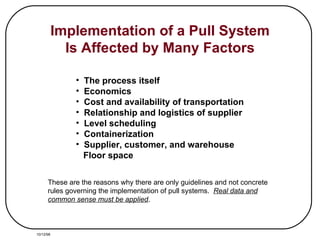
Implementation of a Pull System Is Affected by Many Factors The process itself Economics Cost and availability of transportation Relationship and logistics of supplier Level scheduling Containerization Supplier, customer, and warehouse Floor space These are the reasons why there are only guidelines and not concrete rules governing the implementation of pull systems.  Real data and common sense must be applied . 10/12/98
Benefits of Pull Systems Increases employee involvement Allows decision-making at appropriate levels Allows manufacture of only what is needed by the customer Improves communications of customer needs through visual controls Provides a common system for moving material through a plant 10/12/98
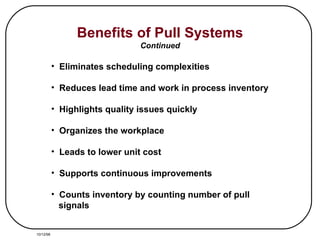
Benefits of Pull Systems Continued Eliminates scheduling complexities Reduces lead time and work in process inventory Highlights quality issues quickly Organizes the workplace Leads to lower unit cost Supports continuous improvements Counts inventory by counting number of pull signals 10/12/98
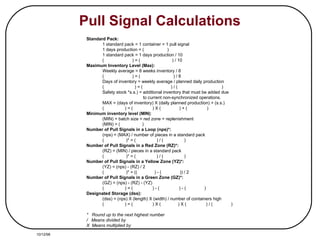
Standard Pack: 1 standard pack = 1 container = 1 pull signal 1 days production = (  ) 1 standard pack = 1 days production / 10 (  ) = (  ) / 10 Maximum Inventory Level (Max): Weekly average = 8 weeks inventory / 8 (  ) = (  ) / 8 Days of inventory = weekly average / planned daily production (  ) = (  ) / (  ) Safety stock *s.s.) = additional inventory that must be added due to current non-synchronized operations. MAX = (days of inventory) X (daily planned production) + (s.s.) (  ) = (  ) X (  ) + (  ) Minimum inventory level (MIN) : (MIN) = batch size = red zone = replenishment (MIN) = (  ) Number of Pull Signals in a Loop (nps)*: (nps) = (MAX) / number of pieces in a standard pack (  )* = (  ) / (  ) Number of Pull Signals in a Red Zone (RZ)*: (RZ) = (MIN) / pieces in a standard pack (  )* = (  ) / (  ) Number of Pull Signals in a Yellow Zone (YZ)*: (YZ) = (nps) - (RZ) / 2 (  )* = ((  ) - (  )) / 2 Number of Pull Signals in a Green Zone (GZ)*: (GZ) = (nps) - (RZ) - (YZ) (  ) = (  ) - (  ) - (  ) Designated Storage (dss): (dss) = (nps) X (length) X (width) / number of containers high (  ) = (  ) X (  ) X (  ) / (  ) *  Round up to the next highest number /  Means divided by X  Means multiplied by Pull Signal Calculations 10/12/98
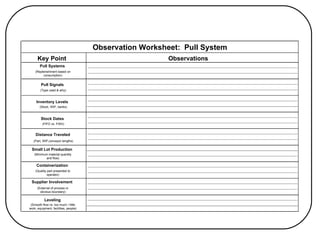
Observation Worksheet:  Pull System Key Point Observations Pull Systems (Replenishment based on consumption) Pull Signals (Type used & why) Inventory Levels (Stock, WIP, banks) Stock Dates (FIFO vs. FISH) Distance Traveled (Part, WIP,conveyor lengths) Small Lot Production (Minimum material quantity and flow) Containerization (Quality part presented to operator) Supplier Involvement (External of process or obvious boundary) Leveling (Smooth flow vs. too much / little work, equipment, facilities, people)

Kanban Pull System

  • 1.
  • 2.
    Pull System Definition:A method of controlling the flow of resources by replacing only what has been consumed . Pull Signals Pull Process Material At Operator Manpower WASTE
  • 3.
    Push System Definition:Resources are provided to the consumer based on forecasts or schedules.
  • 4.
    The Material DilemmaLooking for Parts High Inventory Counting Parts Moving Parts Long Distances PARTS PARTS PARTS PARTS PARTS PARTS PARTS PARTS PARTS PARTS PARTS PARTS PARTS PARTS PARTS PARTS PARTS
  • 5.
    The Toilet PaperAnalogy TP TP TP TP TP TP TP TP TP TP TP TP TP TP TP TP TP TP TP TP TP TP TP TP TP TP TP TP TP TP TP TP TP TP TP TP TP TP TP TP TP TP TP TP TP TP TP TP TP TP TP TP TP TP TP TP TP TP TP TP TP TP TP TP TP TP TP TP TP
  • 6.
    Customer Pull • Requirements - Fresh - Available - Brand - Price - Size Capacity Demand Supply • Requirements - Communications - Specifications - Expectations - Timing GROCERIES J.I.T On Time Delivery FIFO Rotate Stock Quality Cost
  • 7.
    Synchronous / LeanManufacturing Pull System 75¢ m m m m m m&m m&m m&m m&m m&m m&m m&m m E M P T Y mmmn mmmn mmmn mmmn mmmn mmmn mmmn mmmn Provider Consumer Replaces Used Products Uses Products m&m
  • 8.
    Replace Consumption 1/41/2 3/4 F E Fuel Tank Point of Replenishment
  • 9.
    Push vs. PullMake all we can just in case. Make what’s needed when we need it Production Approximation Anticipated Usage's Large Lots High Inventories Waste Management by Firefighting Poor Communication Production Precision Actual Consumption Small Lots Low Inventories Waste Reduction Management by Sight Better Communication PARTS PARTS PARTS PARTS PARTS PARTS PARTS PARTS PARTS PARTS PARTS PARTS PARTS PARTS PARTS PARTS PARTS PARTS PARTS PARTS PARTS PARTS PARTS PARTS PARTS PARTS PARTS
  • 10.
    A Pull SystemIs Flexible and Simple Objectives: Methods of controlling and balancing the flow Of resources. Eliminating waste of handling, storage, expediting, Obsolescence, repair, rework, facilities, equipment, Excess inventory (work-in-process & finished). Manufacture and ship only what has been Consumed . Provides visual control of all resources.
  • 11.
    Pull Signals ElectronicSignals Instruction Sent From the Consumer to the Provider to Replace Resources that have been Used Computer Signals Cards Container Exchange NUMBER QUANTITY WIDGET ADDRESS 1 2 3 4 5 6 7 8 9 EMPTY
  • 12.
    Example of an“Internal” Pull Signal Visual Control Board Information
  • 13.
    Pull Signal -Card Point of Manufacturing Point of Use Standard Pack Container Standard Pack Quantity Description Part Number Designated Storage Area STORE MN 10/12/98
  • 14.
    Reverse side ofPull Signal Card 10/12/98 If found, return to MA, or ship. area Thank You
  • 15.
    Pull - LoopFlow Diagram 10/12/98 Pull Signal Material with Pull Signal Visual Control Board Weld Test Assembly Pipe Shop 4 3 1 2,5 6
  • 16.
    De-Coupled Pull Process8:00 Card / delivery person walks by, picking up cards while delivering material 8:05 Operator puts out card “A” 9:00 Card delivery person walks by, gets Card “A” 10:00 Card “A” material is filled by supermarket Person 11:00 Card “A” material is delivered to the Operator Need Minimum 3 Hours of Material At the Operator 10/12/98
  • 17.
    Is This Familiar?10/12/98 My parts are hot!! My parts are hot!! ? ? ? ? Customer A Customer B Supplier
  • 18.
    Pull Signals ElectronicSignals Instruction Sent From the Consumer to the Provider to Replace Resources that have been Used Computer Signals Cards Container Exchange 10/12/98 NUMBER QUANTITY WIDGET ADDRESS EMPTY 1 2 3 4 5 6 7 8 9
  • 19.
    Pull Signals CONTAINEROR DOLLY EXCHANGE 10/12/98 Uses the empty container as a physical signal that authorizes The replenishment of the consumed material. Requires space for two containers Operator must draw from one container At a time Bulky material EMPTY
  • 20.
    Why a StandardPack? = Pull Signals CONTAINER OR DOLLY EXCHANGE 10/12/98 Specific number of parts = 1 Container of parts 1 Standard pack = 1 Pull signal 1 Container of parts = 1 Standard pack Supplier Toy Co.. Part Number Toy Strut Customer K2 Dock Lot Size Seq.. No.
  • 21.
    Pull Signals ElectronicSignals Instruction Sent From the Consumer to the Provider to Replace Resources that have been Used Computer Signals Cards Container Exchange 10/12/98 NUMBER QUANTITY WIDGET ADDRESS EMPTY 1 2 3 4 5 6 7 8 9
  • 22.
    Pull Signals MATERIALLIGHT BOARD Uses lights to signal the need for bulk material replenishment At a pre-determined re-order point. Operator sensitive Re-order point calculation is critical Large, non-hand carriable containers Container is fork lift compatible Use as last-resort solution 10/12/98 PART # 1234567 PART # 1234567 PART # 1234567 PART # 1234567 PART # 1234567 PART # 1234567
  • 23.
    Material Order IndicatorMaterial Staging Container Removal Material Order Point Pull Sign Pull Signals MATERIAL LIGHT BOARD 10/12/98
  • 24.
    Pull Signals ElectronicSignals Instruction Sent From the Consumer to the Provider to Replace Resources that have been Used Computer Signals Cards Container Exchange 10/12/98 NUMBER QUANTITY WIDGET ADDRESS EMPTY 1 2 3 4 5 6 7 8 9
  • 25.
    Guidelines for Typesof Pull Signals 10/12/98
  • 26.
    Loop 1 Loop2 Loop 3 Loop 4 10/12/98 Assembly Operation 20 Operation 10 Raw Material Finished Goods
  • 27.
    Internal Loop Planning10/12/98 Pull System Coordinator Plant/area pull coordinator Supplier Operator Supervisor Process Engineer Customer Operator Supervisor Material Handling
  • 28.
    How Many PullSignals? What should be considered in establishing maximum inventory levels? Long changeover times Long lead times Machine downtime Schedule increases / decreases Large process or transfer batch sizes Poor quality Long cycle times Bottleneck operations 10/12/98
  • 29.
    Pull Signal Monitoring— Case 1 10/12/98 Interpretation: Customer requirements are being met. Low level of finished goods is maintained. Small lot sizes are produced on a regular basis. Ability to changeover is not a problem. Opportunity exists to remove signals from the loop. Max Signals in Loop Red Zone Yellow Zone Green Zone # Signals On Board 1 2 3 4 5 6 7 8 9 10 11 12 13 14 Days
  • 30.
    Pull Signal Monitoring— Case 2 10/12/98 Interpretation: Department runs on the verge of not satisfying customer requirements. Low level of finished goods is maintained. Problems may exist that prevent department from getting out of the danger zone (e.g., quality, downtime, changeovers.) By not running into the yellow and green zones, the department is unable to maintain the desired amount of safety stock. Max Signals in Loop Red Zone Yellow Zone Green Zone # Signals On Board 1 2 3 4 5 6 7 8 9 10 11 12 13 14 Days
  • 31.
    Pull Signal Monitoring— Case 3 10/12/98 Interpretation: Customer requirements are being met. High level of finished goods is maintained. Department is producing more pull signals than required by customer. Changeovers are not a problem; machinery may be dedicated. Too many signals in the loop. Max Signals in Loop Red Zone Yellow Zone Green Zone # Signals On Board 1 2 3 4 5 6 7 8 9 10 11 12 13 14 Days
  • 32.
    Pull Signal Monitoring— Case 4 10/12/98 Interpretation: Large batch sizes are run. Changeovers are infrequent. Customer may not return pull signals on a frequent basis. Process problems may prevent department from running smoothly. Max Signals in Loop Red Zone Yellow Zone Green Zone # Signals On Board 1 2 3 4 5 6 7 8 9 10 11 12 13 14 Days
  • 33.
    How Will PullSystem Change Your Job? Preventative maintenance Quality improvements Team meetings Housekeeping Training Continuous improvement Pull system provides more time for constructive activities that will make your job and working conditions better tomorrow because with pull you run only the parts that are needed. Shut down time can be spent on: 10/12/98
  • 34.
    Implementation of aPull System Is Affected by Many Factors The process itself Economics Cost and availability of transportation Relationship and logistics of supplier Level scheduling Containerization Supplier, customer, and warehouse Floor space These are the reasons why there are only guidelines and not concrete rules governing the implementation of pull systems. Real data and common sense must be applied . 10/12/98
  • 35.
    Benefits of PullSystems Increases employee involvement Allows decision-making at appropriate levels Allows manufacture of only what is needed by the customer Improves communications of customer needs through visual controls Provides a common system for moving material through a plant 10/12/98
  • 36.
    Benefits of PullSystems Continued Eliminates scheduling complexities Reduces lead time and work in process inventory Highlights quality issues quickly Organizes the workplace Leads to lower unit cost Supports continuous improvements Counts inventory by counting number of pull signals 10/12/98
  • 37.
    Standard Pack: 1standard pack = 1 container = 1 pull signal 1 days production = ( ) 1 standard pack = 1 days production / 10 ( ) = ( ) / 10 Maximum Inventory Level (Max): Weekly average = 8 weeks inventory / 8 ( ) = ( ) / 8 Days of inventory = weekly average / planned daily production ( ) = ( ) / ( ) Safety stock *s.s.) = additional inventory that must be added due to current non-synchronized operations. MAX = (days of inventory) X (daily planned production) + (s.s.) ( ) = ( ) X ( ) + ( ) Minimum inventory level (MIN) : (MIN) = batch size = red zone = replenishment (MIN) = ( ) Number of Pull Signals in a Loop (nps)*: (nps) = (MAX) / number of pieces in a standard pack ( )* = ( ) / ( ) Number of Pull Signals in a Red Zone (RZ)*: (RZ) = (MIN) / pieces in a standard pack ( )* = ( ) / ( ) Number of Pull Signals in a Yellow Zone (YZ)*: (YZ) = (nps) - (RZ) / 2 ( )* = (( ) - ( )) / 2 Number of Pull Signals in a Green Zone (GZ)*: (GZ) = (nps) - (RZ) - (YZ) ( ) = ( ) - ( ) - ( ) Designated Storage (dss): (dss) = (nps) X (length) X (width) / number of containers high ( ) = ( ) X ( ) X ( ) / ( ) * Round up to the next highest number / Means divided by X Means multiplied by Pull Signal Calculations 10/12/98
  • 38.
    Observation Worksheet: Pull System Key Point Observations Pull Systems (Replenishment based on consumption) Pull Signals (Type used & why) Inventory Levels (Stock, WIP, banks) Stock Dates (FIFO vs. FISH) Distance Traveled (Part, WIP,conveyor lengths) Small Lot Production (Minimum material quantity and flow) Containerization (Quality part presented to operator) Supplier Involvement (External of process or obvious boundary) Leveling (Smooth flow vs. too much / little work, equipment, facilities, people)

Editor's Notes

  • #2 We’re going to talk about the pull system; we’re going to define it, discuss the objectives and give some examples of pull systems in use. Then we’re going to discuss traditional systems and how they contrast with a pull system. Next we’re going to investigate how a pull system is managed, what types of pull signals could be used and why you would want to use a particular kind. We’ll close the discussion by looking at the benefits that can be achieved by implementing a pull system. Note: this group of slides contains some that may not be appropriate for the workshop discussions. Use the material as you see find it fits the situation. Key points of Pull Module: Possibilities in all areas: administrative, indirect, direct Simplicity of various types Sends a visual message Operator control, does not require management involvement or sophisticated systems. Must have discipline. Exists in our lives everywhere but work.