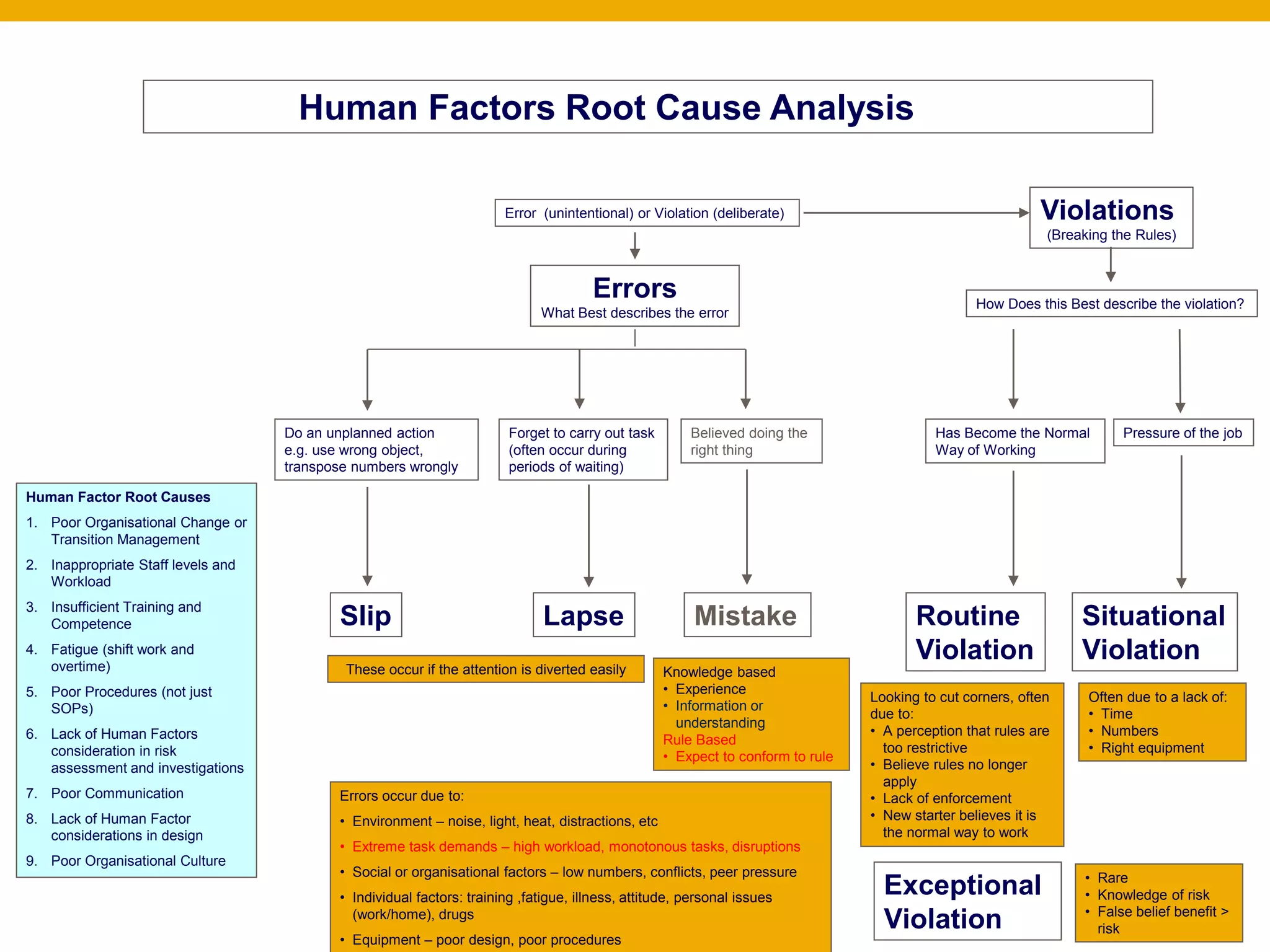
Human Factors Root Cause Analysis
Error (unintentional) or Violation (deliberate) Violations
(Breaking the Rules)
Errors
What Best describes the error
Do an unplanned action
e.g. use wrong object,
transpose numbers wrongly
Slip
Forget to carry out task
(often occur during
periods of waiting)
Lapse
These occur if the attention is diverted easily
Believed doing the
right thing
Knowledge based
• Experience
• Information or
understanding
Rule Based
• Expect to conform to rule
Mistake
Errors occur due to:
• Environment – noise, light, heat, distractions, etc
• Extreme task demands – high workload, monotonous tasks, disruptions
• Social or organisational factors – low numbers, conflicts, peer pressure
• Individual factors: training ,fatigue, illness, attitude, personal issues
(work/home), drugs
• Equipment – poor design, poor procedures
How Does this Best describe the violation?
Has Become the Normal
Way of Working
Routine
Violation
Looking to cut corners, often
due to:
• A perception that rules are
too restrictive
• Believe rules no longer
apply
• Lack of enforcement
• New starter believes it is
the normal way to work
Pressure of the job
Situational
Violation
Often due to a lack of:
• Time
• Numbers
• Right equipment
Human Factor Root Causes
1. Poor Organisational Change or
Transition Management
2. Inappropriate Staff levels and
Workload
3. Insufficient Training and
Competence
4. Fatigue (shift work and
overtime)
5. Poor Procedures (not just
SOPs)
6. Lack of Human Factors
consideration in risk
assessment and investigations
7. Poor Communication
8. Lack of Human Factor
considerations in design
9. Poor Organisational Culture
Exceptional
Violation
• Rare
• Knowledge of risk
• False belief benefit >
risk

Human error analysis.pptx

  • 1.
    Human Factors RootCause Analysis Error (unintentional) or Violation (deliberate) Violations (Breaking the Rules) Errors What Best describes the error Do an unplanned action e.g. use wrong object, transpose numbers wrongly Slip Forget to carry out task (often occur during periods of waiting) Lapse These occur if the attention is diverted easily Believed doing the right thing Knowledge based • Experience • Information or understanding Rule Based • Expect to conform to rule Mistake Errors occur due to: • Environment – noise, light, heat, distractions, etc • Extreme task demands – high workload, monotonous tasks, disruptions • Social or organisational factors – low numbers, conflicts, peer pressure • Individual factors: training ,fatigue, illness, attitude, personal issues (work/home), drugs • Equipment – poor design, poor procedures How Does this Best describe the violation? Has Become the Normal Way of Working Routine Violation Looking to cut corners, often due to: • A perception that rules are too restrictive • Believe rules no longer apply • Lack of enforcement • New starter believes it is the normal way to work Pressure of the job Situational Violation Often due to a lack of: • Time • Numbers • Right equipment Human Factor Root Causes 1. Poor Organisational Change or Transition Management 2. Inappropriate Staff levels and Workload 3. Insufficient Training and Competence 4. Fatigue (shift work and overtime) 5. Poor Procedures (not just SOPs) 6. Lack of Human Factors consideration in risk assessment and investigations 7. Poor Communication 8. Lack of Human Factor considerations in design 9. Poor Organisational Culture Exceptional Violation • Rare • Knowledge of risk • False belief benefit > risk

Editor's Notes

  • #2 HSE – top 10: Organisational change and transition management Popular in last twenty years due to downsizing They result in overseeing all aspects of the other 9 issues so an increase is seen in each of them Care must be taken that in Organisational change Human Factors are taken into account Assessment against number 2-10 should help to provide this Staffing levels and Workload Budgetary Constraints and Downsizing have resulted in less staff and higher workload Appropriate assessment must be made of the number of staff required to carry out a task This must take into account HF issues to ensure that errors, mistakes and violations are not at risk of occurring Training and Competence Quote from the HSE: ‘Sites are good at training but not good at assuring competence’ Ensure training is: High quality Properly managed Content is well chosen Counting the hours training is not enough! Fatigue from Shift work and Overtime Effects of shift patterns and overtime now better understood Shift patterns for quality-critical staff need to be designed to avoid fatigue Effective policies and monitoring needed for overtime and shift swapping Consider use of Fatigue Calculators Procedures Key element of compliance system Need to be technically accurate, well written, usable and up to date Think about ownership, the form of the procedure and the style Try to use Flow charts Decisions tables or trees Questions and diagrams HF in risk assessment and investigations During investigations ensure that Human Factors Root Causes are Considered 40% of Nuclear accidents have a HF root cause When carrying out risk assessments : Do not Introduce the potential for errors in your process Do not allow your system fail due to error (make the system error tolerant) Do not make your system too complex/hard to do/ time consuming that a violation will occur. If these will occur the task should be redefined (where possible) or steps put in place to minimise the risk Communications What can go wrong? Information that is :Missing, unnecessary, inaccurate, poor quality and not carried forward High risk situations During maintenance, during deviations, following absence from work, between experienced and non-experienced staff In improving communications consider Specify key information Using communication aids Repeat key info in different ways Have sufficient shift handovers Encourage the use of confirmation, clarification and repetition Encourage face to face communication Develop skills and set standards for communication HF in Design ‘Ergonomics' – ensuring the fit between people and the things they use Develop Ergonomics awareness in user reps and design staff Develop HF checklists to be used during design and commissioning of equipment Consider equipment and displays Organisational Culture Compliance culture is an important factor in achieving and maintaining good quality performance Key factors include: Open communication Management commitment Leadership Availability of resources Balance of delivery and quality. Maintenance Error As for all tasks Identify if the task is error-tolerant or not subject to a violation being performed. If this is possible the task should where possible redefined or steps put in place to minimise the risk