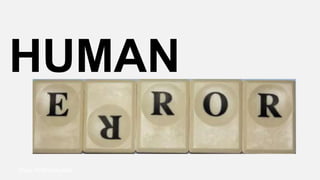
HUMAN
- Divya Krishnakumar
1. Understand Human Error
2. Underlying causes of Human Error
3. Resolution of Human Error
PURPOSE OF THIS SESSION
WHAT DO YOU THINK ABOUT THESE IMAGES?
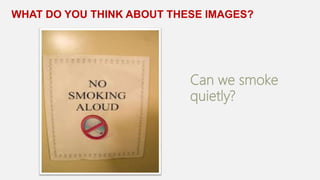
Can we smoke
quietly?
WHAT DO YOU THINK ABOUT THESE IMAGES?
I only have
a human
mom.
¯_(ツ)_/¯
WHAT DO YOU THINK ABOUT THESE IMAGES?
Oops, Sorry!
WHAT DO YOU THINK ABOUT THESE IMAGES?
Wait. So
where’s
the Bus
Stop?
WHAT DO YOU THINK ABOUT THESE IMAGES?
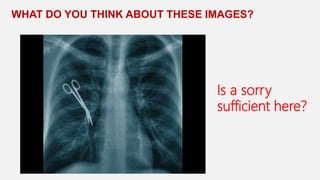
Is a sorry
sufficient here?
UNDERSTANDING
HUMAN
ERROR
•Human error is when someone makes a
mistake which causes an accident or causes
something bad to happen.
WHAT IS HUMAN ERROR?
What could be a few examples from
your work area?
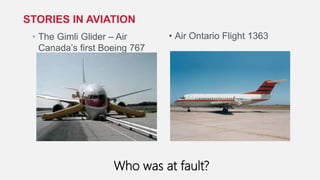
• The Gimli Glider – Air
Canada’s first Boeing 767
STORIES IN AVIATION
Who was at fault?
• Air Ontario Flight 1363
• Studies tell us that EVERYONE commits errors
TO ERR IS HUMAN
Human behaviour
explains human error
Therefore, looking at why and
how we behave in certain
situations helps to explain why
we do what we do.
Human error is rarely
random.
It is connected to the tools,
tasks and environment. That is,
it can often be predicted, and
in some situations, is inevitable.
People want to do
the right thing.
We do what makes sense to us
at the time given our focus of
attention, knowledge,
resources, time and goals
• Are systems and SOPs designed to prevent errors?
• People must create compliance using tools, systems
and technology
Therefore, systems that depend on
perfect behavior are fundamentally
wrong.
PERFECT HUMANS NEED PERFECT SYSTEMS
EXERCISE: Select one SOP from
your respective area where you find
maximum NC. Try to find out factors
that cause the NC other than human
error.
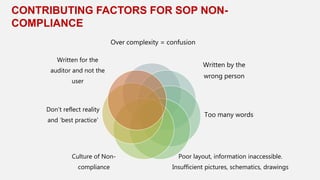
CONTRIBUTING FACTORS FOR SOP NON-
COMPLIANCE
Over complexity = confusion
Written by the
wrong person
Too many words
Poor layout, information inaccessible.
Insufficient pictures, schematics, drawings
Culture of Non-
compliance
Don’t reflect reality
and ‘best practice’
Written for the
auditor and not the
user
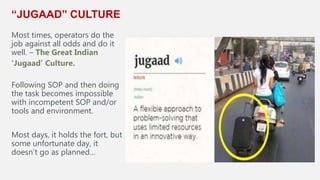
“JUGAAD” CULTURE
Most times, operators do the
job against all odds and do it
well. – The Great Indian
‘Jugaad’ Culture.
Following SOP and then doing
the task becomes impossible
with incompetent SOP and/or
tools and environment.
Most days, it holds the fort, but
some unfortunate day, it
doesn’t go as planned…
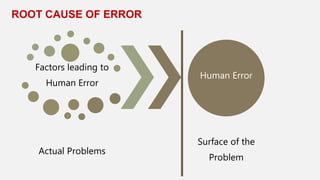
ROOT CAUSE OF ERROR
Factors leading to
Human Error
Actual Problems
Human Error
Surface of the
Problem
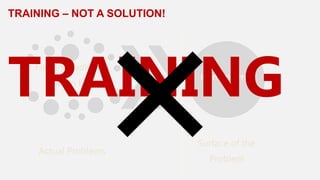
Factors leading to
Human Error
Actual Problems
Human Error
Surface of the
Problem
TRAINING
TRAINING – NOT A SOLUTION!
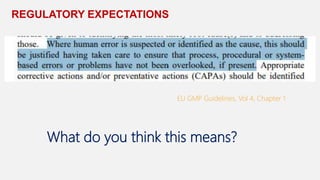
REGULATORY EXPECTATIONS
What do you think this means?
EU GMP Guidelines, Vol 4, Chapter 1
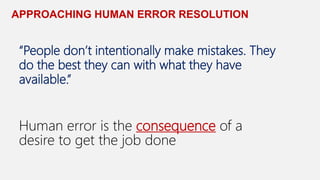
APPROACHING HUMAN ERROR RESOLUTION
“People don’t intentionally make mistakes. They
do the best they can with what they have
available.”
Human error is the consequence of a
desire to get the job done
UNDERLYING
CAUSES OF
HUMAN ERROR
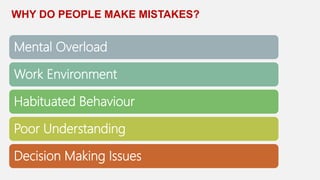
WHY DO PEOPLE MAKE MISTAKES?
Mental Overload
Work Environment
Habituated Behaviour
Poor Understanding
Decision Making Issues
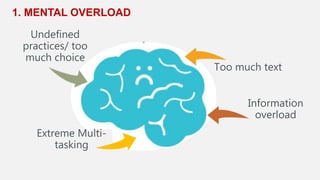
1. MENTAL OVERLOAD
Too much text
Undefined
practices/ too
much choice
Extreme Multi-
tasking
Information
overload
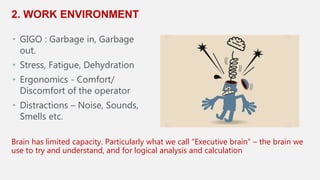
2. WORK ENVIRONMENT
• GIGO : Garbage in, Garbage
out.
• Stress, Fatigue, Dehydration
• Ergonomics - Comfort/
Discomfort of the operator
• Distractions – Noise, Sounds,
Smells etc.
Brain has limited capacity. Particularly what we call “Executive brain” – the brain we
use to try and understand, and for logical analysis and calculation
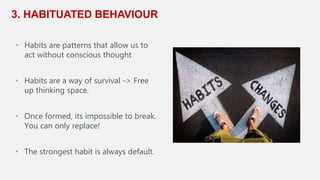
3. HABITUATED BEHAVIOUR
• Habits are patterns that allow us to
act without conscious thought
• Habits are a way of survival -> Free
up thinking space.
• Once formed, its impossible to break.
You can only replace!
• The strongest habit is always default.
4. POOR UNDERSTANDING
• Two areas :
1. Poor understanding
(education)
2. Lack of risk awareness
(consequences)
• Ineffective training
• Trainings are done but there is
failure to habituate it.
5. DECISION MAKING ISSUES
1.
2.
3.
REDUCING
HUMAN ERROR
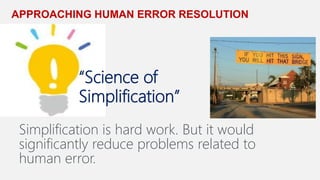
APPROACHING HUMAN ERROR RESOLUTION
“Science of
Simplification”
Simplification is hard work. But it would
significantly reduce problems related to
human error.
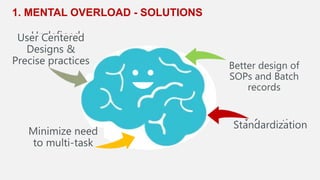
1. MENTAL OVERLOAD - SOLUTIONS
Too much text
Better design of
SOPs and Batch
records
Undefined
practices/ too
much choice
Information
overloadMulti-tasking
User Centered
Designs &
Precise practices
Standardization
Minimize need
to multi-task
2. WORK ENVIRONMENT - SOLUTIONS
• GIGO : Garbage in, Garbage
out.
• Stress, Fatigue, Dehydration
• Ergonomics - Comfort/
Discomfort of the operator
• Distractions – Noise, Sounds,
Smells etc.
Brain has limited capacity. Particularly what we call “Executive brain” – the brain we
use to try and understand, and for logical analysis and calculation
• Stress – Leads to adrenaline
rush – FFF response and
‘cloudy’ thinking
• Ergonomics – Comfortable
atmosphere prevents less
distractions and aids work –
ISO requirement
• Shift timings (might have
increased error rates) Monitor
shift timings continuously.
Avoiding stress will lead to reduction in reverting to old stronger
habits
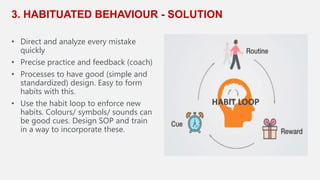
3. HABITUATED BEHAVIOUR - SOLUTION
• Habits are patterns that allow us to
act without conscious thought
• Habits are a way of survival -> Free
up thinking space.
• Once formed, its impossible to break.
You can only replace!
• The strongest habit is always default.
• Direct and analyze every mistake
quickly
• Precise practice and feedback (coach)
• Processes to have good (simple and
standardized) design. Easy to form
habits with this.
• Use the habit loop to enforce new
habits. Colours/ symbols/ sounds can
be good cues. Design SOP and train
in a way to incorporate these.
HABIT LOOP
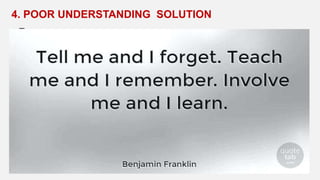
4. POOR UNDERSTANDING SOLUTION
• Two areas :
1. Poor understanding
(education)
2. Lack of risk awareness
(consequences)
• Ineffective training
• Trainings are done but there is
failure to habituate it.
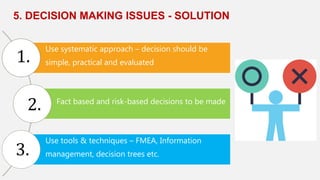
5. DECISION MAKING ISSUES - SOLUTION
Use systematic approach – decision should be
simple, practical and evaluated
Fact based and risk-based decisions to be made
Use tools & techniques – FMEA, Information
management, decision trees etc.
1.
2.
3.
EXERCISE: FORM
GROUPS OF 5
Take an Error cause and
find solutions. Try to
simplify things.
THANK
YOU

Human error

  • 1.
  • 2.
    1. Understand HumanError 2. Underlying causes of Human Error 3. Resolution of Human Error PURPOSE OF THIS SESSION
  • 3.
    WHAT DO YOUTHINK ABOUT THESE IMAGES? Can we smoke quietly?
  • 4.
    WHAT DO YOUTHINK ABOUT THESE IMAGES? I only have a human mom. ¯_(ツ)_/¯
  • 5.
    WHAT DO YOUTHINK ABOUT THESE IMAGES? Oops, Sorry!
  • 6.
    WHAT DO YOUTHINK ABOUT THESE IMAGES? Wait. So where’s the Bus Stop?
  • 7.
    WHAT DO YOUTHINK ABOUT THESE IMAGES? Is a sorry sufficient here?
  • 8.
  • 9.
    •Human error iswhen someone makes a mistake which causes an accident or causes something bad to happen. WHAT IS HUMAN ERROR? What could be a few examples from your work area?
  • 10.
    • The GimliGlider – Air Canada’s first Boeing 767 STORIES IN AVIATION Who was at fault? • Air Ontario Flight 1363
  • 11.
    • Studies tellus that EVERYONE commits errors TO ERR IS HUMAN Human behaviour explains human error Therefore, looking at why and how we behave in certain situations helps to explain why we do what we do. Human error is rarely random. It is connected to the tools, tasks and environment. That is, it can often be predicted, and in some situations, is inevitable. People want to do the right thing. We do what makes sense to us at the time given our focus of attention, knowledge, resources, time and goals
  • 12.
    • Are systemsand SOPs designed to prevent errors? • People must create compliance using tools, systems and technology Therefore, systems that depend on perfect behavior are fundamentally wrong. PERFECT HUMANS NEED PERFECT SYSTEMS
  • 13.
    EXERCISE: Select oneSOP from your respective area where you find maximum NC. Try to find out factors that cause the NC other than human error.
  • 14.
    CONTRIBUTING FACTORS FORSOP NON- COMPLIANCE Over complexity = confusion Written by the wrong person Too many words Poor layout, information inaccessible. Insufficient pictures, schematics, drawings Culture of Non- compliance Don’t reflect reality and ‘best practice’ Written for the auditor and not the user
  • 15.
    “JUGAAD” CULTURE Most times,operators do the job against all odds and do it well. – The Great Indian ‘Jugaad’ Culture. Following SOP and then doing the task becomes impossible with incompetent SOP and/or tools and environment. Most days, it holds the fort, but some unfortunate day, it doesn’t go as planned…
  • 16.
    ROOT CAUSE OFERROR Factors leading to Human Error Actual Problems Human Error Surface of the Problem
  • 17.
    Factors leading to HumanError Actual Problems Human Error Surface of the Problem TRAINING TRAINING – NOT A SOLUTION!
  • 18.
    REGULATORY EXPECTATIONS What doyou think this means? EU GMP Guidelines, Vol 4, Chapter 1
  • 19.
    APPROACHING HUMAN ERRORRESOLUTION “People don’t intentionally make mistakes. They do the best they can with what they have available.” Human error is the consequence of a desire to get the job done
  • 20.
  • 21.
    WHY DO PEOPLEMAKE MISTAKES? Mental Overload Work Environment Habituated Behaviour Poor Understanding Decision Making Issues
  • 22.
    1. MENTAL OVERLOAD Toomuch text Undefined practices/ too much choice Extreme Multi- tasking Information overload
  • 23.
    2. WORK ENVIRONMENT •GIGO : Garbage in, Garbage out. • Stress, Fatigue, Dehydration • Ergonomics - Comfort/ Discomfort of the operator • Distractions – Noise, Sounds, Smells etc. Brain has limited capacity. Particularly what we call “Executive brain” – the brain we use to try and understand, and for logical analysis and calculation
  • 24.
    3. HABITUATED BEHAVIOUR •Habits are patterns that allow us to act without conscious thought • Habits are a way of survival -> Free up thinking space. • Once formed, its impossible to break. You can only replace! • The strongest habit is always default.
  • 25.
    4. POOR UNDERSTANDING •Two areas : 1. Poor understanding (education) 2. Lack of risk awareness (consequences) • Ineffective training • Trainings are done but there is failure to habituate it.
  • 26.
    5. DECISION MAKINGISSUES 1. 2. 3.
  • 27.
  • 28.
    APPROACHING HUMAN ERRORRESOLUTION “Science of Simplification” Simplification is hard work. But it would significantly reduce problems related to human error.
  • 29.
    1. MENTAL OVERLOAD- SOLUTIONS Too much text Better design of SOPs and Batch records Undefined practices/ too much choice Information overloadMulti-tasking User Centered Designs & Precise practices Standardization Minimize need to multi-task
  • 30.
    2. WORK ENVIRONMENT- SOLUTIONS • GIGO : Garbage in, Garbage out. • Stress, Fatigue, Dehydration • Ergonomics - Comfort/ Discomfort of the operator • Distractions – Noise, Sounds, Smells etc. Brain has limited capacity. Particularly what we call “Executive brain” – the brain we use to try and understand, and for logical analysis and calculation • Stress – Leads to adrenaline rush – FFF response and ‘cloudy’ thinking • Ergonomics – Comfortable atmosphere prevents less distractions and aids work – ISO requirement • Shift timings (might have increased error rates) Monitor shift timings continuously. Avoiding stress will lead to reduction in reverting to old stronger habits
  • 31.
    3. HABITUATED BEHAVIOUR- SOLUTION • Habits are patterns that allow us to act without conscious thought • Habits are a way of survival -> Free up thinking space. • Once formed, its impossible to break. You can only replace! • The strongest habit is always default. • Direct and analyze every mistake quickly • Precise practice and feedback (coach) • Processes to have good (simple and standardized) design. Easy to form habits with this. • Use the habit loop to enforce new habits. Colours/ symbols/ sounds can be good cues. Design SOP and train in a way to incorporate these. HABIT LOOP
  • 32.
    4. POOR UNDERSTANDINGSOLUTION • Two areas : 1. Poor understanding (education) 2. Lack of risk awareness (consequences) • Ineffective training • Trainings are done but there is failure to habituate it.
  • 33.
    5. DECISION MAKINGISSUES - SOLUTION Use systematic approach – decision should be simple, practical and evaluated Fact based and risk-based decisions to be made Use tools & techniques – FMEA, Information management, decision trees etc. 1. 2. 3.
  • 34.
    EXERCISE: FORM GROUPS OF5 Take an Error cause and find solutions. Try to simplify things.
  • 35.

Editor's Notes

  • #4 Does it look like somebody made a mistake in the pictures??
  • #5 Does it look like somebody made a mistake in the pictures?? Show one pot wrong. Not all wrong.
  • #6 Does it look like somebody made a mistake in the pictures?? Show one pot wrong. Not all wrong.
  • #7 Does it look like somebody made a mistake in the pictures?? Show one pot wrong. Not all wrong.
  • #8 Does it look like somebody made a mistake in the pictures?? Show one pot wrong. Not all wrong.
  • #11 Canada was converting from imperial to metric system. But fuel quantity got calculated according to pounds. – Less fuel. Another thing – fuel quantity indicator system was not working. Air Ontario -  The investigation revealed that an unserviceable auxiliary power unit (APU), and no available external power unit at Dryden Regional Airport, led to questionable decision-making which was a critical factor leading to the crash of Flight 1363. If the engines had been turned off, they could not have been restarted again due to the unserviceability of the APU and lack of external power. Therefore, the port engine was left running during the stopover in Dryden. Snow was falling gently that afternoon and a layer of 0.6 to 1.3 centimetres of snow had accumulated on the wings. The wings needed to be de-iced before takeoff, but the Fokker F28 aircraft is never supposed to be de-iced while the engines are running because of a risk of toxic fumes entering the cabin of the aircraft. The pilot therefore did not request to have the wings de-iced; at the time, airline instructions were unclear on this point but the subsequent report was very critical of this decision. Fuel needed to be loaded and was done with the engine running while passengers were on board (known as a hot refuel). Off-loading and reloading passengers would have taken considerable time and the longer the aircraft stayed on the ground the greater was the need for the wings to be sprayed with de-icing fluid. To prevent further delay and a greater possibility of a buildup on the wings, the pilot, Captain Morwood, decided to have the aircraft fuelled while the engine was running and with passengers on board.  The accident investigation was subsumed into a judicial inquiry under the Honourable Virgil P. Moshansky. His report showed that competitive pressures caused by commercial deregulation cut into safety standards and that many of the industry's sloppy practices and questionable procedures placed the pilot in a very difficult situation. The report also stated that the aircraft should not have been scheduled to refuel at an airport which did not have proper equipment and that neither training nor manuals had sufficiently warned the pilot of the dangers of ice on the wings.[7] Moshansky blamed Transport Canada for letting Air Ontario expand into the operation of bigger, more complicated aircraft without detecting the deficiencies of their existing aircraft.
  • #13 Perfect humans – do not make any error. Explain the systems need to be error proof to prevent human intervention and therefore errors.
  • #14 Select SOP in their area. SOP non-compliance Contributing Factor: Over complexity = confusion Written by the wrong person Too many words Poor layout, information inaccessible Insufficient pictures, schematics, drawings Culture of Non-compliance (The temptation to compare ourselves to others and use someone else’s behavior as an excuse doesn’t end with childhood. We have likely all been guilty of asking the question, “Why do I have to? Nobody else is doing it that way.” When we are all too willing to blame our actions (or inactions) on the culture of our organization … our management … overly restrictive regulations … and the list could go on. Organizational norms are powerful, but the bottom line is: Change begins with me) Don’t reflect reality and ‘best practice’ Written for the auditor and not the user Therefore, following the SOP and doing the task becomes impossible. Interestingly, most times operators do the job against all odds and do it well. But some unfortunate day, it just doesn’t work out.
  • #16 Can someone tell me what the problems with Jugaad are? A: - Jugaad cares little for consistent quality or endurance, as long as slapup works for a while. jugaad is a product of scarcity, which leaves its practitioners with no option but to innovate with whatever is at hand. This leads to unintended consequences, not all pleasant. Three, jugaad targets minimal expectations. An ill-trained work crew on a slave-driver schedule can hastily assemble a door for a new apartment. If it doesn’t open or shut properly, why, just kick it in. But all this was bound to bite us where it hurts. And that’s happening now. Jugaad, by whatever name, distorts our attitudes towards work and skills. It also numbs our expectations, so we stop noticing what’s amiss. Examples – Eg: Razor balde in powder filled amber coloured Bottles. Operators kept the razor baldes on the turn table.
  • #17 Some safety experts say that there are about 14-16 contributing factors that lead to a safety related incident. Therefore, when somebody makes a mistake, it’s a consequence of a whole lot of things going wrong. This is why errors are not really dealt with. Because it takes a lot of work to get beneath the surface and it doesn’t take a lot of work to train somebody. It doesn’t take a lot of work to add another “checked” signature.
  • #18 Some experts say that there are about 14-16 contributing factors that lead to a safety related incident. Therefore, when somebody makes a mistake, it’s a consequence of a whole lot of things going wrong. This is why errors are not really dealt with. Because it takes a lot of work to get beneath the surface and it doesn’t take a lot of work to train somebody. It doesn’t take a lot of work to add another “checked” signature.
  • #19 It essentially means – “We the regulators are frustrated by the root cause Human Error being written on so many deviations.” Because they know that this isn’t the case. If you’re putting Human Error as your root cause, you better have a very very good investigation that concluded that this is the right analysis and conclusion that this is the right decision rather than using it as a convenient excuse. Human error as a root cause is an indication for them that the deviation is trying to be closed quickly rather than properly.
  • #20 This belief is important when you’re investigating a particular root cause for tricky deviation with a time constraint and money at stake. It is very easy to point fingers at the person who is at the forefront. When you truly believe that people don’t make mistakes intentionally and that they did the best with whatever they had, it changes the way you do an investigation and allows you to dig deeper than the surface. Humans are the most flexible, adaptable, and valuable part of the system while at the same time they are most vulnerable to influences which can adversely affect performance. Most accidents have been attributed to ‘human error’… so the statistics say… Do we fix the people or the system in which the people work? To prevent accidents we address the causal, contributing and underlying factors of the system in which people work.
  • #23 Dimaag par taan. Dimaag ka dahi. Multi tasking – not able to give justice.
  • #25 Simple task – you can make it into a habit by 20 repetitions Complex tasks – have multiple steps. Can take 100s and 1000s of repetition to perfect. Habits – develop for skills that don’t require too much cognitive capacity – more physical tasks. Eg – Inc ase of a year change – Even if 2019 has come, 2018 is still written
  • #26 People simply didn’t know what to do in a situation. They understand “how” to do a certain thing. Just don’t understand the “why” Almost 90% of the information imparted using traditional training methods is forgotten with the first 24 hours.
  • #27 We are designed to think quickly, not accurately. This is the main cause of our fight or flight response. The third F – freeze isn’t an option if we want to keep the business running.
  • #28 Here we have already realized that
  • #29 Decisions need to make the process simpler and not add a layer of complexity. Standardization is essential. It provides reliability.
  • #32 Simple task – you can make it into a habit by 20 repetitions Complex tasks – have multiple steps. Can take 100s and 1000s of repetition to perfect. Habits – develop for skills that don’t require too much cognitive capacity – more physical tasks
  • #33 There is only one way to get people to learn and inculcate a change within. It is to involve them. Discussion, case studies, good points, bad points, revisitng simple classroom trainings. Rapid fire questions. Make it fun. Make it engaging and get people to want to perform better. “Tell me and ……………..learn.” Addition to this – “Motivate me and I achieve”
  • #34 We are designed to think quickly, not accurately. This is the main cause of our fight or flight response. The third F – freeze isn’t an option if we want to keep the business running.
  • #35 Remember this. We will us it at the end of the Day after Investigation workshop.