RootCauseAnalysis
(RCA)
1
2
 Objective
 Root Cause Analysis
 Root Cause
 Philosophy of Root CauseAnalysis
 5Why’s
 How to do Root CauseAnalysis
 Tools Used in Root CauseAnalysis
 Fishbone Diagram
 Example
 Advantages and Disadvantages
 Summary
PresentationOutline
 Objective
 Root Cause Analysis
 Root Cause
 Philosophy of Root Cause
Analysis
 5Why’s
 How to do Root Cause Analysis
 Example 1
 Tools Used in Root Cause
Analysis
 Fishbone Diagram
 Example 2
 Advantages and
Disadvantages
 Summary
3
 Through this, you will:
 Understand the meaning of “RootCause”
 Know the steps used to identify the root cause of
problems.
 Fishbone Diagram.
Objective
 Objective
 Root Cause Analysis
 Root Cause
 Philosophy of Root Cause
Analysis
 5Why’s
 How to do Root Cause Analysis
 Example 1
 Tools Used in Root Cause
Analysis
 Fishbone Diagram
 Example 2
 Advantages and
Disadvantages
 Summary
4
 Root Cause Analysis is a method that is used to address
a problem or non-conformance, in order to get to the
“root cause” of the problem. It is used so we can
correct or eliminate the cause, and prevent the
problem from recurring.
RootCauseAnalysis
 Objective
 Root Cause Analysis
 Root Cause
 Philosophy of Root Cause
Analysis
 5Why’s
 How to do Root Cause Analysis
 Example 1
 Tools Used in Root Cause
Analysis
 Fishbone Diagram
 Example 2
 Advantages and
Disadvantages
 Summary
5
 Root Cause is the fundamental breakdown or failure of
a process which, when resolved, prevents a recurrence
of the problem.
 Or, in other words
 For a particular product problem, Root Cause is the
factor that, when you fix it, the problem goes away
and doesn’t come back.
• Root Cause Analysis is a systematic approach to get
to the true root causes of our process problems.
RootCause
 Objective
 Root Cause Analysis
 Root Cause
 Philosophy of Root Cause
Analysis
 5Why’s
 How to do Root Cause Analysis
 Example 1
 Tools Used in Root Cause
Analysis
 Fishbone Diagram
 Example 2
 Advantages and
Disadvantages
 Summary
6
 Each problem is an opportunity (“golden nugget”)
because it can tell a story about why and how it occurred.
 It is critical that everyone take a personal and active role in
improving quality.
 The “true” problem must be understood before action is
taken.
 Problems are often masked for a variety ofreasons
 To do this well, we must be
 Both focused and open-minded
 Both patient and quick
 Above all, we must be relentless
Philosophy of RootCauseAnalysis
 Objective
 Root Cause Analysis
 Root Cause
 Philosophy of Root Cause
Analysis
 5Why’s
 How to do Root Cause Analysis
 Example 1
 Tools Used in Root Cause
Analysis
 Fishbone Diagram
 Example 2
 Advantages and
Disadvantages
 Summary
7
 The 5-Whys is a simple brainstorming tool that can help QI teams identify
the root cause(s) of a problem. Once a general problem has been
recognized (either using the Fishbone Diagram or Process Mapping), ask
“why” questions to drill down to the root causes. Asking the 5-Whys allows
teams to move beyond obvious answers and reflect on less obvious
explanations or causes.
5Why’s
 Objective
 Root Cause Analysis
 Root Cause
 Philosophy of Root Cause
Analysis
 5Why’s
 How to do Root Cause Analysis
 Example 1
 Tools Used in Root Cause
Analysis
 Fishbone Diagram
 Example 2
 Advantages and
Disadvantages
 Summary
8
 Said simply, Root Cause Analysis is asking why the problem
occurred, and then continuing to ask why that happened
until we reach the fundamental process element that failed.
 The following example illustrates
the basics of Root Cause Analysis.
How to do RootCauseAnalysis
Why???
 Objective
 Root Cause Analysis
 Root Cause
 Philosophy of Root Cause
Analysis
 5Why’s
 How to do Root Cause Analysis
 Example 1
 Tools Used in Root Cause
Analysis
 Fishbone Diagram
 Example 2
 Advantages and
Disadvantages
 Summary
9
Example:
 WHY 1 :Why my car had stopped ?
 No petrol in tank.
 WHY 2 :Why i did not have a petrol in my tank ?
 I did not buy in the morning on my way to work.
 WHY 3 :Why i did not buy a petrol ?
 No money in my pockets.
 WHY 4 : Why no money i my pockets?
 Evening poker.
 WHY 5 : Why i did not win a poker game?
 I do not know how to bluff!
 Objective
 Root Cause Analysis
 Root Cause
 Philosophy of Root Cause
Analysis
 5Why’s
 How to do Root Cause Analysis
 Example 1
 Tools Used in Root Cause
Analysis
 Fishbone Diagram
 Example 2
 Advantages and
Disadvantages
 Summary
10
Example:
Cause
Effect
 Objective
 Root Cause Analysis
 Root Cause
 Philosophy of Root Cause
Analysis
 5Why’s
 How to do Root Cause Analysis
 Example 1
 Tools Used in Root Cause
Analysis
 Fishbone Diagram
 Example 2
 Advantages and
Disadvantages
 Summary
11
ToolsUsed in RootCauseAnalysis
CONTROL CHARTS
X
FISHBONE DIAGRAM
HISTOGRAM
PARETO CHART
RUN CHART
START
STOP
?
Y
N
FLOWCHART
UCL
LCL
TIME
VALUE
X
SCATTER DIAGRAM
USLLSL
BRAINSTORMING
TREE DIAGRAM
2 4
5
6
7
8
FACTOR A FACTOR C
1 3
- FACTOR B +
-
+
-
+
DESIGN OF EXPERIMENTS
 Objective
 Root Cause Analysis
 Root Cause
 Philosophy of Root Cause
Analysis
 5Why’s
 How to do Root Cause Analysis
 Example 1
 Tools Used in Root Cause
Analysis
 Fishbone Diagram
 Example 2
 Advantages and
Disadvantages
 Summary
12
 Using a fishbone diagram while brainstorming possible causes
helps you to focus on the various possibilities.
Some useful categories:
Fishbone Diagram
People
PM
Problem
Measuring/Test Equip. Design
Materials Instructions Environment
Machines
 Objective
 Root Cause Analysis
 Root Cause
 Philosophy of Root Cause
Analysis
 5Why’s
 How to do Root Cause Analysis
 Example 1
 Tools Used in Root Cause
Analysis
 Fishbone Diagram
 Example 2
 Advantages and
Disadvantages
 Summary
13
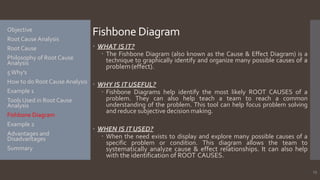
 WHAT IS IT?
 The Fishbone Diagram (also known as the Cause & Effect Diagram) is a
technique to graphically identify and organize many possible causes of a
problem(effect).
 WHY IS ITUSEFUL?
 Fishbone Diagrams help identify the most likely ROOT CAUSES of a
problem. They can also help teach a team to reach a common
understanding of the problem. This tool can help focus problem solving
and reduce subjective decision making.
 WHEN IS ITUSED?
 When the need exists to display and explore many possible causes of a
specific problem or condition. This diagram allows the team to
systematically analyze cause & effect relationships. It can also help
with the identification of ROOT CAUSES.
Fishbone Diagram
 Objective
 Root Cause Analysis
 Root Cause
 Philosophy of Root Cause
Analysis
 5Why’s
 How to do Root Cause Analysis
 Example 1
 Tools Used in Root Cause
Analysis
 Fishbone Diagram
 Example 2
 Advantages and
Disadvantages
 Summary
14
 WHAT DOES IT LOOK LIKE?
Fishbone Diagram
People
PM
Problem
Measuring/Test Equip. Design
Materials Instructions Environment
Machines
 Objective
 Root Cause Analysis
 Root Cause
 Philosophy of Root Cause
Analysis
 5Why’s
 How to do Root Cause Analysis
 Example 1
 Tools Used in Root Cause
Analysis
 Fishbone Diagram
 Example 2
 Advantages and
Disadvantages
 Summary
15
 HOW IS IT DONE?
 Name the effect; determine the specific problem to be analyzed. Draw
the diagram with a process arrow to the effect and draw a box around
it.
 Decide what the major categories of the causes are (i.e., people,
machines, measurement, materials, methods, environment, policies,
etc.).
 Label categories important to your situation. Make it work for you.
 Brainstorm all possible causes and label each cause under the
appropriate category.
 Post the diagram where others can add causes to it (i.e., experts,
affected people, process owners, etc..).
 Analyze causes and eliminate trivial and/or frivolous ideas.
 Rank causes and circle the most likely ones for further consideration and
study.
 Investigate the circled causes. Use other techniques to gather data and
prioritize findings.
Fishbone Diagram
 Objective
 Root Cause Analysis
 Root Cause
 Philosophy of Root Cause
Analysis
 5Why’s
 How to do Root Cause Analysis
 Example 1
 Tools Used in Root Cause
Analysis
 Fishbone Diagram
 Example 2
 Advantages and
Disadvantages
 Summary
16
Example: TheWashing Machine
Problem Description
“Machine is 2 weeks old
(Serial #2345017). When
doing the fourth load of
clothes, I heard a loud noise
and the machine stopped! It
wouldn’t re-start.”
Problem Description
“Machine is 2 weeks old
(Serial #2345017). When
doing the fourth load of
clothes, I heard a loud noise
and the machine stopped!It
wouldn’t re-start.”
 Objective
 Root Cause Analysis
 Root Cause
 Philosophy of Root Cause
Analysis
 5Why’s
 How to do Root Cause Analysis
 Example 1
 Tools Used in Root Cause
Analysis
 Fishbone Diagram
 Example 2
 Advantages and
Disadvantages
 Summary
17
VERIFYTHE COMPLAINT
Problem Verification
Service technician checks
washing machine operation
to test procedure (#8496).
The machine does not
operate.
ProblemVerification
Service technician checks
washing machine operation
to test procedure(#8496).
The machine does not
operate.
Determine
the Cause.
 Objective
 Root Cause Analysis
 Root Cause
 Philosophy of Root Cause
Analysis
 5Why’s
 How to do Root Cause Analysis
 Example 1
 Tools Used in Root Cause
Analysis
 Fishbone Diagram
 Example 2
 Advantages and
Disadvantages
 Summary
18
INVESTIGATE WHY?
Machine
Doesn’t
Work
Machine
Doesn’t
Work
Fuse
Missing?
Machine
Unplugged?
Power
Off?
Fuse
Blown?
Fuse Blown
Determine
theCause.
 Objective
 Root Cause Analysis
 Root Cause
 Philosophy of Root Cause
Analysis
 5Why’s
 How to do Root Cause Analysis
 Example 1
 Tools Used in Root Cause
Analysis
 Fishbone Diagram
 Example 2
 Advantages and
Disadvantages
 Summary
19
INVESTIGATE WHY?
Motor
Overheated
Fuse
Blown
Fuse
Blown
Lightning
Storm?
Electrical
Overload?
Power
Surge?
Motor
Overheated?
Corrective Action for
Specific Deficiency:
Replace the Fuse
Corrective Action for
Specific Deficiency:
Replace the Fuse
Determine
the Cause.
 Objective
 Root Cause Analysis
 Root Cause
 Philosophy of Root Cause
Analysis
 5Why’s
 How to do Root Cause Analysis
 Example 1
 Tools Used in Root Cause
Analysis
 Fishbone Diagram
 Example 2
 Advantages and
Disadvantages
 Summary
20
Example: TheWashing Machine
Shaft
Damaged
Motor
Overheate
d
Motor
Overheated
Motor
Mis-Installed?
Fly-Wheel
Loose?
Cooling
Fan?
Shaft
Damaged?
Determin
e the
Cause.
 Objective
 Root Cause Analysis
 Root Cause
 Philosophy of Root Cause
Analysis
 5Why’s
 How to do Root Cause Analysis
 Example 1
 Tools Used in Root Cause
Analysis
 Fishbone Diagram
 Example 2
 Advantages and
Disadvantages
 Summary
21
Example: TheWashing Machine
Bearing
Destroyed
Shaft
Damage
d
Shaft
DamagedMis-Handled?
Mis-Installed?
Wrong
Belt?
Bearing
Destroyed?
Incorrect
Tolerance/Fit?
Determine
theCause.
 Objective
 Root Cause Analysis
 Root Cause
 Philosophy of Root Cause
Analysis
 5Why’s
 How to do Root Cause Analysis
 Example 1
 Tools Used in Root Cause
Analysis
 Fishbone Diagram
 Example 2
 Advantages and
Disadvantages
 Summary
22
Example: TheWashing Machine
Loss of Lube
Cause of Failure:
SealOmitted
Corrective Action for
Specific Deficiency:
Replace the Motor
Corrective Action for
Specific Deficiency:
Replace the Motor
WasSeal
Omitted??
Bearing
Destroye
Bearing
Destroyed
Bad
Bearings?
Bearing
Loads?
Seal
Omitted?
Wrong
Bearings?
 Objective
 Root Cause Analysis
 Root Cause
 Philosophy of Root Cause
Analysis
 5Why’s
 How to do Root Cause Analysis
 Example 1
 Tools Used in Root Cause
Analysis
 Fishbone Diagram
 Example 2
 Advantages and
Disadvantages
 Summary
23
Example: TheWashing Machine
But.....
is it?
Inadequate Appropriate
Root Cause -
Inadequate
Work Instructions
Root Cause -
Inadequate
Work Instructions
Seal
Omitte
Seal
Omitted
Missed
Operation?
Operator
Error?
Parts
Shortage
Inadequate
Work
Instructions?
FellOut?
 Objective
 Root Cause Analysis
 Root Cause
 Philosophy of Root Cause
Analysis
 5Why’s
 How to do Root Cause Analysis
 Example 1
 Tools Used in Root Cause
Analysis
 Fishbone Diagram
 Example 2
 Advantages and
Disadvantages
 Summary
24
Example: TheWashing Machine
But.....
is it?
Root Cause -
Inadequate
Work Instructions
Root Cause -
Inadequate
Work Instructions
Seal
Omitte
Seal
Omitted
Missed
Operation?
Operator
Error?
Parts
Shortage
Inadequate
Work
Instructions?
FellOut?
Can the design be changed to eliminate the need for a seal?
Can the design be changed to make it impossible to omit the seal?
Can a fixture be made to make it impossible to omit theseal?
Inadequate Appropriate
 Objective
 Root Cause Analysis
 Root Cause
 Philosophy of Root Cause
Analysis
 5Why’s
 How to do Root Cause Analysis
 Example 1
 Tools Used in Root Cause
Analysis
 Fishbone Diagram
 Example 2
 Advantages and
Disadvantages
 Summary
25
Case Study:
 Objective
 Root Cause Analysis
 Root Cause
 Philosophy of Root Cause
Analysis
 5Why’s
 How to do Root Cause Analysis
 Tools Used in Root Cause
Analysis
 Fishbone Diagram
 Example
 Advantages and
Disadvantages
 Summary
26
 Advantages:
 Longer lasting solution.
 RealWorld Problems
 Safer Workplace
 Disadvantages:
 Extra Effort.
 Extra Time.
 Extra Money
Advantages and Disadvantages
 Objective
 Root Cause Analysis
 Root Cause
 Philosophy of Root Cause
Analysis
 5Why’s
 How to do Root Cause Analysis
 Tools Used in Root Cause
Analysis
 Fishbone Diagram
 Example
 Advantages and
Disadvantages
 Summary
27
 RootCauseAnalysis is a method to focus our efforts on the
true “RootCauses” of escapes, so that we truly prevent
their reoccurrence.
 Root CauseAnalysis helps us reduce turnbacks and
frustration, maintain customer satisfaction, and reduce
costs significantly.
 Each problem is an opportunity. It contains the information
needed to eliminate the problem. But to identify the root
cause, we have to ask “Why?” over and over, until we reach it.
Summary
28
Comparison:
Benchmarking GQM Root Cause Analysis
For Both Software and Hardware. For Software only. For Both Software and Hardware.
Requires data from peers. Does not require data. Does not require data.
Does not tell the relation between
cause and effect.
Does not tell the relation
between cause and effect.
Tells the relation between cause
and effect.
29
References:
 Tore Dyba Process Improvement in Practice A Handbook for IT Companies
The Kluwer International Series in Software Engineering 2004.
 http://www.expertbriefings.com/tips/limitations-of-5-whys-in-root-cause-
analysis/ (Dated: 21/03/2017 07:30PM).
 http://www.apollorootcause.com/about/benefits-of-rca/ (Dated:
21/03/2017 07:30PM).
30

Root Cause Analysis

  • 1.
  • 2.
    2  Objective  RootCause Analysis  Root Cause  Philosophy of Root CauseAnalysis  5Why’s  How to do Root CauseAnalysis  Tools Used in Root CauseAnalysis  Fishbone Diagram  Example  Advantages and Disadvantages  Summary PresentationOutline
  • 3.
     Objective  RootCause Analysis  Root Cause  Philosophy of Root Cause Analysis  5Why’s  How to do Root Cause Analysis  Example 1  Tools Used in Root Cause Analysis  Fishbone Diagram  Example 2  Advantages and Disadvantages  Summary 3  Through this, you will:  Understand the meaning of “RootCause”  Know the steps used to identify the root cause of problems.  Fishbone Diagram. Objective
  • 4.
     Objective  RootCause Analysis  Root Cause  Philosophy of Root Cause Analysis  5Why’s  How to do Root Cause Analysis  Example 1  Tools Used in Root Cause Analysis  Fishbone Diagram  Example 2  Advantages and Disadvantages  Summary 4  Root Cause Analysis is a method that is used to address a problem or non-conformance, in order to get to the “root cause” of the problem. It is used so we can correct or eliminate the cause, and prevent the problem from recurring. RootCauseAnalysis
  • 5.
     Objective  RootCause Analysis  Root Cause  Philosophy of Root Cause Analysis  5Why’s  How to do Root Cause Analysis  Example 1  Tools Used in Root Cause Analysis  Fishbone Diagram  Example 2  Advantages and Disadvantages  Summary 5  Root Cause is the fundamental breakdown or failure of a process which, when resolved, prevents a recurrence of the problem.  Or, in other words  For a particular product problem, Root Cause is the factor that, when you fix it, the problem goes away and doesn’t come back. • Root Cause Analysis is a systematic approach to get to the true root causes of our process problems. RootCause
  • 6.
     Objective  RootCause Analysis  Root Cause  Philosophy of Root Cause Analysis  5Why’s  How to do Root Cause Analysis  Example 1  Tools Used in Root Cause Analysis  Fishbone Diagram  Example 2  Advantages and Disadvantages  Summary 6  Each problem is an opportunity (“golden nugget”) because it can tell a story about why and how it occurred.  It is critical that everyone take a personal and active role in improving quality.  The “true” problem must be understood before action is taken.  Problems are often masked for a variety ofreasons  To do this well, we must be  Both focused and open-minded  Both patient and quick  Above all, we must be relentless Philosophy of RootCauseAnalysis
  • 7.
     Objective  RootCause Analysis  Root Cause  Philosophy of Root Cause Analysis  5Why’s  How to do Root Cause Analysis  Example 1  Tools Used in Root Cause Analysis  Fishbone Diagram  Example 2  Advantages and Disadvantages  Summary 7  The 5-Whys is a simple brainstorming tool that can help QI teams identify the root cause(s) of a problem. Once a general problem has been recognized (either using the Fishbone Diagram or Process Mapping), ask “why” questions to drill down to the root causes. Asking the 5-Whys allows teams to move beyond obvious answers and reflect on less obvious explanations or causes. 5Why’s
  • 8.
     Objective  RootCause Analysis  Root Cause  Philosophy of Root Cause Analysis  5Why’s  How to do Root Cause Analysis  Example 1  Tools Used in Root Cause Analysis  Fishbone Diagram  Example 2  Advantages and Disadvantages  Summary 8  Said simply, Root Cause Analysis is asking why the problem occurred, and then continuing to ask why that happened until we reach the fundamental process element that failed.  The following example illustrates the basics of Root Cause Analysis. How to do RootCauseAnalysis Why???
  • 9.
     Objective  RootCause Analysis  Root Cause  Philosophy of Root Cause Analysis  5Why’s  How to do Root Cause Analysis  Example 1  Tools Used in Root Cause Analysis  Fishbone Diagram  Example 2  Advantages and Disadvantages  Summary 9 Example:  WHY 1 :Why my car had stopped ?  No petrol in tank.  WHY 2 :Why i did not have a petrol in my tank ?  I did not buy in the morning on my way to work.  WHY 3 :Why i did not buy a petrol ?  No money in my pockets.  WHY 4 : Why no money i my pockets?  Evening poker.  WHY 5 : Why i did not win a poker game?  I do not know how to bluff!
  • 10.
     Objective  RootCause Analysis  Root Cause  Philosophy of Root Cause Analysis  5Why’s  How to do Root Cause Analysis  Example 1  Tools Used in Root Cause Analysis  Fishbone Diagram  Example 2  Advantages and Disadvantages  Summary 10 Example: Cause Effect
  • 11.
     Objective  RootCause Analysis  Root Cause  Philosophy of Root Cause Analysis  5Why’s  How to do Root Cause Analysis  Example 1  Tools Used in Root Cause Analysis  Fishbone Diagram  Example 2  Advantages and Disadvantages  Summary 11 ToolsUsed in RootCauseAnalysis CONTROL CHARTS X FISHBONE DIAGRAM HISTOGRAM PARETO CHART RUN CHART START STOP ? Y N FLOWCHART UCL LCL TIME VALUE X SCATTER DIAGRAM USLLSL BRAINSTORMING TREE DIAGRAM 2 4 5 6 7 8 FACTOR A FACTOR C 1 3 - FACTOR B + - + - + DESIGN OF EXPERIMENTS
  • 12.
     Objective  RootCause Analysis  Root Cause  Philosophy of Root Cause Analysis  5Why’s  How to do Root Cause Analysis  Example 1  Tools Used in Root Cause Analysis  Fishbone Diagram  Example 2  Advantages and Disadvantages  Summary 12  Using a fishbone diagram while brainstorming possible causes helps you to focus on the various possibilities. Some useful categories: Fishbone Diagram People PM Problem Measuring/Test Equip. Design Materials Instructions Environment Machines
  • 13.
     Objective  RootCause Analysis  Root Cause  Philosophy of Root Cause Analysis  5Why’s  How to do Root Cause Analysis  Example 1  Tools Used in Root Cause Analysis  Fishbone Diagram  Example 2  Advantages and Disadvantages  Summary 13  WHAT IS IT?  The Fishbone Diagram (also known as the Cause & Effect Diagram) is a technique to graphically identify and organize many possible causes of a problem(effect).  WHY IS ITUSEFUL?  Fishbone Diagrams help identify the most likely ROOT CAUSES of a problem. They can also help teach a team to reach a common understanding of the problem. This tool can help focus problem solving and reduce subjective decision making.  WHEN IS ITUSED?  When the need exists to display and explore many possible causes of a specific problem or condition. This diagram allows the team to systematically analyze cause & effect relationships. It can also help with the identification of ROOT CAUSES. Fishbone Diagram
  • 14.
     Objective  RootCause Analysis  Root Cause  Philosophy of Root Cause Analysis  5Why’s  How to do Root Cause Analysis  Example 1  Tools Used in Root Cause Analysis  Fishbone Diagram  Example 2  Advantages and Disadvantages  Summary 14  WHAT DOES IT LOOK LIKE? Fishbone Diagram People PM Problem Measuring/Test Equip. Design Materials Instructions Environment Machines
  • 15.
     Objective  RootCause Analysis  Root Cause  Philosophy of Root Cause Analysis  5Why’s  How to do Root Cause Analysis  Example 1  Tools Used in Root Cause Analysis  Fishbone Diagram  Example 2  Advantages and Disadvantages  Summary 15  HOW IS IT DONE?  Name the effect; determine the specific problem to be analyzed. Draw the diagram with a process arrow to the effect and draw a box around it.  Decide what the major categories of the causes are (i.e., people, machines, measurement, materials, methods, environment, policies, etc.).  Label categories important to your situation. Make it work for you.  Brainstorm all possible causes and label each cause under the appropriate category.  Post the diagram where others can add causes to it (i.e., experts, affected people, process owners, etc..).  Analyze causes and eliminate trivial and/or frivolous ideas.  Rank causes and circle the most likely ones for further consideration and study.  Investigate the circled causes. Use other techniques to gather data and prioritize findings. Fishbone Diagram
  • 16.
     Objective  RootCause Analysis  Root Cause  Philosophy of Root Cause Analysis  5Why’s  How to do Root Cause Analysis  Example 1  Tools Used in Root Cause Analysis  Fishbone Diagram  Example 2  Advantages and Disadvantages  Summary 16 Example: TheWashing Machine Problem Description “Machine is 2 weeks old (Serial #2345017). When doing the fourth load of clothes, I heard a loud noise and the machine stopped! It wouldn’t re-start.” Problem Description “Machine is 2 weeks old (Serial #2345017). When doing the fourth load of clothes, I heard a loud noise and the machine stopped!It wouldn’t re-start.”
  • 17.
     Objective  RootCause Analysis  Root Cause  Philosophy of Root Cause Analysis  5Why’s  How to do Root Cause Analysis  Example 1  Tools Used in Root Cause Analysis  Fishbone Diagram  Example 2  Advantages and Disadvantages  Summary 17 VERIFYTHE COMPLAINT Problem Verification Service technician checks washing machine operation to test procedure (#8496). The machine does not operate. ProblemVerification Service technician checks washing machine operation to test procedure(#8496). The machine does not operate. Determine the Cause.
  • 18.
     Objective  RootCause Analysis  Root Cause  Philosophy of Root Cause Analysis  5Why’s  How to do Root Cause Analysis  Example 1  Tools Used in Root Cause Analysis  Fishbone Diagram  Example 2  Advantages and Disadvantages  Summary 18 INVESTIGATE WHY? Machine Doesn’t Work Machine Doesn’t Work Fuse Missing? Machine Unplugged? Power Off? Fuse Blown? Fuse Blown Determine theCause.
  • 19.
     Objective  RootCause Analysis  Root Cause  Philosophy of Root Cause Analysis  5Why’s  How to do Root Cause Analysis  Example 1  Tools Used in Root Cause Analysis  Fishbone Diagram  Example 2  Advantages and Disadvantages  Summary 19 INVESTIGATE WHY? Motor Overheated Fuse Blown Fuse Blown Lightning Storm? Electrical Overload? Power Surge? Motor Overheated? Corrective Action for Specific Deficiency: Replace the Fuse Corrective Action for Specific Deficiency: Replace the Fuse Determine the Cause.
  • 20.
     Objective  RootCause Analysis  Root Cause  Philosophy of Root Cause Analysis  5Why’s  How to do Root Cause Analysis  Example 1  Tools Used in Root Cause Analysis  Fishbone Diagram  Example 2  Advantages and Disadvantages  Summary 20 Example: TheWashing Machine Shaft Damaged Motor Overheate d Motor Overheated Motor Mis-Installed? Fly-Wheel Loose? Cooling Fan? Shaft Damaged? Determin e the Cause.
  • 21.
     Objective  RootCause Analysis  Root Cause  Philosophy of Root Cause Analysis  5Why’s  How to do Root Cause Analysis  Example 1  Tools Used in Root Cause Analysis  Fishbone Diagram  Example 2  Advantages and Disadvantages  Summary 21 Example: TheWashing Machine Bearing Destroyed Shaft Damage d Shaft DamagedMis-Handled? Mis-Installed? Wrong Belt? Bearing Destroyed? Incorrect Tolerance/Fit? Determine theCause.
  • 22.
     Objective  RootCause Analysis  Root Cause  Philosophy of Root Cause Analysis  5Why’s  How to do Root Cause Analysis  Example 1  Tools Used in Root Cause Analysis  Fishbone Diagram  Example 2  Advantages and Disadvantages  Summary 22 Example: TheWashing Machine Loss of Lube Cause of Failure: SealOmitted Corrective Action for Specific Deficiency: Replace the Motor Corrective Action for Specific Deficiency: Replace the Motor WasSeal Omitted?? Bearing Destroye Bearing Destroyed Bad Bearings? Bearing Loads? Seal Omitted? Wrong Bearings?
  • 23.
     Objective  RootCause Analysis  Root Cause  Philosophy of Root Cause Analysis  5Why’s  How to do Root Cause Analysis  Example 1  Tools Used in Root Cause Analysis  Fishbone Diagram  Example 2  Advantages and Disadvantages  Summary 23 Example: TheWashing Machine But..... is it? Inadequate Appropriate Root Cause - Inadequate Work Instructions Root Cause - Inadequate Work Instructions Seal Omitte Seal Omitted Missed Operation? Operator Error? Parts Shortage Inadequate Work Instructions? FellOut?
  • 24.
     Objective  RootCause Analysis  Root Cause  Philosophy of Root Cause Analysis  5Why’s  How to do Root Cause Analysis  Example 1  Tools Used in Root Cause Analysis  Fishbone Diagram  Example 2  Advantages and Disadvantages  Summary 24 Example: TheWashing Machine But..... is it? Root Cause - Inadequate Work Instructions Root Cause - Inadequate Work Instructions Seal Omitte Seal Omitted Missed Operation? Operator Error? Parts Shortage Inadequate Work Instructions? FellOut? Can the design be changed to eliminate the need for a seal? Can the design be changed to make it impossible to omit the seal? Can a fixture be made to make it impossible to omit theseal? Inadequate Appropriate
  • 25.
     Objective  RootCause Analysis  Root Cause  Philosophy of Root Cause Analysis  5Why’s  How to do Root Cause Analysis  Example 1  Tools Used in Root Cause Analysis  Fishbone Diagram  Example 2  Advantages and Disadvantages  Summary 25 Case Study:
  • 26.
     Objective  RootCause Analysis  Root Cause  Philosophy of Root Cause Analysis  5Why’s  How to do Root Cause Analysis  Tools Used in Root Cause Analysis  Fishbone Diagram  Example  Advantages and Disadvantages  Summary 26  Advantages:  Longer lasting solution.  RealWorld Problems  Safer Workplace  Disadvantages:  Extra Effort.  Extra Time.  Extra Money Advantages and Disadvantages
  • 27.
     Objective  RootCause Analysis  Root Cause  Philosophy of Root Cause Analysis  5Why’s  How to do Root Cause Analysis  Tools Used in Root Cause Analysis  Fishbone Diagram  Example  Advantages and Disadvantages  Summary 27  RootCauseAnalysis is a method to focus our efforts on the true “RootCauses” of escapes, so that we truly prevent their reoccurrence.  Root CauseAnalysis helps us reduce turnbacks and frustration, maintain customer satisfaction, and reduce costs significantly.  Each problem is an opportunity. It contains the information needed to eliminate the problem. But to identify the root cause, we have to ask “Why?” over and over, until we reach it. Summary
  • 28.
    28 Comparison: Benchmarking GQM RootCause Analysis For Both Software and Hardware. For Software only. For Both Software and Hardware. Requires data from peers. Does not require data. Does not require data. Does not tell the relation between cause and effect. Does not tell the relation between cause and effect. Tells the relation between cause and effect.
  • 29.
    29 References:  Tore DybaProcess Improvement in Practice A Handbook for IT Companies The Kluwer International Series in Software Engineering 2004.  http://www.expertbriefings.com/tips/limitations-of-5-whys-in-root-cause- analysis/ (Dated: 21/03/2017 07:30PM).  http://www.apollorootcause.com/about/benefits-of-rca/ (Dated: 21/03/2017 07:30PM).
  • 30.