University of Kentucky / NetLearning CBL ‹#› of 28
All materials on this template are Copyright © 2004 University of Kentucky Chandler Medical Center Learning Center unless
otherwise noted. All rights reserved. Certain graphic images, text elements and logos are derived from The University of Kentucky
and NetLearning and are used by permission.
USP<797> Pharmaceutical Compounding – Sterile Products
Authors:
Philip Trapskin, PharmD
Rebecca Reagan, RPh
Kimberley Hite, MS, PharmD
John Armitstead, MS, RPh, FASHP
Service Area: Pharmacy Services
Phone: (859) 257-8414
Email: khite2@email.uky.edu
Date Developed
Or Revised: April, 2005
Curriculum: Pharmacy
Target Audience: Pharmacists and Pharmacy Technicians
University of Kentucky / NetLearning CBL ‹#› of 46
Background
Personnel Cleansing and Gowning
Responsibilities of Compounding Personnel
Risk Level Classifications
Verification of Accuracy and Sterilization
Personnel Training and Assessment
Environmental Quality and Control
Equipment
Storage and Beyond-Use Dating
Menu
University of Kentucky / NetLearning CBL ‹#› of 46
Background
• United States Pharmacopeia (USP)
– Non-governmental non-profit organization
– Primary activities are creation of standards, patient safety,
healthcare information, and verification of products
• Quality and consistency of medicines
– Prescription
– Non-prescription
– Dietary supplements
– Veterinary drugs
– Healthcare products
• Safe and proper use of medications
– USP standards are developed by a unique process of public
involvement
University of Kentucky / NetLearning CBL ‹#› of 46
Background (cont.)
• Food and Drugs Act – 1906
– US Pharmacopeia (USP/NF) became the official standard for
drugs in the United States
• Federal Food, Drug and Cosmetic Act – 1938
– USP/NF official compendia of drug standards
– Food and Drug Administration (FDA) responsible for
enforcement of the act
– FDA may enforce required standards in USP/NF
USP Legal and Regulatory Basis
University of Kentucky / NetLearning CBL ‹#› of 46
Background (cont.)
• Each general chapter of the USP/NF is assigned a
number which appears in brackets
• Chapter <1> to <999> are required
– Pharmacies are subject to inspection for compliance with
required standards by:
• Boards of Pharmacy
• FDA
• Joint Commission on Accreditation of Healthcare Organizations
(JCAHO)
• Includes Chapter <797>
• Chapter <1000> to <1999> are informational
USP Legal and Regulatory Basis (cont.)
University of Kentucky / NetLearning CBL ‹#› of 46
Background (cont.)
• Goal of USP Chapter <797> is to prevent potential
patient harm or death that could result from:
– Microbial contamination
– Excessive bacterial endotoxins
– Large content errors in the strength of correct ingredients
– Incorrect ingredients
Goal of Chapter <797>
University of Kentucky / NetLearning CBL ‹#› of 46
Background (cont.)
• Preparations prepared according to the manufacturer’s
labeled instructions and other manipulations that expose
contents to potential contamination
• Preparations containing nonsterile ingredients or employ
nonsterile components or devices that must be sterilized
before administration
• Biologics, diagnostics, drugs, nutrients, and
radiopharmaceuticals that possess either of the above
two characteristics
Definition of Compounded Sterile Products (CSP) – USP27 <797>
University of Kentucky / NetLearning CBL ‹#› of 46
Background (cont.)
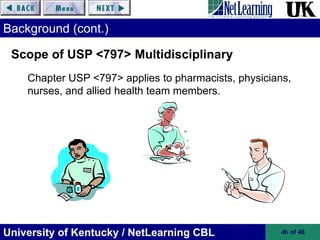
Chapter USP <797> applies to pharmacists, physicians,
nurses, and allied health team members.
Scope of USP <797> Multidisciplinary
University of Kentucky / NetLearning CBL ‹#› of 46
Selected Sections of Chapter <797>
• Personnel cleansing and gowning
• Responsibilities of compounding personnel
• Risk level classification of Compounded Sterile Products
(CSP) and quality assurance
• Verification of accuracy and sterilization of CSP
• Personnel training and assessment
• Environmental quality and control
• Equipment
• Storage and beyond-use dating
University of Kentucky / NetLearning CBL ‹#› of 46
Personnel Cleansing and Gowning
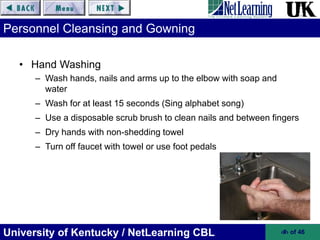
• Hand Washing
– Wash hands, nails and arms up to the elbow with soap and
water
– Wash for at least 15 seconds (Sing alphabet song)
– Use a disposable scrub brush to clean nails and between fingers
– Dry hands with non-shedding towel
– Turn off faucet with towel or use foot pedals
University of Kentucky / NetLearning CBL ‹#› of 46
Personnel Cleansing and Gowning (cont.)
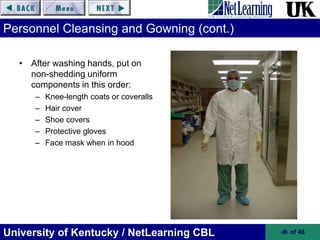
• After washing hands, put on
non-shedding uniform
components in this order:
– Knee-length coats or coveralls
– Hair cover
– Shoe covers
– Protective gloves
– Face mask when in hood
University of Kentucky / NetLearning CBL ‹#› of 46
Personnel Cleansing and Gowning (cont.)
• Hair Covers
– Must cover all hair
– Beards and long sideburns require use of beard cover
• Gloves
– Powder free
– Clean new gloves with 70% isopropyl alcohol before use
– Avoid touching non-sterile surfaces
– Intermittently sanitize gloves with 70% isopropyl alcohol
University of Kentucky / NetLearning CBL ‹#› of 46
Personnel Cleansing and Gowning (cont.)
• Every time you leave the buffer area you must remove
and discard your:
– Hair cover
– Gloves
– Face mask
• Must remove lab coat when leaving buffer area
– May hang coat inside out
– Must discard coat at the end of each shift
University of Kentucky / NetLearning CBL ‹#› of 46
Personnel Cleansing and Gowning (cont.)
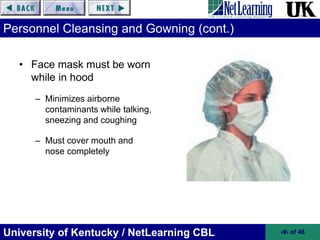
• Face mask must be worn
while in hood
– Minimizes airborne
contaminants while talking,
sneezing and coughing
– Must cover mouth and
nose completely
University of Kentucky / NetLearning CBL ‹#› of 46
Selected Sections of Chapter <797>
• Personnel cleansing and gowning
• Responsibilities of compounding personnel
• Risk level classification of Compounded Sterile Products
(CSP) and quality assurance
• Verification of accuracy and sterilization of CSP
• Personnel training and assessment
• Environmental quality and control
• Equipment
• Storage and beyond-use dating
University of Kentucky / NetLearning CBL ‹#› of 46
Responsibilities of Compounding Personnel
• Manipulate sterile products
aseptically
• Ensure products are accurately
– Identified
– Measured
– Diluted
– Mixed
• Maintain appropriate
cleanliness conditions
• Ensure products are correctly
– Purified
– Sterilized
– Packaged
– Sealed
– Labeled
– Stored
– Dispensed
– Distributed
University of Kentucky / NetLearning CBL ‹#› of 46
Responsibilities of Compounding Personnel (cont.)
• Open or partially used
packages for subsequent use
are:
– Properly stored
– Clearly labeled with date and
time opened or date and time
of expiration
• Labels on products must list
names, amounts added and
concentrations of all
ingredients
• Before dispensing and
administration, products are
visually inspected for clarity
• Beyond-use dates are
assigned based on direct
testing or extrapolation from
reliable literature and other
documentation
University of Kentucky / NetLearning CBL ‹#› of 46
Selected Sections of Chapter <797>
• Personnel cleansing and gowning
• Responsibilities of compounding personnel
• Risk level classification of Compounded Sterile Products
(CSP) and quality assurance
• Verification of accuracy and sterilization of CSP
• Personnel training and assessment
• Environmental quality and control
• Equipment
• Storage and beyond-use dating
University of Kentucky / NetLearning CBL ‹#› of 46
Risk Level Classifications of Compounded Sterile Products
• Appropriate risk level (low, medium, high) assigned
according to corresponding probability of contamination
with:
– Microbial (organisms, spores, endotoxins)
– Chemical or Physical (foreign chemicals or physical
matter)
• Characteristics serve as guide and are not prescriptive
• Risk level ultimately determined by professional
judgment
University of Kentucky / NetLearning CBL ‹#› of 46
Risk Level Classifications of Compounded Sterile Products (cont.)
• Low-Risk Conditions
– Products compounded with aseptic manipulations entirely within
ISO class 5 quality air using only sterile ingredients, products,
components or devices
– Involves only transfer, measuring, and mixing manipulations with
closed or sealed packaging systems performed promptly and
attentively
– Manipulations limited to aseptically opening ampules,
penetrating sterile stoppers on vials with sterile needles and
syringes, and transferring sterile liquids in sterile syringes to
other sterile products
Low-Risk Level Characteristics
University of Kentucky / NetLearning CBL ‹#› of 46
Risk Level Classifications of Compounded Sterile Products (cont.)
• Examples of Low-Risk Compounding
– Single transfers of sterile dosage forms from ampules, bottles,
bags, and vials using sterile syringes with sterile needles, and
other sterile containers. The contents of ampules requires sterile
filtration to remove glass particles
– Manually measuring and mixing no more than three
manufactured products to compound drug admixtures
– Tobramycin piggyback
– Morphine drip
Low-Risk Level Characteristics (cont.)
University of Kentucky / NetLearning CBL ‹#› of 46
Risk Level Classifications of Compounded Sterile Products (cont.)
• Quality Assurance
– Routine disinfection of the direct compounding environment to
minimize microbial surface contamination
– Visual conformation that personnel are properly garbed with hair
covers, gloves, masks, etc.
– Review of all products to ensure correct identity and amounts of
ingredients were compounded
– Visual inspection of products to ensure the absence of
particulates in solutions, the absence leakage from vials or bags,
accuracy of labeling
Low-Risk Level Characteristics (cont.)
University of Kentucky / NetLearning CBL ‹#› of 46
Risk Level Classifications of Compounded Sterile Products (cont.)
• Medium-Risk Conditions include all low-risk conditions in
addition to one or more of the following:
– Multiple individual or small doses of sterile products are
combined or pooled to prepare a product that will be
administered to multiple patients or the same patient on multiple
occasions
– Compounding includes complex aseptic manipulations other
than single volume transfer
– Compounding requires unusually long duration to complete
dilution or homogenous mixing
– The product does not contain bacteriostatic substances and is
administered over several days (e.g. external or implanted
pump)
Medium-Risk Level Characteristics
University of Kentucky / NetLearning CBL ‹#› of 46
Risk Level Classifications of Compounded Sterile Products (cont.)
• Examples Medium-Risk Compounding
– Compounding of total parenteral nutrition using manual or
automated devices
– Filling of reservoirs of injection and infusion devices
• with multiple sterile products
• administered over several days at ambient temperatures (implanted
pumps)
– Transfer of volumes from multiple ampules or vials into a single,
final sterile container or product (terbutaline drip)
– Hydromorphone IVPCA batches using commercial sterile
ingredients
Medium-Risk Level Characteristics (cont.)
University of Kentucky / NetLearning CBL ‹#› of 46
Risk Level Classifications of Compounded Sterile Products (cont.)
• Quality Assurance
– Routine disinfection of the direct compounding environment to
minimize microbial surface contamination
– Visual conformation that personnel are properly garbed with hair
covers, gloves, masks, etc.
– Review of all products to ensure correct identity and amounts of
ingredients were compounded
– Visual inspection of products to ensure the absence of
particulates in solutions, the absence leakage from vials or bags,
accuracy of labeling
Medium-Risk Level Characteristics (cont.)
University of Kentucky / NetLearning CBL ‹#› of 46
Risk Level Classifications of Compounded Sterile Products (cont.)
• High-Risk Conditions include all low-risk and medium-
risk conditions in addition to one or more of the following
– Non-sterile ingredients are incorporated or a non-sterile device is
employed before terminal sterilization
– Sterile ingredients, components, devices, and mixtures are
exposed to air quality inferior to ISO class 5
– Non-sterile preparations are stored greater than 6 hours before
being sterilized
High-Risk Level Characteristics
University of Kentucky / NetLearning CBL ‹#› of 46
Risk Level Classifications of Compounded Sterile Products (cont.)
• Examples of High-Risk Compounding
– Dissolving non-sterile bulk drug and nutrient powders to make
solutions, which will be terminally sterilized
– Exposure of sterile ingredients to air less than ISO class 5 (e.g.
nursing preparation on the ward)
– Measuring or mixing of sterile ingredients in non-sterile devices
before sterilization is performed
High-Risk Level Characteristics (cont.)
University of Kentucky / NetLearning CBL ‹#› of 46
Risk Level Classifications of Compounded Sterile Products (cont.)
• Quality Assurance
– Routine disinfection of the direct compounding environment to
minimize microbial surface contamination
– Visual conformation that personnel are properly garbed with hair
covers, gloves, masks, etc.
– Review of all products to ensure correct identity and amounts of
ingredients were compounded
– Visual inspection of products to ensure the absence of
particulates in solutions, the absence leakage from vials or bags,
accuracy of labeling
High-Risk Level Characteristics (cont.)
University of Kentucky / NetLearning CBL ‹#› of 46
Risk Level Classifications of Compounded Sterile Products (cont.)
• Low and Medium Risk Levels
– Personnel authorized to compound low or medium risk products
are required to perform media-fill testing annually
– Test must simulate most challenging and stressful conditions
during compounding of low or medium risk products respectively
• High-Risk Level
– Personnel authorized to compound high-risk products are
required to perform media-fill testing semi-annually
– Test must simulate most challenging and stressful conditions
during compounding of high-risk products
Media-Fill Testing
University of Kentucky / NetLearning CBL ‹#› of 46
Selected Sections of Chapter <797>
• Personnel cleansing and gowning
• Responsibilities of compounding personnel
• Risk level classification of Compounded Sterile Products
(CSP) and quality assurance
• Verification of accuracy and sterilization of CSP
• Personnel training and assessment
• Environmental quality and control
• Equipment
• Storage and beyond-use dating
University of Kentucky / NetLearning CBL ‹#› of 46
Verification of Accuracy and Sterilization for CSP
• Physical Inspection
– Finished products to be individually inspected for
• Particulates
• Foreign matter
• Container-closure integrity
• Other apparent visual defects
– Products not immediately distributed must be inspected before
leaving the storage area
University of Kentucky / NetLearning CBL ‹#› of 46
Verification of Accuracy and Sterilization for CSP (cont.)
• Compounding Accuracy Checks
– Written procedures for double-checking compounding accuracy
must be followed
– Double check should include label accuracy and accuracy of the
addition of all products or ingredients
– Used containers and syringes should be quarantined with the
final product until double check is performed
– Double check should be performed by person other than the
compounder
University of Kentucky / NetLearning CBL ‹#› of 46
Verification of Accuracy and Sterilization for CSP (cont.)
• Sterilization and Bacterial Endotoxin Testing
– Required for high-risk level products that involve nonsterile
products or devices
– Product must be tested according to USP Chapter <85>
Bacterial Endotoxins Test
– Sterilization Methods
• Dry Heat
– 250°C for two hours
• Steam (autoclave)
– 121°C at 15 pounds per square inch (p.s.i.) for 20 to 60 minutes
• Filtration
– 0.2 micron filter certified to retain 107 Brevundimonas diminuta per cm2
• Must verify sterilization procedures
– Required to prove it
– Accomplish with media fill testing
University of Kentucky / NetLearning CBL ‹#› of 46
Selected Sections of Chapter <797>
• Personnel cleansing and gowning
• Responsibilities of compounding personnel
• Risk level classification of Compounded Sterile Products
(CSP) and quality assurance
• Verification of accuracy and sterilization of CSP
• Personnel training and assessment
• Environmental quality and control
• Equipment
• Storage and beyond-use dating
University of Kentucky / NetLearning CBL ‹#› of 46
Personnel Training and Assessment
• Personnel who prepare compounded sterile products or
parenteral preparations must be provided with
appropriate training in the theoretical principals and
practical skills of aseptic manipulations.
• Assessment of knowledge and skills
– Annually for personnel preparing low and medium-risk level
products
– Semi-annually for personnel preparing high-risk level products
University of Kentucky / NetLearning CBL ‹#› of 46
Personnel Training and Assessment (cont.)
• Assessment
– Written tests
– Media-fill challenge testing
– Failure of assessment requires re-instruction and re-evaluation
before being allowed to compound sterile products
• Media-fill challenge testing
– Sterile bacterial culture medium transferred via a variety of aseptic
manipulations
– Test should represent the most challenging products made for a
particular risk level
– Products are monitored for microbial growth, indicated by visual
turbidity, for 14 days
University of Kentucky / NetLearning CBL ‹#› of 46
Selected Sections of Chapter <797>
• Personnel cleansing and gowning
• Responsibilities of compounding personnel
• Risk level classification of Compounded Sterile Products
(CSP) and quality assurance
• Verification of accuracy and sterilization of CSP
• Personnel training and assessment
• Environmental quality and control
• Equipment
• Storage and beyond-use dating
University of Kentucky / NetLearning CBL ‹#› of 46
Environmental Quality and Control
• Critical Site
– Any opening providing a direct pathway between a sterile product
and the environment or any surface coming into direct contact with
the product and the environment
– Must protect these sites from environmental contamination
• Air Quality
– ISO Class 5 (Class 100) required in critical area (area where
sterile products are directly exposed, e.g. hood)
– ISO Class 8 (Class 100,000) required for buffer area or clean room
– Minimize air currents from open doors, personnel traffic and
ventilation ducts
– Air conditioning and humidity control required
University of Kentucky / NetLearning CBL ‹#› of 46
Environmental Quality and Control (cont.)
• Cleaning and sanitizing workspaces
– Standard operating procedures are required
– Pharmacy policy PH06-05 fulfills this requirement and discusses specific
UKCMC procedures
– Please “click” on policy link above for PH06-05 and read the policy.
Required to answer a test question.
• Personnel garb and hand washing (policy PH06-04)
– Please “click” on policy link above for PH06-04 and read the policy.
Required to answer a test question.
• Environmental monitoring
– Air quality inspections (every 6 months)
– Certification of hoods and barrier isolators (every 6 months)
– Evaluation of airborne microorganisms
• Monthly for low and medium risk-level compounding areas
• Weekly for high risk-level compounding areas
University of Kentucky / NetLearning CBL ‹#› of 46
Selected Sections of Chapter <797>
• Personnel cleansing and gowning
• Responsibilities of compounding personnel
• Risk level classification of Compounded Sterile Products
(CSP) and quality assurance
• Verification of accuracy and sterilization of CSP
• Personnel training and assessment
• Environmental quality and control
• Equipment
• Storage and beyond-use dating
University of Kentucky / NetLearning CBL ‹#› of 46
Equipment
• Personnel are to be trained to operate any piece of
equipment or apparatus they may use to prepare
compounded sterile products
• Equipment calibration documentation
• Annual and routine maintenance documentation
• Monitoring for proper function documentation
• Procedures for use
• Calibration and maintenance reports to be kept on file
University of Kentucky / NetLearning CBL ‹#› of 46
Selected Sections of Chapter <797>
• Personnel cleansing and gowning
• Responsibilities of compounding personnel
• Risk level classification of Compounded Sterile Products
(CSP) and quality assurance
• Verification of accuracy and sterilization of CSP
• Personnel training and assessment
• Environmental quality and control
• Equipment
• Storage and beyond-use dating
University of Kentucky / NetLearning CBL ‹#› of 46
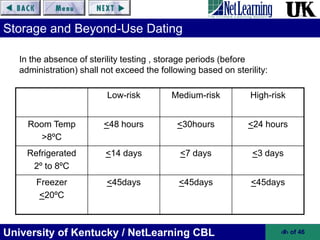
Storage and Beyond-Use Dating
In the absence of sterility testing , storage periods (before
administration) shall not exceed the following based on sterility:
Low-risk Medium-risk High-risk
Room Temp
>8ºC
<48 hours <30hours <24 hours
Refrigerated
2º to 8ºC
<14 days <7 days <3 days
Freezer
<20ºC
<45days <45days <45days
University of Kentucky / NetLearning CBL ‹#› of 46
Storage and Beyond-Use Dating (cont.)
• Use stABility dating only if shorter than stERility beyond-
use dating recommendations
– Low-risk level product “ABC” in refrigerator would receive a
beyond-use date of <7 days based on stERility
– If the stABility of product “ABC” is 24 hours, then product should
be labeled with beyond-use date of <24 hours
• Beyond-use dating can be extended if direct sterility
testing is performed
University of Kentucky / NetLearning CBL ‹#› of 46
Storage and Beyond-Use Dating (cont.)
• Single dose or single use vials shall be discarded within:
– 24 hours if stored at room temperature
– 72 hours if stored in the refridgerator
• Multi-dose vials shall be discarded within 28 days
• Beyond-use dating can be extended if direct sterility
testing is performed
University of Kentucky / NetLearning CBL ‹#› of 46
• USP<797> is an important patient safety initiative
• Adoption of the standards will require personal
motivation and teamwork
• For more information on USP<797> visit
http://www.ashp.org/SterileCpd/
• USP<797 is under continual revisions. Please obtain
a current copy of the chapter for the most current
information.
Summary
University of Kentucky / NetLearning CBL ‹#› of 47
We hope this Computer Based Learning course has been both informative and helpful.
Feel free to review the screens of this course until you are confident about your knowledge of
the material presented.
Click the Take Test button on the left side of the screen when you are ready to complete the
requirements for this course.
Exit
Choose the My Records button to view your transcript.
Select Exit to close the Student Interface.

1588048.ppt

  • 1.
    University of Kentucky/ NetLearning CBL ‹#› of 28 All materials on this template are Copyright © 2004 University of Kentucky Chandler Medical Center Learning Center unless otherwise noted. All rights reserved. Certain graphic images, text elements and logos are derived from The University of Kentucky and NetLearning and are used by permission. USP<797> Pharmaceutical Compounding – Sterile Products Authors: Philip Trapskin, PharmD Rebecca Reagan, RPh Kimberley Hite, MS, PharmD John Armitstead, MS, RPh, FASHP Service Area: Pharmacy Services Phone: (859) 257-8414 Email: khite2@email.uky.edu Date Developed Or Revised: April, 2005 Curriculum: Pharmacy Target Audience: Pharmacists and Pharmacy Technicians
  • 2.
    University of Kentucky/ NetLearning CBL ‹#› of 46 Background Personnel Cleansing and Gowning Responsibilities of Compounding Personnel Risk Level Classifications Verification of Accuracy and Sterilization Personnel Training and Assessment Environmental Quality and Control Equipment Storage and Beyond-Use Dating Menu
  • 3.
    University of Kentucky/ NetLearning CBL ‹#› of 46 Background • United States Pharmacopeia (USP) – Non-governmental non-profit organization – Primary activities are creation of standards, patient safety, healthcare information, and verification of products • Quality and consistency of medicines – Prescription – Non-prescription – Dietary supplements – Veterinary drugs – Healthcare products • Safe and proper use of medications – USP standards are developed by a unique process of public involvement
  • 4.
    University of Kentucky/ NetLearning CBL ‹#› of 46 Background (cont.) • Food and Drugs Act – 1906 – US Pharmacopeia (USP/NF) became the official standard for drugs in the United States • Federal Food, Drug and Cosmetic Act – 1938 – USP/NF official compendia of drug standards – Food and Drug Administration (FDA) responsible for enforcement of the act – FDA may enforce required standards in USP/NF USP Legal and Regulatory Basis
  • 5.
    University of Kentucky/ NetLearning CBL ‹#› of 46 Background (cont.) • Each general chapter of the USP/NF is assigned a number which appears in brackets • Chapter <1> to <999> are required – Pharmacies are subject to inspection for compliance with required standards by: • Boards of Pharmacy • FDA • Joint Commission on Accreditation of Healthcare Organizations (JCAHO) • Includes Chapter <797> • Chapter <1000> to <1999> are informational USP Legal and Regulatory Basis (cont.)
  • 6.
    University of Kentucky/ NetLearning CBL ‹#› of 46 Background (cont.) • Goal of USP Chapter <797> is to prevent potential patient harm or death that could result from: – Microbial contamination – Excessive bacterial endotoxins – Large content errors in the strength of correct ingredients – Incorrect ingredients Goal of Chapter <797>
  • 7.
    University of Kentucky/ NetLearning CBL ‹#› of 46 Background (cont.) • Preparations prepared according to the manufacturer’s labeled instructions and other manipulations that expose contents to potential contamination • Preparations containing nonsterile ingredients or employ nonsterile components or devices that must be sterilized before administration • Biologics, diagnostics, drugs, nutrients, and radiopharmaceuticals that possess either of the above two characteristics Definition of Compounded Sterile Products (CSP) – USP27 <797>
  • 8.
    University of Kentucky/ NetLearning CBL ‹#› of 46 Background (cont.) Chapter USP <797> applies to pharmacists, physicians, nurses, and allied health team members. Scope of USP <797> Multidisciplinary
  • 9.
    University of Kentucky/ NetLearning CBL ‹#› of 46 Selected Sections of Chapter <797> • Personnel cleansing and gowning • Responsibilities of compounding personnel • Risk level classification of Compounded Sterile Products (CSP) and quality assurance • Verification of accuracy and sterilization of CSP • Personnel training and assessment • Environmental quality and control • Equipment • Storage and beyond-use dating
  • 10.
    University of Kentucky/ NetLearning CBL ‹#› of 46 Personnel Cleansing and Gowning • Hand Washing – Wash hands, nails and arms up to the elbow with soap and water – Wash for at least 15 seconds (Sing alphabet song) – Use a disposable scrub brush to clean nails and between fingers – Dry hands with non-shedding towel – Turn off faucet with towel or use foot pedals
  • 11.
    University of Kentucky/ NetLearning CBL ‹#› of 46 Personnel Cleansing and Gowning (cont.) • After washing hands, put on non-shedding uniform components in this order: – Knee-length coats or coveralls – Hair cover – Shoe covers – Protective gloves – Face mask when in hood
  • 12.
    University of Kentucky/ NetLearning CBL ‹#› of 46 Personnel Cleansing and Gowning (cont.) • Hair Covers – Must cover all hair – Beards and long sideburns require use of beard cover • Gloves – Powder free – Clean new gloves with 70% isopropyl alcohol before use – Avoid touching non-sterile surfaces – Intermittently sanitize gloves with 70% isopropyl alcohol
  • 13.
    University of Kentucky/ NetLearning CBL ‹#› of 46 Personnel Cleansing and Gowning (cont.) • Every time you leave the buffer area you must remove and discard your: – Hair cover – Gloves – Face mask • Must remove lab coat when leaving buffer area – May hang coat inside out – Must discard coat at the end of each shift
  • 14.
    University of Kentucky/ NetLearning CBL ‹#› of 46 Personnel Cleansing and Gowning (cont.) • Face mask must be worn while in hood – Minimizes airborne contaminants while talking, sneezing and coughing – Must cover mouth and nose completely
  • 15.
    University of Kentucky/ NetLearning CBL ‹#› of 46 Selected Sections of Chapter <797> • Personnel cleansing and gowning • Responsibilities of compounding personnel • Risk level classification of Compounded Sterile Products (CSP) and quality assurance • Verification of accuracy and sterilization of CSP • Personnel training and assessment • Environmental quality and control • Equipment • Storage and beyond-use dating
  • 16.
    University of Kentucky/ NetLearning CBL ‹#› of 46 Responsibilities of Compounding Personnel • Manipulate sterile products aseptically • Ensure products are accurately – Identified – Measured – Diluted – Mixed • Maintain appropriate cleanliness conditions • Ensure products are correctly – Purified – Sterilized – Packaged – Sealed – Labeled – Stored – Dispensed – Distributed
  • 17.
    University of Kentucky/ NetLearning CBL ‹#› of 46 Responsibilities of Compounding Personnel (cont.) • Open or partially used packages for subsequent use are: – Properly stored – Clearly labeled with date and time opened or date and time of expiration • Labels on products must list names, amounts added and concentrations of all ingredients • Before dispensing and administration, products are visually inspected for clarity • Beyond-use dates are assigned based on direct testing or extrapolation from reliable literature and other documentation
  • 18.
    University of Kentucky/ NetLearning CBL ‹#› of 46 Selected Sections of Chapter <797> • Personnel cleansing and gowning • Responsibilities of compounding personnel • Risk level classification of Compounded Sterile Products (CSP) and quality assurance • Verification of accuracy and sterilization of CSP • Personnel training and assessment • Environmental quality and control • Equipment • Storage and beyond-use dating
  • 19.
    University of Kentucky/ NetLearning CBL ‹#› of 46 Risk Level Classifications of Compounded Sterile Products • Appropriate risk level (low, medium, high) assigned according to corresponding probability of contamination with: – Microbial (organisms, spores, endotoxins) – Chemical or Physical (foreign chemicals or physical matter) • Characteristics serve as guide and are not prescriptive • Risk level ultimately determined by professional judgment
  • 20.
    University of Kentucky/ NetLearning CBL ‹#› of 46 Risk Level Classifications of Compounded Sterile Products (cont.) • Low-Risk Conditions – Products compounded with aseptic manipulations entirely within ISO class 5 quality air using only sterile ingredients, products, components or devices – Involves only transfer, measuring, and mixing manipulations with closed or sealed packaging systems performed promptly and attentively – Manipulations limited to aseptically opening ampules, penetrating sterile stoppers on vials with sterile needles and syringes, and transferring sterile liquids in sterile syringes to other sterile products Low-Risk Level Characteristics
  • 21.
    University of Kentucky/ NetLearning CBL ‹#› of 46 Risk Level Classifications of Compounded Sterile Products (cont.) • Examples of Low-Risk Compounding – Single transfers of sterile dosage forms from ampules, bottles, bags, and vials using sterile syringes with sterile needles, and other sterile containers. The contents of ampules requires sterile filtration to remove glass particles – Manually measuring and mixing no more than three manufactured products to compound drug admixtures – Tobramycin piggyback – Morphine drip Low-Risk Level Characteristics (cont.)
  • 22.
    University of Kentucky/ NetLearning CBL ‹#› of 46 Risk Level Classifications of Compounded Sterile Products (cont.) • Quality Assurance – Routine disinfection of the direct compounding environment to minimize microbial surface contamination – Visual conformation that personnel are properly garbed with hair covers, gloves, masks, etc. – Review of all products to ensure correct identity and amounts of ingredients were compounded – Visual inspection of products to ensure the absence of particulates in solutions, the absence leakage from vials or bags, accuracy of labeling Low-Risk Level Characteristics (cont.)
  • 23.
    University of Kentucky/ NetLearning CBL ‹#› of 46 Risk Level Classifications of Compounded Sterile Products (cont.) • Medium-Risk Conditions include all low-risk conditions in addition to one or more of the following: – Multiple individual or small doses of sterile products are combined or pooled to prepare a product that will be administered to multiple patients or the same patient on multiple occasions – Compounding includes complex aseptic manipulations other than single volume transfer – Compounding requires unusually long duration to complete dilution or homogenous mixing – The product does not contain bacteriostatic substances and is administered over several days (e.g. external or implanted pump) Medium-Risk Level Characteristics
  • 24.
    University of Kentucky/ NetLearning CBL ‹#› of 46 Risk Level Classifications of Compounded Sterile Products (cont.) • Examples Medium-Risk Compounding – Compounding of total parenteral nutrition using manual or automated devices – Filling of reservoirs of injection and infusion devices • with multiple sterile products • administered over several days at ambient temperatures (implanted pumps) – Transfer of volumes from multiple ampules or vials into a single, final sterile container or product (terbutaline drip) – Hydromorphone IVPCA batches using commercial sterile ingredients Medium-Risk Level Characteristics (cont.)
  • 25.
    University of Kentucky/ NetLearning CBL ‹#› of 46 Risk Level Classifications of Compounded Sterile Products (cont.) • Quality Assurance – Routine disinfection of the direct compounding environment to minimize microbial surface contamination – Visual conformation that personnel are properly garbed with hair covers, gloves, masks, etc. – Review of all products to ensure correct identity and amounts of ingredients were compounded – Visual inspection of products to ensure the absence of particulates in solutions, the absence leakage from vials or bags, accuracy of labeling Medium-Risk Level Characteristics (cont.)
  • 26.
    University of Kentucky/ NetLearning CBL ‹#› of 46 Risk Level Classifications of Compounded Sterile Products (cont.) • High-Risk Conditions include all low-risk and medium- risk conditions in addition to one or more of the following – Non-sterile ingredients are incorporated or a non-sterile device is employed before terminal sterilization – Sterile ingredients, components, devices, and mixtures are exposed to air quality inferior to ISO class 5 – Non-sterile preparations are stored greater than 6 hours before being sterilized High-Risk Level Characteristics
  • 27.
    University of Kentucky/ NetLearning CBL ‹#› of 46 Risk Level Classifications of Compounded Sterile Products (cont.) • Examples of High-Risk Compounding – Dissolving non-sterile bulk drug and nutrient powders to make solutions, which will be terminally sterilized – Exposure of sterile ingredients to air less than ISO class 5 (e.g. nursing preparation on the ward) – Measuring or mixing of sterile ingredients in non-sterile devices before sterilization is performed High-Risk Level Characteristics (cont.)
  • 28.
    University of Kentucky/ NetLearning CBL ‹#› of 46 Risk Level Classifications of Compounded Sterile Products (cont.) • Quality Assurance – Routine disinfection of the direct compounding environment to minimize microbial surface contamination – Visual conformation that personnel are properly garbed with hair covers, gloves, masks, etc. – Review of all products to ensure correct identity and amounts of ingredients were compounded – Visual inspection of products to ensure the absence of particulates in solutions, the absence leakage from vials or bags, accuracy of labeling High-Risk Level Characteristics (cont.)
  • 29.
    University of Kentucky/ NetLearning CBL ‹#› of 46 Risk Level Classifications of Compounded Sterile Products (cont.) • Low and Medium Risk Levels – Personnel authorized to compound low or medium risk products are required to perform media-fill testing annually – Test must simulate most challenging and stressful conditions during compounding of low or medium risk products respectively • High-Risk Level – Personnel authorized to compound high-risk products are required to perform media-fill testing semi-annually – Test must simulate most challenging and stressful conditions during compounding of high-risk products Media-Fill Testing
  • 30.
    University of Kentucky/ NetLearning CBL ‹#› of 46 Selected Sections of Chapter <797> • Personnel cleansing and gowning • Responsibilities of compounding personnel • Risk level classification of Compounded Sterile Products (CSP) and quality assurance • Verification of accuracy and sterilization of CSP • Personnel training and assessment • Environmental quality and control • Equipment • Storage and beyond-use dating
  • 31.
    University of Kentucky/ NetLearning CBL ‹#› of 46 Verification of Accuracy and Sterilization for CSP • Physical Inspection – Finished products to be individually inspected for • Particulates • Foreign matter • Container-closure integrity • Other apparent visual defects – Products not immediately distributed must be inspected before leaving the storage area
  • 32.
    University of Kentucky/ NetLearning CBL ‹#› of 46 Verification of Accuracy and Sterilization for CSP (cont.) • Compounding Accuracy Checks – Written procedures for double-checking compounding accuracy must be followed – Double check should include label accuracy and accuracy of the addition of all products or ingredients – Used containers and syringes should be quarantined with the final product until double check is performed – Double check should be performed by person other than the compounder
  • 33.
    University of Kentucky/ NetLearning CBL ‹#› of 46 Verification of Accuracy and Sterilization for CSP (cont.) • Sterilization and Bacterial Endotoxin Testing – Required for high-risk level products that involve nonsterile products or devices – Product must be tested according to USP Chapter <85> Bacterial Endotoxins Test – Sterilization Methods • Dry Heat – 250°C for two hours • Steam (autoclave) – 121°C at 15 pounds per square inch (p.s.i.) for 20 to 60 minutes • Filtration – 0.2 micron filter certified to retain 107 Brevundimonas diminuta per cm2 • Must verify sterilization procedures – Required to prove it – Accomplish with media fill testing
  • 34.
    University of Kentucky/ NetLearning CBL ‹#› of 46 Selected Sections of Chapter <797> • Personnel cleansing and gowning • Responsibilities of compounding personnel • Risk level classification of Compounded Sterile Products (CSP) and quality assurance • Verification of accuracy and sterilization of CSP • Personnel training and assessment • Environmental quality and control • Equipment • Storage and beyond-use dating
  • 35.
    University of Kentucky/ NetLearning CBL ‹#› of 46 Personnel Training and Assessment • Personnel who prepare compounded sterile products or parenteral preparations must be provided with appropriate training in the theoretical principals and practical skills of aseptic manipulations. • Assessment of knowledge and skills – Annually for personnel preparing low and medium-risk level products – Semi-annually for personnel preparing high-risk level products
  • 36.
    University of Kentucky/ NetLearning CBL ‹#› of 46 Personnel Training and Assessment (cont.) • Assessment – Written tests – Media-fill challenge testing – Failure of assessment requires re-instruction and re-evaluation before being allowed to compound sterile products • Media-fill challenge testing – Sterile bacterial culture medium transferred via a variety of aseptic manipulations – Test should represent the most challenging products made for a particular risk level – Products are monitored for microbial growth, indicated by visual turbidity, for 14 days
  • 37.
    University of Kentucky/ NetLearning CBL ‹#› of 46 Selected Sections of Chapter <797> • Personnel cleansing and gowning • Responsibilities of compounding personnel • Risk level classification of Compounded Sterile Products (CSP) and quality assurance • Verification of accuracy and sterilization of CSP • Personnel training and assessment • Environmental quality and control • Equipment • Storage and beyond-use dating
  • 38.
    University of Kentucky/ NetLearning CBL ‹#› of 46 Environmental Quality and Control • Critical Site – Any opening providing a direct pathway between a sterile product and the environment or any surface coming into direct contact with the product and the environment – Must protect these sites from environmental contamination • Air Quality – ISO Class 5 (Class 100) required in critical area (area where sterile products are directly exposed, e.g. hood) – ISO Class 8 (Class 100,000) required for buffer area or clean room – Minimize air currents from open doors, personnel traffic and ventilation ducts – Air conditioning and humidity control required
  • 39.
    University of Kentucky/ NetLearning CBL ‹#› of 46 Environmental Quality and Control (cont.) • Cleaning and sanitizing workspaces – Standard operating procedures are required – Pharmacy policy PH06-05 fulfills this requirement and discusses specific UKCMC procedures – Please “click” on policy link above for PH06-05 and read the policy. Required to answer a test question. • Personnel garb and hand washing (policy PH06-04) – Please “click” on policy link above for PH06-04 and read the policy. Required to answer a test question. • Environmental monitoring – Air quality inspections (every 6 months) – Certification of hoods and barrier isolators (every 6 months) – Evaluation of airborne microorganisms • Monthly for low and medium risk-level compounding areas • Weekly for high risk-level compounding areas
  • 40.
    University of Kentucky/ NetLearning CBL ‹#› of 46 Selected Sections of Chapter <797> • Personnel cleansing and gowning • Responsibilities of compounding personnel • Risk level classification of Compounded Sterile Products (CSP) and quality assurance • Verification of accuracy and sterilization of CSP • Personnel training and assessment • Environmental quality and control • Equipment • Storage and beyond-use dating
  • 41.
    University of Kentucky/ NetLearning CBL ‹#› of 46 Equipment • Personnel are to be trained to operate any piece of equipment or apparatus they may use to prepare compounded sterile products • Equipment calibration documentation • Annual and routine maintenance documentation • Monitoring for proper function documentation • Procedures for use • Calibration and maintenance reports to be kept on file
  • 42.
    University of Kentucky/ NetLearning CBL ‹#› of 46 Selected Sections of Chapter <797> • Personnel cleansing and gowning • Responsibilities of compounding personnel • Risk level classification of Compounded Sterile Products (CSP) and quality assurance • Verification of accuracy and sterilization of CSP • Personnel training and assessment • Environmental quality and control • Equipment • Storage and beyond-use dating
  • 43.
    University of Kentucky/ NetLearning CBL ‹#› of 46 Storage and Beyond-Use Dating In the absence of sterility testing , storage periods (before administration) shall not exceed the following based on sterility: Low-risk Medium-risk High-risk Room Temp >8ºC <48 hours <30hours <24 hours Refrigerated 2º to 8ºC <14 days <7 days <3 days Freezer <20ºC <45days <45days <45days
  • 44.
    University of Kentucky/ NetLearning CBL ‹#› of 46 Storage and Beyond-Use Dating (cont.) • Use stABility dating only if shorter than stERility beyond- use dating recommendations – Low-risk level product “ABC” in refrigerator would receive a beyond-use date of <7 days based on stERility – If the stABility of product “ABC” is 24 hours, then product should be labeled with beyond-use date of <24 hours • Beyond-use dating can be extended if direct sterility testing is performed
  • 45.
    University of Kentucky/ NetLearning CBL ‹#› of 46 Storage and Beyond-Use Dating (cont.) • Single dose or single use vials shall be discarded within: – 24 hours if stored at room temperature – 72 hours if stored in the refridgerator • Multi-dose vials shall be discarded within 28 days • Beyond-use dating can be extended if direct sterility testing is performed
  • 46.
    University of Kentucky/ NetLearning CBL ‹#› of 46 • USP<797> is an important patient safety initiative • Adoption of the standards will require personal motivation and teamwork • For more information on USP<797> visit http://www.ashp.org/SterileCpd/ • USP<797 is under continual revisions. Please obtain a current copy of the chapter for the most current information. Summary
  • 47.
    University of Kentucky/ NetLearning CBL ‹#› of 47 We hope this Computer Based Learning course has been both informative and helpful. Feel free to review the screens of this course until you are confident about your knowledge of the material presented. Click the Take Test button on the left side of the screen when you are ready to complete the requirements for this course. Exit Choose the My Records button to view your transcript. Select Exit to close the Student Interface.