Understanding and
and learning from
error
Dr Ihab Suliman
5/3/2019
Learning objectiveLearning objective
Understand the nature of error and how health care
can learn from error to improve patient safety
Knowledge requirementKnowledge requirement
Explain the terms error, violation,
near miss, hindsight bias
Performance requirements:Performance requirements:
o know the ways to learn from errors
o participate in the analysis of an
adverse event
o practise strategies to reduce errors
ErrorError
a simple definition is:
o “Doing the wrong thing when meaning to do the
right thing.”
Runciman
a more formal definition is:
• “Planned sequences of mental or physical
activities that fail to achieve their intended
outcomes, when these failures cannot be
attributed to the intervention of some chance
agency.”
Reason
Note: violationNote: violation
A deliberate deviation from an accepted protocol or standard of care
Error and outcomeError and outcome
• error and outcome are not inextricably
linked:
o harm can befall a patient in the form of a complication of
care without an error having occurred
o many errors occur that have no consequence for the
patient as they are recognized before harm occurs
Error is theError is the inevitableinevitable downsidedownside
of having a brain!of having a brain!
One definition of “human error”
is “human nature”.
Human factors principles
remind us
Human beings makeHuman beings make
“silly” mistakes“silly” mistakes
Activity
Think about and then discuss with your colleagues any
“silly” mistakes you have made recently when you
were not in your place of work or study - and why
you think they happened
Regardless of their experience,
intelligence, motivation or vigilance, people
make mistakes
Health-care context isHealth-care context is
problematicproblematic
• when errors occur in the workplace the
consequences can be a problem for the patient
o a situation that is relatively unique to health care
• in all other respects there is nothing unique about
“medical” errors
o they are no different from the human factors
problems that exist in settings outside health care
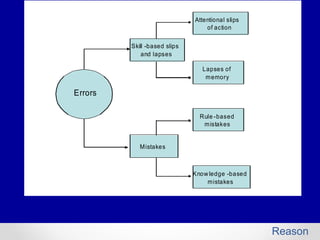
Errors
Mistakes
Skill -based slips
and lapses
Attentional slips
of action
Lapses of
memory
Rule -based
mistakes
Knowledge -based
mistakes
Reason
Situations associated with anSituations associated with an
increased risk of errorincreased risk of error
• unfamiliarity with the task*
• inexperience*
• shortage of time
• inadequate checking
• poor procedures
• poor human equipment interface
Vincent
* Especially if combined with lack of supervision
Individual factors thatIndividual factors that
predispose to errorpredispose to error
• limited memory capacity
• further reduced by:
o fatigue
o stress
o hunger
o illness
o language or cultural factors
o hazardous attitudes
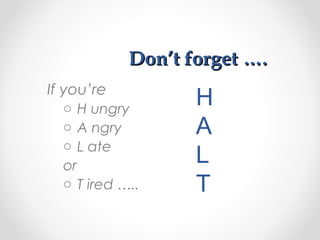
Don’t forget ….Don’t forget ….
If you’re
o H ungry
o A ngry
o L ate
or
o T ired …..
H
A
L
T
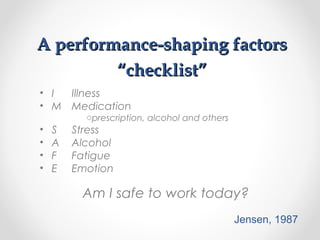
A performance-shaping factorsA performance-shaping factors
“checklist”“checklist”
• I Illness
• M Medication
oprescription, alcohol and others
• S Stress
• A Alcohol
• F Fatigue
• E Emotion
Am I safe to work today?
Jensen, 1987
Incident monitoringIncident monitoring
• involves collecting and analysing information about
any events that could have harmed or did harm
anyone in the organization
• a fundamental component of an organization’s
ability to learn from error
Removing error trapsRemoving error traps
• a primary function of an incident
reporting system is to identify recurring
problem areas - known as “error
traps” (Reason)
• identifying and removing these traps is
one of the main functions of error
management
Error traps
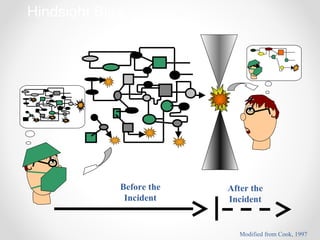
Modified from Cook, 1997
Hindsight Bias
Before the
Incident
After the
Incident
Culture: a workableCulture: a workable
definition (Reason)definition (Reason)
Shared values (what is important) andShared values (what is important) and
beliefs (how things work) that interactbeliefs (how things work) that interact
with an organization’s structure andwith an organization’s structure and
control systems to produce behaviouralcontrol systems to produce behavioural
norms (the way we do things around here)norms (the way we do things around here)
Safety culture
Culture in the workplaceCulture in the workplace
• it is hard to “change the world” as a junior doctor
• but …
o you can be on the look out for ways to improve the “system”
o you can contribute to the culture in your work environment
Incident reporting and monitoringIncident reporting and monitoring
strategiesstrategies
• others include:
o anonymous reporting
o timely feedback
o open acknowledgement of successes resulting
from incident reporting
o reporting of near misses
• “free lessons” can be learned
• system improvements can be instituted as a result of the
investigation but at no “cost” to a patient
Larson
Root cause analysisRoot cause analysis
Established by the US Department of
Veterans Affairs
National Center for Patient Safety
http://www.va.gov/NCPS/curriculum/RCA/index.html
RCA modelRCA model
• a rigorous, confidential approach to
answering:
o What happened?
o Why did it happen?
o What are we going to do to prevent it from
happening again?
o How will we know that our actions improved
patient safety?
RCA modelRCA model
• focuses on prevention, not blame or
punishment
• focuses on system level vulnerabilities rather
than individual performance
- communication - environment/equipment
- training - rules/policies/procedures
- fatigue/scheduling - barriers
Personal errorPersonal error
reduction strategiesreduction strategies
• know yourself
o eat well, sleep well, look after yourself …
• know your environment
• know your task
• preparation and planning
o “What if …?”
• build “checks” into your routine
• Ask if you don’t know!
Mental preparednessMental preparedness
• assume that errors can and will occur
• identify those circumstances most likely to breed
error
• have contingencies in place to cope with problems,
interruptions and distractions
• mentally rehearse complex procedures
Reason
Getting the balance right
SummarySummary
• medical error is a complex issue, but error
itself is an inevitable part of the human
condition
• learning from error is more productive if it is
considered at an organizational level
• root cause analysis is a highly structured
system approach to incident analysis

Errors ihab 2019

  • 1.
    Understanding and and learningfrom error Dr Ihab Suliman 5/3/2019
  • 2.
    Learning objectiveLearning objective Understandthe nature of error and how health care can learn from error to improve patient safety
  • 3.
    Knowledge requirementKnowledge requirement Explainthe terms error, violation, near miss, hindsight bias
  • 4.
    Performance requirements:Performance requirements: oknow the ways to learn from errors o participate in the analysis of an adverse event o practise strategies to reduce errors
  • 5.
    ErrorError a simple definitionis: o “Doing the wrong thing when meaning to do the right thing.” Runciman a more formal definition is: • “Planned sequences of mental or physical activities that fail to achieve their intended outcomes, when these failures cannot be attributed to the intervention of some chance agency.” Reason
  • 6.
    Note: violationNote: violation Adeliberate deviation from an accepted protocol or standard of care
  • 7.
    Error and outcomeErrorand outcome • error and outcome are not inextricably linked: o harm can befall a patient in the form of a complication of care without an error having occurred o many errors occur that have no consequence for the patient as they are recognized before harm occurs
  • 8.
    Error is theErroris the inevitableinevitable downsidedownside of having a brain!of having a brain! One definition of “human error” is “human nature”. Human factors principles remind us
  • 9.
    Human beings makeHumanbeings make “silly” mistakes“silly” mistakes Activity Think about and then discuss with your colleagues any “silly” mistakes you have made recently when you were not in your place of work or study - and why you think they happened Regardless of their experience, intelligence, motivation or vigilance, people make mistakes
  • 10.
    Health-care context isHealth-carecontext is problematicproblematic • when errors occur in the workplace the consequences can be a problem for the patient o a situation that is relatively unique to health care • in all other respects there is nothing unique about “medical” errors o they are no different from the human factors problems that exist in settings outside health care
  • 11.
    Errors Mistakes Skill -based slips andlapses Attentional slips of action Lapses of memory Rule -based mistakes Knowledge -based mistakes Reason
  • 12.
    Situations associated withanSituations associated with an increased risk of errorincreased risk of error • unfamiliarity with the task* • inexperience* • shortage of time • inadequate checking • poor procedures • poor human equipment interface Vincent * Especially if combined with lack of supervision
  • 13.
    Individual factors thatIndividualfactors that predispose to errorpredispose to error • limited memory capacity • further reduced by: o fatigue o stress o hunger o illness o language or cultural factors o hazardous attitudes
  • 14.
    Don’t forget ….Don’tforget …. If you’re o H ungry o A ngry o L ate or o T ired ….. H A L T
  • 15.
    A performance-shaping factorsAperformance-shaping factors “checklist”“checklist” • I Illness • M Medication oprescription, alcohol and others • S Stress • A Alcohol • F Fatigue • E Emotion Am I safe to work today? Jensen, 1987
  • 16.
    Incident monitoringIncident monitoring •involves collecting and analysing information about any events that could have harmed or did harm anyone in the organization • a fundamental component of an organization’s ability to learn from error
  • 17.
    Removing error trapsRemovingerror traps • a primary function of an incident reporting system is to identify recurring problem areas - known as “error traps” (Reason) • identifying and removing these traps is one of the main functions of error management Error traps
  • 18.
    Modified from Cook,1997 Hindsight Bias Before the Incident After the Incident
  • 19.
    Culture: a workableCulture:a workable definition (Reason)definition (Reason) Shared values (what is important) andShared values (what is important) and beliefs (how things work) that interactbeliefs (how things work) that interact with an organization’s structure andwith an organization’s structure and control systems to produce behaviouralcontrol systems to produce behavioural norms (the way we do things around here)norms (the way we do things around here) Safety culture
  • 20.
    Culture in theworkplaceCulture in the workplace • it is hard to “change the world” as a junior doctor • but … o you can be on the look out for ways to improve the “system” o you can contribute to the culture in your work environment
  • 21.
    Incident reporting andmonitoringIncident reporting and monitoring strategiesstrategies • others include: o anonymous reporting o timely feedback o open acknowledgement of successes resulting from incident reporting o reporting of near misses • “free lessons” can be learned • system improvements can be instituted as a result of the investigation but at no “cost” to a patient Larson
  • 22.
    Root cause analysisRootcause analysis Established by the US Department of Veterans Affairs National Center for Patient Safety http://www.va.gov/NCPS/curriculum/RCA/index.html
  • 23.
    RCA modelRCA model •a rigorous, confidential approach to answering: o What happened? o Why did it happen? o What are we going to do to prevent it from happening again? o How will we know that our actions improved patient safety?
  • 24.
    RCA modelRCA model •focuses on prevention, not blame or punishment • focuses on system level vulnerabilities rather than individual performance - communication - environment/equipment - training - rules/policies/procedures - fatigue/scheduling - barriers
  • 25.
    Personal errorPersonal error reductionstrategiesreduction strategies • know yourself o eat well, sleep well, look after yourself … • know your environment • know your task • preparation and planning o “What if …?” • build “checks” into your routine • Ask if you don’t know!
  • 26.
    Mental preparednessMental preparedness •assume that errors can and will occur • identify those circumstances most likely to breed error • have contingencies in place to cope with problems, interruptions and distractions • mentally rehearse complex procedures Reason Getting the balance right
  • 27.
    SummarySummary • medical erroris a complex issue, but error itself is an inevitable part of the human condition • learning from error is more productive if it is considered at an organizational level • root cause analysis is a highly structured system approach to incident analysis

Editor's Notes

  • #10 Detailed story + reason why
  • #13 All common situations for inexperienced staff
  • #16 Here is a useful acronym to consider prior to to the entering the workplace each day It is borrowed (surprise, surprise) from the aviation industry!
  • #27 Accept that errors can and will occur. Assess the local “bad stuff” before embarking upon a task. Have contingencies ready to deal with anticipated problems. Be prepared to seek more qualified assistance. Do not let professional courtesy get in the way of checking your colleagues’ knowledge and experience, particularly when they are strangers. Appreciate that the path to adverse incidents is paved with false assumptions.