JOB
ANALYSIS

By:Mithilesh Trivedi
What is a Job?
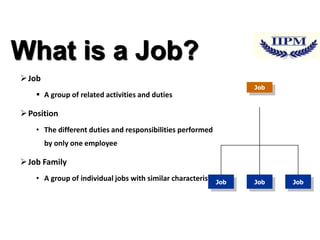
 Job
 A group of related activities and duties

Job

 Position
• The different duties and responsibilities performed
by only one employee

 Job Family
• A group of individual jobs with similar characteristics
Job

Job

Job
Job Analysis
The process of obtaining information about jobs by determining what the
duties, tasks, or activities of jobs are
HR managers use the data to develop job descriptions and job
specifications that are the basis for recruitment, training, employee
performance appraisal and career development

The ultimate purpose of job analysis is to improve organizational
performance and productivity
Approaches to Understanding
Jobs
 Workflow analysis
 Re-engineering
 Job design
 Job analysis
 Job descriptions and job specifications
Workflow Analysis
Workflow Analysis
• A study of the way work (inputs, activities, and outputs) moves through an
organization.

Business Process Re-engineering (BPR)
• Measures for improving such activities as product development, customer
service, and service delivery.

Phases of Reengineering
• Rethink
• Redesign
• Retool
Job Design
Job Enlargement
• Broadening the scope of a job by expanding the number of
different tasks to be performed

Job Enrichment
• Increasing the depth of a job by adding the responsibility for
planning, organizing , controlling, and evaluating the job

Job Rotation
• The process of shifting a person from job to job
JOB REQUIREMENTS
Job Specification
• Statement of the needed knowledge, skills, and abilities (KSAs) of the
person who is to perform the job
• Since Griggs v Duke Power and the Civil Rights Act of 1991, job
specifications used in selection must relate specifically to the duties of the
job

Job Description
• Statement of the tasks, duties, and responsibilities (TDRs) of a job to be
performed
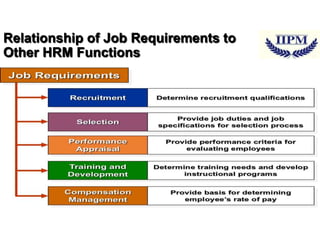
Relationship of Job Requirements to
Other HRM Functions
Determining Job Requirements
Types of Job Analysis
1. TASK BASED
 Task
• A distinct, identifiable work activity composed of motions

 Duty
• A larger work segment composed of several tasks that are performed by an individual

 Responsibilities
• Obligations to perform certain tasks and duties

2. COMPETENCY BASED
 Competencies
• Individual capabilities that can be linked to enhanced performance by individuals or teams
o Technical competencies
o Behavioral competencies
Sources of Gathering Job
Information
Interviews
Questionnaires

Observation
Diaries

Computerized Job Analysis
The Process of Job Analysis
?

Job analysis HRM

  • 1.
  • 2.
    What is aJob?  Job  A group of related activities and duties Job  Position • The different duties and responsibilities performed by only one employee  Job Family • A group of individual jobs with similar characteristics Job Job Job
  • 3.
    Job Analysis The processof obtaining information about jobs by determining what the duties, tasks, or activities of jobs are HR managers use the data to develop job descriptions and job specifications that are the basis for recruitment, training, employee performance appraisal and career development The ultimate purpose of job analysis is to improve organizational performance and productivity
  • 4.
    Approaches to Understanding Jobs Workflow analysis  Re-engineering  Job design  Job analysis  Job descriptions and job specifications
  • 5.
    Workflow Analysis Workflow Analysis •A study of the way work (inputs, activities, and outputs) moves through an organization. Business Process Re-engineering (BPR) • Measures for improving such activities as product development, customer service, and service delivery. Phases of Reengineering • Rethink • Redesign • Retool
  • 6.
    Job Design Job Enlargement •Broadening the scope of a job by expanding the number of different tasks to be performed Job Enrichment • Increasing the depth of a job by adding the responsibility for planning, organizing , controlling, and evaluating the job Job Rotation • The process of shifting a person from job to job
  • 7.
    JOB REQUIREMENTS Job Specification •Statement of the needed knowledge, skills, and abilities (KSAs) of the person who is to perform the job • Since Griggs v Duke Power and the Civil Rights Act of 1991, job specifications used in selection must relate specifically to the duties of the job Job Description • Statement of the tasks, duties, and responsibilities (TDRs) of a job to be performed
  • 8.
    Relationship of JobRequirements to Other HRM Functions
  • 9.
  • 10.
    Types of JobAnalysis 1. TASK BASED  Task • A distinct, identifiable work activity composed of motions  Duty • A larger work segment composed of several tasks that are performed by an individual  Responsibilities • Obligations to perform certain tasks and duties 2. COMPETENCY BASED  Competencies • Individual capabilities that can be linked to enhanced performance by individuals or teams o Technical competencies o Behavioral competencies
  • 11.
    Sources of GatheringJob Information Interviews Questionnaires Observation Diaries Computerized Job Analysis
  • 12.
    The Process ofJob Analysis
  • 14.