1
Job Analysis
Session- 3
2
Human Resource Planning
• Determines the human resources requirement of the organization to
achieve its strategic goals
• The right number & right kind of people at the right place at the right
time
• Integral part of the business planning exercise
3
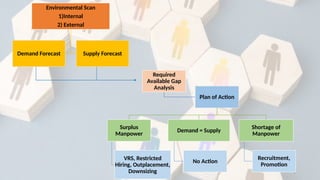
Environmental Scan
1)Internal
2) External
Demand Forecast Supply Forecast
Required
Available Gap
Analysis
Plan of Action
Surplus
Manpower
VRS, Restricted
Hiring, Outplacement,
Downsizing
Demand = Supply
No Action
Shortage of
Manpower
Recruitment,
Promotion
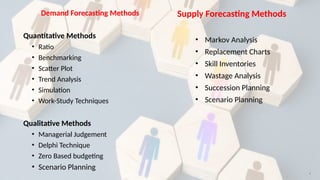
Demand Forecasting Methods
Quantitative Methods
• Ratio
• Benchmarking
• Scatter Plot
• Trend Analysis
• Simulation
• Work-Study Techniques
Qualitative Methods
• Managerial Judgement
• Delphi Technique
• Zero Based budgeting
• Scenario Planning
Supply Forecasting Methods
• Markov Analysis
• Replacement Charts
• Skill Inventories
• Wastage Analysis
• Succession Planning
• Scenario Planning
4
5
Work Flow Design
• The process of analysing the tasks necessary for the production of a
product or service.
• Managers analyze the tasks needed to produce a product or service.
• With this information, they assign these tasks to specific jobs and
positions.
• Job is a set of related duties.
• A position is the set of duties performed by one person.
6
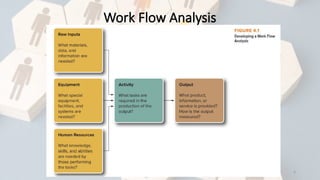
Work Flow Analysis
7
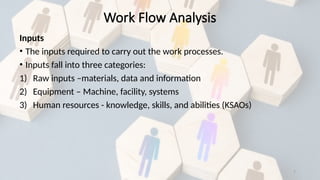
Inputs
• The inputs required to carry out the work processes.
• Inputs fall into three categories:
1) Raw inputs –materials, data and information
2) Equipment – Machine, facility, systems
3) Human resources - knowledge, skills, and abilities (KSAOs)
Work Flow Analysis
8
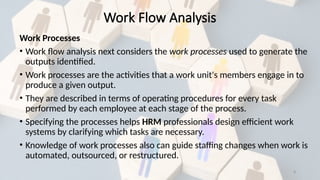
Work Processes
• Work flow analysis next considers the work processes used to generate the
outputs identified.
• Work processes are the activities that a work unit's members engage in to
produce a given output.
• They are described in terms of operating procedures for every task
performed by each employee at each stage of the process.
• Specifying the processes helps HRM professionals design efficient work
systems by clarifying which tasks are necessary.
• Knowledge of work processes also can guide staffing changes when work is
automated, outsourced, or restructured.
Work Flow Analysis
9
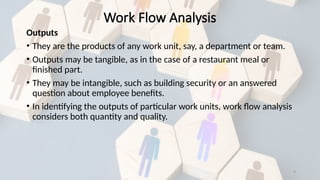
Outputs
• They are the products of any work unit, say, a department or team.
• Outputs may be tangible, as in the case of a restaurant meal or
finished part.
• They may be intangible, such as building security or an answered
question about employee benefits.
• In identifying the outputs of particular work units, work flow analysis
considers both quantity and quality.
Work Flow Analysis
10
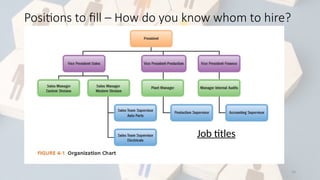
Positions to fill – How do you know whom to hire?
Job titles
11
Job Analysis
• The procedure for determining the knowledge, skills, and abilities required for
performing a job in the organization
• Done in beginning of designing formal HR processes
• Done when new roles and jobs are created
• Done when job content has undergone a modification, review, or redesign
• Process – Gather data about the job requirements from managers and job
holders  Compile and Sort the data  Analyze
12
Job Analysis : Information Hierarchy
1. Job Family: HR professional
1.1. Occupation: Compensation Specialist
1.2. Job: Payroll Manager
1.3. Position: Policy Administrator
1.4. Duty: Payroll Processing
1.5. Task: Preparing Forms
1.6. Element: Signing Pay Checks
13
Outcome of Job Analysis
1) Overall Purpose – The reason why the job exists & expectations from the
job holder
2) Organization – Fitment of job in the organization, reporting structure
3) Job Content – Task & duties to be carried out, KSAs needed by job holder
4) Dimensions – Measurable indicators of the size of job, eg. Span, targets etc
14
Outcome of Job Analysis
• Job analysis produces information for writing job descriptions (a list of
what the job entails) and job (or “person”) specifications (what kind of
people to hire for the job).
1) Job descriptions - A list of a job’s duties, responsibilities, reporting
relationships, working conditions, and supervisory –
tasks, duties, and responsibilities (TDRs)
2) Job specifications- A list of a job’s “human requirements,” that is, the
requisite education, knowledge, skills, personality, ability - KSAOs
15
• Knowledge refers to factual or procedural information that is necessary for
successfully performing a task.
• Skill is an individual's level of proficiency at performing a particular i.e., the
capability to perform it well. With knowledge and experience, one can
acquire skill in the task
• Ability, in contrast to skill, refers to a more general enduring capability that
an individual possesses.
• Other characteristics might be personality traits such as someone's
persistence or motivation to achieve. Some jobs also have legal
requirements, such as licensing or certification.
16
Details given in Job Description
• Job Title
• Location of the job
• Work duration – Time, number of days, etc.
• Materials, equipment, tools, software, etc. to be used on the job
• Complete list of duties to be performed on the job
• Conditions at work (mention of any job hazards)
• Designation of supervisor
• Number and designation of sub-ordinates
• Salary level and details (Basic Pay, Dearness Allowance, Bonus, Incentive, Other allowance,
method and time of payment)
• Training, development, and promotion opportunities
• Definition of any un-usual terms used
17
Details given in Job Specification
• Education and Professional qualifications
• Skills
• Practical experience
• Physical fitness
• Special qualities required for performing the job
• Intelligence, judgement, and initiatives required for performing the
job
18
Information Required To Do Job Analysis
1. Work activities. Information about the job’s actual work activities,
such as cleaning, selling, teaching, or painting. This list may also
include how, why, and when the worker performs each activity.
2. Human behaviors. Information about human behaviors the job
requires, like sensing, communicating, lifting weights, or walking long
distances.
3. Machines, tools, equipment, and work aids. Information regarding
tools used, materials processed, knowledge dealt with or applied
(such as finance or law), and services rendered (such as counseling or
repairing).
19
4. Performance standards. Information about the job’s performance
standards (in terms of quantity or quality levels for each job duty, for
instance).
5. Job context. Information about such matters as physical working
conditions, work schedule, incentives, and, for instance, the number of
people with whom the employee would normally interact.
6. Human requirements. Information such as knowledge or skills
(education,training, work experience) and required personal attributes
(aptitudes, personality, interests).
Information Required To Do Job Analysis
20
• Observers– Supervisor, external job analysts, labour departments
- Provide most accurate information about the job
• Doer– Present and past Job incumbents, Trainer
- Provide elaborated and accurate information, but information may be
biased or inflated
Sources of Information Required To Do Job Analysis
21
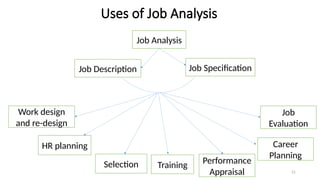
Uses of Job Analysis
Job Analysis
Job Specification
Job Description
Work design
and re-design
HR planning
Selection Training Performance
Appraisal
Career
Planning
Job
Evaluation
22
Uses of Job Analysis
• Work design and redesign- Often an organization seeks to redesign work
to make it more efficient or to improve quality. The redesign requires
detailed information about the existing job(s). In addition, preparing the
redesign is similar to analyzing a job that does not yet exist.
• Human resource planning- As planners analyze human resource needs
and how to meet those needs, they must have accurate information about
the levels of skill required in various jobs, so that they can tell what kinds
of human resources will be needed.
• Selection-To identify the most qualified applicants for various positions,
decision makers need to know what tasks the individuals must perform, as
well as the necessary knowledge, skills, and abilities.
23
• Training- Almost every employee hired by an organization will require
training. Any training program requires knowledge of the tasks
performed in a job so that the training is related to the necessary
knowledge and skills.
• Performance appraisal- An accurate performance appraisal requires
information about how well each employee is performing in order to
reward employees who perform well and to improve their
performance if it is below standard. Job analysis helps in identifying
the behaviors and the results associated with effective performance.
Uses of Job Analysis
24
• Career planning- Matching an individual's skills and aspirations with
career opportunities requires that those in charge of career planning
know the skill requirements of the various jobs. This allows them to guide
individuals into jobs in which they will succeed and be satisfied.
• Job evaluation- The process of job evaluation involves assessing the
relative dollar value of each job to the organization in order to set up fair
pay structures. If employees do not believe pay structures are fair, they
will become dissatisfied and may quit, or they will not see much benefit in
striving for promotions. To put dollar values on jobs, it is necessary to get
information about different jobs and compare them.
Uses of Job Analysis
25
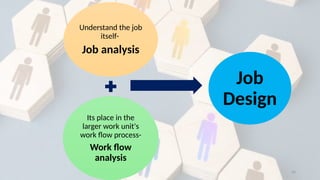
Job Design
The process of defining how work will be performed and what tasks will
be required in a given job
Required when-
1) Organization is expanding
2) Organization is trying to improve the efficiency and quality
26
Understand the job
itself-
Job analysis
Its place in the
larger work unit's
work flow process-
Work flow
analysis
Job
Design
27
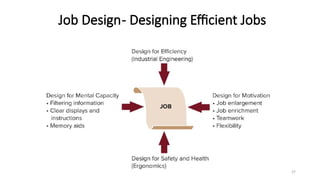
Job Design- Designing Efficient Jobs
28
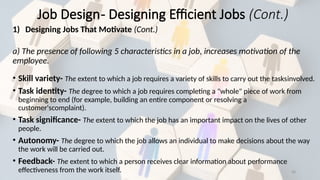
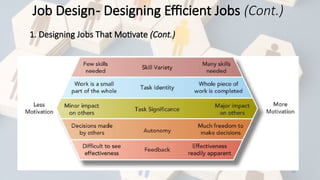
1) Designing Jobs That Motivate (Cont.)
a) The presence of following 5 characteristics in a job, increases motivation of the
employee.
• Skill variety- The extent to which a job requires a variety of skills to carry out the tasksinvolved.
• Task identity- The degree to which a job requires completing a "whole" piece of work from
beginning to end (for example, building an entire component or resolving a
customer'scomplaint).
• Task significance- The extent to which the job has an important impact on the lives of other
people.
• Autonomy- The degree to which the job allows an individual to make decisions about the way
the work will be carried out.
• Feedback- The extent to which a person receives clear information about performance
effectiveness from the work itself.
Job Design- Designing Efficient Jobs (Cont.)
29
Job Design- Designing Efficient Jobs (Cont.)
1. Designing Jobs That Motivate (Cont.)
30
b) Job Enlargement
• It is an exercise of broadening the types of tasks performed.
• The objective of job enlargement is to make jobs less repetitive and more interesting
• Jobs also become enlarged when organizations add new goals or ask fewer workers to
accomplish work that had been spread among more people.
It can be done by two ways –
• Job extension - Enlarging jobs by combining several relatively simple jobs to form a
job with a wider rangeof tasks.
• Job rotation - Enlarging jobs by moving employees among several different jobs.
Job Design- Designing Efficient Jobs (Cont.)
1. Designing Jobs That Motivate (Cont.)
31
c) Job Enrichment
• Empowering workers by adding more decision making authority to jobs.
• According to Herzberg's two-factor theory, individuals are motivated more by the intrinsic
aspects of work (for example, the meaningfulness of a job) than by extrinsic rewards, such
as pay.
• Herzberg identified five factors he associated with motivating jobs:
- achievement
- recognition
- growth
- responsibility
- performance of the entire job
Job Design- Designing Efficient Jobs (Cont.)
1. Designing Jobs That Motivate (Cont.)
32
d) Shared team work
• In team work, jobs usually are defined broadly and include sharing of work
assignments. Team members may, at one time or another, perform every duty of the
team.
• The challenge for the organization is to provide enough training so that the team
members can learn the necessary skills.
• Another approach, when teams are responsible for particular work processes or
customers, is to assign the team responsibility for the process or customer, then let the
team decide which members will carry out which tasks.
Job Design- Designing Efficient Jobs (Cont.)
1. Designing Jobs That Motivate (Cont.)
33
e) Flexible work schedules
• A scheduling policy in which full-time employees may choose starting and ending times
within guidelines specified by the organization.
Some other common practices associated with flexible work schedules
1) Job sharing - A work option in which two part-time employees carry out the tasks
associated with a single job.
2) Compressed work week – It is a schedule in which full-time workers complete their
weekly hours in fewer than five days.
3) Telework - Doing one's work away from a centrally located office is telework, or
telecommuting.
Job Design- Designing Efficient Jobs (Cont.)
1. Designing Jobs That Motivate (Cont.)
34
a) Ergonomic Jobs
Ergonomics- The study of the interface between individuals‘ physiology and
the characteristics of the physical work environment.
• The goal is to minimize physical strain on the worker by structuring the physical work
environment around the way the human body works.
• It focuses on outcomes such as reducing physical fatigue, aches and pains, and health
complaints.
• It includes the context in which work takes place, such as the lighting, space, and hours
worked.
Job Design- Designing Efficient Jobs (Cont.)
2. Designing for Health and Safety
35
• Just as the human body has capabilities and limitations, addressed by ergonomics, the mind,
too, has capabilities and limitations.
• Besides hiring people with certain mental skills, organizations can design jobs so that they
can be accurately and safely performed given the way the brain processes information.
• Generally, this means reducing the information-processing requirements of a job. In these
simpler jobs, workers may be less likely to make mistakes or have accidents.
• There are several ways to simplify a job's mental demands.
1) By limiting the amount of information and memorization that the job requires.
2) Organizations can also provide adequate lighting, easy-to-understand gauges and displays, simple-to-
operate equipment, and clear instructions.
3) By creating checklists, charts, or other aids.
4) A well-designed information system can help by presenting information in a way that makes it easier to
process
Job Design- Designing Efficient Jobs (Cont.)
3. Designing to meet mental capabilities

Work-flow analysis, Job Analysis, Job design.pptx

  • 1.
  • 2.
    2 Human Resource Planning •Determines the human resources requirement of the organization to achieve its strategic goals • The right number & right kind of people at the right place at the right time • Integral part of the business planning exercise
  • 3.
    3 Environmental Scan 1)Internal 2) External DemandForecast Supply Forecast Required Available Gap Analysis Plan of Action Surplus Manpower VRS, Restricted Hiring, Outplacement, Downsizing Demand = Supply No Action Shortage of Manpower Recruitment, Promotion
  • 4.
    Demand Forecasting Methods QuantitativeMethods • Ratio • Benchmarking • Scatter Plot • Trend Analysis • Simulation • Work-Study Techniques Qualitative Methods • Managerial Judgement • Delphi Technique • Zero Based budgeting • Scenario Planning Supply Forecasting Methods • Markov Analysis • Replacement Charts • Skill Inventories • Wastage Analysis • Succession Planning • Scenario Planning 4
  • 5.
    5 Work Flow Design •The process of analysing the tasks necessary for the production of a product or service. • Managers analyze the tasks needed to produce a product or service. • With this information, they assign these tasks to specific jobs and positions. • Job is a set of related duties. • A position is the set of duties performed by one person.
  • 6.
  • 7.
    7 Inputs • The inputsrequired to carry out the work processes. • Inputs fall into three categories: 1) Raw inputs –materials, data and information 2) Equipment – Machine, facility, systems 3) Human resources - knowledge, skills, and abilities (KSAOs) Work Flow Analysis
  • 8.
    8 Work Processes • Workflow analysis next considers the work processes used to generate the outputs identified. • Work processes are the activities that a work unit's members engage in to produce a given output. • They are described in terms of operating procedures for every task performed by each employee at each stage of the process. • Specifying the processes helps HRM professionals design efficient work systems by clarifying which tasks are necessary. • Knowledge of work processes also can guide staffing changes when work is automated, outsourced, or restructured. Work Flow Analysis
  • 9.
    9 Outputs • They arethe products of any work unit, say, a department or team. • Outputs may be tangible, as in the case of a restaurant meal or finished part. • They may be intangible, such as building security or an answered question about employee benefits. • In identifying the outputs of particular work units, work flow analysis considers both quantity and quality. Work Flow Analysis
  • 10.
    10 Positions to fill– How do you know whom to hire? Job titles
  • 11.
    11 Job Analysis • Theprocedure for determining the knowledge, skills, and abilities required for performing a job in the organization • Done in beginning of designing formal HR processes • Done when new roles and jobs are created • Done when job content has undergone a modification, review, or redesign • Process – Gather data about the job requirements from managers and job holders  Compile and Sort the data  Analyze
  • 12.
    12 Job Analysis :Information Hierarchy 1. Job Family: HR professional 1.1. Occupation: Compensation Specialist 1.2. Job: Payroll Manager 1.3. Position: Policy Administrator 1.4. Duty: Payroll Processing 1.5. Task: Preparing Forms 1.6. Element: Signing Pay Checks
  • 13.
    13 Outcome of JobAnalysis 1) Overall Purpose – The reason why the job exists & expectations from the job holder 2) Organization – Fitment of job in the organization, reporting structure 3) Job Content – Task & duties to be carried out, KSAs needed by job holder 4) Dimensions – Measurable indicators of the size of job, eg. Span, targets etc
  • 14.
    14 Outcome of JobAnalysis • Job analysis produces information for writing job descriptions (a list of what the job entails) and job (or “person”) specifications (what kind of people to hire for the job). 1) Job descriptions - A list of a job’s duties, responsibilities, reporting relationships, working conditions, and supervisory – tasks, duties, and responsibilities (TDRs) 2) Job specifications- A list of a job’s “human requirements,” that is, the requisite education, knowledge, skills, personality, ability - KSAOs
  • 15.
    15 • Knowledge refersto factual or procedural information that is necessary for successfully performing a task. • Skill is an individual's level of proficiency at performing a particular i.e., the capability to perform it well. With knowledge and experience, one can acquire skill in the task • Ability, in contrast to skill, refers to a more general enduring capability that an individual possesses. • Other characteristics might be personality traits such as someone's persistence or motivation to achieve. Some jobs also have legal requirements, such as licensing or certification.
  • 16.
    16 Details given inJob Description • Job Title • Location of the job • Work duration – Time, number of days, etc. • Materials, equipment, tools, software, etc. to be used on the job • Complete list of duties to be performed on the job • Conditions at work (mention of any job hazards) • Designation of supervisor • Number and designation of sub-ordinates • Salary level and details (Basic Pay, Dearness Allowance, Bonus, Incentive, Other allowance, method and time of payment) • Training, development, and promotion opportunities • Definition of any un-usual terms used
  • 17.
    17 Details given inJob Specification • Education and Professional qualifications • Skills • Practical experience • Physical fitness • Special qualities required for performing the job • Intelligence, judgement, and initiatives required for performing the job
  • 18.
    18 Information Required ToDo Job Analysis 1. Work activities. Information about the job’s actual work activities, such as cleaning, selling, teaching, or painting. This list may also include how, why, and when the worker performs each activity. 2. Human behaviors. Information about human behaviors the job requires, like sensing, communicating, lifting weights, or walking long distances. 3. Machines, tools, equipment, and work aids. Information regarding tools used, materials processed, knowledge dealt with or applied (such as finance or law), and services rendered (such as counseling or repairing).
  • 19.
    19 4. Performance standards.Information about the job’s performance standards (in terms of quantity or quality levels for each job duty, for instance). 5. Job context. Information about such matters as physical working conditions, work schedule, incentives, and, for instance, the number of people with whom the employee would normally interact. 6. Human requirements. Information such as knowledge or skills (education,training, work experience) and required personal attributes (aptitudes, personality, interests). Information Required To Do Job Analysis
  • 20.
    20 • Observers– Supervisor,external job analysts, labour departments - Provide most accurate information about the job • Doer– Present and past Job incumbents, Trainer - Provide elaborated and accurate information, but information may be biased or inflated Sources of Information Required To Do Job Analysis
  • 21.
    21 Uses of JobAnalysis Job Analysis Job Specification Job Description Work design and re-design HR planning Selection Training Performance Appraisal Career Planning Job Evaluation
  • 22.
    22 Uses of JobAnalysis • Work design and redesign- Often an organization seeks to redesign work to make it more efficient or to improve quality. The redesign requires detailed information about the existing job(s). In addition, preparing the redesign is similar to analyzing a job that does not yet exist. • Human resource planning- As planners analyze human resource needs and how to meet those needs, they must have accurate information about the levels of skill required in various jobs, so that they can tell what kinds of human resources will be needed. • Selection-To identify the most qualified applicants for various positions, decision makers need to know what tasks the individuals must perform, as well as the necessary knowledge, skills, and abilities.
  • 23.
    23 • Training- Almostevery employee hired by an organization will require training. Any training program requires knowledge of the tasks performed in a job so that the training is related to the necessary knowledge and skills. • Performance appraisal- An accurate performance appraisal requires information about how well each employee is performing in order to reward employees who perform well and to improve their performance if it is below standard. Job analysis helps in identifying the behaviors and the results associated with effective performance. Uses of Job Analysis
  • 24.
    24 • Career planning-Matching an individual's skills and aspirations with career opportunities requires that those in charge of career planning know the skill requirements of the various jobs. This allows them to guide individuals into jobs in which they will succeed and be satisfied. • Job evaluation- The process of job evaluation involves assessing the relative dollar value of each job to the organization in order to set up fair pay structures. If employees do not believe pay structures are fair, they will become dissatisfied and may quit, or they will not see much benefit in striving for promotions. To put dollar values on jobs, it is necessary to get information about different jobs and compare them. Uses of Job Analysis
  • 25.
    25 Job Design The processof defining how work will be performed and what tasks will be required in a given job Required when- 1) Organization is expanding 2) Organization is trying to improve the efficiency and quality
  • 26.
    26 Understand the job itself- Jobanalysis Its place in the larger work unit's work flow process- Work flow analysis Job Design
  • 27.
  • 28.
    28 1) Designing JobsThat Motivate (Cont.) a) The presence of following 5 characteristics in a job, increases motivation of the employee. • Skill variety- The extent to which a job requires a variety of skills to carry out the tasksinvolved. • Task identity- The degree to which a job requires completing a "whole" piece of work from beginning to end (for example, building an entire component or resolving a customer'scomplaint). • Task significance- The extent to which the job has an important impact on the lives of other people. • Autonomy- The degree to which the job allows an individual to make decisions about the way the work will be carried out. • Feedback- The extent to which a person receives clear information about performance effectiveness from the work itself. Job Design- Designing Efficient Jobs (Cont.)
  • 29.
    29 Job Design- DesigningEfficient Jobs (Cont.) 1. Designing Jobs That Motivate (Cont.)
  • 30.
    30 b) Job Enlargement •It is an exercise of broadening the types of tasks performed. • The objective of job enlargement is to make jobs less repetitive and more interesting • Jobs also become enlarged when organizations add new goals or ask fewer workers to accomplish work that had been spread among more people. It can be done by two ways – • Job extension - Enlarging jobs by combining several relatively simple jobs to form a job with a wider rangeof tasks. • Job rotation - Enlarging jobs by moving employees among several different jobs. Job Design- Designing Efficient Jobs (Cont.) 1. Designing Jobs That Motivate (Cont.)
  • 31.
    31 c) Job Enrichment •Empowering workers by adding more decision making authority to jobs. • According to Herzberg's two-factor theory, individuals are motivated more by the intrinsic aspects of work (for example, the meaningfulness of a job) than by extrinsic rewards, such as pay. • Herzberg identified five factors he associated with motivating jobs: - achievement - recognition - growth - responsibility - performance of the entire job Job Design- Designing Efficient Jobs (Cont.) 1. Designing Jobs That Motivate (Cont.)
  • 32.
    32 d) Shared teamwork • In team work, jobs usually are defined broadly and include sharing of work assignments. Team members may, at one time or another, perform every duty of the team. • The challenge for the organization is to provide enough training so that the team members can learn the necessary skills. • Another approach, when teams are responsible for particular work processes or customers, is to assign the team responsibility for the process or customer, then let the team decide which members will carry out which tasks. Job Design- Designing Efficient Jobs (Cont.) 1. Designing Jobs That Motivate (Cont.)
  • 33.
    33 e) Flexible workschedules • A scheduling policy in which full-time employees may choose starting and ending times within guidelines specified by the organization. Some other common practices associated with flexible work schedules 1) Job sharing - A work option in which two part-time employees carry out the tasks associated with a single job. 2) Compressed work week – It is a schedule in which full-time workers complete their weekly hours in fewer than five days. 3) Telework - Doing one's work away from a centrally located office is telework, or telecommuting. Job Design- Designing Efficient Jobs (Cont.) 1. Designing Jobs That Motivate (Cont.)
  • 34.
    34 a) Ergonomic Jobs Ergonomics-The study of the interface between individuals‘ physiology and the characteristics of the physical work environment. • The goal is to minimize physical strain on the worker by structuring the physical work environment around the way the human body works. • It focuses on outcomes such as reducing physical fatigue, aches and pains, and health complaints. • It includes the context in which work takes place, such as the lighting, space, and hours worked. Job Design- Designing Efficient Jobs (Cont.) 2. Designing for Health and Safety
  • 35.
    35 • Just asthe human body has capabilities and limitations, addressed by ergonomics, the mind, too, has capabilities and limitations. • Besides hiring people with certain mental skills, organizations can design jobs so that they can be accurately and safely performed given the way the brain processes information. • Generally, this means reducing the information-processing requirements of a job. In these simpler jobs, workers may be less likely to make mistakes or have accidents. • There are several ways to simplify a job's mental demands. 1) By limiting the amount of information and memorization that the job requires. 2) Organizations can also provide adequate lighting, easy-to-understand gauges and displays, simple-to- operate equipment, and clear instructions. 3) By creating checklists, charts, or other aids. 4) A well-designed information system can help by presenting information in a way that makes it easier to process Job Design- Designing Efficient Jobs (Cont.) 3. Designing to meet mental capabilities