What is System?
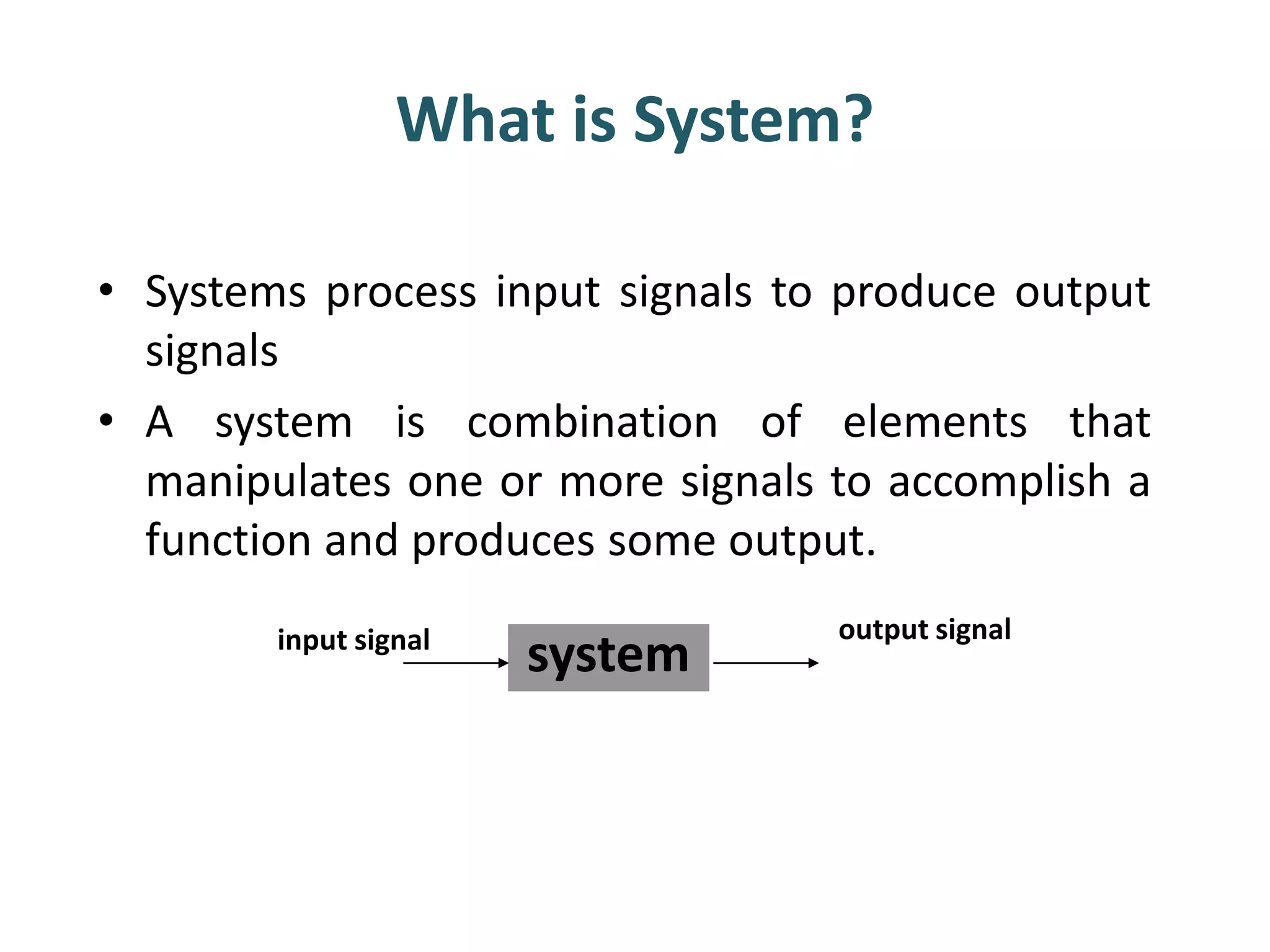
• Systems process input signals to produce output
signals
• A system is combination of elements that
manipulates one or more signals to accomplish a
function and produces some output.
system
output signalinput signal
Types of Systems
• Causal & Anticausal
• Linear & Non Linear
• Time Variant &Time-invariant
• Stable & Unstable
• Static & Dynamic
• Invertible & Inverse Systems
Causal & Anticausal Systems
• Causal system : A system is said to be causal if the
present value of the output signal depends only
on the present and/or past values of the input
signal.
• Example: y[n]=x[n]+1/2x[n-1]
Causal & Anticausal Systems Contd.
• Anticausal system : A system is said to be
anticausal if the present value of the
output signal depends only on the future
values of the input signal.
• Example: y[n]=x[n+1]+1/2x[n-1]
Linear & Non Linear Systems
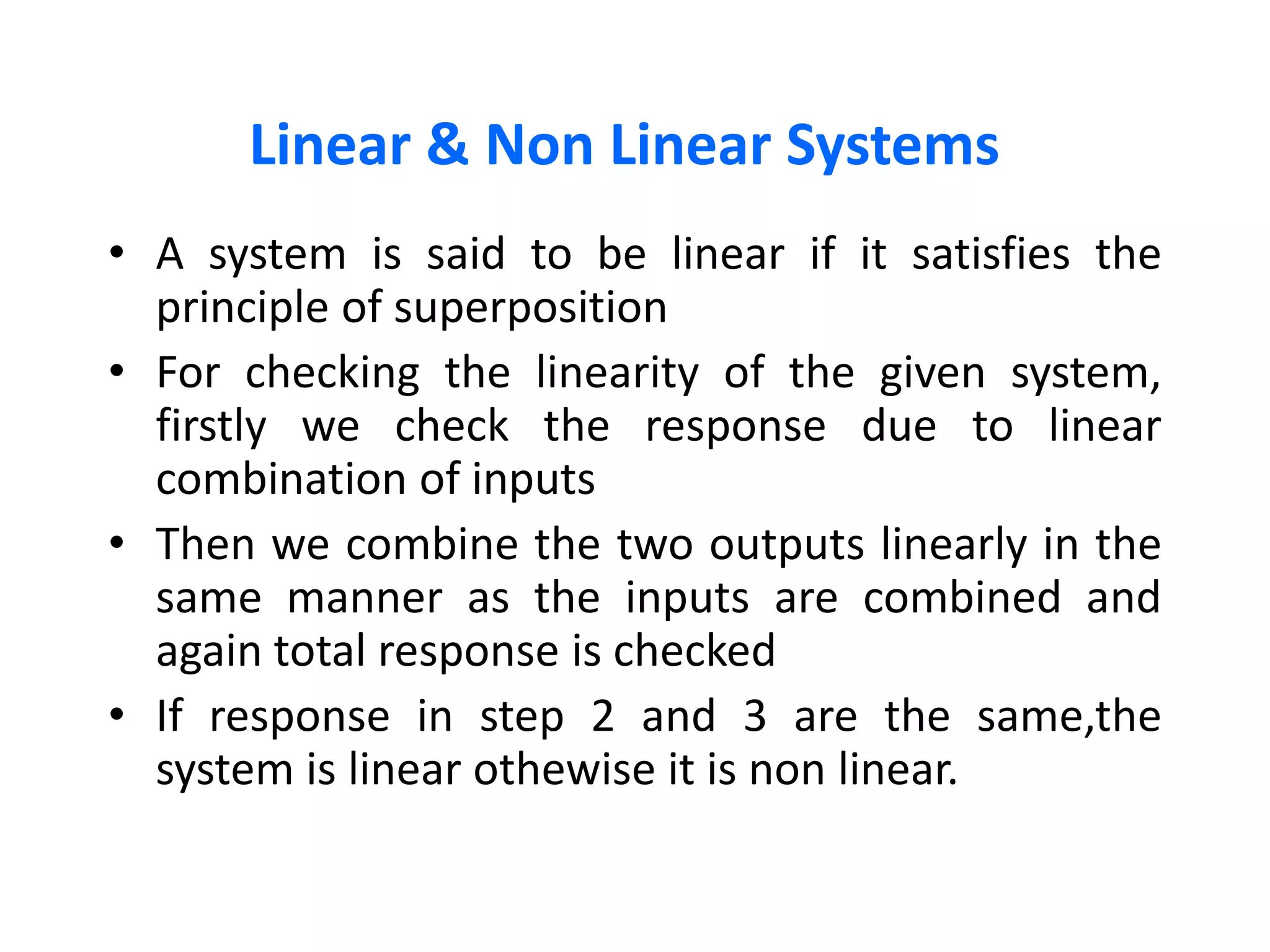
• A system is said to be linear if it satisfies the
principle of superposition
• For checking the linearity of the given system,
firstly we check the response due to linear
combination of inputs
• Then we combine the two outputs linearly in the
same manner as the inputs are combined and
again total response is checked
• If response in step 2 and 3 are the same,the
system is linear othewise it is non linear.
Time Invariant and Time Variant Systems
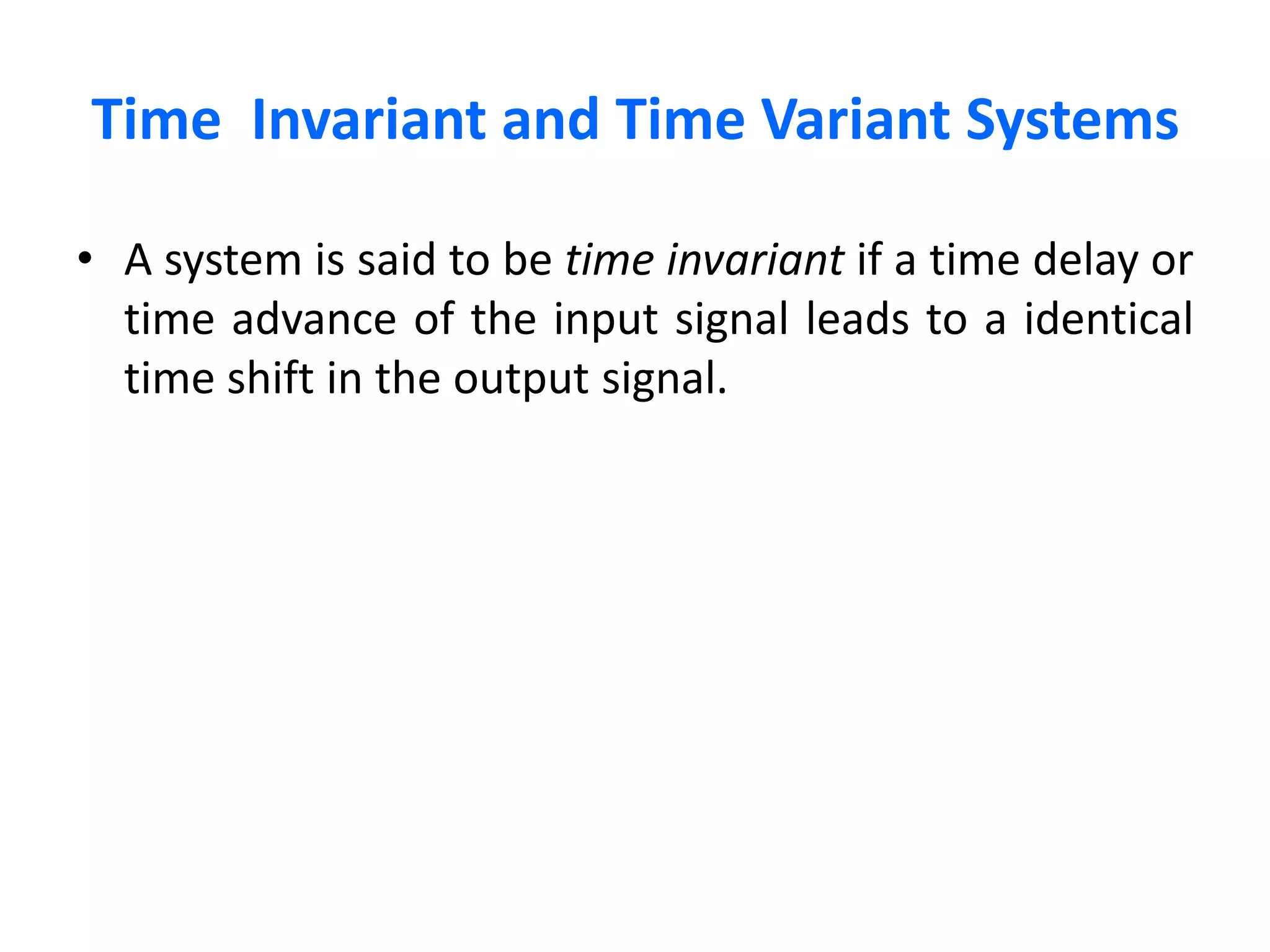
• A system is said to be time invariant if a time delay or
time advance of the input signal leads to a identical
time shift in the output signal.
Stable & Unstable Systems
• A system is said to be bounded-input bounded-
output stable (BIBO stable) if every bounded input
results in a bounded output.
Stable & Unstable Systems Contd.
Example
- y[n]=1/3(x[n]+x[n-1]+x[n-2])
1
[ ] [ ] [ 1] [ 2]
3
1
(| [ ]| | [ 1]| | [ 2]|)
3
1
( )
3
x x x x
y n x n x n x n
x n x n x n
M M M M
    
    
   
Stable & Unstable Systems Contd.
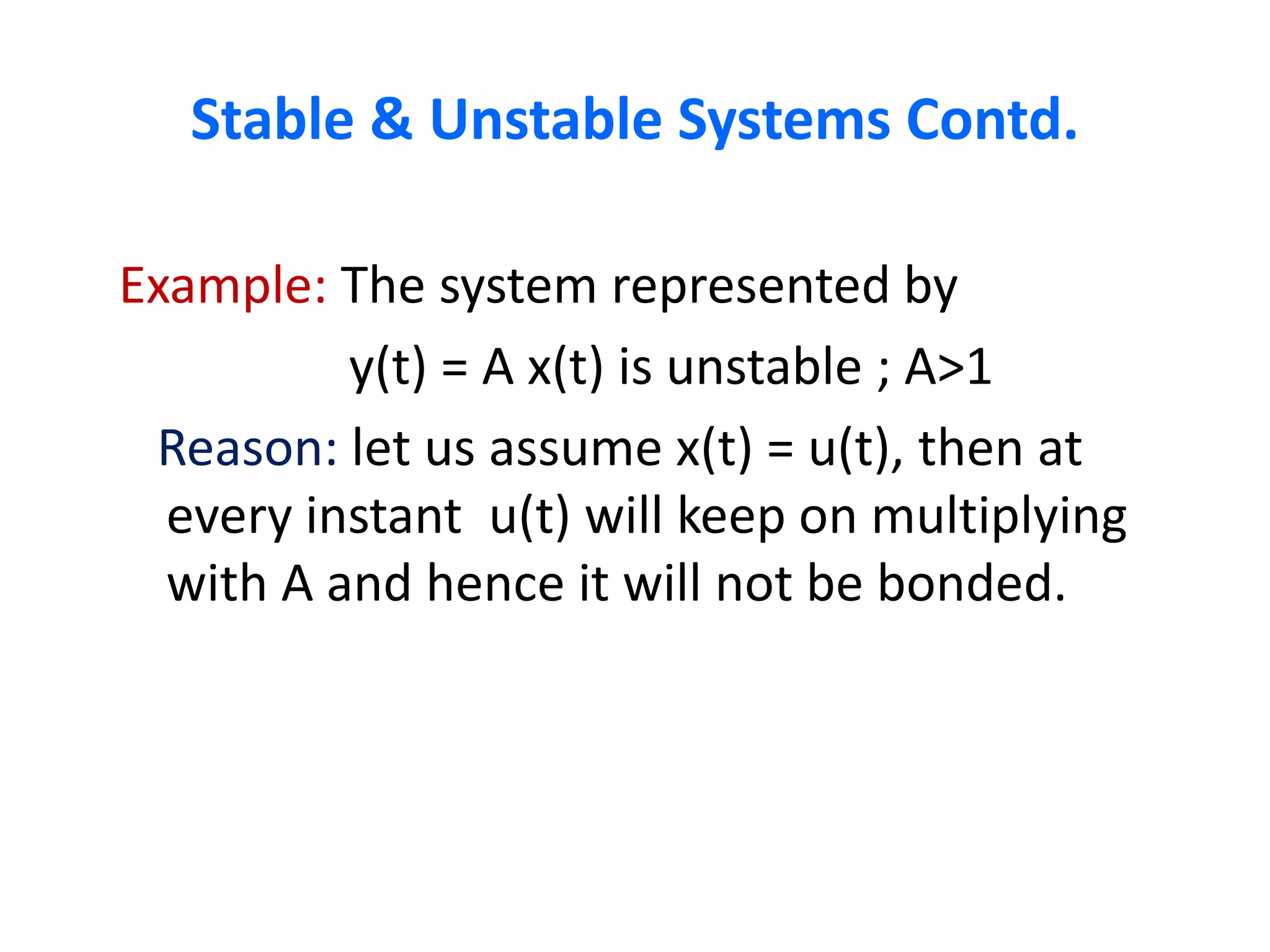
Example: The system represented by
y(t) = A x(t) is unstable ; A˃1
Reason: let us assume x(t) = u(t), then at
every instant u(t) will keep on multiplying
with A and hence it will not be bonded.
Static & Dynamic Systems
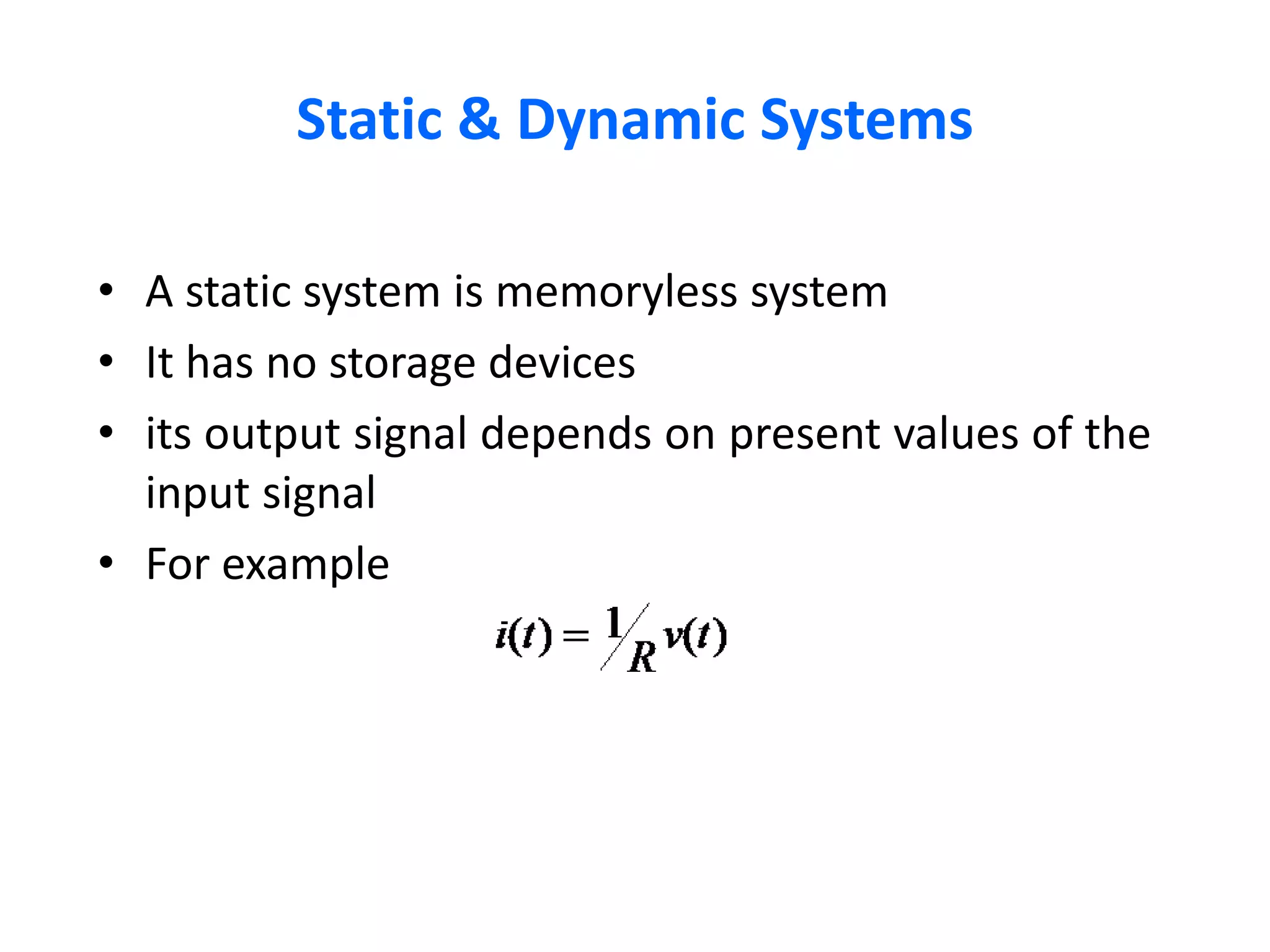
• A static system is memoryless system
• It has no storage devices
• its output signal depends on present values of the
input signal
• For example
Static & Dynamic Systems Contd.
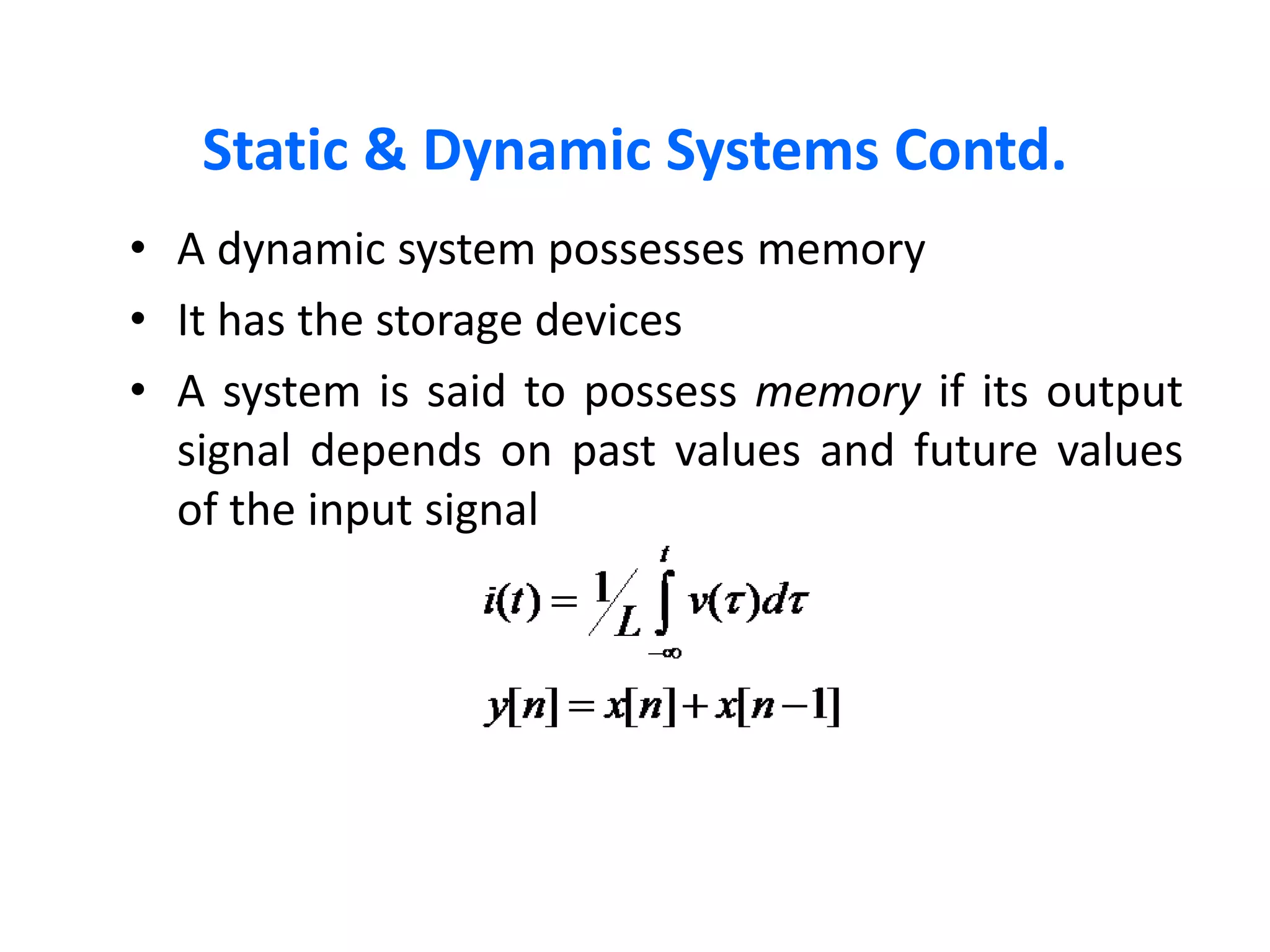
• A dynamic system possesses memory
• It has the storage devices
• A system is said to possess memory if its output
signal depends on past values and future values
of the input signal
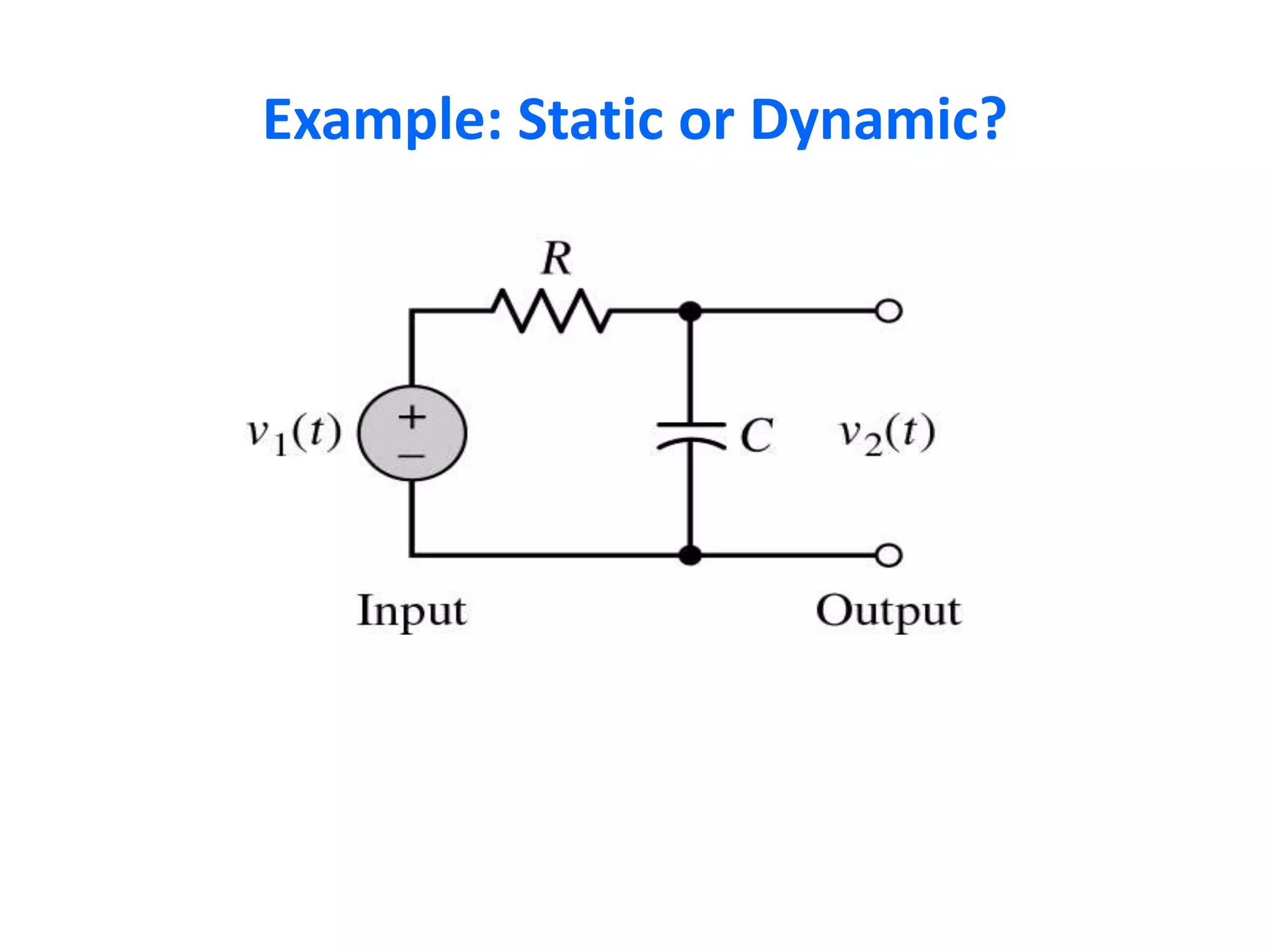
Example: Static or Dynamic?
Answer:
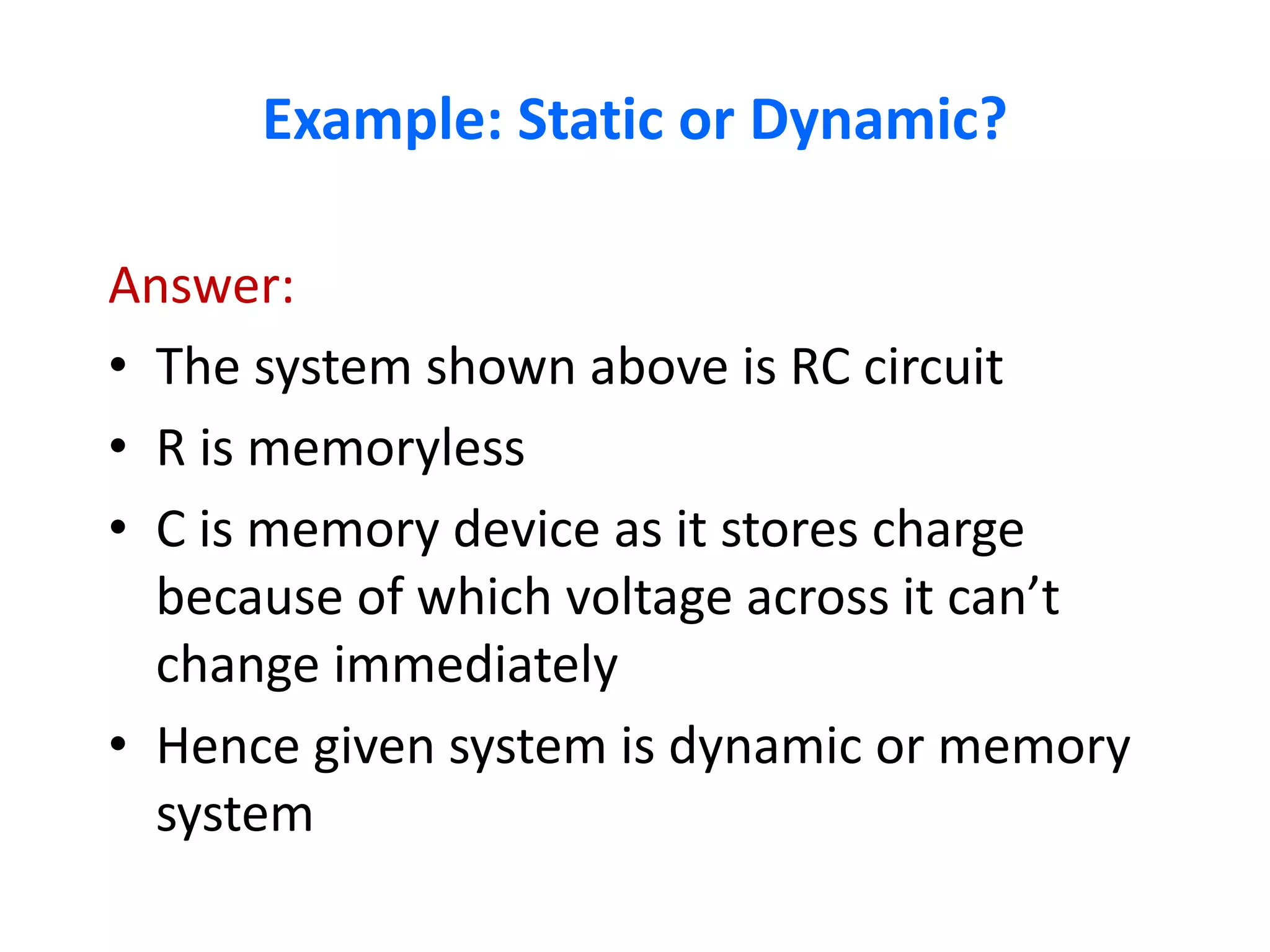
• The system shown above is RC circuit
• R is memoryless
• C is memory device as it stores charge
because of which voltage across it can’t
change immediately
• Hence given system is dynamic or memory
system
Invertible & Inverse Systems
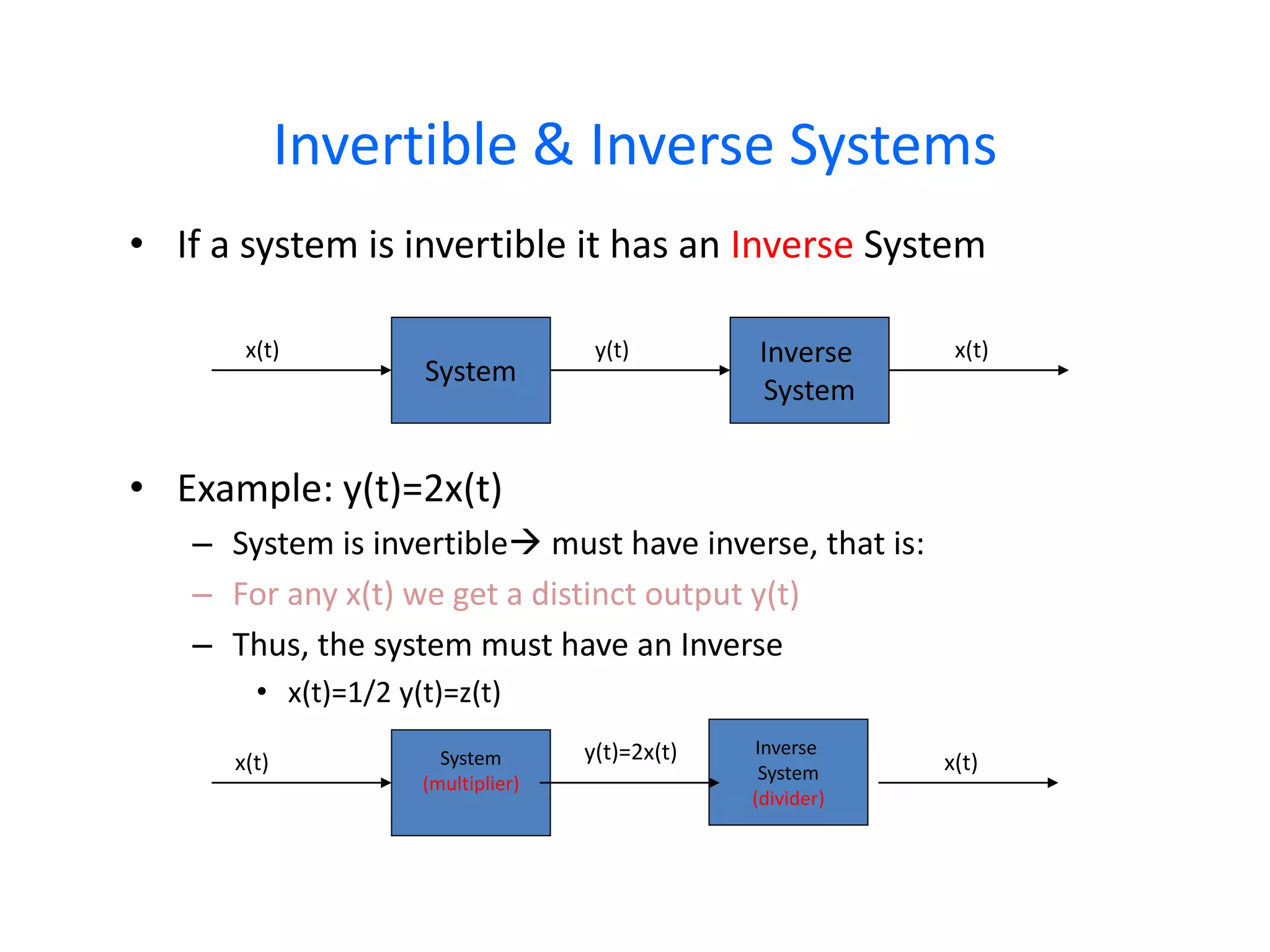
• If a system is invertible it has an Inverse System
• Example: y(t)=2x(t)
– System is invertible must have inverse, that is:
– For any x(t) we get a distinct output y(t)
– Thus, the system must have an Inverse
• x(t)=1/2 y(t)=z(t)
y(t)
System
Inverse
System
x(t) x(t)
y(t)=2x(t)System
(multiplier)
Inverse
System
(divider)
x(t) x(t)

Types of system

  • 1.
    What is System? •Systems process input signals to produce output signals • A system is combination of elements that manipulates one or more signals to accomplish a function and produces some output. system output signalinput signal
  • 2.
    Types of Systems •Causal & Anticausal • Linear & Non Linear • Time Variant &Time-invariant • Stable & Unstable • Static & Dynamic • Invertible & Inverse Systems
  • 3.
    Causal & AnticausalSystems • Causal system : A system is said to be causal if the present value of the output signal depends only on the present and/or past values of the input signal. • Example: y[n]=x[n]+1/2x[n-1]
  • 4.
    Causal & AnticausalSystems Contd. • Anticausal system : A system is said to be anticausal if the present value of the output signal depends only on the future values of the input signal. • Example: y[n]=x[n+1]+1/2x[n-1]
  • 5.
    Linear & NonLinear Systems • A system is said to be linear if it satisfies the principle of superposition • For checking the linearity of the given system, firstly we check the response due to linear combination of inputs • Then we combine the two outputs linearly in the same manner as the inputs are combined and again total response is checked • If response in step 2 and 3 are the same,the system is linear othewise it is non linear.
  • 6.
    Time Invariant andTime Variant Systems • A system is said to be time invariant if a time delay or time advance of the input signal leads to a identical time shift in the output signal.
  • 7.
    Stable & UnstableSystems • A system is said to be bounded-input bounded- output stable (BIBO stable) if every bounded input results in a bounded output.
  • 8.
    Stable & UnstableSystems Contd. Example - y[n]=1/3(x[n]+x[n-1]+x[n-2]) 1 [ ] [ ] [ 1] [ 2] 3 1 (| [ ]| | [ 1]| | [ 2]|) 3 1 ( ) 3 x x x x y n x n x n x n x n x n x n M M M M              
  • 9.
    Stable & UnstableSystems Contd. Example: The system represented by y(t) = A x(t) is unstable ; A˃1 Reason: let us assume x(t) = u(t), then at every instant u(t) will keep on multiplying with A and hence it will not be bonded.
  • 10.
    Static & DynamicSystems • A static system is memoryless system • It has no storage devices • its output signal depends on present values of the input signal • For example
  • 11.
    Static & DynamicSystems Contd. • A dynamic system possesses memory • It has the storage devices • A system is said to possess memory if its output signal depends on past values and future values of the input signal
  • 12.
  • 13.
    Example: Static orDynamic? Answer: • The system shown above is RC circuit • R is memoryless • C is memory device as it stores charge because of which voltage across it can’t change immediately • Hence given system is dynamic or memory system
  • 14.
    Invertible & InverseSystems • If a system is invertible it has an Inverse System • Example: y(t)=2x(t) – System is invertible must have inverse, that is: – For any x(t) we get a distinct output y(t) – Thus, the system must have an Inverse • x(t)=1/2 y(t)=z(t) y(t) System Inverse System x(t) x(t) y(t)=2x(t)System (multiplier) Inverse System (divider) x(t) x(t)