

jgillis767@aol.com First Light 1
Understanding Emotions
The Road to Human Freedom
Spinoza, Buddha, et al.
jgillis767@aol.com First Light 2
Like Freud, too, and Spinoza as well,
the Buddha believes that to
understand is to transcend.
jgillis767@aol.com First Light 3
The fire of life must be put out. For
everything in this world is on fire with
the fire of desire, the fire of hate, and
the fire of illusion.
jgillis767@aol.com First Light 4
The replacement of hate with love, but
better the replacement of both by
understanding.
jgillis767@aol.com First Light 5
An Approach
 Set aside, if you will, all traditional concepts of good and
evil, right and wrong, pagan and Judeo-Christian and
Moslem and Hindu or any religion that may be part of
your mental framework; don’t deny them or throw them
away, just set them aside for a short while.
 Take a fresh approach, if you will, to the fundamental
questions such as: What is God? What is Man? What is
Truth? What is Love?
jgillis767@aol.com First Light 6
Nature
 Nothing comes to pass in nature which can be
understood as a flaw; for nature is always the same, and
everywhere one in the same in her results and effects
and power of action. True?
 Nature’s laws and ordinances, in which all things come
to pass and change from one form to another, are
everywhere and always the same. True?
jgillis767@aol.com First Light 7
Nature
 So one might assume that there should be one and the
same method of understanding the nature of all things
whatsoever, namely, through nature’s universal laws and
rules.
 Thus the passions of hatred, anger, envy, and so on,
considered in themselves, follow from this same
consistent pattern of results and effects and power of
action.
jgillis767@aol.com First Light 8
Nature
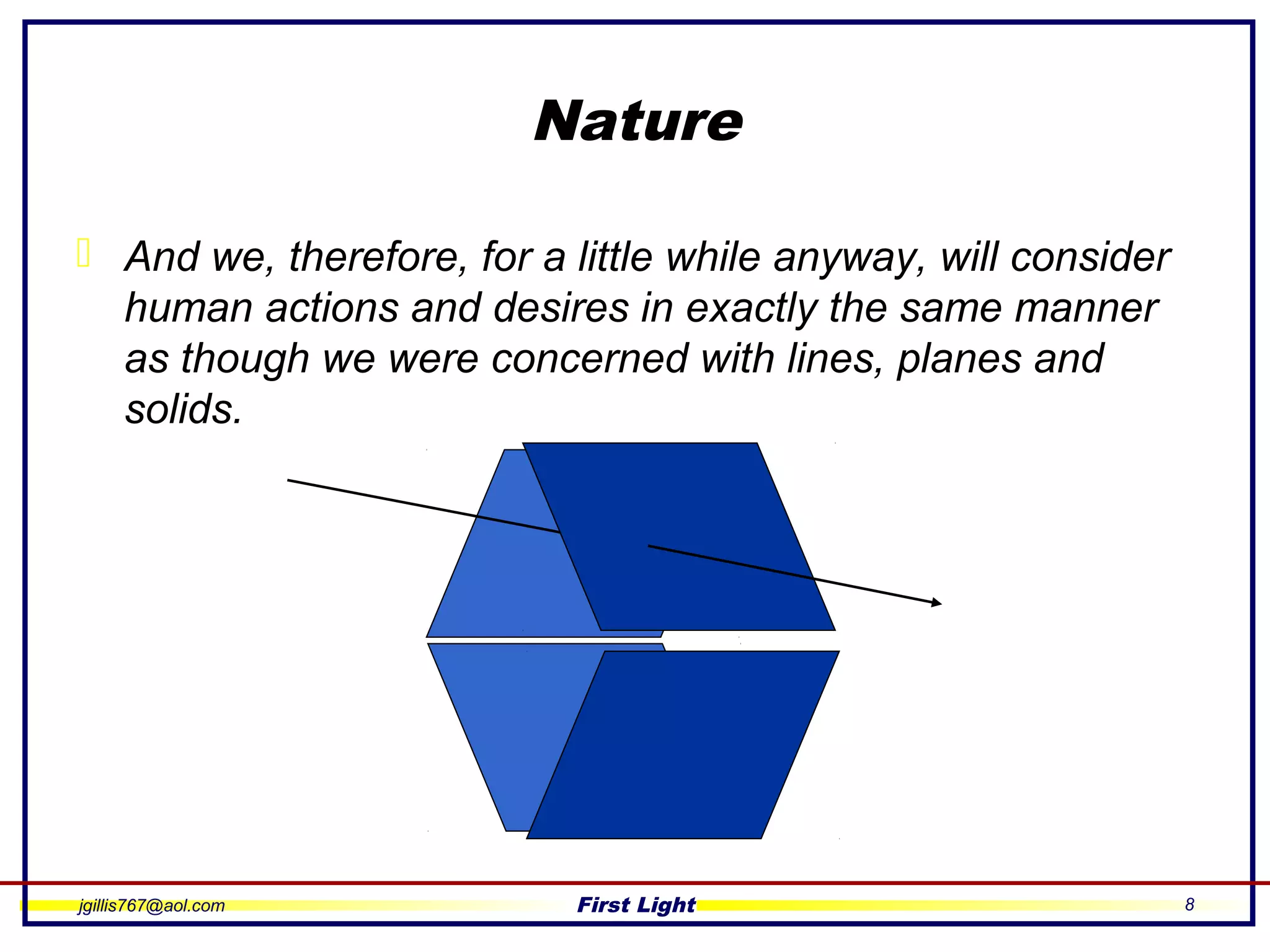
 And we, therefore, for a little while anyway, will consider
human actions and desires in exactly the same manner
as though we were concerned with lines, planes and
solids.
jgillis767@aol.com First Light 9
Mind and Body
 No one knows how or by what means the mind moves
the body.
 No one knows how the mind is “connected” to the body.
 Body cannot determine mind to think, nor can mind
determine body to motion or rest.
 One can say, “I will raise my hand,” and then raise a
hand. This is easy and simple. But one cannot “will” the
hand to rise.
 Thus when people say that their minds “control” their
bodies, they are using words to describe a phenomenon
they do not really understand.
jgillis767@aol.com First Light 10
Mind and Body
 Since no one understands the connection, yet everyone
knows there is a total connection, it perhaps is safe to
assume, at least for most intents and purposes, that
body and mind are one and the same thing – a thing that
can be thought of from (1) the angle of thought or mind
or (2) the angle of action or bodily function.
 This is important when we consider that a mental
decision and a bodily appetite are simultaneous, or one
and the same thing, which we call (1) decision when it is
thought and (2) a conditioned state when it is the body in
action.
jgillis767@aol.com First Light 11
Emotions
 Everyone shapes their actions according to their
emotions.
 Desire may be stimulated by almost anything.
 Experience abundantly shows that people can govern
anything more easily than their tongues, and restrain
anything more easily than their appetites.
jgillis767@aol.com First Light 12
Emotions
 Emotions do not have only one satisfying object, but are
able to derive satisfaction from almost any object
whatsoever.
 The most spiritual forms of human love have the same
emotional foundations as the most bestial forms of
human lust.
 Anything can, accidentally, be the cause of pleasure,
pain, or desire.
jgillis767@aol.com First Light 13
Hope-Fear – Confidence-Despair
Joy-Disappointment
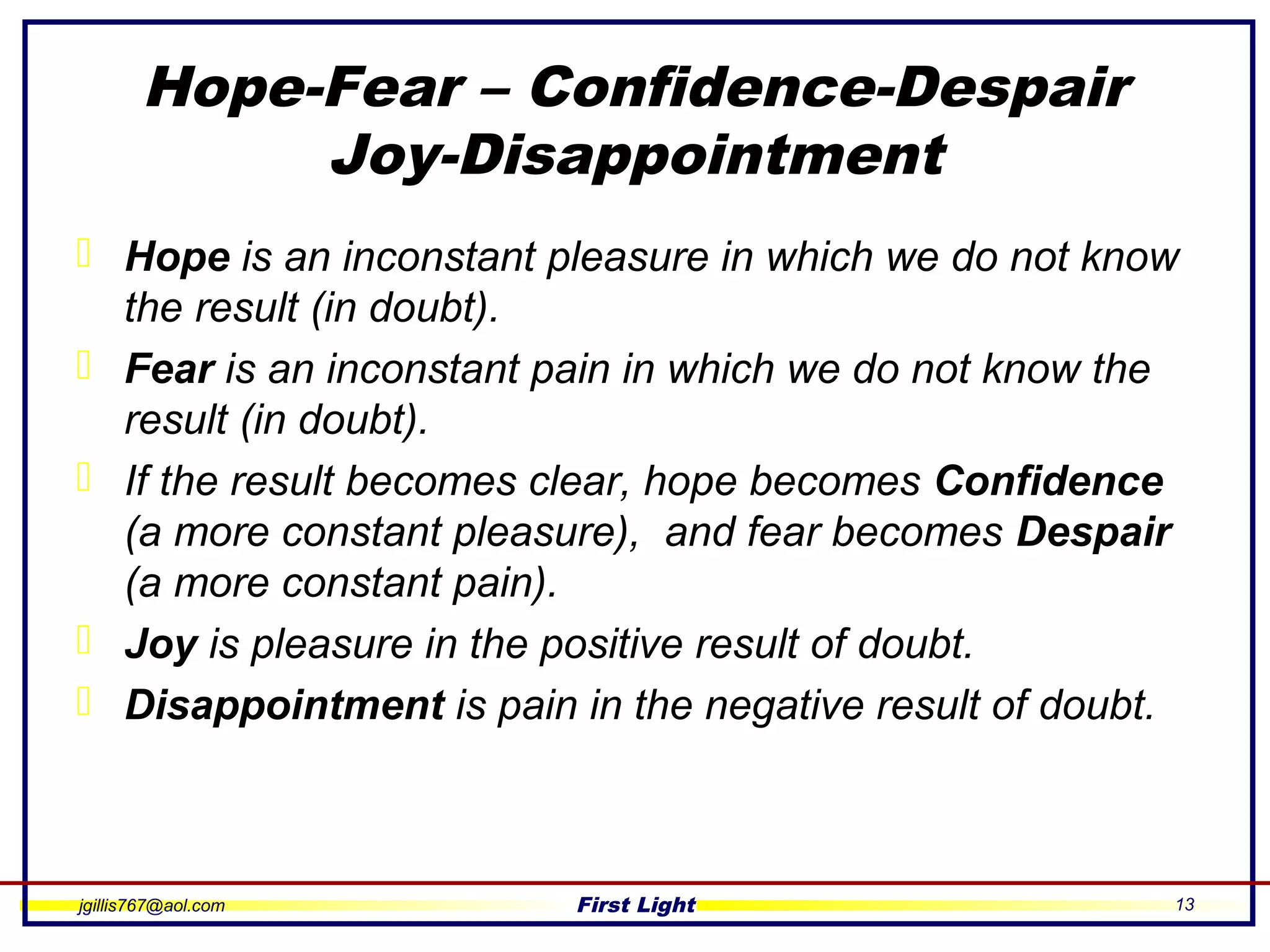
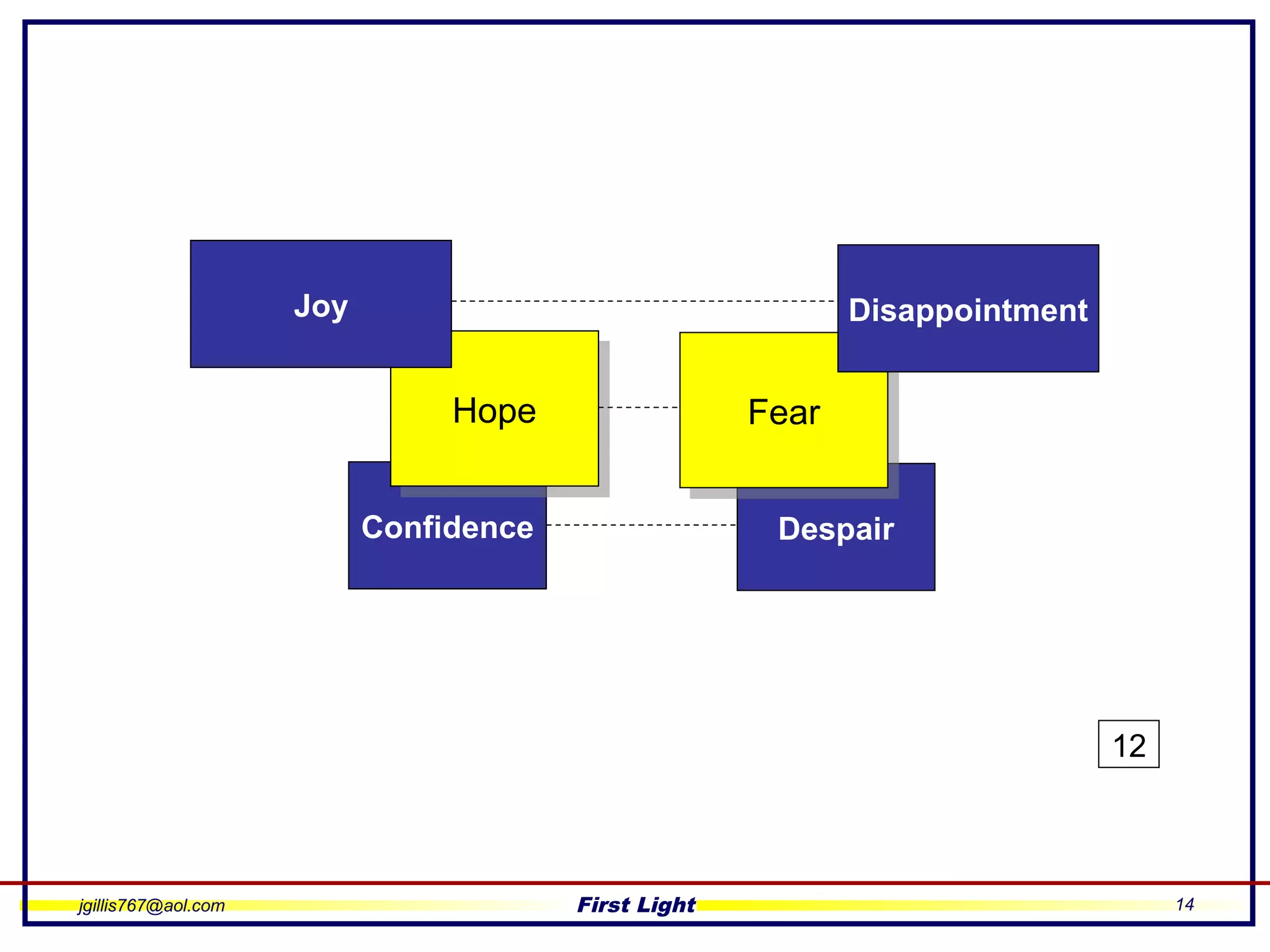
 Hope is an inconstant pleasure in which we do not know
the result (in doubt).
 Fear is an inconstant pain in which we do not know the
result (in doubt).
 If the result becomes clear, hope becomes Confidence
(a more constant pleasure), and fear becomes Despair
(a more constant pain).
 Joy is pleasure in the positive result of doubt.
 Disappointment is pain in the negative result of doubt.
jgillis767@aol.com First Light 14
Confidence
HopeHope
Despair
FearFear
DisappointmentJoy
12
jgillis767@aol.com First Light 15
Pity-Approval – Envy-Pride
Compassion-Emulation
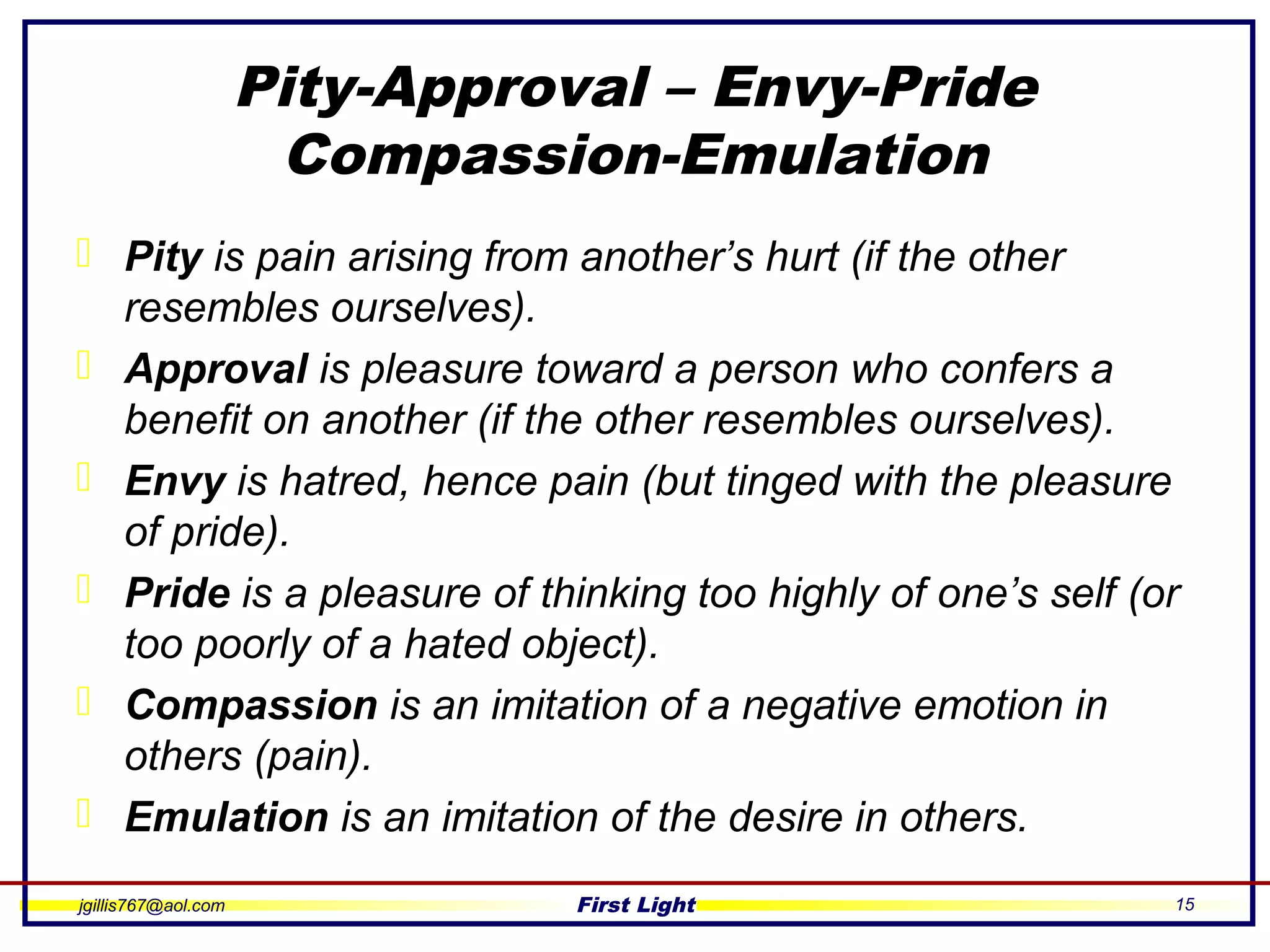
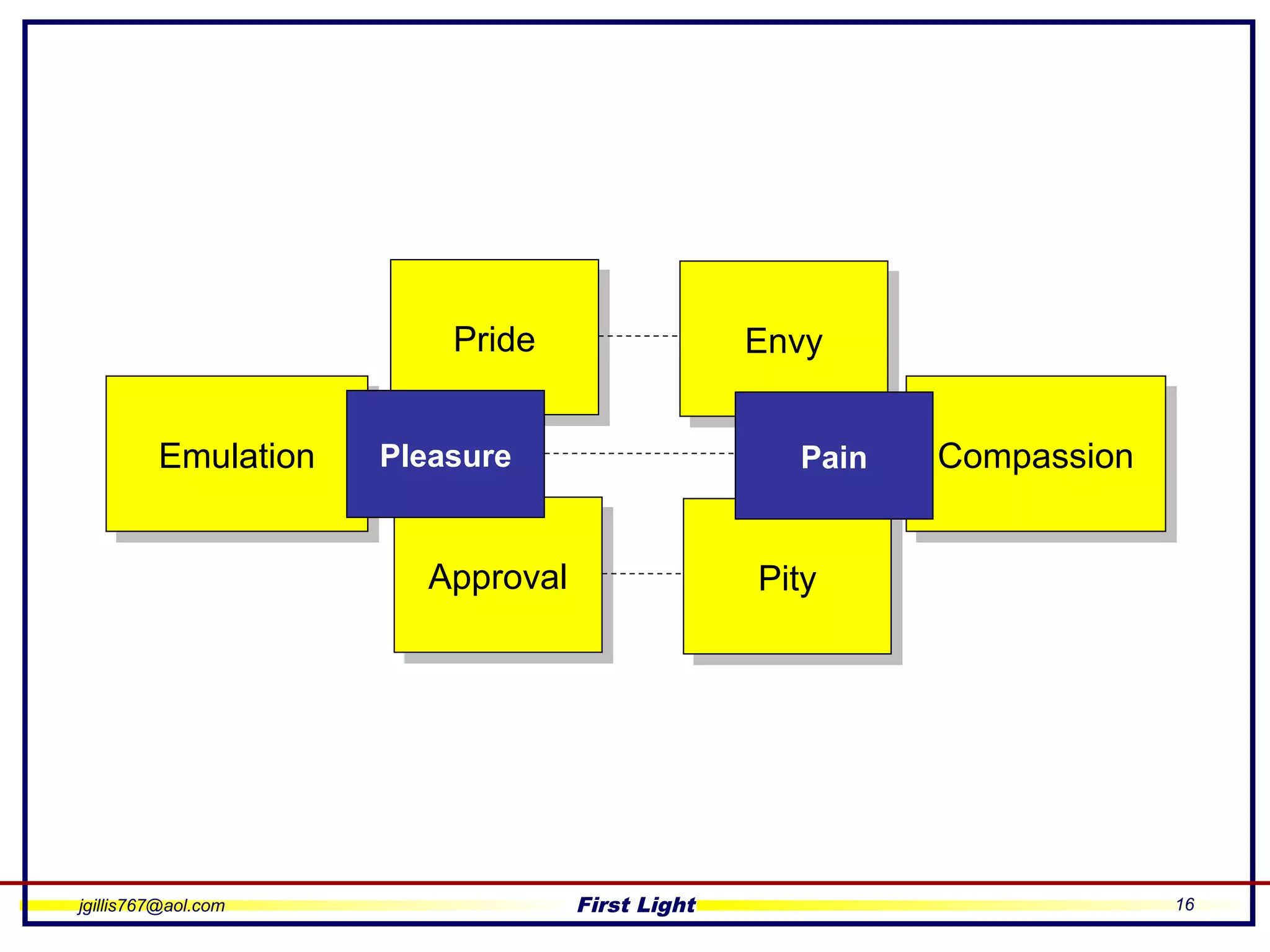
 Pity is pain arising from another’s hurt (if the other
resembles ourselves).
 Approval is pleasure toward a person who confers a
benefit on another (if the other resembles ourselves).
 Envy is hatred, hence pain (but tinged with the pleasure
of pride).
 Pride is a pleasure of thinking too highly of one’s self (or
too poorly of a hated object).
 Compassion is an imitation of a negative emotion in
others (pain).
 Emulation is an imitation of the desire in others.
jgillis767@aol.com First Light 16
EmulationEmulation CompassionCompassion
PridePride EnvyEnvy
ApprovalApproval PityPity
Pleasure Pain
jgillis767@aol.com First Light 17
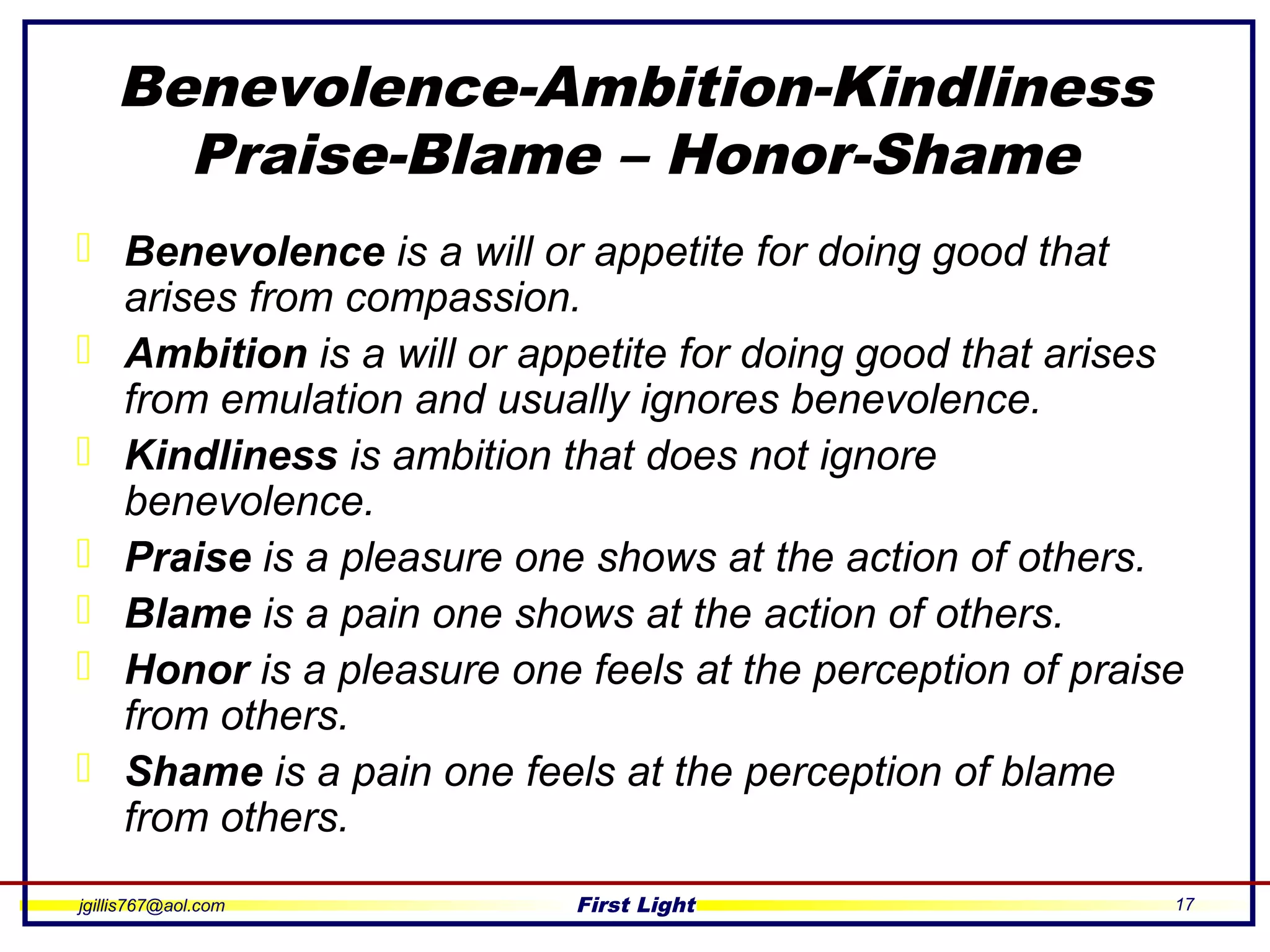
Benevolence-Ambition-Kindliness
Praise-Blame – Honor-Shame
 Benevolence is a will or appetite for doing good that
arises from compassion.
 Ambition is a will or appetite for doing good that arises
from emulation and usually ignores benevolence.
 Kindliness is ambition that does not ignore
benevolence.
 Praise is a pleasure one shows at the action of others.
 Blame is a pain one shows at the action of others.
 Honor is a pleasure one feels at the perception of praise
from others.
 Shame is a pain one feels at the perception of blame
from others.
jgillis767@aol.com First Light 18
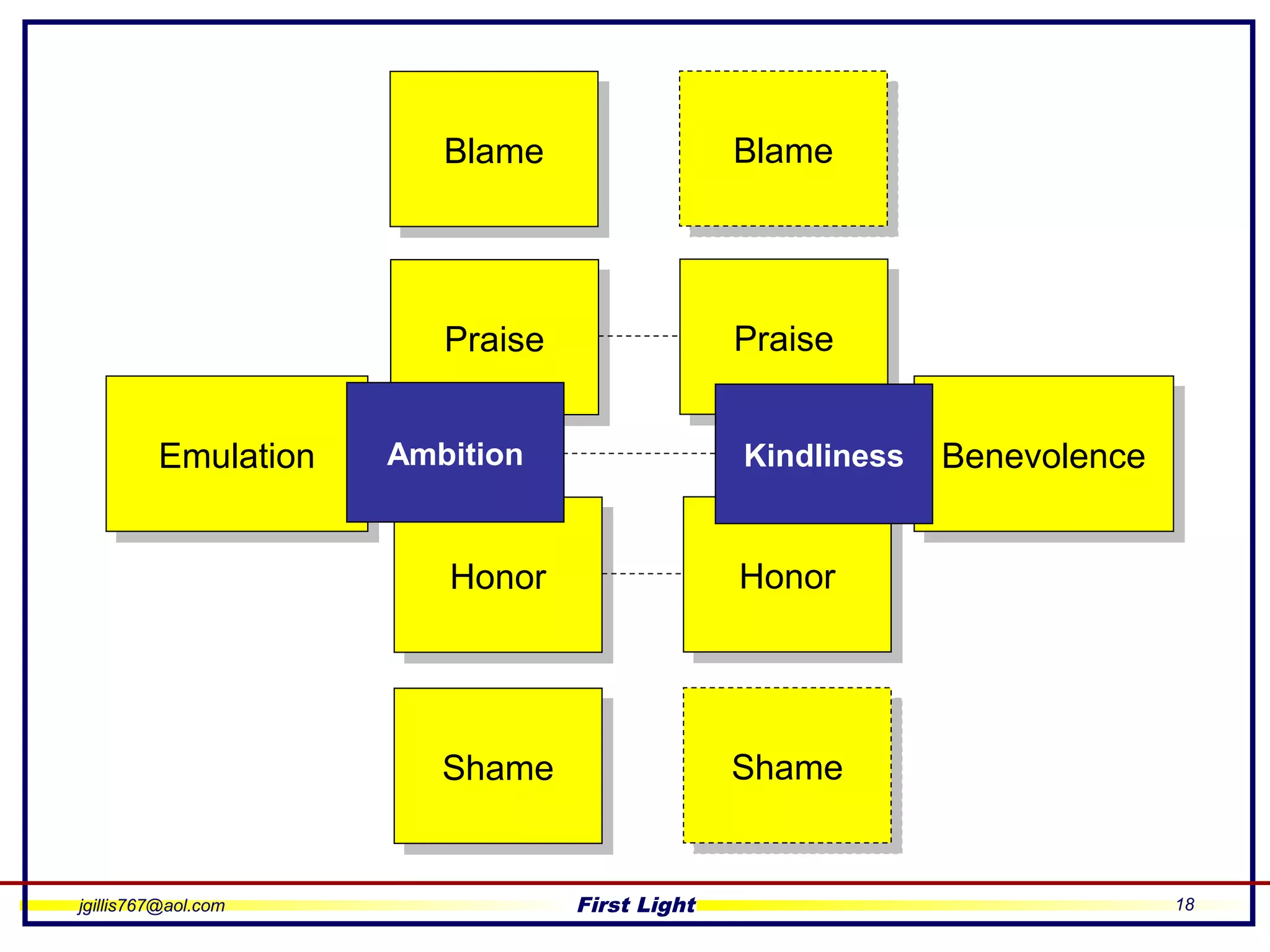
EmulationEmulation BenevolenceBenevolence
PraisePraise
BlameBlame
HonorHonor
ShameShame
Ambition
PraisePraise
BlameBlame
HonorHonor
ShameShame
Kindliness
jgillis767@aol.com First Light 19
Love is pleasure accompanied by the
idea of an external cause, and hatred
is pain accompanied by the idea of an
external cause.
jgillis767@aol.com First Light 20
The idea that our own likes and
dislikes should meet with universal
approval is really ambition. If
everyone thinks this way, then all
stand in each others way, and all
become mutually hateful.
jgillis767@aol.com First Light 21
Jealousy
 Jealousy is hatred combined with envy toward an object
of love.
 Timidity causes a person to turn from what they wish
for.
 Bashfulness is timidity because of shame.
 Consternation is the timidity of not knowing which is the
lesser evil to choose, when a choice must be made.
jgillis767@aol.com First Light 22
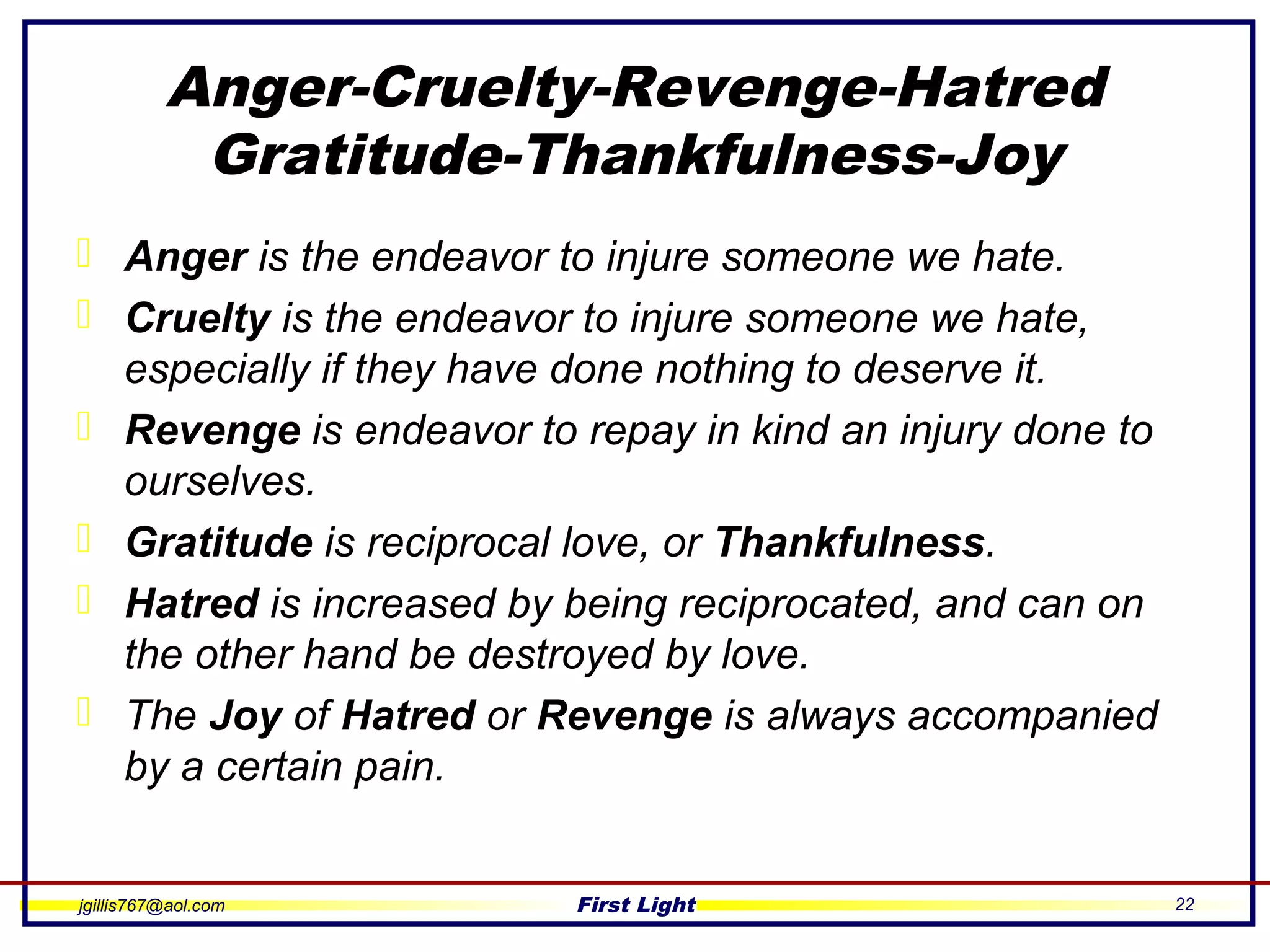
Anger-Cruelty-Revenge-Hatred
Gratitude-Thankfulness-Joy
 Anger is the endeavor to injure someone we hate.
 Cruelty is the endeavor to injure someone we hate,
especially if they have done nothing to deserve it.
 Revenge is endeavor to repay in kind an injury done to
ourselves.
 Gratitude is reciprocal love, or Thankfulness.
 Hatred is increased by being reciprocated, and can on
the other hand be destroyed by love.
 The Joy of Hatred or Revenge is always accompanied
by a certain pain.
jgillis767@aol.com First Light 23
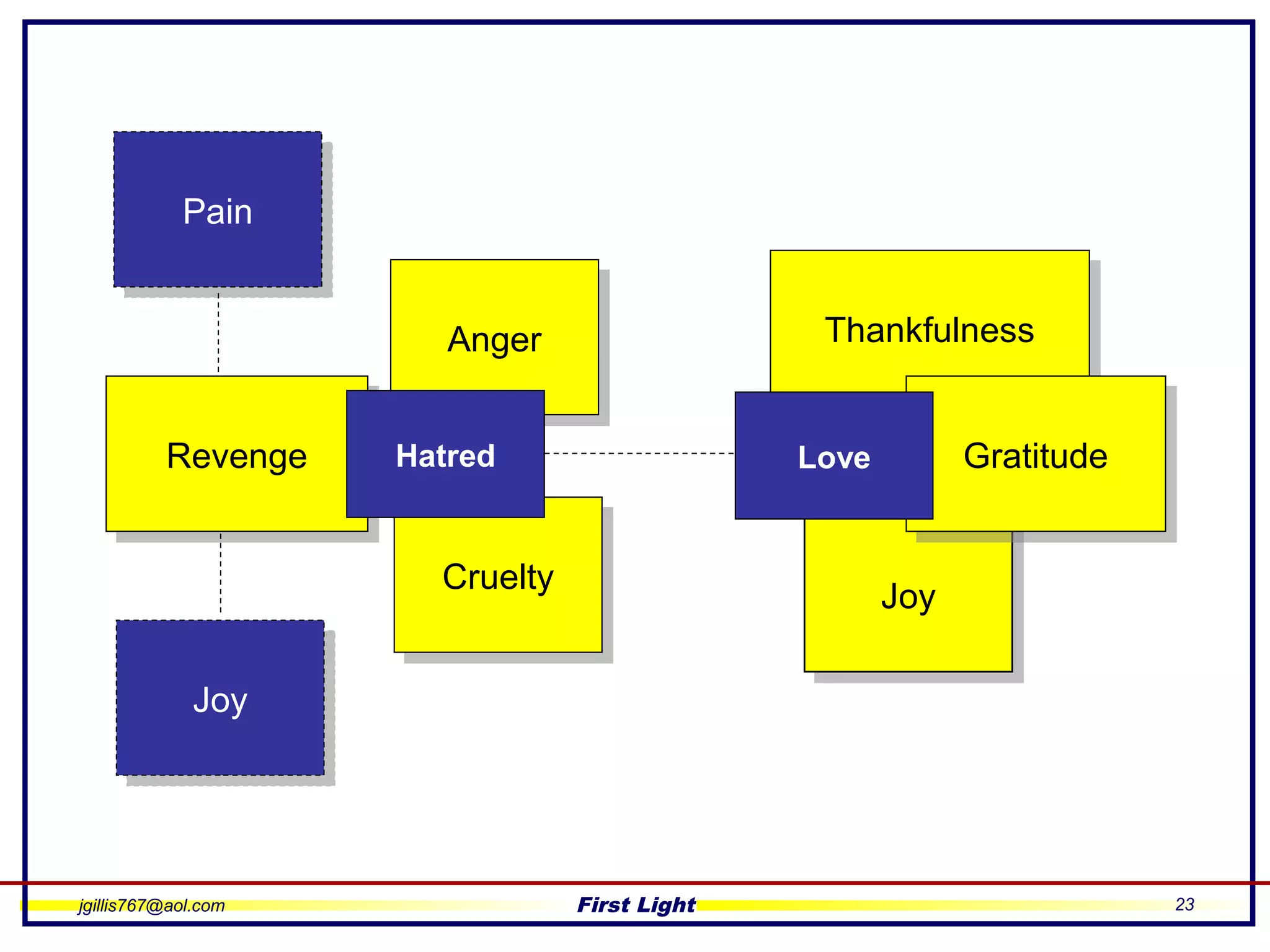
JoyJoy
ThankfulnessThankfulness
RevengeRevenge GratitudeGratitude
AngerAnger
JoyJoy
CrueltyCruelty
Hatred Love
PainPain
jgillis767@aol.com First Light 24
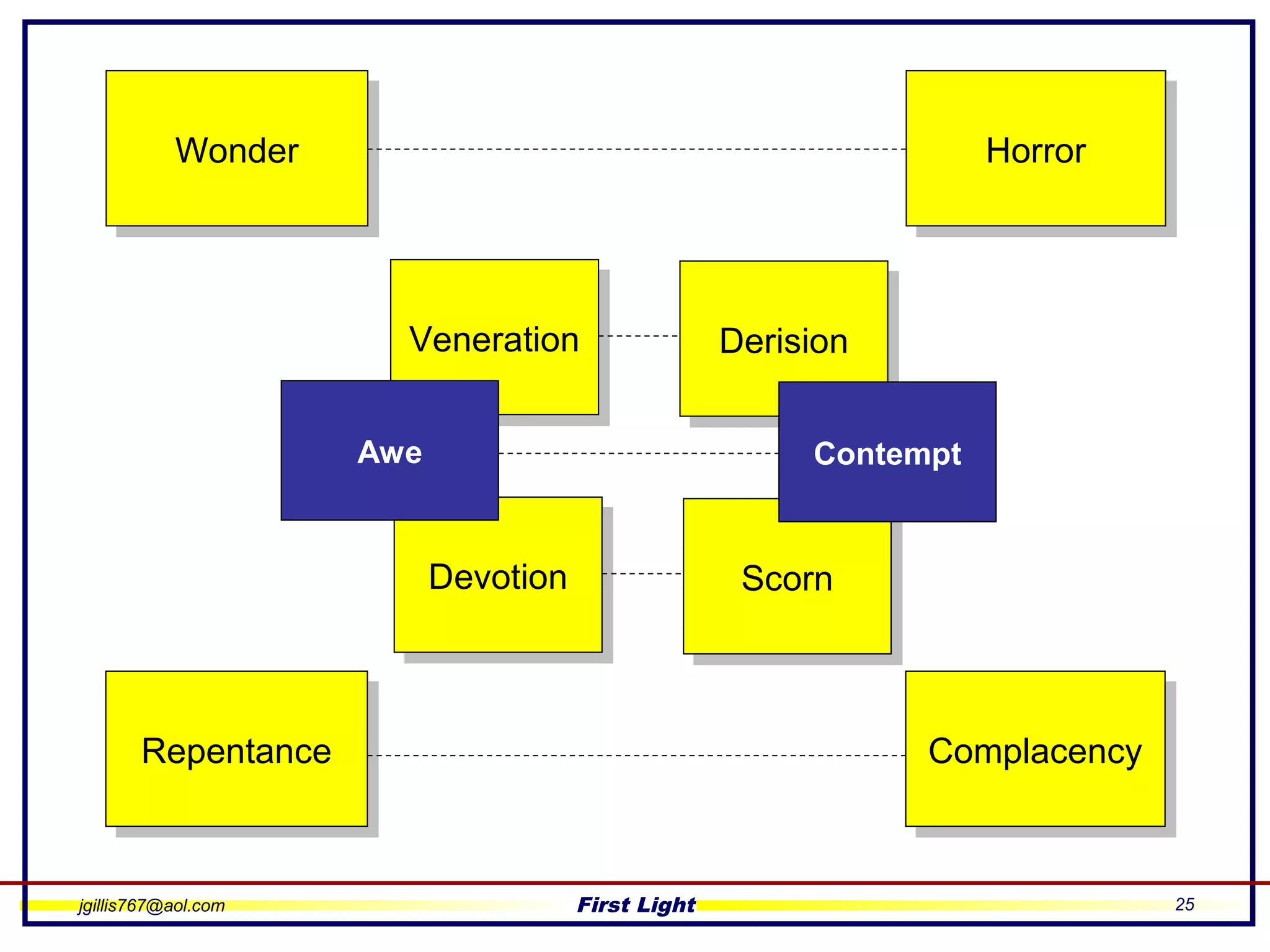
Repentance-Complacency
Wonder-Horror – Veneration-Devotion
Contempt-Derision-Scorn
 Repentance is pain with one’s self as cause.
 Complacency is pleasure with one’s self as cause.
 Wonder is incomparable awe.
 Horror is incomparable evil.
 Veneration is awe at people who we regard as far
surpassing ourselves in achieving the level of our
aspirations.
 Devotion is love joined with veneration and awe.
 Contempt is the opposite of wonder or awe.
 Derision springs from contempt of what we hate or fear.
 Scorn is contempt of what we deem stupid or ridiculous.
jgillis767@aol.com First Light 25
WonderWonder HorrorHorror
VenerationVeneration DerisionDerision
DevotionDevotion ScornScorn
Awe Contempt
RepentanceRepentance ComplacencyComplacency
jgillis767@aol.com First Light 26
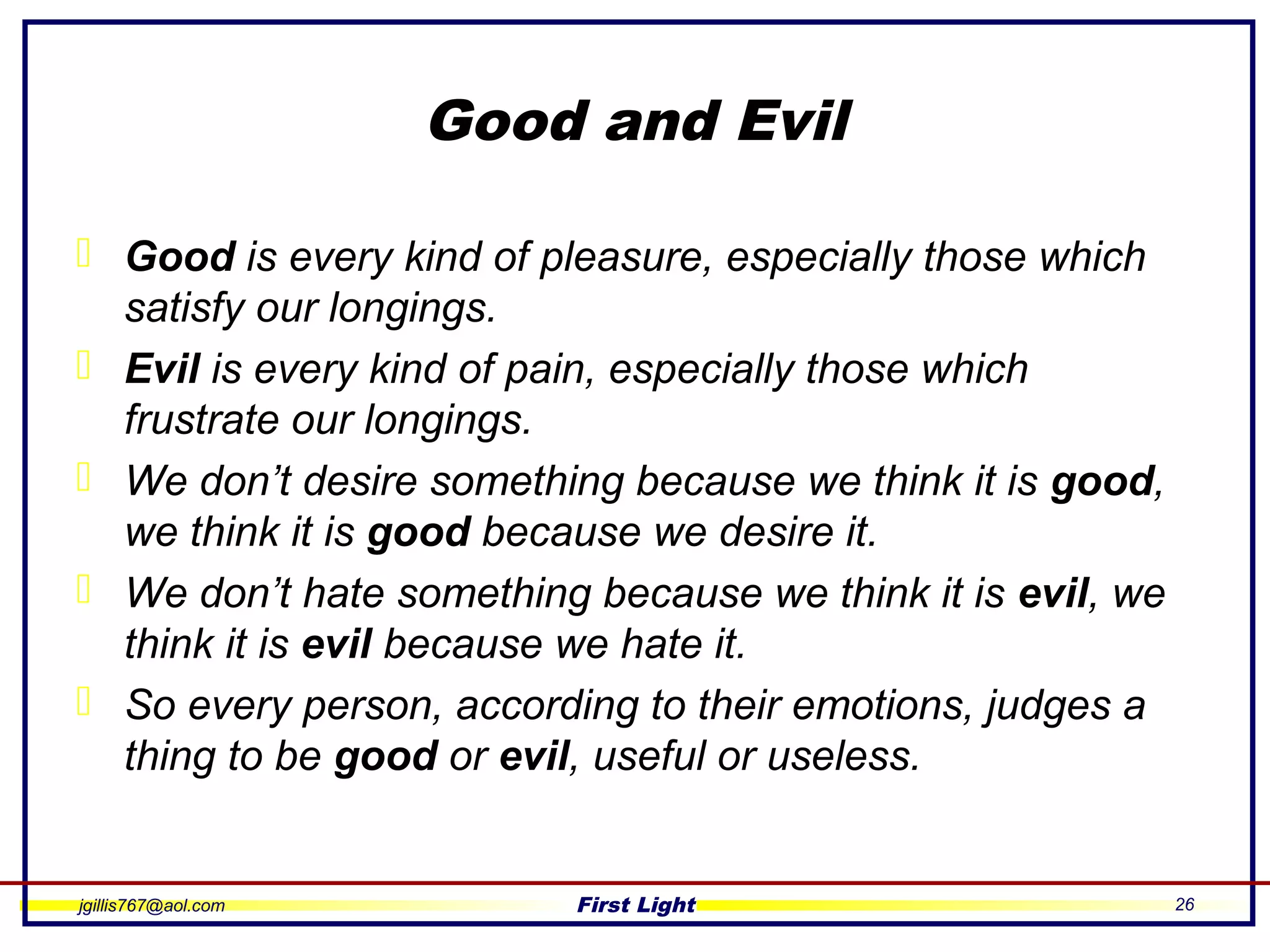
Good and Evil
 Good is every kind of pleasure, especially those which
satisfy our longings.
 Evil is every kind of pain, especially those which
frustrate our longings.
 We don’t desire something because we think it is good,
we think it is good because we desire it.
 We don’t hate something because we think it is evil, we
think it is evil because we hate it.
 So every person, according to their emotions, judges a
thing to be good or evil, useful or useless.
jgillis767@aol.com First Light 27
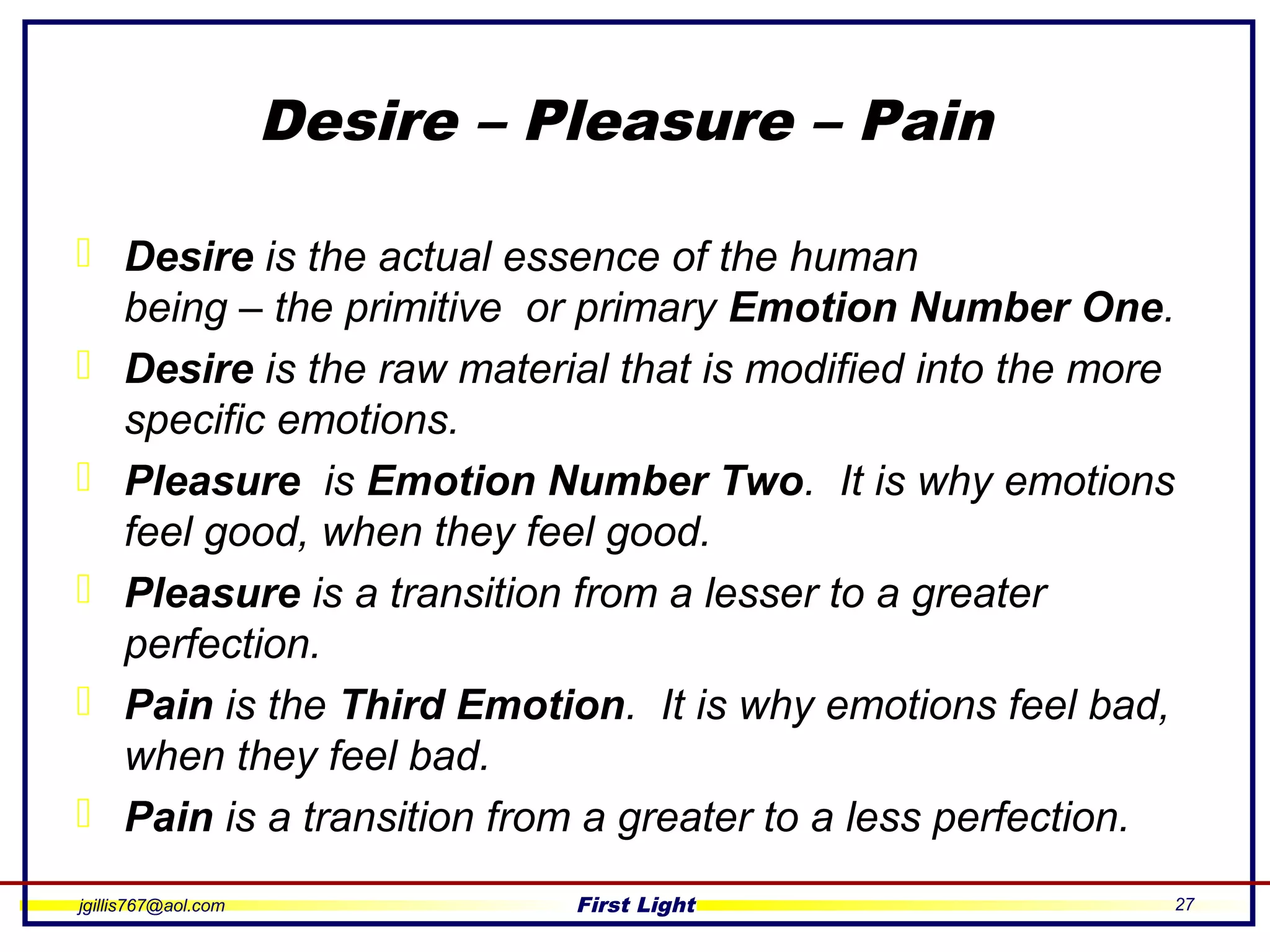
Desire – Pleasure – Pain
 Desire is the actual essence of the human
being – the primitive or primary Emotion Number One.
 Desire is the raw material that is modified into the more
specific emotions.
 Pleasure is Emotion Number Two. It is why emotions
feel good, when they feel good.
 Pleasure is a transition from a lesser to a greater
perfection.
 Pain is the Third Emotion. It is why emotions feel bad,
when they feel bad.
 Pain is a transition from a greater to a less perfection.
jgillis767@aol.com First Light 28
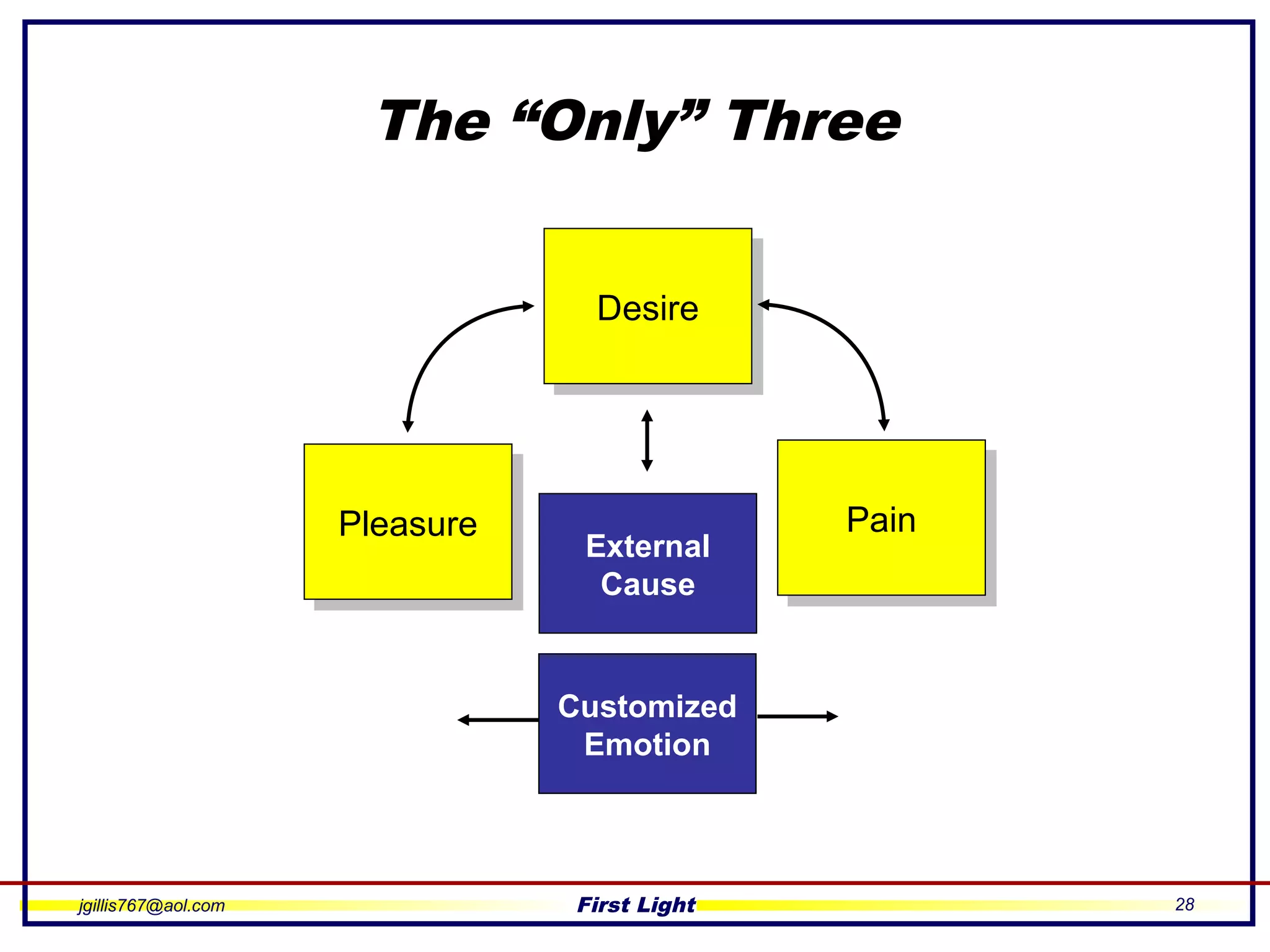
The “Only” Three
DesireDesire
PleasurePleasure PainPain
External
Cause
Customized
Emotion
jgillis767@aol.com First Light 29
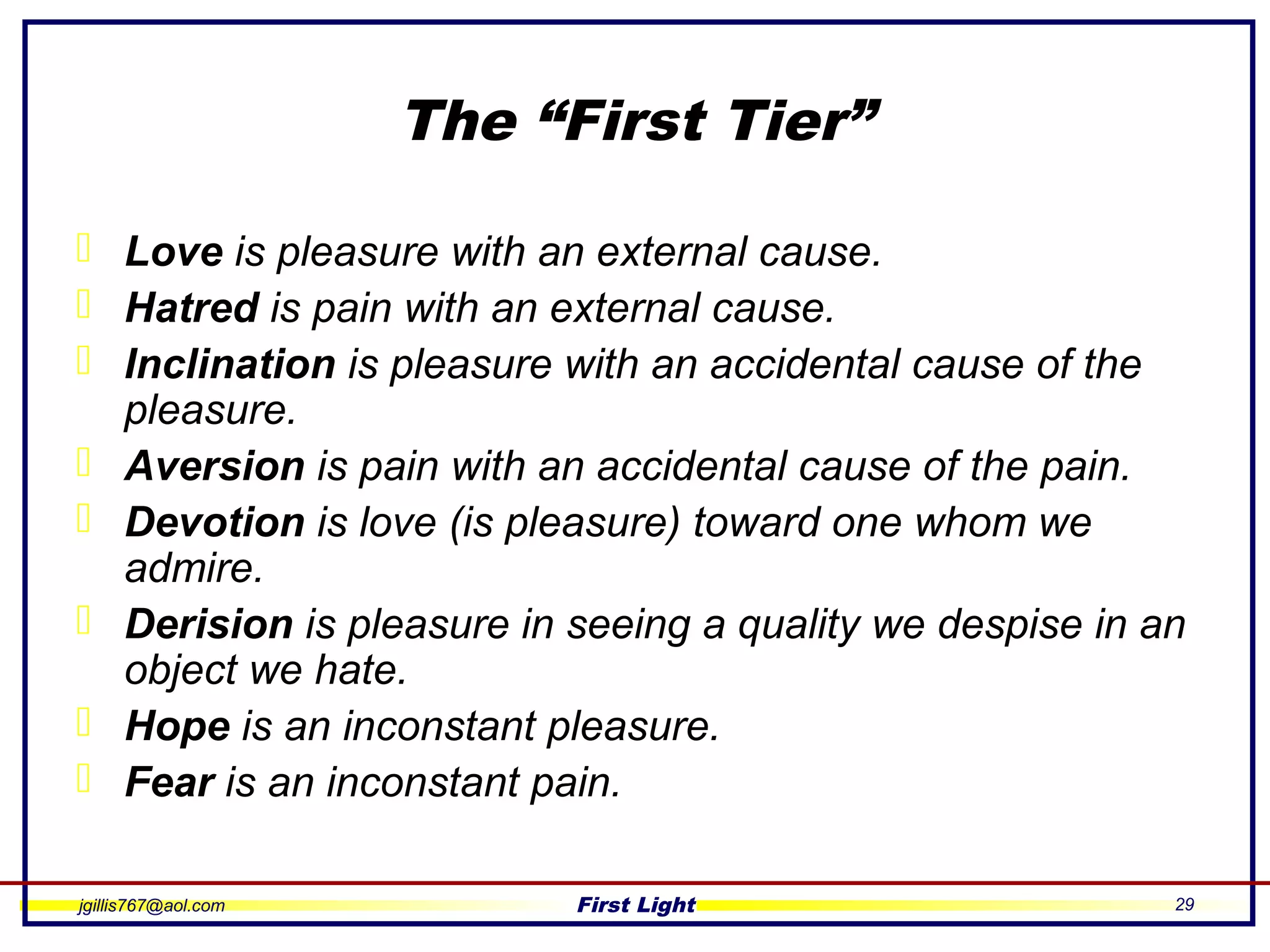
The “First Tier”
 Love is pleasure with an external cause.
 Hatred is pain with an external cause.
 Inclination is pleasure with an accidental cause of the
pleasure.
 Aversion is pain with an accidental cause of the pain.
 Devotion is love (is pleasure) toward one whom we
admire.
 Derision is pleasure in seeing a quality we despise in an
object we hate.
 Hope is an inconstant pleasure.
 Fear is an inconstant pain.
jgillis767@aol.com First Light 30
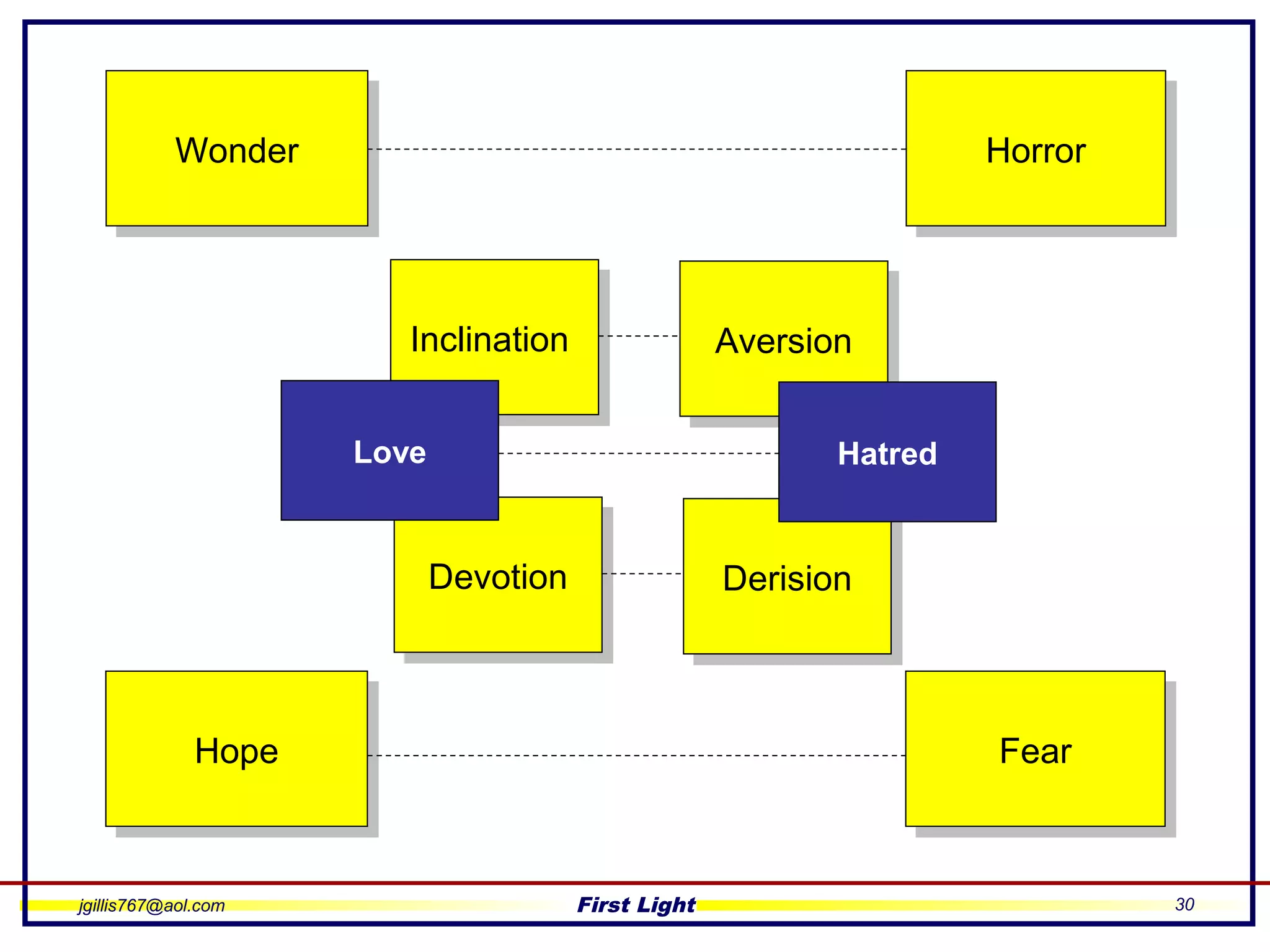
WonderWonder HorrorHorror
InclinationInclination AversionAversion
DevotionDevotion DerisionDerision
Love Hatred
HopeHope FearFear
jgillis767@aol.com First Light 31
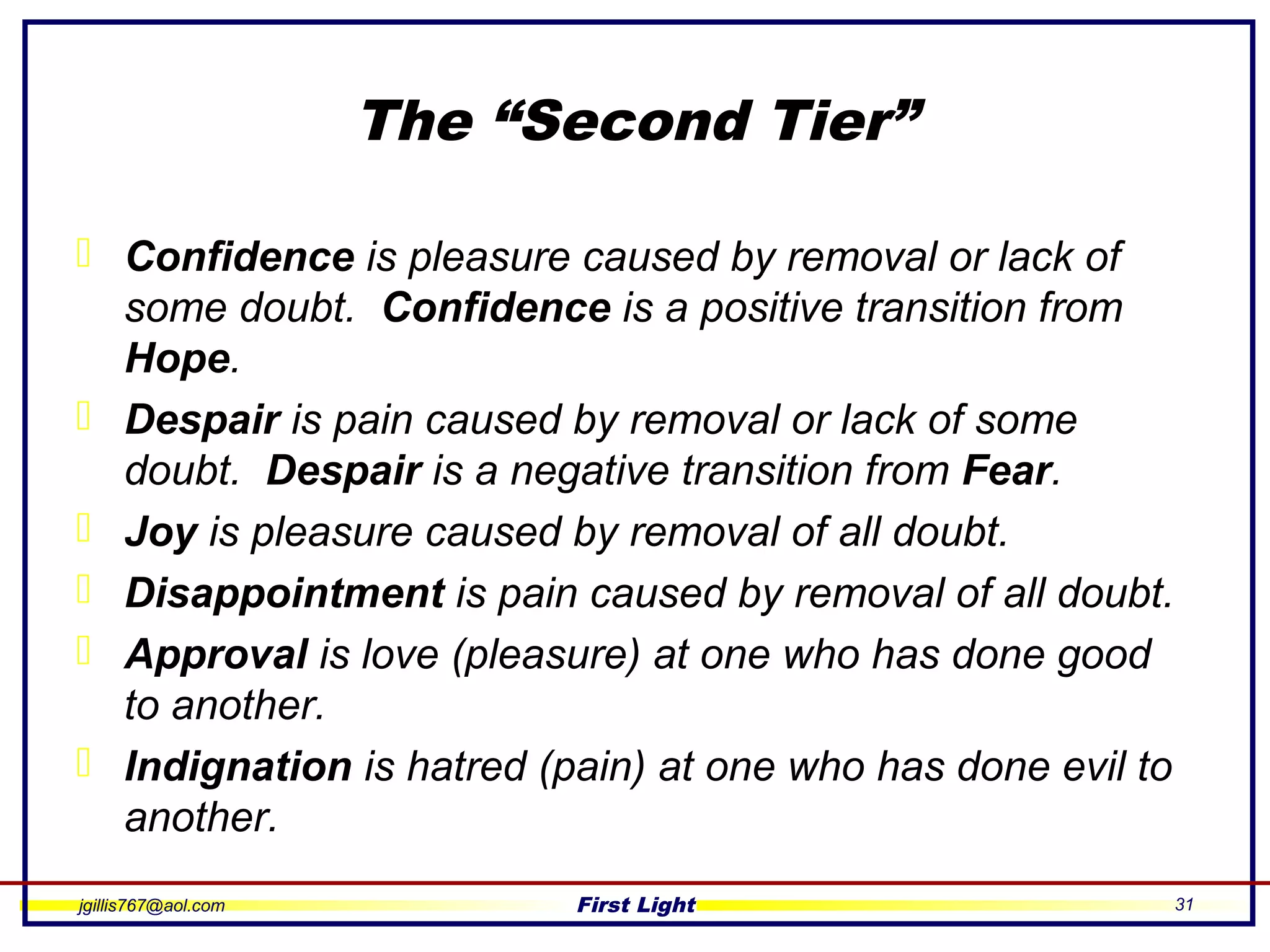
The “Second Tier”
 Confidence is pleasure caused by removal or lack of
some doubt. Confidence is a positive transition from
Hope.
 Despair is pain caused by removal or lack of some
doubt. Despair is a negative transition from Fear.
 Joy is pleasure caused by removal of all doubt.
 Disappointment is pain caused by removal of all doubt.
 Approval is love (pleasure) at one who has done good
to another.
 Indignation is hatred (pain) at one who has done evil to
another.
jgillis767@aol.com First Light 32
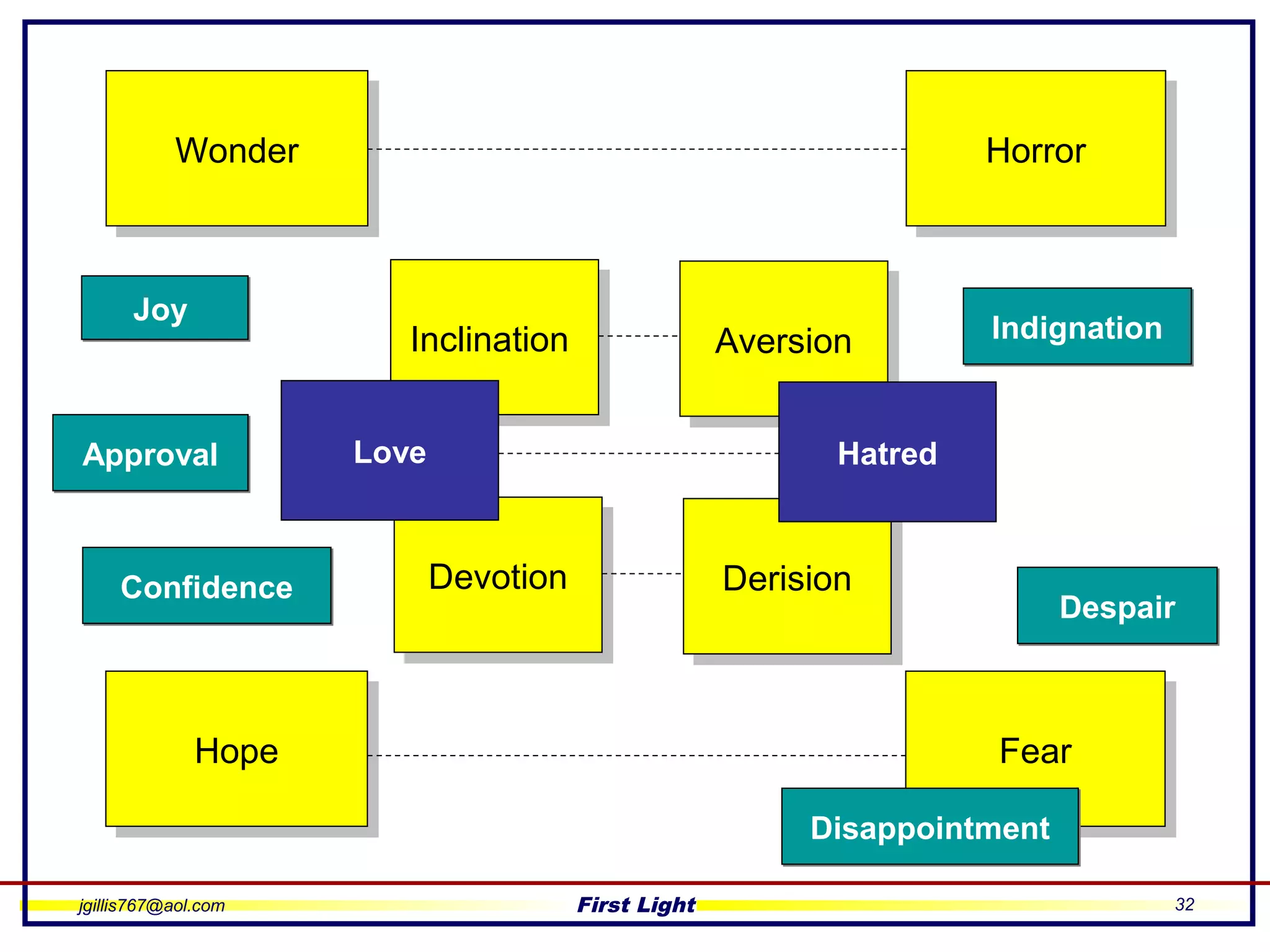
WonderWonder HorrorHorror
InclinationInclination AversionAversion
DevotionDevotion DerisionDerision
Love Hatred
HopeHope FearFear
ConfidenceConfidence
JoyJoy
DespairDespair
DisappointmentDisappointment
ApprovalApproval
IndignationIndignation
jgillis767@aol.com First Light 33
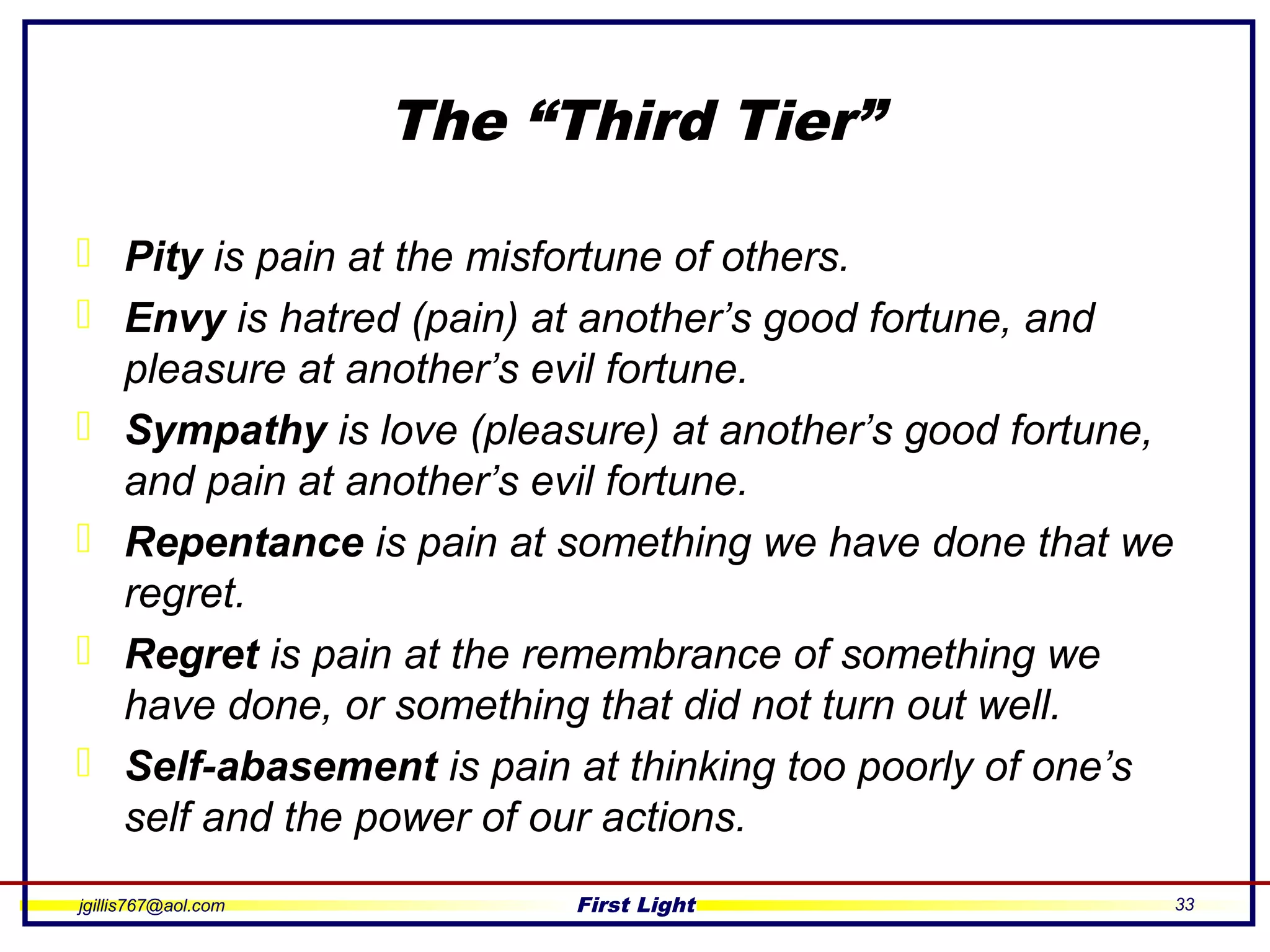
The “Third Tier”
 Pity is pain at the misfortune of others.
 Envy is hatred (pain) at another’s good fortune, and
pleasure at another’s evil fortune.
 Sympathy is love (pleasure) at another’s good fortune,
and pain at another’s evil fortune.
 Repentance is pain at something we have done that we
regret.
 Regret is pain at the remembrance of something we
have done, or something that did not turn out well.
 Self-abasement is pain at thinking too poorly of one’s
self and the power of our actions.
jgillis767@aol.com First Light 34
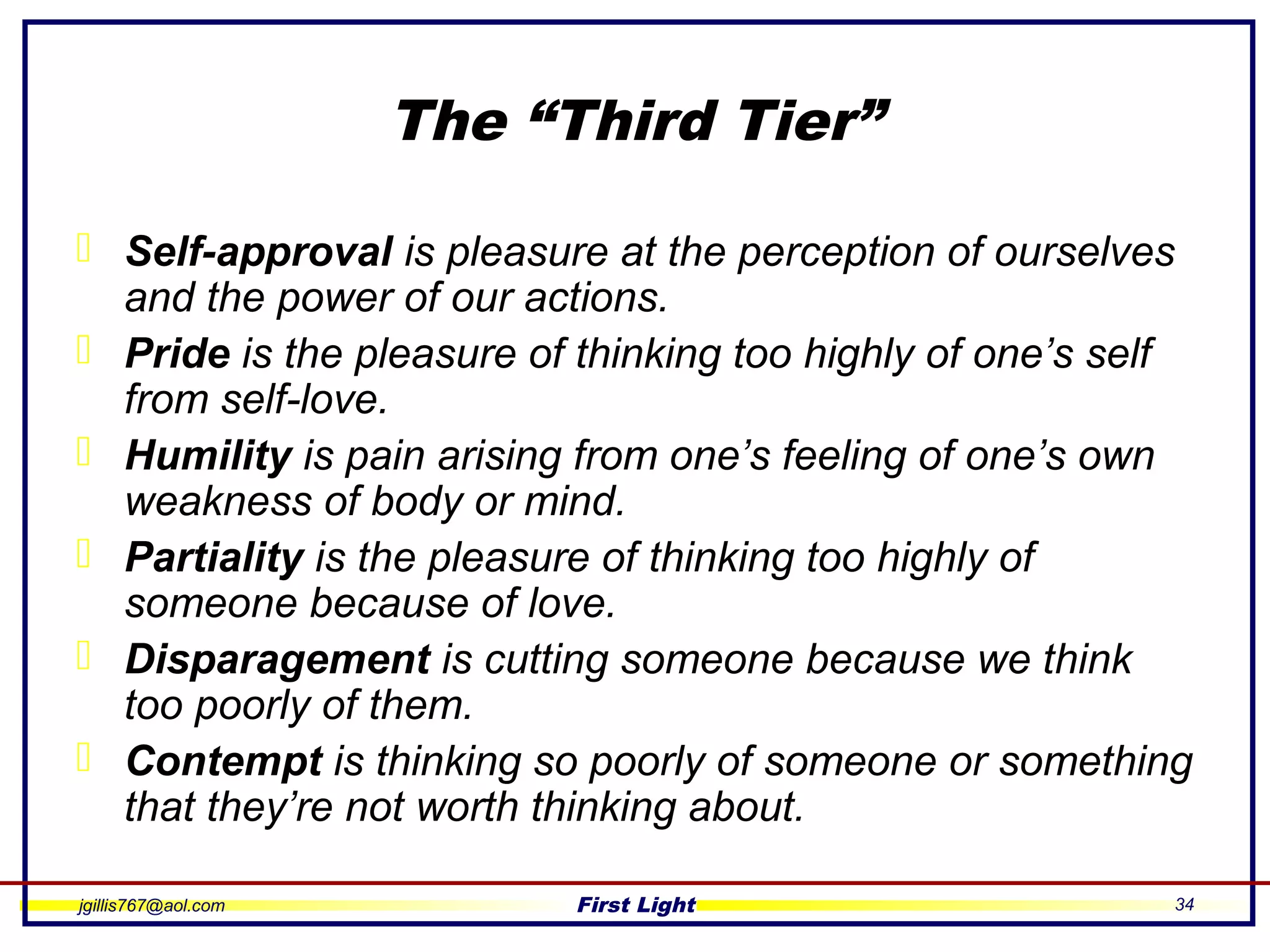
The “Third Tier”
 Self-approval is pleasure at the perception of ourselves
and the power of our actions.
 Pride is the pleasure of thinking too highly of one’s self
from self-love.
 Humility is pain arising from one’s feeling of one’s own
weakness of body or mind.
 Partiality is the pleasure of thinking too highly of
someone because of love.
 Disparagement is cutting someone because we think
too poorly of them.
 Contempt is thinking so poorly of someone or something
that they’re not worth thinking about.
jgillis767@aol.com First Light 35
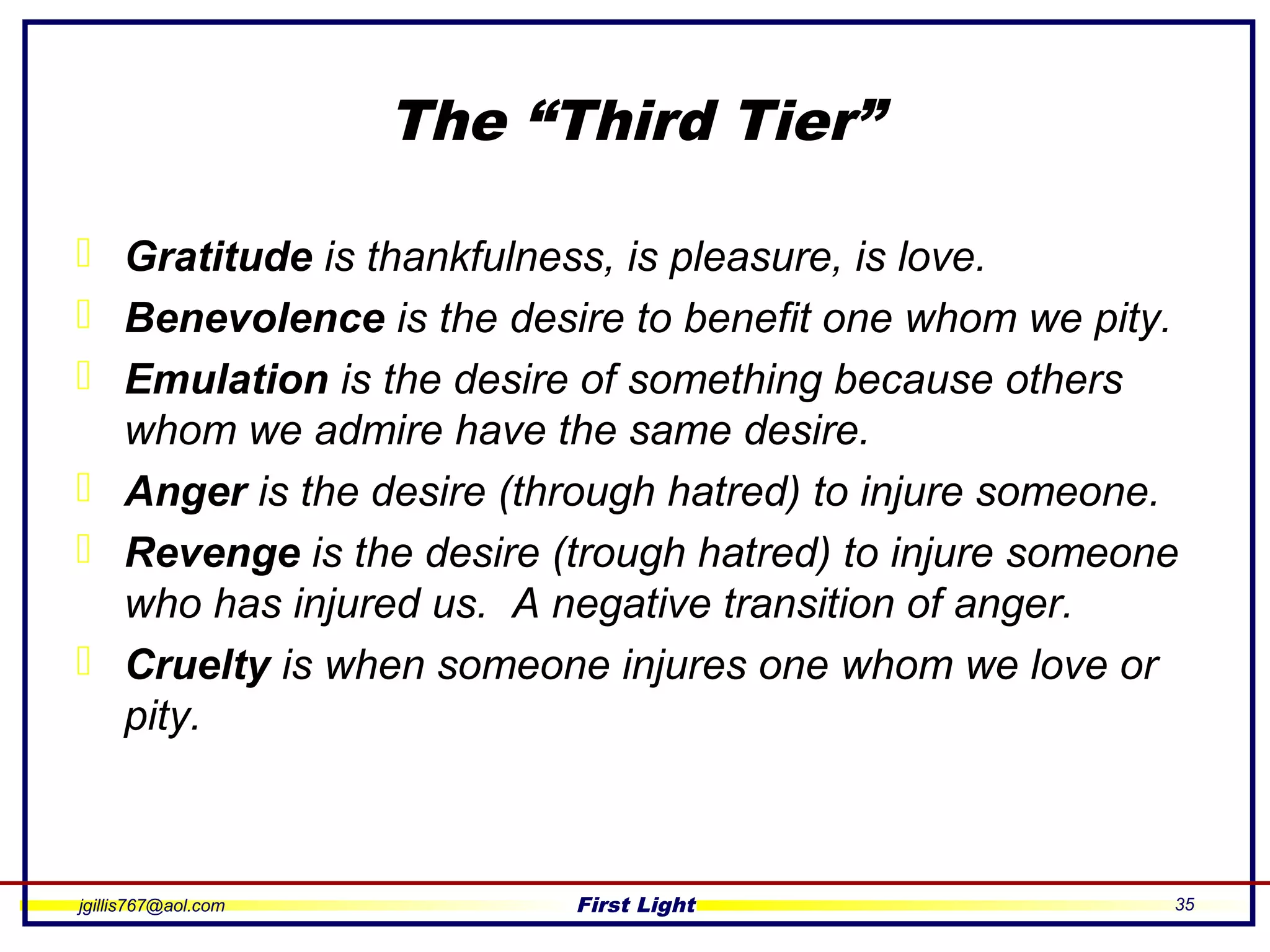
The “Third Tier”
 Gratitude is thankfulness, is pleasure, is love.
 Benevolence is the desire to benefit one whom we pity.
 Emulation is the desire of something because others
whom we admire have the same desire.
 Anger is the desire (through hatred) to injure someone.
 Revenge is the desire (trough hatred) to injure someone
who has injured us. A negative transition of anger.
 Cruelty is when someone injures one whom we love or
pity.
jgillis767@aol.com First Light 36
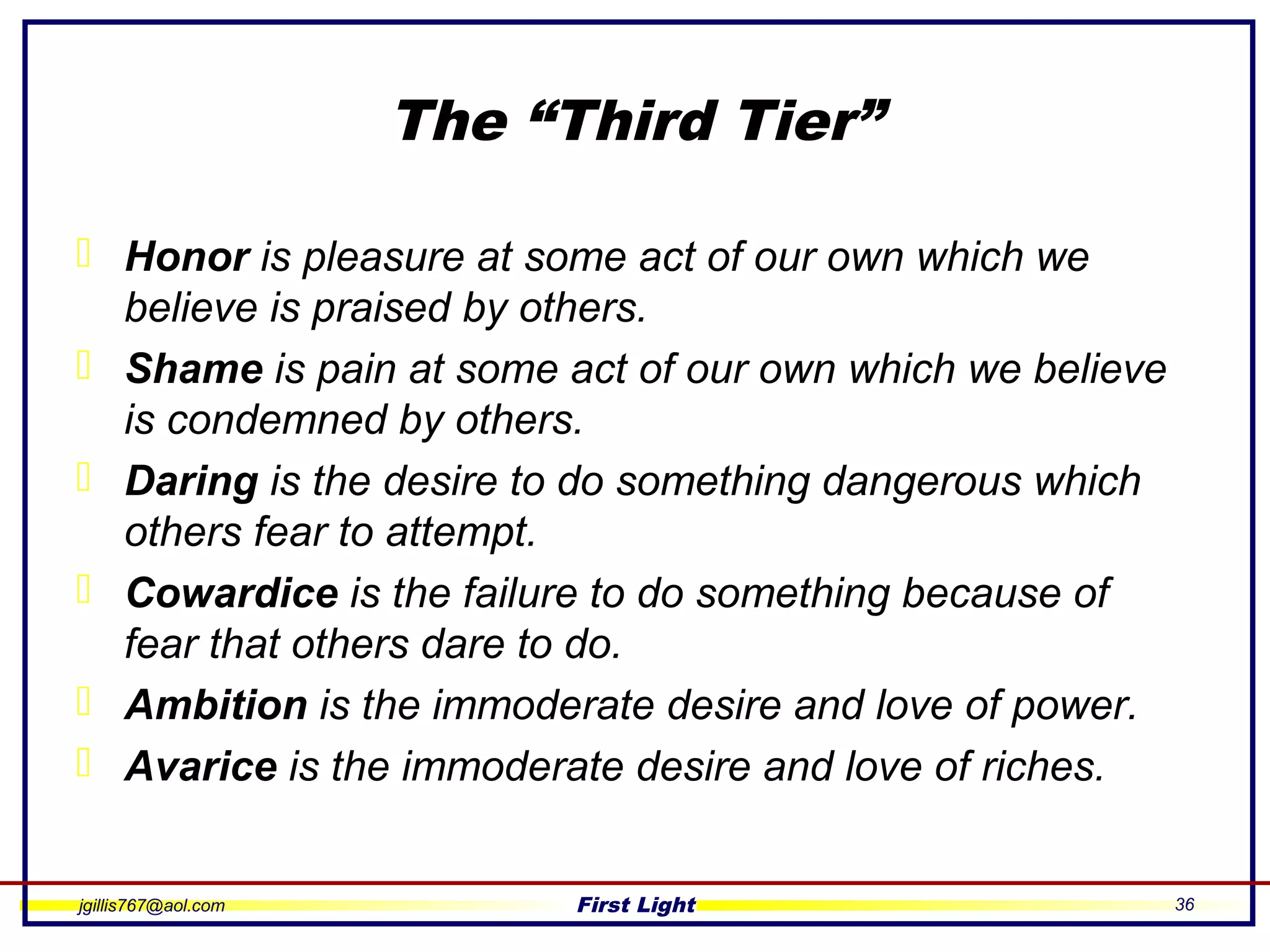
The “Third Tier”
 Honor is pleasure at some act of our own which we
believe is praised by others.
 Shame is pain at some act of our own which we believe
is condemned by others.
 Daring is the desire to do something dangerous which
others fear to attempt.
 Cowardice is the failure to do something because of
fear that others dare to do.
 Ambition is the immoderate desire and love of power.
 Avarice is the immoderate desire and love of riches.
jgillis767@aol.com First Light 37
The “Third Tier”
 Timidity is the desire to avoid a greater evil, which we
dread, by undergoing a lesser evil.
 Consternation is not knowing what to do when faced
with evil.
 Courtesy is a desire to act in a way that will please
others or not displease them.
 Luxury is the immoderate desire and love of living
sumptuously.
 Intemperance is the immoderate desire and love of
drinking alcohol.
 Lust is desire and love in the matter of sexual
intercourse (whether immoderate or not).
jgillis767@aol.com First Light 38
Analytic and Synthetic Concepts
 An “analytic” concept is one in which the predicate is part
of the subject. Obvious.
 A tall man is a man.
 An equilateral triangle is a triangle.
 A “synthetic” concept is one that is not “analytic.”
 All concepts that we know only through experience of
ourselves or others are “synthetic.” Inferred.
 Tuesday was a wet day.
 Napoleon was a great general.
jgillis767@aol.com First Light 39
Empirical and “a priori” Concepts
 An “empirical” concept is something we cannot know
except by the help of the five senses, either our own or
that of someone else whose testimony we accept.
 Experience of the senses. Observation.
 The facts of history and geography are empirical.
 So are the laws of science, whenever our knowledge of
their truth depends on observational data.
 An “a priori” concept is seen to have a basis other than
experience. 2 + 2 = 4
 Experience of certainty. Logic.
jgillis767@aol.com First Light 40
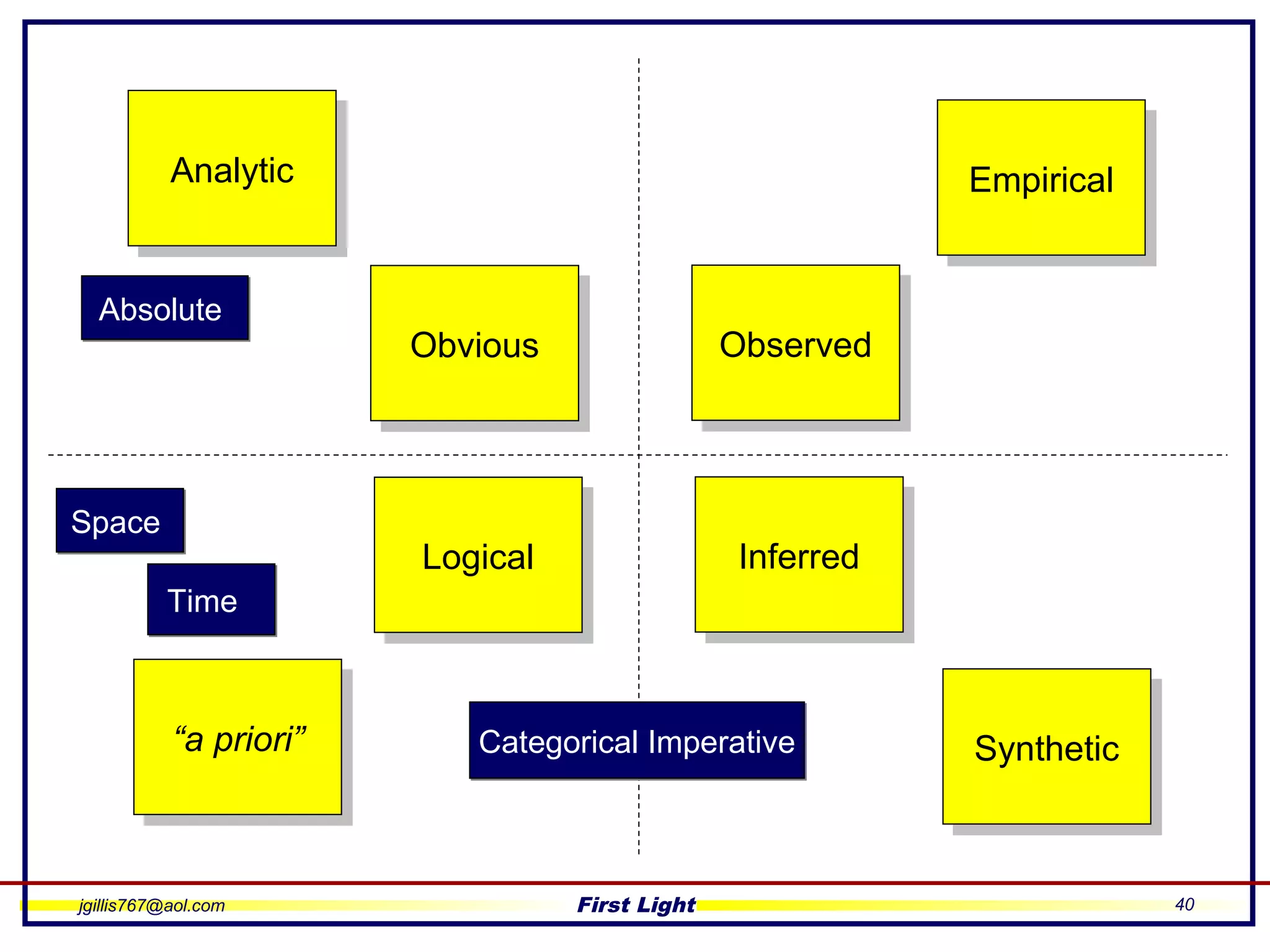
ObviousObvious
LogicalLogical
ObservedObserved
InferredInferred
AnalyticAnalytic
“a priori”“a priori”
EmpiricalEmpirical
SyntheticSyntheticCategorical ImperativeCategorical Imperative
SpaceSpace
TimeTime
AbsoluteAbsolute
jgillis767@aol.com First Light 41
Bibliography
 Baruch de Spinoza. Tractatus Theologico-Politicus (written 1665-
1670, published 1670) (translated by R. H. M. Elwes, 1889).
 Baruch de Spinoza. Ethica in Ordine Geometrico Demonstrata
(written 1662-1675, published 1677).
 W. H. White and A. Stirling. Ethics (1894).
 Bertrand Russell. A History of Western Philosophy (1945).
 Dagobert D. Runes. Spinoza: The Road to Inner Freedom (The
Ethics) (written by Spinoza 1662-1675, translated by Elwes, edited
by Runes, published 1957).
 Joseph Ratner (Ed.). The Philosophy of Spinoza (1926)
jgillis767@aol.com First Light 42
The complete understanding of
emotions and of their causation
deprives them of their overmastering
quality.
jgillis767@aol.com First Light 43
The Categorical Imperative
 Hypothetical Imperative
 “You must do so-and-so if you wish to achieve such-
and-such an end.”
 Categorical Imperative
 “A certain kind of action is objectively necessary,
without regard to any end.”
 The categorical imperative is synthetic and “a priori.”
jgillis767@aol.com First Light 44
The Categorical Imperative
 The Categorical Imperative
 “Act only according to a maxim by which you can at
the same time will that it shall be a general law.”
 Or, stated another way, “Act as if the maxim of your
action were to become through your will a general
natural law.”
 Theft and murder, for example, are condemned by the
categorical imperative.
 Do unto others as you would like them to do unto you.
jgillis767@aol.com First Light 45
Spinoza
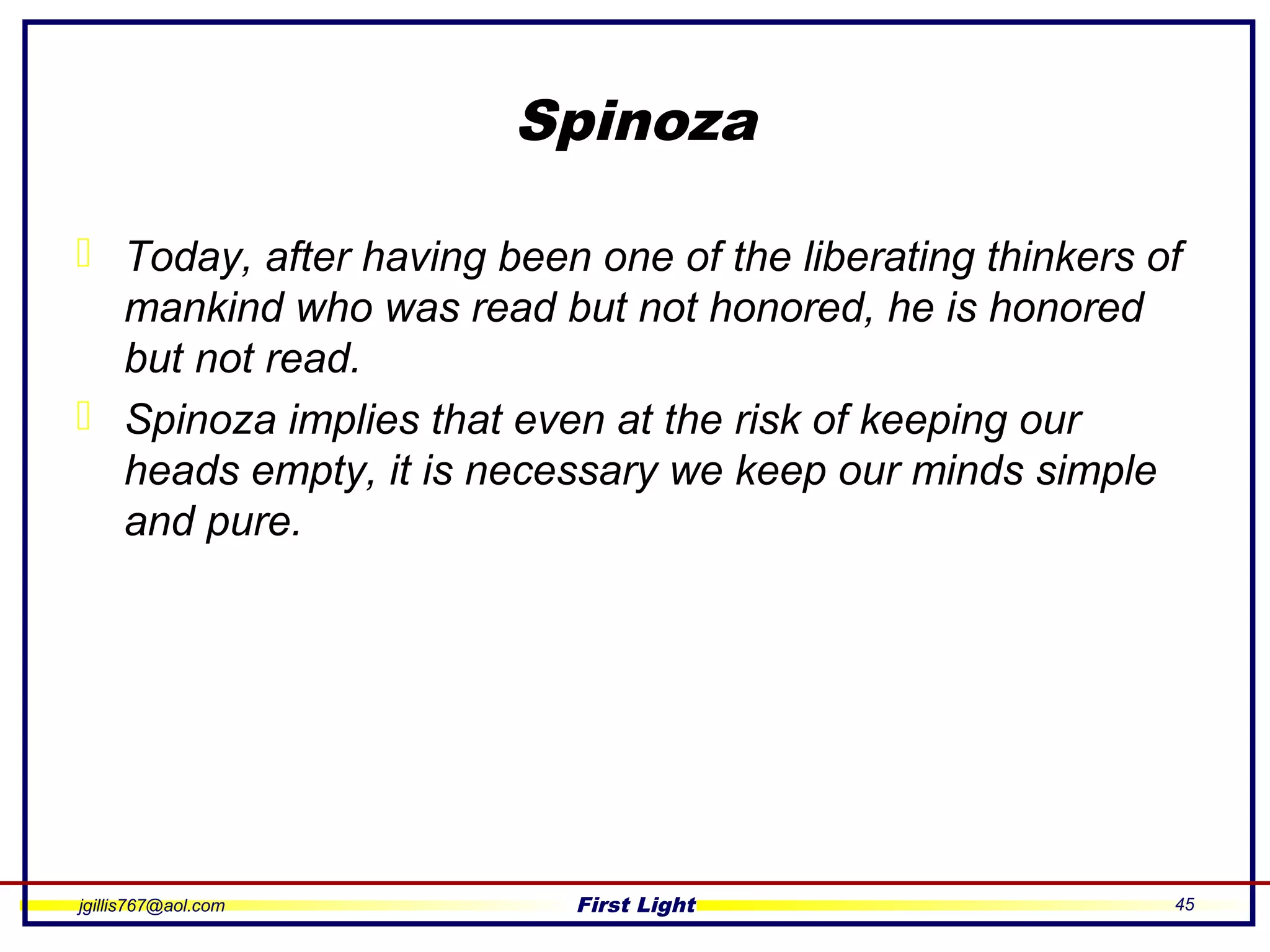
 Today, after having been one of the liberating thinkers of
mankind who was read but not honored, he is honored
but not read.
 Spinoza implies that even at the risk of keeping our
heads empty, it is necessary we keep our minds simple
and pure.
jgillis767@aol.com First Light 46
Spinoza
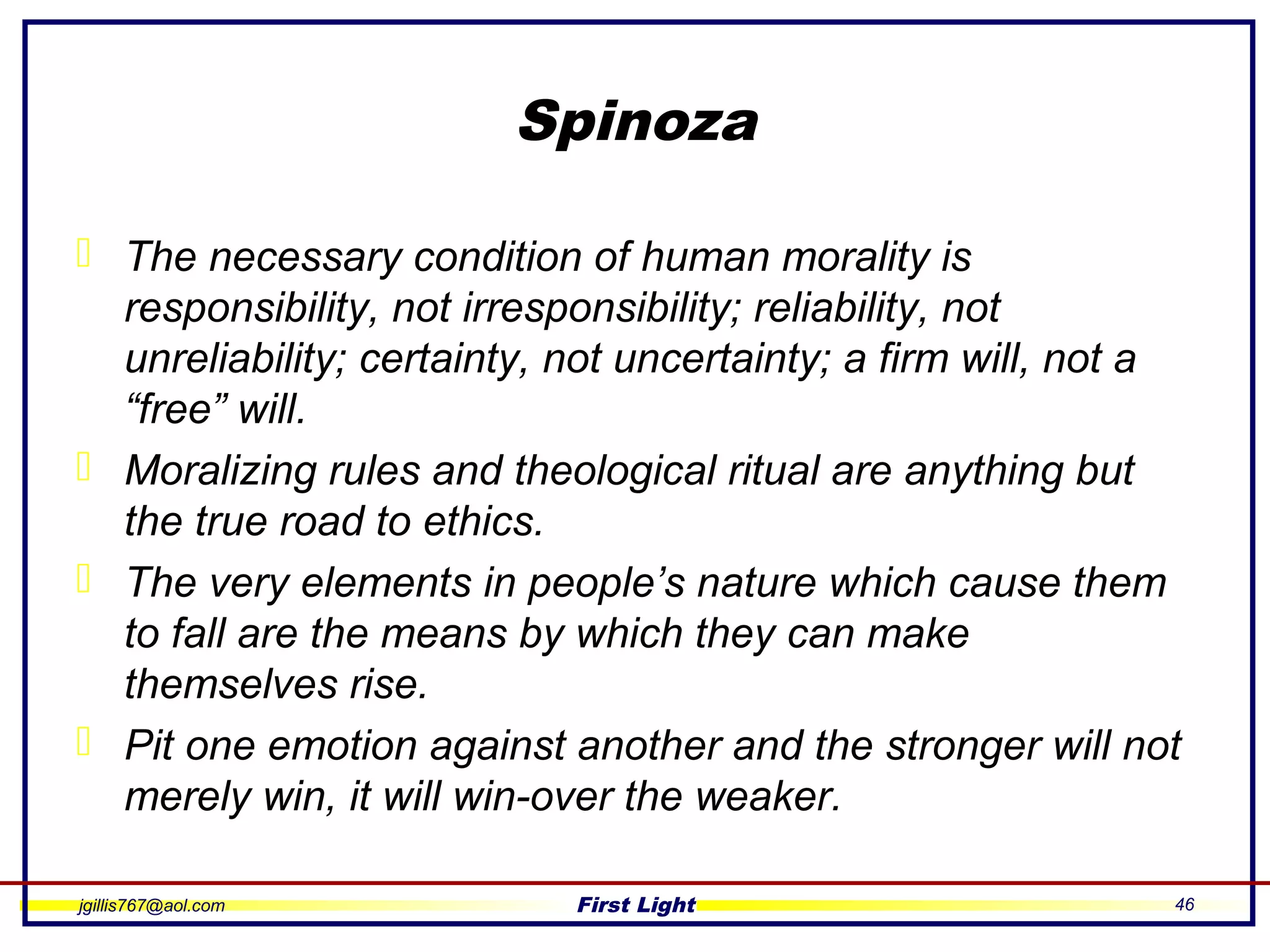
 The necessary condition of human morality is
responsibility, not irresponsibility; reliability, not
unreliability; certainty, not uncertainty; a firm will, not a
“free” will.
 Moralizing rules and theological ritual are anything but
the true road to ethics.
 The very elements in people’s nature which cause them
to fall are the means by which they can make
themselves rise.
 Pit one emotion against another and the stronger will not
merely win, it will win-over the weaker.
jgillis767@aol.com First Light 47
On Marriage
 In marriage, legal or religious or social ceremonial law
can at best secure man or woman wealth and social
position.
 Happiness or blessedness lie beyond the powerful reach
of these laws.
 Natural love, or love free from all ceremonial coercions,
is not merely a questionable source of marital happiness:
it is the only source.
 It must be among our chief ethical rules to see that we
build the lofty structure of human society on the sure and
simple foundations of the human organism.
jgillis767@aol.com First Light 48
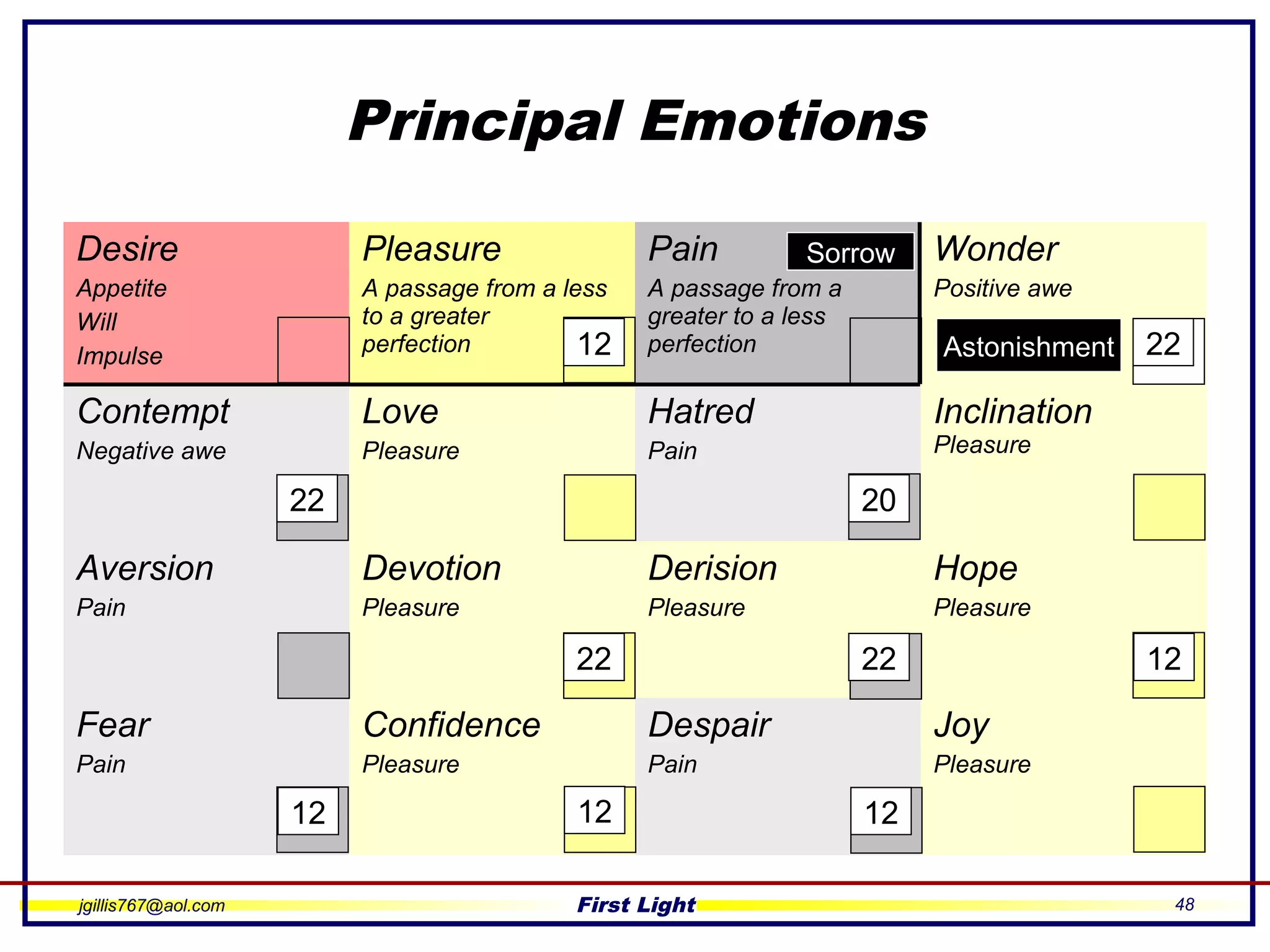
Principal Emotions
Desire
Appetite
Will
Impulse
Pleasure
A passage from a less
to a greater
perfection
Pain
A passage from a
greater to a less
perfection
Wonder
Positive awe
Contempt
Negative awe
Love
Pleasure
Hatred
Pain
Inclination
Pleasure
Aversion
Pain
Devotion
Pleasure
Derision
Pleasure
Hope
Pleasure
Fear
Pain
Confidence
Pleasure
Despair
Pain
Joy
Pleasure
i
i
Sorrow
Astonishment
12
12
1212
12
20
22
22
22
22
jgillis767@aol.com First Light 49
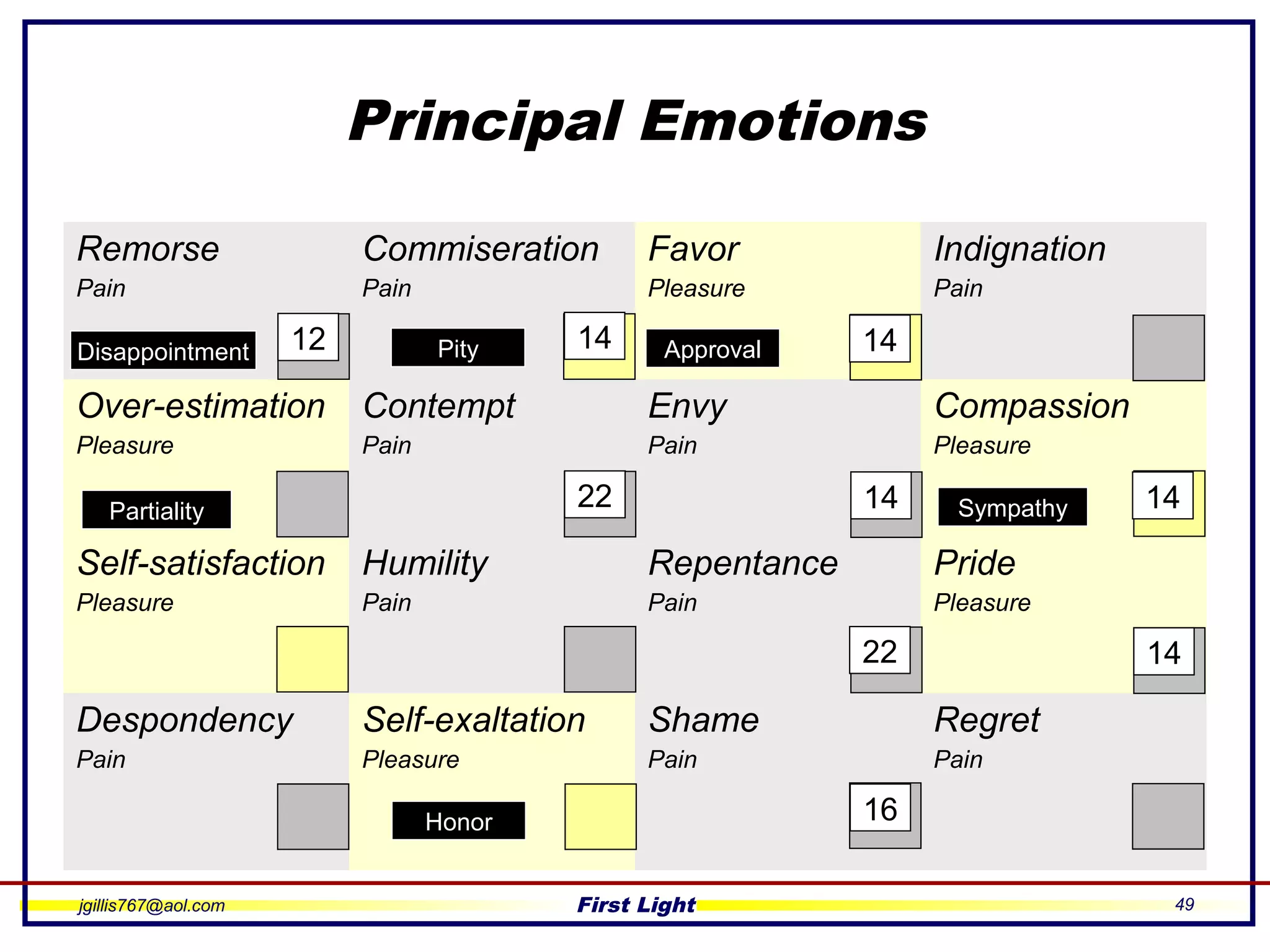
Principal Emotions
Remorse
Pain
Commiseration
Pain
Favor
Pleasure
Indignation
Pain
Over-estimation
Pleasure
Contempt
Pain
Envy
Pain
Compassion
Pleasure
Self-satisfaction
Pleasure
Humility
Pain
Repentance
Pain
Pride
Pleasure
Despondency
Pain
Self-exaltation
Pleasure
Shame
Pain
Regret
Pain
Disappointment Pity Approval
Partiality Sympathy
Honor
12
14
14
14 14
14
16
22
22
jgillis767@aol.com First Light 50
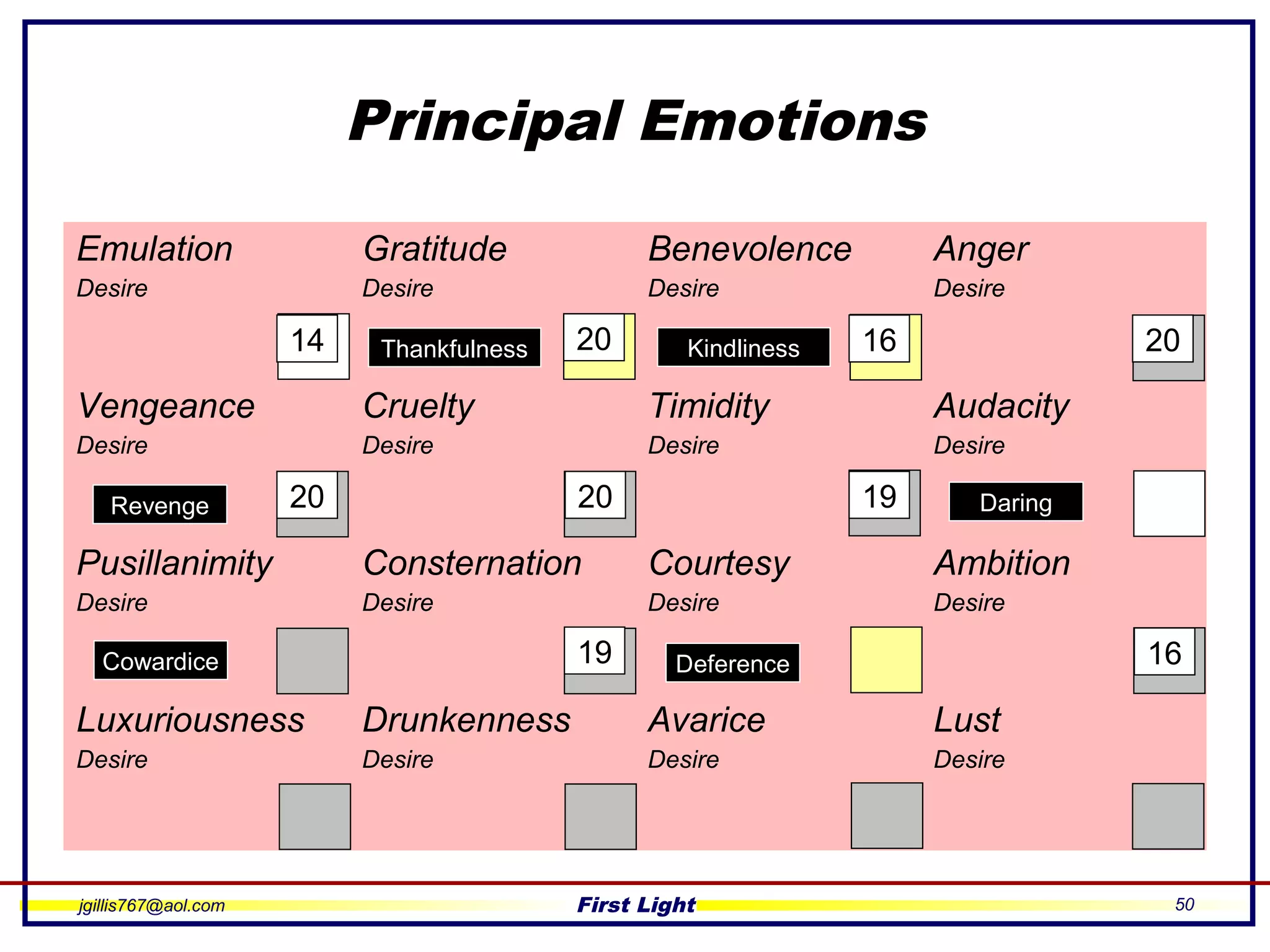
Principal Emotions
Emulation
Desire
Gratitude
Desire
Benevolence
Desire
Anger
Desire
Vengeance
Desire
Cruelty
Desire
Timidity
Desire
Audacity
Desire
Pusillanimity
Desire
Consternation
Desire
Courtesy
Desire
Ambition
Desire
Luxuriousness
Desire
Drunkenness
Desire
Avarice
Desire
Lust
Desire
Thankfulness
Revenge Daring
Cowardice Deference
Kindliness14 16
16
19
19
20
2020
20
jgillis767@aol.com First Light 51
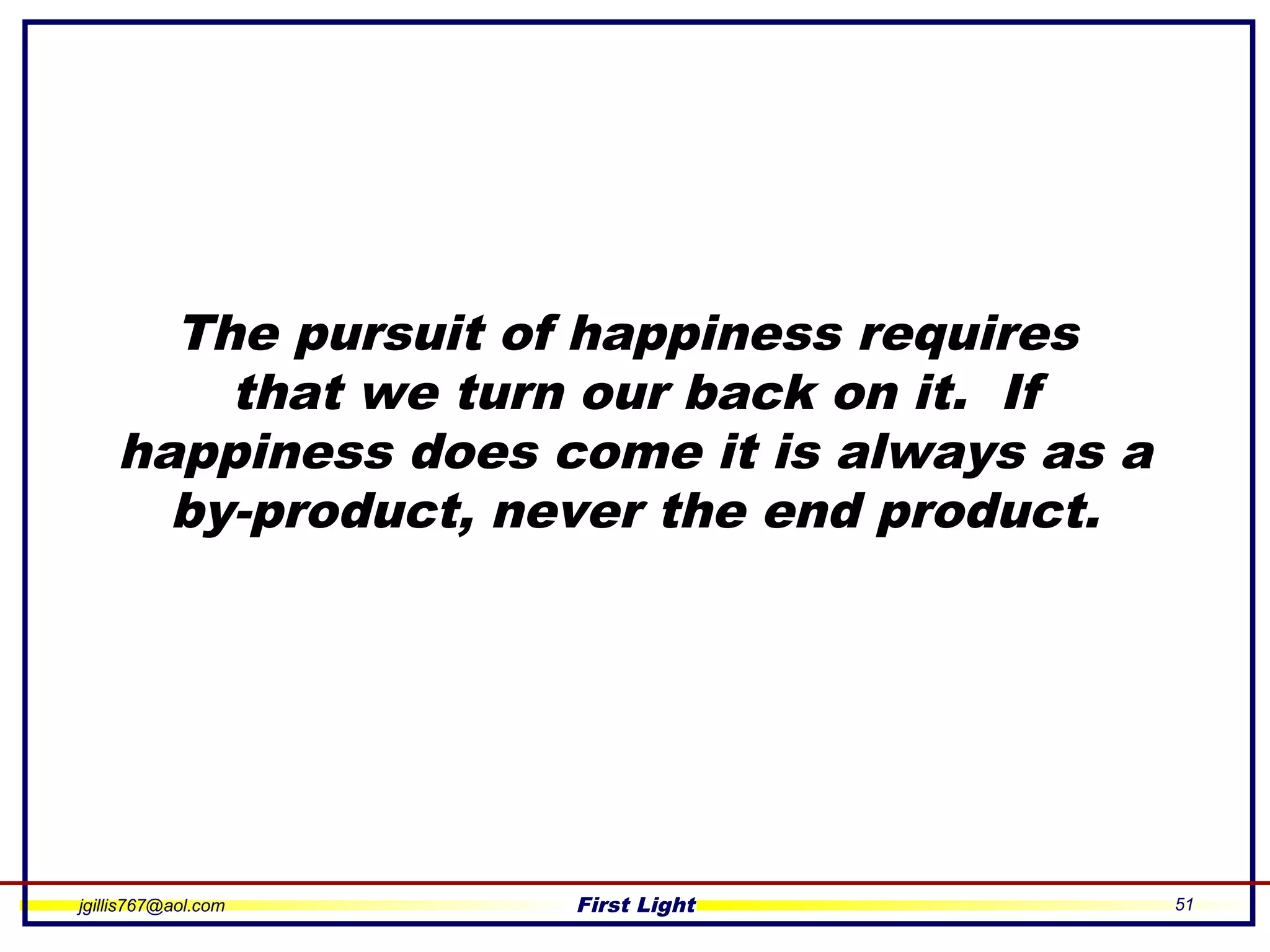
The pursuit of happiness requires
that we turn our back on it. If
happiness does come it is always as a
by-product, never the end product.
jgillis767@aol.com First Light 52
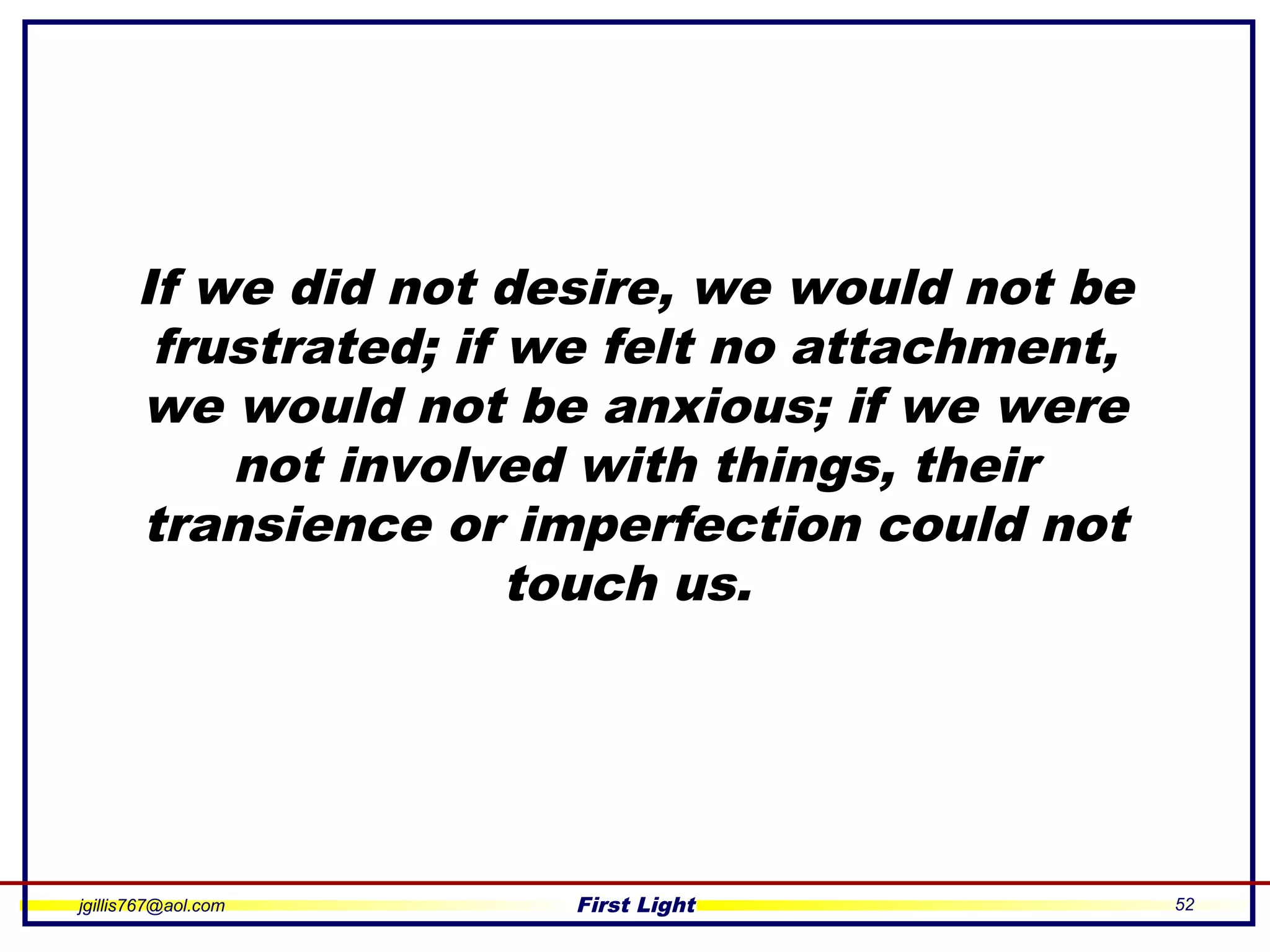
If we did not desire, we would not be
frustrated; if we felt no attachment,
we would not be anxious; if we were
not involved with things, their
transience or imperfection could not
touch us.
jgillis767@aol.com First Light 53
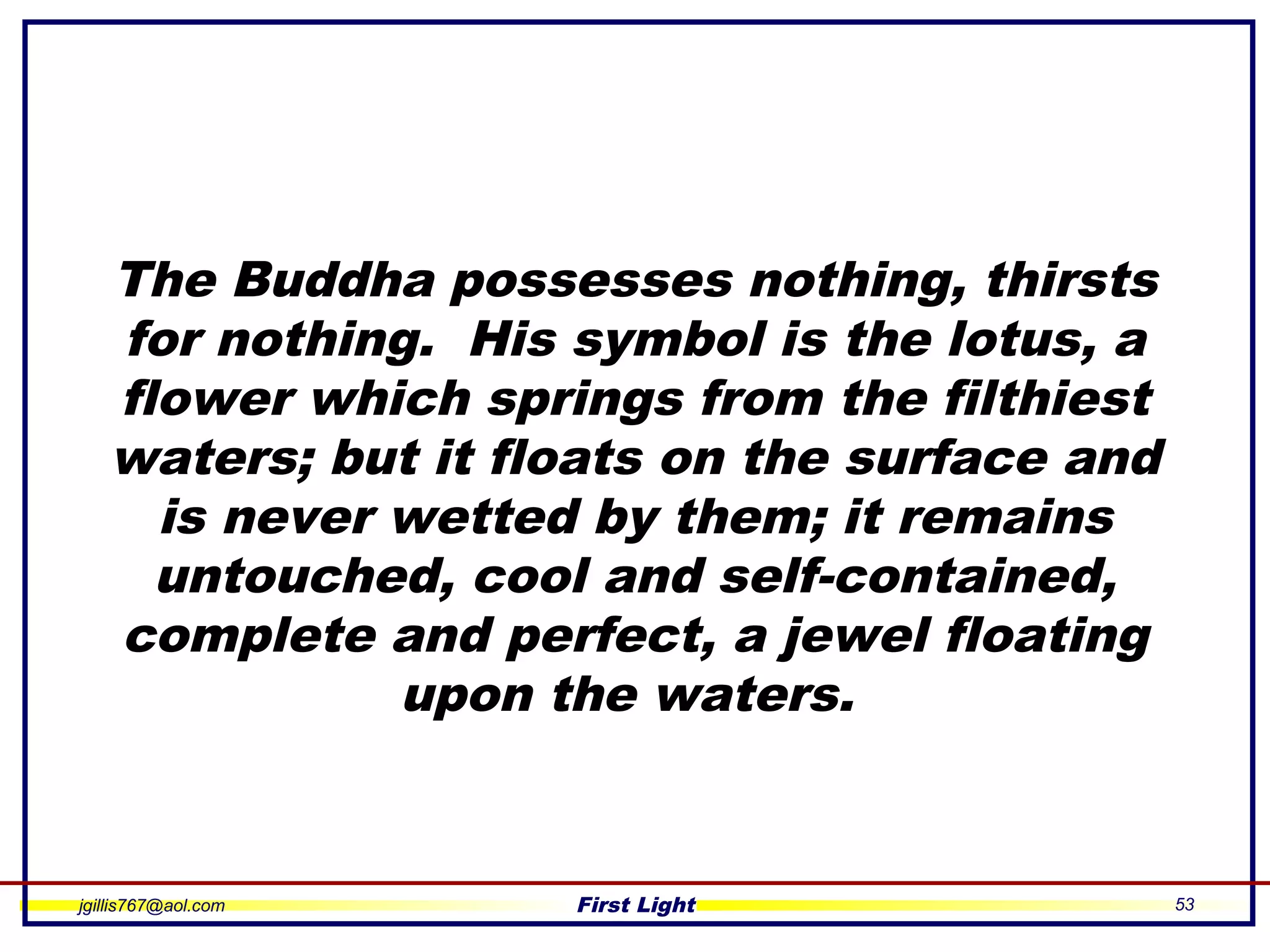
The Buddha possesses nothing, thirsts
for nothing. His symbol is the lotus, a
flower which springs from the filthiest
waters; but it floats on the surface and
is never wetted by them; it remains
untouched, cool and self-contained,
complete and perfect, a jewel floating
upon the waters.
jgillis767@aol.com First Light 54
8-Fold Noble Path
Right views
Right aspirations
Right speech
Right conduct
Right livelihood
Right efforts
Right thoughts
Right contemplation
8 8
jgillis767@aol.com First Light 55
“For my part, when I enter most
intimately into what I call myself, I
always stumble on some particular
perception or other, of heat or cold,
light or shade, love or hatred, pain or
pleasure. I never can catch myself at
any time without a perception and
never can observe anything but the
perception….”
David Hume
jgillis767@aol.com First Light 56
Darshana – a particular point of view.
Synthesize the various darshanas into
one comprehensive word view, the
understanding of which will bring
emancipation. I believe in everything.
jgillis767@aol.com First Light 57
The Nature of Human Knowledge
 Three forms of human knowledge
 Understanding, also called perception
 Reason
 Intuition, also called wisdom
 A universe of knowledge in three buckets: what you
believe you know or don’t know; what you know because
it is purely logical (2 x 2 = 4); and what you know you
know because it is common to all men and women.
jgillis767@aol.com First Light 58
Spinoza conceives of human beings as
mechanisms in nature that are
motivated by self-preservation and
individual advantage, and who, by the
mutual employment of reason, can
improve their way of life.
jgillis767@aol.com First Light 59
Ethics, for Spinoza, is a knowledge of
“the right way of living,” that allows
people to rise above temporary desires
and reach a natural participation in an
“eternal blessedness.”
jgillis767@aol.com First Light 60
Spinoza seeks improvement of the
mind not just as a theoretical
exercise, but as a remedy against
three ethical hindrances – the
overvaluing of wealth, fame, and
sensual pleasure.
jgillis767@aol.com First Light 61
The human mind and the human body
are one. Therefore thoughts and
emotions are one, therefore ethics
includes both mental and physical.
Spinoza’s concept of ethics,
therefore, emphasizes the connection,
not the separation, between the mind
and the body.
jgillis767@aol.com First Light 62
Veritas

Understanding emotions

  • 1.
    jgillis767@aol.com First Light1 Understanding Emotions The Road to Human Freedom Spinoza, Buddha, et al.
  • 2.
    jgillis767@aol.com First Light2 Like Freud, too, and Spinoza as well, the Buddha believes that to understand is to transcend.
  • 3.
    jgillis767@aol.com First Light3 The fire of life must be put out. For everything in this world is on fire with the fire of desire, the fire of hate, and the fire of illusion.
  • 4.
    jgillis767@aol.com First Light4 The replacement of hate with love, but better the replacement of both by understanding.
  • 5.
    jgillis767@aol.com First Light5 An Approach  Set aside, if you will, all traditional concepts of good and evil, right and wrong, pagan and Judeo-Christian and Moslem and Hindu or any religion that may be part of your mental framework; don’t deny them or throw them away, just set them aside for a short while.  Take a fresh approach, if you will, to the fundamental questions such as: What is God? What is Man? What is Truth? What is Love?
  • 6.
    jgillis767@aol.com First Light6 Nature  Nothing comes to pass in nature which can be understood as a flaw; for nature is always the same, and everywhere one in the same in her results and effects and power of action. True?  Nature’s laws and ordinances, in which all things come to pass and change from one form to another, are everywhere and always the same. True?
  • 7.
    jgillis767@aol.com First Light7 Nature  So one might assume that there should be one and the same method of understanding the nature of all things whatsoever, namely, through nature’s universal laws and rules.  Thus the passions of hatred, anger, envy, and so on, considered in themselves, follow from this same consistent pattern of results and effects and power of action.
  • 8.
    jgillis767@aol.com First Light8 Nature  And we, therefore, for a little while anyway, will consider human actions and desires in exactly the same manner as though we were concerned with lines, planes and solids.
  • 9.
    jgillis767@aol.com First Light9 Mind and Body  No one knows how or by what means the mind moves the body.  No one knows how the mind is “connected” to the body.  Body cannot determine mind to think, nor can mind determine body to motion or rest.  One can say, “I will raise my hand,” and then raise a hand. This is easy and simple. But one cannot “will” the hand to rise.  Thus when people say that their minds “control” their bodies, they are using words to describe a phenomenon they do not really understand.
  • 10.
    jgillis767@aol.com First Light10 Mind and Body  Since no one understands the connection, yet everyone knows there is a total connection, it perhaps is safe to assume, at least for most intents and purposes, that body and mind are one and the same thing – a thing that can be thought of from (1) the angle of thought or mind or (2) the angle of action or bodily function.  This is important when we consider that a mental decision and a bodily appetite are simultaneous, or one and the same thing, which we call (1) decision when it is thought and (2) a conditioned state when it is the body in action.
  • 11.
    jgillis767@aol.com First Light11 Emotions  Everyone shapes their actions according to their emotions.  Desire may be stimulated by almost anything.  Experience abundantly shows that people can govern anything more easily than their tongues, and restrain anything more easily than their appetites.
  • 12.
    jgillis767@aol.com First Light12 Emotions  Emotions do not have only one satisfying object, but are able to derive satisfaction from almost any object whatsoever.  The most spiritual forms of human love have the same emotional foundations as the most bestial forms of human lust.  Anything can, accidentally, be the cause of pleasure, pain, or desire.
  • 13.
    jgillis767@aol.com First Light13 Hope-Fear – Confidence-Despair Joy-Disappointment  Hope is an inconstant pleasure in which we do not know the result (in doubt).  Fear is an inconstant pain in which we do not know the result (in doubt).  If the result becomes clear, hope becomes Confidence (a more constant pleasure), and fear becomes Despair (a more constant pain).  Joy is pleasure in the positive result of doubt.  Disappointment is pain in the negative result of doubt.
  • 14.
    jgillis767@aol.com First Light14 Confidence HopeHope Despair FearFear DisappointmentJoy 12
  • 15.
    jgillis767@aol.com First Light15 Pity-Approval – Envy-Pride Compassion-Emulation  Pity is pain arising from another’s hurt (if the other resembles ourselves).  Approval is pleasure toward a person who confers a benefit on another (if the other resembles ourselves).  Envy is hatred, hence pain (but tinged with the pleasure of pride).  Pride is a pleasure of thinking too highly of one’s self (or too poorly of a hated object).  Compassion is an imitation of a negative emotion in others (pain).  Emulation is an imitation of the desire in others.
  • 16.
    jgillis767@aol.com First Light16 EmulationEmulation CompassionCompassion PridePride EnvyEnvy ApprovalApproval PityPity Pleasure Pain
  • 17.
    jgillis767@aol.com First Light17 Benevolence-Ambition-Kindliness Praise-Blame – Honor-Shame  Benevolence is a will or appetite for doing good that arises from compassion.  Ambition is a will or appetite for doing good that arises from emulation and usually ignores benevolence.  Kindliness is ambition that does not ignore benevolence.  Praise is a pleasure one shows at the action of others.  Blame is a pain one shows at the action of others.  Honor is a pleasure one feels at the perception of praise from others.  Shame is a pain one feels at the perception of blame from others.
  • 18.
    jgillis767@aol.com First Light18 EmulationEmulation BenevolenceBenevolence PraisePraise BlameBlame HonorHonor ShameShame Ambition PraisePraise BlameBlame HonorHonor ShameShame Kindliness
  • 19.
    jgillis767@aol.com First Light19 Love is pleasure accompanied by the idea of an external cause, and hatred is pain accompanied by the idea of an external cause.
  • 20.
    jgillis767@aol.com First Light20 The idea that our own likes and dislikes should meet with universal approval is really ambition. If everyone thinks this way, then all stand in each others way, and all become mutually hateful.
  • 21.
    jgillis767@aol.com First Light21 Jealousy  Jealousy is hatred combined with envy toward an object of love.  Timidity causes a person to turn from what they wish for.  Bashfulness is timidity because of shame.  Consternation is the timidity of not knowing which is the lesser evil to choose, when a choice must be made.
  • 22.
    jgillis767@aol.com First Light22 Anger-Cruelty-Revenge-Hatred Gratitude-Thankfulness-Joy  Anger is the endeavor to injure someone we hate.  Cruelty is the endeavor to injure someone we hate, especially if they have done nothing to deserve it.  Revenge is endeavor to repay in kind an injury done to ourselves.  Gratitude is reciprocal love, or Thankfulness.  Hatred is increased by being reciprocated, and can on the other hand be destroyed by love.  The Joy of Hatred or Revenge is always accompanied by a certain pain.
  • 23.
    jgillis767@aol.com First Light23 JoyJoy ThankfulnessThankfulness RevengeRevenge GratitudeGratitude AngerAnger JoyJoy CrueltyCruelty Hatred Love PainPain
  • 24.
    jgillis767@aol.com First Light24 Repentance-Complacency Wonder-Horror – Veneration-Devotion Contempt-Derision-Scorn  Repentance is pain with one’s self as cause.  Complacency is pleasure with one’s self as cause.  Wonder is incomparable awe.  Horror is incomparable evil.  Veneration is awe at people who we regard as far surpassing ourselves in achieving the level of our aspirations.  Devotion is love joined with veneration and awe.  Contempt is the opposite of wonder or awe.  Derision springs from contempt of what we hate or fear.  Scorn is contempt of what we deem stupid or ridiculous.
  • 25.
    jgillis767@aol.com First Light25 WonderWonder HorrorHorror VenerationVeneration DerisionDerision DevotionDevotion ScornScorn Awe Contempt RepentanceRepentance ComplacencyComplacency
  • 26.
    jgillis767@aol.com First Light26 Good and Evil  Good is every kind of pleasure, especially those which satisfy our longings.  Evil is every kind of pain, especially those which frustrate our longings.  We don’t desire something because we think it is good, we think it is good because we desire it.  We don’t hate something because we think it is evil, we think it is evil because we hate it.  So every person, according to their emotions, judges a thing to be good or evil, useful or useless.
  • 27.
    jgillis767@aol.com First Light27 Desire – Pleasure – Pain  Desire is the actual essence of the human being – the primitive or primary Emotion Number One.  Desire is the raw material that is modified into the more specific emotions.  Pleasure is Emotion Number Two. It is why emotions feel good, when they feel good.  Pleasure is a transition from a lesser to a greater perfection.  Pain is the Third Emotion. It is why emotions feel bad, when they feel bad.  Pain is a transition from a greater to a less perfection.
  • 28.
    jgillis767@aol.com First Light28 The “Only” Three DesireDesire PleasurePleasure PainPain External Cause Customized Emotion
  • 29.
    jgillis767@aol.com First Light29 The “First Tier”  Love is pleasure with an external cause.  Hatred is pain with an external cause.  Inclination is pleasure with an accidental cause of the pleasure.  Aversion is pain with an accidental cause of the pain.  Devotion is love (is pleasure) toward one whom we admire.  Derision is pleasure in seeing a quality we despise in an object we hate.  Hope is an inconstant pleasure.  Fear is an inconstant pain.
  • 30.
    jgillis767@aol.com First Light30 WonderWonder HorrorHorror InclinationInclination AversionAversion DevotionDevotion DerisionDerision Love Hatred HopeHope FearFear
  • 31.
    jgillis767@aol.com First Light31 The “Second Tier”  Confidence is pleasure caused by removal or lack of some doubt. Confidence is a positive transition from Hope.  Despair is pain caused by removal or lack of some doubt. Despair is a negative transition from Fear.  Joy is pleasure caused by removal of all doubt.  Disappointment is pain caused by removal of all doubt.  Approval is love (pleasure) at one who has done good to another.  Indignation is hatred (pain) at one who has done evil to another.
  • 32.
    jgillis767@aol.com First Light32 WonderWonder HorrorHorror InclinationInclination AversionAversion DevotionDevotion DerisionDerision Love Hatred HopeHope FearFear ConfidenceConfidence JoyJoy DespairDespair DisappointmentDisappointment ApprovalApproval IndignationIndignation
  • 33.
    jgillis767@aol.com First Light33 The “Third Tier”  Pity is pain at the misfortune of others.  Envy is hatred (pain) at another’s good fortune, and pleasure at another’s evil fortune.  Sympathy is love (pleasure) at another’s good fortune, and pain at another’s evil fortune.  Repentance is pain at something we have done that we regret.  Regret is pain at the remembrance of something we have done, or something that did not turn out well.  Self-abasement is pain at thinking too poorly of one’s self and the power of our actions.
  • 34.
    jgillis767@aol.com First Light34 The “Third Tier”  Self-approval is pleasure at the perception of ourselves and the power of our actions.  Pride is the pleasure of thinking too highly of one’s self from self-love.  Humility is pain arising from one’s feeling of one’s own weakness of body or mind.  Partiality is the pleasure of thinking too highly of someone because of love.  Disparagement is cutting someone because we think too poorly of them.  Contempt is thinking so poorly of someone or something that they’re not worth thinking about.
  • 35.
    jgillis767@aol.com First Light35 The “Third Tier”  Gratitude is thankfulness, is pleasure, is love.  Benevolence is the desire to benefit one whom we pity.  Emulation is the desire of something because others whom we admire have the same desire.  Anger is the desire (through hatred) to injure someone.  Revenge is the desire (trough hatred) to injure someone who has injured us. A negative transition of anger.  Cruelty is when someone injures one whom we love or pity.
  • 36.
    jgillis767@aol.com First Light36 The “Third Tier”  Honor is pleasure at some act of our own which we believe is praised by others.  Shame is pain at some act of our own which we believe is condemned by others.  Daring is the desire to do something dangerous which others fear to attempt.  Cowardice is the failure to do something because of fear that others dare to do.  Ambition is the immoderate desire and love of power.  Avarice is the immoderate desire and love of riches.
  • 37.
    jgillis767@aol.com First Light37 The “Third Tier”  Timidity is the desire to avoid a greater evil, which we dread, by undergoing a lesser evil.  Consternation is not knowing what to do when faced with evil.  Courtesy is a desire to act in a way that will please others or not displease them.  Luxury is the immoderate desire and love of living sumptuously.  Intemperance is the immoderate desire and love of drinking alcohol.  Lust is desire and love in the matter of sexual intercourse (whether immoderate or not).
  • 38.
    jgillis767@aol.com First Light38 Analytic and Synthetic Concepts  An “analytic” concept is one in which the predicate is part of the subject. Obvious.  A tall man is a man.  An equilateral triangle is a triangle.  A “synthetic” concept is one that is not “analytic.”  All concepts that we know only through experience of ourselves or others are “synthetic.” Inferred.  Tuesday was a wet day.  Napoleon was a great general.
  • 39.
    jgillis767@aol.com First Light39 Empirical and “a priori” Concepts  An “empirical” concept is something we cannot know except by the help of the five senses, either our own or that of someone else whose testimony we accept.  Experience of the senses. Observation.  The facts of history and geography are empirical.  So are the laws of science, whenever our knowledge of their truth depends on observational data.  An “a priori” concept is seen to have a basis other than experience. 2 + 2 = 4  Experience of certainty. Logic.
  • 40.
    jgillis767@aol.com First Light40 ObviousObvious LogicalLogical ObservedObserved InferredInferred AnalyticAnalytic “a priori”“a priori” EmpiricalEmpirical SyntheticSyntheticCategorical ImperativeCategorical Imperative SpaceSpace TimeTime AbsoluteAbsolute
  • 41.
    jgillis767@aol.com First Light41 Bibliography  Baruch de Spinoza. Tractatus Theologico-Politicus (written 1665- 1670, published 1670) (translated by R. H. M. Elwes, 1889).  Baruch de Spinoza. Ethica in Ordine Geometrico Demonstrata (written 1662-1675, published 1677).  W. H. White and A. Stirling. Ethics (1894).  Bertrand Russell. A History of Western Philosophy (1945).  Dagobert D. Runes. Spinoza: The Road to Inner Freedom (The Ethics) (written by Spinoza 1662-1675, translated by Elwes, edited by Runes, published 1957).  Joseph Ratner (Ed.). The Philosophy of Spinoza (1926)
  • 42.
    jgillis767@aol.com First Light42 The complete understanding of emotions and of their causation deprives them of their overmastering quality.
  • 43.
    jgillis767@aol.com First Light43 The Categorical Imperative  Hypothetical Imperative  “You must do so-and-so if you wish to achieve such- and-such an end.”  Categorical Imperative  “A certain kind of action is objectively necessary, without regard to any end.”  The categorical imperative is synthetic and “a priori.”
  • 44.
    jgillis767@aol.com First Light44 The Categorical Imperative  The Categorical Imperative  “Act only according to a maxim by which you can at the same time will that it shall be a general law.”  Or, stated another way, “Act as if the maxim of your action were to become through your will a general natural law.”  Theft and murder, for example, are condemned by the categorical imperative.  Do unto others as you would like them to do unto you.
  • 45.
    jgillis767@aol.com First Light45 Spinoza  Today, after having been one of the liberating thinkers of mankind who was read but not honored, he is honored but not read.  Spinoza implies that even at the risk of keeping our heads empty, it is necessary we keep our minds simple and pure.
  • 46.
    jgillis767@aol.com First Light46 Spinoza  The necessary condition of human morality is responsibility, not irresponsibility; reliability, not unreliability; certainty, not uncertainty; a firm will, not a “free” will.  Moralizing rules and theological ritual are anything but the true road to ethics.  The very elements in people’s nature which cause them to fall are the means by which they can make themselves rise.  Pit one emotion against another and the stronger will not merely win, it will win-over the weaker.
  • 47.
    jgillis767@aol.com First Light47 On Marriage  In marriage, legal or religious or social ceremonial law can at best secure man or woman wealth and social position.  Happiness or blessedness lie beyond the powerful reach of these laws.  Natural love, or love free from all ceremonial coercions, is not merely a questionable source of marital happiness: it is the only source.  It must be among our chief ethical rules to see that we build the lofty structure of human society on the sure and simple foundations of the human organism.
  • 48.
    jgillis767@aol.com First Light48 Principal Emotions Desire Appetite Will Impulse Pleasure A passage from a less to a greater perfection Pain A passage from a greater to a less perfection Wonder Positive awe Contempt Negative awe Love Pleasure Hatred Pain Inclination Pleasure Aversion Pain Devotion Pleasure Derision Pleasure Hope Pleasure Fear Pain Confidence Pleasure Despair Pain Joy Pleasure i i Sorrow Astonishment 12 12 1212 12 20 22 22 22 22
  • 49.
    jgillis767@aol.com First Light49 Principal Emotions Remorse Pain Commiseration Pain Favor Pleasure Indignation Pain Over-estimation Pleasure Contempt Pain Envy Pain Compassion Pleasure Self-satisfaction Pleasure Humility Pain Repentance Pain Pride Pleasure Despondency Pain Self-exaltation Pleasure Shame Pain Regret Pain Disappointment Pity Approval Partiality Sympathy Honor 12 14 14 14 14 14 16 22 22
  • 50.
    jgillis767@aol.com First Light50 Principal Emotions Emulation Desire Gratitude Desire Benevolence Desire Anger Desire Vengeance Desire Cruelty Desire Timidity Desire Audacity Desire Pusillanimity Desire Consternation Desire Courtesy Desire Ambition Desire Luxuriousness Desire Drunkenness Desire Avarice Desire Lust Desire Thankfulness Revenge Daring Cowardice Deference Kindliness14 16 16 19 19 20 2020 20
  • 51.
    jgillis767@aol.com First Light51 The pursuit of happiness requires that we turn our back on it. If happiness does come it is always as a by-product, never the end product.
  • 52.
    jgillis767@aol.com First Light52 If we did not desire, we would not be frustrated; if we felt no attachment, we would not be anxious; if we were not involved with things, their transience or imperfection could not touch us.
  • 53.
    jgillis767@aol.com First Light53 The Buddha possesses nothing, thirsts for nothing. His symbol is the lotus, a flower which springs from the filthiest waters; but it floats on the surface and is never wetted by them; it remains untouched, cool and self-contained, complete and perfect, a jewel floating upon the waters.
  • 54.
    jgillis767@aol.com First Light54 8-Fold Noble Path Right views Right aspirations Right speech Right conduct Right livelihood Right efforts Right thoughts Right contemplation 8 8
  • 55.
    jgillis767@aol.com First Light55 “For my part, when I enter most intimately into what I call myself, I always stumble on some particular perception or other, of heat or cold, light or shade, love or hatred, pain or pleasure. I never can catch myself at any time without a perception and never can observe anything but the perception….” David Hume
  • 56.
    jgillis767@aol.com First Light56 Darshana – a particular point of view. Synthesize the various darshanas into one comprehensive word view, the understanding of which will bring emancipation. I believe in everything.
  • 57.
    jgillis767@aol.com First Light57 The Nature of Human Knowledge  Three forms of human knowledge  Understanding, also called perception  Reason  Intuition, also called wisdom  A universe of knowledge in three buckets: what you believe you know or don’t know; what you know because it is purely logical (2 x 2 = 4); and what you know you know because it is common to all men and women.
  • 58.
    jgillis767@aol.com First Light58 Spinoza conceives of human beings as mechanisms in nature that are motivated by self-preservation and individual advantage, and who, by the mutual employment of reason, can improve their way of life.
  • 59.
    jgillis767@aol.com First Light59 Ethics, for Spinoza, is a knowledge of “the right way of living,” that allows people to rise above temporary desires and reach a natural participation in an “eternal blessedness.”
  • 60.
    jgillis767@aol.com First Light60 Spinoza seeks improvement of the mind not just as a theoretical exercise, but as a remedy against three ethical hindrances – the overvaluing of wealth, fame, and sensual pleasure.
  • 61.
    jgillis767@aol.com First Light61 The human mind and the human body are one. Therefore thoughts and emotions are one, therefore ethics includes both mental and physical. Spinoza’s concept of ethics, therefore, emphasizes the connection, not the separation, between the mind and the body.
  • 62.

Editor's Notes