











1
NSPC
TWENTY YEARS
A CELEBRATION
Phenomenology
and
Human Emotions
John Bennett
Johnb6604@gmail.com
2
Credits
• The Dimensions of Existence Slides are from
Deurzen van, E. (1997, 2010). Everyday
mysteries.
• Shortened version of SEA is from: Deurzen van, E.
& Adams, M. (2011). Skills in existential
counselling and psychotherapy.
• Film scenes: Remains of the Day
Directed byJames Ivory Produced by Ismail
Merchant, Mike Nichols,
& John Calley. Columbia Pictures
3
• Emotion is a word derived from the
Latin ‘emovere’ which means to move
out.
4
Bodily Theory of Emotions
(James & Lange. James,1884)
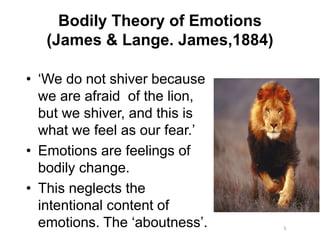
• ‘We do not shiver because
we are afraid of the lion,
but we shiver, and this is
what we feel as our fear.’
• Emotions are feelings of
bodily change.
• This neglects the
intentional content of
emotions. The ‘aboutness’. 5
Cognitive Theories of Emotions
(Lyons, 1980; Nussbaum, 2001;Solomon, 1976; Gordon, 1987; Downing, 2000;
De Sousa, 2010).
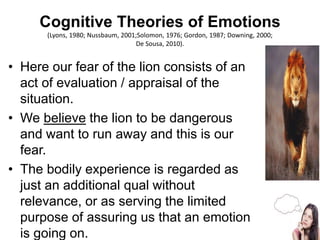
• Here our fear of the lion consists of an
act of evaluation / appraisal of the
situation.
• We believe the lion to be dangerous
and want to run away and this is our
fear.
• The bodily experience is regarded as
just an additional qual without
relevance, or as serving the limited
purpose of assuring us that an emotion
is going on. 6
Cognitive Theories of Emotions
(Continued).
• Belief based theories are unable to
capture the experiential and phenomenal
aspects.
• Without referring to bodily experience
cognitive approaches cannot account for
the intensity of emotions, (Increased heart
rate, muscle tension etc). So it’s virtually
impossible to indicate what a more or less
intense emotion might be like. There are
no ‘intense cognitions.’
7
Affect intentionality
(De Sousa, 2010; Frijda, 1994; Solomon, 1976; Gibson, 1979).
• Emotions are characterized by intentionality.
• Emotions relate to persons, objects, situations
and events in the world. (Lifeworld).
• Intentionality is not neutral but concerns what is
valuable and relevant for the person, or what an
action affords us.
• Emotions are a way of attending to salient
features of our world and giving them weight they
would not otherwise have.
8
Affect intentionality.
(Affordance: Gibson, 1979).
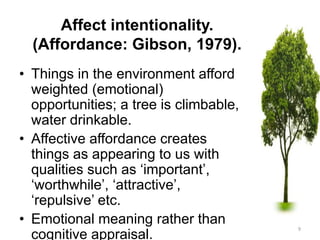
• Things in the environment afford
weighted (emotional)
opportunities; a tree is climbable,
water drinkable.
• Affective affordance creates
things as appearing to us with
qualities such as ‘important’,
‘worthwhile’, ‘attractive’,
‘repulsive’ etc.
• Emotional meaning rather than
cognitive appraisal.
9
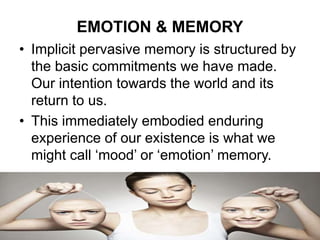
EMOTION & MEMORY
• Implicit pervasive memory is structured by
the basic commitments we have made.
Our intention towards the world and its
return to us.
• This immediately embodied enduring
experience of our existence is what we
might call ‘mood’ or ‘emotion’ memory.
10
• ‘the possibilities of disclosure
belonging to cognition fall far
short of the primordial
disclosure of moods in which
Dasein is brought before its
being as the there.’
• Heidegger 1926 p127
11
Husserl
on
emotions.
• Husserl categorizes emotions as ‘positing
acts’. (Logical Investigations 5 s29) and
Ideas 1 s117.
12
HUSSERL
Logical Investigations 1900 s29
Ideas 1 s60.
• Emotions are said to be involved in
suppositional creativity and structural
reasoning as well as being central to the
aspirational movement towards meaning
and purpose.
13
Subjective –Objective.
• Phenomenology has the role of
paying attention to the role of
subjectivity in the constitution of
objectivity.
• Precisely the realm of our emotions.
14
Subjective -Objective
• Phenomenology offers a method of
explicating the subjective in the objective
and the objective in the subjective.
• Phenomenology is concerned with the
uncovering of the mundane.
15
16
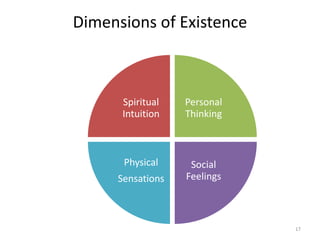
Dimensions of Existence
Spiritual
Intuition
Personal
Thinking
Social
Feelings
Physical
Sensations
17
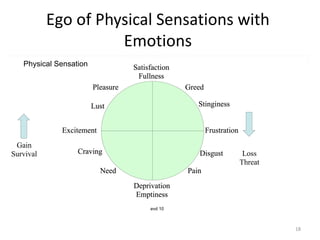
Ego of Physical Sensations with
Emotions
Greed
Stinginess
Frustration
Disgust
PainNeed
Craving
Excitement
Lust
Pleasure
Deprivation
Emptiness
Satisfaction
Fullness
Gain
Survival Loss
Threat
Physical Sensation
evd 10
18
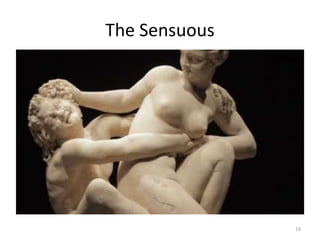
The Sensuous
19
20
• ‘asks nothing of us and does not summon
us to do anything.’
21
22
• Red ‘penetrates the eye.’
• red and yellow encourage a retreating
movement of our body’s motor actions.
23
24
• Blue ‘yields to our gaze.’
• encourages a bodily turn towards the
colour that draws us out into the world.
25
26
• yellow encourages a retreating movement
of our body’s motor actions.
• yellow is ‘stinging’.
27
• ‘What is called sensation is only
the most rudimentary of
perceptions.’
Merleau-Ponty (1962, 2003, p241).
28
Empfindnisse
• Spontaneously and passively given
physical sensations are the reflections and
shadows (Abschattungen) of objects that
in appearing give the non-intentional
layer of the lifeworld to consciousness.
They are the ‘Empfindnisse’ or ‘sensings’
which Husserl (1989, p152-155) refers to
as bringing together the terms sensation
and lived experience.
29
Heidegger 1982, 1988, p131 -133.
• ‘The first determination, animateness,
distinguishes man as a living being in
general . . . there pertains to sensibility . .
. not only the faculty of sensation but also
the . . . faculty of pleasure and
unpleasure, or delight in the agreeable, or
the reverse. Pleasure . . . is not only
desire for something . . . but always also
enjoyment . . . the human being, turning
with pleasure toward something,
experiences himself as enjoying - he is
joyous.’
30
What are these people being?
31
32
33
34
35
• How do you know what these facial
expressions convey?
• How do you know what these people
are being?
36
Heidegger (1982, 1988, p132-133).
• ‘In having a feeling for something there is
always present . . . a self-feeling, . . . a
mode of becoming revealed to oneself . . .
feeling is not a simple reflection upon
oneself but rather a feeling of self in
having a feeling for something . . . What is
phenomenologically decisive . . . is that it
directly uncovers and makes accessible
that which is felt, and it does this . . . in
the sense of a direct having-of-oneself.’
37
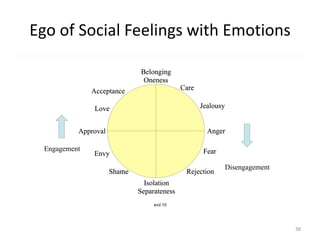
Ego of Social Feelings with Emotions
Care
Jealousy
Anger
Fear
RejectionShame
Envy
Approval
Love
Acceptance
Isolation
Separateness
Belonging
Oneness
Engagement
Disengagement
evd 10
38
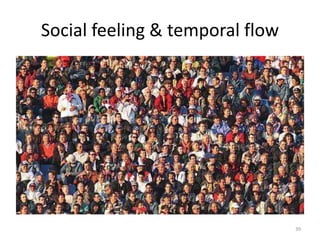
Social feeling & temporal flow
39
• ‘ My passivity stands in connection
with the passivity of all others; One
and the same thing-world is
constituted for us, one and the same
time as objective time such that
through this, my Now and the Now of
every other - and thus his life-present
- (with all immanences) and my life-
present - are objectively
‘simultaneous
40
these are indices for ordering my and
others’ phenomenal systems, not as
separated orders, but coordinated
orders in ‘the same time’ . . . my life
and the life of another do not exist,
each for themselves; rather, one is
‘directed’ toward the other
41
. . . not only has empathy ensued . . .
empathy has been ratified by the fact
that . . . the other ego has expressed
itself in a regular manner, and . . .
newly determined and ratified my
appresentations again and again.
Primordial laws of genesis are laws of
original time-consciousness.’ Husserl
(1900, 1970, 2001, p632-633).
42
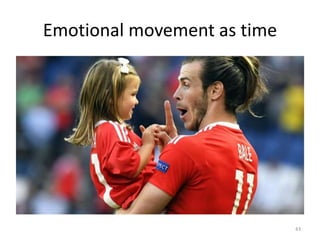
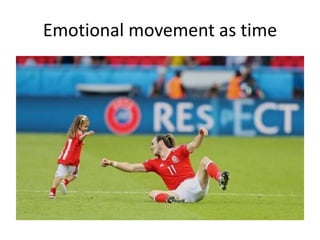
Emotional movement as time
43
Emotional movement as time
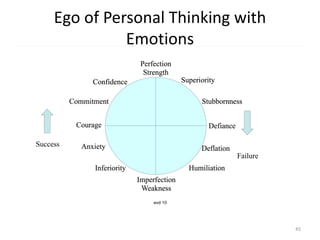
Ego of Personal Thinking with
Emotions
Superiority
Stubbornness
Defiance
Deflation
HumiliationInferiority
Anxiety
Courage
Confidence
Imperfection
Weakness
Perfection
Strength
Success
Failure
evd 10
Commitment
45
Psychological Ego
of Apprehension
• This psychological ego is grounded in and
therefore “presupposes the
personalitas transcendentalis”
(Heidegger 1982, 1988, p131) the subject
ego or ego of apperception.
• We move then always towards an
unknown future presupposing the creation
of meaning and with a purpose.
46
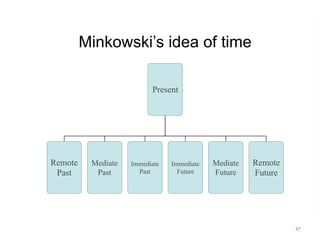
Minkowski’s idea of time
Present
Remote
Past
Mediate
Past
Immediate
Past
Immediate
Future
Mediate
Future
Remote
Future
47
• The reasoning of our personal thinking
overlaps with motivating feelings and
states of body-sense and in apprehending
the totality of lifeworld, internal and
external, attempts to action our desires.
This is the ego of our personal thinking;
the cogito or act of thinking the content of
what is thought, the cogitatum. This is the
dimension of our cause and effect
thinking; our natural everyday thinking.
48
(Husserl 1980, §5, p20).
‘Ideas iii’
• Husserl says that in all natural scientific
thinking, cause and effect thinking,
‘grounding necessarily leads . . .
beyond the sphere of thinking to
intuition.’
49
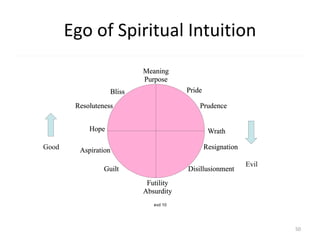
Ego of Spiritual Intuition
Pride
Prudence
Wrath
Resignation
DisillusionmentGuilt
Aspiration
Hope
Resoluteness
Bliss
Futility
Absurdity
Meaning
Purpose
Good
Evil
evd 10
50
Ego of Apperception
• ‘ . . .the original ground of the unity of the
manifold of its determinations . . . as ego I
have them all together with regard to myself .
. . combine them from the outset . . . The
combining is of such a sort that in thinking I
am also thinking myself . . . in all thinking I
think myself along with it. ‘I am conscious of
myself’ is a thought that already contains a
twofold ego, the ego as subject and the ego
as object . . . it looks beyond to an infinity of
self-made representations and concepts {the
ontological ones}.’
• Heidegger (1982, p127-131). 51
• Phenomenology is the act of knowing the
consciousness that I am as active flow of
life rather than a container of life. And in
this movement it transcends solipsism.
Transcendental phenomenology places
me back in the world after the epoche that
removed me, partially, from it.
52
• These dimensions, structured from
emotions and time, are our intentional
consciousness that deliver us toward
the horizon that is our ‘worlding’, our
lifeworld among other lifeworlds .
53
SEA
• Descriptive voices.
• The Explicit, the Implicit and Self
Deception.
• Increasing the complexity of themes.
• Values and Beliefs.
• Dimensions of existence: Projects fears
and tensions.
• Complexity of Meaning.
54
• “experience before it has been formulated in
judgements and expressed in outward
linguistic form, before it becomes packaged for
explicit consciousness . . . all cognitive activity
presupposes a domain that is passively
pregiven, the existent world as I find it.
Returning to examine this pregiven world is a
return to the life-world (Lebenswelt)”.
• Moran ( 2007, p12).
55

Phenomenology and Human Emotions

  • 1.
  • 2.
  • 3.
    Credits • The Dimensionsof Existence Slides are from Deurzen van, E. (1997, 2010). Everyday mysteries. • Shortened version of SEA is from: Deurzen van, E. & Adams, M. (2011). Skills in existential counselling and psychotherapy. • Film scenes: Remains of the Day Directed byJames Ivory Produced by Ismail Merchant, Mike Nichols, & John Calley. Columbia Pictures 3
  • 4.
    • Emotion isa word derived from the Latin ‘emovere’ which means to move out. 4
  • 5.
    Bodily Theory ofEmotions (James & Lange. James,1884) • ‘We do not shiver because we are afraid of the lion, but we shiver, and this is what we feel as our fear.’ • Emotions are feelings of bodily change. • This neglects the intentional content of emotions. The ‘aboutness’. 5
  • 6.
    Cognitive Theories ofEmotions (Lyons, 1980; Nussbaum, 2001;Solomon, 1976; Gordon, 1987; Downing, 2000; De Sousa, 2010). • Here our fear of the lion consists of an act of evaluation / appraisal of the situation. • We believe the lion to be dangerous and want to run away and this is our fear. • The bodily experience is regarded as just an additional qual without relevance, or as serving the limited purpose of assuring us that an emotion is going on. 6
  • 7.
    Cognitive Theories ofEmotions (Continued). • Belief based theories are unable to capture the experiential and phenomenal aspects. • Without referring to bodily experience cognitive approaches cannot account for the intensity of emotions, (Increased heart rate, muscle tension etc). So it’s virtually impossible to indicate what a more or less intense emotion might be like. There are no ‘intense cognitions.’ 7
  • 8.
    Affect intentionality (De Sousa,2010; Frijda, 1994; Solomon, 1976; Gibson, 1979). • Emotions are characterized by intentionality. • Emotions relate to persons, objects, situations and events in the world. (Lifeworld). • Intentionality is not neutral but concerns what is valuable and relevant for the person, or what an action affords us. • Emotions are a way of attending to salient features of our world and giving them weight they would not otherwise have. 8
  • 9.
    Affect intentionality. (Affordance: Gibson,1979). • Things in the environment afford weighted (emotional) opportunities; a tree is climbable, water drinkable. • Affective affordance creates things as appearing to us with qualities such as ‘important’, ‘worthwhile’, ‘attractive’, ‘repulsive’ etc. • Emotional meaning rather than cognitive appraisal. 9
  • 10.
    EMOTION & MEMORY •Implicit pervasive memory is structured by the basic commitments we have made. Our intention towards the world and its return to us. • This immediately embodied enduring experience of our existence is what we might call ‘mood’ or ‘emotion’ memory. 10
  • 11.
    • ‘the possibilitiesof disclosure belonging to cognition fall far short of the primordial disclosure of moods in which Dasein is brought before its being as the there.’ • Heidegger 1926 p127 11
  • 12.
    Husserl on emotions. • Husserl categorizesemotions as ‘positing acts’. (Logical Investigations 5 s29) and Ideas 1 s117. 12
  • 13.
    HUSSERL Logical Investigations 1900s29 Ideas 1 s60. • Emotions are said to be involved in suppositional creativity and structural reasoning as well as being central to the aspirational movement towards meaning and purpose. 13
  • 14.
    Subjective –Objective. • Phenomenologyhas the role of paying attention to the role of subjectivity in the constitution of objectivity. • Precisely the realm of our emotions. 14
  • 15.
    Subjective -Objective • Phenomenologyoffers a method of explicating the subjective in the objective and the objective in the subjective. • Phenomenology is concerned with the uncovering of the mundane. 15
  • 16.
  • 17.
  • 18.
    Ego of PhysicalSensations with Emotions Greed Stinginess Frustration Disgust PainNeed Craving Excitement Lust Pleasure Deprivation Emptiness Satisfaction Fullness Gain Survival Loss Threat Physical Sensation evd 10 18
  • 19.
  • 20.
  • 21.
    • ‘asks nothingof us and does not summon us to do anything.’ 21
  • 22.
  • 23.
    • Red ‘penetratesthe eye.’ • red and yellow encourage a retreating movement of our body’s motor actions. 23
  • 24.
  • 25.
    • Blue ‘yieldsto our gaze.’ • encourages a bodily turn towards the colour that draws us out into the world. 25
  • 26.
  • 27.
    • yellow encouragesa retreating movement of our body’s motor actions. • yellow is ‘stinging’. 27
  • 28.
    • ‘What iscalled sensation is only the most rudimentary of perceptions.’ Merleau-Ponty (1962, 2003, p241). 28
  • 29.
    Empfindnisse • Spontaneously andpassively given physical sensations are the reflections and shadows (Abschattungen) of objects that in appearing give the non-intentional layer of the lifeworld to consciousness. They are the ‘Empfindnisse’ or ‘sensings’ which Husserl (1989, p152-155) refers to as bringing together the terms sensation and lived experience. 29
  • 30.
    Heidegger 1982, 1988,p131 -133. • ‘The first determination, animateness, distinguishes man as a living being in general . . . there pertains to sensibility . . . not only the faculty of sensation but also the . . . faculty of pleasure and unpleasure, or delight in the agreeable, or the reverse. Pleasure . . . is not only desire for something . . . but always also enjoyment . . . the human being, turning with pleasure toward something, experiences himself as enjoying - he is joyous.’ 30
  • 31.
    What are thesepeople being? 31
  • 32.
  • 33.
  • 34.
  • 35.
  • 36.
    • How doyou know what these facial expressions convey? • How do you know what these people are being? 36
  • 37.
    Heidegger (1982, 1988,p132-133). • ‘In having a feeling for something there is always present . . . a self-feeling, . . . a mode of becoming revealed to oneself . . . feeling is not a simple reflection upon oneself but rather a feeling of self in having a feeling for something . . . What is phenomenologically decisive . . . is that it directly uncovers and makes accessible that which is felt, and it does this . . . in the sense of a direct having-of-oneself.’ 37
  • 38.
    Ego of SocialFeelings with Emotions Care Jealousy Anger Fear RejectionShame Envy Approval Love Acceptance Isolation Separateness Belonging Oneness Engagement Disengagement evd 10 38
  • 39.
    Social feeling &temporal flow 39
  • 40.
    • ‘ Mypassivity stands in connection with the passivity of all others; One and the same thing-world is constituted for us, one and the same time as objective time such that through this, my Now and the Now of every other - and thus his life-present - (with all immanences) and my life- present - are objectively ‘simultaneous 40
  • 41.
    these are indicesfor ordering my and others’ phenomenal systems, not as separated orders, but coordinated orders in ‘the same time’ . . . my life and the life of another do not exist, each for themselves; rather, one is ‘directed’ toward the other 41
  • 42.
    . . .not only has empathy ensued . . . empathy has been ratified by the fact that . . . the other ego has expressed itself in a regular manner, and . . . newly determined and ratified my appresentations again and again. Primordial laws of genesis are laws of original time-consciousness.’ Husserl (1900, 1970, 2001, p632-633). 42
  • 43.
  • 44.
  • 45.
    Ego of PersonalThinking with Emotions Superiority Stubbornness Defiance Deflation HumiliationInferiority Anxiety Courage Confidence Imperfection Weakness Perfection Strength Success Failure evd 10 Commitment 45
  • 46.
    Psychological Ego of Apprehension •This psychological ego is grounded in and therefore “presupposes the personalitas transcendentalis” (Heidegger 1982, 1988, p131) the subject ego or ego of apperception. • We move then always towards an unknown future presupposing the creation of meaning and with a purpose. 46
  • 47.
    Minkowski’s idea oftime Present Remote Past Mediate Past Immediate Past Immediate Future Mediate Future Remote Future 47
  • 48.
    • The reasoningof our personal thinking overlaps with motivating feelings and states of body-sense and in apprehending the totality of lifeworld, internal and external, attempts to action our desires. This is the ego of our personal thinking; the cogito or act of thinking the content of what is thought, the cogitatum. This is the dimension of our cause and effect thinking; our natural everyday thinking. 48
  • 49.
    (Husserl 1980, §5,p20). ‘Ideas iii’ • Husserl says that in all natural scientific thinking, cause and effect thinking, ‘grounding necessarily leads . . . beyond the sphere of thinking to intuition.’ 49
  • 50.
    Ego of SpiritualIntuition Pride Prudence Wrath Resignation DisillusionmentGuilt Aspiration Hope Resoluteness Bliss Futility Absurdity Meaning Purpose Good Evil evd 10 50
  • 51.
    Ego of Apperception •‘ . . .the original ground of the unity of the manifold of its determinations . . . as ego I have them all together with regard to myself . . . combine them from the outset . . . The combining is of such a sort that in thinking I am also thinking myself . . . in all thinking I think myself along with it. ‘I am conscious of myself’ is a thought that already contains a twofold ego, the ego as subject and the ego as object . . . it looks beyond to an infinity of self-made representations and concepts {the ontological ones}.’ • Heidegger (1982, p127-131). 51
  • 52.
    • Phenomenology isthe act of knowing the consciousness that I am as active flow of life rather than a container of life. And in this movement it transcends solipsism. Transcendental phenomenology places me back in the world after the epoche that removed me, partially, from it. 52
  • 53.
    • These dimensions,structured from emotions and time, are our intentional consciousness that deliver us toward the horizon that is our ‘worlding’, our lifeworld among other lifeworlds . 53
  • 54.
    SEA • Descriptive voices. •The Explicit, the Implicit and Self Deception. • Increasing the complexity of themes. • Values and Beliefs. • Dimensions of existence: Projects fears and tensions. • Complexity of Meaning. 54
  • 55.
    • “experience beforeit has been formulated in judgements and expressed in outward linguistic form, before it becomes packaged for explicit consciousness . . . all cognitive activity presupposes a domain that is passively pregiven, the existent world as I find it. Returning to examine this pregiven world is a return to the life-world (Lebenswelt)”. • Moran ( 2007, p12). 55

Editor's Notes

  • #14 We must notice that Husserl has split the ego in two transcendental and mundane
  • #15 So if we enter into the practice of phenomenology do we do psychology at all? Or might transcendental phenomenology be the underpinning philosophical discipline needed to move psychology on from the duality which I attempted to demonstrate earlier by comparison of James & Lange and the cognitivists.