EMOTIONS
Presented by:
Sirajuddin
Chapter 3 of the oxford handbook of analytical Sociology by JON ELSTER
And Chapter 8 of the Explaining Social behavior ( more Nuts and Bolts for
the Social sciences )by JON ELSTER
Presented To
Prof. Zoltán Szántó
What are Emotions?
• Emotions is a complex psychological phenomena which occurs as
animals or people live their lives .
• It is intense feeling that are directed at someone or something.
• We may think that emotions are triggered by beliefs, but how do we
then explain that people can get emotionally upset by reading stories or
watching movies that are clearly fictitious?
• A state of physiological arousal accompanied by changes in facial
expressions, gestures, postures and subjective feelings. Examples of
emotions are –surprise, sad, joy, disgust, fear, acceptance and anger.
Introduction
• The term ‘emotion’ harbors various complexities.
• First it may refer to an Occur rent (a fit of range) event or to a standing
disposition(irritability). Both occurent emotional and emotional dispositions may,
therefore, enter into the explanation of behavior.
• Second it may refer to ‘proto-emotions’. They do affect behavior, proto emotions
usually have less of a causal impact than the full blown emotions that are
conceptualized by society and acknowledged by the individual.
• Third the term emotion should not be identified with the older term ‘passion’ or with
the more recent term Visceral factor (Loewenstein 1996).
• Fourth emotion theorists disagree on what emotions are and on what emotions there
are. The emotions do not form a natural kind.
• Finally, emotion theorists also disagree on what emotions are for.
Cognations and Emotions
Belief
• A imposed an unjust harm on B
• A imposed an unjust harm on C in
the presence of B
• A is Evil
• A is weak or inferior
• ?
• B feels contempt towards A
• A has behaved unjustly or
immorally
• A has something that B lacks and
desire
• A is faced with impending danger
• A suffer unmerited distress
• A has helped B
Emotion
• B feels anger towards A
• B feels ‘Cartesian indignation’
towards A
• B feels hatred towards A
• B feels contempt towards A
• B loves A
• A feels Shame
• A feels Guilt
• B feels envy
• A feels fear
• B feels pity towards A
• B feels gratitude towards A
Ref. Elster1999a
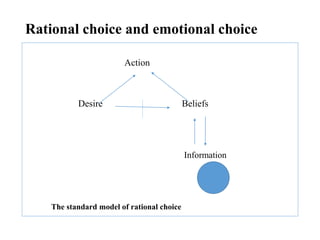
Rational choice and emotional choice
Action
Desire Beliefs
The standard model of rational choice
Information
Features of Emotions
• Cognitive antecedents
• Physiological arousal
• Physiological expressions
• Action tendencies
• Intentional objects
• Valence
Emotions by Negative and positive belief
• Shame is triggered by a negative belief about one’s own character.
• Contempt and hatred are triggered by negative beliefs about another’s
character. Contempt is induced by the thought that another is inferior, hatred
by the thought that he is evil.
• Guilt is triggered by a negative belief about one’s own action.
• Anger is triggered by a negative belief about another’s action toward oneself.
• Cartesian indignation is triggered by a negative belief about another’s action
toward a third party.
• Pridefulness is triggered by a positive belief about one’s own character
• Liking is triggered by a positive belief about another’s character.
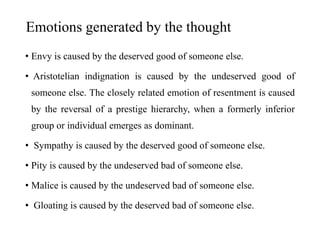
Emotions generated by the thought
• Envy is caused by the deserved good of someone else.
• Aristotelian indignation is caused by the undeserved good of
someone else. The closely related emotion of resentment is caused
by the reversal of a prestige hierarchy, when a formerly inferior
group or individual emerges as dominant.
• Sympathy is caused by the deserved good of someone else.
• Pity is caused by the undeserved bad of someone else.
• Malice is caused by the undeserved bad of someone else.
• Gloating is caused by the deserved bad of someone else.
Emotions and happiness
• Subjective well-being is the perception people have about their happiness
and satisfaction with life. Subjective well-being depends more on attitudes to
external circumstances than on the circumstances themselves. That is, factors
such as wealth or employment don’t matter as much as how we feel about our
wealth or employment.
• Although circumstances do not reliably predict happiness, some
circumstances do correlate with increased happiness. These include having a
good social network, being married, having a satisfying job, and having
strong religious convictions. These circumstances, however, are only
correlated with happiness.
• The reason we want to know about economic output is that it contributes to
subjective welfare or happiness.
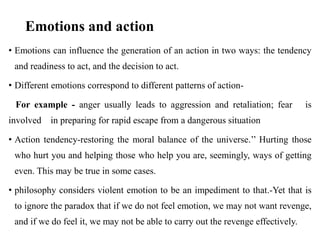
Emotions and action
• Emotions can influence the generation of an action in two ways: the tendency
and readiness to act, and the decision to act.
• Different emotions correspond to different patterns of action-
For example - anger usually leads to aggression and retaliation; fear is
involved in preparing for rapid escape from a dangerous situation
• Action tendency-restoring the moral balance of the universe.’’ Hurting those
who hurt you and helping those who help you are, seemingly, ways of getting
even. This may be true in some cases.
• philosophy considers violent emotion to be an impediment to that.-Yet that is
to ignore the paradox that if we do not feel emotion, we may not want revenge,
and if we do feel it, we may not be able to carry out the revenge effectively.
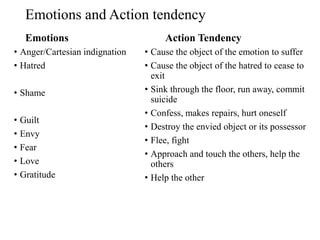
Emotions and Action tendency
Emotions
• Anger/Cartesian indignation
• Hatred
• Shame
• Guilt
• Envy
• Fear
• Love
• Gratitude
Action Tendency
• Cause the object of the emotion to suffer
• Cause the object of the hatred to cease to
exit
• Sink through the floor, run away, commit
suicide
• Confess, makes repairs, hurt oneself
• Destroy the envied object or its possessor
• Flee, fight
• Approach and touch the others, help the
others
• Help the other
Culture and Emotions
• Some aspects of emotion are universal to all cultures, while other aspects
differ across cultures.
• There are half a dozen emotions – happiness, surprise, fear, sadness,
disgust, and anger – that have facial expressions people recognize across
cultures
• Culture play a very important role in an individual ability to recognize the
expression of emotions.
• Facial Expressions Are Innate- Both people who can see and people who
have been blind since birth have similar facial expressions of emotions.
This observation suggests that facial expressions are innate, since blind
people could not have learned these expressions by observing others.
Cont..
• Differences Among Cultures- Although many emotions and expressions of emotions are
universal, some differences exist among cultures:
• Categories of emotions: People in different cultures categorize emotions differently.
Some languages have labels for emotions that are not labeled in other languages.
• Prioritization of emotions: Different cultures consider different emotions to be primary.
• Different emotions evoked: The same situation may evoke different emotions in different
cultures.
• Power of cultural norms: Cultural norms determine how and when to show emotions that
are not actually felt. Acting out an emotion that is not felt is called emotion work.
Conclusion
• emotion most commonly is treated as a dependent variable, although increasingly,
its role as an intervening and independent variable in social processes is being
recognized, especially with regard to problems in substantive fields as diverse as
gender roles, stress, small groups, social movements, and stratification.
• Considerable gaps exist in sociological knowledge about emotions; in particular,
little is known about distribution of different emotional experiences in the
population, the content of emotion culture, emotional socialization processes,
emotional interactions, and relationships between social structure and emotion
norms.
Thank youYour emotions are the slaves to your thoughts, and you are the slave to your emotions by
Elizabeth Gilbert

Emotions

  • 1.
    EMOTIONS Presented by: Sirajuddin Chapter 3of the oxford handbook of analytical Sociology by JON ELSTER And Chapter 8 of the Explaining Social behavior ( more Nuts and Bolts for the Social sciences )by JON ELSTER Presented To Prof. Zoltán Szántó
  • 2.
    What are Emotions? •Emotions is a complex psychological phenomena which occurs as animals or people live their lives . • It is intense feeling that are directed at someone or something. • We may think that emotions are triggered by beliefs, but how do we then explain that people can get emotionally upset by reading stories or watching movies that are clearly fictitious? • A state of physiological arousal accompanied by changes in facial expressions, gestures, postures and subjective feelings. Examples of emotions are –surprise, sad, joy, disgust, fear, acceptance and anger.
  • 3.
    Introduction • The term‘emotion’ harbors various complexities. • First it may refer to an Occur rent (a fit of range) event or to a standing disposition(irritability). Both occurent emotional and emotional dispositions may, therefore, enter into the explanation of behavior. • Second it may refer to ‘proto-emotions’. They do affect behavior, proto emotions usually have less of a causal impact than the full blown emotions that are conceptualized by society and acknowledged by the individual. • Third the term emotion should not be identified with the older term ‘passion’ or with the more recent term Visceral factor (Loewenstein 1996). • Fourth emotion theorists disagree on what emotions are and on what emotions there are. The emotions do not form a natural kind. • Finally, emotion theorists also disagree on what emotions are for.
  • 4.
    Cognations and Emotions Belief •A imposed an unjust harm on B • A imposed an unjust harm on C in the presence of B • A is Evil • A is weak or inferior • ? • B feels contempt towards A • A has behaved unjustly or immorally • A has something that B lacks and desire • A is faced with impending danger • A suffer unmerited distress • A has helped B Emotion • B feels anger towards A • B feels ‘Cartesian indignation’ towards A • B feels hatred towards A • B feels contempt towards A • B loves A • A feels Shame • A feels Guilt • B feels envy • A feels fear • B feels pity towards A • B feels gratitude towards A Ref. Elster1999a
  • 5.
    Rational choice andemotional choice Action Desire Beliefs The standard model of rational choice Information
  • 6.
    Features of Emotions •Cognitive antecedents • Physiological arousal • Physiological expressions • Action tendencies • Intentional objects • Valence
  • 7.
    Emotions by Negativeand positive belief • Shame is triggered by a negative belief about one’s own character. • Contempt and hatred are triggered by negative beliefs about another’s character. Contempt is induced by the thought that another is inferior, hatred by the thought that he is evil. • Guilt is triggered by a negative belief about one’s own action. • Anger is triggered by a negative belief about another’s action toward oneself. • Cartesian indignation is triggered by a negative belief about another’s action toward a third party. • Pridefulness is triggered by a positive belief about one’s own character • Liking is triggered by a positive belief about another’s character.
  • 8.
    Emotions generated bythe thought • Envy is caused by the deserved good of someone else. • Aristotelian indignation is caused by the undeserved good of someone else. The closely related emotion of resentment is caused by the reversal of a prestige hierarchy, when a formerly inferior group or individual emerges as dominant. • Sympathy is caused by the deserved good of someone else. • Pity is caused by the undeserved bad of someone else. • Malice is caused by the undeserved bad of someone else. • Gloating is caused by the deserved bad of someone else.
  • 9.
    Emotions and happiness •Subjective well-being is the perception people have about their happiness and satisfaction with life. Subjective well-being depends more on attitudes to external circumstances than on the circumstances themselves. That is, factors such as wealth or employment don’t matter as much as how we feel about our wealth or employment. • Although circumstances do not reliably predict happiness, some circumstances do correlate with increased happiness. These include having a good social network, being married, having a satisfying job, and having strong religious convictions. These circumstances, however, are only correlated with happiness. • The reason we want to know about economic output is that it contributes to subjective welfare or happiness.
  • 10.
    Emotions and action •Emotions can influence the generation of an action in two ways: the tendency and readiness to act, and the decision to act. • Different emotions correspond to different patterns of action- For example - anger usually leads to aggression and retaliation; fear is involved in preparing for rapid escape from a dangerous situation • Action tendency-restoring the moral balance of the universe.’’ Hurting those who hurt you and helping those who help you are, seemingly, ways of getting even. This may be true in some cases. • philosophy considers violent emotion to be an impediment to that.-Yet that is to ignore the paradox that if we do not feel emotion, we may not want revenge, and if we do feel it, we may not be able to carry out the revenge effectively.
  • 11.
    Emotions and Actiontendency Emotions • Anger/Cartesian indignation • Hatred • Shame • Guilt • Envy • Fear • Love • Gratitude Action Tendency • Cause the object of the emotion to suffer • Cause the object of the hatred to cease to exit • Sink through the floor, run away, commit suicide • Confess, makes repairs, hurt oneself • Destroy the envied object or its possessor • Flee, fight • Approach and touch the others, help the others • Help the other
  • 12.
    Culture and Emotions •Some aspects of emotion are universal to all cultures, while other aspects differ across cultures. • There are half a dozen emotions – happiness, surprise, fear, sadness, disgust, and anger – that have facial expressions people recognize across cultures • Culture play a very important role in an individual ability to recognize the expression of emotions. • Facial Expressions Are Innate- Both people who can see and people who have been blind since birth have similar facial expressions of emotions. This observation suggests that facial expressions are innate, since blind people could not have learned these expressions by observing others.
  • 13.
    Cont.. • Differences AmongCultures- Although many emotions and expressions of emotions are universal, some differences exist among cultures: • Categories of emotions: People in different cultures categorize emotions differently. Some languages have labels for emotions that are not labeled in other languages. • Prioritization of emotions: Different cultures consider different emotions to be primary. • Different emotions evoked: The same situation may evoke different emotions in different cultures. • Power of cultural norms: Cultural norms determine how and when to show emotions that are not actually felt. Acting out an emotion that is not felt is called emotion work.
  • 14.
    Conclusion • emotion mostcommonly is treated as a dependent variable, although increasingly, its role as an intervening and independent variable in social processes is being recognized, especially with regard to problems in substantive fields as diverse as gender roles, stress, small groups, social movements, and stratification. • Considerable gaps exist in sociological knowledge about emotions; in particular, little is known about distribution of different emotional experiences in the population, the content of emotion culture, emotional socialization processes, emotional interactions, and relationships between social structure and emotion norms.
  • 15.
    Thank youYour emotionsare the slaves to your thoughts, and you are the slave to your emotions by Elizabeth Gilbert