
Made to Stick
(Why Some Ideas Survive and Others Die)
Chip Heath & Dan Heath
(New York, NY: Random House, 2007)
People with important ideas, like
business people, teachers, politicians,
struggle to make their ideas “stick.”
“Made to Stick” gives suggestions
for tailoring ideas in a way that makes
the ideas more effective.
If you want to spread your ideas,
work within the confines of the rules
that have succeeded over time.
A medium size “buttered” popcorn
at a typical movie theatre contains
more artery-clogging fat than a
bacon-and-egg breakfast, a Big Mac
and fries for lunch, and a steak dinner
with all the trimmings – combined !
True Fact
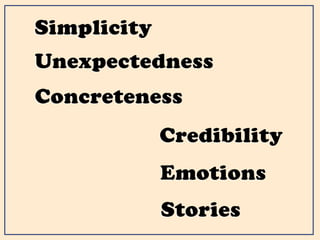
Simplicity
Unexpectedness
Concreteness
Credibility
Emotions
Stories
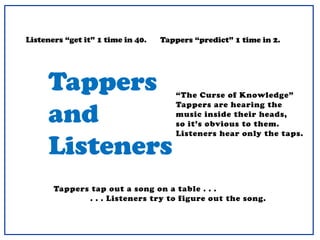
Tappers
and
Listeners
Tappers tap out a song on a table . . .
. . . Listeners try to figure out the song.
Listeners “get it” 1 time in 40. Tappers “predict” 1 time in 2.
“The Curse of Knowledge”
Tappers are hearing the
music inside their heads,
so it’s obvious to them.
Listeners hear only the taps.
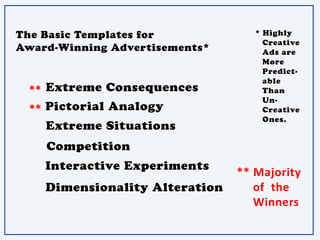
The Basic Templates for
Award-Winning Advertisements*
* Highly
Creative
Ads are
More
Predict-
able
Than
Un-
Creative
Ones.
Extreme Consequences
Extreme Situations
Competition
Interactive Experiments
Dimensionality Alteration
Pictorial Analogy
**
**
** Majority
of the
Winners
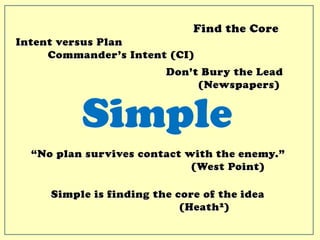
Simple
Intent versus Plan
Commander’s Intent (CI)
“No plan survives contact with the enemy.”
(West Point)
Find the Core
Don’t Bury the Lead
(Newspapers)
Simple is finding the core of the idea
(Heath2)
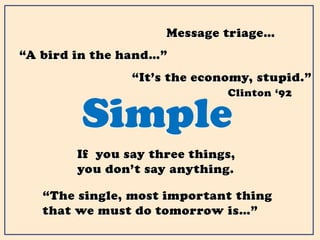
If you say three things,
you don’t say anything.
“It’s the economy, stupid.”
Clinton ‘92
Message triage…
“A bird in the hand…”
Simple
“The single, most important thing
that we must do tomorrow is…”
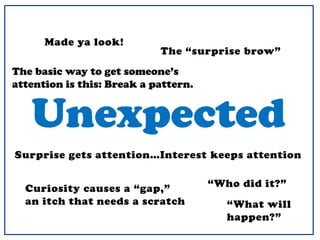
Unexpected
Made ya look!
Surprise gets attention…Interest keeps attention
The “surprise brow”
Curiosity causes a “gap,”
an itch that needs a scratch
“Who did it?”
“What will
happen?”
The basic way to get someone’s
attention is this: Break a pattern.
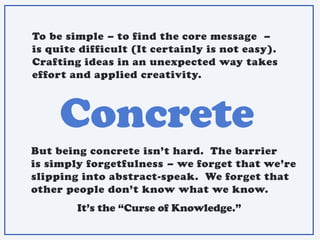
Concrete
To be simple – to find the core message –
is quite difficult (It certainly is not easy).
Crafting ideas in an unexpected way takes
effort and applied creativity.
But being concrete isn’t hard. The barrier
is simply forgetfulness – we forget that we’re
slipping into abstract-speak. We forget that
other people don’t know what we know.
It’s the “Curse of Knowledge.”
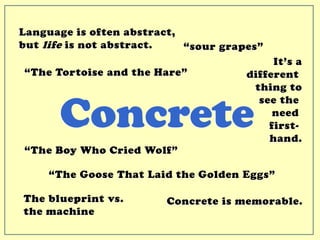
Concrete
Language is often abstract,
but life is not abstract.
“The Tortoise and the Hare”
“The Boy Who Cried Wolf”
“The Goose That Laid the Golden Eggs”
“sour grapes”
Concrete is memorable.The blueprint vs.
the machine
It’s a
different
thing to
see the
need
first-
hand.
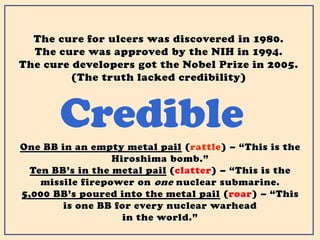
Credible
The cure for ulcers was discovered in 1980.
The cure was approved by the NIH in 1994.
The cure developers got the Nobel Prize in 2005.
(The truth lacked credibility)
One BB in an empty metal pail (rattle) – “This is the
Hiroshima bomb.”
Ten BB’s in the metal pail (clatter) – “This is the
missile firepower on one nuclear submarine.
5,000 BB’s poured into the metal pail (roar) – “This
is one BB for every nuclear warhead
in the world.”
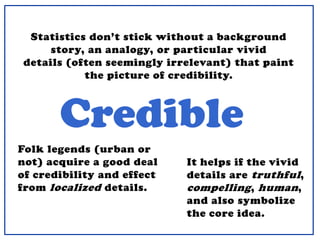
Credible
Statistics don’t stick without a background
story, an analogy, or particular vivid
details (often seemingly irrelevant) that paint
the picture of credibility.
Folk legends (urban or
not) acquire a good deal
of credibility and effect
from localized details.
It helps if the vivid
details are truthful,
compelling, human,
and also symbolize
the core idea.
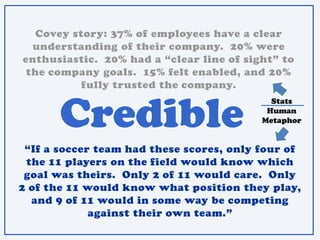
Credible
Covey story: 37% of employees have a clear
understanding of their company. 20% were
enthusiastic. 20% had a “clear line of sight” to
the company goals. 15% felt enabled, and 20%
fully trusted the company.
“If a soccer team had these scores, only four of
the 11 players on the field would know which
goal was theirs. Only 2 of 11 would care. Only
2 of the 11 would know what position they play,
and 9 of 11 would in some way be competing
against their own team.”
Stats
Human
Metaphor
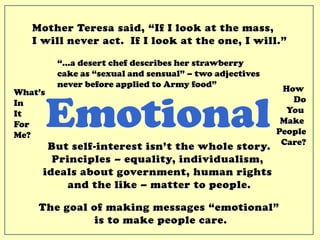
Mother Teresa said, “If I look at the mass,
I will never act. If I look at the one, I will.”
But self-interest isn’t the whole story.
Principles – equality, individualism,
ideals about government, human rights
and the like – matter to people.
How
Do
You
Make
People
Care?
What’s
In
It
For
Me?
“…a desert chef describes her strawberry
cake as “sexual and sensual” – two adjectives
never before applied to Army food”
Emotional
The goal of making messages “emotional”
is to make people care.
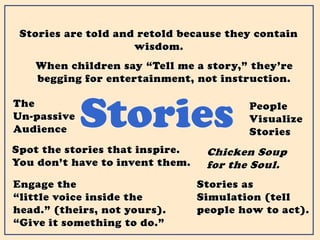
Stories
Stories are told and retold because they contain
wisdom.
When children say “Tell me a story,” they’re
begging for entertainment, not instruction.
The
Un-passive
Audience
People
Visualize
Stories
Spot the stories that inspire.
You don’t have to invent them.
Chicken Soup
for the Soul.
Engage the
“little voice inside the
head.” (theirs, not yours).
“Give it something to do.”
Stories as
Simulation (tell
people how to act).
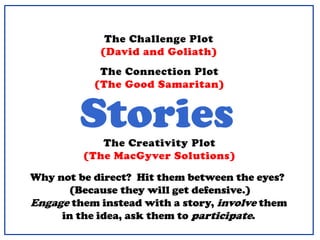
Stories
The Challenge Plot
(David and Goliath)
The Connection Plot
(The Good Samaritan)
The Creativity Plot
(The MacGyver Solutions)
Why not be direct? Hit them between the eyes?
(Because they will get defensive.)
Engage them instead with a story, involve them
in the idea, ask them to participate.
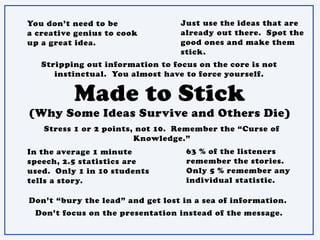
Made to Stick
(Why Some Ideas Survive and Others Die)
You don’t need to be
a creative genius to cook
up a great idea.
Just use the ideas that are
already out there. Spot the
good ones and make them
stick.
In the average 1 minute
speech, 2.5 statistics are
used. Only 1 in 10 students
tells a story.
63 % of the listeners
remember the stories.
Only 5 % remember any
individual statistic.
Don’t “bury the lead” and get lost in a sea of information.
Stripping out information to focus on the core is not
instinctual. You almost have to force yourself.
Don’t focus on the presentation instead of the message.
Stress 1 or 2 points, not 10. Remember the “Curse of
Knowledge.”
Credible
Chip Heath is a professor of organizational
behavior in the Graduate School of Business
at Stanford University. He lives in Los Gatos,
California.
Dan Heath is a consultant at Duke Corporate
Education. He is a former researcher at Harvard
Business School and a co-founder of Thinkwell,
an innovative new-media textbook company.
He lives in Raleigh, North Carolina.
Extracted, excerpted, quoted,
paraphrased, selected and
otherwise handpicked
verbiage for this PowerPoint
presentation is from the book:
Made to Stick by Chip Heath &
Dan Heath. Published by
Random House in 2007.
(all communicators should have this book)
Veritas
jgillis767@aol.com
First Light, LLC

Made to Stick - Communication Styles

  • 1.
    Made to Stick (WhySome Ideas Survive and Others Die) Chip Heath & Dan Heath (New York, NY: Random House, 2007)
  • 2.
    People with importantideas, like business people, teachers, politicians, struggle to make their ideas “stick.” “Made to Stick” gives suggestions for tailoring ideas in a way that makes the ideas more effective. If you want to spread your ideas, work within the confines of the rules that have succeeded over time.
  • 3.
    A medium size“buttered” popcorn at a typical movie theatre contains more artery-clogging fat than a bacon-and-egg breakfast, a Big Mac and fries for lunch, and a steak dinner with all the trimmings – combined ! True Fact
  • 4.
  • 5.
    Tappers and Listeners Tappers tap outa song on a table . . . . . . Listeners try to figure out the song. Listeners “get it” 1 time in 40. Tappers “predict” 1 time in 2. “The Curse of Knowledge” Tappers are hearing the music inside their heads, so it’s obvious to them. Listeners hear only the taps.
  • 6.
    The Basic Templatesfor Award-Winning Advertisements* * Highly Creative Ads are More Predict- able Than Un- Creative Ones. Extreme Consequences Extreme Situations Competition Interactive Experiments Dimensionality Alteration Pictorial Analogy ** ** ** Majority of the Winners
  • 7.
    Simple Intent versus Plan Commander’sIntent (CI) “No plan survives contact with the enemy.” (West Point) Find the Core Don’t Bury the Lead (Newspapers) Simple is finding the core of the idea (Heath2)
  • 8.
    If you saythree things, you don’t say anything. “It’s the economy, stupid.” Clinton ‘92 Message triage… “A bird in the hand…” Simple “The single, most important thing that we must do tomorrow is…”
  • 9.
    Unexpected Made ya look! Surprisegets attention…Interest keeps attention The “surprise brow” Curiosity causes a “gap,” an itch that needs a scratch “Who did it?” “What will happen?” The basic way to get someone’s attention is this: Break a pattern.
  • 10.
    Concrete To be simple– to find the core message – is quite difficult (It certainly is not easy). Crafting ideas in an unexpected way takes effort and applied creativity. But being concrete isn’t hard. The barrier is simply forgetfulness – we forget that we’re slipping into abstract-speak. We forget that other people don’t know what we know. It’s the “Curse of Knowledge.”
  • 11.
    Concrete Language is oftenabstract, but life is not abstract. “The Tortoise and the Hare” “The Boy Who Cried Wolf” “The Goose That Laid the Golden Eggs” “sour grapes” Concrete is memorable.The blueprint vs. the machine It’s a different thing to see the need first- hand.
  • 12.
    Credible The cure forulcers was discovered in 1980. The cure was approved by the NIH in 1994. The cure developers got the Nobel Prize in 2005. (The truth lacked credibility) One BB in an empty metal pail (rattle) – “This is the Hiroshima bomb.” Ten BB’s in the metal pail (clatter) – “This is the missile firepower on one nuclear submarine. 5,000 BB’s poured into the metal pail (roar) – “This is one BB for every nuclear warhead in the world.”
  • 13.
    Credible Statistics don’t stickwithout a background story, an analogy, or particular vivid details (often seemingly irrelevant) that paint the picture of credibility. Folk legends (urban or not) acquire a good deal of credibility and effect from localized details. It helps if the vivid details are truthful, compelling, human, and also symbolize the core idea.
  • 14.
    Credible Covey story: 37%of employees have a clear understanding of their company. 20% were enthusiastic. 20% had a “clear line of sight” to the company goals. 15% felt enabled, and 20% fully trusted the company. “If a soccer team had these scores, only four of the 11 players on the field would know which goal was theirs. Only 2 of 11 would care. Only 2 of the 11 would know what position they play, and 9 of 11 would in some way be competing against their own team.” Stats Human Metaphor
  • 15.
    Mother Teresa said,“If I look at the mass, I will never act. If I look at the one, I will.” But self-interest isn’t the whole story. Principles – equality, individualism, ideals about government, human rights and the like – matter to people. How Do You Make People Care? What’s In It For Me? “…a desert chef describes her strawberry cake as “sexual and sensual” – two adjectives never before applied to Army food” Emotional The goal of making messages “emotional” is to make people care.
  • 16.
    Stories Stories are toldand retold because they contain wisdom. When children say “Tell me a story,” they’re begging for entertainment, not instruction. The Un-passive Audience People Visualize Stories Spot the stories that inspire. You don’t have to invent them. Chicken Soup for the Soul. Engage the “little voice inside the head.” (theirs, not yours). “Give it something to do.” Stories as Simulation (tell people how to act).
  • 17.
    Stories The Challenge Plot (Davidand Goliath) The Connection Plot (The Good Samaritan) The Creativity Plot (The MacGyver Solutions) Why not be direct? Hit them between the eyes? (Because they will get defensive.) Engage them instead with a story, involve them in the idea, ask them to participate.
  • 18.
    Made to Stick (WhySome Ideas Survive and Others Die) You don’t need to be a creative genius to cook up a great idea. Just use the ideas that are already out there. Spot the good ones and make them stick. In the average 1 minute speech, 2.5 statistics are used. Only 1 in 10 students tells a story. 63 % of the listeners remember the stories. Only 5 % remember any individual statistic. Don’t “bury the lead” and get lost in a sea of information. Stripping out information to focus on the core is not instinctual. You almost have to force yourself. Don’t focus on the presentation instead of the message. Stress 1 or 2 points, not 10. Remember the “Curse of Knowledge.”
  • 19.
    Credible Chip Heath isa professor of organizational behavior in the Graduate School of Business at Stanford University. He lives in Los Gatos, California. Dan Heath is a consultant at Duke Corporate Education. He is a former researcher at Harvard Business School and a co-founder of Thinkwell, an innovative new-media textbook company. He lives in Raleigh, North Carolina.
  • 20.
    Extracted, excerpted, quoted, paraphrased,selected and otherwise handpicked verbiage for this PowerPoint presentation is from the book: Made to Stick by Chip Heath & Dan Heath. Published by Random House in 2007. (all communicators should have this book)
  • 21.