IEEE PES
Cathodic Protection Use
On Tank Bottoms
& Underground Piping
In Power Generation Plants
PG&E Office
San Francisco
January 18, 2007
Craig K. Meier
Corrosion Control Incorporated
IEEE PES
• Corrosion process for tanks and piping
• Principles of cathodic protection
• Effects of coatings
• Cathodic protection design requirements
• Selecting the proper system
• Construction implementation issues
• Compliance testing
• Continued monitoring and maintenance
IEEE PES
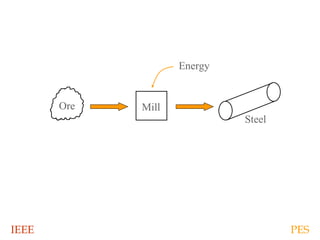
Ore Mill
Steel
Energy
IEEE PES
IEEE PES
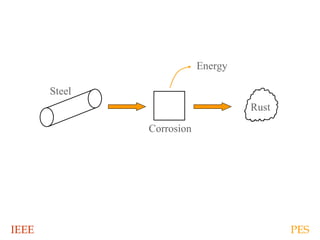
Rust
Corrosion
Steel
Energy
IEEE PES
Fe++
Iron ion
Cathode Anode
e-
Electron flow
H2O + 1/2O2 + 2e- → 2OH- Feº→ Fe++ + 2e-
Conventional
Current Flow
IEEE PES
Rate of Corrosion
• Soil Corrosivity
– Resistivity
– pH
– Salts
• Bi-metallic effect
• Mixed soils
• Differences in oxygen
IEEE PES
Corrosion
Clay
Sand
Pipe
Excavation
Native Soil
IEEE PES
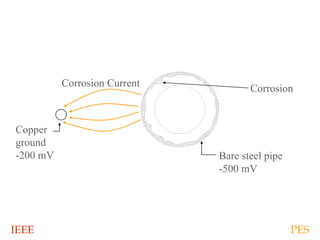
Corrosion
Bare steel pipe
-500 mV
Copper
ground
-200 mV
Corrosion Current
IEEE PES
Copper
ground
Corrosion
Steel pipe
Coating
Coating flaw
IEEE PES
Corrosion
Tank floor
Clay lump
Copper
ground
Corrosion
IEEE PES
IEEE PES
• API recommends against the use of asphalt and
concrete tank pads.
Concrete or asphalt
Tank floor
Corrosion
IEEE PES
IEEE PES
Corrosion Losses
• Will occur in all plants
• Rate of loss dependent on soil and materials used
• Coatings alone do not stop soil corrosion
• Care during construction can significantly reduce losses
IEEE PES
Corrosion Control
• Material selection
• Bedding
• Coatings
• Cathodic Protection
IEEE PES
• Reduces amount of exposed metal
• Coatings are not perfect
Steel
Coating flaw
Coating
IEEE PES
Cathodic Protection
H2O + 1/2O2 + 2e- → 2OH-
Pipe
Anode
Ground
IEEE PES
Cathodic Protection
• Galvanic
• Impressed Current
IEEE PES
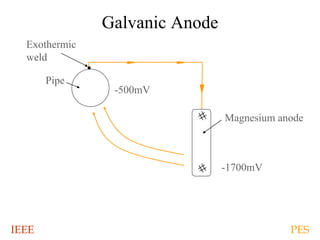
Galvanic Anode
Pipe
-500mV
Magnesium anode
-1700mV
Exothermic
weld
IEEE PES
Galvanic Cathodic Protection
• Galvanic anodes have a limited current output, 10 to 30
milliamperes per anode.
• Due to the limited current output, the use of galvanic
anodes is limited to coated and electrically isolated
underground piping and underground tanks.
IEEE PES
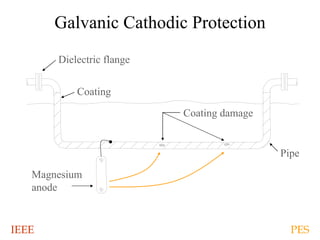
Galvanic Cathodic Protection
Magnesium
anode
Coating damage
Pipe
Coating
Dielectric flange
IEEE PES
Galvanic
anode
Protects only outer floor
Bare steel tank bottom
IEEE PES
Impressed Current
AC Power
Rectifier
Anode
Structure
(+) (-)
IEEE PES
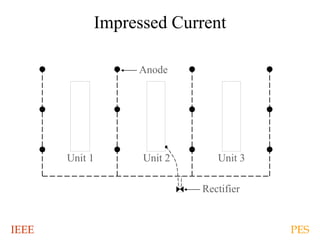
Impressed Current
Unit 1 Unit 3Unit 2
Rectifier
Anode
IEEE PES
IEEE PES
Impressed Current
20’
Rectifier
Anode
Tank
IEEE PES
Impressed Current
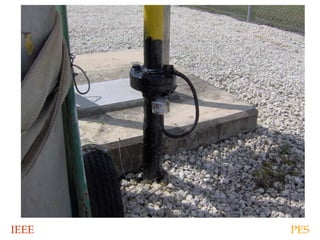
• Anodes produce high amounts of current, 1000 to 5000
milliamperes per anode.
• High current output allows protection of bare steel
structures.
• Structures do not necessarily need to be electrically
isolated.
IEEE PES
New Power Plant Design
• Involve corrosion engineer from the start
• Obtain site soil resistivitiy data
• Select piping materials
• Select coating types and quality control procedures
• Decide which structures require cathodic protection
IEEE PES
Cathodic Protection Design - Piping
• Soil resistivity data
• Clearly identify piping to receive cathodic protection
• Yard plan showing piping layout, isometric drawings are
difficult to use
• Location of all risers
• Type of coating
• Responsibility of isolation gaskets
• Desired service life
IEEE PES
Cathodic Protection Design - Tanks
• Site soil resistivity data
• Tank diameters and layout
• Equipment access
• Type of foundation
• Containment
• Monitoring capability
• Desired service life
IEEE PES
Design Options
• Design documents issued in construction plans
• Contract responsible for cathodic design
IEEE PES
Design Submittal
• Qualifications of person responsible for design,
supervision during installation and testing
– Can not mail order
• Detailed calculations for each tank and pipeline showing
current required, number of anodes, circuit resistance
and life
• Material list providing descriptions, models and
quantities
• Product data sheets
• Detailed installation plans – not diagrams
IEEE PES
Implementation
• The cathodic design submittals must be approved before
construction of structures
• A site meeting must be held to discuss how the cathodic
protection system will be installed, and special concerns
during construction
• Mechanical and electrical foremen should be involved in
cathodic discussions
IEEE PES
Avoid Costly Mistakes
• Grounding cables must be at least 12 inches from
underground pipes
• Temporary pipe supports must be removed
• Piping must be inspected for coating quality and
separation from grounding before burial
IEEE PES
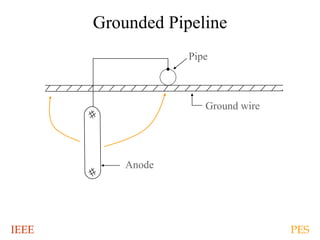
Grounded Pipeline
Pipe
Ground wire
Anode
IEEE PES
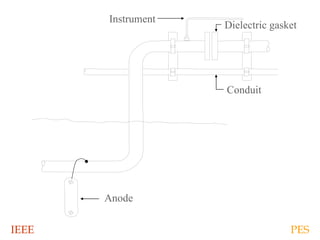
Dielectric gasket
Instrument
Conduit
Anode
IEEE PES
IEEE PES
IEEE PES
IEEE PES
IEEE PES
IEEE PES
IEEE PES
IEEE PES
IEEE PES
IEEE PES
IEEE PES
IEEE PES
IEEE PES
IEEE PES
Test station
Galvanic
anode
Tag
Shunt
Anode
Pipeline
Ring
terminals
IEEE PES
IEEE PES
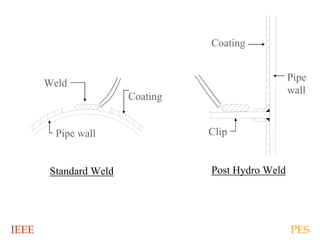
Coating
Standard Weld
Weld
Pipe wall
Post Hydro Weld
Clip
Coating
Pipe
wall
IEEE PES
IEEE PES
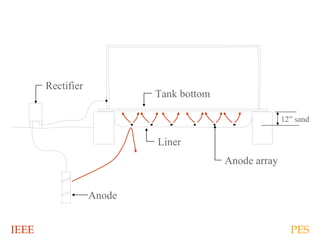
Anode
Rectifier
Tank bottom
Liner
Anode array
12” sand
IEEE PES
Completed Before Testing
• All pipe flanges connected and isolated
• Pipes back filled and cathodic protection is complete
• AC power to rectifier unit
• Storage tanks contain product
• Schedule for testing and training issued
IEEE PES
Compliance Testing - Specialist
• Inspect cathodic systems to ensure they are properly
installed
• Test each dielectric flange for isolation
• Obtain native potentials on pipes and tanks
• Connect galvanic anodes at test stations and/or energize
rectifier(s)
• Cathodic protection systems on isolated coated structures
should operate at least 4 hours before testing
• Cathodic protection systems on bare steel or grounded
structures must operate between 12 hours and 7 days
before testing
IEEE PES
Soil
Set to
DC volts
-.892
Pipe
Reference cell
6”
IEEE PES
Galvanic Anode Current
Shunt
Set to
DC millivolts
IEEE PES
Impressed Current Rectifier Unit
Shunt
Meters
Transformer
adjustments
AmpsVolts
(-) (+)
Breaker
Output lug
IEEE PES
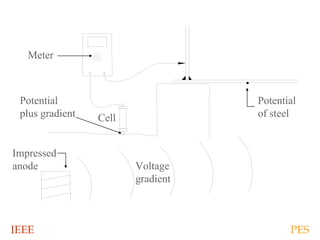
Impressed
anode Voltage
gradient
Cell
Potential
plus gradient
Potential
of steel
Meter
IEEE PES
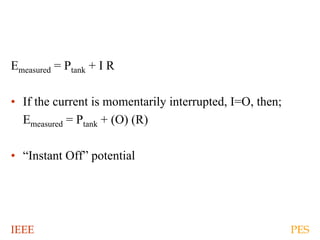
Emeasured = Ptank + I R
• If the current is momentarily interrupted, I=O, then;
Emeasured = Ptank + (O) (R)
• “Instant Off” potential
IEEE PES
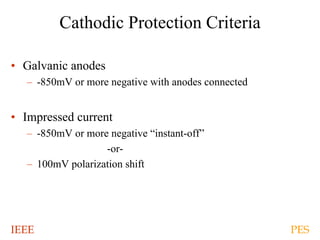
Cathodic Protection Criteria
• Galvanic anodes
– -850mV or more negative with anodes connected
• Impressed current
– -850mV or more negative “instant-off”
-or-
– 100mV polarization shift
IEEE PES
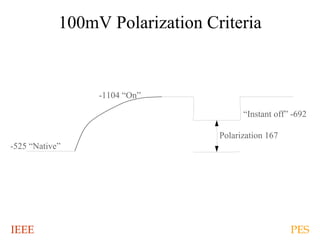
100mV Polarization Criteria
-525 “Native”
-1104 “On”
Polarization 167
“Instant off” -692
IEEE PES
Compliance Report
• Tabulated Data
• Narrative analysis of the data
• Compliance statement
• Calculated anode life
• Test procedures and instrumentation
• As-built drawings
• O&M Manual
IEEE PES
O&M Manual
• Test Procedures
• Instrument requirements
• Qualification requirements
• Frequency
• Criteria
• Trouble shooting
• Spare parts
• Wiring diagrams
IEEE PES
Conclusions
• Cathodic protection is viable and necessary to preserve
power plant structures
• Proper planning and coordination are essential through
out the design and construction phases, to ensure
cathodic protection systems work properly
• Properly implemented and monitored cathodic protection
will extend the service life of storage tanks and yard
piping more than 30 years
IEEE PES
Owner Monitoring & Maintenance
• Record rectifier output levels monthly and compare
output to target values
• Repair inoperable rectifiers within 30 days
• Inspect test stations and dielectric flanges every six (6)
months for damage and removal
• Instruct maintenance staff to replace and test removed
dielectric gaskets
• Annually, obtain potential measurements and ensure
effective cathodic protection levels

Cathodic Protection