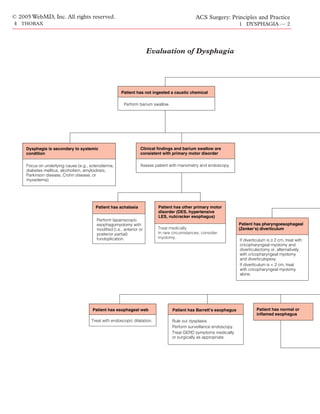
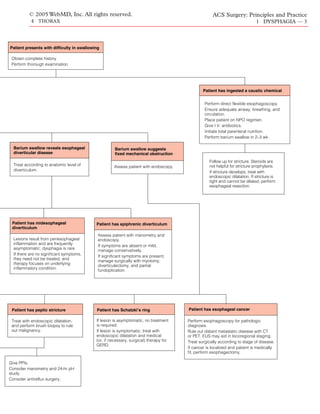
This document discusses dysphagia, or difficulty swallowing, which can be caused by abnormalities in the oral, pharyngeal, or esophageal phases of swallowing. It describes oropharyngeal dysphagia, which usually results from issues in the mouth or throat, and esophageal dysphagia, which causes chest or abdominal symptoms. The evaluation of a dysphagia patient involves obtaining a history, performing a physical exam, and typically starting with a barium swallow test to identify any lesions. Further tests may include endoscopy, manometry, pH study, and imaging. Management depends on the underlying cause found.
![© 2005 WebMD, Inc. All rights reserved. ACS Surgery: Principles and Practice
4 THORAX 1 DYSPHAGIA — 1
1 DYSPHAGIA
Ahmad S. Ashrafi, M.D., F.R.C.S.C., and R. Sudhir Sundaresan, M.D., F.A.C.S., F.R.C.S.C.
Dysphagia may be defined as difficulty in transferring a food bolus (PET), is particularly valuable in assessing patients with esophageal
from the mouth to the stomach. It may be associated with abnor- cancer.
malities in the oral, the pharyngeal, or the esophageal phase of swal-
OROPHARYNGEAL DYSPHAGIA
lowing. Unlike the term globus, which describes a painless sensa-
tion of fullness in the neck or throat, the term dysphagia implies Oropharyngeal dysphagia is usually associated with symptoms
actual interference with the swallowing mechanism [see Sidebar that originate in the oropharynx, including inability to chew
The Swallowing Mechanism]. Dysphagia may be classified as oro- food, drooling, coughing during a meal, and nasal regurgitation
pharyngeal or esophageal. Whereas oropharyngeal dysphagia (i.e., of solids or liquids. In general, if a patient experiences dysphagia
dysphagia resulting from abnormalities in the oral or the pharyn- within 1 second of swallowing, an oropharyngeal origin is likely.
geal phase of swallowing) usually implies a functional disturbance A variety of different conditions are capable of causing oropha-
in the swallowing mechanism, esophageal dysphagia may result ryngeal dysphagia. The common causes can be grouped into
from a discrete mechanical obstruction or from an esophageal three broad categories: (1) generalized (systemic) conditions, (2)
motility disorder. intrinsic functional disturbances, and (3) conditions that give
The exact prevalence of dysphagia is difficult to determine, but rise to fixed mechanical obstruction [see Table 1]. Overall, the
it is estimated that 35% of persons older than 50 years complain most common cause of oropharyngeal dysphagia is a cerebro-
of dysphagia at least once a week. It is important to keep in mind, vascular accident (CVA).
however, that the changes in swallowing physiology associated
ESOPHAGEAL DYSPHAGIA
with aging rarely lead to true dysphagia. Esophageal dysphagia
arises primarily from intrinsic diseases of the esophagus; oropha- Esophageal dysphagia causes symptoms that are referable to the
ryngeal dysphagia frequently occurs as part of a neurologic, meta- chest or the abdomen. In approximately 75% of cases, the pa-
bolic, myopathic, or infectious syndrome.1 tient’s perception of the location of the obstructive site corre-
In what follows, we review the diagnostic and therapeutic deci- sponds to the actual anatomic site of the lesion.2 In addition to
sion-making approaches employed in assessing patients with dys- dysphagia, patients may experience associated symptoms, such as
phagia. Although it is important that surgeons have a working know- chest pain (with a character and a radiation pattern resembling
ledge of all causes of dysphagia, our focus here is on evaluation of those of coronary artery disease [CAD]), retrosternal burning,
conditions that give rise to esophageal dysphagia.We mention sur- and regurgitation of undigested food.3
gical management options but do not address them in detail; the As a general rule, if the swallowing difficulty gradually progress-
operative procedures performed to treat the various clinical enti- es from solids to liquids, the dysphagia probably has a mechanical
ties that cause dysphagia are described more fully elsewhere [see cause. Patients who have mechanical obstruction usually complain
4:7 Open Esophageal Procedures, 4:8 Minimally Invasive Esophageal of dysphagia without pain and can relieve their symptoms only by
Procedures, and 4:10 Video-Assisted Thoracic Surgery]. regurgitating or by altering their diet. If significant weight loss and
Clinical Evaluation
Evaluation of a patient with The Swallowing Mechanism
dysphagia must be performed
in a systematic manner. As- Swallowing consists of both a voluntary phase (comprising the oral
sessment begins with obtain- phase and the first part of the pharyngeal phase) and an involuntary
ing a detailed history, followed phase (comprising the latter part of the pharyngeal phase and the
esophageal phase). The voluntary phase starts with mastication and
by physical examination. Ex-
ends with the positioning of an appropriately sized food bolus in the
cept in the case of acute caustic ingestion, for which direct flexible back of the oropharynx via tongue retraction. The involuntary phase
esophagoscopy is the first line of assessment, the barium swallow, a starts with the opening of the glossopalatal gate and the propulsion of
readily available and noninvasive test, should be the first investiga- the bolus into the pharynx, beyond the upper esophageal sphincter.
tive tool. The barium swallow is a cost-effective, rapid, and easily Once in the esophagus, the food bolus is propelled into the stomach by
available test that provides a “road map” of the esophagus and the primary and secondary esophageal peristaltic waves. The lower esoph-
lesion and yields a tremendous amount of information before ageal sphincter relaxes, allowing the food to be delivered into the stom-
ach. The brain-stem swallowing center, located in the medulla and the
endoscopic assessment. Additional diagnostic information can be pons, provides involuntary control of swallowing. Although swallowing
obtained by means of fiberoptic esophagoscopy, manometry, 24- begins in the oropharynx and is initially voluntary, the subsequent reflex
hour pH study, and, occasionally, bronchoscopy and endoscopic mechanisms are based on peripheral input from the oropharyngeal in-
ultrasonography (EUS). Further diagnostic imaging, in the form nervation and are involuntary.
of computed tomography and positron emission tomography](https://image.slidesharecdn.com/acs0401-dysphagia-100726063213-phpapp01/85/Acs0401-Dysphagia-1-320.jpg)
![© 2005 WebMD, Inc. All rights reserved. ACS Surgery: Principles and Practice
4 THORAX 1 DYSPHAGIA — 1
1 DYSPHAGIA
Ahmad S. Ashrafi, M.D., F.R.C.S.C., and R. Sudhir Sundaresan, M.D., F.A.C.S., F.R.C.S.C.
Dysphagia may be defined as difficulty in transferring a food bolus (PET), is particularly valuable in assessing patients with esophageal
from the mouth to the stomach. It may be associated with abnor- cancer.
malities in the oral, the pharyngeal, or the esophageal phase of swal-
OROPHARYNGEAL DYSPHAGIA
lowing. Unlike the term globus, which describes a painless sensa-
tion of fullness in the neck or throat, the term dysphagia implies Oropharyngeal dysphagia is usually associated with symptoms
actual interference with the swallowing mechanism [see Sidebar that originate in the oropharynx, including inability to chew
The Swallowing Mechanism]. Dysphagia may be classified as oro- food, drooling, coughing during a meal, and nasal regurgitation
pharyngeal or esophageal. Whereas oropharyngeal dysphagia (i.e., of solids or liquids. In general, if a patient experiences dysphagia
dysphagia resulting from abnormalities in the oral or the pharyn- within 1 second of swallowing, an oropharyngeal origin is likely.
geal phase of swallowing) usually implies a functional disturbance A variety of different conditions are capable of causing oropha-
in the swallowing mechanism, esophageal dysphagia may result ryngeal dysphagia. The common causes can be grouped into
from a discrete mechanical obstruction or from an esophageal three broad categories: (1) generalized (systemic) conditions, (2)
motility disorder. intrinsic functional disturbances, and (3) conditions that give
The exact prevalence of dysphagia is difficult to determine, but rise to fixed mechanical obstruction [see Table 1]. Overall, the
it is estimated that 35% of persons older than 50 years complain most common cause of oropharyngeal dysphagia is a cerebro-
of dysphagia at least once a week. It is important to keep in mind, vascular accident (CVA).
however, that the changes in swallowing physiology associated
ESOPHAGEAL DYSPHAGIA
with aging rarely lead to true dysphagia. Esophageal dysphagia
arises primarily from intrinsic diseases of the esophagus; oropha- Esophageal dysphagia causes symptoms that are referable to the
ryngeal dysphagia frequently occurs as part of a neurologic, meta- chest or the abdomen. In approximately 75% of cases, the pa-
bolic, myopathic, or infectious syndrome.1 tient’s perception of the location of the obstructive site corre-
In what follows, we review the diagnostic and therapeutic deci- sponds to the actual anatomic site of the lesion.2 In addition to
sion-making approaches employed in assessing patients with dys- dysphagia, patients may experience associated symptoms, such as
phagia. Although it is important that surgeons have a working know- chest pain (with a character and a radiation pattern resembling
ledge of all causes of dysphagia, our focus here is on evaluation of those of coronary artery disease [CAD]), retrosternal burning,
conditions that give rise to esophageal dysphagia.We mention sur- and regurgitation of undigested food.3
gical management options but do not address them in detail; the As a general rule, if the swallowing difficulty gradually progress-
operative procedures performed to treat the various clinical enti- es from solids to liquids, the dysphagia probably has a mechanical
ties that cause dysphagia are described more fully elsewhere [see cause. Patients who have mechanical obstruction usually complain
4:7 Open Esophageal Procedures, 4:8 Minimally Invasive Esophageal of dysphagia without pain and can relieve their symptoms only by
Procedures, and 4:10 Video-Assisted Thoracic Surgery]. regurgitating or by altering their diet. If significant weight loss and
Clinical Evaluation
Evaluation of a patient with The Swallowing Mechanism
dysphagia must be performed
in a systematic manner. As- Swallowing consists of both a voluntary phase (comprising the oral
sessment begins with obtain- phase and the first part of the pharyngeal phase) and an involuntary
ing a detailed history, followed phase (comprising the latter part of the pharyngeal phase and the
esophageal phase). The voluntary phase starts with mastication and
by physical examination. Ex-
ends with the positioning of an appropriately sized food bolus in the
cept in the case of acute caustic ingestion, for which direct flexible back of the oropharynx via tongue retraction. The involuntary phase
esophagoscopy is the first line of assessment, the barium swallow, a starts with the opening of the glossopalatal gate and the propulsion of
readily available and noninvasive test, should be the first investiga- the bolus into the pharynx, beyond the upper esophageal sphincter.
tive tool. The barium swallow is a cost-effective, rapid, and easily Once in the esophagus, the food bolus is propelled into the stomach by
available test that provides a “road map” of the esophagus and the primary and secondary esophageal peristaltic waves. The lower esoph-
lesion and yields a tremendous amount of information before ageal sphincter relaxes, allowing the food to be delivered into the stom-
ach. The brain-stem swallowing center, located in the medulla and the
endoscopic assessment. Additional diagnostic information can be pons, provides involuntary control of swallowing. Although swallowing
obtained by means of fiberoptic esophagoscopy, manometry, 24- begins in the oropharynx and is initially voluntary, the subsequent reflex
hour pH study, and, occasionally, bronchoscopy and endoscopic mechanisms are based on peripheral input from the oropharyngeal in-
ultrasonography (EUS). Further diagnostic imaging, in the form nervation and are involuntary.
of computed tomography and positron emission tomography](https://image.slidesharecdn.com/acs0401-dysphagia-100726063213-phpapp01/75/Acs0401-Dysphagia-1-2048.jpg)
![© 2005 WebMD, Inc. All rights reserved. ACS Surgery: Principles and Practice
4 THORAX 1 DYSPHAGIA — 4
Table 1 Common Causes of disposed to ulcerative esophagitis and peptic stricture [see Dis-
Oropharyngeal Dysphagia orders Producing Fixed Mechanical Obstruction, Peptic Stric-
ture, below].
CVA Other causes of secondary esophageal motility disturbance
Generalized conditions resulting in dysphagia are amyloidosis, Parkinson disease, Crohn
Myasthenia gravis
disease, and myxedema.
Cricopharyngeal achalasia
Intrinsic functional disturbances
Zenker’s diverticulum INTRINSIC FUNCTIONAL
DISTURBANCES
Neoplasm
Conditions producing fixed Webs
mechanical obstruction Previous surgical treatment
Primary Motor Disorders
Previous radiation therapy Achalasia The majority
of patients with achalasia pre-
sent with dysphagia for liquids
anorexia develop and symptoms are progressing rapidly, esoph- and solids. Most describe a long-standing history of swallowing dif-
ageal cancer is the likely cause of the dysphagia. ficulty, with or without associated weight loss. Other presenting
If, however, the patient has dysphagia for both liquids and solids, symptoms include regurgitation, chest pain, heartburn, and cough-
an underlying esophageal motor disorder is probably responsible. ing or choking spells. Typically, patients will have developed coping
Patients who have motor disorders that cause dysphagia often mechanisms to deal with the problem (e.g., changing position dur-
develop certain unusual maneuvers to relieve their difficulty, ing eating, drinking liquids to “wash down” the food, and practic-
including repeated swallowing, raising the arms over the head or ing repetitive swallowing and chewing).
assuming different positions during swallowing, and the Valsalva A barium x-ray with fluoroscopy will show absent peristalsis
maneuver. Such patients also frequently complain of other associ- and a dilated esophagus. Other findings include a tapered nar-
ated symptoms (e.g., chest pain). rowing in the distal esophagus (a so-called bird’s beak [see Figure
Physical examination is not as helpful as a detailed history. 1]) and, occasionally, an epiphrenic diverticulum [see Esophageal
Clues that may help identify malignant conditions include the devel- Diverticula, below]. Because the study is dynamic, failure of LES
opment of head and neck lymphadenopathy, the presence of an oro- relaxation must be watched for as it is performed. Over time, the
pharyngeal mass, the appearance of subcutaneous lumps (sugges- esophagus can dilate significantly, to the point where it takes on a
tive of cutaneous metastasis), and the occurrence of clinical fea- sigmoid shape.
tures associated with abdominal organ metastasis (jaundice, as- Although some radiologists will declare a diagnosis of achalasia
cites, hepatomegaly). Muscle weakness, fatigability, and other solely on the basis of barium x-rays and fluoroscopy, upper GI
neurologic deficits detected on physical examination may suggest endoscopy is essential to rule out fixed mechanical obstruction
a CVA or myasthenia gravis as the cause of dysphagia. Like oro- (long-standing achalasia is a risk factor for squamous cell cancer
pharyngeal dysphagia, esophageal dysphagia may be caused by a of the esophagus because of chronic stasis and retention esophagi-
number of different generalized conditions, intrinsic functional tis) or so-called pseudoachalasia (a motility disorder resulting
disturbances, or conditions that give rise to fixed mechanical from a carcinoma on the underside of the cardia that extends
obstruction [see Table 2].4 proximally within the wall of the esophagus). The key diagnostic
test in the setting of suspected achalasia is esophageal manome-
Workup and Management
try. Characteristic manometric features of achalasia include aperi-
of Specific Causes of
stalsis and incomplete relaxation of the LES; the LES pressure
Dysphagia
may be either high or normal.
A detailed discussion of the management of achalasia is beyond
SECONDARY MOTOR
the scope of this chapter. Briefly, medical management offers vir-
DISORDERS RESULTING
tually no benefit. Pneumatic dilatation offers subjective improve-
FROM SYSTEMIC
CONDITIONS Table 2 Common Causes of
In patients with secondary motility disorders, the esophageal Esophageal Dysphagia
motor disturbance is a manifestation of a systemic condition; thus,
organs other than the esophagus are also involved. The classic Scleroderma
examples of systemic conditions that give rise to esophageal motil- Generalized conditions Diabetes mellitus
ity disorders are scleroderma, diabetes mellitus, and alcoholism. Alcoholism
Patients who have one or more of these conditions may present GERD with decreased motility
with varying degrees of dysphagia, and their evaluation usually Intrinsic functional disturbances
Motor disorders
entails functional and structural evaluation of the esophagus.
Treatment is aimed at the underlying cause. Patients with scle- Webs
Peptic strictures
roderma exhibit atrophy and sclerosis of distal esophageal smooth
Schatzki’s ring
muscle with fragmentation of connective tissue. Consequently,
Conditions producing fixed Caustic injury
primary peristalsis is absent, and the lower esophageal sphincter mechanical obstruction Neoplasms
(LES) is hypotensive or virtually absent. Patients usually present
Extrinsic compression
with gastroesophageal reflux and heartburn. Because they also Previous surgical treatment
lack secondary peristalsis, there is no mechanism for clearing the Previous radiation therapy
refluxed acid back to the stomach, and as a result, patients are pre-](https://image.slidesharecdn.com/acs0401-dysphagia-100726063213-phpapp01/85/Acs0401-Dysphagia-4-320.jpg)
![© 2005 WebMD, Inc. All rights reserved. ACS Surgery: Principles and Practice
4 THORAX 1 DYSPHAGIA — 5
can occur in isolation, it is usually seen in association with achala-
sia, nutcracker esophagus, or DES. Patients present with dyspha-
gia for liquids and solids. Manometric evaluation shows a mean
LES resting pressure higher than 45 mm Hg in midrespiration.
Treatment is primarily medical, but balloon dilatation has been
employed to relieve persistent dysphagia.
Nutcracker esophagus Nutcracker esophagus is an esoph-
ageal motility disorder of unknown etiology that affects women
more often than men. Patients usually present with chest pain but
may have associated dysphagia as well. Manometry typically
shows peristaltic waves with significantly elevated amplitude
(> 180 mm Hg). Barium x-rays are usually normal. Treatment is
similar to that of DES and is primarily medical.
Esophageal Diverticula
Esophageal diverticula ac-
count for fewer than 5% of
all cases of dysphagia. They
may be classified into two
broad categories: true and
false.True diverticula include
all layers of the esophageal
wall, whereas false diverticula include only the mucosal layer.True
diverticula develop as a result of a periesophageal inflammatory
process that places traction on the esophageal wall (and thus are
Figure 1 Shown are proximal dilatation and classic bird’s-beak also referred to as traction diverticula), whereas false diverticula
narrowing consistent with achalasia in a 22-year-old woman being
are manifestations of an underlying motor dysfunction (and thus
evaluated for dysphagia.
are also referred to as pulsion diverticula). Esophageal diverticula
may also be classified into three categories on the basis of the
ment in more than two thirds of patients; however, the result is anatomic level at which they occur: pharyngoesophageal (Zen-
durable in only a minority of cases, and the procedure carries a 4% ker’s), midesophageal, and epiphrenic. A few patients will exhibit
to 5% risk of rupture. Laparoscopic esophagomyotomy with ante-
rior (Dor) fundoplication (or, as some surgeons prefer, posterior
partial fundoplication) [see 4:8 Minimally Invasive Esophageal Pro-
cedures] probably represents the current standard of care.
Diffuse esophageal spasm
Diffuse esophageal spasm
(DES) is a motility disorder of
unknown etiology that gives
rise to dysphagia and chest
pain. The dysphagia is non-
progressive and is encountered
with both liquids and solids.
The chest pain is nonexertional but may respond to nitroglycerin.
A barium x-ray may show the classic corkscrew appearance [see
Figure 2], but this finding is nondiagnostic.The diagnosis is estab-
lished by manometry; the key finding is the periodic occurrence of
simultaneous high-amplitude contractions with intervening peri-
ods of normal peristalsis.The presence of these intervals of normal
peristalsis is important for distinguishing DES from nutcracker
esophagus [see Nutcracker Esophagus, below]. An elaborate
workup is often necessary to clarify the basis of the chest pain and
rule out the possibility of CAD.
Once CAD has been ruled out, management is primarily med-
ical and consists of reassurance, nitrates, and calcium channel
blockers. Botulinum toxin injection and extended esophagomy-
otomy have been used to treat DES, with some success, but in
general, surgery does not have an established role in this setting.
Figure 2 Shown is classic corkscrew appearance of esophagus in
Hypertensive lower esophageal sphincter Hypertensive a middle-aged man presenting with dysphagia and intermittent
LES is a rare motility disorder of unknown etiology. Although it chest pain.](https://image.slidesharecdn.com/acs0401-dysphagia-100726063213-phpapp01/85/Acs0401-Dysphagia-5-320.jpg)
![© 2005 WebMD, Inc. All rights reserved. ACS Surgery: Principles and Practice
4 THORAX 1 DYSPHAGIA — 6
Midesophageal diver-
ticula Midesophageal diver-
ticula are true (i.e., traction)
diverticula that are caused by
periesophageal inflammation.
The usual cause is granulo-
matous inflammation of the
subcarinal lymph nodes
resulting from tuberculosis or fungal infection (typically, histoplas-
mosis). These diverticula are frequently asymptomatic and are
often found incidentally during evaluation for some other disorder.
Dysphagia does occur but is a rare symptom; the clinical manifes-
tations are usually related to the underlying inflammatory disease
or to associated complications (e.g., infection, bleeding, or fis-
tulization to the airway). If the diverticula are not symptomatic,
they need not be treated, and the therapeutic focus is on the
underlying problem that prompted the evaluation.
Epiphrenic diverticula
Epiphrenic diverticula are ac-
quired pulsion diverticula that
arise in the distal 10 cm of the
esophagus [see Figure 4]. Al-
though these diverticula are
usually associated with other
Figure 3 Shown is a large pharyngoesophageal pouch (Zenker’s esophageal motor disorders
diverticulum) in an elderly patient with dysphagia, regurgitation (e.g., achalasia, DES, and hypertensive LES), they occasionally occur
of old retained food, and recurrent pneumonia. in the absence of any underlying esophageal dysfunction. If symp-
toms are absent or mild, conservative management is appropriate. If
significant symptoms (e.g., dysphagia) are present, however, surgical
diffuse intramural diverticulosis, a rare condition characterized by management—usually entailing myotomy, diverticulectomy, and
the development of multiple 1 to 5 mm outpouchings in associa- modified fundoplication—is indicated. Before operation, patients
tion with esophageal inflammation and fibrosis. These outpouch- should undergo a thorough functional assessment with manometry.
ings are believed to be dilated esophageal mucous glands resulting
from chronic inflammation. Dysphagia is the most common pre-
senting complaint for this condition, though one third of patients
complain of gastroesophageal reflux.
Pharyngoesophageal diverticula Zenker’s diverticula are
the most common esophageal diverticula.These pulsion diverticu-
la result from pharyngocricopharyngeal incoordination that leads
to herniation of the mucosa in Killian’s triangle (the posterior mid-
line of the lower pharynx, between the oblique muscle fibers of the
inferior pharyngeal constrictor and the transverse fibers of the
cricopharyngeus). Dysphagia is the most common symptom, but
patients may also complain of halitosis, regurgitation of undigest-
ed food, throat discomfort, a palpable neck mass, a gurgling noise
during swallowing, and recurrent aspiration pneumonia.
The best initial diagnostic tool is a barium swallow [see Figure 3],
which will establish the diagnosis and also may help diagnose any
associated problems (e.g., gastroesophageal reflux disease [GERD]
and hiatal hernia). Performing upper GI endoscopy without first
obtaining a barium study is a potentially disastrous maneuver:
because the endoscope will preferentially enter the pouch rather than
the true esophageal lumen, there is a significant risk of inadvertent
esophageal perforation. Endoscopy does play a role in assessing the
esophageal mucosa, but it is best performed at the time of operation.
The fundamental component of surgical treatment is relief of
the functional obstruction at the cricopharyngeus (via cricopha-
ryngeal myotomy) [see 4:7 Open Esophageal Procedures]. Once this
is done, diverticula larger than 2 cm should be excised; smaller Figure 4 Shown is a giant epiphrenic diverticulum in an elderly
diverticula can generally be managed with myotomy alone. Diver- woman with progressive dysphagia and weight loss, in whom can-
ticulopexy is another option for dealing with the pouch. cer was initially suspected.](https://image.slidesharecdn.com/acs0401-dysphagia-100726063213-phpapp01/85/Acs0401-Dysphagia-6-320.jpg)
![© 2005 WebMD, Inc. All rights reserved. ACS Surgery: Principles and Practice
4 THORAX 1 DYSPHAGIA — 7
DISORDERS PRODUCING annular fibrosis. Proton pump inhibitors (PPIs) have proved high-
FIXED MECHANICAL ly effective in controlling GERD symptoms and enhancing the
OBSTRUCTION healing of esophageal ulcers; as a result of their widespread use,
peptic stricture is now an infrequent complication.
Esophageal Webs
Peptic strictures may occur at any age, and there is usually an
A web is a localized narrow- antecedent history of GERD. The symptoms are progressive but
ing of the esophagus caused unlike those of a malignant process, in that the dysphagia usually
by intraluminal extension of dates back several years and weight loss is usually absent.Typical-
the mucosa and part of the submucosa of the esophageal wall. ly, a patient with a peptic stricture describes gradually worsening
Webs may be either congenital or, more commonly, acquired, usu- dysphagia, initially for solids and eventually for liquids as well. If
ally secondary to conditions such as iron deficiency anemia, pem- the patient has dysphagia for liquids before solids or has dyspha-
phigoid, and ulcerative colitis (among others). The main present- gia for both liquids and solids, an associated motility disorder
ing symptom is dysphagia, the severity of which is proportional to must be suspected. Strictures induced by reflux are located in the
the degree of obstruction. Treatment usually consists of simple distal esophagus at the squamocolumnar junction [see Figure 5];
endoscopic dilatation [see 5:18 Gastrointestinal Endoscopy] after the presence of strictures in other parts of the esophagus raises the
careful verification of the nature of the lesion. possibility of causes other than acid-peptic injury. The best initial
diagnostic testing approach consists of a barium swallow [see
Peptic Stricture
Figure 5] followed by upper GI endoscopy, which shows ulcers
GERD is a very common and a concentric stenosis (which is usually short).
problem. The majority of Management of GERD patients with peptic strictures is con-
patients will present with troversial. One approach consists of dilatation of the stricture [see
heartburn and regurgitation. 5:18 Gastrointestinal Endoscopy] in conjunction with high-dose PPI
Although the associated hy- therapy. An important component of this approach is the perfor-
pomotility observed in some mance of a brush biopsy at the time of dilatation to rule out a
GERD patients can account malignancy. If the stricture recurs, then dilatation with an antire-
for some of the dysphagia, it is important to consider (and, if pos- flux procedure [see 4:7 Open Esophageal Procedures and 4:8
sible, rule out) more significant complications, such as peptic Minimally Invasive Esophageal Procedures] is indicated. In the rare
stricture, Barrett’s esophagus, and carcinoma. cases in which the stricture cannot be dilated, esophageal resec-
Peptic stricture represents the end stage of ulcerative esophagi- tion [see 4:7 Open Esophageal Procedures and 4:10 Video-Assisted Thor-
tis, in which the healing of circumferential ulceration results in acic Surgery] must be considered.
Schatzki’s Ring
Schatzki’s ring is a concen-
tric, symmetrical narrowing
at the squamocolumnar junc-
tion that arises from the
development of submucosal
annular fibrosis and is usual-
ly accompanied by a small
hiatal hernia.5 The exact cause is unknown, though there is a
strong correlation with GERD. Dysphagia is usually for solids and
is proportional to the diameter of the ring. Barium swallow estab-
lishes the diagnosis [see Figure 6], and esophagoscopy is recom-
mended to confirm it.
For asymptomatic patients, no specific treatment is needed. For
patients who present with food impaction, emergency treatment,
involving rigid esophagoscopy and removal of the food bolus, is
indicated. Definitive treatment entails dilatation of the ring in con-
junction with medical therapy for GERD. If the ring proves refrac-
tory to this approach, dilatation plus antireflux surgery (fundopli-
cation) [see 4:7 Open Esophageal Procedures and 4:8 Minimally
Invasive Esophageal Procedures] may be indicated.
Chemical Ingestion
Alkali are commonly found
in household cleaning agents,
mostly in the form of sodi-
um or potassium hydroxide
(NaOH, KOH).The majority
Figure 5 Barium swallow shows severe ulcerative esophagitis, of alkali-related injuries occur
annular fibrosis (stricture), and evidence of acquired esophageal accidentally in children; how-
shortening. Shortness of narrowed segment suggests benign ever, such injuries also occasionally occur in adults as part of a sui-
underlying cause. cide attempt.The magnitude and site of the injury are directly relat-](https://image.slidesharecdn.com/acs0401-dysphagia-100726063213-phpapp01/85/Acs0401-Dysphagia-7-320.jpg)
![© 2005 WebMD, Inc. All rights reserved. ACS Surgery: Principles and Practice
4 THORAX 1 DYSPHAGIA — 8
A careful endoscopic examination is an essential initial step.The
scope should be advanced under direct vision to the proximal
injury site; if severe injury is observed, the scope should not be
advanced any further. A barium swallow should be done in the
first month after injury to detect any stricture that may have
formed and to determine its location, severity, and length. Serial
barium swallows are helpful in following patients to monitor heal-
ing after caustic injury [see Figure 7].
At one time, it was common to administer steroids prophylacti-
cally to patients with caustic injuries to the esophagus as a strate-
gy for preventing stricture formation. A 1990 study, however,
found that this practice had no beneficial effect on healing and
stricture formation rates in children,6 and thus, steroids currently
are not widely used in this setting. Strictures are treated by endo-
scopic dilatation as necessary [see 5:18 Gastrointestinal Endoscopy].
The ultimate solution for a tight, nondilatable stricture [see Figure
7] is esophageal resection [see 4:7 Open Esophageal Procedures and
4:10 Video-Assisted Thoracic Surgery].
Esophageal Cancer
The incidence of esoph-
Figure 6 Shown is Schatzki’s ring in a middle-aged man with ageal adenocarcinoma is ris-
severe reflux symptoms and recent-onset dysphagia. ing at an alarming rate. Dys-
phagia is the presenting
ed to the length of the contact time between the offending sub- symptom in more than 90%
stance and the esophageal mucosa. Injury can occur at any level, of esophageal cancer patients.
but the most common site is the distal esophagus; the proximal Dysphagia caused by cancer
esophagus, where the transit time is very short, is frequently is usually gradual in onset and starts with solids, then progresses
spared. The inflammation and injury eventually lead to submu- to include liquids. Other nonspecific presenting symptoms of
cosal scar formation, which in turn leads to stricture formation esophageal cancer are odynophagia, regurgitation, and pain in the
and dysphagia.
Figure 8 Shown is classic appearance of midesophageal squa-
Figure 7 Barium swallow from a 22-year-old patient who ingest- mous cell carcinoma. Mucosal irregularity is apparent within
ed toilet cleaner shows long, stringlike lumen from midesophagus lesion, along with proximal dilatation and shouldering at upper
to stomach. Dilatation was impossible in this case, and thus, man- and lower borders. Bronchoscopy confirmed penetration of
agement included esophageal resection with colonic interposition. tumor into airway mucosa.](https://image.slidesharecdn.com/acs0401-dysphagia-100726063213-phpapp01/85/Acs0401-Dysphagia-8-320.jpg)
![© 2005 WebMD, Inc. All rights reserved. ACS Surgery: Principles and Practice
4 THORAX 1 DYSPHAGIA — 9
neck, abdomen, or back. Fistulization of an esophageal tumor into Treatment is determined by the stage of the disease. In a
the airway will result in ongoing aspiration (the so-called swallow- medically fit patient with localized esophageal cancer, esoph-
cough sequence) and pulmonary sepsis. Weight loss occurring in agectomy is indicated [see 4:7 Open Esophageal Procedures and
association with dysphagia is strongly suggestive of esophageal 4:10 Video-Assisted Thoracic Surgery]. Traditionally, CT scan-
cancer and should prompt appropriate investigation. ning of the neck, the chest, the abdomen, and the pelvis has
A complete history and physical examination should be carried been performed to rule out distant metastatic disease. More
out, followed by a barium swallow. Characteristic features of esoph- recently, PET scanning has also been used for this purpose.
ageal cancer on barium x-ray include narrowing, mucosal irregular- EUS, if available, may also aid in locoregional staging. For
ity, the presence of a mass, and, occasionally, a so-called shouldered lesions in the upper third or the middle third of the esopha-
stricture [see Figure 8]. Esophagoscopy is essential for establishing a gus, bronchoscopy is necessary to rule out direct tumor inva-
pathologic diagnosis by means of biopsy, brushings, and washings. sion of the airway.
References
1. Cook IA, Kahrilas PJ: AGA technical review on and other esophageal symptoms. Gastrointes- 5. Schatzki R, Gary JE: Dysphagia due to a
management of oropharyngeal dysphagia. Gas- tinal Disease: Pathophysiology, Diagnosis and diaphragm-like localized narrowing in the lower
troenterology 116:455, 1999 Management, 5th ed. Sleisinger MH, Fordtran JS, esophagus (lower esophageal ring). Am J Roent-
genol Radium Ther Nucl Med 70:911, 1953
2. Wilcox SM, Alexander LN, Clark WS: Locali- Eds.WB Saunders Co, Philadelphia, 1993, p 331
zation of an obstructing esophageal lesion: is the 6. Anderson KD, Rouse TM, Randolph JG: A con-
4. Dysphagia: Diagnosis and Management, 3rd ed. trolled trial of corticosteroids in children with
patient accurate? Dig Dis Sci 40:2192, 1995 Groher ME, Ed. Butterworth-Heinemann, Boston, corrosive injury of the esophagus. N Engl J Med
3. Richter JE: Heartburn, dysphagia, odynophagia, 1997 323:637, 1990](https://image.slidesharecdn.com/acs0401-dysphagia-100726063213-phpapp01/85/Acs0401-Dysphagia-9-320.jpg)


