RAMA RAJU
INCISIONS
 MAIN INCISIONS
1. Caudal septal incision (hemitransfixion)
2. Intercartilaginous incision
3. Vestibular incision
4. Infracartilaginous incision
5. Transcolumellar inverted-V-incision
CAUDAL SEPTAL INCISION
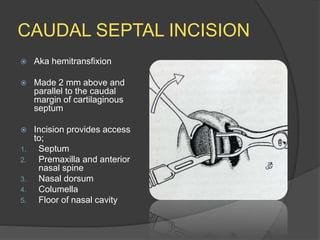
 Aka hemitransfixion
 Made 2 mm above and
parallel to the caudal
margin of cartilaginous
septum
 Incision provides access
to;
1. Septum
2. Premaxilla and anterior
nasal spine
3. Nasal dorsum
4. Columella
5. Floor of nasal cavity
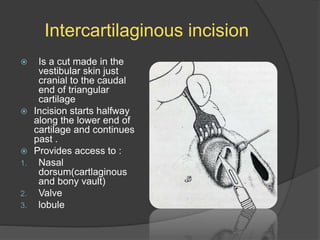
Intercartilaginous incision
 Is a cut made in the
vestibular skin just
cranial to the caudal
end of triangular
cartilage
 Incision starts halfway
along the lower end of
cartilage and continues
past .
 Provides access to :
1. Nasal
dorsum(cartlaginous
and bony vault)
2. Valve
3. lobule
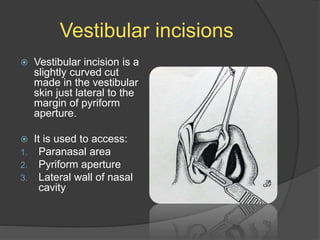
Vestibular incisions
 Vestibular incision is a
slightly curved cut
made in the vestibular
skin just lateral to the
margin of pyriform
aperture.
 It is used to access:
1. Paranasal area
2. Pyriform aperture
3. Lateral wall of nasal
cavity
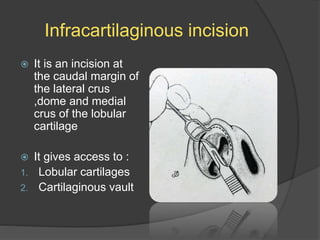
Infracartilaginous incision
 It is an incision at
the caudal margin of
the lateral crus
,dome and medial
crus of the lobular
cartilage
 It gives access to :
1. Lobular cartilages
2. Cartilaginous vault
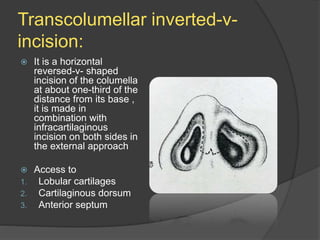
Transcolumellar inverted-v-
incision:
 It is a horizontal
reversed-v- shaped
incision of the columella
at about one-third of the
distance from its base ,
it is made in
combination with
infracartilaginous
incision on both sides in
the external approach
 Access to
1. Lobular cartilages
2. Cartilaginous dorsum
3. Anterior septum
SPECIAL INCISIONS
 EXTERNAL
1. Labiogingival incision
2. Sublabial incision
3. Paranasal incision
4. Lateral columellar
5. Rim incision
6. Alarfacial incision
7. ‘v’ incision of
columellar base
8. Dorsal incisions
 INTERNAL
1. Transfixion incision
2. Transcartilaginous
incision
3. Incisios in the
turbinate mucosa
4. Incisions in the septal
mucosa
Pyramid surgery
One of basic procedures in functional
reconstructive nasal surgery
It involves
 Mobilizing the bony pyramid
 Repositioning and fixation of bony
pyramid
steps for mobilizing the bony
pyramid
1. Mobilizing and correcting the septum
2. Outlining the osteotomies
3. Undermining the skin over the pyramid
4. Bilateral paramedian osteotomies
5. Bilateral lateral osteotomies
6. Bilateral transverse osteotomies
7. Mobilizing the bony pyramid
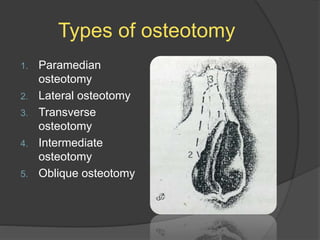
Types of osteotomy
1. Paramedian
osteotomy
2. Lateral osteotomy
3. Transverse
osteotomy
4. Intermediate
osteotomy
5. Oblique osteotomy
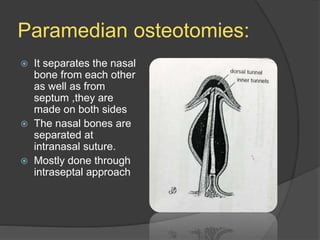
Paramedian osteotomies:
 It separates the nasal
bone from each other
as well as from
septum ,they are
made on both sides
 The nasal bones are
separated at
intranasal suture.
 Mostly done through
intraseptal approach
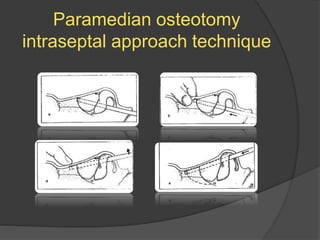
Paramedian osteotomy
intraseptal approach technique
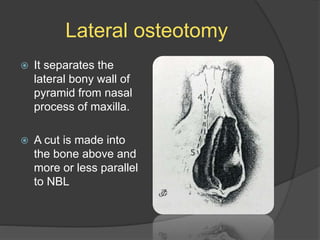
Lateral osteotomy
 It separates the
lateral bony wall of
pyramid from nasal
process of maxilla.
 A cut is made into
the bone above and
more or less parallel
to NBL
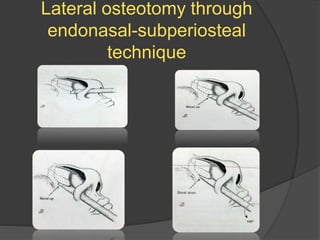
Lateral osteotomy through
endonasal-subperiosteal
technique
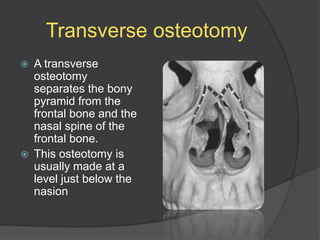
Transverse osteotomy
 A transverse
osteotomy
separates the bony
pyramid from the
frontal bone and the
nasal spine of the
frontal bone.
 This osteotomy is
usually made at a
level just below the
nasion
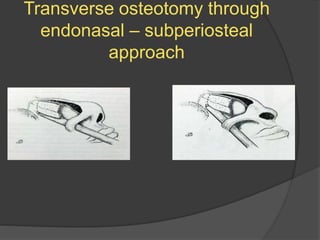
Transverse osteotomy through
endonasal – subperiosteal
approach
Repositioning the bony pyramid
 After mobilizing, bony pyramid is
repositioned using maneuvers like
1. Bilateral infracture
2. Bilateral outfracture
3. Rotation by unilateral infracture and
outfracture on opposite side
4. Rotation following u/l wedge resection
5. Push down with bilateral infracture
6. Letdown following b/l wedge resection
7. Push up
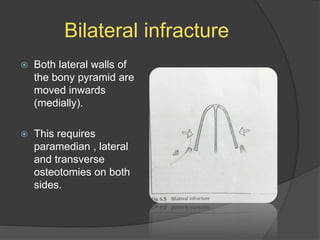
Bilateral infracture
 Both lateral walls of
the bony pyramid are
moved inwards
(medially).
 This requires
paramedian , lateral
and transverse
osteotomies on both
sides.
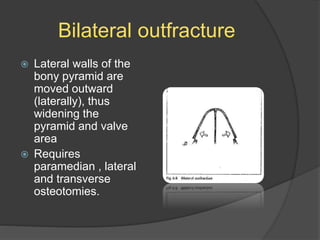
Bilateral outfracture
 Lateral walls of the
bony pyramid are
moved outward
(laterally), thus
widening the
pyramid and valve
area
 Requires
paramedian , lateral
and transverse
osteotomies.
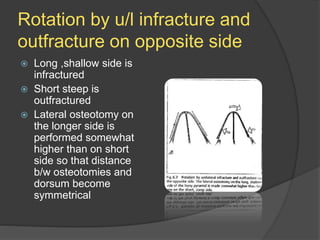
Rotation by u/l infracture and
outfracture on opposite side
 Long ,shallow side is
infractured
 Short steep is
outfractured
 Lateral osteotomy on
the longer side is
performed somewhat
higher than on short
side so that distance
b/w osteotomies and
dorsum become
symmetrical
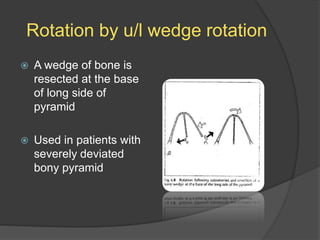
Rotation by u/l wedge rotation
 A wedge of bone is
resected at the base
of long side of
pyramid
 Used in patients with
severely deviated
bony pyramid
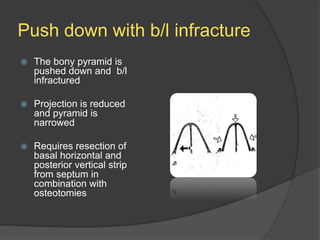
Push down with b/l infracture
 The bony pyramid is
pushed down and b/l
infractured
 Projection is reduced
and pyramid is
narrowed
 Requires resection of
basal horizontal and
posterior vertical strip
from septum in
combination with
osteotomies
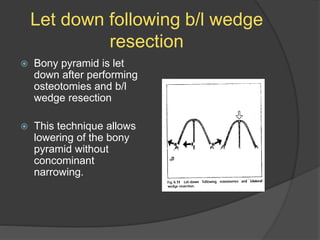
Let down following b/l wedge
resection
 Bony pyramid is let
down after performing
osteotomies and b/l
wedge resection
 This technique allows
lowering of the bony
pyramid without
concominant
narrowing.
HUMP REMOVAL
 TYPES OF HUMP
1. Bony hump
2. Bony and cartilaginous hump
3. Cartilaginous hump
Surgical techniques:
1. Reduction by rasp and file
2. Resection
3. Push-down with infracture of pyramid
4. Let down of pyramid following bilateral
wedge resection
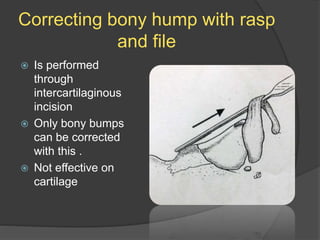
Correcting bony hump with rasp
and file
 Is performed
through
intercartilaginous
incision
 Only bony bumps
can be corrected
with this .
 Not effective on
cartilage
Resection of bony and/or
cartilaginous hump
 Most common way to correct bony and/or
cartilaginous hump
 Had several drawbacks
 We resect the bony part of hump first and
f/b cartilaginous part
 The bony part is resected with chisel ,f/b
smoothing the defect with rasp
 The cartilaginous hump is then resected by
using straight or angled scissors
Resecting bony hump
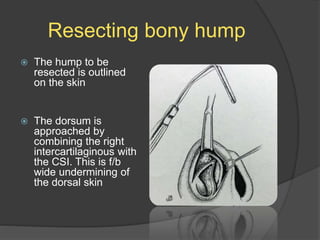
 The hump to be
resected is outlined
on the skin
 The dorsum is
approached by
combining the right
intercartilaginous with
the CSI. This is f/b
wide undermining of
the dorsal skin
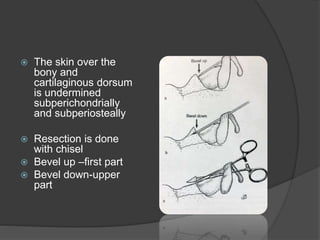
 The skin over the
bony and
cartilaginous dorsum
is undermined
subperichondrially
and subperiosteally
 Resection is done
with chisel
 Bevel up –first part
 Bevel down-upper
part
Resecting a cartilaginous hump
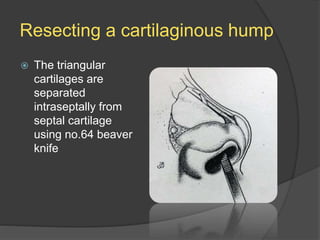
 The triangular
cartilages are
separated
intraseptally from
septal cartilage
using no.64 beaver
knife
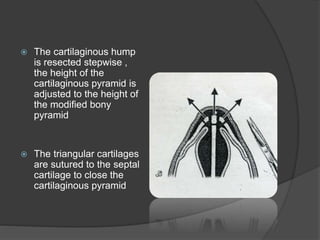
 The cartilaginous hump
is resected stepwise ,
the height of the
cartilaginous pyramid is
adjusted to the height of
the modified bony
pyramid
 The triangular cartilages
are sutured to the septal
cartilage to close the
cartilaginous pyramid
saddle nose correction
 Types of saddling
1. bony and cartilaginous saddle nose
2. Low , wide pyramid syndrome
3. Bony saddle
4. Cartilaginous saddling
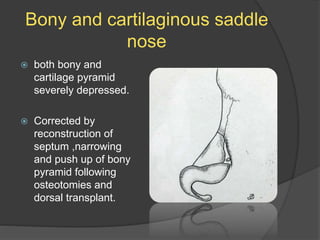
Bony and cartilaginous saddle
nose
 both bony and
cartilage pyramid
severely depressed.
 Corrected by
reconstruction of
septum ,narrowing
and push up of bony
pyramid following
osteotomies and
dorsal transplant.
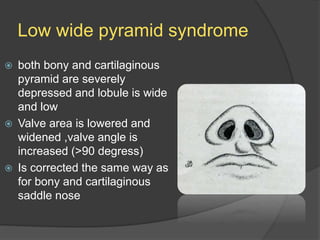
Low wide pyramid syndrome
 both bony and cartilaginous
pyramid are severely
depressed and lobule is wide
and low
 Valve area is lowered and
widened ,valve angle is
increased (>90 degress)
 Is corrected the same way as
for bony and cartilaginous
saddle nose
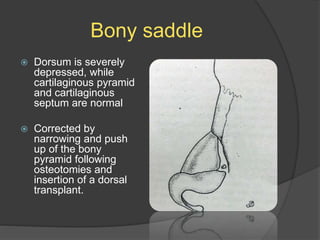
Bony saddle
 Dorsum is severely
depressed, while
cartilaginous pyramid
and cartilaginous
septum are normal
 Corrected by
narrowing and push
up of the bony
pyramid following
osteotomies and
insertion of a dorsal
transplant.
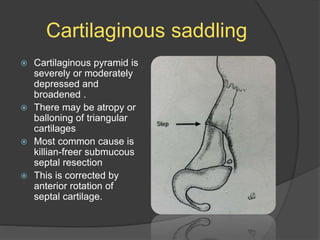
Cartilaginous saddling
 Cartilaginous pyramid is
severely or moderately
depressed and
broadened .
 There may be atropy or
balloning of triangular
cartilages
 Most common cause is
killian-freer submucous
septal resection
 This is corrected by
anterior rotation of
septal cartilage.
Surgical techniques
 Repositioning and reconstruction of
anterior septum
 Narrowing and push up of bony pyramid
following osteotomies
 Augmentation of pyramid by inserting a
dorsal implant
 Increasing lobular projection and narrowing
lobular width
 Lengthening and lowering the columella
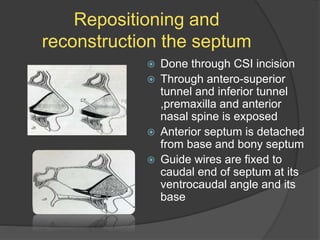
Repositioning and
reconstruction the septum
 Done through CSI incision
 Through antero-superior
tunnel and inferior tunnel
,premaxilla and anterior
nasal spine is exposed
 Anterior septum is detached
from base and bony septum
 Guide wires are fixed to
caudal end of septum at its
ventrocaudal angle and its
base
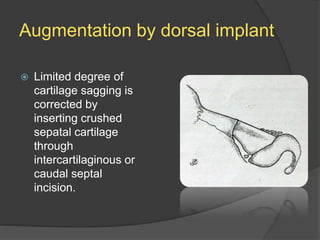
Augmentation by dorsal implant
 Limited degree of
cartilage sagging is
corrected by
inserting crushed
sepatal cartilage
through
intercartilaginous or
caudal septal
incision.
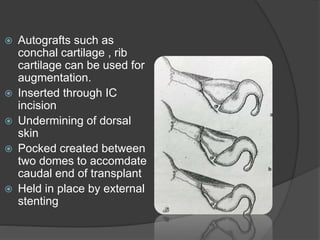
 Autografts such as
conchal cartilage , rib
cartilage can be used for
augmentation.
 Inserted through IC
incision
 Undermining of dorsal
skin
 Pocked created between
two domes to accomdate
caudal end of transplant
 Held in place by external
stenting
Tip surgery
“The one who masters tip masters nose”
 tip surgery is never related to
improvement of function ,but is always
done for aesthetic reasons.
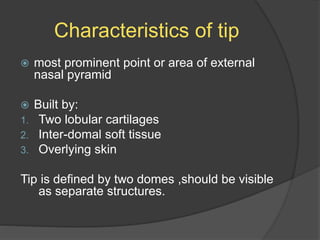
Characteristics of tip
 most prominent point or area of external
nasal pyramid
 Built by:
1. Two lobular cartilages
2. Inter-domal soft tissue
3. Overlying skin
Tip is defined by two domes ,should be visible
as separate structures.
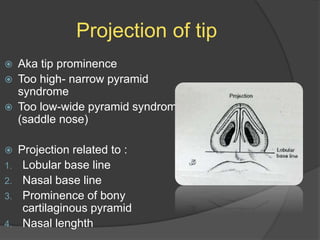
Projection of tip
 Aka tip prominence
 Too high- narrow pyramid
syndrome
 Too low-wide pyramid syndrome
(saddle nose)
 Projection related to :
1. Lobular base line
2. Nasal base line
3. Prominence of bony
cartilaginous pyramid
4. Nasal lenghth
Position of tip
 Position of tip in vertical and horizontal
axis of face is determined by above
mentioned factors.
 Upwardly rotated tip
 Pendant or drooping tip
Tip abnormalities
1. Broad ,bullous,square,ball tip
2. Bifid tip
3. Asymmetrical tip
4. Underprojected tip
5. Overprojected tip
6. Upwardly rotated tip
7. Hanging (pendant ,drooping )tip
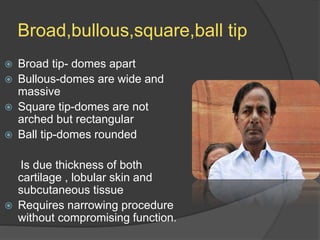
Broad,bullous,square,ball tip
 Broad tip- domes apart
 Bullous-domes are wide and
massive
 Square tip-domes are not
arched but rectangular
 Ball tip-domes rounded
Is due thickness of both
cartilage , lobular skin and
subcutaneous tissue
 Requires narrowing procedure
without compromising function.
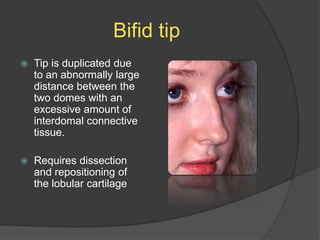
Bifid tip
 Tip is duplicated due
to an abnormally large
distance between the
two domes with an
excessive amount of
interdomal connective
tissue.
 Requires dissection
and repositioning of
the lobular cartilage
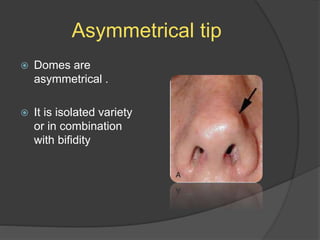
Asymmetrical tip
 Domes are
asymmetrical .
 It is isolated variety
or in combination
with bifidity
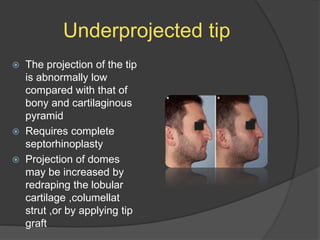
Underprojected tip
 The projection of the tip
is abnormally low
compared with that of
bony and cartilaginous
pyramid
 Requires complete
septorhinoplasty
 Projection of domes
may be increased by
redraping the lobular
cartilage ,columellat
strut ,or by applying tip
graft
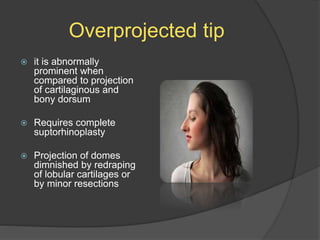
Overprojected tip
 it is abnormally
prominent when
compared to projection
of cartilaginous and
bony dorsum
 Requires complete
suptorhinoplasty
 Projection of domes
dimnished by redraping
of lobular cartilages or
by minor resections
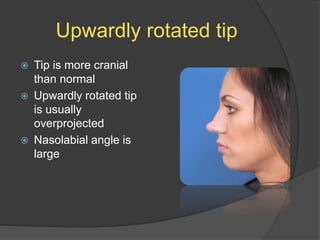
Upwardly rotated tip
 Tip is more cranial
than normal
 Upwardly rotated tip
is usually
overprojected
 Nasolabial angle is
large
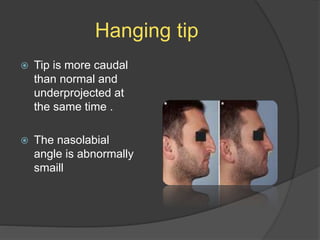
Hanging tip
 Tip is more caudal
than normal and
underprojected at
the same time .
 The nasolabial
angle is abnormally
smaill
Surgical technique
1. Narrowing tip and supratip area
2. Increasing tip projection
3. Reducing tip projection
4. Upward positioning (rotation) of tip
5. Downward positioning of tip
Narrowing tip and supratip area
 it is narrowed by
1. Resecting a strip or wedge of cartilage
from the cranial margin of lateral crus
2. Suturing the domes together
3. Redraping the lobular cartilage
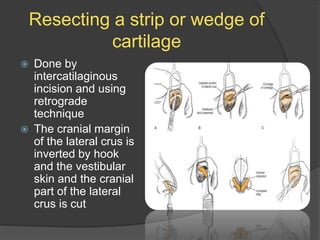
Resecting a strip or wedge of
cartilage
 Done by
intercatilaginous
incision and using
retrograde
technique
 The cranial margin
of the lateral crus is
inverted by hook
and the vestibular
skin and the cranial
part of the lateral
crus is cut
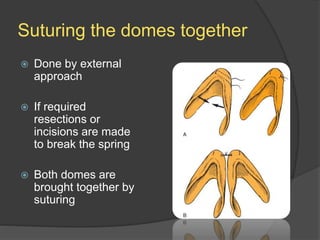
Suturing the domes together
 Done by external
approach
 If required
resections or
incisions are made
to break the spring
 Both domes are
brought together by
suturing
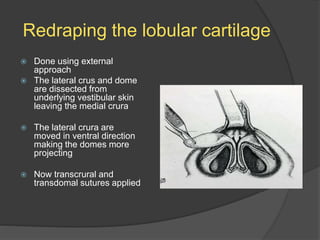
Redraping the lobular cartilage
 Done using external
approach
 The lateral crus and dome
are dissected from
underlying vestibular skin
leaving the medial crura
 The lateral crura are
moved in ventral direction
making the domes more
projecting
 Now transcrural and
transdomal sutures applied
Reducing tip projection
 Reduced by various ways
1. Let down of pyramid and lobule
2. Lowering domes by dome resection
and reconstruction technique
3. Resecting strips from medial crura
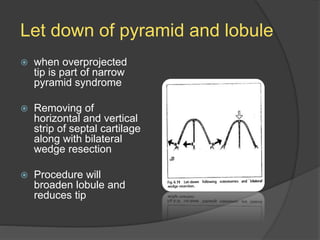
Let down of pyramid and lobule
 when overprojected
tip is part of narrow
pyramid syndrome
 Removing of
horizontal and vertical
strip of septal cartilage
along with bilateral
wedge resection
 Procedure will
broaden lobule and
reduces tip
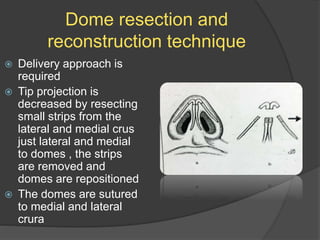
Dome resection and
reconstruction technique
 Delivery approach is
required
 Tip projection is
decreased by resecting
small strips from the
lateral and medial crus
just lateral and medial
to domes , the strips
are removed and
domes are repositioned
 The domes are sutured
to medial and lateral
crura
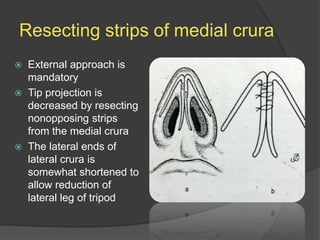
Resecting strips of medial crura
 External approach is
mandatory
 Tip projection is
decreased by resecting
nonopposing strips
from the medial crura
 The lateral ends of
lateral crura is
somewhat shortened to
allow reduction of
lateral leg of tripod
Upward positioning of tip
1. Resecting a triangle of cartilage from
the caudal septal end,with or without
resecting a triangle of skin from the
membranous septum
2. Trimming the cranial margin of the
lateral crus with resection of a triangle
of vestibular skin
3. Resecting a triangle of cartilage,skin
and mucosa from the lower margin of
triangular cartilage
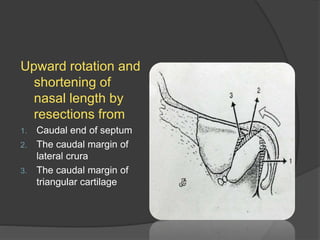
Upward rotation and
shortening of
nasal length by
resections from
1. Caudal end of septum
2. The caudal margin of
lateral crura
3. The caudal margin of
triangular cartilage
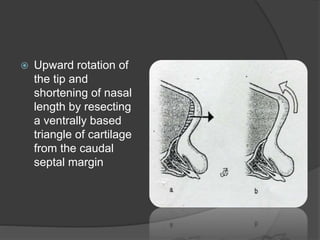
 Upward rotation of
the tip and
shortening of nasal
length by resecting
a ventrally based
triangle of cartilage
from the caudal
septal margin
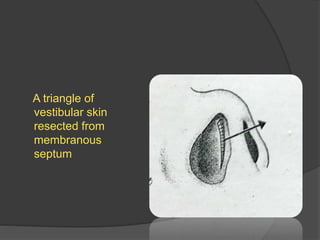
A triangle of
vestibular skin
resected from
membranous
septum
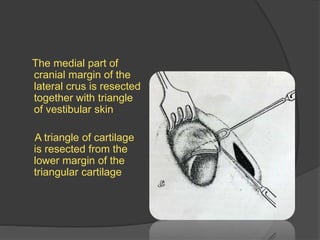
The medial part of
cranial margin of the
lateral crus is resected
together with triangle
of vestibular skin
A triangle of cartilage
is resected from the
lower margin of the
triangular cartilage
Increasing tip projection
1. a columellar strut (in combination with
anterior septal reconstruction)
2. A tip graft (a shield graft)
3. Redraping of the lateral crura and
domes with lateral crural steal
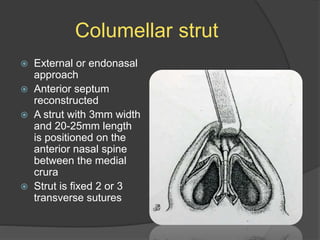
Columellar strut
 External or endonasal
approach
 Anterior septum
reconstructed
 A strut with 3mm width
and 20-25mm length
is positioned on the
anterior nasal spine
between the medial
crura
 Strut is fixed 2 or 3
transverse sutures
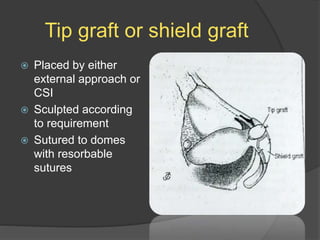
Tip graft or shield graft
 Placed by either
external approach or
CSI
 Sculpted according
to requirement
 Sutured to domes
with resorbable
sutures

Rhinoplasty raju ppt full

  • 1.
  • 2.
    INCISIONS  MAIN INCISIONS 1.Caudal septal incision (hemitransfixion) 2. Intercartilaginous incision 3. Vestibular incision 4. Infracartilaginous incision 5. Transcolumellar inverted-V-incision
  • 3.
    CAUDAL SEPTAL INCISION Aka hemitransfixion  Made 2 mm above and parallel to the caudal margin of cartilaginous septum  Incision provides access to; 1. Septum 2. Premaxilla and anterior nasal spine 3. Nasal dorsum 4. Columella 5. Floor of nasal cavity
  • 4.
    Intercartilaginous incision  Isa cut made in the vestibular skin just cranial to the caudal end of triangular cartilage  Incision starts halfway along the lower end of cartilage and continues past .  Provides access to : 1. Nasal dorsum(cartlaginous and bony vault) 2. Valve 3. lobule
  • 5.
    Vestibular incisions  Vestibularincision is a slightly curved cut made in the vestibular skin just lateral to the margin of pyriform aperture.  It is used to access: 1. Paranasal area 2. Pyriform aperture 3. Lateral wall of nasal cavity
  • 6.
    Infracartilaginous incision  Itis an incision at the caudal margin of the lateral crus ,dome and medial crus of the lobular cartilage  It gives access to : 1. Lobular cartilages 2. Cartilaginous vault
  • 7.
    Transcolumellar inverted-v- incision:  Itis a horizontal reversed-v- shaped incision of the columella at about one-third of the distance from its base , it is made in combination with infracartilaginous incision on both sides in the external approach  Access to 1. Lobular cartilages 2. Cartilaginous dorsum 3. Anterior septum
  • 8.
    SPECIAL INCISIONS  EXTERNAL 1.Labiogingival incision 2. Sublabial incision 3. Paranasal incision 4. Lateral columellar 5. Rim incision 6. Alarfacial incision 7. ‘v’ incision of columellar base 8. Dorsal incisions  INTERNAL 1. Transfixion incision 2. Transcartilaginous incision 3. Incisios in the turbinate mucosa 4. Incisions in the septal mucosa
  • 9.
    Pyramid surgery One ofbasic procedures in functional reconstructive nasal surgery It involves  Mobilizing the bony pyramid  Repositioning and fixation of bony pyramid
  • 10.
    steps for mobilizingthe bony pyramid 1. Mobilizing and correcting the septum 2. Outlining the osteotomies 3. Undermining the skin over the pyramid 4. Bilateral paramedian osteotomies 5. Bilateral lateral osteotomies 6. Bilateral transverse osteotomies 7. Mobilizing the bony pyramid
  • 11.
    Types of osteotomy 1.Paramedian osteotomy 2. Lateral osteotomy 3. Transverse osteotomy 4. Intermediate osteotomy 5. Oblique osteotomy
  • 12.
    Paramedian osteotomies:  Itseparates the nasal bone from each other as well as from septum ,they are made on both sides  The nasal bones are separated at intranasal suture.  Mostly done through intraseptal approach
  • 13.
  • 14.
    Lateral osteotomy  Itseparates the lateral bony wall of pyramid from nasal process of maxilla.  A cut is made into the bone above and more or less parallel to NBL
  • 15.
  • 16.
    Transverse osteotomy  Atransverse osteotomy separates the bony pyramid from the frontal bone and the nasal spine of the frontal bone.  This osteotomy is usually made at a level just below the nasion
  • 17.
    Transverse osteotomy through endonasal– subperiosteal approach
  • 18.
    Repositioning the bonypyramid  After mobilizing, bony pyramid is repositioned using maneuvers like 1. Bilateral infracture 2. Bilateral outfracture 3. Rotation by unilateral infracture and outfracture on opposite side 4. Rotation following u/l wedge resection 5. Push down with bilateral infracture 6. Letdown following b/l wedge resection 7. Push up
  • 19.
    Bilateral infracture  Bothlateral walls of the bony pyramid are moved inwards (medially).  This requires paramedian , lateral and transverse osteotomies on both sides.
  • 20.
    Bilateral outfracture  Lateralwalls of the bony pyramid are moved outward (laterally), thus widening the pyramid and valve area  Requires paramedian , lateral and transverse osteotomies.
  • 21.
    Rotation by u/linfracture and outfracture on opposite side  Long ,shallow side is infractured  Short steep is outfractured  Lateral osteotomy on the longer side is performed somewhat higher than on short side so that distance b/w osteotomies and dorsum become symmetrical
  • 22.
    Rotation by u/lwedge rotation  A wedge of bone is resected at the base of long side of pyramid  Used in patients with severely deviated bony pyramid
  • 23.
    Push down withb/l infracture  The bony pyramid is pushed down and b/l infractured  Projection is reduced and pyramid is narrowed  Requires resection of basal horizontal and posterior vertical strip from septum in combination with osteotomies
  • 24.
    Let down followingb/l wedge resection  Bony pyramid is let down after performing osteotomies and b/l wedge resection  This technique allows lowering of the bony pyramid without concominant narrowing.
  • 25.
    HUMP REMOVAL  TYPESOF HUMP 1. Bony hump 2. Bony and cartilaginous hump 3. Cartilaginous hump
  • 26.
    Surgical techniques: 1. Reductionby rasp and file 2. Resection 3. Push-down with infracture of pyramid 4. Let down of pyramid following bilateral wedge resection
  • 27.
    Correcting bony humpwith rasp and file  Is performed through intercartilaginous incision  Only bony bumps can be corrected with this .  Not effective on cartilage
  • 28.
    Resection of bonyand/or cartilaginous hump  Most common way to correct bony and/or cartilaginous hump  Had several drawbacks  We resect the bony part of hump first and f/b cartilaginous part  The bony part is resected with chisel ,f/b smoothing the defect with rasp  The cartilaginous hump is then resected by using straight or angled scissors
  • 29.
    Resecting bony hump The hump to be resected is outlined on the skin  The dorsum is approached by combining the right intercartilaginous with the CSI. This is f/b wide undermining of the dorsal skin
  • 30.
     The skinover the bony and cartilaginous dorsum is undermined subperichondrially and subperiosteally  Resection is done with chisel  Bevel up –first part  Bevel down-upper part
  • 31.
    Resecting a cartilaginoushump  The triangular cartilages are separated intraseptally from septal cartilage using no.64 beaver knife
  • 32.
     The cartilaginoushump is resected stepwise , the height of the cartilaginous pyramid is adjusted to the height of the modified bony pyramid  The triangular cartilages are sutured to the septal cartilage to close the cartilaginous pyramid
  • 33.
    saddle nose correction Types of saddling 1. bony and cartilaginous saddle nose 2. Low , wide pyramid syndrome 3. Bony saddle 4. Cartilaginous saddling
  • 34.
    Bony and cartilaginoussaddle nose  both bony and cartilage pyramid severely depressed.  Corrected by reconstruction of septum ,narrowing and push up of bony pyramid following osteotomies and dorsal transplant.
  • 35.
    Low wide pyramidsyndrome  both bony and cartilaginous pyramid are severely depressed and lobule is wide and low  Valve area is lowered and widened ,valve angle is increased (>90 degress)  Is corrected the same way as for bony and cartilaginous saddle nose
  • 36.
    Bony saddle  Dorsumis severely depressed, while cartilaginous pyramid and cartilaginous septum are normal  Corrected by narrowing and push up of the bony pyramid following osteotomies and insertion of a dorsal transplant.
  • 37.
    Cartilaginous saddling  Cartilaginouspyramid is severely or moderately depressed and broadened .  There may be atropy or balloning of triangular cartilages  Most common cause is killian-freer submucous septal resection  This is corrected by anterior rotation of septal cartilage.
  • 38.
    Surgical techniques  Repositioningand reconstruction of anterior septum  Narrowing and push up of bony pyramid following osteotomies  Augmentation of pyramid by inserting a dorsal implant  Increasing lobular projection and narrowing lobular width  Lengthening and lowering the columella
  • 39.
    Repositioning and reconstruction theseptum  Done through CSI incision  Through antero-superior tunnel and inferior tunnel ,premaxilla and anterior nasal spine is exposed  Anterior septum is detached from base and bony septum  Guide wires are fixed to caudal end of septum at its ventrocaudal angle and its base
  • 40.
    Augmentation by dorsalimplant  Limited degree of cartilage sagging is corrected by inserting crushed sepatal cartilage through intercartilaginous or caudal septal incision.
  • 41.
     Autografts suchas conchal cartilage , rib cartilage can be used for augmentation.  Inserted through IC incision  Undermining of dorsal skin  Pocked created between two domes to accomdate caudal end of transplant  Held in place by external stenting
  • 42.
    Tip surgery “The onewho masters tip masters nose”  tip surgery is never related to improvement of function ,but is always done for aesthetic reasons.
  • 43.
    Characteristics of tip most prominent point or area of external nasal pyramid  Built by: 1. Two lobular cartilages 2. Inter-domal soft tissue 3. Overlying skin Tip is defined by two domes ,should be visible as separate structures.
  • 44.
    Projection of tip Aka tip prominence  Too high- narrow pyramid syndrome  Too low-wide pyramid syndrome (saddle nose)  Projection related to : 1. Lobular base line 2. Nasal base line 3. Prominence of bony cartilaginous pyramid 4. Nasal lenghth
  • 45.
    Position of tip Position of tip in vertical and horizontal axis of face is determined by above mentioned factors.  Upwardly rotated tip  Pendant or drooping tip
  • 46.
    Tip abnormalities 1. Broad,bullous,square,ball tip 2. Bifid tip 3. Asymmetrical tip 4. Underprojected tip 5. Overprojected tip 6. Upwardly rotated tip 7. Hanging (pendant ,drooping )tip
  • 47.
    Broad,bullous,square,ball tip  Broadtip- domes apart  Bullous-domes are wide and massive  Square tip-domes are not arched but rectangular  Ball tip-domes rounded Is due thickness of both cartilage , lobular skin and subcutaneous tissue  Requires narrowing procedure without compromising function.
  • 48.
    Bifid tip  Tipis duplicated due to an abnormally large distance between the two domes with an excessive amount of interdomal connective tissue.  Requires dissection and repositioning of the lobular cartilage
  • 49.
    Asymmetrical tip  Domesare asymmetrical .  It is isolated variety or in combination with bifidity
  • 50.
    Underprojected tip  Theprojection of the tip is abnormally low compared with that of bony and cartilaginous pyramid  Requires complete septorhinoplasty  Projection of domes may be increased by redraping the lobular cartilage ,columellat strut ,or by applying tip graft
  • 51.
    Overprojected tip  itis abnormally prominent when compared to projection of cartilaginous and bony dorsum  Requires complete suptorhinoplasty  Projection of domes dimnished by redraping of lobular cartilages or by minor resections
  • 52.
    Upwardly rotated tip Tip is more cranial than normal  Upwardly rotated tip is usually overprojected  Nasolabial angle is large
  • 53.
    Hanging tip  Tipis more caudal than normal and underprojected at the same time .  The nasolabial angle is abnormally smaill
  • 54.
    Surgical technique 1. Narrowingtip and supratip area 2. Increasing tip projection 3. Reducing tip projection 4. Upward positioning (rotation) of tip 5. Downward positioning of tip
  • 55.
    Narrowing tip andsupratip area  it is narrowed by 1. Resecting a strip or wedge of cartilage from the cranial margin of lateral crus 2. Suturing the domes together 3. Redraping the lobular cartilage
  • 56.
    Resecting a stripor wedge of cartilage  Done by intercatilaginous incision and using retrograde technique  The cranial margin of the lateral crus is inverted by hook and the vestibular skin and the cranial part of the lateral crus is cut
  • 57.
    Suturing the domestogether  Done by external approach  If required resections or incisions are made to break the spring  Both domes are brought together by suturing
  • 58.
    Redraping the lobularcartilage  Done using external approach  The lateral crus and dome are dissected from underlying vestibular skin leaving the medial crura  The lateral crura are moved in ventral direction making the domes more projecting  Now transcrural and transdomal sutures applied
  • 59.
    Reducing tip projection Reduced by various ways 1. Let down of pyramid and lobule 2. Lowering domes by dome resection and reconstruction technique 3. Resecting strips from medial crura
  • 60.
    Let down ofpyramid and lobule  when overprojected tip is part of narrow pyramid syndrome  Removing of horizontal and vertical strip of septal cartilage along with bilateral wedge resection  Procedure will broaden lobule and reduces tip
  • 61.
    Dome resection and reconstructiontechnique  Delivery approach is required  Tip projection is decreased by resecting small strips from the lateral and medial crus just lateral and medial to domes , the strips are removed and domes are repositioned  The domes are sutured to medial and lateral crura
  • 62.
    Resecting strips ofmedial crura  External approach is mandatory  Tip projection is decreased by resecting nonopposing strips from the medial crura  The lateral ends of lateral crura is somewhat shortened to allow reduction of lateral leg of tripod
  • 63.
    Upward positioning oftip 1. Resecting a triangle of cartilage from the caudal septal end,with or without resecting a triangle of skin from the membranous septum 2. Trimming the cranial margin of the lateral crus with resection of a triangle of vestibular skin 3. Resecting a triangle of cartilage,skin and mucosa from the lower margin of triangular cartilage
  • 64.
    Upward rotation and shorteningof nasal length by resections from 1. Caudal end of septum 2. The caudal margin of lateral crura 3. The caudal margin of triangular cartilage
  • 65.
     Upward rotationof the tip and shortening of nasal length by resecting a ventrally based triangle of cartilage from the caudal septal margin
  • 66.
    A triangle of vestibularskin resected from membranous septum
  • 67.
    The medial partof cranial margin of the lateral crus is resected together with triangle of vestibular skin A triangle of cartilage is resected from the lower margin of the triangular cartilage
  • 68.
    Increasing tip projection 1.a columellar strut (in combination with anterior septal reconstruction) 2. A tip graft (a shield graft) 3. Redraping of the lateral crura and domes with lateral crural steal
  • 69.
    Columellar strut  Externalor endonasal approach  Anterior septum reconstructed  A strut with 3mm width and 20-25mm length is positioned on the anterior nasal spine between the medial crura  Strut is fixed 2 or 3 transverse sutures
  • 70.
    Tip graft orshield graft  Placed by either external approach or CSI  Sculpted according to requirement  Sutured to domes with resorbable sutures