ASSIGNMENT ON…..
RESEARCH DESIGN
EXPLORATORY
DESCRIPTIVE
EXPLANATORY
INSTITUTE OF SOCIAL SCIENCES
DEPARTMENT OF SOCIAL WORK
SUBMITTED TO:
DR. R K. BHARTI
SUBMITTED BY:
MANJALI
M.S.W 2ND SEM
ROLL NO -16
INTRODUCTION
The preparation of a research design is an important
step in the research design . A research design is a
written plan for a study . It communicates the intention
of the researcher.
“Research design , thus is a logical and systematic plan
prepared for conducting a research study . It is
comparable to blue print which the architect prepare
before construction of the building commences”.
DEFINITION OF RESEARCH DESIGN
• According to Kerlinger “ research design is
the plan, structure and strategy of
investigation conceived so as to obtain
answer to research questions and to control
variance”.
• Burnes and grove (2003) define a research
design as a blueprint for conducting a study
with maximum control over factors that may
interfere with the validity of the findings”.
NEED FOR RESEARCH DESIGN
Research design is needed because:
It facilitates the smooth sailing of the various
research operations.
For making research as efficient as possible
yielding maximal information with minimal
expenditure of effort, time and money.
For advance planning of the methods to be
adopted for collecting the relevant data and
the techniques.
FEATURES OF A GOOD DESIGN
• A good design is often characterized by
adjectives like flexible, appropriate, efficient,
economical and so on.
• The design which yields maximal information
and provide an opportunity for considering
many different aspects of a problem is
considered most appropriate and efficient
design.
IMPORTANT CONCEPTS RELATING TO
RESEARCH DESIGN
• Dependent and independent variables.
• Extraneous variable
• Control
• Confounded relationship
• Research hypothesis
CONTENTS OF RESEARCH DESIGN
• Statement of research objective ,i.e. why the
research project is to be conducted.
• Type of data needed
• Definition of population and sampling
procedures to be followed
• Time, costs, and responsibility specification
• Methods ways ,and procedures used for
collection of data
• Data analysis tools or methods used to analysse
data
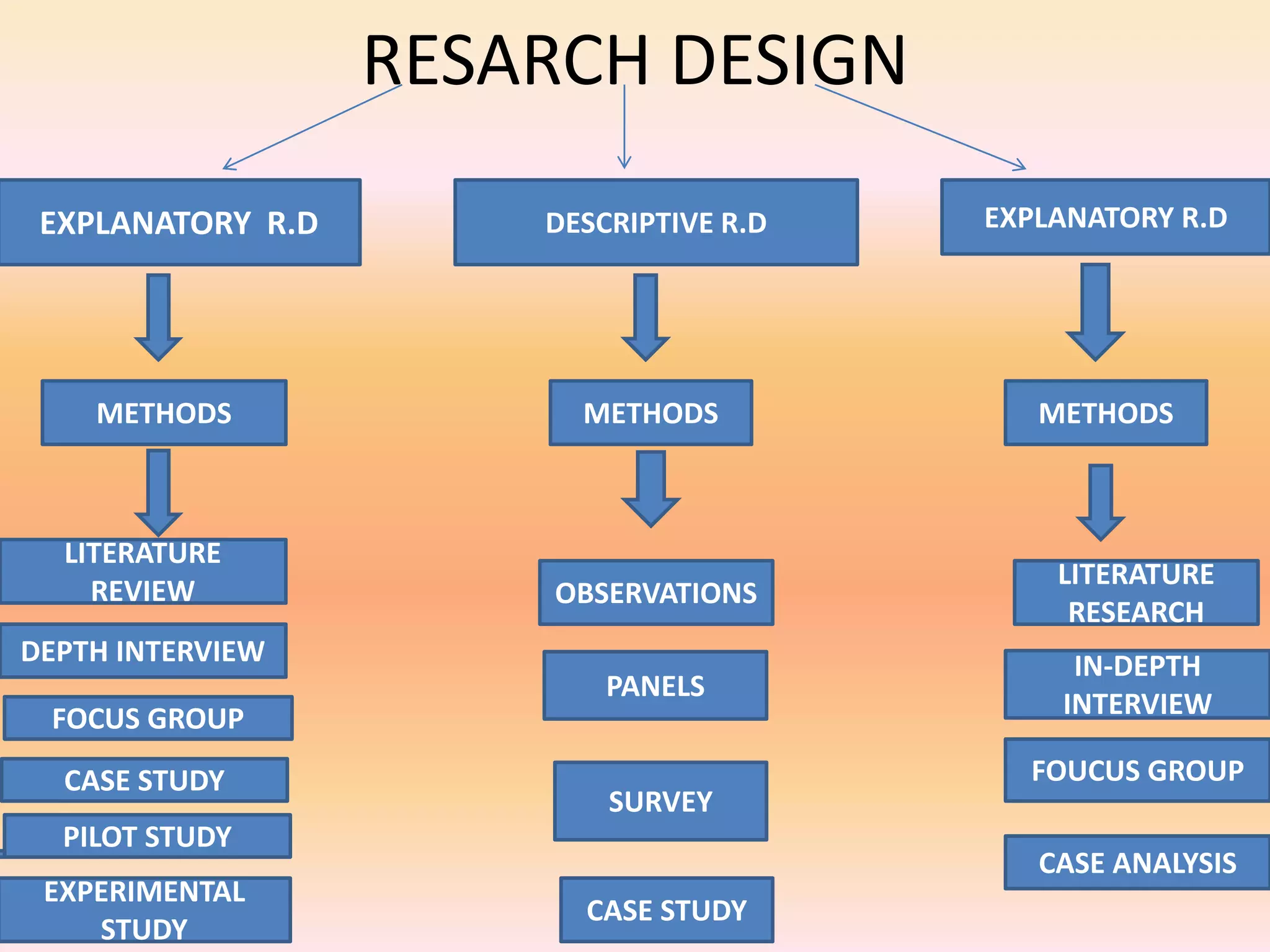
RESARCH DESIGN
EXPLANATORY R.D DESCRIPTIVE R.D EXPLANATORY R.D
METHODS
LITERATURE
REVIEW
DEPTH INTERVIEW
FOCUS GROUP
CASE STUDY
PILOT STUDY
EXPERIMENTAL
STUDY
METHODS
OBSERVATIONS
PANELS
SURVEY
CASE STUDY
METHODS
LITERATURE
RESEARCH
IN-DEPTH
INTERVIEW
FOUCUS GROUP
CASE ANALYSIS
TYPES OF RESEARCH DESIGN
• The research design is a broad framework
that describes how the entire research
project is carried out .basically, there can be
three types of research design. Exploratory
research design, descriptive research design,
explanatory research design.
EXPLORATORY RESEARCH DESIGN
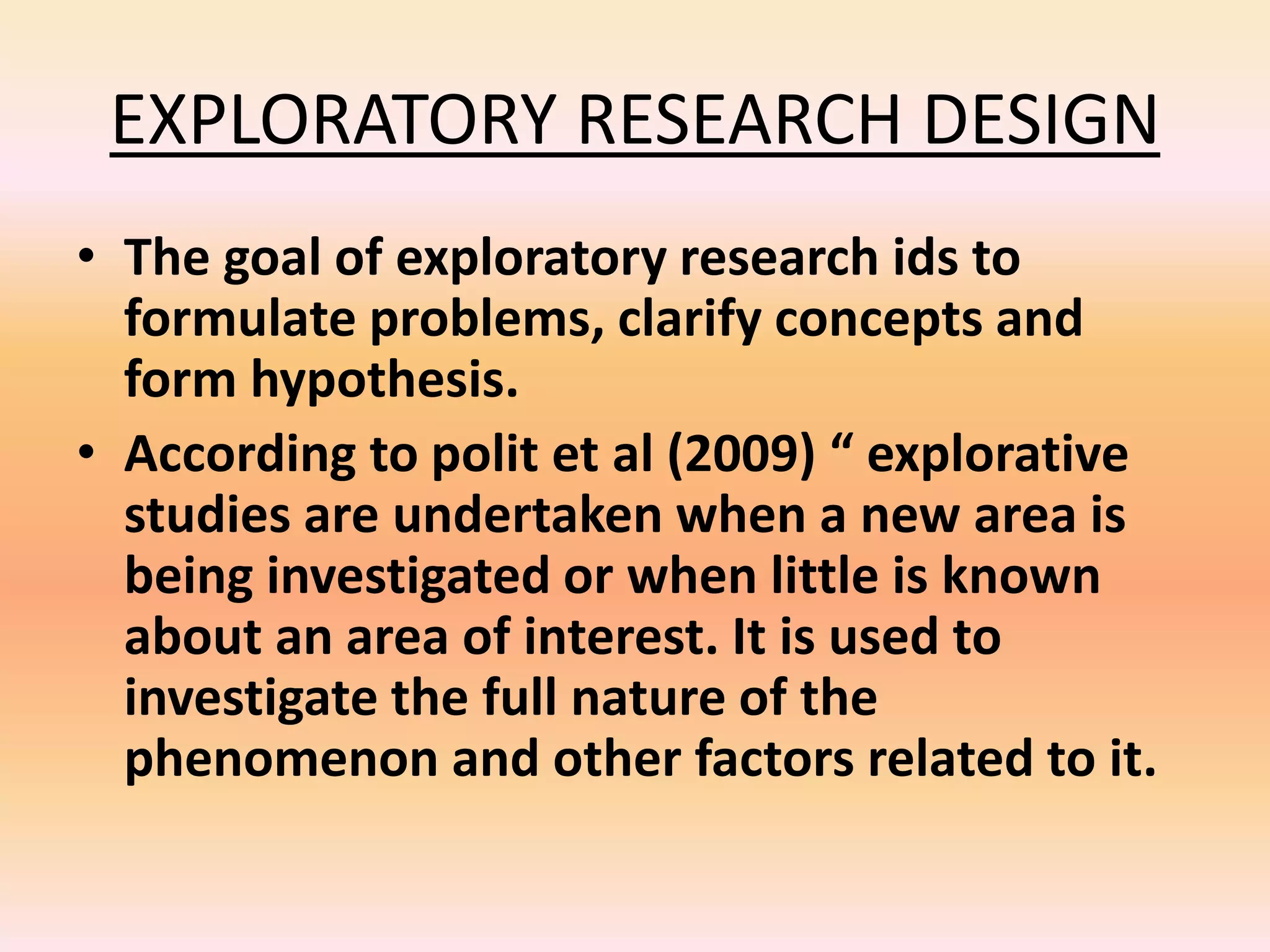
• The goal of exploratory research ids to
formulate problems, clarify concepts and
form hypothesis.
• According to polit et al (2009) “ explorative
studies are undertaken when a new area is
being investigated or when little is known
about an area of interest. It is used to
investigate the full nature of the
phenomenon and other factors related to it.
METHODS OF EXPLORATORY DESIGN
• Literature review
• Depth interview
• Focus group
• Case study
• Pilot study
• Experimental survey
DESCRIPTIVE RESEARCH DESIGN
• Descriptive research is typically concerned
with describing problem and its solution.
• Descriptive research requires clear
specification of who, what, when ,where ,
and how of the research. Descriptive design
is directed to answer these questions.
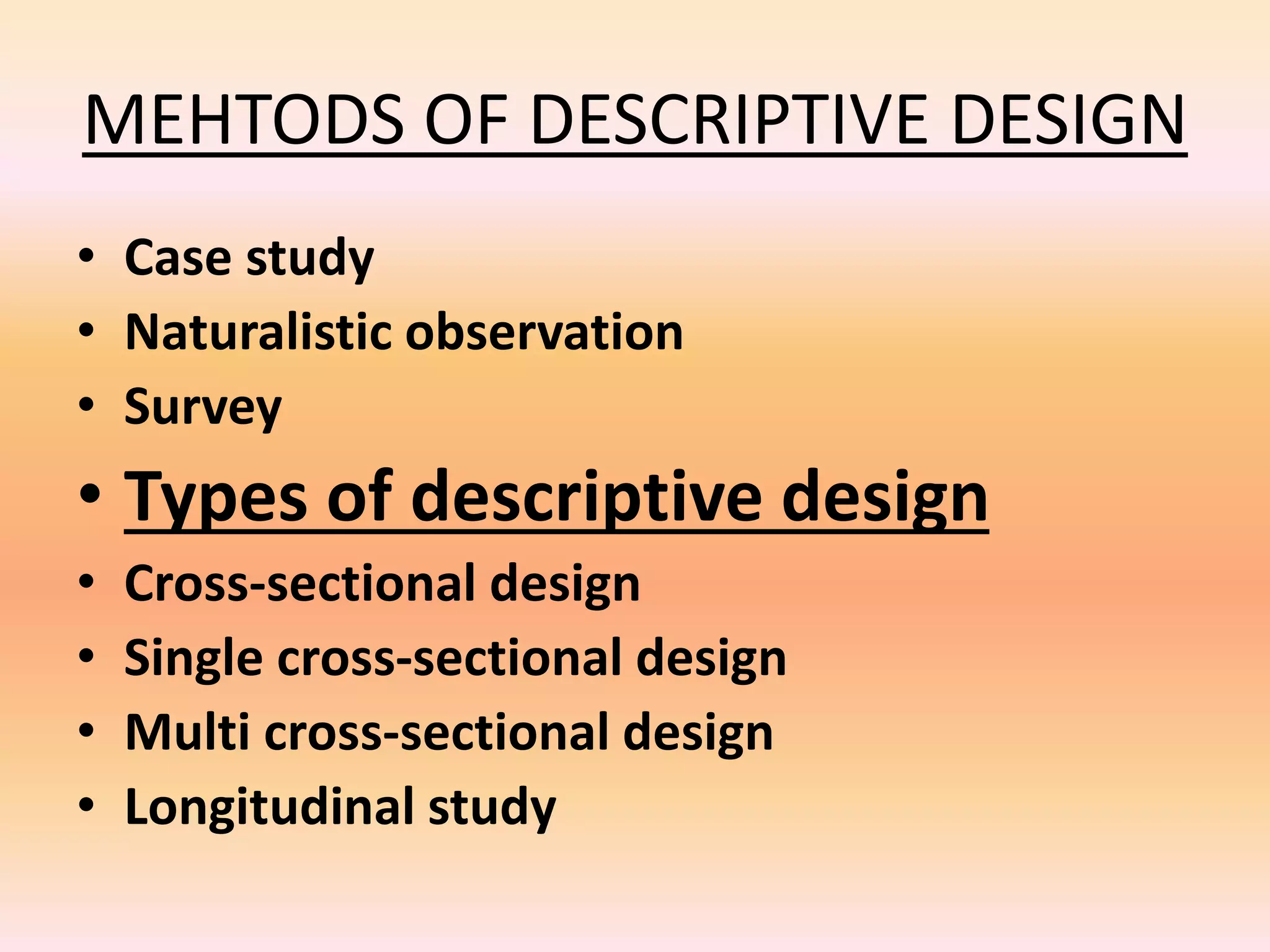
MEHTODS OF DESCRIPTIVE DESIGN
• Case study
• Naturalistic observation
• Survey
• Types of descriptive design
• Cross-sectional design
• Single cross-sectional design
• Multi cross-sectional design
• Longitudinal study
EXPLANATORY RESEARCH DESIGN
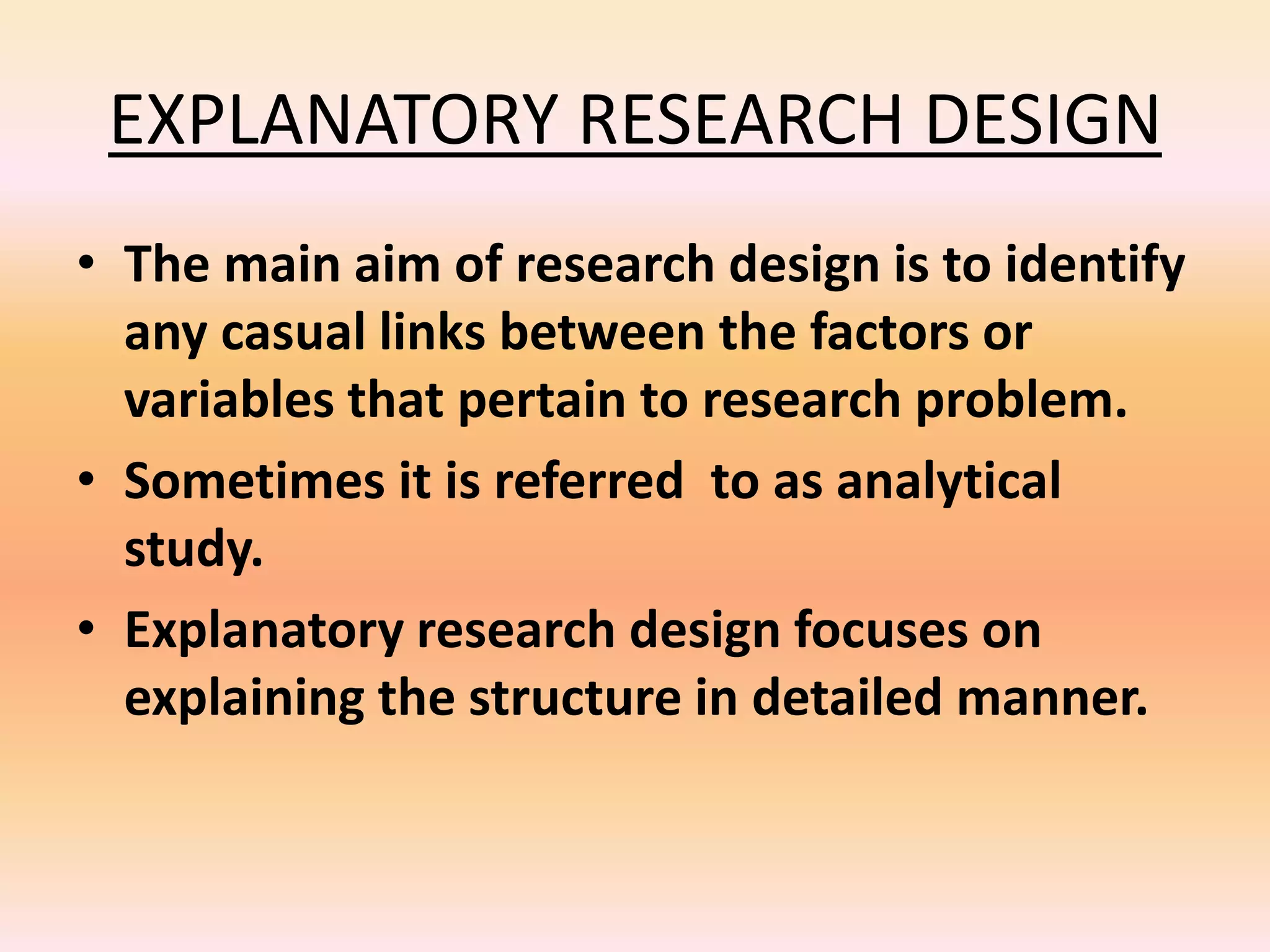
• The main aim of research design is to identify
any casual links between the factors or
variables that pertain to research problem.
• Sometimes it is referred to as analytical
study.
• Explanatory research design focuses on
explaining the structure in detailed manner.
PURPOSE OF EXPLANATORY RESEARCH
DESIGN
• Increasing understanding
• The flexibility of sources
• Better conclusion
METHODS OF EXPLANATORY
RESEARCH DESIGN
• Literature research
• In depth study
• Focus group research
• Case analysis
CONCULISION
• In this way the purpose of research design is
to maximize valid answer to a research
question. This was achieved by using a
exploratory , descriptive and explanatory
approach.
REFERENCES
• “INTRODUCTION” Research methodology’ by
Rajendra kumar ,https://books google.com
• “NEED FOR RESEARCH DESIGN” FEATURES OF
GOOD DESIGN; C R Kothari-( research
methodology methods and techniques)
• “DEFINITION OF RESEARCH DESIGN” https://
explorable.com/research design
• “CONTENTS OF RESEARCH
DESIGN’’www.youarticlelibrary.com/marketing
research design.
• “EXPLANATORY RESEARCH” better
thesis.dk/reasearch methods empirical,
scholarshipfellow.com,
slideshare.com/explanatory research
Research design ppt (1)

Research design ppt (1)

  • 1.
    ASSIGNMENT ON….. RESEARCH DESIGN EXPLORATORY DESCRIPTIVE EXPLANATORY INSTITUTEOF SOCIAL SCIENCES DEPARTMENT OF SOCIAL WORK SUBMITTED TO: DR. R K. BHARTI SUBMITTED BY: MANJALI M.S.W 2ND SEM ROLL NO -16
  • 2.
    INTRODUCTION The preparation ofa research design is an important step in the research design . A research design is a written plan for a study . It communicates the intention of the researcher. “Research design , thus is a logical and systematic plan prepared for conducting a research study . It is comparable to blue print which the architect prepare before construction of the building commences”.
  • 3.
    DEFINITION OF RESEARCHDESIGN • According to Kerlinger “ research design is the plan, structure and strategy of investigation conceived so as to obtain answer to research questions and to control variance”. • Burnes and grove (2003) define a research design as a blueprint for conducting a study with maximum control over factors that may interfere with the validity of the findings”.
  • 4.
    NEED FOR RESEARCHDESIGN Research design is needed because: It facilitates the smooth sailing of the various research operations. For making research as efficient as possible yielding maximal information with minimal expenditure of effort, time and money. For advance planning of the methods to be adopted for collecting the relevant data and the techniques.
  • 5.
    FEATURES OF AGOOD DESIGN • A good design is often characterized by adjectives like flexible, appropriate, efficient, economical and so on. • The design which yields maximal information and provide an opportunity for considering many different aspects of a problem is considered most appropriate and efficient design.
  • 6.
    IMPORTANT CONCEPTS RELATINGTO RESEARCH DESIGN • Dependent and independent variables. • Extraneous variable • Control • Confounded relationship • Research hypothesis
  • 7.
    CONTENTS OF RESEARCHDESIGN • Statement of research objective ,i.e. why the research project is to be conducted. • Type of data needed • Definition of population and sampling procedures to be followed • Time, costs, and responsibility specification • Methods ways ,and procedures used for collection of data • Data analysis tools or methods used to analysse data
  • 8.
    RESARCH DESIGN EXPLANATORY R.DDESCRIPTIVE R.D EXPLANATORY R.D METHODS LITERATURE REVIEW DEPTH INTERVIEW FOCUS GROUP CASE STUDY PILOT STUDY EXPERIMENTAL STUDY METHODS OBSERVATIONS PANELS SURVEY CASE STUDY METHODS LITERATURE RESEARCH IN-DEPTH INTERVIEW FOUCUS GROUP CASE ANALYSIS
  • 9.
    TYPES OF RESEARCHDESIGN • The research design is a broad framework that describes how the entire research project is carried out .basically, there can be three types of research design. Exploratory research design, descriptive research design, explanatory research design.
  • 10.
    EXPLORATORY RESEARCH DESIGN •The goal of exploratory research ids to formulate problems, clarify concepts and form hypothesis. • According to polit et al (2009) “ explorative studies are undertaken when a new area is being investigated or when little is known about an area of interest. It is used to investigate the full nature of the phenomenon and other factors related to it.
  • 11.
    METHODS OF EXPLORATORYDESIGN • Literature review • Depth interview • Focus group • Case study • Pilot study • Experimental survey
  • 12.
    DESCRIPTIVE RESEARCH DESIGN •Descriptive research is typically concerned with describing problem and its solution. • Descriptive research requires clear specification of who, what, when ,where , and how of the research. Descriptive design is directed to answer these questions.
  • 13.
    MEHTODS OF DESCRIPTIVEDESIGN • Case study • Naturalistic observation • Survey • Types of descriptive design • Cross-sectional design • Single cross-sectional design • Multi cross-sectional design • Longitudinal study
  • 14.
    EXPLANATORY RESEARCH DESIGN •The main aim of research design is to identify any casual links between the factors or variables that pertain to research problem. • Sometimes it is referred to as analytical study. • Explanatory research design focuses on explaining the structure in detailed manner.
  • 15.
    PURPOSE OF EXPLANATORYRESEARCH DESIGN • Increasing understanding • The flexibility of sources • Better conclusion
  • 16.
    METHODS OF EXPLANATORY RESEARCHDESIGN • Literature research • In depth study • Focus group research • Case analysis
  • 17.
    CONCULISION • In thisway the purpose of research design is to maximize valid answer to a research question. This was achieved by using a exploratory , descriptive and explanatory approach.
  • 18.
    REFERENCES • “INTRODUCTION” Researchmethodology’ by Rajendra kumar ,https://books google.com • “NEED FOR RESEARCH DESIGN” FEATURES OF GOOD DESIGN; C R Kothari-( research methodology methods and techniques) • “DEFINITION OF RESEARCH DESIGN” https:// explorable.com/research design • “CONTENTS OF RESEARCH DESIGN’’www.youarticlelibrary.com/marketing research design.
  • 19.
    • “EXPLANATORY RESEARCH”better thesis.dk/reasearch methods empirical, scholarshipfellow.com, slideshare.com/explanatory research