Business Research Design
Meaning
Decisions regarding what, where, when, how much,
by what means concerning an inquiry or a research study
constitute a research design.
Meaning
(i) What is the study about?
(ii) Why is the study being made?
(iii) Where will the study be carried out?
(iv) What type of data is required?
(v) Where can the required data be found?
(vi) What periods of time will the study include?
(vii) What will be the sample design?
(viii) What techniques of data collection will be used?
(ix) How will the data be analyzed?
(x) In what style will the report be prepared?
Important Features Of A Research Design As
 It is a plan that specifies the sources and types of
information relevant to the research problem.
 It is a strategy specifying which approach will be used for
gathering and analyzing the data.
 It also includes the time and cost budgets since most studies
are done under these two constraints.
 A good design is often characterized by adjectives like
flexible, appropriate, efficient, economical
 The design which minimizes bias and maximizes the
reliability of the data collected and analyzed is considered a
good design
Consideration Of The Following Factors:
(i) The means of obtaining information;
(ii) The availability and skills of the researcher and
his staff, if any;
(iii) The objective of the problem to be studied;
(iv) The nature of the problem to be studied; and
(v) The availability of time and money for the research
work.
DIFFERENT RESEARCH DESIGNS
Different research designs can be conveniently described if
we categorize them as:
(1) Research design in case of exploratory research studies;
(2) research design in case of conclusive/descriptive and
diagnostic research studies, and
(3) research design in case of experimental/hypothesis-testing
research studies.
Exploratory Research Design
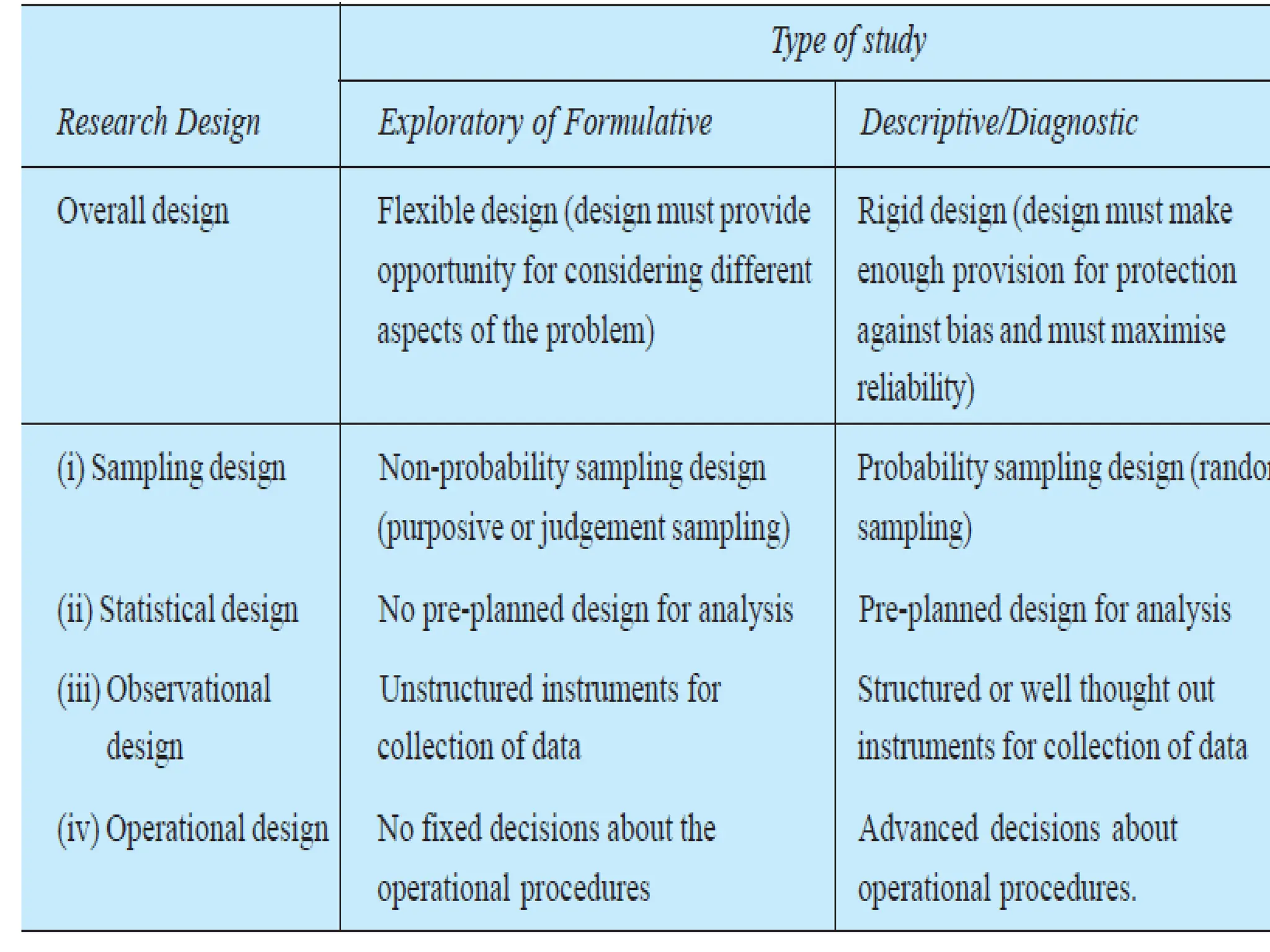
 Also termed as formulative research studies. The main
purpose of such studies is that of formulating a problem for
more precise investigation or of developing the working
hypotheses from an operational point of view
Purpose
 The major emphasis in such studies is on the discovery of
ideas and insights. As such
 The research design appropriate for such studies must be
flexible enough to provide opportunity for Considering
different aspects of a problem under study
 The purpose of exploratory research is to gather
preliminary information that will help define problems and
suggest hypotheses
 To gain familiarity with a phenomenon or acquire new
insight into it in order to formulate a more precise problem
or develop hypothesis
Methods Of Exploratory Research Design
(a) The survey of concerning literature search/survey
(b) The experience survey
(c) Comprehensive case methods
(d) Focus group
Descriptive And Diagnostic Research
Design
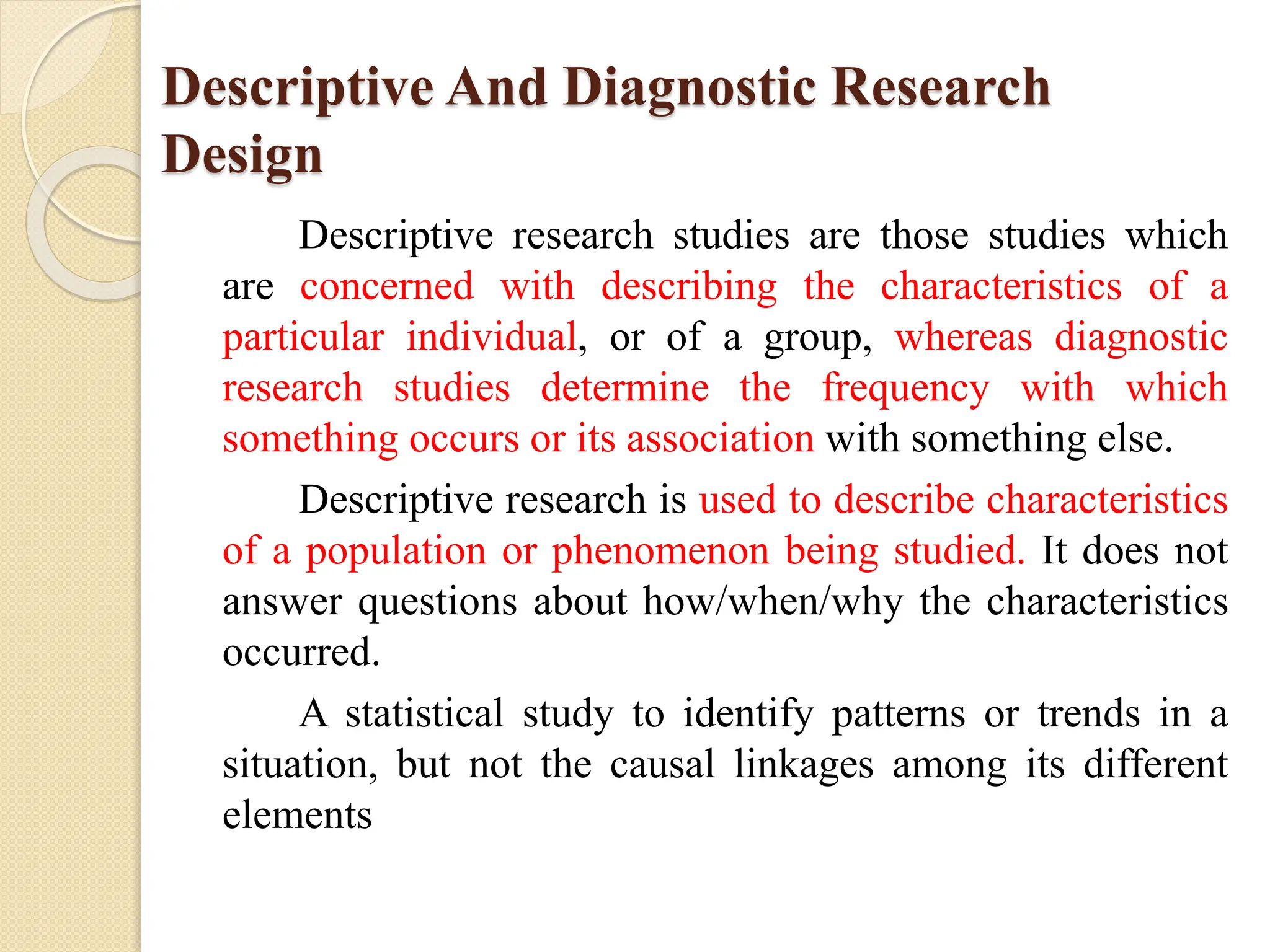
Descriptive research studies are those studies which
are concerned with describing the characteristics of a
particular individual, or of a group, whereas diagnostic
research studies determine the frequency with which
something occurs or its association with something else.
Descriptive research is used to describe characteristics
of a population or phenomenon being studied. It does not
answer questions about how/when/why the characteristics
occurred.
A statistical study to identify patterns or trends in a
situation, but not the causal linkages among its different
elements
Types
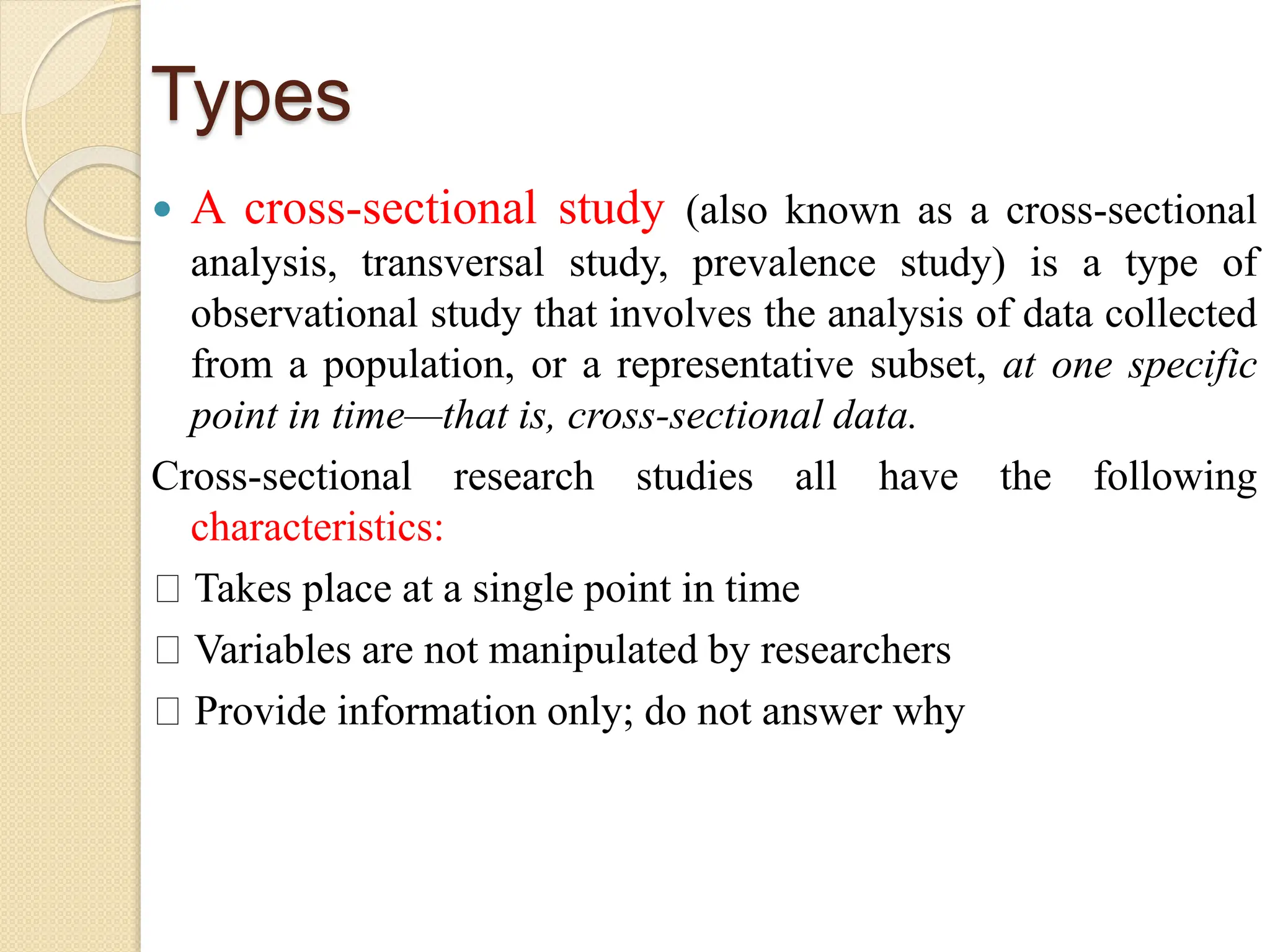
 A cross-sectional study (also known as a cross-sectional
analysis, transversal study, prevalence study) is a type of
observational study that involves the analysis of data collected
from a population, or a representative subset, at one specific
point in time—that is, cross-sectional data.
Cross-sectional research studies all have the following
characteristics:
Takes place at a single point in time
Variables are not manipulated by researchers
Provide information only; do not answer why
Longitudinal studies
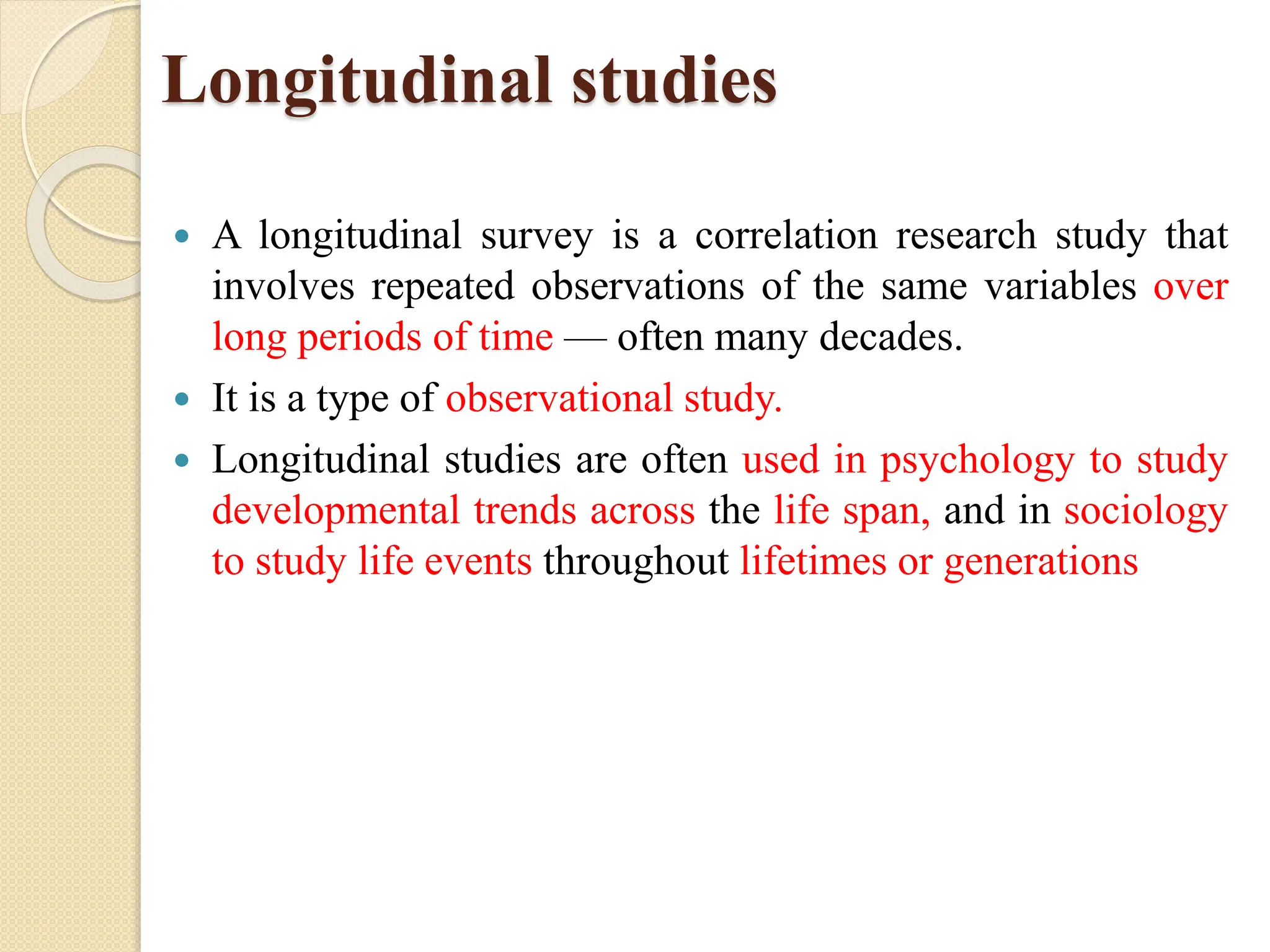
 A longitudinal survey is a correlation research study that
involves repeated observations of the same variables over
long periods of time — often many decades.
 It is a type of observational study.
 Longitudinal studies are often used in psychology to study
developmental trends across the life span, and in sociology
to study life events throughout lifetimes or generations
Hypothesis-testing Research Design
Studies (generally known as experimental studies)
are those where the researcher tests the hypotheses of
causal relationships between variables
Experimental research design
Is a systematic and scientific approach to research
in which the researcher manipulates one or more
variables, and controls and measures any change in other
variables.
Classification of Experimental Designs
Classified as:
1. Pre experimental design-Pre-experimental designs are so
named because they follow basic experimental steps but fail
to include a control group.
2. Quasi-experimental design, -A quasi-experiment is an
empirical study used to estimate the causal impact of an
intervention on its target population.
3. True experimental design-True experimental design is
regarded as the most accurate form of experimental research,
in that it tries to prove or disprove a hypothesis
mathematically, with statistical analysis.
4. Statistical experimental design-The term Statistical
experimental design refers to a plan for assigning
experimental units to treatment conditions

research design, research methodology, approaches, types of research,. Ppt

  • 1.
  • 2.
    Meaning Decisions regarding what,where, when, how much, by what means concerning an inquiry or a research study constitute a research design.
  • 3.
    Meaning (i) What isthe study about? (ii) Why is the study being made? (iii) Where will the study be carried out? (iv) What type of data is required? (v) Where can the required data be found? (vi) What periods of time will the study include? (vii) What will be the sample design? (viii) What techniques of data collection will be used? (ix) How will the data be analyzed? (x) In what style will the report be prepared?
  • 4.
    Important Features OfA Research Design As  It is a plan that specifies the sources and types of information relevant to the research problem.  It is a strategy specifying which approach will be used for gathering and analyzing the data.  It also includes the time and cost budgets since most studies are done under these two constraints.  A good design is often characterized by adjectives like flexible, appropriate, efficient, economical  The design which minimizes bias and maximizes the reliability of the data collected and analyzed is considered a good design
  • 5.
    Consideration Of TheFollowing Factors: (i) The means of obtaining information; (ii) The availability and skills of the researcher and his staff, if any; (iii) The objective of the problem to be studied; (iv) The nature of the problem to be studied; and (v) The availability of time and money for the research work.
  • 6.
    DIFFERENT RESEARCH DESIGNS Differentresearch designs can be conveniently described if we categorize them as: (1) Research design in case of exploratory research studies; (2) research design in case of conclusive/descriptive and diagnostic research studies, and (3) research design in case of experimental/hypothesis-testing research studies.
  • 7.
    Exploratory Research Design Also termed as formulative research studies. The main purpose of such studies is that of formulating a problem for more precise investigation or of developing the working hypotheses from an operational point of view
  • 8.
    Purpose  The majoremphasis in such studies is on the discovery of ideas and insights. As such  The research design appropriate for such studies must be flexible enough to provide opportunity for Considering different aspects of a problem under study  The purpose of exploratory research is to gather preliminary information that will help define problems and suggest hypotheses  To gain familiarity with a phenomenon or acquire new insight into it in order to formulate a more precise problem or develop hypothesis
  • 9.
    Methods Of ExploratoryResearch Design (a) The survey of concerning literature search/survey (b) The experience survey (c) Comprehensive case methods (d) Focus group
  • 10.
    Descriptive And DiagnosticResearch Design Descriptive research studies are those studies which are concerned with describing the characteristics of a particular individual, or of a group, whereas diagnostic research studies determine the frequency with which something occurs or its association with something else. Descriptive research is used to describe characteristics of a population or phenomenon being studied. It does not answer questions about how/when/why the characteristics occurred. A statistical study to identify patterns or trends in a situation, but not the causal linkages among its different elements
  • 11.
    Types  A cross-sectionalstudy (also known as a cross-sectional analysis, transversal study, prevalence study) is a type of observational study that involves the analysis of data collected from a population, or a representative subset, at one specific point in time—that is, cross-sectional data. Cross-sectional research studies all have the following characteristics: Takes place at a single point in time Variables are not manipulated by researchers Provide information only; do not answer why
  • 12.
    Longitudinal studies  Alongitudinal survey is a correlation research study that involves repeated observations of the same variables over long periods of time — often many decades.  It is a type of observational study.  Longitudinal studies are often used in psychology to study developmental trends across the life span, and in sociology to study life events throughout lifetimes or generations
  • 14.
    Hypothesis-testing Research Design Studies(generally known as experimental studies) are those where the researcher tests the hypotheses of causal relationships between variables
  • 15.
    Experimental research design Isa systematic and scientific approach to research in which the researcher manipulates one or more variables, and controls and measures any change in other variables.
  • 16.
    Classification of ExperimentalDesigns Classified as: 1. Pre experimental design-Pre-experimental designs are so named because they follow basic experimental steps but fail to include a control group. 2. Quasi-experimental design, -A quasi-experiment is an empirical study used to estimate the causal impact of an intervention on its target population. 3. True experimental design-True experimental design is regarded as the most accurate form of experimental research, in that it tries to prove or disprove a hypothesis mathematically, with statistical analysis. 4. Statistical experimental design-The term Statistical experimental design refers to a plan for assigning experimental units to treatment conditions