TYPES OF
RESEARCH DESIGN
Table of Contents
01
OVERVIEW
Description
about research
02
TYPES OF RESEARCH
Different types depending
on different aspect
03
BENEFITS OF RESEARCH
What are the benefits of
research?
04
IMPORTANCE OF RESEARCH
Why do we do research?
OVERVIEW
Research means Re + Search where,
Re means again and again,
Search means to find something,
Which include collecting, organizing and evaluating the data.
Business research is a process of obtaining a detailed study of all the business areas including
the market and the customers.
TYPES OF RESEARCH
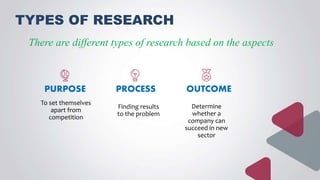
There are different types of research based on the aspects
PURPOSE PROCESS OUTCOME
To set themselves
apart from
competition
Finding results
to the problem
Determine
whether a
company can
succeed in new
sector
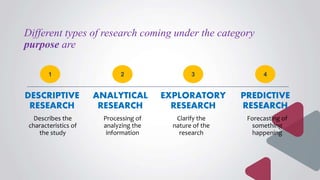
Different types of research coming under the category
purpose are
DESCRIPTIVE
RESEARCH
ANALYTICAL
RESEARCH
EXPLORATORY
RESEARCH
Describes the
characteristics of
the study
Processing of
analyzing the
information
Clarify the
nature of the
research
PREDICTIVE
RESEARCH
Forecasting of
something
happening
1 2 3 4
DESCRIPTIVE RESEARCH
Descriptive research is used to describe characteristics of
a population or phenomenon being studied. It does not
answer questions about how / when / why the
characteristics occurred.
The methods used by this researchers involves survey
method of all kind including comparative and correlational
method.
The periodic table categorizes the elements is an example
of descriptive research
ANALYTICAL RESEARCH
Analytical research involves critical thinking skills and
the evaluation of facts and information relative to the
research being conducted.
The aim of this research is to understand phenomena by
discovering and measuring causal relations among them.
How can the absentee rate among employees be
reduced? It is an example of analytical research
EXPLORATORY RESEARCH
Exploratory research is the preliminary research to
clarify the exact nature of the problem to be solved. It is
used to ensure research is taken into consideration during
an experiment.
It commonly use unstructured interview.
Gathers preliminary information that will help to define a
problem and suggest a hypothesis.
It is conducted about a research problem when there are
few or no earlier studies to refer to.
PREDICTIVE RESEARCH
Predictive research is involved with the forecasting
(predicting) of a likelihood of something happening. It
studies determine the frequency with which something
occurs or its association with something else.
Statistical tools used in this research design includes
regression, linear regression and logistic regression.
The major areas in which predictive / diagnostic research
design used include: business, marketing, clinical setting,
govt agency and all.
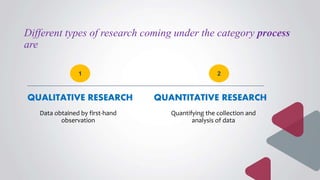
Different types of research coming under the category process
are
QUALITATIVE RESEARCH QUANTITATIVE RESEARCH
Data obtained by first-hand
observation
Quantifying the collection and
analysis of data
1 2
QUALITATIVE RESEARCH
Qualitative research relies on data obtained by the
researcher from first-hand observation, interviews,
questionnaires. The data are generally nonnumerical.
The research designed to find out how people feel or
what people often think are coming under this research.
Its aim is to discover the underlying motives of human
behavior through detailed description.
The data is in the form of words, pictures or objects and
all.
QUANTITATIVE RESEARCH
Quantitative research focuses on quantifying the
collection and analysis of data. It is formed from a
deductive approach where emphasis is placed on the
testing of theory.
This research is based on the measurement of quantity
or amount.
Here data is in the form of numbers or statistics and this
data is more efficient and able to test.
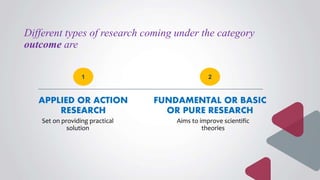
Different types of research coming under the category
outcome are
APPLIED OR ACTION
RESEARCH
FUNDAMENTAL OR BASIC
OR PURE RESEARCH
Set on providing practical
solution
Aims to improve scientific
theories
1 2
APPLIED OR ACTION RESEARCH
It is defined as a research which is used to answer a
specific question, solve a specific problem or to gain
better understanding.
It also known as action research.
It seeks to solve a specific problem or provide innovative
solutions to issues affecting an individual, group or
society.
It is designed to solve problem of modern world than
acquire knowledge. The main goal of applied scientist is
to improve the human condition.
FUNDAMENTAL OR BASIC OR PURE RESEARCH
This research is concerned with generalization and
formulation of theory.
This type of research has limited direct applications but
in which researcher has careful control over the research
setting.
Basic research, also called pure research or fundamental
research, is a type of scientific research with the aim of
improving scientific theories for better understanding
and prediction of natural or other phenomena.
BENEFITS OF RESEARCH
DESIGN
Better documentation of the various activities while the
project work is going on.
Helps in proper planning of the resources and their
procurement in right time.
Consumes less time.
Ensures project time schedule.
Helps researcher to prepare himself to carry out
research in a proper and a systematic way.
IMPORTANTS OF RESEARCH DESIGN
Better documentation of the various activities while the
project work is going on.
It cuts down on inaccuracy.
Reduce wastage of time.
Reduce uncertainty, confusion and practical haphazard
related to any research problem.
Maximizes reliability of results.
Gets rid of bias and marginal errors.
Thank You!
Lorem ipsum dolor sit amet, tollit epicuri
est ex, exerci accumsan singulis ei mel.
First / Last Name
(123) 456-7890
Your Company

Types of research

  • 1.
  • 2.
    Table of Contents 01 OVERVIEW Description aboutresearch 02 TYPES OF RESEARCH Different types depending on different aspect 03 BENEFITS OF RESEARCH What are the benefits of research? 04 IMPORTANCE OF RESEARCH Why do we do research?
  • 3.
    OVERVIEW Research means Re+ Search where, Re means again and again, Search means to find something, Which include collecting, organizing and evaluating the data. Business research is a process of obtaining a detailed study of all the business areas including the market and the customers.
  • 4.
    TYPES OF RESEARCH Thereare different types of research based on the aspects PURPOSE PROCESS OUTCOME To set themselves apart from competition Finding results to the problem Determine whether a company can succeed in new sector
  • 5.
    Different types ofresearch coming under the category purpose are DESCRIPTIVE RESEARCH ANALYTICAL RESEARCH EXPLORATORY RESEARCH Describes the characteristics of the study Processing of analyzing the information Clarify the nature of the research PREDICTIVE RESEARCH Forecasting of something happening 1 2 3 4
  • 6.
    DESCRIPTIVE RESEARCH Descriptive researchis used to describe characteristics of a population or phenomenon being studied. It does not answer questions about how / when / why the characteristics occurred. The methods used by this researchers involves survey method of all kind including comparative and correlational method. The periodic table categorizes the elements is an example of descriptive research
  • 7.
    ANALYTICAL RESEARCH Analytical researchinvolves critical thinking skills and the evaluation of facts and information relative to the research being conducted. The aim of this research is to understand phenomena by discovering and measuring causal relations among them. How can the absentee rate among employees be reduced? It is an example of analytical research
  • 8.
    EXPLORATORY RESEARCH Exploratory researchis the preliminary research to clarify the exact nature of the problem to be solved. It is used to ensure research is taken into consideration during an experiment. It commonly use unstructured interview. Gathers preliminary information that will help to define a problem and suggest a hypothesis. It is conducted about a research problem when there are few or no earlier studies to refer to.
  • 9.
    PREDICTIVE RESEARCH Predictive researchis involved with the forecasting (predicting) of a likelihood of something happening. It studies determine the frequency with which something occurs or its association with something else. Statistical tools used in this research design includes regression, linear regression and logistic regression. The major areas in which predictive / diagnostic research design used include: business, marketing, clinical setting, govt agency and all.
  • 10.
    Different types ofresearch coming under the category process are QUALITATIVE RESEARCH QUANTITATIVE RESEARCH Data obtained by first-hand observation Quantifying the collection and analysis of data 1 2
  • 11.
    QUALITATIVE RESEARCH Qualitative researchrelies on data obtained by the researcher from first-hand observation, interviews, questionnaires. The data are generally nonnumerical. The research designed to find out how people feel or what people often think are coming under this research. Its aim is to discover the underlying motives of human behavior through detailed description. The data is in the form of words, pictures or objects and all.
  • 12.
    QUANTITATIVE RESEARCH Quantitative researchfocuses on quantifying the collection and analysis of data. It is formed from a deductive approach where emphasis is placed on the testing of theory. This research is based on the measurement of quantity or amount. Here data is in the form of numbers or statistics and this data is more efficient and able to test.
  • 13.
    Different types ofresearch coming under the category outcome are APPLIED OR ACTION RESEARCH FUNDAMENTAL OR BASIC OR PURE RESEARCH Set on providing practical solution Aims to improve scientific theories 1 2
  • 14.
    APPLIED OR ACTIONRESEARCH It is defined as a research which is used to answer a specific question, solve a specific problem or to gain better understanding. It also known as action research. It seeks to solve a specific problem or provide innovative solutions to issues affecting an individual, group or society. It is designed to solve problem of modern world than acquire knowledge. The main goal of applied scientist is to improve the human condition.
  • 15.
    FUNDAMENTAL OR BASICOR PURE RESEARCH This research is concerned with generalization and formulation of theory. This type of research has limited direct applications but in which researcher has careful control over the research setting. Basic research, also called pure research or fundamental research, is a type of scientific research with the aim of improving scientific theories for better understanding and prediction of natural or other phenomena.
  • 16.
    BENEFITS OF RESEARCH DESIGN Betterdocumentation of the various activities while the project work is going on. Helps in proper planning of the resources and their procurement in right time. Consumes less time. Ensures project time schedule. Helps researcher to prepare himself to carry out research in a proper and a systematic way.
  • 17.
    IMPORTANTS OF RESEARCHDESIGN Better documentation of the various activities while the project work is going on. It cuts down on inaccuracy. Reduce wastage of time. Reduce uncertainty, confusion and practical haphazard related to any research problem. Maximizes reliability of results. Gets rid of bias and marginal errors.
  • 18.
    Thank You! Lorem ipsumdolor sit amet, tollit epicuri est ex, exerci accumsan singulis ei mel. First / Last Name (123) 456-7890 Your Company

Editor's Notes

  • #2 © Copyright PresentationGO.com – The free PowerPoint and Google Slides template library
  • #3 © Copyright PresentationGO.com – The free PowerPoint and Google Slides template library