ANATOMY
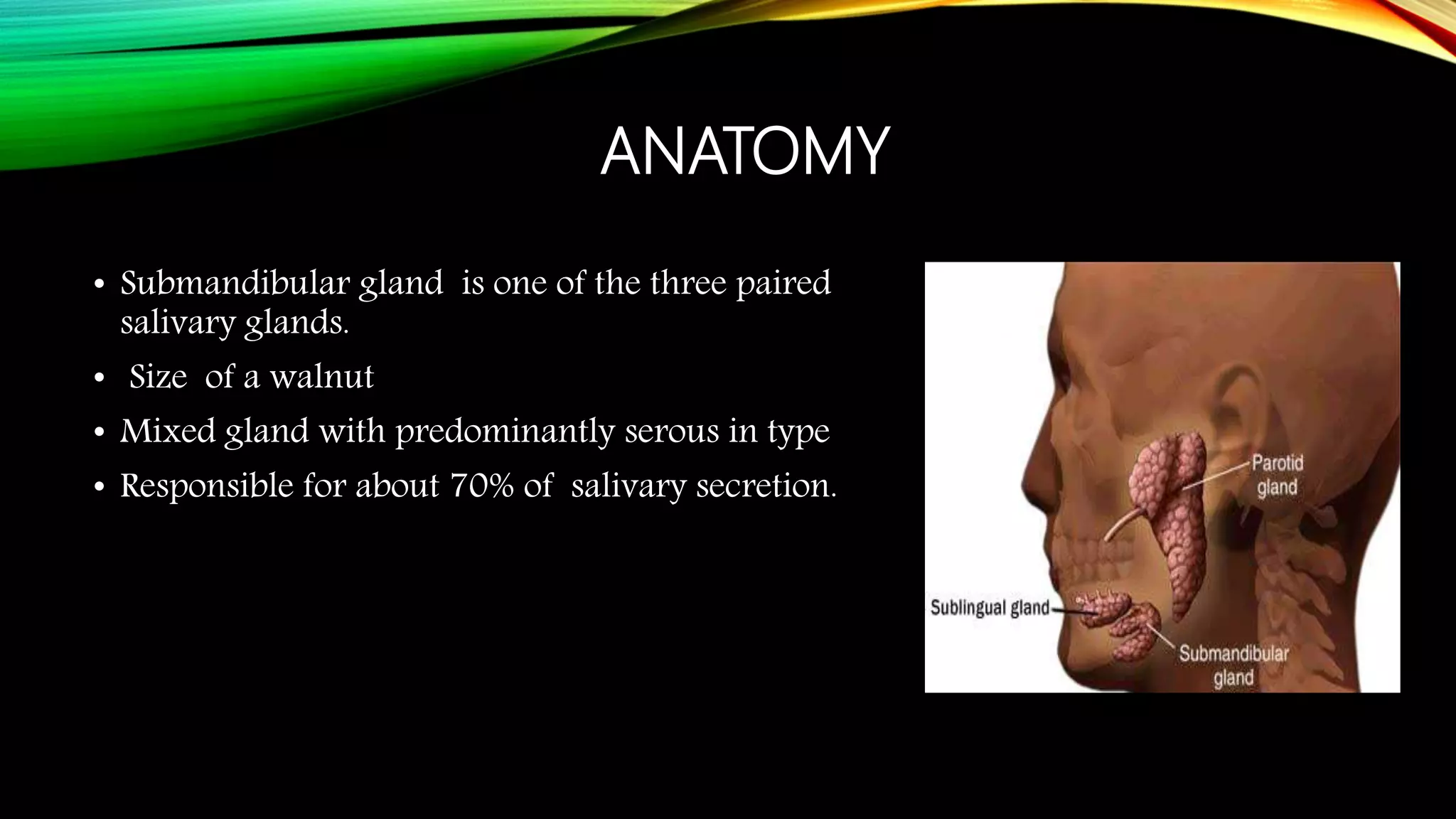
• Submandibular gland is one of the three paired
salivary glands.
• Size of a walnut
• Mixed gland with predominantly serous in type
• Responsible for about 70% of salivary secretion.
ANATOMY
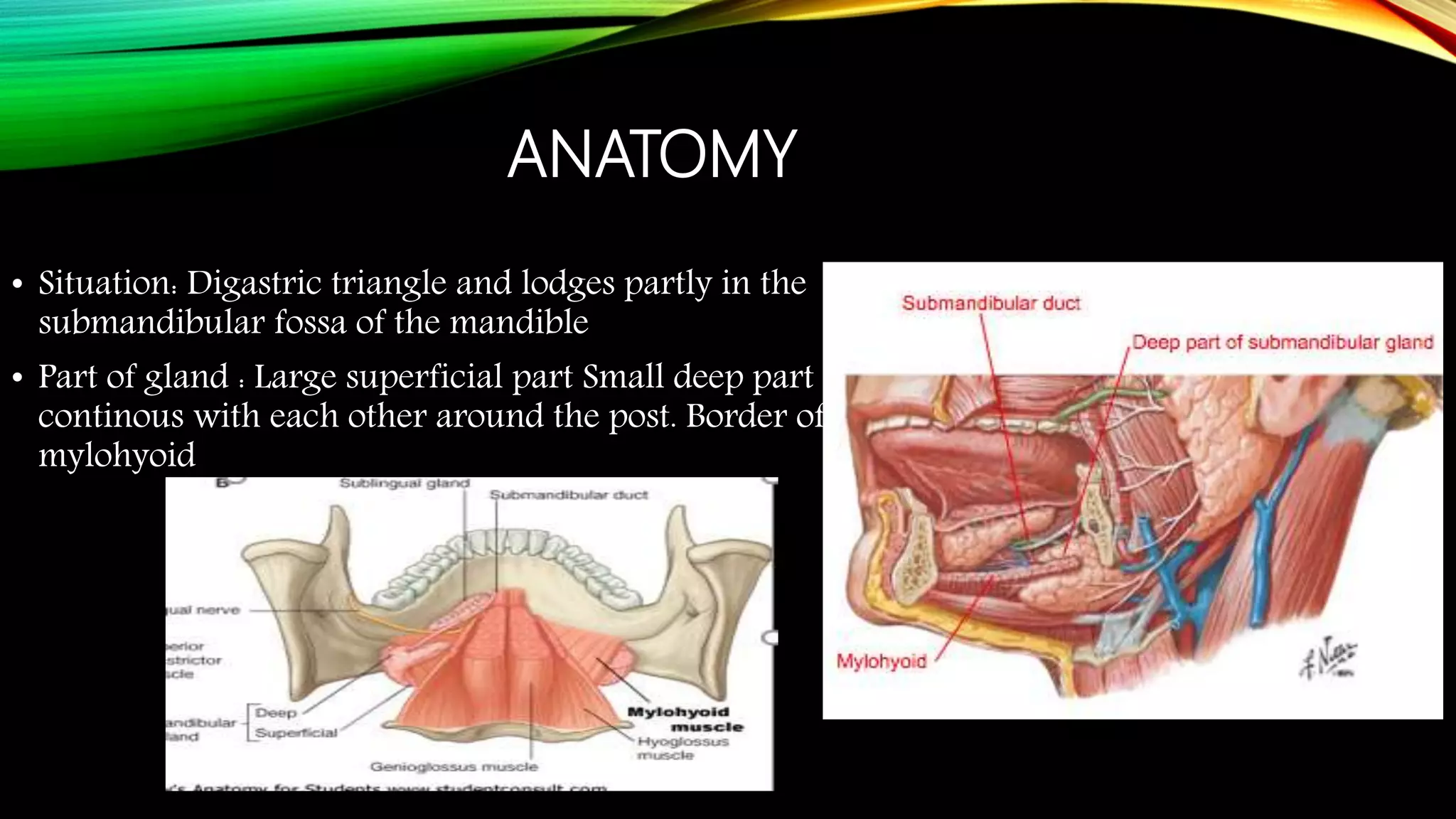
• Situation: Digastric triangle and lodges partly in the
submandibular fossa of the mandible
• Part of gland : Large superficial part Small deep part
continous with each other around the post. Border of
mylohyoid
ANATOMY
ANATOMY
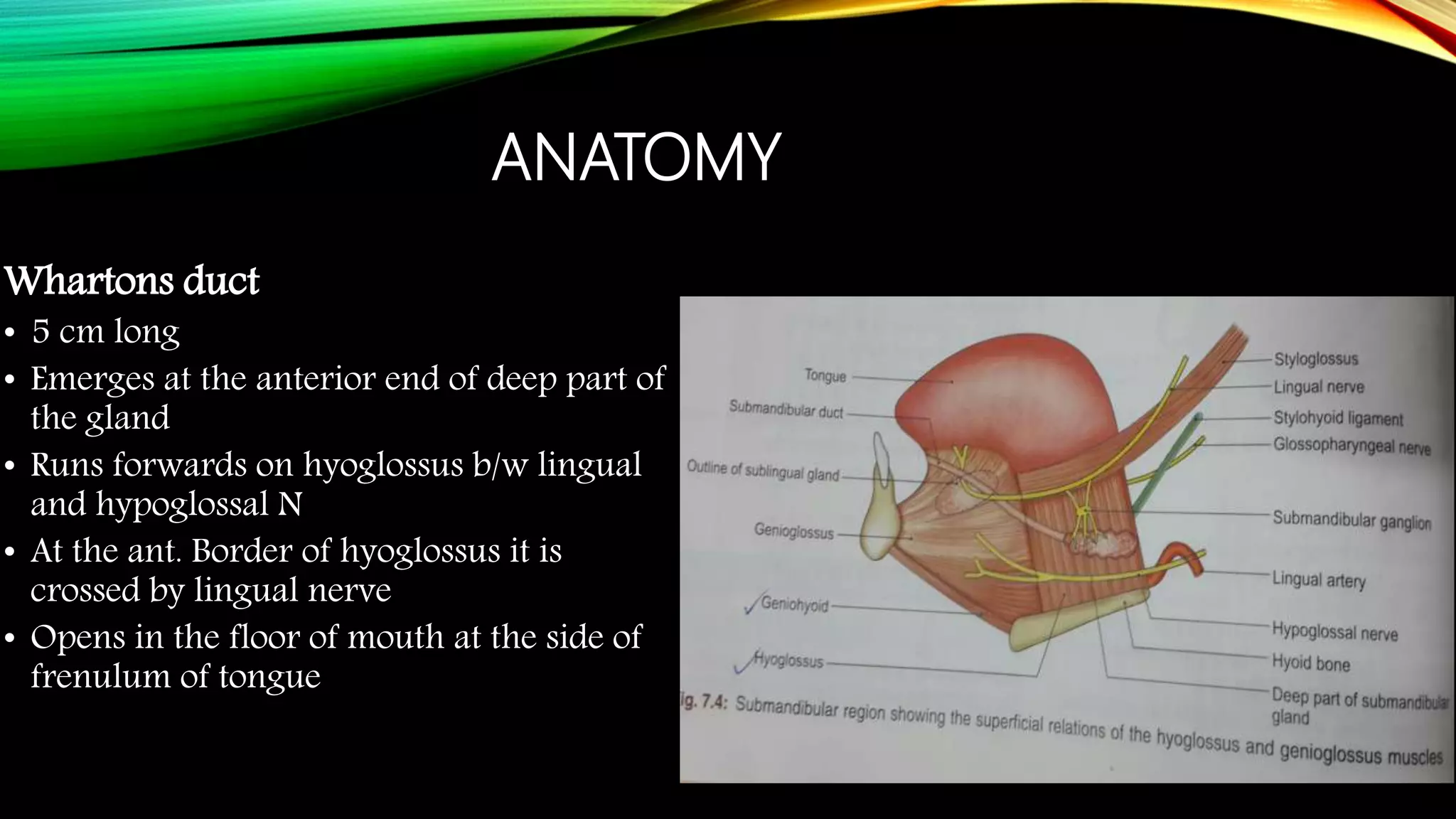
Whartons duct
• 5 cm long
• Emerges at the anterior end of deep part of
the gland
• Runs forwards on hyoglossus b/w lingual
and hypoglossal N
• At the ant. Border of hyoglossus it is
crossed by lingual nerve
• Opens in the floor of mouth at the side of
frenulum of tongue
SURGICAL ANATOMY
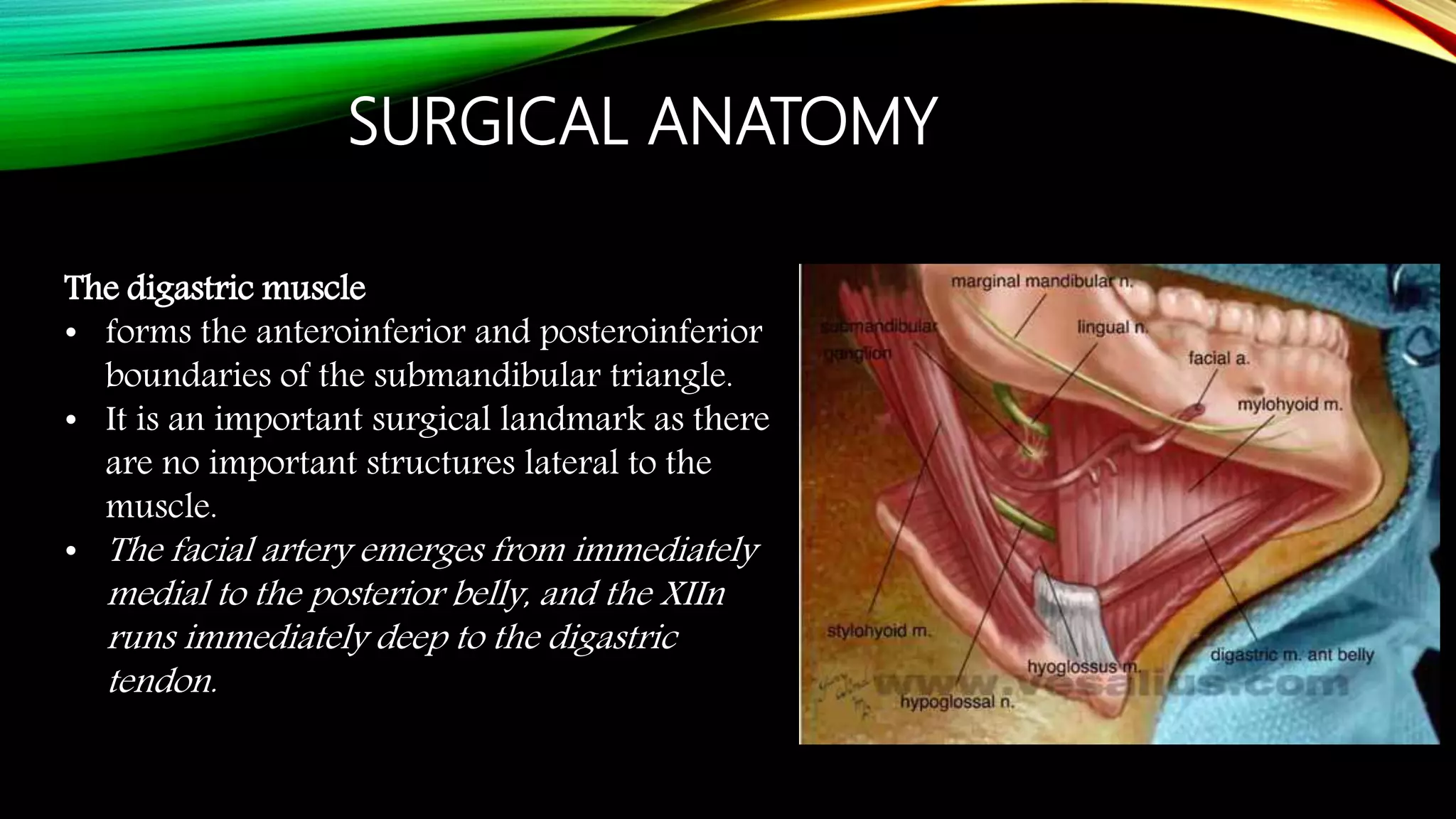
The digastric muscle
• forms the anteroinferior and posteroinferior
boundaries of the submandibular triangle.
• It is an important surgical landmark as there
are no important structures lateral to the
muscle.
• The facial artery emerges from immediately
medial to the posterior belly, and the XIIn
runs immediately deep to the digastric
tendon.
SURGICAL ANATOMY
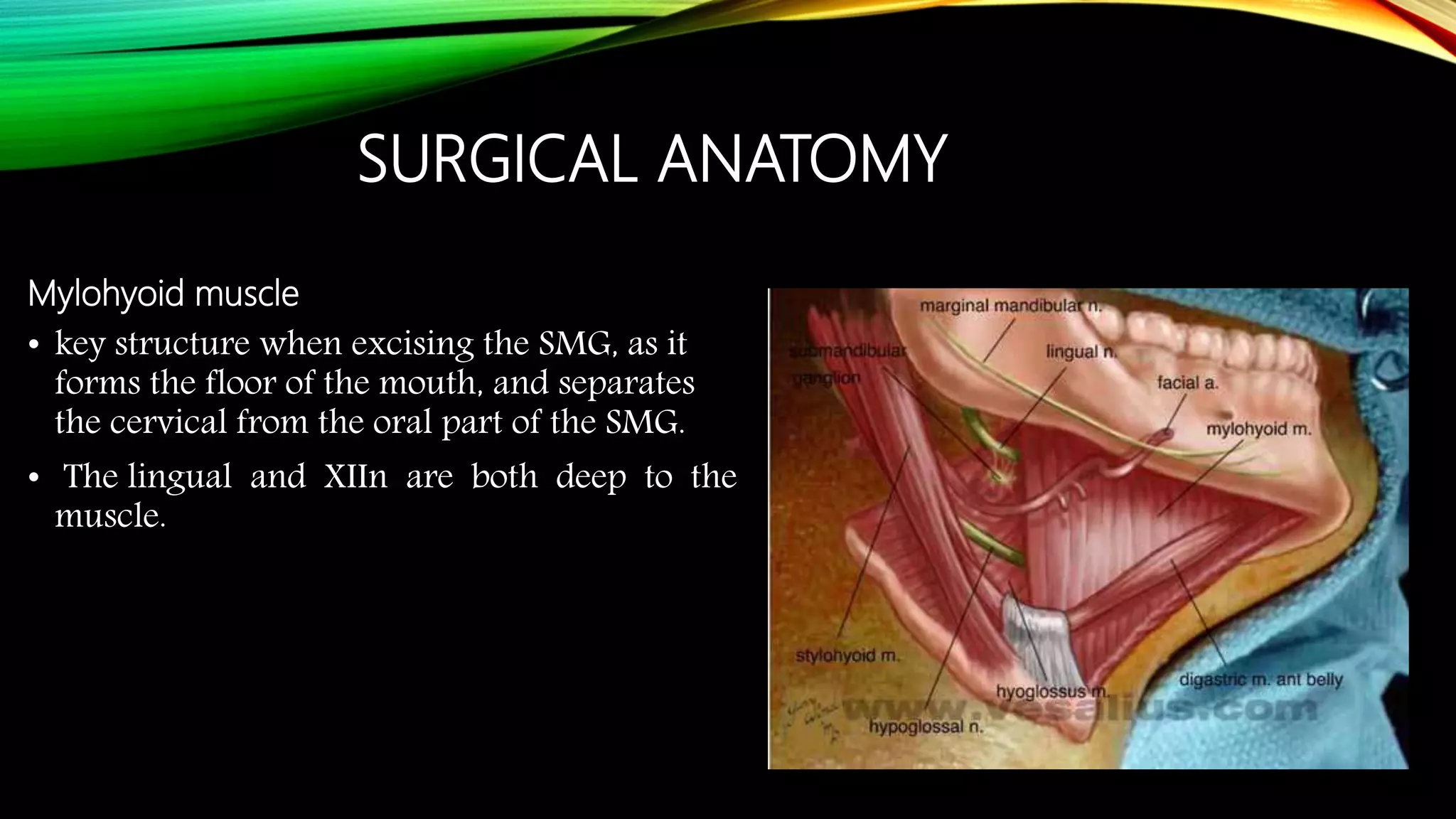
Mylohyoid muscle
• key structure when excising the SMG, as it
forms the floor of the mouth, and separates
the cervical from the oral part of the SMG.
• The lingual and XIIn are both deep to the
muscle.
SURGICAL ANATOMY
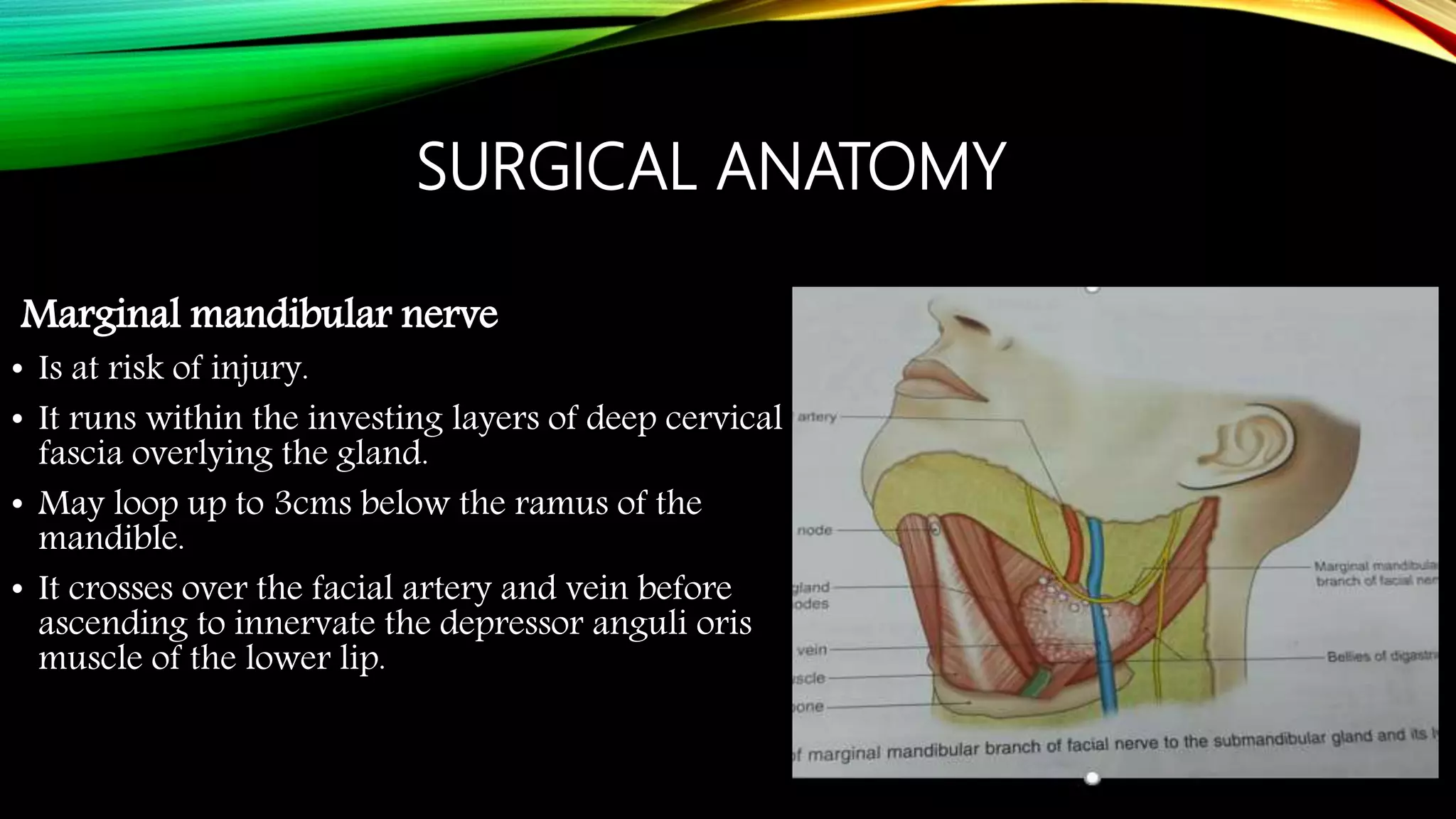
Marginal mandibular nerve
• Is at risk of injury.
• It runs within the investing layers of deep cervical
fascia overlying the gland.
• May loop up to 3cms below the ramus of the
mandible.
• It crosses over the facial artery and vein before
ascending to innervate the depressor anguli oris
muscle of the lower lip.
SURGICAL ANATOMY
3 methods of preserving
1. Approaching the gland at the level of hyoid bone, and keeping the
dissection deep to the glands facial covering.
2. Dividing the facial vessels well below the mandible and on lifting up the
upper ligated stumps.
3. Identify tail of parotid where it lies anterior to retromandibular vein and
to trace it forward
SURGICAL ANATOMY
lingual nerve
• comes into view during SMG excision when the
SMG is retracted inferiorly, and the mylohyoid is
retracted anteriorly.
SURGICAL ANATOMY
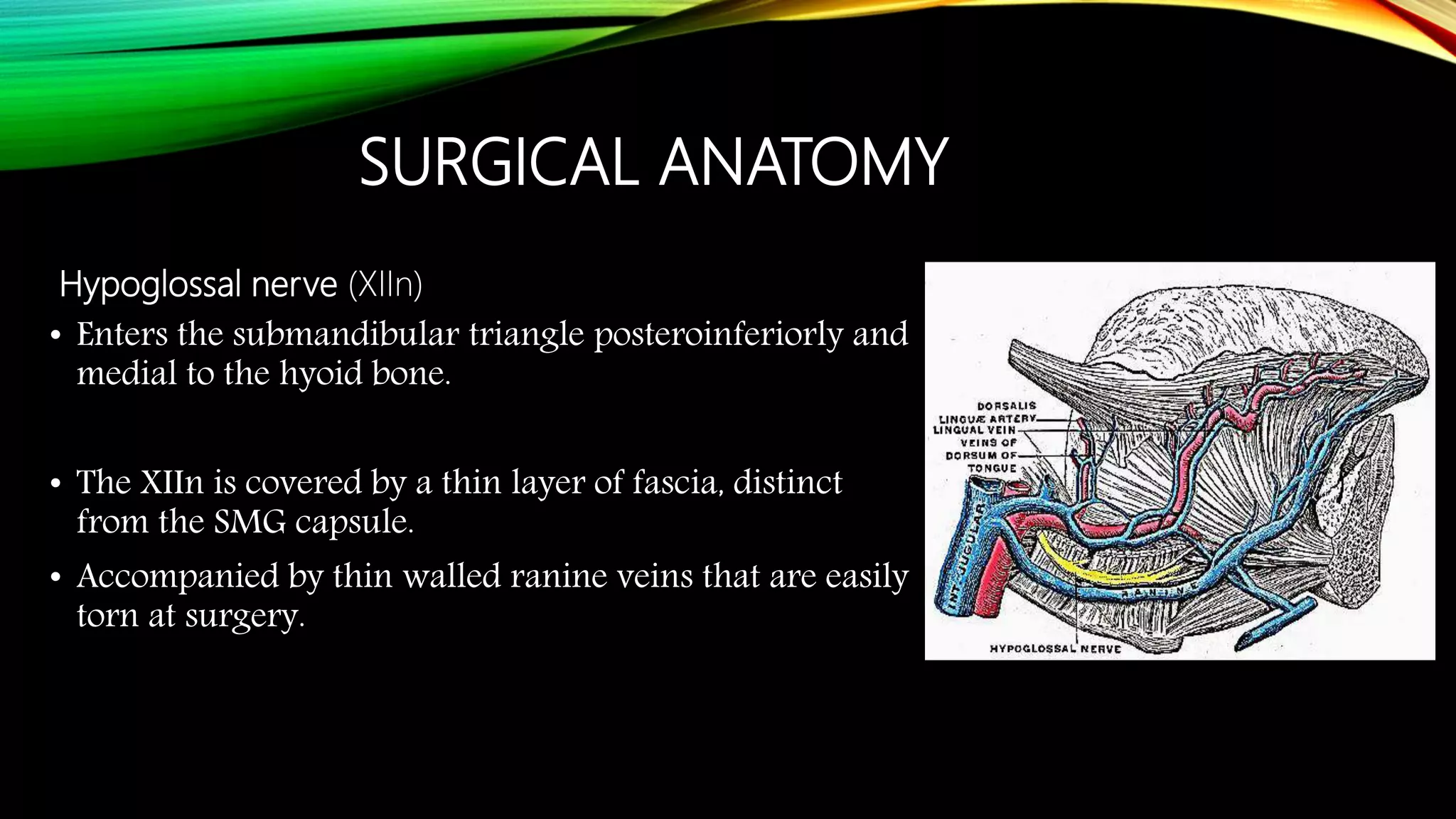
Hypoglossal nerve (XIIn)
• Enters the submandibular triangle posteroinferiorly and
medial to the hyoid bone.
• The XIIn is covered by a thin layer of fascia, distinct
from the SMG capsule.
• Accompanied by thin walled ranine veins that are easily
torn at surgery.
SURGICAL ANATOMY
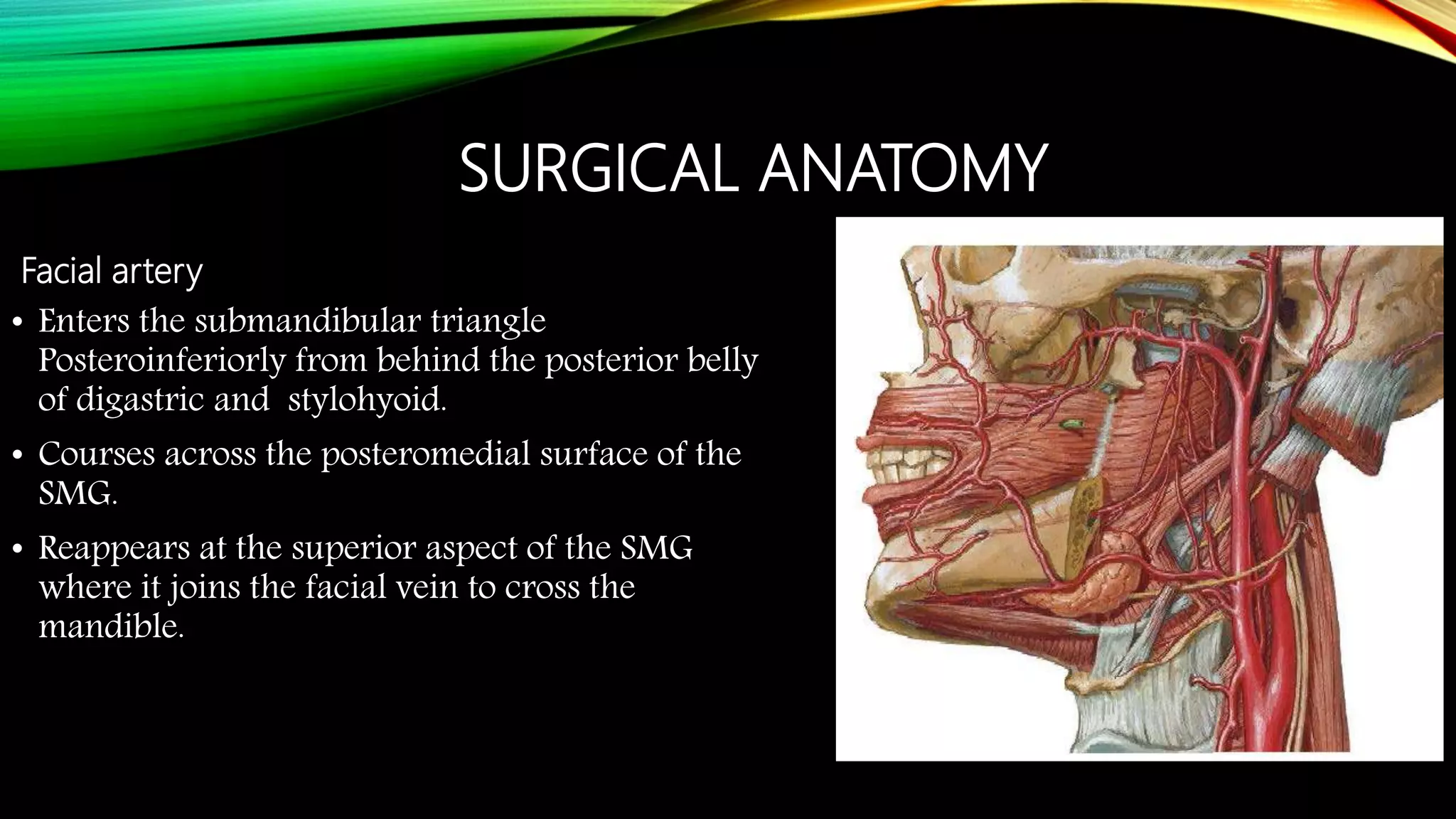
Facial artery
• Enters the submandibular triangle
Posteroinferiorly from behind the posterior belly
of digastric and stylohyoid.
• Courses across the posteromedial surface of the
SMG.
• Reappears at the superior aspect of the SMG
where it joins the facial vein to cross the
mandible.
Indications
• Repeated enlargement of the gland.
• Salivary gland calculi
• Chronic salivary gland infection.
• Duct stenosis
• Suspected submandibular neoplasm
PREOPERATIVE EVALUATION
History
• History of swellings (onset ,duration, recurrence )
• Pain
• Variation with meals
• Bilateral
• Dry mouth
• Radiation history
• Recent operative history
Examination : Inspection
• Asymmetry (glands, face, neck)
• Diffuse or focal enlargement
• Erythema
• Trismus
• Medial displacement of structures intraorally
• Cranial nerve examination
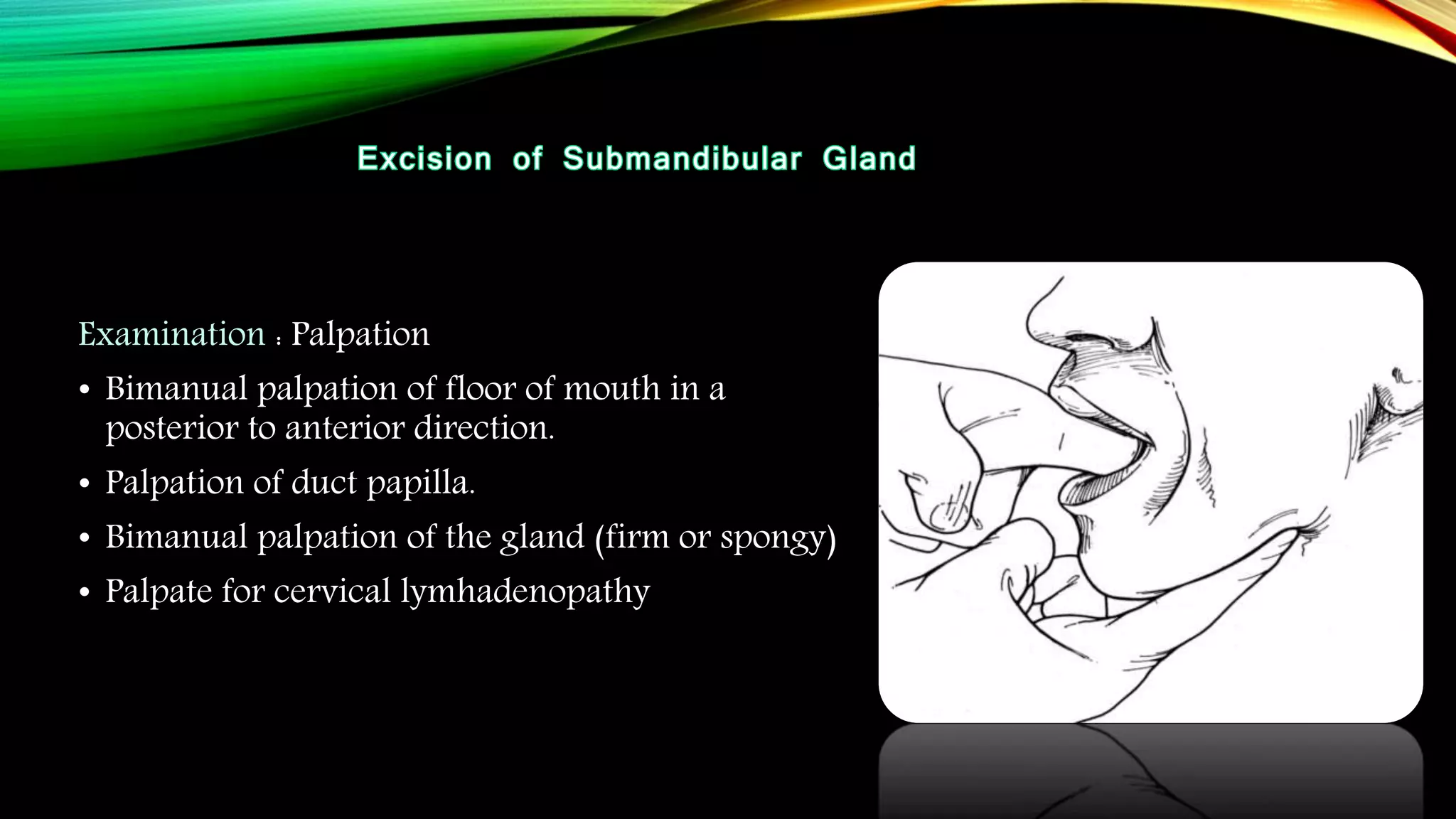
Examination : Palpation
• Bimanual palpation of floor of mouth in a
posterior to anterior direction.
• Palpation of duct papilla.
• Bimanual palpation of the gland (firm or spongy)
• Palpate for cervical lymhadenopathy
INVESTIGTIONS
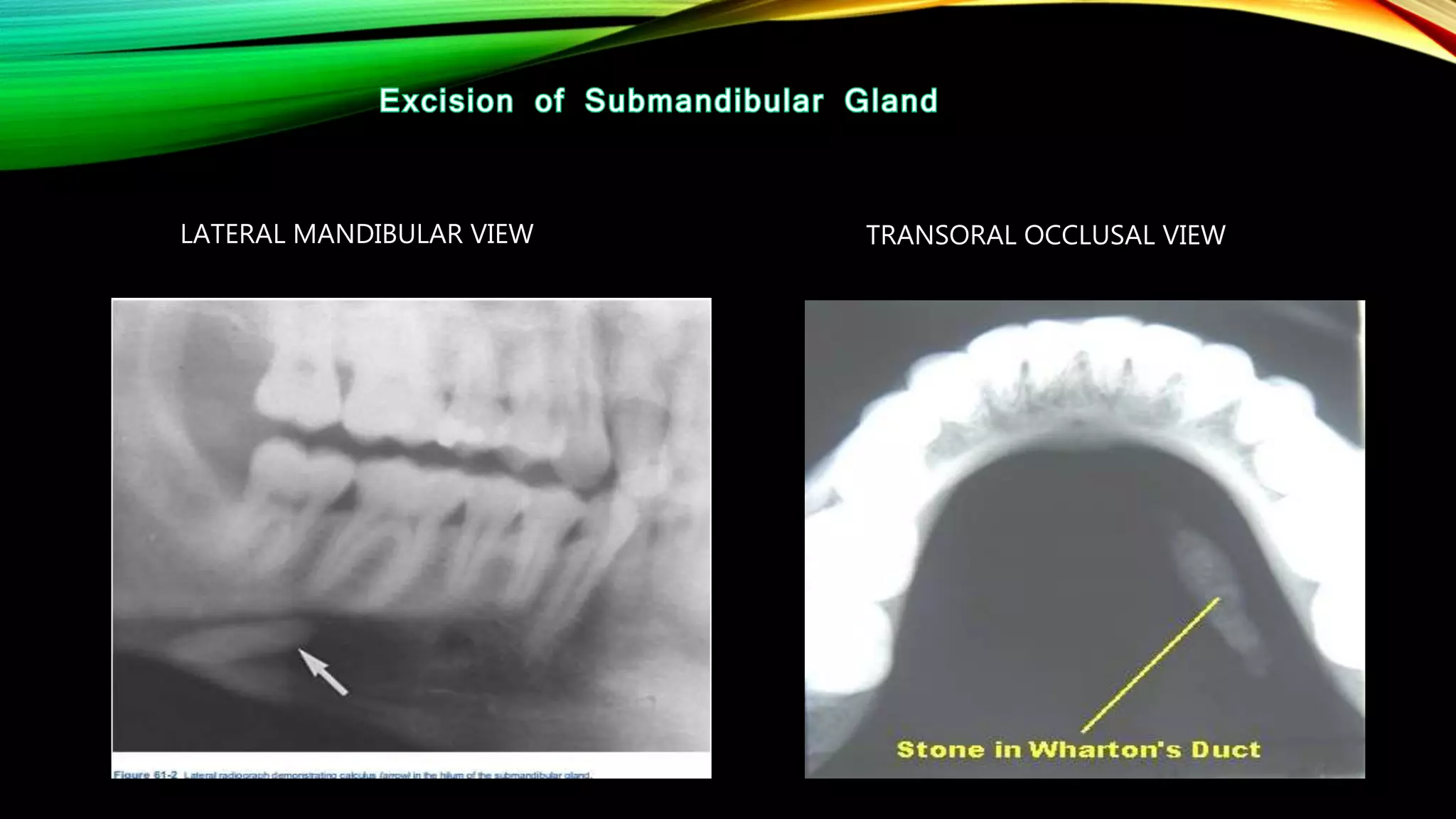
• Plain X-ray
• Ultrasound
• Sialography
• CT and MRI scanning
• Fine-Needle Aspiration Biopsy
LATERAL MANDIBULAR VIEW TRANSORAL OCCLUSAL VIEW
Advantage
detects
radiolucent
stones
Disadvantage
• invasive
• bleeding &
perforations
contraindicated
• acute
infections
• allergic to
contrast
Sialography
Ultrasound: differntiate between
• solid versus cystic lesion
• Intrinsic from extrinsic
CT scan
involvement of the mandible,
 the presence or absence of pathologic
lymphadenopathy
 local extent of the tumor.
Fine-Needle Aspiration Biopsy
• Useful tool for differentiating chronic inflammatory disease from neoplasia.
Surgical approaches
• Transcervical approach
• Transoral approach
Informed Consent
Marginal mandibular nerve>possibility of weakness of the lower lip.
 Lingual > numbness of the tongue
Hypoglossal nerves > paralysis of the tongue on the operated side
OPERATION STEPS
Anesthesia
• General anesthesia
• Avoid muscle relaxant to monitor lower lip movement
OPERATION STEPS
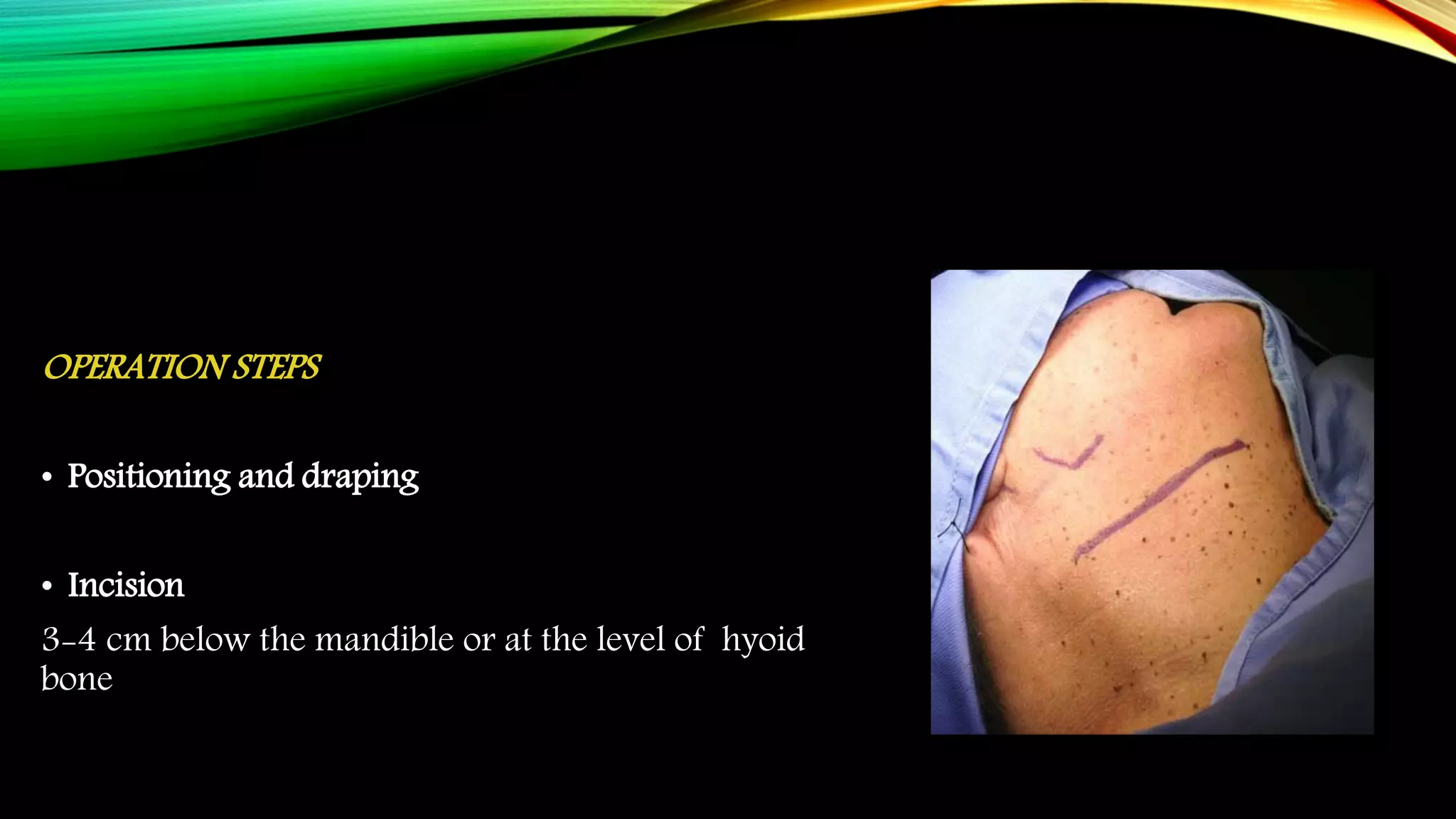
• Positioning and draping
• Incision
3-4 cm below the mandible or at the level of hyoid
bone
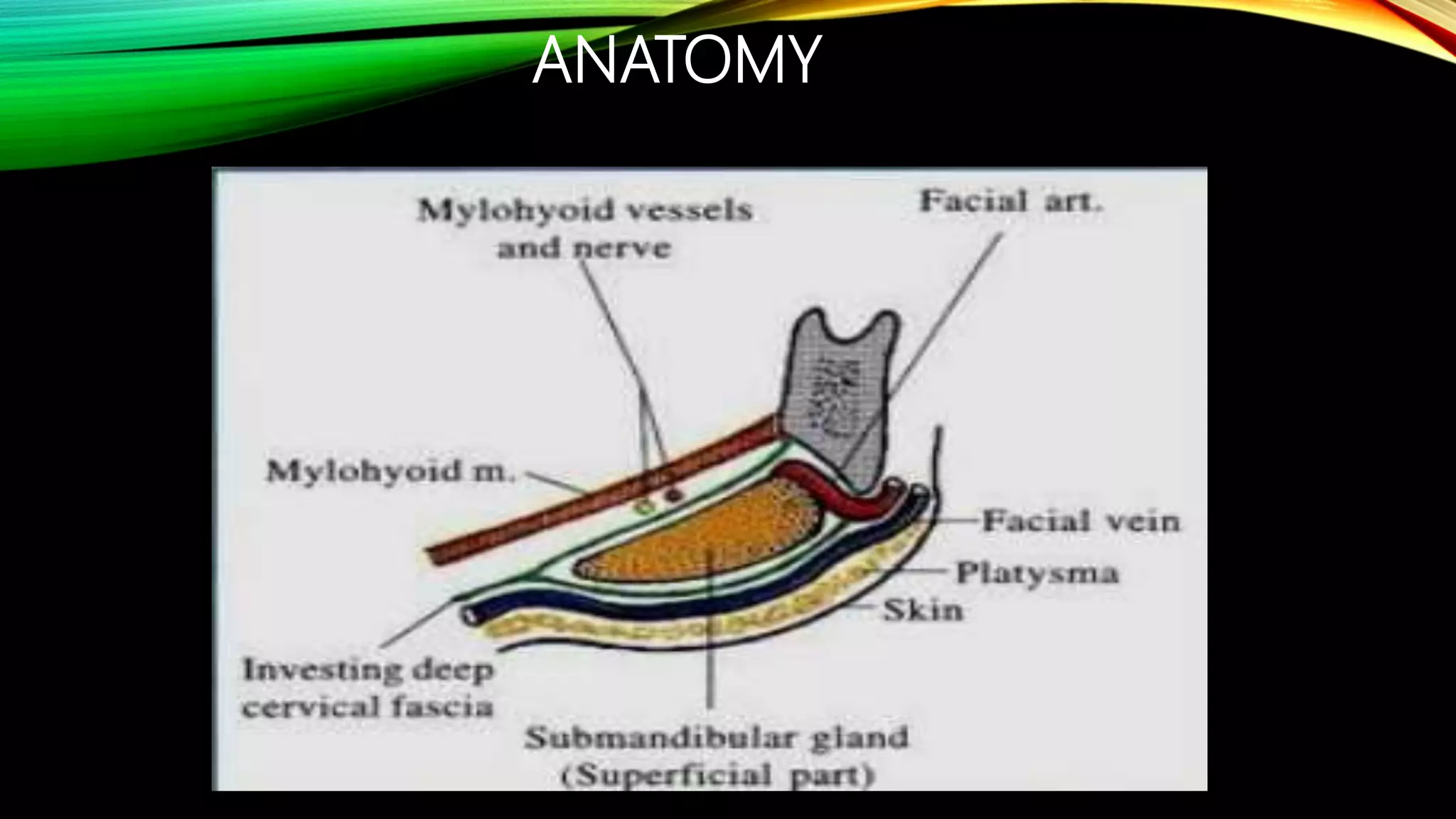
• The incision is carried through skin,
subcutaneous tissue and platysma to
expose the capsule of the SMG, the facial
vein and posteriorly, the external jugular
vein
• The facial vein is ligated and
divided where it crosses the SMG
• The fascial capsule of the SMG is incised
• subcapsular dissection
• Dissect bluntly with a hemostat in the
fatty tissue above the gland to identify
the facial artery and vein
• Divide and ligate facial artery and
vein as close as possible to SMG.
• Front-to-back mobilisation of SMG off
mylohyoid muscle, and division of
mylohyoid nerve and vessels to gain access
to the posterior border of mylohyoid
muscle
• Exposing posterior part of mylohyoid
• Retracting mylohyoid brings lingual
nerve, XIIn and submandibular
duct into view
• Finger dissection in plane between
SMG and fascia covering XIIn and
ranine veins
• Division and ligation of submandibular
duct and submandibular ganglion
• follow and divide the duct more anteriorly if
surgery for sialolithiasis so as not to leave
behind a calculus
• The SMG can then be reflected inferiorly,
and the facial artery is identified,
ligated and divided where if exits from
behind the posterior belly of digastric
• The SMG is then finally freed from the
tendon and posterior belly of the digastric and
removed
• Wound irrigation
• Placement of suction drain
• Wound is closed in layers
Post-operative management
• Head end elevation
• NPO for 4-6hours
• Patient observed for airway compromise
• Monitoring of vital signs
• I/V antibiotics
• Analgesics
• Removal of drain after 24-48hrs
Complications
• General
• Hematoma
• Infection
• Specific
• Marginal mandibular nerve injury
• Lingual nerve injury
• Hypoglossal nerve injury
• Retained calculi in duct
• The submandibular gland can be safely and successfully
removed through an intraoral approach in a select population
of patients with benign pathology
Advantages of the transoral approach
• less risk of injury to the marginal mandibular nerve
• Avoidance of an external scar
• Minimal risk of postoperative mucocele formation, or inflammation of
Wharton’s duct
Disadvantages
• Narrow surgical field
• Scar contracture in the floor of mouth
• Temporary or permanent restriction of tongue movement,
• Abnormal tongue sensation
Contraindication
• Suspected or proven malignancy,
• Extensive scarring from prior abscessed gland
• Surgeon lack of familiarity with the procedure
• Nasotracheal intubation
• Injection of lidocaine with epinephrine
• Insertion of a probe into the orifice of
Wharton's duct
• An incision is made in the floor of mouth from
the submandibular papilla to the retromolar
trigone.
• A cuff of mucosa on the gingival side is
preserved to allow for tension free closure and
to prevent limitation of tongue mobility due to
scar contracture
• The lingual nerve is identified and dissected free of its attachments to the submandibular
duct and gland
• The submandibular gland is bluntly
dissected and delivered into the surgical
wound by applying external pressure on
the neck
• Branches of the facial artery and vein are
ligated with care not to disrupt the
marginal mandibular branch of the facial
nerve.
• The hypoglossal nerve is identified and
preserved.
• The gland is removed
• Wound bed irrigated and closed in a tension free manor
Submandibular gland excision

Submandibular gland excision

  • 2.
    ANATOMY • Submandibular glandis one of the three paired salivary glands. • Size of a walnut • Mixed gland with predominantly serous in type • Responsible for about 70% of salivary secretion.
  • 3.
    ANATOMY • Situation: Digastrictriangle and lodges partly in the submandibular fossa of the mandible • Part of gland : Large superficial part Small deep part continous with each other around the post. Border of mylohyoid
  • 4.
  • 5.
    ANATOMY Whartons duct • 5cm long • Emerges at the anterior end of deep part of the gland • Runs forwards on hyoglossus b/w lingual and hypoglossal N • At the ant. Border of hyoglossus it is crossed by lingual nerve • Opens in the floor of mouth at the side of frenulum of tongue
  • 6.
    SURGICAL ANATOMY The digastricmuscle • forms the anteroinferior and posteroinferior boundaries of the submandibular triangle. • It is an important surgical landmark as there are no important structures lateral to the muscle. • The facial artery emerges from immediately medial to the posterior belly, and the XIIn runs immediately deep to the digastric tendon.
  • 7.
    SURGICAL ANATOMY Mylohyoid muscle •key structure when excising the SMG, as it forms the floor of the mouth, and separates the cervical from the oral part of the SMG. • The lingual and XIIn are both deep to the muscle.
  • 8.
    SURGICAL ANATOMY Marginal mandibularnerve • Is at risk of injury. • It runs within the investing layers of deep cervical fascia overlying the gland. • May loop up to 3cms below the ramus of the mandible. • It crosses over the facial artery and vein before ascending to innervate the depressor anguli oris muscle of the lower lip.
  • 9.
    SURGICAL ANATOMY 3 methodsof preserving 1. Approaching the gland at the level of hyoid bone, and keeping the dissection deep to the glands facial covering. 2. Dividing the facial vessels well below the mandible and on lifting up the upper ligated stumps. 3. Identify tail of parotid where it lies anterior to retromandibular vein and to trace it forward
  • 10.
    SURGICAL ANATOMY lingual nerve •comes into view during SMG excision when the SMG is retracted inferiorly, and the mylohyoid is retracted anteriorly.
  • 11.
    SURGICAL ANATOMY Hypoglossal nerve(XIIn) • Enters the submandibular triangle posteroinferiorly and medial to the hyoid bone. • The XIIn is covered by a thin layer of fascia, distinct from the SMG capsule. • Accompanied by thin walled ranine veins that are easily torn at surgery.
  • 12.
    SURGICAL ANATOMY Facial artery •Enters the submandibular triangle Posteroinferiorly from behind the posterior belly of digastric and stylohyoid. • Courses across the posteromedial surface of the SMG. • Reappears at the superior aspect of the SMG where it joins the facial vein to cross the mandible.
  • 13.
    Indications • Repeated enlargementof the gland. • Salivary gland calculi • Chronic salivary gland infection. • Duct stenosis • Suspected submandibular neoplasm
  • 14.
    PREOPERATIVE EVALUATION History • Historyof swellings (onset ,duration, recurrence ) • Pain • Variation with meals • Bilateral • Dry mouth • Radiation history • Recent operative history
  • 15.
    Examination : Inspection •Asymmetry (glands, face, neck) • Diffuse or focal enlargement • Erythema • Trismus • Medial displacement of structures intraorally • Cranial nerve examination
  • 16.
    Examination : Palpation •Bimanual palpation of floor of mouth in a posterior to anterior direction. • Palpation of duct papilla. • Bimanual palpation of the gland (firm or spongy) • Palpate for cervical lymhadenopathy
  • 17.
    INVESTIGTIONS • Plain X-ray •Ultrasound • Sialography • CT and MRI scanning • Fine-Needle Aspiration Biopsy
  • 18.
    LATERAL MANDIBULAR VIEWTRANSORAL OCCLUSAL VIEW
  • 19.
    Advantage detects radiolucent stones Disadvantage • invasive • bleeding& perforations contraindicated • acute infections • allergic to contrast Sialography
  • 20.
    Ultrasound: differntiate between •solid versus cystic lesion • Intrinsic from extrinsic
  • 21.
    CT scan involvement ofthe mandible,  the presence or absence of pathologic lymphadenopathy  local extent of the tumor.
  • 22.
    Fine-Needle Aspiration Biopsy •Useful tool for differentiating chronic inflammatory disease from neoplasia.
  • 23.
    Surgical approaches • Transcervicalapproach • Transoral approach
  • 25.
    Informed Consent Marginal mandibularnerve>possibility of weakness of the lower lip.  Lingual > numbness of the tongue Hypoglossal nerves > paralysis of the tongue on the operated side
  • 26.
    OPERATION STEPS Anesthesia • Generalanesthesia • Avoid muscle relaxant to monitor lower lip movement
  • 27.
    OPERATION STEPS • Positioningand draping • Incision 3-4 cm below the mandible or at the level of hyoid bone
  • 28.
    • The incisionis carried through skin, subcutaneous tissue and platysma to expose the capsule of the SMG, the facial vein and posteriorly, the external jugular vein
  • 29.
    • The facialvein is ligated and divided where it crosses the SMG
  • 30.
    • The fascialcapsule of the SMG is incised • subcapsular dissection
  • 31.
    • Dissect bluntlywith a hemostat in the fatty tissue above the gland to identify the facial artery and vein • Divide and ligate facial artery and vein as close as possible to SMG.
  • 32.
    • Front-to-back mobilisationof SMG off mylohyoid muscle, and division of mylohyoid nerve and vessels to gain access to the posterior border of mylohyoid muscle
  • 33.
    • Exposing posteriorpart of mylohyoid
  • 34.
    • Retracting mylohyoidbrings lingual nerve, XIIn and submandibular duct into view
  • 35.
    • Finger dissectionin plane between SMG and fascia covering XIIn and ranine veins
  • 36.
    • Division andligation of submandibular duct and submandibular ganglion • follow and divide the duct more anteriorly if surgery for sialolithiasis so as not to leave behind a calculus
  • 37.
    • The SMGcan then be reflected inferiorly, and the facial artery is identified, ligated and divided where if exits from behind the posterior belly of digastric
  • 38.
    • The SMGis then finally freed from the tendon and posterior belly of the digastric and removed
  • 39.
    • Wound irrigation •Placement of suction drain • Wound is closed in layers
  • 40.
    Post-operative management • Headend elevation • NPO for 4-6hours • Patient observed for airway compromise • Monitoring of vital signs • I/V antibiotics • Analgesics • Removal of drain after 24-48hrs
  • 41.
    Complications • General • Hematoma •Infection • Specific • Marginal mandibular nerve injury • Lingual nerve injury • Hypoglossal nerve injury • Retained calculi in duct
  • 43.
    • The submandibulargland can be safely and successfully removed through an intraoral approach in a select population of patients with benign pathology
  • 44.
    Advantages of thetransoral approach • less risk of injury to the marginal mandibular nerve • Avoidance of an external scar • Minimal risk of postoperative mucocele formation, or inflammation of Wharton’s duct
  • 45.
    Disadvantages • Narrow surgicalfield • Scar contracture in the floor of mouth • Temporary or permanent restriction of tongue movement, • Abnormal tongue sensation
  • 46.
    Contraindication • Suspected orproven malignancy, • Extensive scarring from prior abscessed gland • Surgeon lack of familiarity with the procedure
  • 47.
    • Nasotracheal intubation •Injection of lidocaine with epinephrine • Insertion of a probe into the orifice of Wharton's duct
  • 48.
    • An incisionis made in the floor of mouth from the submandibular papilla to the retromolar trigone. • A cuff of mucosa on the gingival side is preserved to allow for tension free closure and to prevent limitation of tongue mobility due to scar contracture
  • 49.
    • The lingualnerve is identified and dissected free of its attachments to the submandibular duct and gland
  • 50.
    • The submandibulargland is bluntly dissected and delivered into the surgical wound by applying external pressure on the neck • Branches of the facial artery and vein are ligated with care not to disrupt the marginal mandibular branch of the facial nerve.
  • 51.
    • The hypoglossalnerve is identified and preserved.
  • 52.
    • The glandis removed • Wound bed irrigated and closed in a tension free manor