By
URVASHI OJHA
DEPT. OF CONSERVATIVE
DENTISTRY AND ENDODONTICS
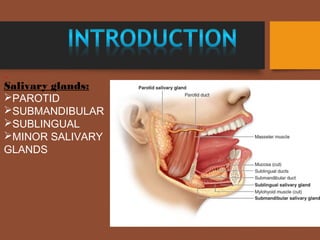
Salivary glands:
PAROTID
SUBMANDIBULAR
SUBLINGUAL
MINOR SALIVARY
GLANDS
• Paired gland that lie below the mandible on either
side.Sometimes referred to as “the submaxillary gland”
• Second largest major salivary gland
• Weighs 7–16 g, about the size of a walnut
• J – shaped gland being Intended by posterior border of
mylohyoid which divides it into 2 parts superficial &
deep.
• Submandibular gland drains through Wharton's duct that
opens into anterior floor of mouth.
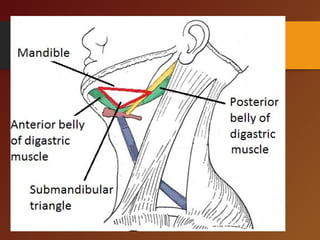
• Located in the submandibular triangle, which has
a superior boundary formed by the inferior edge
of the mandible and inferior boundaries formed by
the anterior and posterior bellies of the digastric
muscle. Also lying within the triangle are the
submandibular lymph nodes, facial artery and
vein, mylohyoid muscle, and the lingual,
hypoglossal, and mylohyoid nerves.
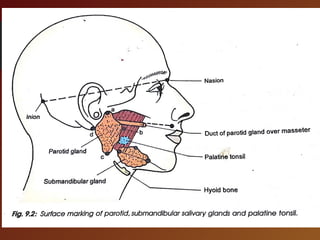
SURFACE MARKING:
• Marked by an oval shaped area over posterior
half of base of mandible including posterior
border of ramus .The submandibular region
extends 1.5 cm above the base of mandible
and below to the greater cornua of hyoid
bone.
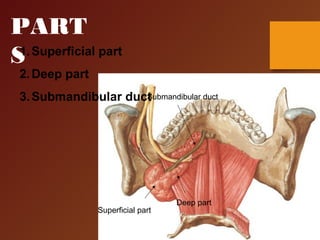
PART
S1.Superficial part
2.Deep part
3.Submandibular duct
Superficial part
Deep part
Submandibular duct
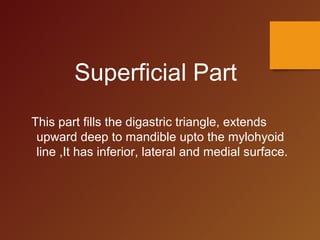
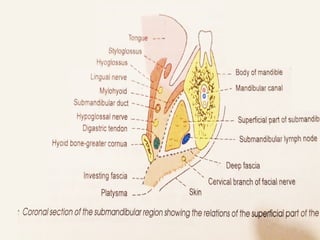
Superficial Part
This part fills the digastric triangle, extends
upward deep to mandible upto the mylohyoid
line ,It has inferior, lateral and medial surface.
Relations
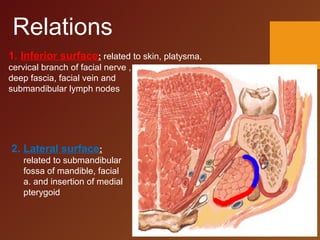
1. Inferior surface: related to skin, platysma,
cervical branch of facial nerve ,
deep fascia, facial vein and
submandibular lymph nodes
2. Lateral surface:
related to submandibular
fossa of mandible, facial
a. and insertion of medial
pterygoid
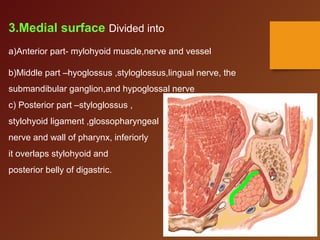
3.Medial surface Divided into
a)Anterior part- mylohyoid muscle,nerve and vessel
b)Middle part –hyoglossus ,styloglossus,lingual nerve, the
submandibular ganglion,and hypoglossal nerve
c) Posterior part –styloglossus ,
stylohyoid ligament ,glossopharyngeal
nerve and wall of pharynx, inferiorly
it overlaps stylohyoid and
posterior belly of digastric.
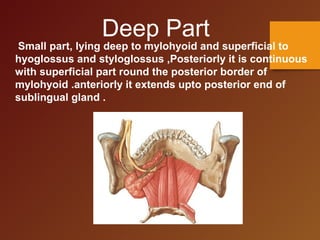
Deep Part
Small part, lying deep to mylohyoid and superficial to
hyoglossus and styloglossus ,Posteriorly it is continuous
with superficial part round the posterior border of
mylohyoid .anteriorly it extends upto posterior end of
sublingual gland .
RELATIONS:
•Lateral-mylohyoid;
•Medial- hyoglossus ;
•Superior-lingual nerve and submandibular ganglion;
•Inferior- hypoglossal nerve accompanied by a pair of
veins.
SUBMANDIBULAR DUCT OR
WHARTON’S DUCT :
• Wharton’s duct, the main excretory duct of the
Submandibular gland, is approximately 4–5 cm long,
running superior to the hypoglossal nerve while
inferior to the lingual nerve. It empties lateral to
the lingual frenulum through a papilla in the floor
of the mouth behind the lower incisor tooth. The
openings for the sublingual gland, or the sublingual
caruncles, are located near the midline of the
sublingual fold in the ventral tongue.
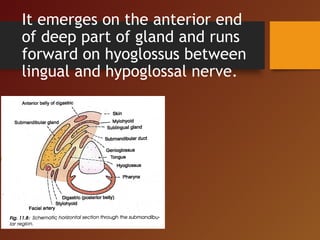
It emerges on the anterior end
of deep part of gland and runs
forward on hyoglossus between
lingual and hypoglossal nerve.
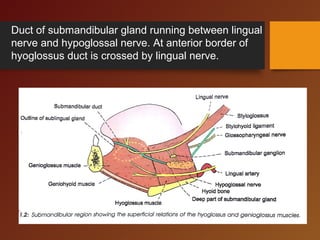
Duct of submandibular gland running between lingual
nerve and hypoglossal nerve. At anterior border of
hyoglossus duct is crossed by lingual nerve.
• Both the submandibular and sublingual glands are supplied
by the submental and sublingual arteries, branches of the
lingual and facial arteries. The facial artery, the tortuous
branch of the external carotid artery, is the main arterial
blood supply of the submandibular gland.
BLOOD SUPPLY :
VENOUS DRAINAGE :
The submandibular gland is mainly drained by the anterior
facial vein, which in close approximation to the facial artery
runs inferiorly and posteriorly from the face to the inferior
aspect of the mandible.
LYMPHATIC DRAINAGE:
Deep Cervical and Jugular chains
NERVE SUPPLY
• Secretomotor pathway begins from the superior salivatory
nucleus in the pons passes through the nervus intermedius
and into the internal auditory canal to join the facial nerve.
The fibers are next conveyed by the chorda tympani nerve in
the mastoid segment of CN VII, which travels through the
middle ear and petrotympanic fissure to the infratemporal
fossa. The lingual nerve, a branch of the marginal
mandibular division of the fifth cranial nerve (CN V), then
carries the presynaptic fibers to the submandibular ganglion.
The postsynaptic nerve leaves the ganglion to innervate both
the submandibular and sublingual glands to secrete watery
saliva.
• Sympathetic innervation from the superior cervical ganglion
accompanies the lingual artery to the submandibular tissue
and causes glandular production of mucoid saliva instead
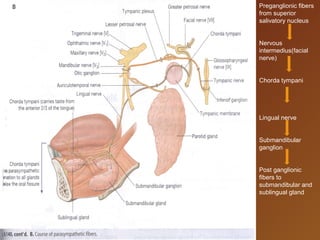
Preganglionic fibers
from superior
salivatory nucleus
Nervous
intermedius(facial
nerve)
Chorda tympani
Lingual nerve
Submandibular
ganglion
Post ganglionic
fibers to
submandibular and
sublingual gland
• CLINICAL ANATOMY:
• Excision of tumor or calculus of this gland done by
incision below the angle of jaw .Since the marginal
mandibular branch of facial nerve passes
posteroinferior to angle of jaw before crossing it,
the incision must be place 2.5 cm below angle to
preserve the nerve.
• Most of the part of submandibular gland lies
posterolateral to the mylohyoid muscle. During neck
dissection or submandibular gland excision, this
mylohyoid muscle must be gently retracted
anteriorly to expose the lingual nerve and
submandibular ganglion.
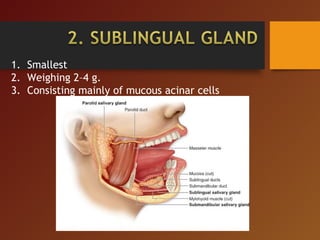
1. Smallest
2. Weighing 2–4 g.
3. Consisting mainly of mucous acinar cells
LOCATION :
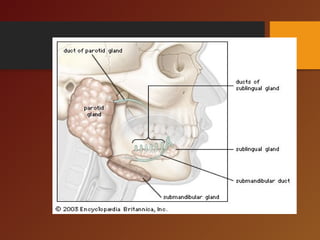
1. It lies superior to the mylohyoid muscle below mucosa of
floor of mouth ,medial to sublingual fossa of mandible
and lateral to genioglossus .
2. There is no true fascial capsule surrounding the gland.
SUBLINGUAL DUCT :
1. Several ducts (of rivinus) from the superior portion of the
sublingual gland either secrete directly into the floor of
mouth, or empty into bartholin’s duct that then continues
into wharton’s duct
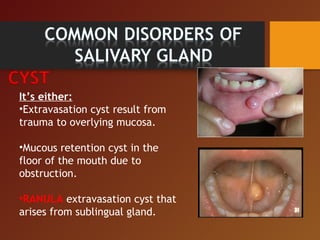
It’s either:
•Extravasation cyst result from
trauma to overlying mucosa.
•Mucous retention cyst in the
floor of the mouth due to
obstruction.
•RANULA extravasation cyst that
arises from sublingual gland.
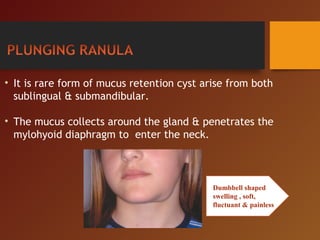
• It is rare form of mucus retention cyst arise from both
sublingual & submandibular.
• The mucus collects around the gland & penetrates the
mylohyoid diaphragm to enter the neck.
Dumbbell shaped
swelling , soft,
fluctuant & painless
• Tumors of minor & sublingual salivary gland are
extremely rare,90% are malignant.Most common site:
upper lip, palate & retromolar region.
• For parotid most common tumor is pleomorphic
adenoma, and for submandibular gland most common
tumor is warthins tumor
Treatment:
antibiotics and
surgically
SIALOLITHIASIS
• Thought to form via….an initial organic nidus that
progressively grows by deposition of layers of inorganic and
organic substances.
May eventually obstruct flow of saliva from the gland to the
oral cavity. Acute ductal obstruction may occur at meal time
when saliva production is at its maximum.
Gradually reduction of the swelling can result but it recurs
repeatedly when flow is stimulated.
This process may continue until complete obstruction and/or
infection occurs.
1. Plain occlusal film.
2. CT Scan.
3. Ultrasound.
4. Sialography.
5. Radionuclide Studies.
6. Diagnostic Sialendoscopy2
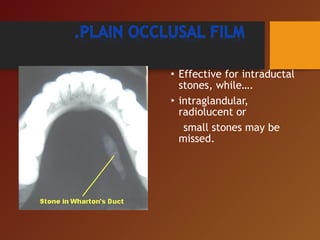
• Effective for intraductal
stones, while….
• intraglandular,
radiolucent or
small stones may be
missed.
• Large stones or small CT slices done.
• Also used for inflammatory disorders
• Operator dependent, can detect small stones
(>2mm), inexpensive, non-invasive
• Consists of opacification of the ducts by a retrograde
injection of a water-soluble dye.
• Provides image of stones and duct morphological
structure
• May be therapeutic, but success of therapeutic
sialography never documented
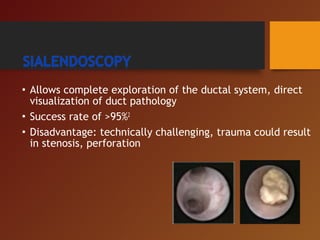
• Allows complete exploration of the ductal system, direct
visualization of duct pathology
• Success rate of >95%2
• Disadvantage: technically challenging, trauma could result
in stenosis, perforation
submandibular Salivary glands antomy

submandibular Salivary glands antomy

  • 1.
    By URVASHI OJHA DEPT. OFCONSERVATIVE DENTISTRY AND ENDODONTICS
  • 2.
  • 4.
    • Paired glandthat lie below the mandible on either side.Sometimes referred to as “the submaxillary gland” • Second largest major salivary gland • Weighs 7–16 g, about the size of a walnut • J – shaped gland being Intended by posterior border of mylohyoid which divides it into 2 parts superficial & deep. • Submandibular gland drains through Wharton's duct that opens into anterior floor of mouth.

  • 5.
    • Located inthe submandibular triangle, which has a superior boundary formed by the inferior edge of the mandible and inferior boundaries formed by the anterior and posterior bellies of the digastric muscle. Also lying within the triangle are the submandibular lymph nodes, facial artery and vein, mylohyoid muscle, and the lingual, hypoglossal, and mylohyoid nerves.
  • 8.
    SURFACE MARKING: • Markedby an oval shaped area over posterior half of base of mandible including posterior border of ramus .The submandibular region extends 1.5 cm above the base of mandible and below to the greater cornua of hyoid bone.
  • 10.
    PART S1.Superficial part 2.Deep part 3.Submandibularduct Superficial part Deep part Submandibular duct
  • 11.
    Superficial Part This partfills the digastric triangle, extends upward deep to mandible upto the mylohyoid line ,It has inferior, lateral and medial surface.
  • 12.
    Relations 1. Inferior surface:related to skin, platysma, cervical branch of facial nerve , deep fascia, facial vein and submandibular lymph nodes 2. Lateral surface: related to submandibular fossa of mandible, facial a. and insertion of medial pterygoid
  • 14.
    3.Medial surface Dividedinto a)Anterior part- mylohyoid muscle,nerve and vessel b)Middle part –hyoglossus ,styloglossus,lingual nerve, the submandibular ganglion,and hypoglossal nerve c) Posterior part –styloglossus , stylohyoid ligament ,glossopharyngeal nerve and wall of pharynx, inferiorly it overlaps stylohyoid and posterior belly of digastric.
  • 15.
    Deep Part Small part,lying deep to mylohyoid and superficial to hyoglossus and styloglossus ,Posteriorly it is continuous with superficial part round the posterior border of mylohyoid .anteriorly it extends upto posterior end of sublingual gland .
  • 16.
    RELATIONS: •Lateral-mylohyoid; •Medial- hyoglossus ; •Superior-lingualnerve and submandibular ganglion; •Inferior- hypoglossal nerve accompanied by a pair of veins.
  • 17.
    SUBMANDIBULAR DUCT OR WHARTON’SDUCT : • Wharton’s duct, the main excretory duct of the Submandibular gland, is approximately 4–5 cm long, running superior to the hypoglossal nerve while inferior to the lingual nerve. It empties lateral to the lingual frenulum through a papilla in the floor of the mouth behind the lower incisor tooth. The openings for the sublingual gland, or the sublingual caruncles, are located near the midline of the sublingual fold in the ventral tongue.
  • 18.
    It emerges onthe anterior end of deep part of gland and runs forward on hyoglossus between lingual and hypoglossal nerve.
  • 19.
    Duct of submandibulargland running between lingual nerve and hypoglossal nerve. At anterior border of hyoglossus duct is crossed by lingual nerve.
  • 20.
    • Both thesubmandibular and sublingual glands are supplied by the submental and sublingual arteries, branches of the lingual and facial arteries. The facial artery, the tortuous branch of the external carotid artery, is the main arterial blood supply of the submandibular gland. BLOOD SUPPLY :
  • 21.
    VENOUS DRAINAGE : Thesubmandibular gland is mainly drained by the anterior facial vein, which in close approximation to the facial artery runs inferiorly and posteriorly from the face to the inferior aspect of the mandible. LYMPHATIC DRAINAGE: Deep Cervical and Jugular chains
  • 22.
    NERVE SUPPLY • Secretomotorpathway begins from the superior salivatory nucleus in the pons passes through the nervus intermedius and into the internal auditory canal to join the facial nerve. The fibers are next conveyed by the chorda tympani nerve in the mastoid segment of CN VII, which travels through the middle ear and petrotympanic fissure to the infratemporal fossa. The lingual nerve, a branch of the marginal mandibular division of the fifth cranial nerve (CN V), then carries the presynaptic fibers to the submandibular ganglion. The postsynaptic nerve leaves the ganglion to innervate both the submandibular and sublingual glands to secrete watery saliva. • Sympathetic innervation from the superior cervical ganglion accompanies the lingual artery to the submandibular tissue and causes glandular production of mucoid saliva instead
  • 23.
    Preganglionic fibers from superior salivatorynucleus Nervous intermedius(facial nerve) Chorda tympani Lingual nerve Submandibular ganglion Post ganglionic fibers to submandibular and sublingual gland
  • 24.
    • CLINICAL ANATOMY: •Excision of tumor or calculus of this gland done by incision below the angle of jaw .Since the marginal mandibular branch of facial nerve passes posteroinferior to angle of jaw before crossing it, the incision must be place 2.5 cm below angle to preserve the nerve. • Most of the part of submandibular gland lies posterolateral to the mylohyoid muscle. During neck dissection or submandibular gland excision, this mylohyoid muscle must be gently retracted anteriorly to expose the lingual nerve and submandibular ganglion.
  • 25.
    1. Smallest 2. Weighing2–4 g. 3. Consisting mainly of mucous acinar cells
  • 26.
    LOCATION : 1. Itlies superior to the mylohyoid muscle below mucosa of floor of mouth ,medial to sublingual fossa of mandible and lateral to genioglossus . 2. There is no true fascial capsule surrounding the gland. SUBLINGUAL DUCT : 1. Several ducts (of rivinus) from the superior portion of the sublingual gland either secrete directly into the floor of mouth, or empty into bartholin’s duct that then continues into wharton’s duct
  • 28.
    It’s either: •Extravasation cystresult from trauma to overlying mucosa. •Mucous retention cyst in the floor of the mouth due to obstruction. •RANULA extravasation cyst that arises from sublingual gland.
  • 29.
    • It israre form of mucus retention cyst arise from both sublingual & submandibular. • The mucus collects around the gland & penetrates the mylohyoid diaphragm to enter the neck. Dumbbell shaped swelling , soft, fluctuant & painless
  • 30.
    • Tumors ofminor & sublingual salivary gland are extremely rare,90% are malignant.Most common site: upper lip, palate & retromolar region. • For parotid most common tumor is pleomorphic adenoma, and for submandibular gland most common tumor is warthins tumor
  • 31.
  • 32.
    SIALOLITHIASIS • Thought toform via….an initial organic nidus that progressively grows by deposition of layers of inorganic and organic substances. May eventually obstruct flow of saliva from the gland to the oral cavity. Acute ductal obstruction may occur at meal time when saliva production is at its maximum. Gradually reduction of the swelling can result but it recurs repeatedly when flow is stimulated. This process may continue until complete obstruction and/or infection occurs.
  • 33.
    1. Plain occlusalfilm. 2. CT Scan. 3. Ultrasound. 4. Sialography. 5. Radionuclide Studies. 6. Diagnostic Sialendoscopy2
  • 34.
    • Effective forintraductal stones, while…. • intraglandular, radiolucent or small stones may be missed.
  • 35.
    • Large stonesor small CT slices done. • Also used for inflammatory disorders • Operator dependent, can detect small stones (>2mm), inexpensive, non-invasive
  • 36.
    • Consists ofopacification of the ducts by a retrograde injection of a water-soluble dye. • Provides image of stones and duct morphological structure • May be therapeutic, but success of therapeutic sialography never documented
  • 37.
    • Allows completeexploration of the ductal system, direct visualization of duct pathology • Success rate of >95%2 • Disadvantage: technically challenging, trauma could result in stenosis, perforation