BASIC RESEARCH
TERMINOLOGIES
DR.MAHESWARI JAIKUMAR
maheswarijaikumar2103@gmail.com
ABSTRACT
DATA
VARIABLE CONCEPT
OPERATIONAL
DEFINITION
SAMPLE
ASSUMPTION
POPULATION
HYPOTHESES LIMITATIONS
VALIDITY
CONSTRUCT
STUDTY SETTING
RESEARCH
• Research is defined as a
systematic and scientific process
to answer questions about facts
and relationship between facts.
It is an activity involved in
seeking answer to unanswered
questions.
RESEARCH
• Research seeks to generate an
answer to the problems as well
as suggesting additional
questions in need of further
inquiry.
RESEARCH
• Research is a scientific,
systematic, controlled, orderly
and objective investigation to
develop, refine and expand body
of knowledge.
ABSTRACT
A clear, concise summary that
communicates the essential
information about the study. In
research journals, it is usually
located at the beginning of an
article
DATA
Units of information or any
statistics, facts, figures, general
material, evidence, or
knowledge collected during the
course of the study.
VARIABLES
Attributes or characteristics that
can have more than one value,
such as height or weight. Variables
are qualities or quantities,
properties or characteristics of
people, things, or situations that
change or vary.
INDEPENDENT VARIABLE
Variables that are purposely
manipulated or changed by the
researcher. It is also called as “
MANIPULATED VARIBLE”.
RESEARCH VARIABLE
Refers to Qualities, Properties or
Characteristics which are observed
or measured in a natural setting
without manipulating &
establishing cause & effect
relationship
DEMOGRAPHIC VARIABLES
The characteristics & attributes of
study subjects such as age, gender,
place of living, educational status,
religion, social class, marital status,
occupation, income are considered as
demographic variables.
EXTRANEOUS VARIABLES
Are factors that are not the
part of the study but may affect
the measurements of the study
variable.
OPERATIONAL DEFINITION
Refers to the way in which the
researcher defines the variables
under investigation. Operational
definition are stated in such way by
the investigator specifying how the
study variables will be measured in
the actual research situation.
CONCEPT
Refers to a mental idea of a
phenomenon. Concepts are words or
terms that symbolize some aspects of
reality. E.g.. Love, pain.
CONSTRUCT
Is a highly abstract & complex
phenomenon ( concept) which is
denoted by a made up or
constructed term.
A construct term is used to
indicate a phenomenon that
cannot be directly observed but
must be inferred by certain
concrete or less abstract
indicators of the phenomenon.
E.g. self esteem.
PROPOSITION
• A Proposition is a statement
or assertion of the
relationship between
concepts. E.g., relationship
between anxiety and
performance.
CONCEPTUAL FRAMEWORK
• Interrelated concepts or
abstractions that are assembled
together in some rational
scheme by virtue of their
relevance to a common theme. It
is also referred to as theoretical
framework.
ASSUMPTION
• Basic principle that is being
true on the basis of logic or
reason, without proof or
verification.
HYPOTHESIS
• A statement of the predicted
relationship between two or
more variables in a research
study; an educated or calculated
guess by the researcher.
LITERATURE REVIEW
• A critical summary or research
on a topic of interest, generally
prepared to put a research
problem in context or to identify
gaps and weaknesses in prior
studies so as to justify a new
investigation.
LIMITATIONS
• Restrictions in a study that may
decrease the credibility and
generalizability of the research
findings.
MANIPULATION
• An intervention or treatment
introduced by the researcher in
an experimental or quasi
experimental study; the
researcher manipulates the
independent variable to assess its
impact on the dependent
variable.
POPULATION
• The entire set of individuals or
objects having some common
characteristic(s) selected for a
research study is referred to as
population.
TARGET POPULATION
• The entire population in which
the researchers are interested
and to which they would like to
generalize the research findings.
ACCESSIBLE POPULATION
• The aggregate of cases that
conform to designated inclusion
or exclusion criteria and that are
accessible as subjects of the
study.
RESEARCH SETTING
• The study setting is the location
in which the research is
conducted. It could be natural,
partially controlled environment
or laboratories.
SAMPLE
• A part or subset of population
selected to participate in the
research study.
REPRESENTATIVE SAMPLE
• A sample whose characteristics
are highly similar to that of the
population from which it is
drawn.
SAMPLING
• The process of selecting sample
from the target population to
represent the entire population.
PROBABILITY SAMPLING
• The selection of subjects or
sampling units from a population
using random procedure; E.g.,
Simple random Sampling,
Stratified random Sampling.
NON PROBABILITY
SAMPLING
• The selection of subjects or
sampling units from a population
using non random procedure.
E.g., Convenient Sampling,
Purposive Sampling.
RELIABILITY
• The degree of consistency or
accuracy with which an
instrument measures the
attributes it is designed to
measure.
VALIDITY
• The degree to which an
instrument what it is intended
to measure.
PILOT STUDY
• Study carried out at the end of
the planning phase of research in
order to explore and test the
research elements to make
relevant modifications in
research tools and methodology.
ANALYSIS
• Method of organizing , sorting,
and scrutinizing data in such a
way that research question can
be answered or meaningful
inferences can be drawn.
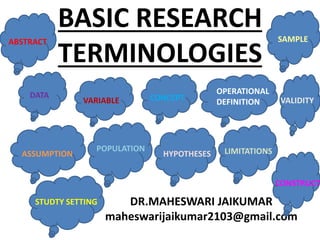
BASIC RESEARCH
TERMINOLOGIES
DR.MAHESWARI JAIKUMAR
maheswarijaikumar2103@gmail.com
ABSTRACT
DATA
VARIABLE CONCEPT
OPERATIONAL
DEFINITION
SAMPLE
ASSUMPTION
POPULATION
HYPOTHESES LIMITATIONS
VALIDITY
CONSTRUCT
STUDTY SETTING

BASIC RESEARCH TERMINOLOGIES

  • 1.
    BASIC RESEARCH TERMINOLOGIES DR.MAHESWARI JAIKUMAR maheswarijaikumar2103@gmail.com ABSTRACT DATA VARIABLECONCEPT OPERATIONAL DEFINITION SAMPLE ASSUMPTION POPULATION HYPOTHESES LIMITATIONS VALIDITY CONSTRUCT STUDTY SETTING
  • 2.
    RESEARCH • Research isdefined as a systematic and scientific process to answer questions about facts and relationship between facts. It is an activity involved in seeking answer to unanswered questions.
  • 3.
    RESEARCH • Research seeksto generate an answer to the problems as well as suggesting additional questions in need of further inquiry.
  • 4.
    RESEARCH • Research isa scientific, systematic, controlled, orderly and objective investigation to develop, refine and expand body of knowledge.
  • 5.
    ABSTRACT A clear, concisesummary that communicates the essential information about the study. In research journals, it is usually located at the beginning of an article
  • 6.
    DATA Units of informationor any statistics, facts, figures, general material, evidence, or knowledge collected during the course of the study.
  • 7.
    VARIABLES Attributes or characteristicsthat can have more than one value, such as height or weight. Variables are qualities or quantities, properties or characteristics of people, things, or situations that change or vary.
  • 8.
    INDEPENDENT VARIABLE Variables thatare purposely manipulated or changed by the researcher. It is also called as “ MANIPULATED VARIBLE”.
  • 9.
    RESEARCH VARIABLE Refers toQualities, Properties or Characteristics which are observed or measured in a natural setting without manipulating & establishing cause & effect relationship
  • 10.
    DEMOGRAPHIC VARIABLES The characteristics& attributes of study subjects such as age, gender, place of living, educational status, religion, social class, marital status, occupation, income are considered as demographic variables.
  • 11.
    EXTRANEOUS VARIABLES Are factorsthat are not the part of the study but may affect the measurements of the study variable.
  • 12.
    OPERATIONAL DEFINITION Refers tothe way in which the researcher defines the variables under investigation. Operational definition are stated in such way by the investigator specifying how the study variables will be measured in the actual research situation.
  • 13.
    CONCEPT Refers to amental idea of a phenomenon. Concepts are words or terms that symbolize some aspects of reality. E.g.. Love, pain.
  • 14.
    CONSTRUCT Is a highlyabstract & complex phenomenon ( concept) which is denoted by a made up or constructed term.
  • 15.
    A construct termis used to indicate a phenomenon that cannot be directly observed but must be inferred by certain concrete or less abstract indicators of the phenomenon. E.g. self esteem.
  • 16.
    PROPOSITION • A Propositionis a statement or assertion of the relationship between concepts. E.g., relationship between anxiety and performance.
  • 17.
    CONCEPTUAL FRAMEWORK • Interrelatedconcepts or abstractions that are assembled together in some rational scheme by virtue of their relevance to a common theme. It is also referred to as theoretical framework.
  • 18.
    ASSUMPTION • Basic principlethat is being true on the basis of logic or reason, without proof or verification.
  • 19.
    HYPOTHESIS • A statementof the predicted relationship between two or more variables in a research study; an educated or calculated guess by the researcher.
  • 20.
    LITERATURE REVIEW • Acritical summary or research on a topic of interest, generally prepared to put a research problem in context or to identify gaps and weaknesses in prior studies so as to justify a new investigation.
  • 21.
    LIMITATIONS • Restrictions ina study that may decrease the credibility and generalizability of the research findings.
  • 22.
    MANIPULATION • An interventionor treatment introduced by the researcher in an experimental or quasi experimental study; the researcher manipulates the independent variable to assess its impact on the dependent variable.
  • 23.
    POPULATION • The entireset of individuals or objects having some common characteristic(s) selected for a research study is referred to as population.
  • 24.
    TARGET POPULATION • Theentire population in which the researchers are interested and to which they would like to generalize the research findings.
  • 25.
    ACCESSIBLE POPULATION • Theaggregate of cases that conform to designated inclusion or exclusion criteria and that are accessible as subjects of the study.
  • 26.
    RESEARCH SETTING • Thestudy setting is the location in which the research is conducted. It could be natural, partially controlled environment or laboratories.
  • 27.
    SAMPLE • A partor subset of population selected to participate in the research study.
  • 28.
    REPRESENTATIVE SAMPLE • Asample whose characteristics are highly similar to that of the population from which it is drawn.
  • 29.
    SAMPLING • The processof selecting sample from the target population to represent the entire population.
  • 30.
    PROBABILITY SAMPLING • Theselection of subjects or sampling units from a population using random procedure; E.g., Simple random Sampling, Stratified random Sampling.
  • 31.
    NON PROBABILITY SAMPLING • Theselection of subjects or sampling units from a population using non random procedure. E.g., Convenient Sampling, Purposive Sampling.
  • 32.
    RELIABILITY • The degreeof consistency or accuracy with which an instrument measures the attributes it is designed to measure.
  • 33.
    VALIDITY • The degreeto which an instrument what it is intended to measure.
  • 34.
    PILOT STUDY • Studycarried out at the end of the planning phase of research in order to explore and test the research elements to make relevant modifications in research tools and methodology.
  • 35.
    ANALYSIS • Method oforganizing , sorting, and scrutinizing data in such a way that research question can be answered or meaningful inferences can be drawn.
  • 36.
    BASIC RESEARCH TERMINOLOGIES DR.MAHESWARI JAIKUMAR maheswarijaikumar2103@gmail.com ABSTRACT DATA VARIABLECONCEPT OPERATIONAL DEFINITION SAMPLE ASSUMPTION POPULATION HYPOTHESES LIMITATIONS VALIDITY CONSTRUCT STUDTY SETTING