Medication/
Medication Administration
Nursing Foundation
Mr. Mahesh Chand
Nursing Tutor
LEARNING OBJECTIVES
On completion of this chapter, the students
will be able to do the following:
 Define the key terms used.
 Discuss the important concepts related to the safe and
effective administration of medication.
 Describe various factors that affect the action of drugs in
individual clients.
 Discuss the legal implications connected with medication
administration.
 List the common abbreviation used in relation to
administration of medication.
 Understand the calculation of drug.
 Develop knowledge regarding medication assessment
INTRODUCTION
Administration of medication is a basic nursing
function that involves knowledge and skill. The safe
and accurate administration is the most important
responsibility of nurse. Improper administration can
cause harmful effects.
Some basic points regarding drugs:
 Name of the drug
 Classification
 Route and time of administration
 Principles of drug action
 Dosage
 Medication standards
Sources of information about medication
System of medication distribution
Medication order
Prescription and non prescription medication
Weights and measures used
Preparation of solution and calculation
Storing of medication
Factors affecting safety
Abbreviation and symbols used
Rules of administration
Legal aspects, nurse practice acts, clients rights
Institutional policies
Nurses role.
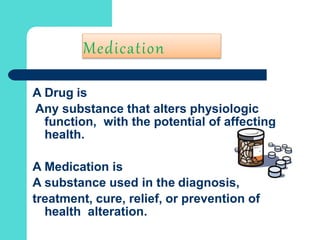
Medication
A Drug is
Any substance that alters physiologic
function, with the potential of affecting
health.
A Medication is
A substance used in the diagnosis,
treatment, cure, relief, or prevention of
health alteration.
Names of the Drugs
Drugs may be known as several name.
1. Chemical Name :Which is known to
chemist; it indicates the ingredient of the
drug. Identify the molecular structure.
E.g. ibuprofen (anti-inflammatory)2-
4(isobutyl phenyl)Propionic acid.
2. Generic Name: It is assigned by the
manufacturer who first developed the
drug and is assigned by the United
States Adopted Names Council. It is
derived form chemical name. E.g.
3. Official Name: It is assigned by the food
and drug administration after approval. It
is often same as generic name.
4. Trade Name: it is assigned by the
manufacturer and is copyrighted. One
drug may be manufactured by several
companies. For E.g. Paracetamol such as
Crocin, Calpol, Ifimol, Metacin etc.
CLASSIFICATION OF DRUGS
According to action:
o Analgesics: Drugs used to relieve pain
o Anesthetics: Drugs which causes loss of sensation
o Anthelmintic: Drugs which destroy and expel worms
o Antipyretics: Drugs which reduce fever
o Antidotes: Used to Counteract the effect of poison.
o Anti-infective: Act either to inhibit, kill the micro organism.
o Anti-inflammatory: To reduce Inflammation
o Anti-coagulants: Inhibit or decrease the blood clotting process.
o Anti-histamines: used to prevent of relieve allergy
o Antacids: react with HCL to decrease activity of stomach
secretions.
o Anti convulsants: used to prevent of treat convulsions
o Antibiotics: Ability to destroy or inhibit the growth of micro
organism
o Anti-diarrhetics: used to treat diarrhea
o Antitussives: drugs inhibit the cough reflex (CNS)
o Anti-asthmatics: Drugs which provides relief for asthmatic attack
by relaxing the smooth muscles of bronchioles.
o Antiseptic: Inhibits the growth of bacteria
o Antifungal: drugs which prevent the growth of fungi
o Antispasmodic: relieves the spasmodic pains or spasm of muscles
o Antiemetics: relieves or prevents nausea and vomiting.
o Anti-tubercular: used to treat tuberculosis
o Coagulants: helps in the coagulation of blood.
o Carminatives: Drugs which cause expulsion of gas from stomach
and intestines.
o Diaphoresis: Increase the action of sweat glands.
o Diuretics: Which increase the flow of urine
o Detergents: A cleansing agent
o Digestants: An agent that promotes digestion
o Emetics: drug that produce vomiting
o Ecbolics or oxytocics: Drugs that stimulates uterine contractions
o Expectorants: Increase the bronchial secretions and aid in the
expulsion of the mucus
o Emollient: Substances that smoothen, soften and protect the skin
o Galactogogue: Substance that increase the flow of milk
o Hypnotics: Drugs that produce sleep
o Hemostatics: An agent to check hemorrhage
o Hypotensive: any substance capable of lowering BP
o Hypoglycemic: Drugs that lower the blood sugar level
o Haematinics: an agent which tends to increase Hb content of blood
o Mydriatics: Dilate the pupils of eye
o Nasal decongestant: Drugs which relieve the nasal congestion
o Narcotics: Drugs that produces stupor or complete
insensibility
o Scabicides: Used in the treatment of scabies
o Sedatives: Substances which lessen the body activity
o Stimulants: Increase functional activity of an organ or system
o Vesicants: A blistering agent
o Vasodilators: Drugs which dilate the blood vessels and
lowering BP
o Vasoconstrictors: Drugs which constrict the blood vessels and
raising the BP
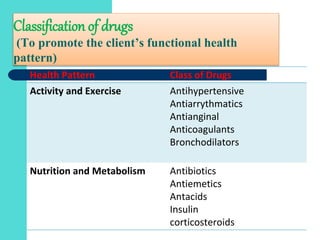
Classification of drugs
(To promote the client’s functional health
pattern)
Health Pattern Class of Drugs
Activity and Exercise Antihypertensive
Antiarrythmatics
Antianginal
Anticoagulants
Bronchodilators
Nutrition and Metabolism Antibiotics
Antiemetics
Antacids
Insulin
corticosteroids
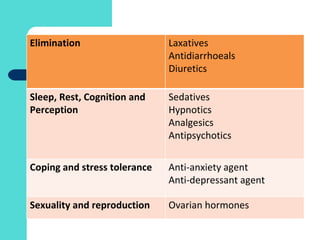
Elimination Laxatives
Antidiarrhoeals
Diuretics
Sleep, Rest, Cognition and
Perception
Sedatives
Hypnotics
Analgesics
Antipsychotics
Coping and stress tolerance Anti-anxiety agent
Anti-depressant agent
Sexuality and reproduction Ovarian hormones
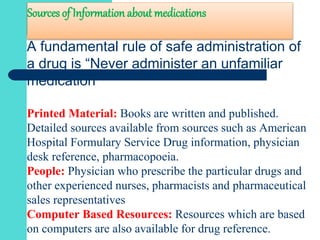
Sources of Information about medications
A fundamental rule of safe administration of
a drug is “Never administer an unfamiliar
medication”
Printed Material: Books are written and published.
Detailed sources available from sources such as American
Hospital Formulary Service Drug information, physician
desk reference, pharmacopoeia.
People: Physician who prescribe the particular drugs and
other experienced nurses, pharmacists and pharmaceutical
sales representatives
Computer Based Resources: Resources which are based
on computers are also available for drug reference.
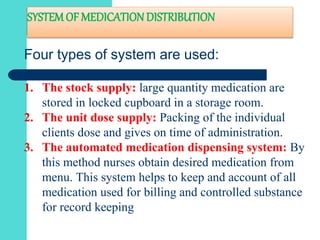
SYSTEMOF MEDICATION DISTRIBUTION
Four types of system are used:
1. The stock supply: large quantity medication are
stored in locked cupboard in a storage room.
2. The unit dose supply: Packing of the individual
clients dose and gives on time of administration.
3. The automated medication dispensing system: By
this method nurses obtain desired medication from
menu. This system helps to keep and account of all
medication used for billing and controlled substance
for record keeping
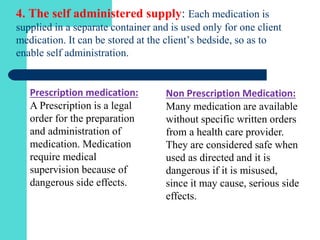
4. The self administered supply: Each medication is
supplied in a separate container and is used only for one client
medication. It can be stored at the client’s bedside, so as to
enable self administration.
Prescription medication:
A Prescription is a legal
order for the preparation
and administration of
medication. Medication
require medical
supervision because of
dangerous side effects.
Non Prescription Medication:
Many medication are available
without specific written orders
from a health care provider.
They are considered safe when
used as directed and it is
dangerous if it is misused,
since it may cause, serious side
effects.
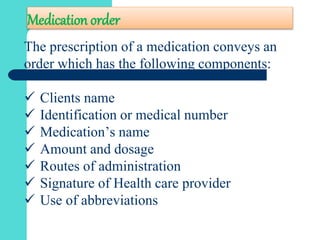
Medication order
The prescription of a medication conveys an
order which has the following components:
 Clients name
 Identification or medical number
 Medication’s name
 Amount and dosage
 Routes of administration
 Signature of Health care provider
 Use of abbreviations
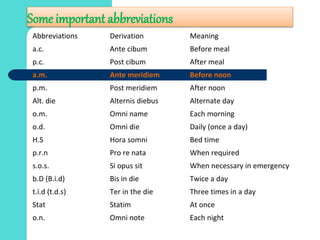
Some important abbreviations
Abbreviations Derivation Meaning
a.c. Ante cibum Before meal
p.c. Post cibum After meal
a.m. Ante meridiem Before noon
p.m. Post meridiem After noon
Alt. die Alternis diebus Alternate day
o.m. Omni name Each morning
o.d. Omni die Daily (once a day)
H.S Hora somni Bed time
p.r.n Pro re nata When required
s.o.s. Si opus sit When necessary in emergency
b.D (B.i.d) Bis in die Twice a day
t.i.d (t.d.s) Ter in the die Three times in a day
Stat Statim At once
o.n. Omni note Each night
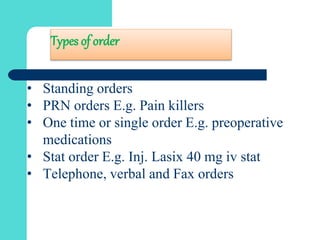
Types of order
• Standing orders
• PRN orders E.g. Pain killers
• One time or single order E.g. preoperative
medications
• Stat order E.g. Inj. Lasix 40 mg iv stat
• Telephone, verbal and Fax orders
PRINCIPLES OF DRUG ACTION
Pharmacokinetics: It is defined as what body does
to the drug.
It has four steps-
i. Absorption
ii. Distribution
iii. Metabolism
iv. Excretion
Pharmacodynamics: It is defined as what a drug
does in the body
EFFECTS OF DRUGS ON THE BODY
1. Therapeutic Effects: It is the effect which is
desired or the reason of drug is prescribed. Therapeutic effects
are the medication’s desired and intentional effects.
The drugs are administered for the following purposes:
• To promote health E.g. Vitamins
• To prevent diseases E.g. Vaccines or anti toxins
• To diagnose diseases E.g. Barium x-ray
• To alleviate diseases E.g. Analgesics
• To treat or cure a disease E.g. malaria, T.b etc
2. Local or systemic Effects: Local effects of a
drug are expected when they are applied topically to the skin. A
drugs used for systemic effect must be absorbed into the blood
stream to produce the desired effect in the various systems and
parts of the body.
3. Adverse effect: Adverse effect is any effect
other than the therapeutic effect. Some adverse effects
are minor, whereas some other may cause very serious
health problems.
4. Side effects: Side effects are the minor adverse
effects. Side effects can be harmful or harmless. Some
side effects are like allergic reactions. Skin rashes,
nausea, vomiting, Hypotension, hypertension, anorexia,
abdominal pain, nephrotoxicity, hepatotoxicity etc.
Routes of Administration
Drugs are administered according to the preparation of the
drug administered and the effect desired.
The different routes of administration of medication are
described as follows:
a. Oral administration E.g. tablets
b. Sublingual administration Tab. NTG
c. Inhalation Eg. Chlorofom, ether to for anesthetic effects
d. Topical application E.g. Ointments
e. Instillation E.g. Eye, ear drops
f. Insertion E.g. Suppository
g. Insufflation E.g. Powder, vapour
h. Implantation: Putting solid drugs in to the bod tissues.
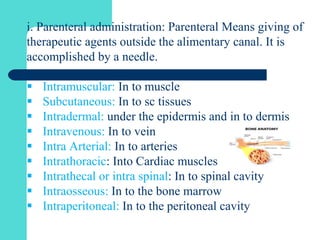
i. Parenteral administration: Parenteral Means giving of
therapeutic agents outside the alimentary canal. It is
accomplished by a needle.
 Intramuscular: In to muscle
 Subcutaneous: In to sc tissues
 Intradermal: under the epidermis and in to dermis
 Intravenous: In to vein
 Intra Arterial: In to arteries
 Intrathoracic: Into Cardiac muscles
 Intrathecal or intra spinal: In to spinal cavity
 Intraosseous: In to the bone marrow
 Intraperitoneal: In to the peritoneal cavity
Medication assessment
Medication assessment is important in order to:
- Administer medication safely.
- Determine effectiveness of the medication.
- Identify any adverse effects of the medication.
- Plan appropriate teaching plan to patient.
- Promote compliance with therapy.
The important information to be obtained
during initial assessment:
 History of medication: Name, dosage, time and purpose.
 Allergies: name of medication and associate signs and
symptoms.
 Medical History: renal, cardiac, respiratory dysfunction.
 Pregnancy and lactation status: avoid using teratogenic drugs
Assessment before medication administration
1. Medication Record medication sheet
and order
2. Diet or fluid order (IF NBM)
3. Laboratory values
4. Physical assessment:
 Ability to swallow
 Gastrointestinal motility
 Adequate muscular mass for sc or im injections
 Adequate venous access
 Vital signs
 Body system assessment
MEDICATION ERROR
It is the administration of drug:
o Which is not given according to the order.
o Is administered as per the order, but is unsafe or inappropriate
for the client.
o When documentation in a client’s chart does not reflect that a
medication was administered as ordered.
o Medication was given, but not charted.
o Administration of I.V. medication at wrong rate.
o Administering medication at wrong dose.
o Administering medication at wrong time.
o Administering the wrong medication.
o Charting medication was not given.
o Administering substitution medication.
o Failure to give a medication within the prescribed time
interval
o Giving a medication by wrong route.
o Incorrect preparation of a drug by an incorrect route.
o Administering medication to a client with known allergy to
that medication.
o Improper technique when administering a drug.
o Administering medication to the wrong client.
When a medication error occurs, it must be documented exactly
as it has occurred
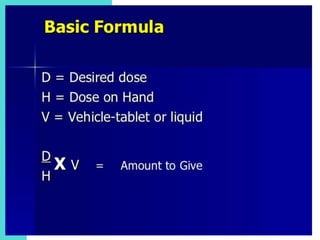
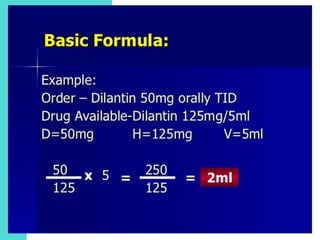
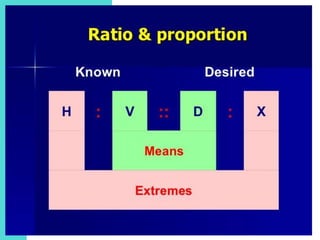
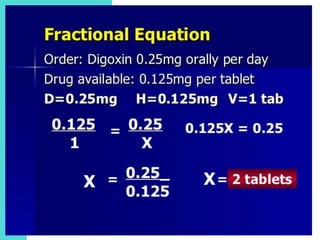
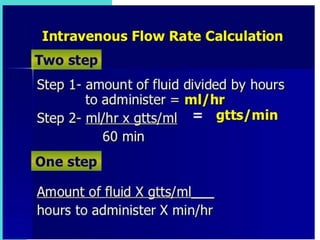
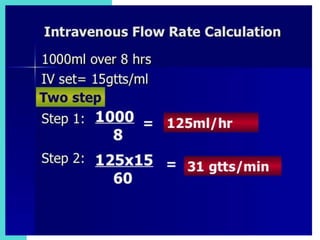
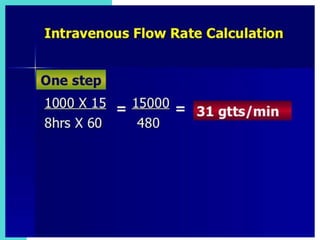
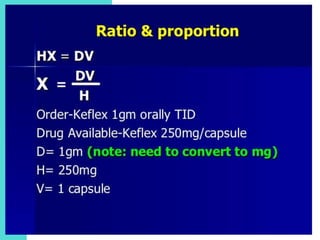
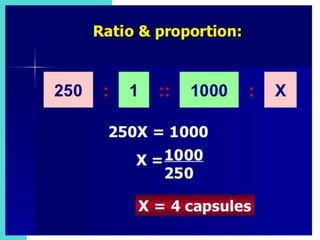
DRUG CALCULATION
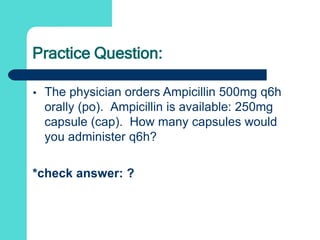
Practice Question:
 The physician orders Ampicillin 500mg q6h
orally (po). Ampicillin is available: 250mg
capsule (cap). How many capsules would
you administer q6h?
*check answer: ?
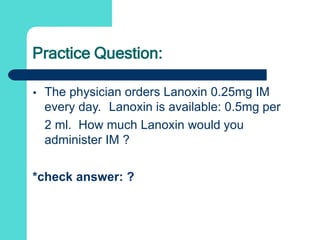
Practice Question:
 The physician orders Lanoxin 0.25mg IM
every day. Lanoxin is available: 0.5mg per
2 ml. How much Lanoxin would you
administer IM ?
*check answer: ?
SAFETY MEASURES
The rights ensures safety of giving drugs:
Right client
Right drug
Right dose
Right route
Right time
Right Documentation
Right to refusal
Medication administration

Medication administration

  • 1.
  • 2.
    LEARNING OBJECTIVES On completionof this chapter, the students will be able to do the following:  Define the key terms used.  Discuss the important concepts related to the safe and effective administration of medication.  Describe various factors that affect the action of drugs in individual clients.  Discuss the legal implications connected with medication administration.  List the common abbreviation used in relation to administration of medication.  Understand the calculation of drug.  Develop knowledge regarding medication assessment
  • 3.
    INTRODUCTION Administration of medicationis a basic nursing function that involves knowledge and skill. The safe and accurate administration is the most important responsibility of nurse. Improper administration can cause harmful effects. Some basic points regarding drugs:  Name of the drug  Classification  Route and time of administration  Principles of drug action  Dosage  Medication standards
  • 4.
    Sources of informationabout medication System of medication distribution Medication order Prescription and non prescription medication Weights and measures used Preparation of solution and calculation Storing of medication Factors affecting safety Abbreviation and symbols used Rules of administration Legal aspects, nurse practice acts, clients rights Institutional policies Nurses role.
  • 5.
    Medication A Drug is Anysubstance that alters physiologic function, with the potential of affecting health. A Medication is A substance used in the diagnosis, treatment, cure, relief, or prevention of health alteration.
  • 6.
    Names of theDrugs Drugs may be known as several name. 1. Chemical Name :Which is known to chemist; it indicates the ingredient of the drug. Identify the molecular structure. E.g. ibuprofen (anti-inflammatory)2- 4(isobutyl phenyl)Propionic acid. 2. Generic Name: It is assigned by the manufacturer who first developed the drug and is assigned by the United States Adopted Names Council. It is derived form chemical name. E.g.
  • 7.
    3. Official Name:It is assigned by the food and drug administration after approval. It is often same as generic name. 4. Trade Name: it is assigned by the manufacturer and is copyrighted. One drug may be manufactured by several companies. For E.g. Paracetamol such as Crocin, Calpol, Ifimol, Metacin etc.
  • 8.
    CLASSIFICATION OF DRUGS Accordingto action: o Analgesics: Drugs used to relieve pain o Anesthetics: Drugs which causes loss of sensation o Anthelmintic: Drugs which destroy and expel worms o Antipyretics: Drugs which reduce fever o Antidotes: Used to Counteract the effect of poison. o Anti-infective: Act either to inhibit, kill the micro organism. o Anti-inflammatory: To reduce Inflammation o Anti-coagulants: Inhibit or decrease the blood clotting process. o Anti-histamines: used to prevent of relieve allergy o Antacids: react with HCL to decrease activity of stomach secretions. o Anti convulsants: used to prevent of treat convulsions
  • 9.
    o Antibiotics: Abilityto destroy or inhibit the growth of micro organism o Anti-diarrhetics: used to treat diarrhea o Antitussives: drugs inhibit the cough reflex (CNS) o Anti-asthmatics: Drugs which provides relief for asthmatic attack by relaxing the smooth muscles of bronchioles. o Antiseptic: Inhibits the growth of bacteria o Antifungal: drugs which prevent the growth of fungi o Antispasmodic: relieves the spasmodic pains or spasm of muscles o Antiemetics: relieves or prevents nausea and vomiting. o Anti-tubercular: used to treat tuberculosis o Coagulants: helps in the coagulation of blood. o Carminatives: Drugs which cause expulsion of gas from stomach and intestines.
  • 10.
    o Diaphoresis: Increasethe action of sweat glands. o Diuretics: Which increase the flow of urine o Detergents: A cleansing agent o Digestants: An agent that promotes digestion o Emetics: drug that produce vomiting o Ecbolics or oxytocics: Drugs that stimulates uterine contractions o Expectorants: Increase the bronchial secretions and aid in the expulsion of the mucus o Emollient: Substances that smoothen, soften and protect the skin o Galactogogue: Substance that increase the flow of milk o Hypnotics: Drugs that produce sleep o Hemostatics: An agent to check hemorrhage o Hypotensive: any substance capable of lowering BP o Hypoglycemic: Drugs that lower the blood sugar level o Haematinics: an agent which tends to increase Hb content of blood
  • 11.
    o Mydriatics: Dilatethe pupils of eye o Nasal decongestant: Drugs which relieve the nasal congestion o Narcotics: Drugs that produces stupor or complete insensibility o Scabicides: Used in the treatment of scabies o Sedatives: Substances which lessen the body activity o Stimulants: Increase functional activity of an organ or system o Vesicants: A blistering agent o Vasodilators: Drugs which dilate the blood vessels and lowering BP o Vasoconstrictors: Drugs which constrict the blood vessels and raising the BP
  • 12.
    Classification of drugs (Topromote the client’s functional health pattern) Health Pattern Class of Drugs Activity and Exercise Antihypertensive Antiarrythmatics Antianginal Anticoagulants Bronchodilators Nutrition and Metabolism Antibiotics Antiemetics Antacids Insulin corticosteroids
  • 13.
    Elimination Laxatives Antidiarrhoeals Diuretics Sleep, Rest,Cognition and Perception Sedatives Hypnotics Analgesics Antipsychotics Coping and stress tolerance Anti-anxiety agent Anti-depressant agent Sexuality and reproduction Ovarian hormones
  • 14.
    Sources of Informationabout medications A fundamental rule of safe administration of a drug is “Never administer an unfamiliar medication” Printed Material: Books are written and published. Detailed sources available from sources such as American Hospital Formulary Service Drug information, physician desk reference, pharmacopoeia. People: Physician who prescribe the particular drugs and other experienced nurses, pharmacists and pharmaceutical sales representatives Computer Based Resources: Resources which are based on computers are also available for drug reference.
  • 15.
    SYSTEMOF MEDICATION DISTRIBUTION Fourtypes of system are used: 1. The stock supply: large quantity medication are stored in locked cupboard in a storage room. 2. The unit dose supply: Packing of the individual clients dose and gives on time of administration. 3. The automated medication dispensing system: By this method nurses obtain desired medication from menu. This system helps to keep and account of all medication used for billing and controlled substance for record keeping
  • 16.
    4. The selfadministered supply: Each medication is supplied in a separate container and is used only for one client medication. It can be stored at the client’s bedside, so as to enable self administration. Prescription medication: A Prescription is a legal order for the preparation and administration of medication. Medication require medical supervision because of dangerous side effects. Non Prescription Medication: Many medication are available without specific written orders from a health care provider. They are considered safe when used as directed and it is dangerous if it is misused, since it may cause, serious side effects.
  • 17.
    Medication order The prescriptionof a medication conveys an order which has the following components:  Clients name  Identification or medical number  Medication’s name  Amount and dosage  Routes of administration  Signature of Health care provider  Use of abbreviations
  • 18.
    Some important abbreviations AbbreviationsDerivation Meaning a.c. Ante cibum Before meal p.c. Post cibum After meal a.m. Ante meridiem Before noon p.m. Post meridiem After noon Alt. die Alternis diebus Alternate day o.m. Omni name Each morning o.d. Omni die Daily (once a day) H.S Hora somni Bed time p.r.n Pro re nata When required s.o.s. Si opus sit When necessary in emergency b.D (B.i.d) Bis in die Twice a day t.i.d (t.d.s) Ter in the die Three times in a day Stat Statim At once o.n. Omni note Each night
  • 19.
    Types of order •Standing orders • PRN orders E.g. Pain killers • One time or single order E.g. preoperative medications • Stat order E.g. Inj. Lasix 40 mg iv stat • Telephone, verbal and Fax orders
  • 20.
    PRINCIPLES OF DRUGACTION Pharmacokinetics: It is defined as what body does to the drug. It has four steps- i. Absorption ii. Distribution iii. Metabolism iv. Excretion Pharmacodynamics: It is defined as what a drug does in the body
  • 21.
    EFFECTS OF DRUGSON THE BODY 1. Therapeutic Effects: It is the effect which is desired or the reason of drug is prescribed. Therapeutic effects are the medication’s desired and intentional effects. The drugs are administered for the following purposes: • To promote health E.g. Vitamins • To prevent diseases E.g. Vaccines or anti toxins • To diagnose diseases E.g. Barium x-ray • To alleviate diseases E.g. Analgesics • To treat or cure a disease E.g. malaria, T.b etc 2. Local or systemic Effects: Local effects of a drug are expected when they are applied topically to the skin. A drugs used for systemic effect must be absorbed into the blood stream to produce the desired effect in the various systems and parts of the body.
  • 22.
    3. Adverse effect:Adverse effect is any effect other than the therapeutic effect. Some adverse effects are minor, whereas some other may cause very serious health problems. 4. Side effects: Side effects are the minor adverse effects. Side effects can be harmful or harmless. Some side effects are like allergic reactions. Skin rashes, nausea, vomiting, Hypotension, hypertension, anorexia, abdominal pain, nephrotoxicity, hepatotoxicity etc.
  • 23.
    Routes of Administration Drugsare administered according to the preparation of the drug administered and the effect desired. The different routes of administration of medication are described as follows: a. Oral administration E.g. tablets b. Sublingual administration Tab. NTG c. Inhalation Eg. Chlorofom, ether to for anesthetic effects d. Topical application E.g. Ointments e. Instillation E.g. Eye, ear drops f. Insertion E.g. Suppository g. Insufflation E.g. Powder, vapour h. Implantation: Putting solid drugs in to the bod tissues.
  • 24.
    i. Parenteral administration:Parenteral Means giving of therapeutic agents outside the alimentary canal. It is accomplished by a needle.  Intramuscular: In to muscle  Subcutaneous: In to sc tissues  Intradermal: under the epidermis and in to dermis  Intravenous: In to vein  Intra Arterial: In to arteries  Intrathoracic: Into Cardiac muscles  Intrathecal or intra spinal: In to spinal cavity  Intraosseous: In to the bone marrow  Intraperitoneal: In to the peritoneal cavity
  • 25.
    Medication assessment Medication assessmentis important in order to: - Administer medication safely. - Determine effectiveness of the medication. - Identify any adverse effects of the medication. - Plan appropriate teaching plan to patient. - Promote compliance with therapy. The important information to be obtained during initial assessment:  History of medication: Name, dosage, time and purpose.  Allergies: name of medication and associate signs and symptoms.  Medical History: renal, cardiac, respiratory dysfunction.  Pregnancy and lactation status: avoid using teratogenic drugs
  • 26.
    Assessment before medicationadministration 1. Medication Record medication sheet and order 2. Diet or fluid order (IF NBM) 3. Laboratory values 4. Physical assessment:  Ability to swallow  Gastrointestinal motility  Adequate muscular mass for sc or im injections  Adequate venous access  Vital signs  Body system assessment
  • 27.
    MEDICATION ERROR It isthe administration of drug: o Which is not given according to the order. o Is administered as per the order, but is unsafe or inappropriate for the client. o When documentation in a client’s chart does not reflect that a medication was administered as ordered. o Medication was given, but not charted. o Administration of I.V. medication at wrong rate. o Administering medication at wrong dose. o Administering medication at wrong time. o Administering the wrong medication. o Charting medication was not given.
  • 28.
    o Administering substitutionmedication. o Failure to give a medication within the prescribed time interval o Giving a medication by wrong route. o Incorrect preparation of a drug by an incorrect route. o Administering medication to a client with known allergy to that medication. o Improper technique when administering a drug. o Administering medication to the wrong client. When a medication error occurs, it must be documented exactly as it has occurred
  • 29.
  • 37.
    Practice Question:  Thephysician orders Ampicillin 500mg q6h orally (po). Ampicillin is available: 250mg capsule (cap). How many capsules would you administer q6h? *check answer: ?
  • 38.
    Practice Question:  Thephysician orders Lanoxin 0.25mg IM every day. Lanoxin is available: 0.5mg per 2 ml. How much Lanoxin would you administer IM ? *check answer: ?
  • 42.
    SAFETY MEASURES The rightsensures safety of giving drugs: Right client Right drug Right dose Right route Right time Right Documentation Right to refusal