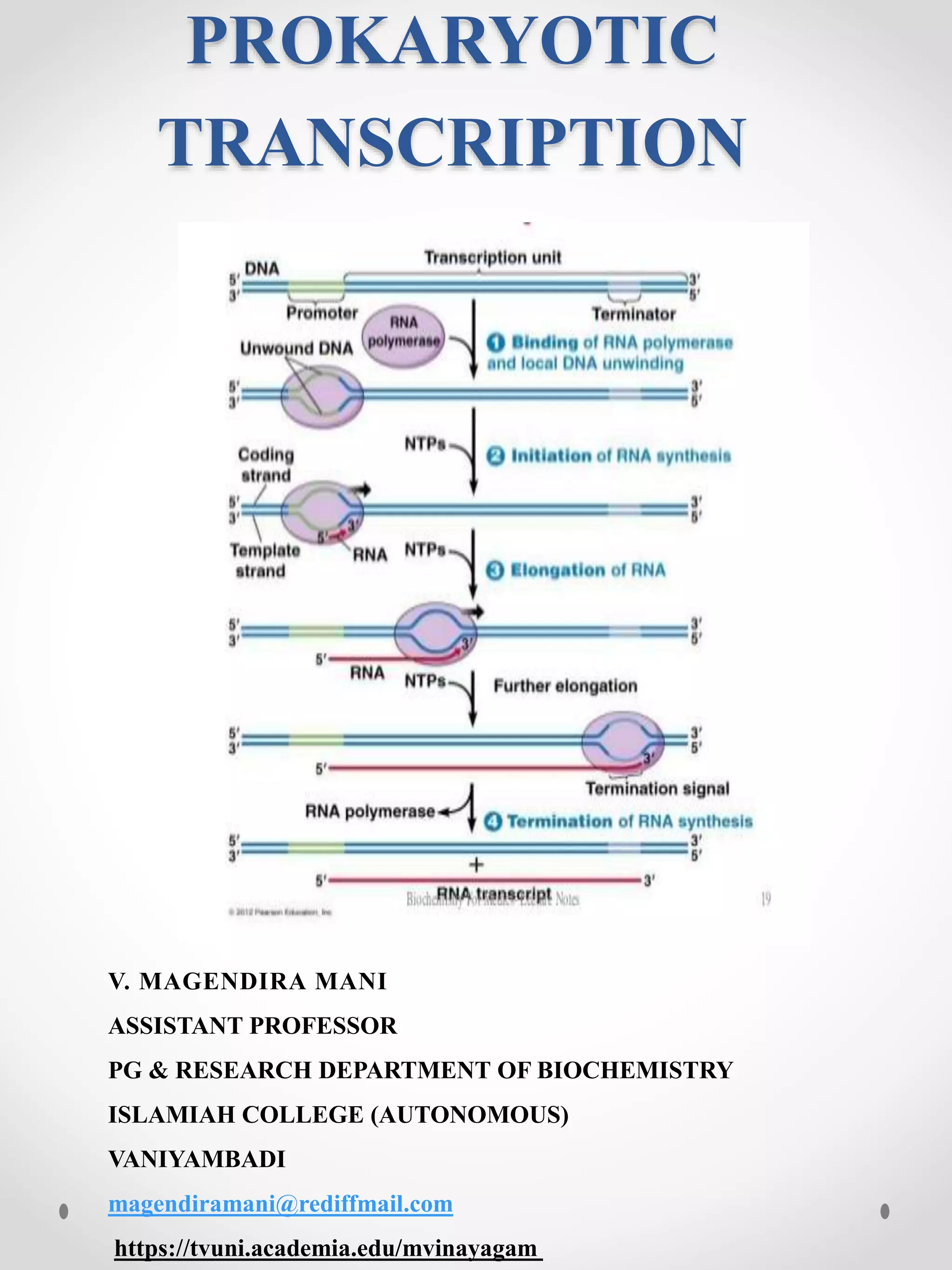
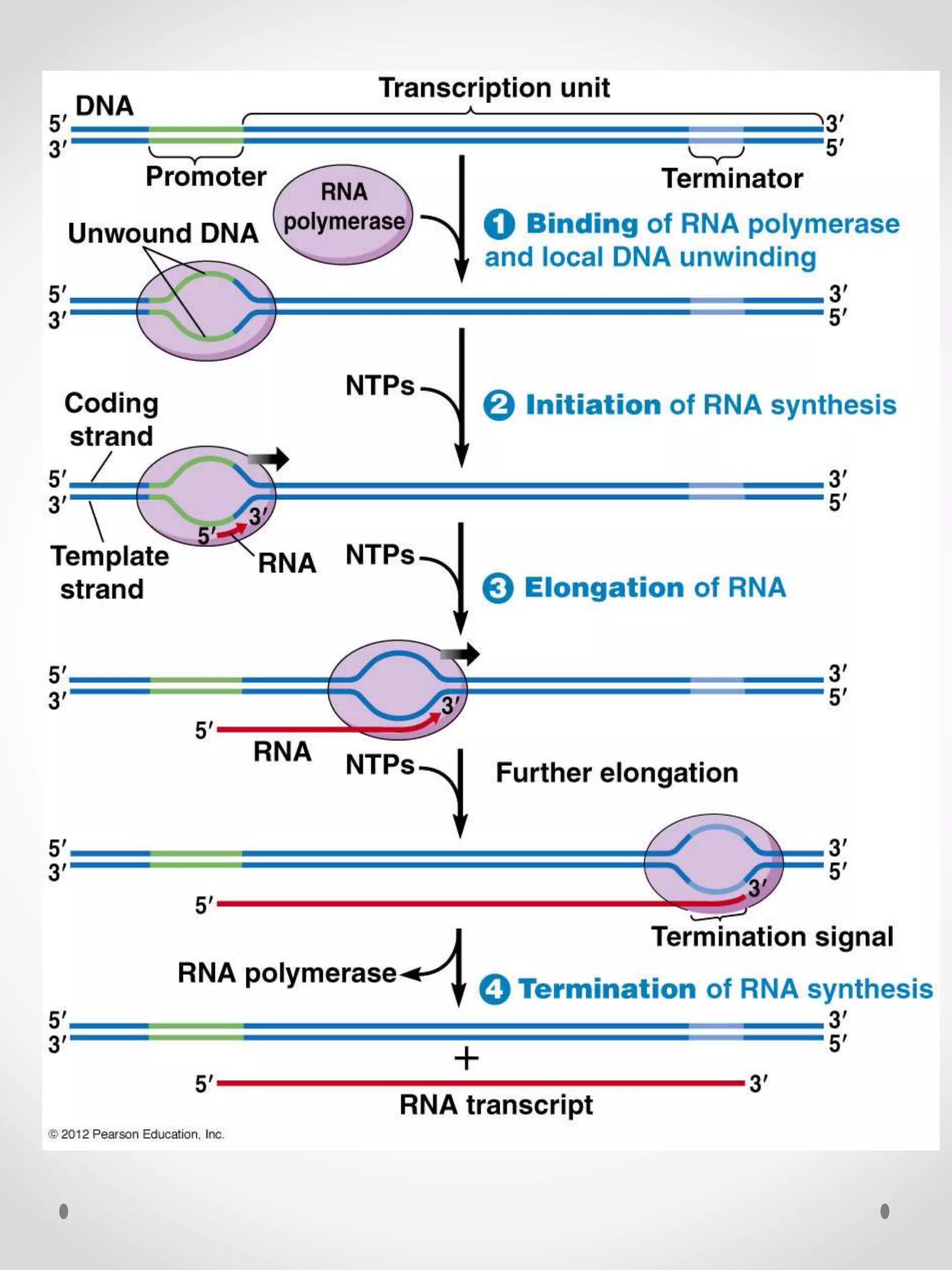
Transcription in prokaryotes involves RNA polymerase producing messenger RNA transcripts of genetic material in the cytoplasm. Unlike in eukaryotes, transcription and translation can occur simultaneously. Transcription is controlled by transcription factors and involves three main steps: initiation, elongation, and termination. Initiation requires RNA polymerase binding to promoter regions with sigma factors. Elongation adds complementary bases to the DNA template. Termination can occur via intrinsic terminator sequences forming stem-loop structures or with rho-dependent termination using a rho factor protein.
PROKARYOTIC
TRANSCRIPTION
V. MAGENDIRA MANI
ASSISTANTPROFESSOR
PG & RESEARCH DEPARTMENT OF BIOCHEMISTRY
ISLAMIAH COLLEGE (AUTONOMOUS)
VANIYAMBADI
magendiramani@rediffmail.com
https://tvuni.academia.edu/mvinayagam
2.
PROKARYOTIC TRANSCRIPTION
Bacterial transcriptionor prokaryotic transcription is the
process in which messenger RNA transcripts of genetic
material in prokaryotes are produced, to be translated for
the production of proteins. Bacterial transcription occurs
in the cytoplasm alongside translation. Unlike in
eukaryotes, prokaryotic transcription and translation can
occur simultaneously. This is impossible in eukaryotes,
where transcription occurs in a membrane-bound nucleus
while translation occurs outside the nucleus in the
cytoplasm. In prokaryotes genetic material is not enclosed
in a membrane-enclosed nucleus and has access to
ribosomes in the cytoplasm.
3.
Transcription is knownto be controlled by a variety
of regulators in prokaryotes. Many of these
transcription factors are homodimers containing
helix- turn-helix DNA-binding motifs.
Three steps in transcription
Initiation
Elongation
Termination
The following steps occur, in order, for
transcription
4.
RNA polymerase
RNA issynthesized by a single RNA polymerase
enzyme which contains multiple polypeptide
subunits. In E. coli, the RNA polymerase has five
subunits: two α, one β, one β’ and one σ subunit
(α2ββ’σ). This form is called the holoenzyme. The
σ subunit may dissociate from the other subunits to
leave a form known as the core enzyme.
5.
INITIATION
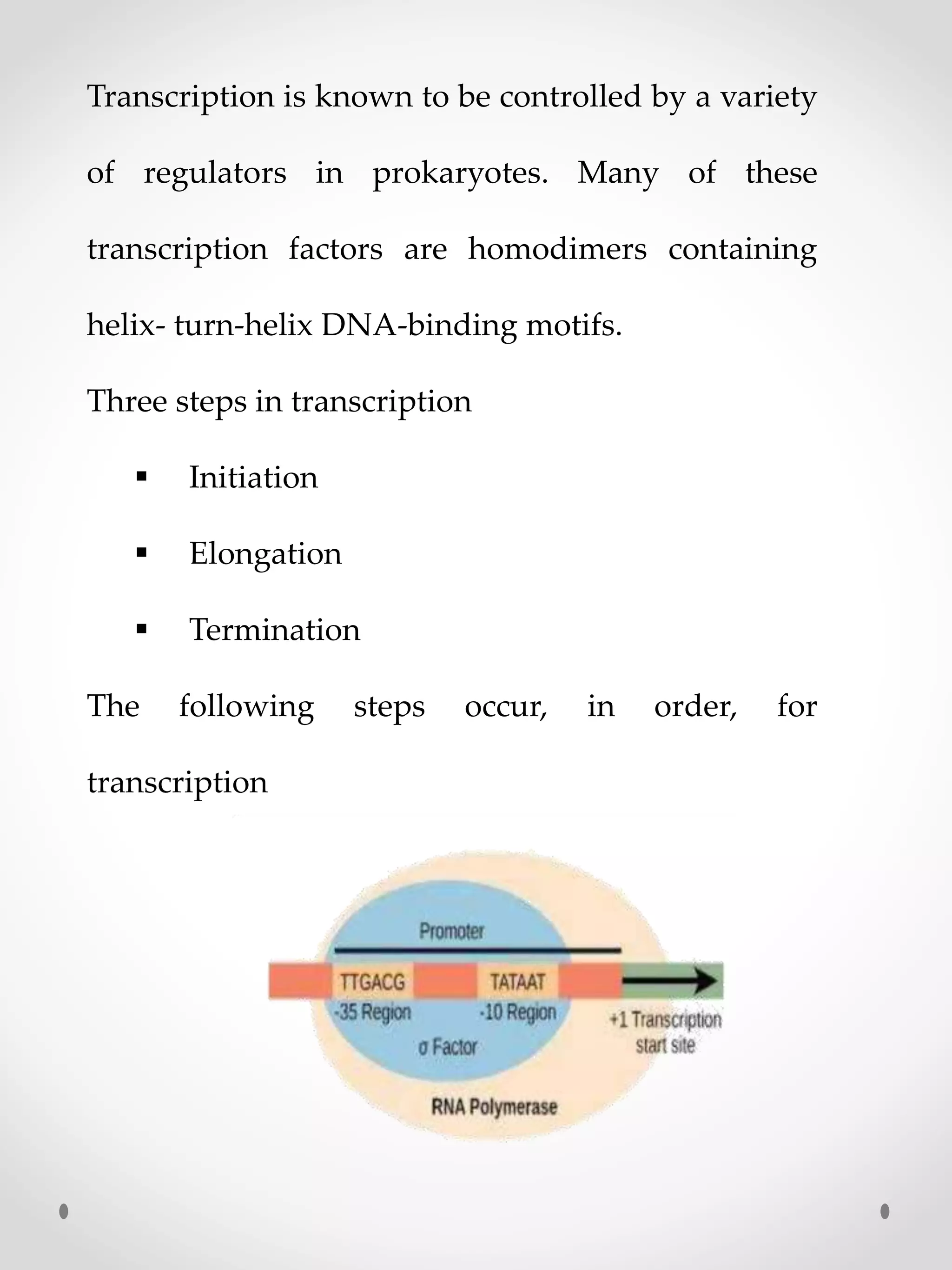
RNA polymerase (RNAP)binds to one of
several specificity factors, σ, to form a holoenzyme. In
this form, it can recognize and bind to specific
promoter regions in the DNA. The -35 region and the -
10 ("Pribnow box") region comprise the core
prokaryotic promoter, and |T| stands for the
terminator. The DNA on the template strand between
the +1 site and the terminator is transcribed into RNA,
which is then translated into protein. At this stage, the
DNA is double-stranded ("closed"). This
holoenzyme/wound-DNA structure is referred to as
the closed complex.
6.
Pribnow box –it contain six nucleotide (TATAAT)
located 8 to 10 nucleotide to the left of transcriptional
start site, the initial base of mRNA.
-35 region – a second sequence nucleotide
(TTGAGA) located 35 nucleotide to the left of
transcriptional start site.
The DNA is unwound and becomes single-
stranded ("open") in the vicinity of the initiation site
(defined as +1). This holoenzyme/unwound-DNA
structure is called the open complex.
8.
• The RNApolymerase transcribes the DNA (the beta
subunit initiates the synthesis), but produces about 10
abortive (short, non-productive) transcripts which are
unable to leave the RNA polymerase because the exit
channel is blocked by the σ-factor.
• The σ-factor eventually dissociates from the core
enzyme and elongation proceeds.
ELONGATION
• Once the promoters region has been recognized by
sigma factor of holoenzyme the enzyme begins to
synthesis RNA sequence, sigma factor is released. This
enzyme has no exo/endo nuclease activity and cannot
repair the mistakes as DNA polymerase in replication.
9.
RNA polymerase addcomplementary
base to the template strand of DNA. It adds
Thiamine for Adenine (T =A), Guanine for Cytosine
(G ≡ C), Cytosine for Guanine (C ≡ G) and Adenine
for Uracil (A = U).
Most transcripts originate using
adenosine-5'-triphosphate (ATP) and, to a lesser
extent, guanosine-5'-triphosphate (GTP) (purine
nucleoside triphosphates) at the +1 site. Uridine-5'-
triphosphate (UTP) and cytidine-5'-triphosphate
(CTP) (pyrimidine nucleoside triphosphates) are
disfavoured at the initiation site.]
10.
TERMINATION
RNA synthesis willcontinue along the DNA template
strand until the polymerase encounters a signal that tells
it to stop, or terminate, transcription. In prokaryotes, this
signal can take two forms, rho-independent and rho-
dependent.
Rho-independent Terminator
Two termination mechanisms are well known:
Intrinsic termination (also called Rho-
independent transcription termination) involves
terminator sequences within the RNA that signal the RNA
polymerase to stop. The terminator sequence is usually a
palindromic sequence that forms a stem-loop hairpin
structure that leads to the dissociation of the RNAP from
the DNA template.
11.
Termination of transcriptionin vitro is classified as
to its dependence on the protein factor, rho (ρ).
Rho‐independent terminators have a characteristic
structure, which features
(a) A strong G‐C rich stem and loop,
(b) a sequence of 4–6 U residues in the RNA, which
are transcribed from a corresponding stretch of As
in the template
12.
Rho-dependent termination usesa termination
factor called ρ factor (rho factor) which is a
protein to stop RNA synthesis at specific sites.
This protein binds at a rho utilization site on the
nascent RNA strand and runs along the mRNA
towards the RNAP. A stem loop structure
upstream of the terminator region pauses the
RNAP, when ρ-factor reaches the RNAP, it
causes RNAP to dissociate from the DNA,
terminating transcription.
13.
V. MAGENDIRA MANI
ASSISTANTPROFESSOR
PG & RESEARCH DEPARTMENT OF BIOCHEMISTRY
ISLAMIAH COLLEGE (AUTONOMOUS)
VANIYAMBADI
magendiramani@rediffmail.com
https://tvuni.academia.edu/mvinayagam




![RNA polymerase add complementary
base to the template strand of DNA. It adds
Thiamine for Adenine (T =A), Guanine for Cytosine
(G ≡ C), Cytosine for Guanine (C ≡ G) and Adenine
for Uracil (A = U).
Most transcripts originate using
adenosine-5'-triphosphate (ATP) and, to a lesser
extent, guanosine-5'-triphosphate (GTP) (purine
nucleoside triphosphates) at the +1 site. Uridine-5'-
triphosphate (UTP) and cytidine-5'-triphosphate
(CTP) (pyrimidine nucleoside triphosphates) are
disfavoured at the initiation site.]](https://image.slidesharecdn.com/prokaryotictranscription-160925100335/75/Prokaryotic-transcription-9-2048.jpg)


