Root canal filling
materials.
Root filling
techniques.
Lecturer: Levkiv Mariana
Department of
Therapeutic Dentistry
TSMU
Purpose of root canal filling
To prevent bacteria and bacterial elements from spreading
from (or through) the canal system to the periapical area,
the fully instrumented root canal has to be provided with a
tight and long-lasting obturation.
A root canal filling material should, therefore, prevent
infection/reinfection of treated root canals. Together with an
acceptable level of biocompatibility (inert material) this will
provide the basis for promoting healing of the periodontal
tissues and for maintaining healthy periapical conditions.
EndodonticEndodontic
MaterialsMaterials
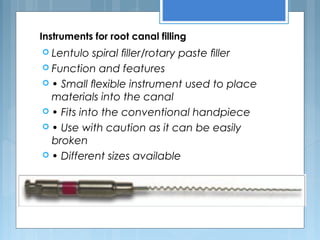
Instruments for root canal filling
 Lentulo spiral filler/rotary paste filler
 Function and features
 • Small flexible instrument used to place
materials into the canal
 • Fits into the conventional handpiece
 • Use with caution as it can be easily
broken
 • Different sizes available
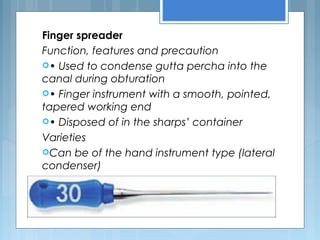
Finger spreader
Function, features and precaution
• Used to condense gutta percha into the
canal during obturation
• Finger instrument with a smooth, pointed,
tapered working end
• Disposed of in the sharps’ container
Varieties
Can be of the hand instrument type (lateral
condenser)
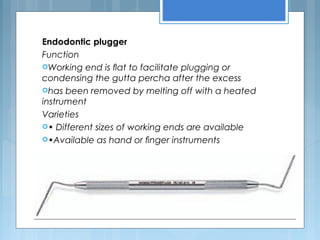
Endodontic plugger
Function
Working end is flat to facilitate plugging or
condensing the gutta percha after the excess
has been removed by melting off with a heated
instrument
Varieties
• Different sizes of working ends are available
•Available as hand or finger instruments
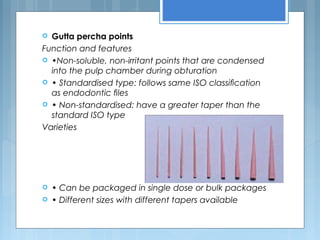
 Gutta percha points
Function and features
 •Non-soluble, non-irritant points that are condensed
into the pulp chamber during obturation
 • Standardised type: follows same ISO classification
as endodontic files
 • Non-standardised: have a greater taper than the
standard ISO type
Varieties
 • Can be packaged in single dose or bulk packages
 • Different sizes with different tapers available
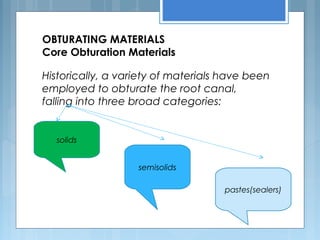
OBTURATING MATERIALS
Core Obturation Materials
Historically, a variety of materials have been
employed to obturate the root canal,
falling into three broad categories:
pastes(sealers)
semisolids
solids
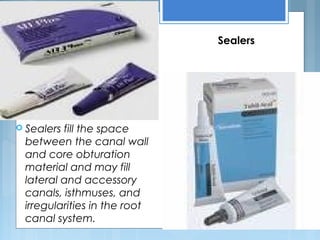
Sealers
 Sealers fill the space
between the canal wall
and core obturation
material and may fill
lateral and accessory
canals, isthmuses, and
irregularities in the root
canal system.
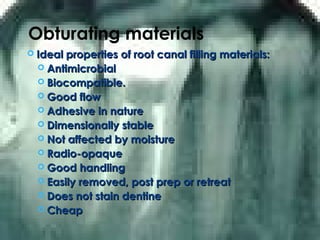
Obturating materials
 Ideal properties of root canal filling materials:Ideal properties of root canal filling materials:
 AntimicrobialAntimicrobial
 Biocompatible.Biocompatible.
 Good flowGood flow
 Adhesive in natureAdhesive in nature
 Dimensionally stableDimensionally stable
 Not affected by moistureNot affected by moisture
 Radio-opaqueRadio-opaque
 Good handlingGood handling
 Easily removed, post prep or retreatEasily removed, post prep or retreat
 Does not stain dentineDoes not stain dentine
 CheapCheap
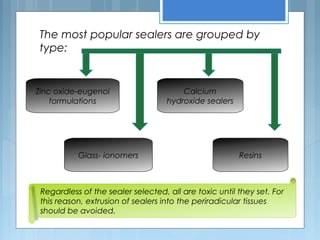
The most popular sealers are grouped by
type:
Zinc oxide-eugenol
formulations
Calcium
hydroxide sealers
Glass- ionomers Resins
Regardless of the sealer selected, all are toxic until they set. For
this reason, extrusion of sealers into the periradicular tissues
should be avoided.
Sealers
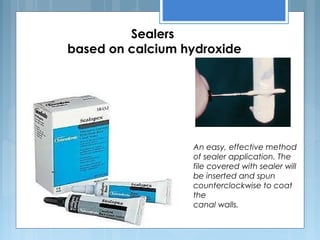
based on calcium hydroxide
An easy, effective method
of sealer application. The
file covered with sealer will
be inserted and spun
counterclockwise to coat
the
canal walls.
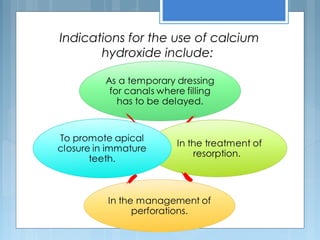
Indications for the use of calcium
hydroxide include:
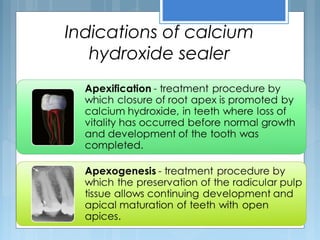
Indications of calcium
hydroxide sealer
Acceptable methods of placing the sealer in
the canal include the following:
Placing the sealer on the master cone and
pumping the cone up and down in the
canal
Placing the sealer on a file and spinning it
counter clockwise
Placing the sealer with a lentulo spiral
Using a syringe
Activating an ultrasonic instrument
The clinician should use care when placing
sealer in a canal with an open apex to
avoid extrusion.
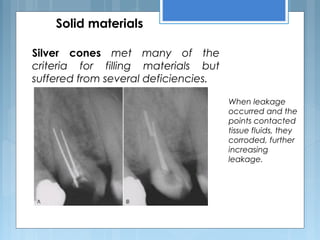
Solid materials
Silver cones met many of the
criteria for filling materials but
suffered from several deficiencies.
When leakage
occurred and the
points contacted
tissue fluids, they
corroded, further
increasing
leakage.
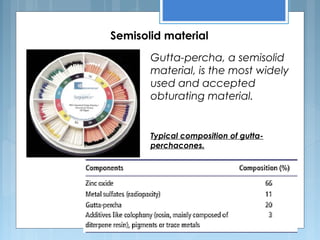
Semisolid material
Gutta-percha, a semisolid
material, is the most widely
used and accepted
obturating material.
Typical composition of gutta-
perchacones.
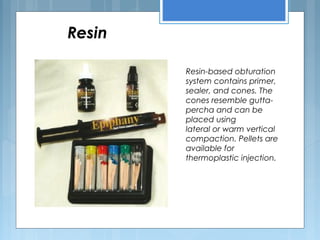
Resin
Resin-based obturation
system contains primer,
sealer, and cones. The
cones resemble gutta-
percha and can be
placed using
lateral or warm vertical
compaction. Pellets are
available for
thermoplastic injection.
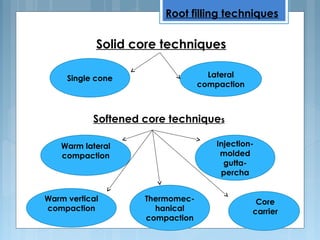
Single cone
Warm lateral
compaction
Warm vertical
compaction
Lateral
compaction
Thermomec-
hanical
compaction
Injection-
molded
gutta-
percha
Core
carrier
Root filling techniques
Solid core techniques
Softened core techniques
Root canal filling technique.
Solid core technique
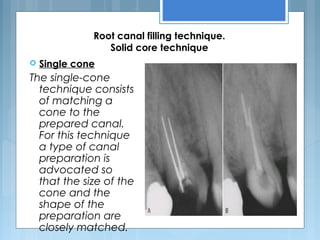
 Single cone
The single-cone
technique consists
of matching a
cone to the
prepared canal.
For this technique
a type of canal
preparation is
advocated so
that the size of the
cone and the
shape of the
preparation are
closely matched.
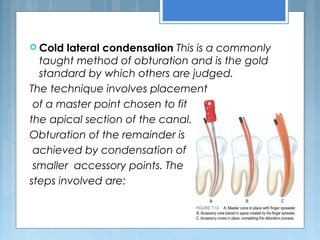
 Cold lateral condensation This is a commonly
taught method of obturation and is the gold
standard by which others are judged.
The technique involves placement
of a master point chosen to fit
the apical section of the canal.
Obturation of the remainder is
achieved by condensation of
smaller accessory points. The
steps involved are:
 1. Select a GP master point to correspond with the master
apical file instrument. This should fit the apical region snugly at
the working length so that on removal a degree of resistance or
'tug-back' is felt. If there is no tug-back select a larger point or
cut 1 mm at a time off the tip of the point until a good fit is
obtained. The point should be notched at the correct working
length to guide its placement to the apical constriction.
 2 . Take a radiograph to confirm that the point is in correct
position if you are in any doubt.
 3. Coat walls of canal with sealer using a small file.
 4. Insert the master point, covered in cement.
 5 . Condense the GP laterally with a finger spreader to provide
space into which accessory points can be inserted until the
canal is full.
 6. Excess GP is cut off with a hot instrument and the remainder
packed vertically into the canal with a cold plugger.
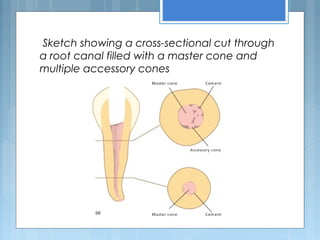
Sketch showing a cross-sectional cut through
a root canal filled with a master cone and
multiple accessory cones
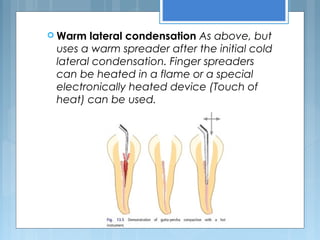
 Warm lateral condensation As above, but
uses a warm spreader after the initial cold
lateral condensation. Finger spreaders
can be heated in a flame or a special
electronically heated device (Touch of
heat) can be used.
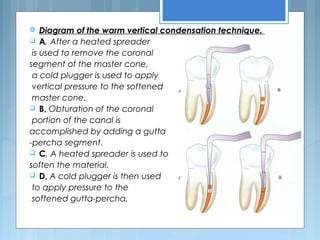
 Diagram of the warm vertical condensation technique.
 A, After a heated spreader
is used to remove the coronal
segment of the master cone,
a cold plugger is used to apply
vertical pressure to the softened
master cone.
 B, Obturation of the coronal
portion of the canal is
accomplished by adding a gutta
-percha segment.
 C, A heated spreader is used to
soften the material.
 D, A cold plugger is then used
to apply pressure to the
softened gutta-percha.
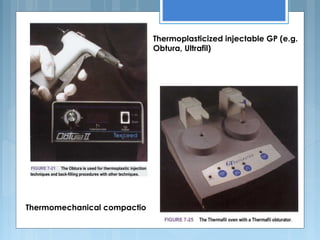
Thermoplasticized injectable GP (e.g.
Obtura, Ultrafil)
Thermomechanical compactio
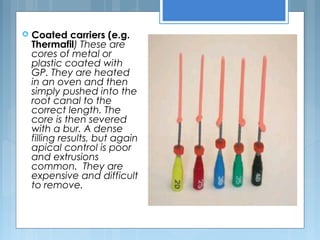
 Coated carriers (e.g.
Thermafil) These are
cores of metal or
plastic coated with
GP. They are heated
in an oven and then
simply pushed into the
root canal to the
correct length. The
core is then severed
with a bur. A dense
filling results, but again
apical control is poor
and extrusions
common. They are
expensive and difficult
to remove.
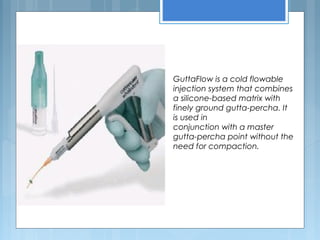
GuttaFlow is a cold flowable
injection system that combines
a silicone-based matrix with
finely ground gutta-percha. It
is used in
conjunction with a master
gutta-percha point without the
need for compaction.
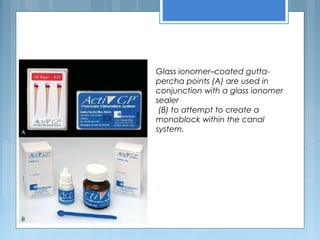
Glass ionomer–coated gutta-
percha points (A) are used in
conjunction with a glass ionomer
sealer
(B) to attempt to create a
monoblock within the canal
system.
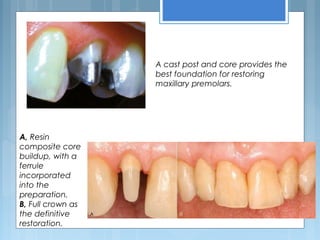
A, Resin
composite core
buildup, with a
ferrule
incorporated
into the
preparation.
B, Full crown as
the definitive
restoration.
A cast post and core provides the
best foundation for restoring
maxillary premolars.
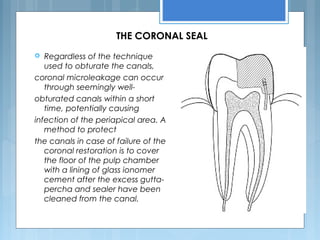
THE CORONAL SEAL
 Regardless of the technique
used to obturate the canals,
coronal microleakage can occur
through seemingly well-
obturated canals within a short
time, potentially causing
infection of the periapical area. A
method to protect
the canals in case of failure of the
coronal restoration is to cover
the floor of the pulp chamber
with a lining of glass ionomer
cement after the excess gutta-
percha and sealer have been
cleaned from the canal.
Root canal filling instruments and materials

Root canal filling instruments and materials

  • 1.
    Root canal filling materials. Rootfilling techniques. Lecturer: Levkiv Mariana Department of Therapeutic Dentistry TSMU
  • 2.
    Purpose of rootcanal filling To prevent bacteria and bacterial elements from spreading from (or through) the canal system to the periapical area, the fully instrumented root canal has to be provided with a tight and long-lasting obturation. A root canal filling material should, therefore, prevent infection/reinfection of treated root canals. Together with an acceptable level of biocompatibility (inert material) this will provide the basis for promoting healing of the periodontal tissues and for maintaining healthy periapical conditions.
  • 3.
  • 4.
    Instruments for rootcanal filling  Lentulo spiral filler/rotary paste filler  Function and features  • Small flexible instrument used to place materials into the canal  • Fits into the conventional handpiece  • Use with caution as it can be easily broken  • Different sizes available
  • 5.
    Finger spreader Function, featuresand precaution • Used to condense gutta percha into the canal during obturation • Finger instrument with a smooth, pointed, tapered working end • Disposed of in the sharps’ container Varieties Can be of the hand instrument type (lateral condenser)
  • 6.
    Endodontic plugger Function Working endis flat to facilitate plugging or condensing the gutta percha after the excess has been removed by melting off with a heated instrument Varieties • Different sizes of working ends are available •Available as hand or finger instruments
  • 7.
     Gutta perchapoints Function and features  •Non-soluble, non-irritant points that are condensed into the pulp chamber during obturation  • Standardised type: follows same ISO classification as endodontic files  • Non-standardised: have a greater taper than the standard ISO type Varieties  • Can be packaged in single dose or bulk packages  • Different sizes with different tapers available
  • 8.
    OBTURATING MATERIALS Core ObturationMaterials Historically, a variety of materials have been employed to obturate the root canal, falling into three broad categories: pastes(sealers) semisolids solids
  • 9.
    Sealers  Sealers fillthe space between the canal wall and core obturation material and may fill lateral and accessory canals, isthmuses, and irregularities in the root canal system.
  • 10.
    Obturating materials  Idealproperties of root canal filling materials:Ideal properties of root canal filling materials:  AntimicrobialAntimicrobial  Biocompatible.Biocompatible.  Good flowGood flow  Adhesive in natureAdhesive in nature  Dimensionally stableDimensionally stable  Not affected by moistureNot affected by moisture  Radio-opaqueRadio-opaque  Good handlingGood handling  Easily removed, post prep or retreatEasily removed, post prep or retreat  Does not stain dentineDoes not stain dentine  CheapCheap
  • 11.
    The most popularsealers are grouped by type: Zinc oxide-eugenol formulations Calcium hydroxide sealers Glass- ionomers Resins Regardless of the sealer selected, all are toxic until they set. For this reason, extrusion of sealers into the periradicular tissues should be avoided.
  • 12.
    Sealers based on calciumhydroxide An easy, effective method of sealer application. The file covered with sealer will be inserted and spun counterclockwise to coat the canal walls.
  • 13.
    Indications for theuse of calcium hydroxide include:
  • 14.
  • 15.
    Acceptable methods ofplacing the sealer in the canal include the following: Placing the sealer on the master cone and pumping the cone up and down in the canal Placing the sealer on a file and spinning it counter clockwise Placing the sealer with a lentulo spiral Using a syringe Activating an ultrasonic instrument The clinician should use care when placing sealer in a canal with an open apex to avoid extrusion.
  • 16.
    Solid materials Silver conesmet many of the criteria for filling materials but suffered from several deficiencies. When leakage occurred and the points contacted tissue fluids, they corroded, further increasing leakage.
  • 17.
    Semisolid material Gutta-percha, asemisolid material, is the most widely used and accepted obturating material. Typical composition of gutta- perchacones.
  • 18.
    Resin Resin-based obturation system containsprimer, sealer, and cones. The cones resemble gutta- percha and can be placed using lateral or warm vertical compaction. Pellets are available for thermoplastic injection.
  • 19.
    Single cone Warm lateral compaction Warmvertical compaction Lateral compaction Thermomec- hanical compaction Injection- molded gutta- percha Core carrier Root filling techniques Solid core techniques Softened core techniques
  • 20.
    Root canal fillingtechnique. Solid core technique  Single cone The single-cone technique consists of matching a cone to the prepared canal. For this technique a type of canal preparation is advocated so that the size of the cone and the shape of the preparation are closely matched.
  • 21.
     Cold lateralcondensation This is a commonly taught method of obturation and is the gold standard by which others are judged. The technique involves placement of a master point chosen to fit the apical section of the canal. Obturation of the remainder is achieved by condensation of smaller accessory points. The steps involved are:
  • 22.
     1. Selecta GP master point to correspond with the master apical file instrument. This should fit the apical region snugly at the working length so that on removal a degree of resistance or 'tug-back' is felt. If there is no tug-back select a larger point or cut 1 mm at a time off the tip of the point until a good fit is obtained. The point should be notched at the correct working length to guide its placement to the apical constriction.  2 . Take a radiograph to confirm that the point is in correct position if you are in any doubt.  3. Coat walls of canal with sealer using a small file.  4. Insert the master point, covered in cement.  5 . Condense the GP laterally with a finger spreader to provide space into which accessory points can be inserted until the canal is full.  6. Excess GP is cut off with a hot instrument and the remainder packed vertically into the canal with a cold plugger.
  • 23.
    Sketch showing across-sectional cut through a root canal filled with a master cone and multiple accessory cones
  • 24.
     Warm lateralcondensation As above, but uses a warm spreader after the initial cold lateral condensation. Finger spreaders can be heated in a flame or a special electronically heated device (Touch of heat) can be used.
  • 25.
     Diagram ofthe warm vertical condensation technique.  A, After a heated spreader is used to remove the coronal segment of the master cone, a cold plugger is used to apply vertical pressure to the softened master cone.  B, Obturation of the coronal portion of the canal is accomplished by adding a gutta -percha segment.  C, A heated spreader is used to soften the material.  D, A cold plugger is then used to apply pressure to the softened gutta-percha.
  • 26.
    Thermoplasticized injectable GP(e.g. Obtura, Ultrafil) Thermomechanical compactio
  • 27.
     Coated carriers(e.g. Thermafil) These are cores of metal or plastic coated with GP. They are heated in an oven and then simply pushed into the root canal to the correct length. The core is then severed with a bur. A dense filling results, but again apical control is poor and extrusions common. They are expensive and difficult to remove.
  • 28.
    GuttaFlow is acold flowable injection system that combines a silicone-based matrix with finely ground gutta-percha. It is used in conjunction with a master gutta-percha point without the need for compaction.
  • 29.
    Glass ionomer–coated gutta- perchapoints (A) are used in conjunction with a glass ionomer sealer (B) to attempt to create a monoblock within the canal system.
  • 30.
    A, Resin composite core buildup,with a ferrule incorporated into the preparation. B, Full crown as the definitive restoration. A cast post and core provides the best foundation for restoring maxillary premolars.
  • 31.
    THE CORONAL SEAL Regardless of the technique used to obturate the canals, coronal microleakage can occur through seemingly well- obturated canals within a short time, potentially causing infection of the periapical area. A method to protect the canals in case of failure of the coronal restoration is to cover the floor of the pulp chamber with a lining of glass ionomer cement after the excess gutta- percha and sealer have been cleaned from the canal.