INTRODUCTION TO
BIOTECHNOLOGY
MBB 1 Lecture 1	

Definition of Terms	

Historical Timeline
Marilen P. Balolong, 2014
(Adapated from the lectures of AVHallare)
LECTURE OUTLINE
Important Concepts
and Definitions
Historical Timeline
LECTURE OUTLINE
Important Concepts
and Definitions
Historical Timeline
IMPORTANT CONCEPTS AND
DEFINITIONS
BIOTECHNOLOGY
Utilize techniques to alter the chemistry of genetic material
(DNA and RNA), to introduce these into host organisms and
thus change the phenotype of the host organism	

Deal with techniques of using live organisms or enzymes from
organisms to produce products and processes useful to
humans
IMPORTANT CONCEPTS AND
DEFINITIONS
BIOTECHNOLOGY
“Any technological application that uses biological
systems, or derivatives thereof, to make or modify
products for specific use” 	


(The UN Convention on Biological Diversity)	

!
IMPORTANT CONCEPTS AND
DEFINITIONS
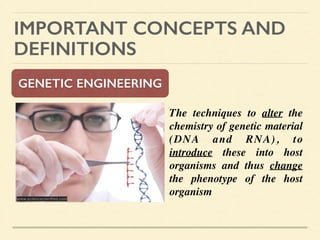
GENETIC ENGINEERING
The techniques to alter the
chemistry of genetic material
(DNA and RNA), to
introduce these into host
organisms and thus change
the phenotype of the host
organism	

www.scienceclarified.com
IMPORTANT CONCEPTS AND
DEFINITIONS
RESTRICTION
ENZYMES
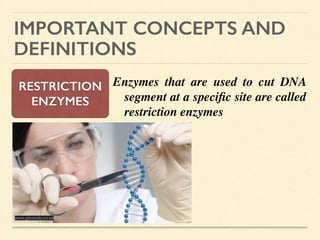
Enzymes that are used to cut DNA
segment at a specific site are called
restriction enzymes 	

www.gizmodo.co.uk
IMPORTANT CONCEPTS AND
DEFINITIONS
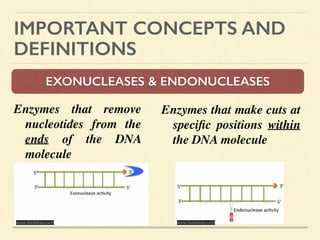
EXONUCLEASES & ENDONUCLEASES
Enzymes that remove
nucleotides from the
ends of the DNA
molecule 	


Enzymes that make cuts at
specific positions within
the DNA molecule 	


www.fastbleep.com www.fastbleep.com
IMPORTANT CONCEPTS AND
DEFINITIONS
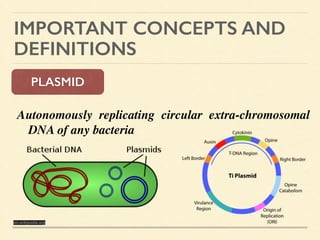
PLASMID
Autonomously replicating circular extra-chromosomal
DNA of any bacteria 	

en.wikipedia.org
IMPORTANT CONCEPTS AND
DEFINITIONS
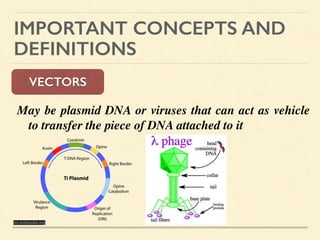
VECTORS
May be plasmid DNA or viruses that can act as vehicle
to transfer the piece of DNA attached to it 	

!
en.wikipedia.org
IMPORTANT CONCEPTS AND
DEFINITIONS
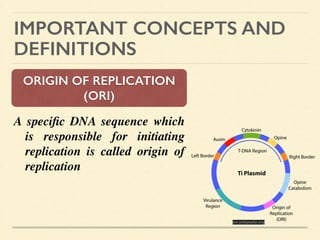
ORIGIN OF REPLICATION
(ORI)
A specific DNA sequence which
is responsible for initiating
replication is called origin of
replication 	


en.wikipedia.org
IMPORTANT CONCEPTS AND
DEFINITIONS
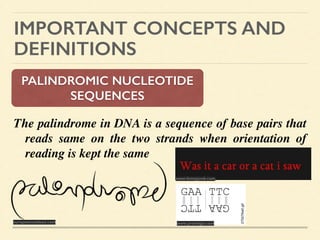
PALINDROMIC NUCLEOTIDE
SEQUENCES
The palindrome in DNA is a sequence of base pairs that
reads same on the two strands when orientation of
reading is kept the same 	


europeisnotdead.com
www.funnyjunk.com
www.promega.com
IMPORTANT CONCEPTS AND
DEFINITIONS
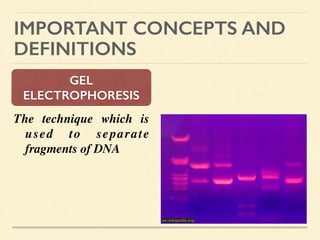
GEL
ELECTROPHORESIS
The technique which is
used to separate
fragments of DNA 	


en.wikipedia.org
IMPORTANT CONCEPTS AND
DEFINITIONS
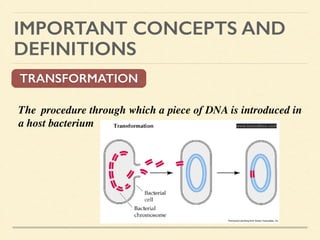
TRANSFORMATION
The 	

procedure through which a piece of DNA is introduced in
a host bacterium 	

!
www.boundless.com
IMPORTANT CONCEPTS AND
DEFINITIONS
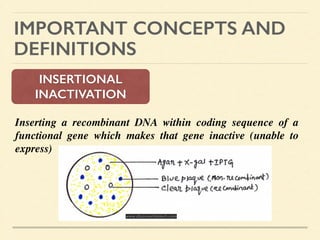
INSERTIONAL
INACTIVATION
Inserting a recombinant DNA within coding sequence of a
functional gene which makes that gene inactive (unable to
express) 	

!
!
www.discoverbiotech.com
IMPORTANT CONCEPTS AND
DEFINITIONS
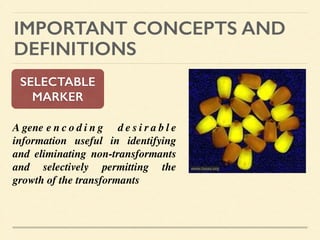
SELECTABLE
MARKER
A gene 	

e n c o d i n g d e s i r a b l e
information useful in identifying
and eliminating non-transformants
and selectively permitting the
growth of the transformants 	

!
!
!
www.isaaa.org
IMPORTANT CONCEPTS AND
DEFINITIONS
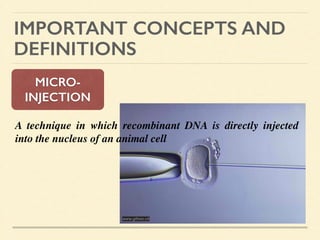
MICRO-
INJECTION
A technique in which recombinant DNA is directly injected
into the nucleus of an animal cell 	

!
!
!
www.gfmer.ch
IMPORTANT CONCEPTS AND
DEFINITIONS
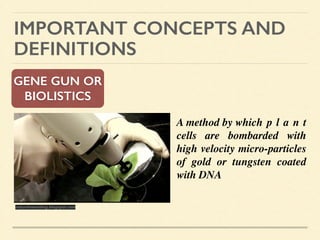
GENE GUN OR
BIOLISTICS
A method by which 	

p l a n t
cells are bombarded with
high velocity micro-particles
of gold or tungsten coated
with DNA 	

!
!
!
!
naturalnewsblog.blogspot.com
IMPORTANT CONCEPTS AND
DEFINITIONS
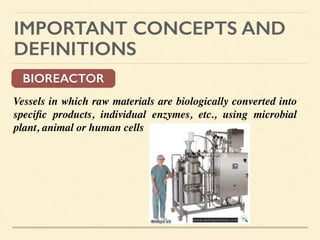
BIOREACTOR
Vessels in which raw materials are biologically converted into
specific products, individual enzymes, etc., using microbial
plant, animal or human cells 	

!
!
!
!
!
www.iaibiopharma.com
LECTURE OUTLINE
Important Concepts
and Definitions
Historical Timeline
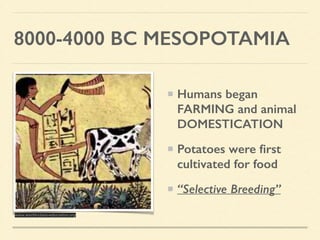
8000-4000 BC MESOPOTAMIA
Humans began
FARMING and animal
DOMESTICATION
Potatoes were first
cultivated for food
“Selective Breeding”
www.world-class-education.org
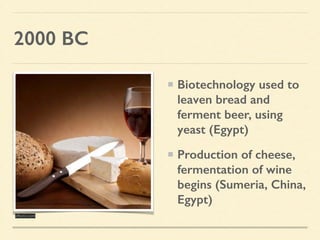
2000 BC
Biotechnology used to
leaven bread and
ferment beer, using
yeast (Egypt)
Production of cheese,
fermentation of wine
begins (Sumeria, China,
Egypt)
dfwnl.com
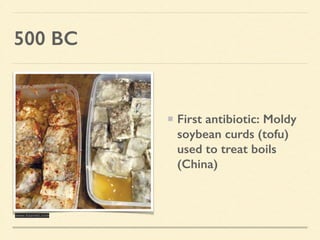
500 BC
First antibiotic: Moldy
soybean curds (tofu)
used to treat boils
(China)
www.haaretz.com
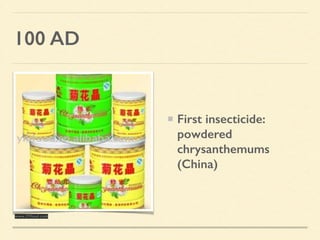
100 AD
First insecticide:
powdered
chrysanthemums
(China)
www.21food.com
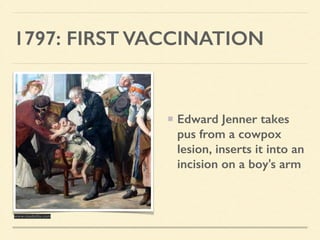
1797: FIRST VACCINATION
Edward Jenner takes
pus from a cowpox
lesion, inserts it into an
incision on a boy's arm
www.medelita.com
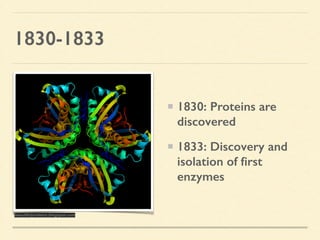
1830-1833
1830: Proteins are
discovered
1833: Discovery and
isolation of first
enzymes
beautifulproteins.blogspot.com
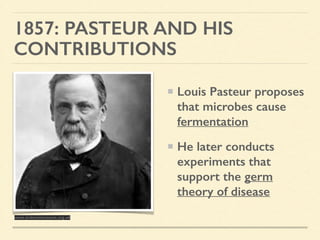
1857: PASTEUR AND HIS
CONTRIBUTIONS
Louis Pasteur proposes
that microbes cause
fermentation
He later conducts
experiments that
support the germ
theory of disease
www.sciencemuseum.org.uk
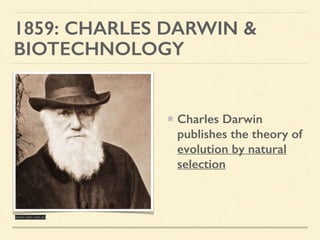
1859: CHARLES DARWIN &
BIOTECHNOLOGY
Charles Darwin
publishes the theory of
evolution by natural
selection
www.abc.net.au
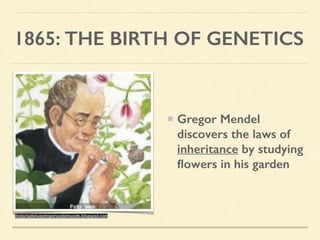
1865: THE BIRTH OF GENETICS
Gregor Mendel
discovers the laws of
inheritance by studying
flowers in his garden
historiadenuestroperuydelmundo.blogspot.com
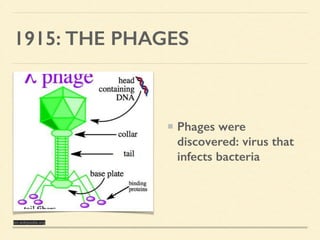
1915: THE PHAGES
Phages were
discovered: virus that
infects bacteria
en.wikipedia.org
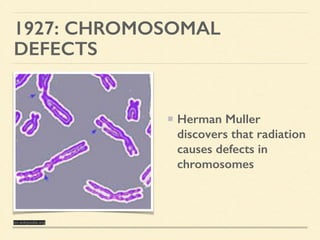
1927: CHROMOSOMAL
DEFECTS
Herman Muller
discovers that radiation
causes defects in
chromosomes
en.wikipedia.org
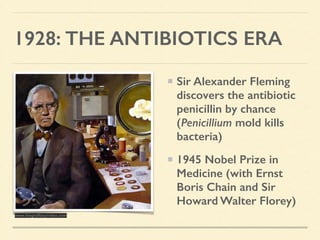
1928: THE ANTIBIOTICS ERA
Sir Alexander Fleming
discovers the antibiotic
penicillin by chance
(Penicillium mold kills
bacteria)
1945 Nobel Prize in
Medicine (with Ernst
Boris Chain and Sir
Howard Walter Florey)
www.biografiasyvidas.com
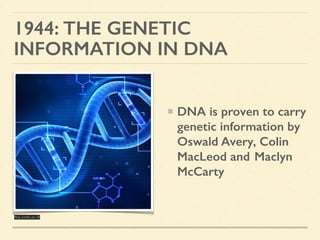
1944: THE GENETIC
INFORMATION IN DNA
DNA is proven to carry
genetic information by
Oswald Avery, Colin
MacLeod and Maclyn
McCarty
fos.cmb.ac.lk
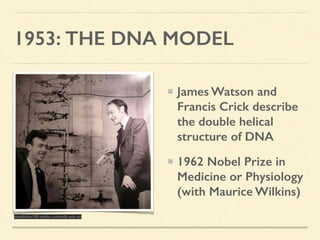
1953: THE DNA MODEL
James Watson and
Francis Crick describe
the double helical
structure of DNA
1962 Nobel Prize in
Medicine or Physiology
(with Maurice Wilkins)
medicine150.mdhs.unimelb.edu.au
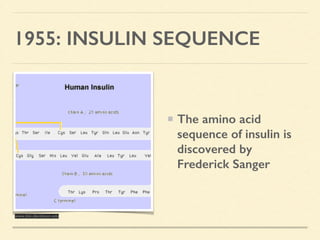
1955: INSULIN SEQUENCE
The amino acid
sequence of insulin is
discovered by
Frederick Sanger
www.bio.davidson.edu
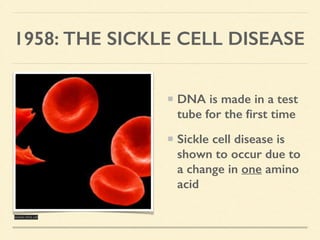
1958: THE SICKLE CELL DISEASE
DNA is made in a test
tube for the first time
Sickle cell disease is
shown to occur due to
a change in one amino
acid
www.nhs.uk
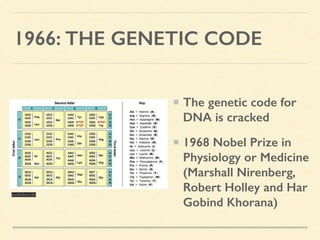
1966: THE GENETIC CODE
audioboo.fm
The genetic code for
DNA is cracked
1968 Nobel Prize in
Physiology or Medicine
(Marshall Nirenberg,
Robert Holley and Har
Gobind Khorana)
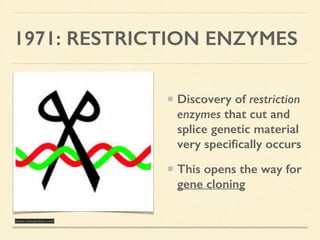
1971: RESTRICTION ENZYMES
Discovery of restriction
enzymes that cut and
splice genetic material
very specifically occurs
This opens the way for
gene cloning
www.simzymes.com
1973-1976: “COPY & PASTE”
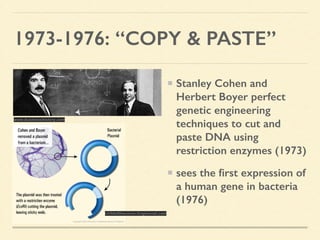
Stanley Cohen and
Herbert Boyer perfect
genetic engineering
techniques to cut and
paste DNA using
restriction enzymes (1973)
sees the first expression of
a human gene in bacteria
(1976)
www.businesshistory.com
childofthecornx.livejournal.com
1975: MONOCLONAL
ANTIBODIES
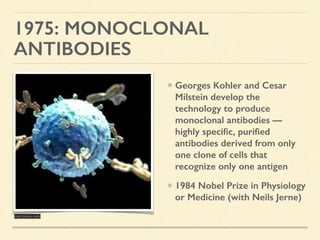
Georges Kohler and Cesar
Milstein develop the
technology to produce
monoclonal antibodies —
highly specific, purified
antibodies derived from only
one clone of cells that
recognize only one antigen
1984 Nobel Prize in Physiology
or Medicine (with Neils Jerne)
iiad.tamu.edu
1981: TRANSGENICS
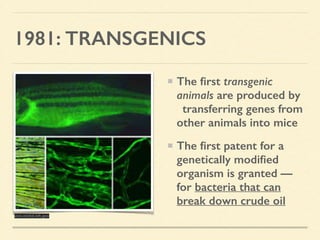
The first transgenic
animals are produced by
transferring genes from
other animals into mice
The first patent for a
genetically modified
organism is granted —
for bacteria that can
break down crude oil
uvo.nichd.nih.gov
1982: GMO INSULIN
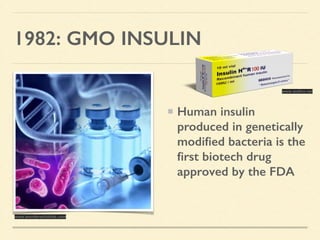
Human insulin
produced in genetically
modified bacteria is the
first biotech drug
approved by the FDA
www.sedico.net
www.wonderwhizkids.com
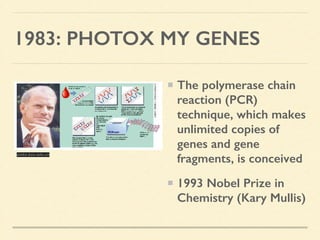
1983: PHOTOX MY GENES
The polymerase chain
reaction (PCR)
technique, which makes
unlimited copies of
genes and gene
fragments, is conceived
1993 Nobel Prize in
Chemistry (Kary Mullis)
smkx.bzu.edu.cn
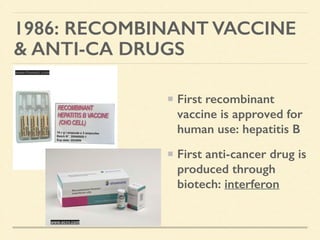
1986: RECOMBINANT VACCINE
& ANTI-CA DRUGS
First recombinant
vaccine is approved for
human use: hepatitis B
First anti-cancer drug is
produced through
biotech: interferon
www.freewtc.com
www.ecvv.com
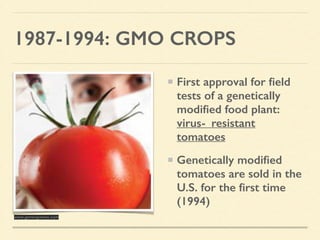
1987-1994: GMO CROPS
First approval for field
tests of a genetically
modified food plant:
virus- resistant
tomatoes
Genetically modified
tomatoes are sold in the
U.S. for the first time
(1994)
www.genengnews.com
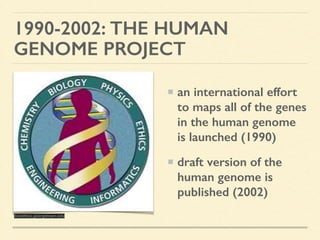
1990-2002: THE HUMAN
GENOME PROJECT
an international effort
to maps all of the genes
in the human genome
is launched (1990)
draft version of the
human genome is
published (2002)
bioethics.georgetown.edu
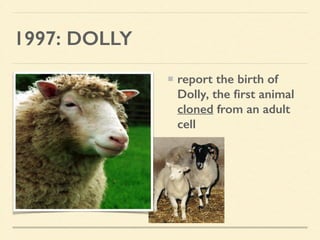
1997: DOLLY
report the birth of
Dolly, the first animal
cloned from an adult
cell
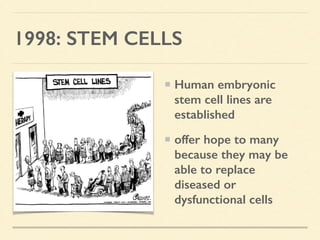
1998: STEM CELLS
Human embryonic
stem cell lines are
established
offer hope to many
because they may be
able to replace
diseased or
dysfunctional cells
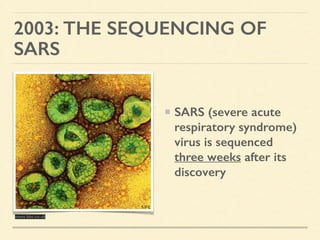
2003: THE SEQUENCING OF
SARS
SARS (severe acute
respiratory syndrome)
virus is sequenced
three weeks after its
discovery
news.bbc.co.uk
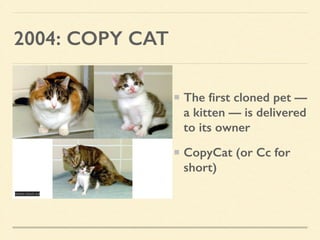
2004: COPY CAT
www.mun.ca
The first cloned pet —
a kitten — is delivered
to its owner
CopyCat (or Cc for
short)
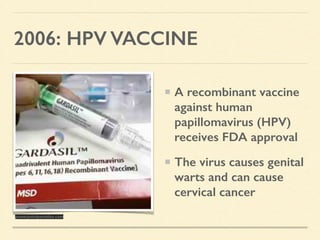
2006: HPV VACCINE
A recombinant vaccine
against human
papillomavirus (HPV)
receives FDA approval
The virus causes genital
warts and can cause
cervical cancer
powerpointparadise.com
AND THE REST….
….IS HISTORY!
QUIZ TIME….
www.happyschool.com.au
NEXT MEETING…
LEVELLING OFF!!!

MMB1 Lecture 1: Introduction to Biotechnology