© Grunt Productions 2007
RADAR PLOTTINGRADAR PLOTTING
A brief by Lance GrindleyA brief by Lance Grindley
© Grunt Productions 2007
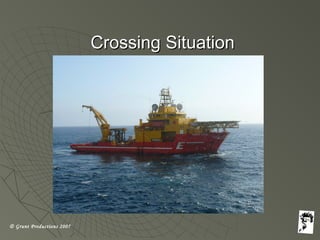
Crossing SituationCrossing Situation
© Grunt Productions 2007
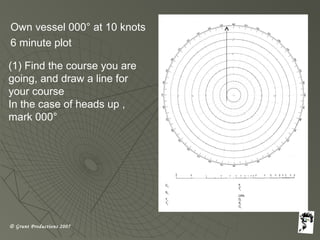
Own vessel 000° at 10 knots
6 minute plot
(1) Find the course you are
going, and draw a line for
your course
In the case of heads up ,
mark 000°
© Grunt Productions 2007
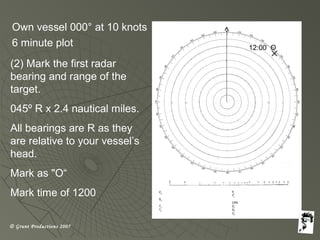
Own vessel 000° at 10 knots
6 minute plot
(2) Mark the first radar
bearing and range of the
target.
045º R x 2.4 nautical miles.
All bearings are R as they
are relative to your vessel’s
head.
Mark as "O“
Mark time of 1200
12:00 O
© Grunt Productions 2007
Own vessel 000° at 10 knots
6 minute plot
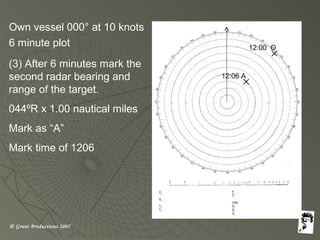
(3) After 6 minutes mark the
second radar bearing and
range of the target.
044ºR x 1.00 nautical miles
Mark as “A”
Mark time of 1206
12:00 O
12:06 A
© Grunt Productions 2007
Own vessel 000° at 10 knots
6 minute plot
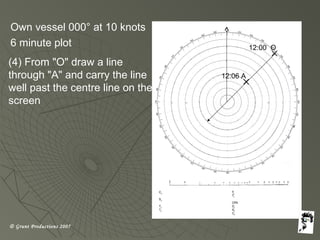
(4) From "O" draw a line
through "A" and carry the line
well past the centre line on the
screen
12:00 O
12:06 A
© Grunt Productions 2007
Own vessel 000° at 10 knots
6 minute plot
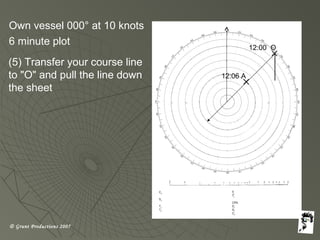
(5) Transfer your course line
to "O" and pull the line down
the sheet
12:00 O
12:06 A
© Grunt Productions 2007
Own vessel 000° at 10 knots
6 minute plot
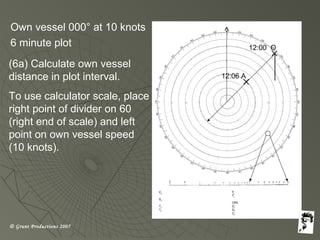
(6a) Calculate own vessel
distance in plot interval.
To use calculator scale, place
right point of divider on 60
(right end of scale) and left
point on own vessel speed
(10 knots).
12:00 O
12:06 A
© Grunt Productions 2007
Own vessel 000° at 10 knots
6 minute plot
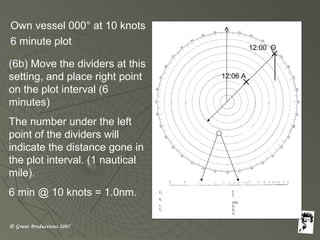
(6b) Move the dividers at this
setting, and place right point
on the plot interval (6
minutes)
The number under the left
point of the dividers will
indicate the distance gone in
the plot interval. (1 nautical
mile).
6 min @ 10 knots = 1.0nm.
12:00 O
12:06 A
© Grunt Productions 2007
Own vessel 000° at 10 knots
6 minute plot
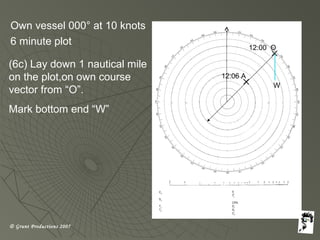
(6c) Lay down 1 nautical mile
on the plot,on own course
vector from “O”.
Mark bottom end “W”
12:00 O
12:06 A
W
© Grunt Productions 2007
Own vessel 000° at 10 knots
6 minute plot
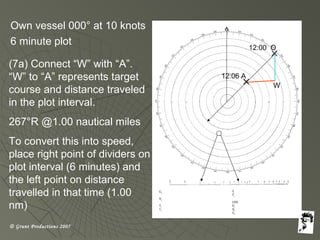
(7a) Connect “W” with “A”.
“W” to “A” represents target
course and distance traveled
in the plot interval.
267°R @1.00 nautical miles
To convert this into speed,
place right point of dividers on
plot interval (6 minutes) and
the left point on distance
travelled in that time (1.00
nm)
12:00 O
12:06 A
W
© Grunt Productions 2007
Own vessel 000° at 10 knots
6 minute plot
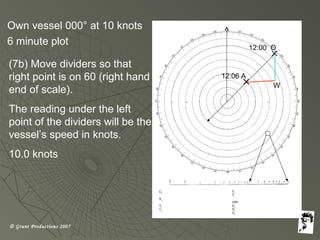
(7b) Move dividers so that
right point is on 60 (right hand
end of scale).
The reading under the left
point of the dividers will be the
vessel’s speed in knots.
10.0 knots
12:00 O
12:06 A
W
© Grunt Productions 2007
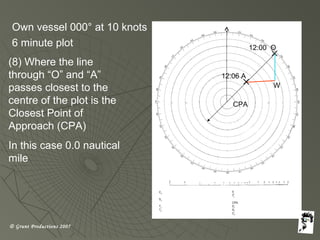
Own vessel 000° at 10 knots
6 minute plot
(8) Where the line
through “O” and “A”
passes closest to the
centre of the plot is the
Closest Point of
Approach (CPA)
In this case 0.0 nautical
mile
12:00 O
12:06 A
W
CPA
© Grunt Productions 2007
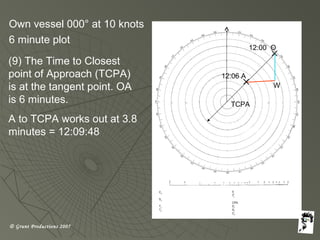
Own vessel 000° at 10 knots
6 minute plot
12:00 O
12:06 A
W
(9) The Time to Closest
point of Approach (TCPA)
is at the tangent point. OA
is 6 minutes.
A to TCPA works out at 3.8
minutes = 12:09:48
TCPA
© Grunt Productions 2007
ResultsResults
In this case, providing neither you nor theIn this case, providing neither you nor the
target vessel alter course or speed:target vessel alter course or speed:
 the target vessel is proceeding at 000° +the target vessel is proceeding at 000° +
267° = 267°C at 10.0 knots267° = 267°C at 10.0 knots
 CPA is at 12:09:48 at a with a collision.CPA is at 12:09:48 at a with a collision.
© Grunt Productions 2007
Results – Clear VisibilityResults – Clear Visibility
 In clear visibility, you are in a crossingIn clear visibility, you are in a crossing
situation with other vessel on yoursituation with other vessel on your
starboard side, and therefore you are thestarboard side, and therefore you are the
give way vessel.give way vessel.
 There is risk of collision. You MUST takeThere is risk of collision. You MUST take
action which should involve a boldaction which should involve a bold
alteration to starboard, and/or a reductionalteration to starboard, and/or a reduction
in speed, until the other vessel is past andin speed, until the other vessel is past and
clear.clear.
© Grunt Productions 2007
Crossing SituationCrossing Situation
 If however at 1206 you acknowledge theIf however at 1206 you acknowledge the
other vessel is on a steady bearing, youother vessel is on a steady bearing, you
can stop and assess the situation.can stop and assess the situation.
 The plot will then change to:The plot will then change to:
© Grunt Productions 2007
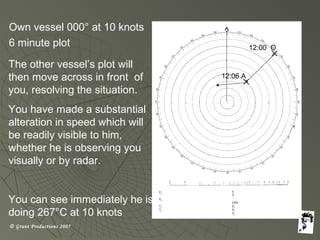
Own vessel 000° at 10 knots
6 minute plot
The other vessel’s plot will
then move across in front of
you, resolving the situation.
You have made a substantial
alteration in speed which will
be readily visible to him,
whether he is observing you
visually or by radar.
You can see immediately he is
doing 267°C at 10 knots
12:00 O
12:06 A

Radar plotting lrg

  • 1.
    © Grunt Productions2007 RADAR PLOTTINGRADAR PLOTTING A brief by Lance GrindleyA brief by Lance Grindley
  • 2.
    © Grunt Productions2007 Crossing SituationCrossing Situation
  • 3.
    © Grunt Productions2007 Own vessel 000° at 10 knots 6 minute plot (1) Find the course you are going, and draw a line for your course In the case of heads up , mark 000°
  • 4.
    © Grunt Productions2007 Own vessel 000° at 10 knots 6 minute plot (2) Mark the first radar bearing and range of the target. 045º R x 2.4 nautical miles. All bearings are R as they are relative to your vessel’s head. Mark as "O“ Mark time of 1200 12:00 O
  • 5.
    © Grunt Productions2007 Own vessel 000° at 10 knots 6 minute plot (3) After 6 minutes mark the second radar bearing and range of the target. 044ºR x 1.00 nautical miles Mark as “A” Mark time of 1206 12:00 O 12:06 A
  • 6.
    © Grunt Productions2007 Own vessel 000° at 10 knots 6 minute plot (4) From "O" draw a line through "A" and carry the line well past the centre line on the screen 12:00 O 12:06 A
  • 7.
    © Grunt Productions2007 Own vessel 000° at 10 knots 6 minute plot (5) Transfer your course line to "O" and pull the line down the sheet 12:00 O 12:06 A
  • 8.
    © Grunt Productions2007 Own vessel 000° at 10 knots 6 minute plot (6a) Calculate own vessel distance in plot interval. To use calculator scale, place right point of divider on 60 (right end of scale) and left point on own vessel speed (10 knots). 12:00 O 12:06 A
  • 9.
    © Grunt Productions2007 Own vessel 000° at 10 knots 6 minute plot (6b) Move the dividers at this setting, and place right point on the plot interval (6 minutes) The number under the left point of the dividers will indicate the distance gone in the plot interval. (1 nautical mile). 6 min @ 10 knots = 1.0nm. 12:00 O 12:06 A
  • 10.
    © Grunt Productions2007 Own vessel 000° at 10 knots 6 minute plot (6c) Lay down 1 nautical mile on the plot,on own course vector from “O”. Mark bottom end “W” 12:00 O 12:06 A W
  • 11.
    © Grunt Productions2007 Own vessel 000° at 10 knots 6 minute plot (7a) Connect “W” with “A”. “W” to “A” represents target course and distance traveled in the plot interval. 267°R @1.00 nautical miles To convert this into speed, place right point of dividers on plot interval (6 minutes) and the left point on distance travelled in that time (1.00 nm) 12:00 O 12:06 A W
  • 12.
    © Grunt Productions2007 Own vessel 000° at 10 knots 6 minute plot (7b) Move dividers so that right point is on 60 (right hand end of scale). The reading under the left point of the dividers will be the vessel’s speed in knots. 10.0 knots 12:00 O 12:06 A W
  • 13.
    © Grunt Productions2007 Own vessel 000° at 10 knots 6 minute plot (8) Where the line through “O” and “A” passes closest to the centre of the plot is the Closest Point of Approach (CPA) In this case 0.0 nautical mile 12:00 O 12:06 A W CPA
  • 14.
    © Grunt Productions2007 Own vessel 000° at 10 knots 6 minute plot 12:00 O 12:06 A W (9) The Time to Closest point of Approach (TCPA) is at the tangent point. OA is 6 minutes. A to TCPA works out at 3.8 minutes = 12:09:48 TCPA
  • 15.
    © Grunt Productions2007 ResultsResults In this case, providing neither you nor theIn this case, providing neither you nor the target vessel alter course or speed:target vessel alter course or speed:  the target vessel is proceeding at 000° +the target vessel is proceeding at 000° + 267° = 267°C at 10.0 knots267° = 267°C at 10.0 knots  CPA is at 12:09:48 at a with a collision.CPA is at 12:09:48 at a with a collision.
  • 16.
    © Grunt Productions2007 Results – Clear VisibilityResults – Clear Visibility  In clear visibility, you are in a crossingIn clear visibility, you are in a crossing situation with other vessel on yoursituation with other vessel on your starboard side, and therefore you are thestarboard side, and therefore you are the give way vessel.give way vessel.  There is risk of collision. You MUST takeThere is risk of collision. You MUST take action which should involve a boldaction which should involve a bold alteration to starboard, and/or a reductionalteration to starboard, and/or a reduction in speed, until the other vessel is past andin speed, until the other vessel is past and clear.clear.
  • 17.
    © Grunt Productions2007 Crossing SituationCrossing Situation  If however at 1206 you acknowledge theIf however at 1206 you acknowledge the other vessel is on a steady bearing, youother vessel is on a steady bearing, you can stop and assess the situation.can stop and assess the situation.  The plot will then change to:The plot will then change to:
  • 18.
    © Grunt Productions2007 Own vessel 000° at 10 knots 6 minute plot The other vessel’s plot will then move across in front of you, resolving the situation. You have made a substantial alteration in speed which will be readily visible to him, whether he is observing you visually or by radar. You can see immediately he is doing 267°C at 10 knots 12:00 O 12:06 A