COLLEGE OF MARINE TRANSPORTATION
INTRODUCTION
TO
MARINE TRANSPORTATION
WHAT IS BACHELOR OF SCIENCE IN MARINE
TRANSPORTATION (BSMT)?
Bachelor of Science in Marine Transportation (BSMT) is a
four-year undergraduate degree program which leads to a
professional career in the maritime industry, as a marine
deck officer.
Through this program, the students will be able to acquire
the necessary skills and knowledge needed to accomplish
their future duties and responsibilities of a marine officer,
and will be exposed to theories and practices in
seamanship, navigation, ship business, meteorology, and
marine laws.
The student is exposed to a substantive amassing of
technical knowledge with concentrations on the theories
and practices of navigation, seamanship, meteorology,
ship business, marine laws and other marine related
subjects.
The thrust of the Bachelor of Science in Marine
Transportation (BSMT) course is towards providing the
shipping industry with technically knowledgeable,
vigorous, and disciplined Marine Deck Officers essential
to the profession.
Generously complimented with hands-on training on
various laboratories and simulator training equipment as
well as mathematical and cultural subjects designed to
mold the student into a dynamic and productive member
of the society.
. The Bachelor of Science in Marine Transportation
is taught through classroom-based frontal instructions,
regular hands-on trainings usually conducted in special
laboratories, as well as simulation activities regarding
the use of modern ship equipment like the RADAR,
ARPA, ECDIS and GMDSS communications equipment.
After successfully completing the three-year academic
requirements, the student is qualified for the mandatory
one-year supervised shipboard training onboard a
coastwise or international vessel as deck cadet. Upon
return from shipboard training and after passing
evaluation, the students graduates with the degree of
Bachelor of Science in Marine Transportation.
Some of the subjects taught in this program include:
• Ship Handling and Maneuvering
• Ships, Ship Routines, and Construction
• Cargo Handling and Storage (Dangerous & Non-dangerous goods)
• Leadership and Teamwork
• Meteorology and Oceanography 1 & 2
• Maritime Communication
• Navigation Instruments w/ Compasses
• Terrestrial and Coastal Navigation 1 & 2
• Celestial Navigation
• Operational use of RADAR/ARPA
• Operational use of ECDIS
• Collision Regulation (Deck Watchkeeping 1)
• Deck Watchkeeping 2
• Basic Safety
• Maritime Law
• Marine Environment
• Voyage Planning
• Basic Marine Engineering
NAVIGATION
Marine navigation blends both science and art. A good
navigator constantly thinks strategically, operationally, and
tactically. He plans each voyage carefully.
As it proceeds, he gathers navigational information
from a variety of sources, evaluates this information, and
determines his ship’s position.
The word “navigate” is derived from the Latin words
Navis, meaning ship, and agere - meaning to move or direct.
Navigation is defined as the art and science of
conducting the movements of a vessel from one place to
another safely and efficiently along the surface of the water
within the least possible time and of accurately determining
the position of the ship at anytime desired.
Commonly recognized types of Navigation are:
1. Dead Reckoning
2. Piloting
3. Celestial Navigation
4. Radar Navigation
5. Electronic Navigation
1. Dead reckoning (DR) determines position by advancing a
known position for courses and distances. A position so
determined is called a dead reckoning (DR) position. It is
generally accepted that only course and speed determine the
DR position. Correcting the DR position for leeway, current
effects, and steering error result in an estimated position
(EP).
2. Piloting involves navigating in restricted waters with
frequent or constant determination of position relative
to nearby geographic and hydrographic features.
3. Celestial navigation involves reducing celestial
measurements taken with a sextant to lines of position
using calculators or computer programs, or by hand with
almanacs and tables or using spherical trigonometry.
4. Radar navigation uses radar to determine the distance
from or bearing of objects whose position is known. This
process is separate from radar’s use in collision
avoidance.
5. Satellite navigation uses radio signals from satellites for
determining position.
Phases of Navigation
Four distinct phases define the navigation process.
1. Inland Waterway Phase: Piloting in narrow canals,
channels, rivers, and estuaries.
2. Harbor/Harbor Approach Phase: Navigating to a
harbor entrance through bays and sounds, and
negotiating harbor approach channels.
3. Coastal Phase: Navigating within 50 miles of the coast
or inshore of the 200 meter depth contour.
4. Ocean Phase: Navigating outside the coastal area in
the open sea. The navigator’s position accuracy
requirements, his fix interval, and his systems
requirements differ in each phase. The following table
can be used as a general guide for selecting the proper
system(s).
BASIC TERMS
• Distance - as customarily used by the navigators, refers to the
length of the rhumb connecting two places and expressed in
nautical miles.
• Knot - is a unit of speed. One knot means “a speed of one
nautical mile per hour”.
• Nautical Mile - is the unit of distance used by navigators at sea
and in the air. For most practical purposes it is considered to
be a length of 6,080 feet or 1,852 meters.
• Statute mile or land mile - is not generally used in navigation,
but navigators may. It is a unit of distance equal to 5,280 feet.
• Great Circle Track – is the arc contained or any part of a great
circle track. It is the shortest distance between two places on
the earth surface.
• Rhumbline – a line on the surface of the earth that cuts all the
meridian of the same angle.
• Heading – is the direction in which a vessel is
pointing, expressed as angular distance from north
usually from 0000
at north, clockwise through 3600
.
• Course is the direction of movement of the
observer.
• Bearing (B, Brg) – is the direction of one terrestrial
point from another, expressed as angular distance
from a reference direction, usually from 0000
at
reference direction, clockwise through 3600
.
• Azimuth – is used exclusively for reference to
horizontal direction of a point on the celestial
sphere from a point on the earth. Bearing and
azimuth are sometimes used interchangeably
TWO TYPES OF BEARING:
1. True Bearing (T/B) – is measured from the
true north. It is measured from the 0000
at the
true north, clockwise to 3600
.
2. Relative Bearing (R/B) – is one relative to the
heading or the vessel itself. It is measured from
the 0000
at the ship’s heading, clockwise to 3600
.
THE COMPASS
Compass is an instrument designed for the measurement of
direction.
To measure direction correctly the zero point of the compass
must point towards the direction of the north pole.
It is graduated from 0 to 360 degrees clockwise.
The compass is divided into thirty two (32) points. Each point is
equivalent to 11.250
.
It is also divided into four quadrants:
a. NE’LY or 1st
quadrant,
b. SE’LY or 2nd
quadrant,
c. SW’LY or 3rd
quadrant, and
d. NW’LY or 4th
quadrant.
Each quadrant consists of eight (8) points
FOUR CARDINAL POINTS OF THE COMPASS:
1. North (00
)
2. East (900
)
3. South (1800
)
4. West (2700
)
FOUR INTERCARDINAL POINTS OF THE COMPASS:
1. Northeast (NE - 450
)
2. Southeast (SE - 1350
)
3. Southwest (SW - 2250
)
4. Northwest (NW - 3150
)
Boxing the compass
First Quadrant
North (N)
North by East (NXE)
North, Northeast (NNE)
Northeast by North (NEXN)
Northeast (NE)
Northeast by East (NEXE)
East, Northeast (ENE)
East by North (EXN)
Second Quadrant
Eest (E)
East by South (EXS)
East, Southeast (ESE)
Southeast by East (SEXE)
Southeast (SE)
Southeast by South (SEXS)
South, Southeast SSE
S X E
Boxing the compass
Third Quadrant
South (S)
South by West (SXW)
South, Southwest (SSW)
Southwest by South (SWXS)
Southwest (SW)
Southwest by West (SWXW)
West, Southwest (WSW)
West by South (WXS)
Fourth Quadrant
West (W)
West by North (WXN)
West, Northwest (WNW)
Northwest by West (NWXW)
Northwest (NW)
Northwest by North (NWXN)
North, Northwest (NNW)
North by West (NXW)
SEAMANSHIP
Seamanship is the skills of seaman onboard ship.
BASIC SEAMANSHIP TERMINOLOGIES:
Sailors use many traditional nautical terms for the parts of or
directions on a vessel;
• starboard (right),
• port (left),
• forward or fore (front),
• aft (rearward),
• bow (forward part of the hull),
• stern (aft part of the hull),
• Mast are vertical spars,
• Booms are horizontal spars
• Walls are called 'bulkheads'
• 'ceilings' are called 'overheads'.
• Floors are called ‘deck'.
• The toilet is traditionally called the 'head',
• The kitchen is the 'galley‘
• "Pooped" refers to the aftermost deck of a ship, taken
from "puppis" the Latin word for "stern".
• Port holes are windows
• Hospital or clinic is sickbay
• Stairways are ladders
PARTS OF THE SHIP
• Aft – in or toward the back of a ship
• Amidships – in the middle part of a ship
• Beam – the widest part of a ship from one side to the other
• Bow – the front part of a ship
• Bridge – the part of the ship from which it is controlled
• Bulwark – the ship of the ship above the deck
• Cabin – a room on the ship for passengers or crew
• Capstans – a round piece of equipment that you turn to wind heavy
rope, especially on a ship or at a port
• Cleat – a metal object that you can tie a rope around in order to fasten
something in place, especially on a ship
• Crow’s nest – a place near the top of a ship’s mast where a sailor
stands to look-out over the ocean
• Deck – the outside top part of a ship that you can walk on
• Fender – a piece of a rope or tire that protects the side of a ship from
knock
• Forecastle – the elevated deck on the forward part of the ship
• Funnel – the tube that lets out smoke and steam from the engine of
a ship
• Galley – the kitchen of a ship
• Gangplank – a long narrow board that you put between to ships, so
that you can walk across
• Gangway – a flat board or metal structure that can be put in place
between the ship and the land to let people get off and on the ship
• Gunwale – the upper edge of the side of a ship
• Hawser – a heavy cable or rope that is used for tying up or pulling a
ship
• Helm – a wheel or handle used for making a boat go in the direction
you want
• Hull – a part of a ship that floats on the water or the body of a ship
• Keel – the backbone on a ship
• Main deck – the highest continuous deck exposed to weather
• Muster station – a place where people should gather if there is an
emergency
• Port side – the side of the ship that is on your left side when you are
looking forward
• Port hole – a small window in the side of the ship
• Propeller – a piece of equipment with blades that spin, used for
moving a ship
• Rudder – a flat piece of metal at back of the ship that is move to
change the direction of travel
• Sickbay – a room where sick people go to rest and get medical
treatment on a ship
• Side – the edge of the ship
• Starboard side – the right side of the as seen by someone who is
looking toward the front
• Stern – the back part of the ship
• Superstructure – the part of the ship that is above the main
deck, it is where the accommodation spaces are located
• Waterline – the highest point where water touches the side
of the ship
• Wheel house – a room on the ship where the helm, controls
and other navigational equipment are located
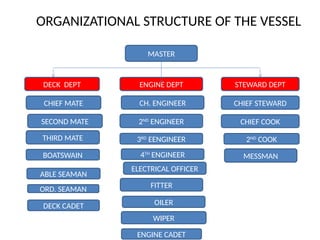
ORGANIZATIONAL STRUCTURE OF THE VESSEL
MASTER
DECK DEPT STEWARD DEPT
ENGINE DEPT
CHIEF MATE
SECOND MATE
THIRD MATE
BOATSWAIN
ABLE SEAMAN
ORD. SEAMAN
CHIEF STEWARD
CHIEF COOK
2ND
COOK
CH. ENGINEER
3RD
EENGINEER
2ND
ENGINEER
4TH
ENGINEER
ELECTRICAL OFFICER
DECK CADET OILER
WIPER
FITTER
ENGINE CADET
MESSMAN
CAPTAIN or MASTER
• Over-all in Command of the vessel.
• Oversee the entire operations of the
ship.
• Supervise the work of other officers
and crew on board.
DECK DEPARTMENT
The deck department in-charge deck operation of the ship
Chief Officer/ First Mate
• head of the deck department,
• Second in command
• In-charge of cargo operation of the ship
• supervises the deck crew and ensures that personnel are working in
coordination with the boatswain.
• At sea, stand on watch from 0400H-0800H and 1600H-2000H.
Second Officer/Second Mate
• the navigating officer, prepares the voyage plan
• responsible for the navigational chart and nautical publications
• responsible for maintaining navigational equipment on the bridge.
• Act as medical officer
• At sea, stand on watch from 0000H-0400H and 1200H-1600H
Third Officer/Third Mate
• Acts as the safety officer of a ship
• responsible for the maintenance of life-saving apparatus and fire-
fighting equipment.
• At sea, stand on watch from 0800H-1200H and 2000H-2400H
Boatswain
• acts as a foreman of the unlicensed deck crew, directly reporting to the
chief officer
• A senior Able Seaman is usually considered for this position.
• Reasonable English skill is desired for this position.
Able Seaman
• works as a watchstander or a day worker, depending on the
requirement on the ship.
• When the ship is not moving, he may be asked to perform security
related watches.
• Acts as helmsman when needed.
• Reasonable English skill is desired.
Ordinary Seaman
• Ordinary Seaman or OS is an entry-level position in the deck
department.
• performs various general duties within the deck department.
His duties include taking care of general needs of the crew
and guarding the ship while in port.
• This position has a possibility for promotion to Able Seaman.
Deck Cadet / apprentice officer
• provides assistance in various duties on a merchant ship, such
as maintenance and minor repair duties.
• This level is necessary for further career development in deck
department.
• This is the entry-level position that requires no previous
working experience.
ENGINE DEPARTMENT
The Engine Department onboard a merchant ship is
responsible for all maintenance and repairs of engines,
electric motors, pumps, winches and other mechanical
and electrical equipment.
Chief Engineer
• Head of the engine department, oversees the entire
operations of the engine department.
• responsible for operations and maintenance work of
all engineering equipment throughout the ship.
• reports to the captain of the ship.
Second Engineer
He/she is responsible for maintenance of the main engine and repair
of all electrical and mechanical equipment within the engine room
and other areas of the ship.
Third Engineer
He/she is responsible for maintenance and repair of the auxiliary
engines and boilers.
Fourth Engineer
He/she is responsible for maintenance and repair of all pumps and
compressor.
Engine Cadet
Reporting to the second engineer, an engine cadet assists senior
engineers in carrying out daily maintenance and repair works within
the engine room. No prior experience is required for this position.
Electrical Engineer
Electrical engineer is responsible for maintenance of all the electrical
equipment on a ship such as motors, switchboards, fire detectors,
navigational lights, batteries etc. He assists ship's deck officer and
engineer in all kind of electrical malfunctions.
Fitter
Fitter is responsible for daily maintenance and minor repairs of all
mechanical equipment onboard the ship.
Oiler
Oiler lubricates moving components of the engines and their auxiliary
equipment and monitors the condition and oil level in the engines.
Wiper
Wiper is responsible for general duties within the engine department
such as cleaning of engine room and various tools and equipment. No
prior experience required for this position.
STEWARD DEPARTEMNT
The steward department is responsible for preparation and serving of foods to the
crew on board of a ship.
Chief Steward
Chief Steward oversees the entire operations within the steward department of a
ship. He/she assigns daily duties to catering personnel such as preparing and
serving food, cleaning the catering area, and receiving, issuing, and inventorying
the stores. He/she is also responsible for preparing daily food menu.
Chief Cook
The chief cook oversees all the food preparation and quality control in the
Steward's department of a ship.
Second Cook
Second Cook supervises the food preparation and quality control
Messman
Messman undertakes various duties within the catering department such as
cleaning and maintenance of the galley, cleaning and storage of dishes, cutlery,
pots and saucepans on board the ship. No prior experience required for this
position.
DIFFERENT TYPES OF SHIP
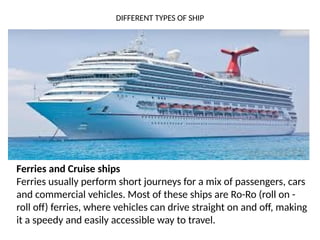
Ferries and Cruise ships
Ferries usually perform short journeys for a mix of passengers, cars
and commercial vehicles. Most of these ships are Ro-Ro (roll on -
roll off) ferries, where vehicles can drive straight on and off, making
it a speedy and easily accessible way to travel.
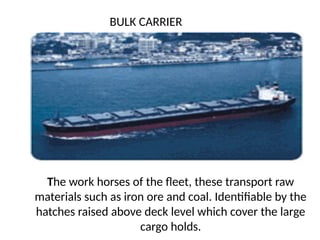
The work horses of the fleet, these transport raw
materials such as iron ore and coal. Identifiable by the
hatches raised above deck level which cover the large
cargo holds.
BULK CARRIER
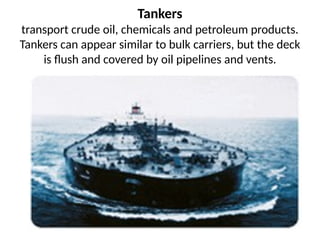
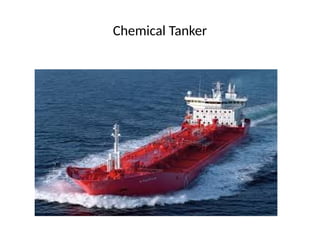
Tankers
transport crude oil, chemicals and petroleum products.
Tankers can appear similar to bulk carriers, but the deck
is flush and covered by oil pipelines and vents.
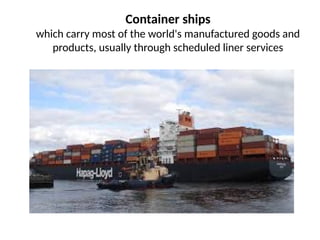
Container ships
which carry most of the world's manufactured goods and
products, usually through scheduled liner services
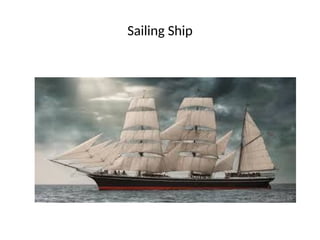
Sailing Ship
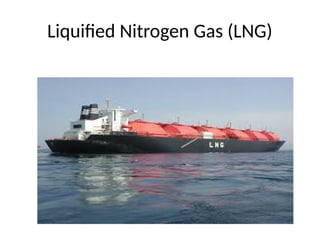
Liquified Nitrogen Gas (LNG)
Chemical Tanker
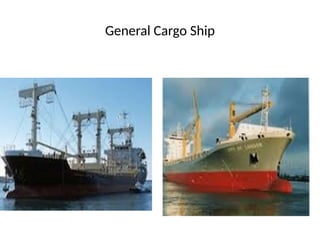
General Cargo Ship

Introduction to Maritime Transportations

  • 1.
    COLLEGE OF MARINETRANSPORTATION INTRODUCTION TO MARINE TRANSPORTATION
  • 2.
    WHAT IS BACHELOROF SCIENCE IN MARINE TRANSPORTATION (BSMT)? Bachelor of Science in Marine Transportation (BSMT) is a four-year undergraduate degree program which leads to a professional career in the maritime industry, as a marine deck officer. Through this program, the students will be able to acquire the necessary skills and knowledge needed to accomplish their future duties and responsibilities of a marine officer, and will be exposed to theories and practices in seamanship, navigation, ship business, meteorology, and marine laws.
  • 3.
    The student isexposed to a substantive amassing of technical knowledge with concentrations on the theories and practices of navigation, seamanship, meteorology, ship business, marine laws and other marine related subjects. The thrust of the Bachelor of Science in Marine Transportation (BSMT) course is towards providing the shipping industry with technically knowledgeable, vigorous, and disciplined Marine Deck Officers essential to the profession. Generously complimented with hands-on training on various laboratories and simulator training equipment as well as mathematical and cultural subjects designed to mold the student into a dynamic and productive member of the society.
  • 4.
    . The Bachelorof Science in Marine Transportation is taught through classroom-based frontal instructions, regular hands-on trainings usually conducted in special laboratories, as well as simulation activities regarding the use of modern ship equipment like the RADAR, ARPA, ECDIS and GMDSS communications equipment. After successfully completing the three-year academic requirements, the student is qualified for the mandatory one-year supervised shipboard training onboard a coastwise or international vessel as deck cadet. Upon return from shipboard training and after passing evaluation, the students graduates with the degree of Bachelor of Science in Marine Transportation.
  • 5.
    Some of thesubjects taught in this program include: • Ship Handling and Maneuvering • Ships, Ship Routines, and Construction • Cargo Handling and Storage (Dangerous & Non-dangerous goods) • Leadership and Teamwork • Meteorology and Oceanography 1 & 2 • Maritime Communication • Navigation Instruments w/ Compasses • Terrestrial and Coastal Navigation 1 & 2 • Celestial Navigation • Operational use of RADAR/ARPA • Operational use of ECDIS • Collision Regulation (Deck Watchkeeping 1) • Deck Watchkeeping 2 • Basic Safety • Maritime Law • Marine Environment • Voyage Planning • Basic Marine Engineering
  • 6.
    NAVIGATION Marine navigation blendsboth science and art. A good navigator constantly thinks strategically, operationally, and tactically. He plans each voyage carefully. As it proceeds, he gathers navigational information from a variety of sources, evaluates this information, and determines his ship’s position. The word “navigate” is derived from the Latin words Navis, meaning ship, and agere - meaning to move or direct. Navigation is defined as the art and science of conducting the movements of a vessel from one place to another safely and efficiently along the surface of the water within the least possible time and of accurately determining the position of the ship at anytime desired.
  • 7.
    Commonly recognized typesof Navigation are: 1. Dead Reckoning 2. Piloting 3. Celestial Navigation 4. Radar Navigation 5. Electronic Navigation 1. Dead reckoning (DR) determines position by advancing a known position for courses and distances. A position so determined is called a dead reckoning (DR) position. It is generally accepted that only course and speed determine the DR position. Correcting the DR position for leeway, current effects, and steering error result in an estimated position (EP).
  • 8.
    2. Piloting involvesnavigating in restricted waters with frequent or constant determination of position relative to nearby geographic and hydrographic features. 3. Celestial navigation involves reducing celestial measurements taken with a sextant to lines of position using calculators or computer programs, or by hand with almanacs and tables or using spherical trigonometry. 4. Radar navigation uses radar to determine the distance from or bearing of objects whose position is known. This process is separate from radar’s use in collision avoidance. 5. Satellite navigation uses radio signals from satellites for determining position.
  • 9.
    Phases of Navigation Fourdistinct phases define the navigation process. 1. Inland Waterway Phase: Piloting in narrow canals, channels, rivers, and estuaries. 2. Harbor/Harbor Approach Phase: Navigating to a harbor entrance through bays and sounds, and negotiating harbor approach channels. 3. Coastal Phase: Navigating within 50 miles of the coast or inshore of the 200 meter depth contour. 4. Ocean Phase: Navigating outside the coastal area in the open sea. The navigator’s position accuracy requirements, his fix interval, and his systems requirements differ in each phase. The following table can be used as a general guide for selecting the proper system(s).
  • 10.
    BASIC TERMS • Distance- as customarily used by the navigators, refers to the length of the rhumb connecting two places and expressed in nautical miles. • Knot - is a unit of speed. One knot means “a speed of one nautical mile per hour”. • Nautical Mile - is the unit of distance used by navigators at sea and in the air. For most practical purposes it is considered to be a length of 6,080 feet or 1,852 meters. • Statute mile or land mile - is not generally used in navigation, but navigators may. It is a unit of distance equal to 5,280 feet. • Great Circle Track – is the arc contained or any part of a great circle track. It is the shortest distance between two places on the earth surface. • Rhumbline – a line on the surface of the earth that cuts all the meridian of the same angle.
  • 11.
    • Heading –is the direction in which a vessel is pointing, expressed as angular distance from north usually from 0000 at north, clockwise through 3600 . • Course is the direction of movement of the observer. • Bearing (B, Brg) – is the direction of one terrestrial point from another, expressed as angular distance from a reference direction, usually from 0000 at reference direction, clockwise through 3600 . • Azimuth – is used exclusively for reference to horizontal direction of a point on the celestial sphere from a point on the earth. Bearing and azimuth are sometimes used interchangeably
  • 12.
    TWO TYPES OFBEARING: 1. True Bearing (T/B) – is measured from the true north. It is measured from the 0000 at the true north, clockwise to 3600 . 2. Relative Bearing (R/B) – is one relative to the heading or the vessel itself. It is measured from the 0000 at the ship’s heading, clockwise to 3600 .
  • 13.
    THE COMPASS Compass isan instrument designed for the measurement of direction. To measure direction correctly the zero point of the compass must point towards the direction of the north pole. It is graduated from 0 to 360 degrees clockwise. The compass is divided into thirty two (32) points. Each point is equivalent to 11.250 . It is also divided into four quadrants: a. NE’LY or 1st quadrant, b. SE’LY or 2nd quadrant, c. SW’LY or 3rd quadrant, and d. NW’LY or 4th quadrant. Each quadrant consists of eight (8) points
  • 14.
    FOUR CARDINAL POINTSOF THE COMPASS: 1. North (00 ) 2. East (900 ) 3. South (1800 ) 4. West (2700 ) FOUR INTERCARDINAL POINTS OF THE COMPASS: 1. Northeast (NE - 450 ) 2. Southeast (SE - 1350 ) 3. Southwest (SW - 2250 ) 4. Northwest (NW - 3150 )
  • 15.
    Boxing the compass FirstQuadrant North (N) North by East (NXE) North, Northeast (NNE) Northeast by North (NEXN) Northeast (NE) Northeast by East (NEXE) East, Northeast (ENE) East by North (EXN) Second Quadrant Eest (E) East by South (EXS) East, Southeast (ESE) Southeast by East (SEXE) Southeast (SE) Southeast by South (SEXS) South, Southeast SSE S X E
  • 16.
    Boxing the compass ThirdQuadrant South (S) South by West (SXW) South, Southwest (SSW) Southwest by South (SWXS) Southwest (SW) Southwest by West (SWXW) West, Southwest (WSW) West by South (WXS) Fourth Quadrant West (W) West by North (WXN) West, Northwest (WNW) Northwest by West (NWXW) Northwest (NW) Northwest by North (NWXN) North, Northwest (NNW) North by West (NXW)
  • 17.
    SEAMANSHIP Seamanship is theskills of seaman onboard ship. BASIC SEAMANSHIP TERMINOLOGIES: Sailors use many traditional nautical terms for the parts of or directions on a vessel; • starboard (right), • port (left), • forward or fore (front), • aft (rearward), • bow (forward part of the hull), • stern (aft part of the hull), • Mast are vertical spars, • Booms are horizontal spars
  • 18.
    • Walls arecalled 'bulkheads' • 'ceilings' are called 'overheads'. • Floors are called ‘deck'. • The toilet is traditionally called the 'head', • The kitchen is the 'galley‘ • "Pooped" refers to the aftermost deck of a ship, taken from "puppis" the Latin word for "stern". • Port holes are windows • Hospital or clinic is sickbay • Stairways are ladders
  • 19.
    PARTS OF THESHIP • Aft – in or toward the back of a ship • Amidships – in the middle part of a ship • Beam – the widest part of a ship from one side to the other • Bow – the front part of a ship • Bridge – the part of the ship from which it is controlled • Bulwark – the ship of the ship above the deck • Cabin – a room on the ship for passengers or crew • Capstans – a round piece of equipment that you turn to wind heavy rope, especially on a ship or at a port • Cleat – a metal object that you can tie a rope around in order to fasten something in place, especially on a ship • Crow’s nest – a place near the top of a ship’s mast where a sailor stands to look-out over the ocean • Deck – the outside top part of a ship that you can walk on • Fender – a piece of a rope or tire that protects the side of a ship from knock
  • 20.
    • Forecastle –the elevated deck on the forward part of the ship • Funnel – the tube that lets out smoke and steam from the engine of a ship • Galley – the kitchen of a ship • Gangplank – a long narrow board that you put between to ships, so that you can walk across • Gangway – a flat board or metal structure that can be put in place between the ship and the land to let people get off and on the ship • Gunwale – the upper edge of the side of a ship • Hawser – a heavy cable or rope that is used for tying up or pulling a ship • Helm – a wheel or handle used for making a boat go in the direction you want • Hull – a part of a ship that floats on the water or the body of a ship
  • 21.
    • Keel –the backbone on a ship • Main deck – the highest continuous deck exposed to weather • Muster station – a place where people should gather if there is an emergency • Port side – the side of the ship that is on your left side when you are looking forward • Port hole – a small window in the side of the ship • Propeller – a piece of equipment with blades that spin, used for moving a ship • Rudder – a flat piece of metal at back of the ship that is move to change the direction of travel • Sickbay – a room where sick people go to rest and get medical treatment on a ship • Side – the edge of the ship • Starboard side – the right side of the as seen by someone who is looking toward the front
  • 22.
    • Stern –the back part of the ship • Superstructure – the part of the ship that is above the main deck, it is where the accommodation spaces are located • Waterline – the highest point where water touches the side of the ship • Wheel house – a room on the ship where the helm, controls and other navigational equipment are located
  • 23.
    ORGANIZATIONAL STRUCTURE OFTHE VESSEL MASTER DECK DEPT STEWARD DEPT ENGINE DEPT CHIEF MATE SECOND MATE THIRD MATE BOATSWAIN ABLE SEAMAN ORD. SEAMAN CHIEF STEWARD CHIEF COOK 2ND COOK CH. ENGINEER 3RD EENGINEER 2ND ENGINEER 4TH ENGINEER ELECTRICAL OFFICER DECK CADET OILER WIPER FITTER ENGINE CADET MESSMAN
  • 24.
    CAPTAIN or MASTER •Over-all in Command of the vessel. • Oversee the entire operations of the ship. • Supervise the work of other officers and crew on board.
  • 25.
    DECK DEPARTMENT The deckdepartment in-charge deck operation of the ship Chief Officer/ First Mate • head of the deck department, • Second in command • In-charge of cargo operation of the ship • supervises the deck crew and ensures that personnel are working in coordination with the boatswain. • At sea, stand on watch from 0400H-0800H and 1600H-2000H. Second Officer/Second Mate • the navigating officer, prepares the voyage plan • responsible for the navigational chart and nautical publications • responsible for maintaining navigational equipment on the bridge. • Act as medical officer • At sea, stand on watch from 0000H-0400H and 1200H-1600H
  • 26.
    Third Officer/Third Mate •Acts as the safety officer of a ship • responsible for the maintenance of life-saving apparatus and fire- fighting equipment. • At sea, stand on watch from 0800H-1200H and 2000H-2400H Boatswain • acts as a foreman of the unlicensed deck crew, directly reporting to the chief officer • A senior Able Seaman is usually considered for this position. • Reasonable English skill is desired for this position. Able Seaman • works as a watchstander or a day worker, depending on the requirement on the ship. • When the ship is not moving, he may be asked to perform security related watches. • Acts as helmsman when needed. • Reasonable English skill is desired.
  • 27.
    Ordinary Seaman • OrdinarySeaman or OS is an entry-level position in the deck department. • performs various general duties within the deck department. His duties include taking care of general needs of the crew and guarding the ship while in port. • This position has a possibility for promotion to Able Seaman. Deck Cadet / apprentice officer • provides assistance in various duties on a merchant ship, such as maintenance and minor repair duties. • This level is necessary for further career development in deck department. • This is the entry-level position that requires no previous working experience.
  • 28.
    ENGINE DEPARTMENT The EngineDepartment onboard a merchant ship is responsible for all maintenance and repairs of engines, electric motors, pumps, winches and other mechanical and electrical equipment. Chief Engineer • Head of the engine department, oversees the entire operations of the engine department. • responsible for operations and maintenance work of all engineering equipment throughout the ship. • reports to the captain of the ship.
  • 29.
    Second Engineer He/she isresponsible for maintenance of the main engine and repair of all electrical and mechanical equipment within the engine room and other areas of the ship. Third Engineer He/she is responsible for maintenance and repair of the auxiliary engines and boilers. Fourth Engineer He/she is responsible for maintenance and repair of all pumps and compressor. Engine Cadet Reporting to the second engineer, an engine cadet assists senior engineers in carrying out daily maintenance and repair works within the engine room. No prior experience is required for this position.
  • 30.
    Electrical Engineer Electrical engineeris responsible for maintenance of all the electrical equipment on a ship such as motors, switchboards, fire detectors, navigational lights, batteries etc. He assists ship's deck officer and engineer in all kind of electrical malfunctions. Fitter Fitter is responsible for daily maintenance and minor repairs of all mechanical equipment onboard the ship. Oiler Oiler lubricates moving components of the engines and their auxiliary equipment and monitors the condition and oil level in the engines. Wiper Wiper is responsible for general duties within the engine department such as cleaning of engine room and various tools and equipment. No prior experience required for this position.
  • 31.
    STEWARD DEPARTEMNT The stewarddepartment is responsible for preparation and serving of foods to the crew on board of a ship. Chief Steward Chief Steward oversees the entire operations within the steward department of a ship. He/she assigns daily duties to catering personnel such as preparing and serving food, cleaning the catering area, and receiving, issuing, and inventorying the stores. He/she is also responsible for preparing daily food menu. Chief Cook The chief cook oversees all the food preparation and quality control in the Steward's department of a ship. Second Cook Second Cook supervises the food preparation and quality control Messman Messman undertakes various duties within the catering department such as cleaning and maintenance of the galley, cleaning and storage of dishes, cutlery, pots and saucepans on board the ship. No prior experience required for this position.
  • 32.
    DIFFERENT TYPES OFSHIP Ferries and Cruise ships Ferries usually perform short journeys for a mix of passengers, cars and commercial vehicles. Most of these ships are Ro-Ro (roll on - roll off) ferries, where vehicles can drive straight on and off, making it a speedy and easily accessible way to travel.
  • 33.
    The work horsesof the fleet, these transport raw materials such as iron ore and coal. Identifiable by the hatches raised above deck level which cover the large cargo holds. BULK CARRIER
  • 34.
    Tankers transport crude oil,chemicals and petroleum products. Tankers can appear similar to bulk carriers, but the deck is flush and covered by oil pipelines and vents.
  • 35.
    Container ships which carrymost of the world's manufactured goods and products, usually through scheduled liner services
  • 36.
  • 37.
  • 38.
  • 39.