1
UNIT-3 WAVE MECHANICS
1. Derive De-Broglie’s equation
According to De-Brogle every moving particle is associated with wave. The dual Nature of light
possessing both wave and particle properties was explained by combining Planck’s expression
for the energy of photon E  h with Einstein’s mass energy relation E  mc2
to give
mc2
 h Or  
mc2
h
c  mc2
(  c )
 h 
 h = h , where  is the wavelength of photon
p
mc
If particle moves with velocity ‘v’ then   h
mv
From above equation if particle velocity is less, then wavelength of wave is more .It was by analogy
with this equation associating momentum with a photon that de Broglie expressed the concept of
matter wave, according to which a material particle of mass ‘m’ moving with a velocity
‘v’ should have an associated wavelength ‘  ’ , called the de-Broglie wavelength .
2. Write difference forms of De-Broglie’s Wavelength
(1) De-Broglie’s wave equation is given by   mv
h
---- (1)
1
 mv ---- (2)
If kinetic Energy of particle is E  mv2
or 2Em
2
substitute Eq (2) in Eq (1)

h
(Where E is kinetic Energy)
2Em
(2) The wavelength associated with a moving particle is independent of any charge associate with it. If
the velocity ‘v’ is given to an electron by accelerating it through a potential difference ‘V’ then the
work done on the electron is Ve. This work done is converted into the kinetic energy of the
electron, then
1
1  2eV 
2 2
eV  mv Or v   
2  m 
2meV  mv
2
Substituting this value in the De Broglie equation we have  
h
2meV
Charge of electron is 1.610-19
C/s and Mass of electron is 9.1 10-31
Kg substitute in above equations

12.27
A0
V

3. What are the properties of de Broglie’s waves or Matter Waves?
(1) Lighter is the particle, greater is the wavelength associated with it.
(2) Smaller is the velocity of the particle greater is the wavelength associated with it.
(3) When v = 0 then   i.e., wave becomes indeterminate and if v =  then  = 0 This shows
that matter waves are generated by the motion of particles. These waves are produced
whether the particles are charged particles or they are uncharged. This fact reveals that these
waves are not electromagnetic waves but they are a new kind of waves
(4) The velocity of matter waves depends on the velocity of material particle i.e. it is not a constant
while the velocity of electromagnetic wave is constant.
(5) The wave nature of matter introduces an uncertainty in the location of the position of the
particle because a wave cannot be said exactly at this point or exactly at that point. However,
where the wave is large there is good chance of finding the particle while, where the wave is
small there is very small chance of finding the particle.
4. Derive Schrödinger time independent equation
Let us consider a group of waves associated with a moving particle. Let  represent the
displacement of these waves at any time‘t’. Let us consider that the wave motion be represent
by classical wave equation.
2
1 2 
----- (1)
v2
t 2
Where v is the velocity. The solution of the above equation is given by
  o eit
-------- (2)
Differentiate above equation with respect to ‘t’

 o (i)eit
And
2
 o (i)2
eit
2

t t 2
1
Substitute above value in equation (1) then 2 ( 2
 )
v2
3
2 2
(2)2
4 2
2   0 But  
v2
v 2
()2
2
The wave equation is given by 2
 
4 2
  0
2
We can substitute the wavelength of the wave accompanying the particle in terms of the
particle like property i.e.  
h Then
mv
2
4
2m2v2
 0
h2
If E and V are the total energy and the potential energy of the particle, respectively, then
1
2 mv2
 E V or mv  2m(E V )
The wave equation is given by 2
 
8 2
m
(E V )  0 or 2
2m
(E V )  0
h2 2
This equation is known as Schrödinger time independent wave equation.
5. Derive Schrödinger time dependent equation
Let us consider a group of waves associated with a moving particle. Let  represent the
displacement of these waves at any time‘t’. Let us consider that the wave motion be represent
by classical wave equation.
2 
1

2


----- (1)
v 2
t2
Where ‘v’ is the velocity. The solution of the above equation is given by
 oeit
-------- (2)
Differentiate above equation with respect to‘t’ then

 o (i)eit
t
But  = 2 substitute in above equation   o (i2)eit
2i E
 ( E h )
h
t
Or   iE 
t
Multiplying both side with ‘i’ i



E
t
4
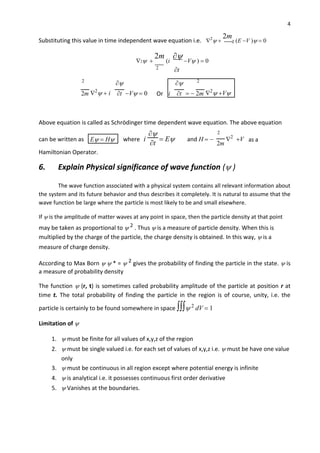
Substituting this value in time independent wave equation i.e. 2

2m
2(EV)0
2 
2m
(i

V)0
2
t
2
  2
2
  i V  0 Or i  2
 V
2m t t 2m
Above equation is called as Schrödinger time dependent wave equation. The above equation
can be written as where i

 E and H 
2
2
V
E  H as a
t 2m
Hamiltonian Operator.
6. Explain Physical significance of wave function ( )
The wave function associated with a physical system contains all relevant information about
the system and its future behavior and thus describes it completely. It is natural to assume that the
wave function be large where the particle is most likely to be and small elsewhere.
If  is the amplitude of matter waves at any point in space, then the particle density at that point
may be taken as proportional to  2 . Thus  is a measure of particle density. When this is
multiplied by the charge of the particle, the charge density is obtained. In this way,  is a
measure of charge density.
According to Max Born  * =  2 gives the probability of finding the particle in the state.  is
a measure of probability density
The function  (r, t) is sometimes called probability amplitude of the particle at position r at
time t. The total probability of finding the particle in the region is of course, unity, i.e. the
particle is certainly to be found somewhere in space  2
dV  1
Limitation of 
1.  must be finite for all values of x,y,z of the region
2.  must be single valued i.e. for each set of values of x,y,z i.e.  must be have one value
only
3.  must be continuous in all region except where potential energy is infinite
4.  is analytical i.e. it possesses continuous first order derivative
5.  Vanishes at the boundaries.
5
7. Apply Schrodinger time independent wave equation to particle
in Potential Box
Let us consider a square potential well with infinitely high sides, as
indicated below fig… If particle in potential well the potential energy is
zero. If particle is moving then potential energy increases.
According to Schrödinger time independent wave equation is given by
2
 
2m
2 (E V )  0

Potential energy is zero if particle ‘x’ lies in between 0 to a i.e. V(x) =0 for 0 < x < a
Boundary condition for wave function is given by
  0 If particle at a i.e. ( )xa  0 And   0 at 0 i.e. ( )x0  0
If potential energy is equal to zero then S. E equation becomes 2
2m
(E)  0
2
2 2  2  2mE
Or     0 ------ (1) ( )
2
The solution of above differential equation is   Asinx  B cosx ------- (1)
Applying the boundary conditions
  0 at x  a and   0 at x  0
i.e Asin a  BCosa  0 (2)
BCosa  0 (3)
If we substitute equation 3 in equation 2 then we have ASina  0
This means wither A=0 or sina  0
sina  0 or a  ,2, n
Where n=0,1, 2, 3----- and  
n
a

If we substitute above condition in equation, we have
  Asin
n
a
x
- - - - - - - (4)
And  2

2mE
or E 
2 2
or En 
n2
h2
2m 8ma2
2
6
The integer ‘n’ introduce above is called a quantum number. The E values are called energy levels.
The particle that is described by the wave function with a certain n values is said to be in quantum
state ‘n’. For n=1 the state is called ground state. For 2, 3, ---etc. are known as excited states.
The general form of wavefunciton may be written as
  Asin nx ( n  1,2,3,- - --)
n
a
For A and B values we should normalize above function, normalize condition is
a
2 dV1
0
a A2
Sin 2 nxdx 1
0 a
a A2
(1  cos 2nx)dx 1
2
0 a
A 2 a 2nx 
[ ] x  sin  1
2 2n a
 
A2
 2  A  2
a
a
Hence the normalized wavefucntions will have the
form  n  a
2
sin
n
a
x
The energy level and wave function as shown in the fig.... The Probability of finding the particles
more at maximum amplitude.
7
University Questions
1. Discuss the properties of wave function?
2. What is the de-Broglie’s hypothesis? Obtain the De-broglie’s wavelength of matter wave
3. Apply Schrödinger’s Wave equation to a particle in Infinite Square well potential and obtain
wave function and energy values?
4. Write the properties of matter waves and show that matter waves can travel with speed
greater than speed of light in vacuum.
5. Obtain Schrödinger’s time independent wave equation?
6. Find the K.E and velocity of Photon associated with de-Broglies of wavelength of 0.2865A0
h  6.6 1034
Js, mp  1.67 1027
Kg
7. Calculate the wavelength associated with a neutron energy 0.025eV (mn=1.67X10⁻²⁷
Kg)
8. Compute the de-Broglie wavelength of a proton whose kinetic energy is equal to the rest
energy of an electron (m= 9.1 x 10⁻³¹
kg, mp=1.67 x 10⁻²⁷
kg)
9. Calculate the energy of an electron wavelength of 3x10⁻²
m. Given h = 6.62x10⁻³⁴
Js
10. Compute the De-Broglie wavelength of a proton whose kinetic energy is equal to the rest
energy of an electron (me = 9.1 X10⁻³¹
Kg, mp=1.67 X 10⁻²⁷
Kg) (May06,Dec2004) (2M)
11. Find the first excited state energy of an electron moving along X-axis confined in a box of side
length 10-10
m (july02) (2M)
12. Calculate the De-Broglie wavelength of an electron which is accelerated by a potential of 100V
h  6.61034
Js, m  9.11031
Kg
13. Find the energy and momentum of the neutron whose De-Broglie wavelength is l.5Ao
14. Calculate the de Broglie’s wavelength of an electron subjected to a potential difference of 12.5
KV.
15. Calculate the energy of an electron wave of wavelength 3x10⁻²
m
16. The electron is confined to a box of length 10-8
m. Calculate the minimum uncertainty in its
velocity.
17. Determine the de-Broglie wavelength of an electron, having kinetic energy of 1eV
18. Compute the energy difference between the first and second quantum state for an electron in
one dimension’s material having cube side1m.
UNIT-III Maxwell’s Equations and Electromagnetic waves
1. Write the basic equations of Electricity and Magnetism
1. E.dS 
q
.....(1)
0
This is Gauss’s law of electrostatics which states that the electric flux through a closed
surface is equal to the net charge enclosed by the surface divided by the permittivity
constant 0
2. B.dS  0 ......(2)
This is Gauss’s law of magnetism.
surface is zero.
3. E.dI 
d
B
dt
This states that the magnetic flux through a closed
.....(3)
This is Faraday’s law of Electromagnetic induction.
This law states that an electric field is produced by changing magnetic field.
4. B.dI  0i ......(4)
This is Ampere’s law for magnetic field due to steady current. This law states that the
amount of work done in carrying a unit magnetic pole one around a closed arbitrary path
linked with the current is 0 times the current i .
2. Derive the expression Displacement Current.
According to Basic equation (4) i.e. Ampere’s law B.dl  0i
Maxwell’s suggested that above equation ‘i’ is not
total current. He suggested that something must be
added in ‘i’ of above equations. In order to know this
something Maxwell’s postulated that similar to the
electric field due to changing magnetic field, there
would be a magnetic field due to changing electric
field. Thus a changing electric field is equivalent to a
current which flows as long as the electric field is changing and produces the same
magnetic effect as an ordinary conduction current. This is known as displacement current.
And Ampere’s law is valid only for steady state phenomena and not for changing
fields Let us consider Parallel capacitor for changing field.
Electric field is given by
E 
Q
( Q is th charge and A is the Area between the plates)
o A
For changing electric fields differentiating above equation
1
E

1 Q

1 i
t o A t o A Q
 i )
(
E
i   A t
o t
Displacement Current is given by
i
d
 
o
A E
t
Now Modified ampere’s law is given by B.dl  0 (i  id )
3. Derive Maxwell differential equations
Derivations
1. E.dS 
q
(Gauss’ law for electricity) ----- (1)
0
If  be the charge density and dV be the small volume then charge density
  ch arg e  q
Volume dV
q   dV
For total charge
q 
V dV Substitute ‘q’ value in eq.1
  E.dS 
1
VdV
 0
or  0 E.dS  V dV
i.e.,  D.dS  V dV (  0 E  D)
According to Gauss divergence theorem
 A.dS  V (.A) dV
Hence  D.dS  V (.D) dV
VdV
so, V (.D) dV 
 .D  

or .E 
0
or div.E   .....(a)
0
or E x  E y
 E z  
0
x y z
2
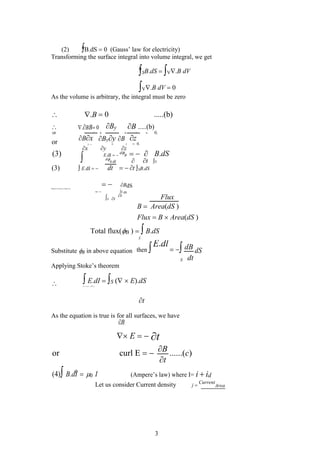
(2) B.dS  0 (Gauss’ law for electricity)
Transforming the surface integral into volume integral, we get
SB.dS  V.B dV
V.B dV  0
As the volume is arbitrary, the integral must be zero
t
As the equation is true is for all surfaces, we have
B
 E  t
or curl E  B ......(c)
t
(4)B.dI0I (Ampere’s law) where I= i  id
Let us consider Current density j 
Current
Area
3
  0 .....(b)
.B
 By B .....(b)
.BB 0
or x
  z
 0.
Bx z
or Byy B
x   z  0.
(3)
x y z
  B.dS
 E.dI 
d
B
dB dt  t S
(3)  E.dI  dt  t SB.dS
 BdS
Magnetic Flux density isBgiven by
 S dS
Flux
Stt
B  Area(dS )
Flux  B  Area(dS )
Total flux(B )   B.dS
S
Substitute B in above equation then E.dl
 dB dS
S dt
Applying Stoke’s theorem
  E.dI  S ( E).dS
S ( E).dS S
B
.dS
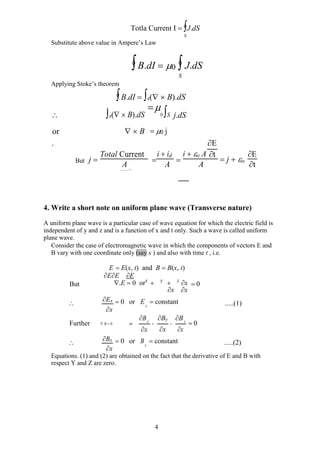
Totla Current I  J.dS
S
Substitute above value in Ampere’s Law
B.dI  0  J.dS
S
Applying Stoke’s theorem
B.dI  s( B).dS
0 S
 s( B).dS j.dS
or  B  0 j
.
i  id i  o A
E
E
Total Current
But j   
t
 j  o
A A A t
 B   (j  
E
)
4. Write a short note on uniform plane wave (Transverse nature)
A uniform plane wave is a particular case of wave equation for which the electric field is
independent of y and z and is a function of x and t only. Such a wave is called uniform
plane wave.
Consider the case of electromagnetic wave in which the components of vectors E and
B vary with one coordinate only (say x ) and also with time t , i.e.
But

Further

E  E(x, t) and B  B(x, t)
EEE
.E  0 orx
 y
 z
x
x x
Ex  0 or Ex
 constant
x
Bx
By Bz
.B  0 or  
x x
x
Bx  0 or Bx
 constant
x
 0





 0
.....(1)
.....(2)
Equations. (1) and (2) are obtained on the fact that the derivative of E and B with
respect Y and Z are zero.
4
Futher
i
 
x
E x
Now
From eq.(3)
curl E  B
t
j k

iB x  jB y  kBz 
y z 
t
E y E z
 E z

E y 
i
B x
 0
i 
z t
 y 
E z

E y
 0
y z
Bx
 0 or B  constant
t
x
.....(3)
.....(4)
Similarly, taking curt B, we can show that E = constant.
Hence, we conclude that E and B are constants as regards to time and space. So these
components are static components and hence no part of wave motion. Thus,
E  jE y  kEz
B  jBy  kBz
As vectors E and B do not contain any x-component, and hence I-direction being the
direction of propagation of the wave. Further both these vectors are perpendicular to the
direction of propagation. Hence, Maxwe1l electromagnetic waves are purely transverse
in nature.
5. State and Derive Poynting vector
One important characteristic of electromagnetic waves is that they transport energy from one
point to another point. The amount of field energy passing through unit area of the surface
perpendicular to the direction of propagation of energy is called as Poynting vector. This
is denoted by P.For example in a plane electromagnetic wave; E and B are perpendicular to
each other and also to the direction of wave propagation. They involve stored energy. So P
has a magnitude EB sin 900
= EB and points in the direction of wave propagation. The units
of P will be Joule/rn2
x sec or Watt/rn2
.
P  1 (E  B)or (E  H )
0
Derivation of Expression.
In order to derive the expression for Poynting vector, consider
form of a rectangular parallelepiped of sides dr , dy and dz
an elementary volume in the
as shown in. The volume of
parallelepiped is dx dy dz . Suppose the electromagnetic energy
5
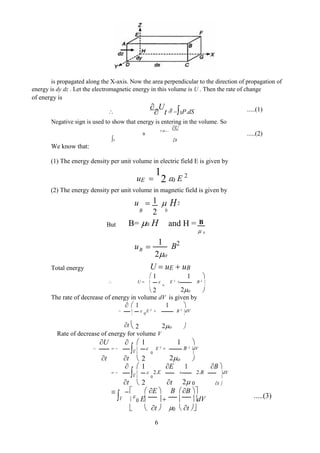
is propagated along the X-axis. Now the area perpendicular to the direction of propagation of
energy is dy dz . Let the electromagnetic energy in this volume is U . Then the rate of change
of energy is



U
t SP.dS
Negative sign is used to show that energy is entering in the volume. So
U
P.dS 
S t
We know that:
(1) The energy density per unit volume in electric field E is given by
uE 
1
2 0 E 2
(2) The energy density per unit volume in magnetic field is given by
u  1  H2
B 2 0
But B= 0 H and H = B
 0
u 
1
B2
B
2o
Total energy U  uE  uB
 1 1 
 U    E 2
 B 2


2
0
2o

 
The rate of decrease of energy in volume dV is given by
  1 1 
  
0
E 2
 B 2
dV

2 2o

t  
Rate of decrease of energy for volume V
U 
V
 1 1 
    E 2
 B 2
dV
t t

2
0
2o

 

V
 1 E 1 B 
   2.E  2.B dV
t

2
0
t 2 0

 t 

V E  B B 


0 E   dV
0
  t   t 
.....(1)
.....(2)
.....(3)
6
From Maxwell’s equations
 B   (j  
E
)
0
o
t
(Waves are propagating in non-conducting medium)
 00
E


t
 E   B .....(4)
t 00
B
Further  E  ------(5)
t
Substituting the values from esq. (4) and (5) in eq. (3), we get



U
t
Eq.(6) can be written as
   

V
 B   B 
    
0
E

0
  
0
B

0 0
dV

   

 
U
 V  E.( B)  B.( H )dV
t
 V .(E  H )dV
.( A  B)  B.(
.....(6)

A)  A.( B)
Using Gauss theorem of divergence, the volume integral can be expressed in terms of
surface integral. Thus,
 V (E  H ).ndS .....(7)
Where n is the unit vector normal to the surface. Comparing eq. (3) with eq. (2), we get
S P.dS  S (E  H ).dS
Or P  (E  H ) .....(8)
In magnitude P  EH
This vector shows that energy flow takes place in a direction perpendicular to the plane
containing E and H or B. Hence, E and H arc the instantaneous values.
6. Derive the relation between D, E and P
7
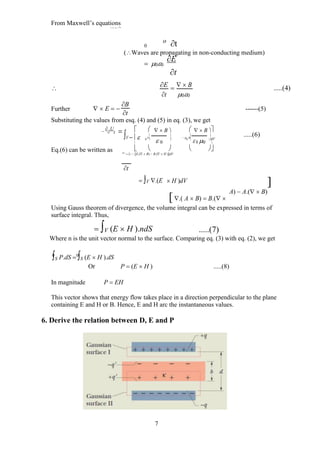
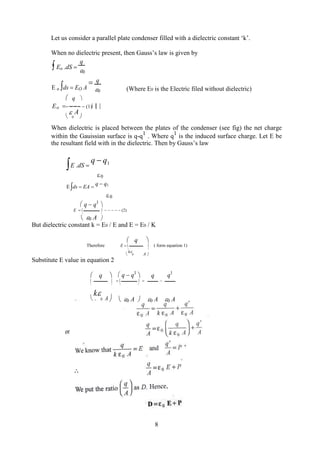
Let us consider a parallel plate condenser filled with a dielectric constant ‘k’.
When no dielectric present, then Gauss’s law is given by
 Eo .dS 
q
0
E o ds  EO A
 q
(Where E0 is the Electric filed without dielectric)
0
 q 
Eo (1)


0
A

When dielectric is placed between the plates of the condenser (see fig) the net charge
within the Gauissian surface is q-q1
. Where q1
is the induced surface charge. Let E be
the resultant field with in the dielectric. Then by Gauss’s law
E .dS 
q  q1

0
Eds  EA 
q  q1
0
 q  q1

E    (2)

0 A

 
But dielectric constant k = E0 / E and E = E0 / K
 q 
Therefore E   ( form equation 1)
 

k
0 A 
Substitute E value in equation 2
 q   q  q1
 q q1
     
  
0 A

0 A 0 A

k
0 A   
8

Wavemechanics

  • 1.
    1 UNIT-3 WAVE MECHANICS 1.Derive De-Broglie’s equation According to De-Brogle every moving particle is associated with wave. The dual Nature of light possessing both wave and particle properties was explained by combining Planck’s expression for the energy of photon E  h with Einstein’s mass energy relation E  mc2 to give mc2  h Or   mc2 h c  mc2 (  c )  h   h = h , where  is the wavelength of photon p mc If particle moves with velocity ‘v’ then   h mv From above equation if particle velocity is less, then wavelength of wave is more .It was by analogy with this equation associating momentum with a photon that de Broglie expressed the concept of matter wave, according to which a material particle of mass ‘m’ moving with a velocity ‘v’ should have an associated wavelength ‘  ’ , called the de-Broglie wavelength . 2. Write difference forms of De-Broglie’s Wavelength (1) De-Broglie’s wave equation is given by   mv h ---- (1) 1  mv ---- (2) If kinetic Energy of particle is E  mv2 or 2Em 2 substitute Eq (2) in Eq (1)  h (Where E is kinetic Energy) 2Em (2) The wavelength associated with a moving particle is independent of any charge associate with it. If the velocity ‘v’ is given to an electron by accelerating it through a potential difference ‘V’ then the work done on the electron is Ve. This work done is converted into the kinetic energy of the electron, then 1 1  2eV  2 2 eV  mv Or v    2  m  2meV  mv
  • 2.
    2 Substituting this valuein the De Broglie equation we have   h 2meV Charge of electron is 1.610-19 C/s and Mass of electron is 9.1 10-31 Kg substitute in above equations  12.27 A0 V  3. What are the properties of de Broglie’s waves or Matter Waves? (1) Lighter is the particle, greater is the wavelength associated with it. (2) Smaller is the velocity of the particle greater is the wavelength associated with it. (3) When v = 0 then   i.e., wave becomes indeterminate and if v =  then  = 0 This shows that matter waves are generated by the motion of particles. These waves are produced whether the particles are charged particles or they are uncharged. This fact reveals that these waves are not electromagnetic waves but they are a new kind of waves (4) The velocity of matter waves depends on the velocity of material particle i.e. it is not a constant while the velocity of electromagnetic wave is constant. (5) The wave nature of matter introduces an uncertainty in the location of the position of the particle because a wave cannot be said exactly at this point or exactly at that point. However, where the wave is large there is good chance of finding the particle while, where the wave is small there is very small chance of finding the particle. 4. Derive Schrödinger time independent equation Let us consider a group of waves associated with a moving particle. Let  represent the displacement of these waves at any time‘t’. Let us consider that the wave motion be represent by classical wave equation. 2 1 2  ----- (1) v2 t 2 Where v is the velocity. The solution of the above equation is given by   o eit -------- (2) Differentiate above equation with respect to ‘t’   o (i)eit And 2  o (i)2 eit 2  t t 2 1 Substitute above value in equation (1) then 2 ( 2  ) v2
  • 3.
    3 2 2 (2)2 4 2 2  0 But   v2 v 2 ()2 2 The wave equation is given by 2   4 2   0 2 We can substitute the wavelength of the wave accompanying the particle in terms of the particle like property i.e.   h Then mv 2 4 2m2v2  0 h2 If E and V are the total energy and the potential energy of the particle, respectively, then 1 2 mv2  E V or mv  2m(E V ) The wave equation is given by 2   8 2 m (E V )  0 or 2 2m (E V )  0 h2 2 This equation is known as Schrödinger time independent wave equation. 5. Derive Schrödinger time dependent equation Let us consider a group of waves associated with a moving particle. Let  represent the displacement of these waves at any time‘t’. Let us consider that the wave motion be represent by classical wave equation. 2  1  2   ----- (1) v 2 t2 Where ‘v’ is the velocity. The solution of the above equation is given by  oeit -------- (2) Differentiate above equation with respect to‘t’ then   o (i)eit t But  = 2 substitute in above equation   o (i2)eit 2i E  ( E h ) h t Or   iE  t Multiplying both side with ‘i’ i    E t
  • 4.
    4 Substituting this valuein time independent wave equation i.e. 2  2m 2(EV)0 2  2m (i  V)0 2 t 2   2 2   i V  0 Or i  2  V 2m t t 2m Above equation is called as Schrödinger time dependent wave equation. The above equation can be written as where i   E and H  2 2 V E  H as a t 2m Hamiltonian Operator. 6. Explain Physical significance of wave function ( ) The wave function associated with a physical system contains all relevant information about the system and its future behavior and thus describes it completely. It is natural to assume that the wave function be large where the particle is most likely to be and small elsewhere. If  is the amplitude of matter waves at any point in space, then the particle density at that point may be taken as proportional to  2 . Thus  is a measure of particle density. When this is multiplied by the charge of the particle, the charge density is obtained. In this way,  is a measure of charge density. According to Max Born  * =  2 gives the probability of finding the particle in the state.  is a measure of probability density The function  (r, t) is sometimes called probability amplitude of the particle at position r at time t. The total probability of finding the particle in the region is of course, unity, i.e. the particle is certainly to be found somewhere in space  2 dV  1 Limitation of  1.  must be finite for all values of x,y,z of the region 2.  must be single valued i.e. for each set of values of x,y,z i.e.  must be have one value only 3.  must be continuous in all region except where potential energy is infinite 4.  is analytical i.e. it possesses continuous first order derivative 5.  Vanishes at the boundaries.
  • 5.
    5 7. Apply Schrodingertime independent wave equation to particle in Potential Box Let us consider a square potential well with infinitely high sides, as indicated below fig… If particle in potential well the potential energy is zero. If particle is moving then potential energy increases. According to Schrödinger time independent wave equation is given by 2   2m 2 (E V )  0  Potential energy is zero if particle ‘x’ lies in between 0 to a i.e. V(x) =0 for 0 < x < a Boundary condition for wave function is given by   0 If particle at a i.e. ( )xa  0 And   0 at 0 i.e. ( )x0  0 If potential energy is equal to zero then S. E equation becomes 2 2m (E)  0 2 2 2  2  2mE Or     0 ------ (1) ( ) 2 The solution of above differential equation is   Asinx  B cosx ------- (1) Applying the boundary conditions   0 at x  a and   0 at x  0 i.e Asin a  BCosa  0 (2) BCosa  0 (3) If we substitute equation 3 in equation 2 then we have ASina  0 This means wither A=0 or sina  0 sina  0 or a  ,2, n Where n=0,1, 2, 3----- and   n a  If we substitute above condition in equation, we have   Asin n a x - - - - - - - (4) And  2  2mE or E  2 2 or En  n2 h2 2m 8ma2 2
  • 6.
    6 The integer ‘n’introduce above is called a quantum number. The E values are called energy levels. The particle that is described by the wave function with a certain n values is said to be in quantum state ‘n’. For n=1 the state is called ground state. For 2, 3, ---etc. are known as excited states. The general form of wavefunciton may be written as   Asin nx ( n  1,2,3,- - --) n a For A and B values we should normalize above function, normalize condition is a 2 dV1 0 a A2 Sin 2 nxdx 1 0 a a A2 (1  cos 2nx)dx 1 2 0 a A 2 a 2nx  [ ] x  sin  1 2 2n a   A2  2  A  2 a a Hence the normalized wavefucntions will have the form  n  a 2 sin n a x The energy level and wave function as shown in the fig.... The Probability of finding the particles more at maximum amplitude.
  • 7.
    7 University Questions 1. Discussthe properties of wave function? 2. What is the de-Broglie’s hypothesis? Obtain the De-broglie’s wavelength of matter wave 3. Apply Schrödinger’s Wave equation to a particle in Infinite Square well potential and obtain wave function and energy values? 4. Write the properties of matter waves and show that matter waves can travel with speed greater than speed of light in vacuum. 5. Obtain Schrödinger’s time independent wave equation? 6. Find the K.E and velocity of Photon associated with de-Broglies of wavelength of 0.2865A0 h  6.6 1034 Js, mp  1.67 1027 Kg 7. Calculate the wavelength associated with a neutron energy 0.025eV (mn=1.67X10⁻²⁷ Kg) 8. Compute the de-Broglie wavelength of a proton whose kinetic energy is equal to the rest energy of an electron (m= 9.1 x 10⁻³¹ kg, mp=1.67 x 10⁻²⁷ kg) 9. Calculate the energy of an electron wavelength of 3x10⁻² m. Given h = 6.62x10⁻³⁴ Js 10. Compute the De-Broglie wavelength of a proton whose kinetic energy is equal to the rest energy of an electron (me = 9.1 X10⁻³¹ Kg, mp=1.67 X 10⁻²⁷ Kg) (May06,Dec2004) (2M) 11. Find the first excited state energy of an electron moving along X-axis confined in a box of side length 10-10 m (july02) (2M) 12. Calculate the De-Broglie wavelength of an electron which is accelerated by a potential of 100V h  6.61034 Js, m  9.11031 Kg 13. Find the energy and momentum of the neutron whose De-Broglie wavelength is l.5Ao 14. Calculate the de Broglie’s wavelength of an electron subjected to a potential difference of 12.5 KV. 15. Calculate the energy of an electron wave of wavelength 3x10⁻² m 16. The electron is confined to a box of length 10-8 m. Calculate the minimum uncertainty in its velocity. 17. Determine the de-Broglie wavelength of an electron, having kinetic energy of 1eV 18. Compute the energy difference between the first and second quantum state for an electron in one dimension’s material having cube side1m.
  • 8.
    UNIT-III Maxwell’s Equationsand Electromagnetic waves 1. Write the basic equations of Electricity and Magnetism 1. E.dS  q .....(1) 0 This is Gauss’s law of electrostatics which states that the electric flux through a closed surface is equal to the net charge enclosed by the surface divided by the permittivity constant 0 2. B.dS  0 ......(2) This is Gauss’s law of magnetism. surface is zero. 3. E.dI  d B dt This states that the magnetic flux through a closed .....(3) This is Faraday’s law of Electromagnetic induction. This law states that an electric field is produced by changing magnetic field. 4. B.dI  0i ......(4) This is Ampere’s law for magnetic field due to steady current. This law states that the amount of work done in carrying a unit magnetic pole one around a closed arbitrary path linked with the current is 0 times the current i . 2. Derive the expression Displacement Current. According to Basic equation (4) i.e. Ampere’s law B.dl  0i Maxwell’s suggested that above equation ‘i’ is not total current. He suggested that something must be added in ‘i’ of above equations. In order to know this something Maxwell’s postulated that similar to the electric field due to changing magnetic field, there would be a magnetic field due to changing electric field. Thus a changing electric field is equivalent to a current which flows as long as the electric field is changing and produces the same magnetic effect as an ordinary conduction current. This is known as displacement current. And Ampere’s law is valid only for steady state phenomena and not for changing fields Let us consider Parallel capacitor for changing field. Electric field is given by E  Q ( Q is th charge and A is the Area between the plates) o A For changing electric fields differentiating above equation 1
  • 9.
    E  1 Q  1 i to A t o A Q  i ) ( E i   A t o t Displacement Current is given by i d   o A E t Now Modified ampere’s law is given by B.dl  0 (i  id ) 3. Derive Maxwell differential equations Derivations 1. E.dS  q (Gauss’ law for electricity) ----- (1) 0 If  be the charge density and dV be the small volume then charge density   ch arg e  q Volume dV q   dV For total charge q  V dV Substitute ‘q’ value in eq.1   E.dS  1 VdV  0 or  0 E.dS  V dV i.e.,  D.dS  V dV (  0 E  D) According to Gauss divergence theorem  A.dS  V (.A) dV Hence  D.dS  V (.D) dV VdV so, V (.D) dV   .D    or .E  0 or div.E   .....(a) 0 or E x  E y  E z   0 x y z 2
  • 10.
    (2) B.dS 0 (Gauss’ law for electricity) Transforming the surface integral into volume integral, we get SB.dS  V.B dV V.B dV  0 As the volume is arbitrary, the integral must be zero t As the equation is true is for all surfaces, we have B  E  t or curl E  B ......(c) t (4)B.dI0I (Ampere’s law) where I= i  id Let us consider Current density j  Current Area 3   0 .....(b) .B  By B .....(b) .BB 0 or x   z  0. Bx z or Byy B x   z  0. (3) x y z   B.dS  E.dI  d B dB dt  t S (3)  E.dI  dt  t SB.dS  BdS Magnetic Flux density isBgiven by  S dS Flux Stt B  Area(dS ) Flux  B  Area(dS ) Total flux(B )   B.dS S Substitute B in above equation then E.dl  dB dS S dt Applying Stoke’s theorem   E.dI  S ( E).dS S ( E).dS S B .dS
  • 11.
    Totla Current I J.dS S Substitute above value in Ampere’s Law B.dI  0  J.dS S Applying Stoke’s theorem B.dI  s( B).dS 0 S  s( B).dS j.dS or  B  0 j . i  id i  o A E E Total Current But j    t  j  o A A A t  B   (j   E ) 4. Write a short note on uniform plane wave (Transverse nature) A uniform plane wave is a particular case of wave equation for which the electric field is independent of y and z and is a function of x and t only. Such a wave is called uniform plane wave. Consider the case of electromagnetic wave in which the components of vectors E and B vary with one coordinate only (say x ) and also with time t , i.e. But  Further  E  E(x, t) and B  B(x, t) EEE .E  0 orx  y  z x x x Ex  0 or Ex  constant x Bx By Bz .B  0 or   x x x Bx  0 or Bx  constant x  0       0 .....(1) .....(2) Equations. (1) and (2) are obtained on the fact that the derivative of E and B with respect Y and Z are zero. 4
  • 12.
    Futher i   x E x Now Fromeq.(3) curl E  B t j k  iB x  jB y  kBz  y z  t E y E z  E z  E y  i B x  0 i  z t  y  E z  E y  0 y z Bx  0 or B  constant t x .....(3) .....(4) Similarly, taking curt B, we can show that E = constant. Hence, we conclude that E and B are constants as regards to time and space. So these components are static components and hence no part of wave motion. Thus, E  jE y  kEz B  jBy  kBz As vectors E and B do not contain any x-component, and hence I-direction being the direction of propagation of the wave. Further both these vectors are perpendicular to the direction of propagation. Hence, Maxwe1l electromagnetic waves are purely transverse in nature. 5. State and Derive Poynting vector One important characteristic of electromagnetic waves is that they transport energy from one point to another point. The amount of field energy passing through unit area of the surface perpendicular to the direction of propagation of energy is called as Poynting vector. This is denoted by P.For example in a plane electromagnetic wave; E and B are perpendicular to each other and also to the direction of wave propagation. They involve stored energy. So P has a magnitude EB sin 900 = EB and points in the direction of wave propagation. The units of P will be Joule/rn2 x sec or Watt/rn2 . P  1 (E  B)or (E  H ) 0 Derivation of Expression. In order to derive the expression for Poynting vector, consider form of a rectangular parallelepiped of sides dr , dy and dz an elementary volume in the as shown in. The volume of parallelepiped is dx dy dz . Suppose the electromagnetic energy 5
  • 13.
    is propagated alongthe X-axis. Now the area perpendicular to the direction of propagation of energy is dy dz . Let the electromagnetic energy in this volume is U . Then the rate of change of energy is    U t SP.dS Negative sign is used to show that energy is entering in the volume. So U P.dS  S t We know that: (1) The energy density per unit volume in electric field E is given by uE  1 2 0 E 2 (2) The energy density per unit volume in magnetic field is given by u  1  H2 B 2 0 But B= 0 H and H = B  0 u  1 B2 B 2o Total energy U  uE  uB  1 1   U    E 2  B 2   2 0 2o    The rate of decrease of energy in volume dV is given by   1 1     0 E 2  B 2 dV  2 2o  t   Rate of decrease of energy for volume V U  V  1 1      E 2  B 2 dV t t  2 0 2o     V  1 E 1 B     2.E  2.B dV t  2 0 t 2 0   t   V E  B B    0 E   dV 0   t   t  .....(1) .....(2) .....(3) 6
  • 14.
    From Maxwell’s equations B   (j   E ) 0 o t (Waves are propagating in non-conducting medium)  00 E   t  E   B .....(4) t 00 B Further  E  ------(5) t Substituting the values from esq. (4) and (5) in eq. (3), we get    U t Eq.(6) can be written as      V  B   B       0 E  0    0 B  0 0 dV         U  V  E.( B)  B.( H )dV t  V .(E  H )dV .( A  B)  B.( .....(6)  A)  A.( B) Using Gauss theorem of divergence, the volume integral can be expressed in terms of surface integral. Thus,  V (E  H ).ndS .....(7) Where n is the unit vector normal to the surface. Comparing eq. (3) with eq. (2), we get S P.dS  S (E  H ).dS Or P  (E  H ) .....(8) In magnitude P  EH This vector shows that energy flow takes place in a direction perpendicular to the plane containing E and H or B. Hence, E and H arc the instantaneous values. 6. Derive the relation between D, E and P 7
  • 15.
    Let us considera parallel plate condenser filled with a dielectric constant ‘k’. When no dielectric present, then Gauss’s law is given by  Eo .dS  q 0 E o ds  EO A  q (Where E0 is the Electric filed without dielectric) 0  q  Eo (1)   0 A  When dielectric is placed between the plates of the condenser (see fig) the net charge within the Gauissian surface is q-q1 . Where q1 is the induced surface charge. Let E be the resultant field with in the dielectric. Then by Gauss’s law E .dS  q  q1  0 Eds  EA  q  q1 0  q  q1  E    (2)  0 A    But dielectric constant k = E0 / E and E = E0 / K  q  Therefore E   ( form equation 1)    k 0 A  Substitute E value in equation 2  q   q  q1  q q1          0 A  0 A 0 A  k 0 A    8