Embed presentation
Download to read offline


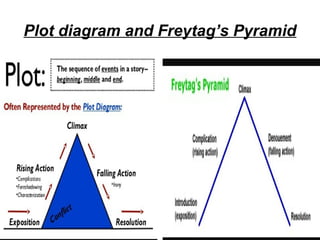
The document discusses the concept of plot as an essential component of tragedy, referencing Aristotle's definition and importance of plot structure. It emphasizes that a tragic plot must have a clear beginning, middle, and end, and explores the characteristics of simple versus complex plots, as well as the laws of probability and necessity in plot development. Additionally, it includes a reference to Freytag’s pyramid as a framework for understanding plot structure.


Overview of presentation detailing the topic, presenter, and academic context.
Definition of tragedy emphasizing imitation of serious actions, evoking pity and fear, and achieving catharsis.
Plot as the central element of tragedy, defined by Aristotle as the structured arrangement of incidents.
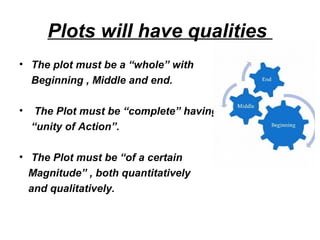
A successful plot should have wholeness, unity of action, and appropriate magnitude in its structure.
Distinction between simple and complex plots, emphasizing the significance of action in creating tragedy.
Explains the necessity for incidents to be plausible and causally connected in progressing the plot.
Introduction to plot diagram and Freytag’s Pyramid, visual aids for understanding plot structure.