 Topic
“Plot according to the definition of Aristotle”
Aristotle’s definition of Tragedy
“Tragedy is an imitation of an action, that is serious and also having
magnitude; complete in itself; in language with pleasurable accessories ,
each kind brought in separately in various part of a work ; in a dramatic ,
not in narrative form ; with incidents arousing pity and fear , wherewith
to accomplish its catharsis of such emotion”
 Elements of Tragedy
• Plot
• Character
• Thought
• Diction
• Melody
• spectacle
 Plot
• “the arrangement of incidents”
• Not the story itself but the way incidents are presented to the
audience
• Tragedies where the outcome depends on a tightly constructed
cause-and-effect chain of action are superior to those that depend
primarlly on the character and personality of the protagonist.
 Importance Of The Plot
• Soul of tragedy, “the first principle , the soul of tragedy”
• A tragedy can be successful without character but not the plot.
• The character should be according to the plot .
• A lifeless plot with well-sketched character fails.
• A stirring plot with common place characters will succeed.
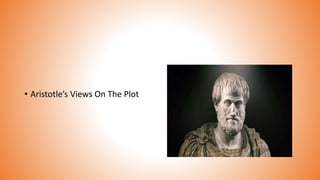
• Aristotle’s Views On The Plot
 Form OF The Plot
• Size
• Subject
• Nature
 Size of the Plot
• “With regard to the limit set by the nature of the action , the longer the
story is the more beautiful it will be, provided that it is quite clear . To give
a simple definition a length which, as a matter either of probability or of
necessity , allows of a change from misery to happiness or from happiness
to misery is the proper limit of length to be observed”
• Plot should neither be too long nor too short
• It should be long enough for the catastrophe to occur
• It should also be short enough to be grasped as a single artistic whole .
• The length of tragedy was one sunny day previously, but now on European
stage , it is 2-3 hours.
 Aristotle says
• “ A minutely small creature, therefore , would not be beautiful, for it
would take almost no time to see it and our perception of it would be
blurred; nor would an extremely large one, for it could not be taken
to all at once and its unity and wholeness would be last to the view of
the beholder”.
 Structure of the Plot
• “ A well constructed Plot must neither begin nor end haphazard”
• A play should have a proper beginning , middle and the end.
• A play should have a good and obvious reasons for beginning, where is
begins and for ending where it ends.
• There should be a cause & effect chain (incidents should follow one
another).
• The beginning is called “incentive moment”.
• The middle or climax must be caused by earlier incidents.
• The end or resolution must be caused by the preceding events.
• The end should resolve the problem created during the incentive moment.
 Dramatic Unities:-
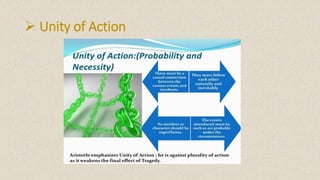
1. Unity of Action- One main action, few subplots
2. Unity of Time- Action should take place in 24 hours maximum
3. Unity of Place- Single physical space
 Aristotle's unities
• According to Aristotle's definition, Tragedy is an imitation of an action that
is complete, and whole, and of a certain magnitude … This part of
definition shows that the structural union of the parts being such that, if
any one of them is displaced or removed, the whole will be disjointed and
disturbed.
• A thing whose presence or absence makes no visible difference, is not an
organic part of the whole.
• There should be a single action or event in the tragedy e.g in Oedipus Rex,
only last 24 hours of his life are discussed .
• Unity of place is also present in Oedipus Rex. The main setting is the palace
of Oedipus only.
• Plot should depict not what actually happened but also what logically &
inevitably happen. This is Aristotle’s Law of probability.
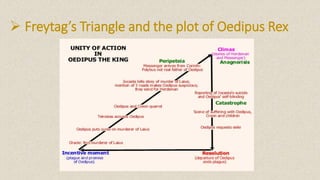
 Freytag’s Triangle and the plot of Oedipus Rex
 Unity of Action
 Subject of the plot
1. The subject of the plot includes the 1.characters, 2.actions &
incidents, 3.errors.
2. Themes should produce the tragic effects of pity and fear.
3. People, action and error should cause catastrophe.
 Persons
Tragedy aims at exciting pity and fear, so three types of persons should
be excluded from the plot.
• A good man should not be shown passing from prosperity to misery.
• A bad man should not be shown progressing from misery to
prosperity
• An utterly worthless man should not be seen falling from prosperity
into misery.
Perfect Subject
• Our pity is awakened by undeserved misfortune and our fear by
someone just like ourselves.
• He should be a person of mediocre virtue and average power.
• He should be a man of noble nature, like us, and idealized.
• He should meet the tragic end due to some error of judgment.
• Such a man can be a fit subject of the tragic plot.
 Actions and incidents :-
• Actions should arouse pity and fear.
• A catastrophe may result from action of three kinds of agents:
• It may be work of a friend
• The work of an enemy
• Or the work of an utter stranger.
• The true or ideal tragedy is made through the work of a person
nearer and dearer.
 Error !
• Aristotle says that it is not due to vice and depravity, but rather to
some error or frailty.
• Aristotle has used the word hamartia which later was translated as a
“tragic flaw” .
• Some writers take it as tragic flaw while the others take it an “error of
judgement” .
• F. L. Lucas says: “Aristotle’s ideal tragedy is one in which the
destruction of hero or heroine is caused by some false step taken in
blindness”.
 Nature of the plot :-
• Aristotle divides plot into 2 types Good Plot and Bad Plot.
• Bad plots are episodic plots.
• These stories have unimportant aspects and length the story.
• Good plot is the one in which “things happened unexpectedly as well
as logically.
 Simple & Complex plot :-
• Aristotle defines simple plot as the one which is single and continuous
and in which the change of fortune comes about without reversal or
discovery.
• Complex plots are those which have peripety and Anagrorisis or
Discovery and leuognition.
 Comparison:-
Peripeteia
• Peripeteia means that humans
actions produce results exactly
opposite to what was intended
• It is working in blindness to
one’s own defeat.
• Its agalse step taken in the dark.
Anagnorisis
• Anagnorisis or recognition is the
realization of truth, the opening
of the eyes, the sudden
lightening flash in the darkness.
o Conclusion
Thanks For your time !!!
Any question ???

Ppt drama

  • 1.
     Topic “Plot accordingto the definition of Aristotle”
  • 2.
    Aristotle’s definition ofTragedy “Tragedy is an imitation of an action, that is serious and also having magnitude; complete in itself; in language with pleasurable accessories , each kind brought in separately in various part of a work ; in a dramatic , not in narrative form ; with incidents arousing pity and fear , wherewith to accomplish its catharsis of such emotion”
  • 3.
     Elements ofTragedy • Plot • Character • Thought • Diction • Melody • spectacle
  • 4.
     Plot • “thearrangement of incidents” • Not the story itself but the way incidents are presented to the audience • Tragedies where the outcome depends on a tightly constructed cause-and-effect chain of action are superior to those that depend primarlly on the character and personality of the protagonist.
  • 5.
     Importance OfThe Plot • Soul of tragedy, “the first principle , the soul of tragedy” • A tragedy can be successful without character but not the plot. • The character should be according to the plot . • A lifeless plot with well-sketched character fails. • A stirring plot with common place characters will succeed.
  • 6.
  • 7.
     Form OFThe Plot • Size • Subject • Nature
  • 8.
     Size ofthe Plot • “With regard to the limit set by the nature of the action , the longer the story is the more beautiful it will be, provided that it is quite clear . To give a simple definition a length which, as a matter either of probability or of necessity , allows of a change from misery to happiness or from happiness to misery is the proper limit of length to be observed” • Plot should neither be too long nor too short • It should be long enough for the catastrophe to occur • It should also be short enough to be grasped as a single artistic whole . • The length of tragedy was one sunny day previously, but now on European stage , it is 2-3 hours.
  • 9.
     Aristotle says •“ A minutely small creature, therefore , would not be beautiful, for it would take almost no time to see it and our perception of it would be blurred; nor would an extremely large one, for it could not be taken to all at once and its unity and wholeness would be last to the view of the beholder”.
  • 10.
     Structure ofthe Plot • “ A well constructed Plot must neither begin nor end haphazard” • A play should have a proper beginning , middle and the end. • A play should have a good and obvious reasons for beginning, where is begins and for ending where it ends. • There should be a cause & effect chain (incidents should follow one another). • The beginning is called “incentive moment”. • The middle or climax must be caused by earlier incidents. • The end or resolution must be caused by the preceding events. • The end should resolve the problem created during the incentive moment.
  • 11.
     Dramatic Unities:- 1.Unity of Action- One main action, few subplots 2. Unity of Time- Action should take place in 24 hours maximum 3. Unity of Place- Single physical space
  • 12.
     Aristotle's unities •According to Aristotle's definition, Tragedy is an imitation of an action that is complete, and whole, and of a certain magnitude … This part of definition shows that the structural union of the parts being such that, if any one of them is displaced or removed, the whole will be disjointed and disturbed. • A thing whose presence or absence makes no visible difference, is not an organic part of the whole. • There should be a single action or event in the tragedy e.g in Oedipus Rex, only last 24 hours of his life are discussed . • Unity of place is also present in Oedipus Rex. The main setting is the palace of Oedipus only. • Plot should depict not what actually happened but also what logically & inevitably happen. This is Aristotle’s Law of probability.
  • 13.
     Freytag’s Triangleand the plot of Oedipus Rex
  • 14.
  • 15.
     Subject ofthe plot 1. The subject of the plot includes the 1.characters, 2.actions & incidents, 3.errors. 2. Themes should produce the tragic effects of pity and fear. 3. People, action and error should cause catastrophe.
  • 16.
     Persons Tragedy aimsat exciting pity and fear, so three types of persons should be excluded from the plot. • A good man should not be shown passing from prosperity to misery. • A bad man should not be shown progressing from misery to prosperity • An utterly worthless man should not be seen falling from prosperity into misery.
  • 17.
    Perfect Subject • Ourpity is awakened by undeserved misfortune and our fear by someone just like ourselves. • He should be a person of mediocre virtue and average power. • He should be a man of noble nature, like us, and idealized. • He should meet the tragic end due to some error of judgment. • Such a man can be a fit subject of the tragic plot.
  • 18.
     Actions andincidents :- • Actions should arouse pity and fear. • A catastrophe may result from action of three kinds of agents: • It may be work of a friend • The work of an enemy • Or the work of an utter stranger. • The true or ideal tragedy is made through the work of a person nearer and dearer.
  • 19.
     Error ! •Aristotle says that it is not due to vice and depravity, but rather to some error or frailty. • Aristotle has used the word hamartia which later was translated as a “tragic flaw” . • Some writers take it as tragic flaw while the others take it an “error of judgement” . • F. L. Lucas says: “Aristotle’s ideal tragedy is one in which the destruction of hero or heroine is caused by some false step taken in blindness”.
  • 20.
     Nature ofthe plot :- • Aristotle divides plot into 2 types Good Plot and Bad Plot. • Bad plots are episodic plots. • These stories have unimportant aspects and length the story. • Good plot is the one in which “things happened unexpectedly as well as logically.
  • 21.
     Simple &Complex plot :- • Aristotle defines simple plot as the one which is single and continuous and in which the change of fortune comes about without reversal or discovery. • Complex plots are those which have peripety and Anagrorisis or Discovery and leuognition.
  • 22.
     Comparison:- Peripeteia • Peripeteiameans that humans actions produce results exactly opposite to what was intended • It is working in blindness to one’s own defeat. • Its agalse step taken in the dark. Anagnorisis • Anagnorisis or recognition is the realization of truth, the opening of the eyes, the sudden lightening flash in the darkness.
  • 23.
  • 24.
    Thanks For yourtime !!! Any question ???