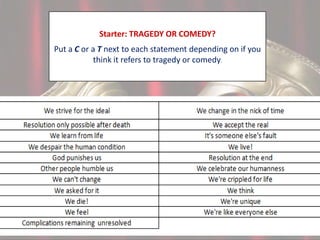
Starter: TRAGEDY OR COMEDY?
Put a C or a T next to each statement depending on if you
think it refers to tragedy or comedy.
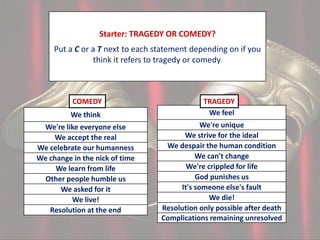
Starter: TRAGEDY OR COMEDY?
Put a C or a T next to each statement depending on if you
think it refers to tragedy or comedy.

COMEDY
We think
We're like everyone else
We accept the real
We celebrate our humanness
We change in the nick of time
We learn from life
Other people humble us
We asked for it
We live!
Resolution at the end

TRAGEDY
We feel
We're unique
We strive for the ideal
We despair the human condition
We can't change
We're crippled for life
God punishes us
It's someone else's fault
We die!
Resolution only possible after death
Complications remaining unresolved
Much Ado About Nothing
William Shakespeare
AQA English Literature – Unit 2 Dramatic Genres
Week 2 of Comedy Lesson 3 and 4
Task 1:
As a table come up with a compiled list of
all the features you identified for
homework. You will be sharing these in a
minute the class.
Use the A3 or A4 paper as this will allow
you to present your work
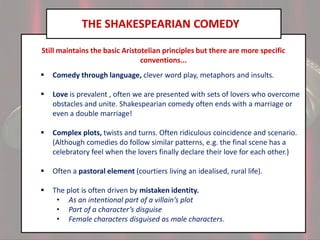
THE SHAKESPEARIAN COMEDY
Still maintains the basic Aristotelian principles but there are more specific
conventions...


Comedy through language, clever word play, metaphors and insults.



Love is prevalent , often we are presented with sets of lovers who overcome
obstacles and unite. Shakespearian comedy often ends with a marriage or
even a double marriage!



Complex plots, twists and turns. Often ridiculous coincidence and scenario.
(Although comedies do follow similar patterns, e.g. the final scene has a
celebratory feel when the lovers finally declare their love for each other.)



Often a pastoral element (courtiers living an idealised, rural life).



The plot is often driven by mistaken identity.
• As an intentional part of a villain’s plot
• Part of a character’s disguise
• Female characters disguised as male characters.
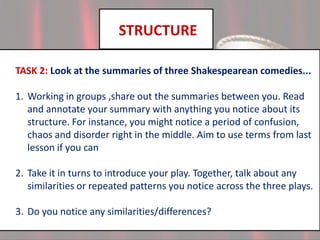
STRUCTURE
TASK 2: Look at the summaries of three Shakespearean comedies...
1. Working in groups ,share out the summaries between you. Read
and annotate your summary with anything you notice about its
structure. For instance, you might notice a period of confusion,
chaos and disorder right in the middle. Aim to use terms from last
lesson if you can
2. Take it in turns to introduce your play. Together, talk about any
similarities or repeated patterns you notice across the three plays.
3. Do you notice any similarities/differences?
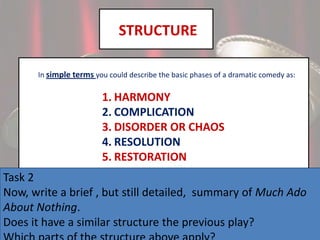
STRUCTURE
In simple terms you could describe the basic phases of a dramatic comedy as:

1. HARMONY
2. COMPLICATION
3. DISORDER OR CHAOS
4. RESOLUTION
5. RESTORATION
Task 2
Now, write a brief , but still detailed, summary of Much Ado
About Nothing.
Does it have a similar structure the previous play?
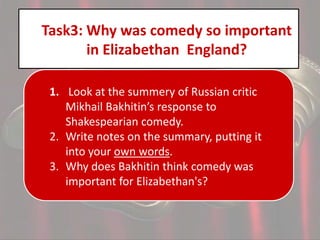
Task3: Why was comedy so important
in Elizabethan England?
1. Look at the summery of Russian critic
Mikhail Bakhitin’s response to
Shakespearian comedy.
2. Write notes on the summary, putting it
into your own words.
3. Why does Bakhitin think comedy was
important for Elizabethan's?
Mikhail Bakhitin (1895-1975) and the Carnivalesque
In the 1930s Bakhitin formulated some of his ideas based on the French novelist
Francois Rabelais (1494-1553), which was eventually published in English as
Rebelais and his World in 1968. In the book Rebelais makes observations on the
contrast between the official culture of the state and religious organisations and
the culture of the market place and people.

Within this he notices that carnival is a significant celebration because it allowed
freedom for the people away from the official culture. Carnival allowed both
indulgence on food and sexual activity, as well as any kind of misrule. Misrule
permitted temporary suspension of the normal rules. In Catholic countries this
happened during Mardi Gras before the restrictions of lent.
In this way, some bad and comic behaviour was tolerated. Like a carnival or feast,
dramatic comedy may be away of the official society and church tolerating
dissent and discontentment. Some people might say that in order to prevent
riotous or revolutionary behaviour, the ruling authorities have allowed workingclass people the opportunity for a kind of controlled misrule. Comedy therefore
has an extremely important social function. Bakhtin’s theories tell us much about
the issues of control and freedom in the genre of dramatic comedy.
Stop and think
Do we still need
‘controlled misrule’?
Can you think of any modern
day examples of
‘controlled misrule’?
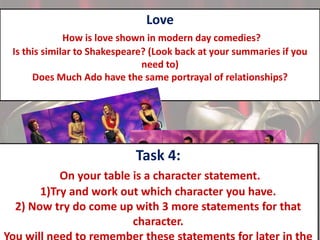
Love
How is love shown in modern day comedies?
Is this similar to Shakespeare? (Look back at your summaries if you
need to)
Does Much Ado have the same portrayal of relationships?

Task 4:
On your table is a character statement.
1)Try and work out which character you have.
2) Now try do come up with 3 more statements for that
character.
Characters in comedy
• In comedy the play may seem to have more ‘leading’
characters
• Characters in comedies may seem to represent
particular social or personality types
• Names of characters may be significant
• As always, it is important to distinguish between
character and characterisation and character and role
Task 5:
Look at the cast list for Much Ado.
• What conclusions might we draw about character, role and
dramatic relationships here?
• Do they fit into the above categories?
• Begin to find specific examples from the text to support
your ideas.
Task 6: What can you remember about
the characters in the play?
Hero, Beatrice, Leonarto, Don Pedro, Don
John, Claudio, Benedick, Dogberry,
Borachio

Comedy lesson 3 and 4

  • 1.
    Starter: TRAGEDY ORCOMEDY? Put a C or a T next to each statement depending on if you think it refers to tragedy or comedy.
  • 2.
    Starter: TRAGEDY ORCOMEDY? Put a C or a T next to each statement depending on if you think it refers to tragedy or comedy. COMEDY We think We're like everyone else We accept the real We celebrate our humanness We change in the nick of time We learn from life Other people humble us We asked for it We live! Resolution at the end TRAGEDY We feel We're unique We strive for the ideal We despair the human condition We can't change We're crippled for life God punishes us It's someone else's fault We die! Resolution only possible after death Complications remaining unresolved
  • 3.
    Much Ado AboutNothing William Shakespeare AQA English Literature – Unit 2 Dramatic Genres Week 2 of Comedy Lesson 3 and 4
  • 4.
    Task 1: As atable come up with a compiled list of all the features you identified for homework. You will be sharing these in a minute the class. Use the A3 or A4 paper as this will allow you to present your work
  • 5.
    THE SHAKESPEARIAN COMEDY Stillmaintains the basic Aristotelian principles but there are more specific conventions...  Comedy through language, clever word play, metaphors and insults.  Love is prevalent , often we are presented with sets of lovers who overcome obstacles and unite. Shakespearian comedy often ends with a marriage or even a double marriage!  Complex plots, twists and turns. Often ridiculous coincidence and scenario. (Although comedies do follow similar patterns, e.g. the final scene has a celebratory feel when the lovers finally declare their love for each other.)  Often a pastoral element (courtiers living an idealised, rural life).  The plot is often driven by mistaken identity. • As an intentional part of a villain’s plot • Part of a character’s disguise • Female characters disguised as male characters.
  • 6.
    STRUCTURE TASK 2: Lookat the summaries of three Shakespearean comedies... 1. Working in groups ,share out the summaries between you. Read and annotate your summary with anything you notice about its structure. For instance, you might notice a period of confusion, chaos and disorder right in the middle. Aim to use terms from last lesson if you can 2. Take it in turns to introduce your play. Together, talk about any similarities or repeated patterns you notice across the three plays. 3. Do you notice any similarities/differences?
  • 7.
    STRUCTURE In simple termsyou could describe the basic phases of a dramatic comedy as: 1. HARMONY 2. COMPLICATION 3. DISORDER OR CHAOS 4. RESOLUTION 5. RESTORATION Task 2 Now, write a brief , but still detailed, summary of Much Ado About Nothing. Does it have a similar structure the previous play?
  • 8.
    Task3: Why wascomedy so important in Elizabethan England? 1. Look at the summery of Russian critic Mikhail Bakhitin’s response to Shakespearian comedy. 2. Write notes on the summary, putting it into your own words. 3. Why does Bakhitin think comedy was important for Elizabethan's?
  • 9.
    Mikhail Bakhitin (1895-1975)and the Carnivalesque In the 1930s Bakhitin formulated some of his ideas based on the French novelist Francois Rabelais (1494-1553), which was eventually published in English as Rebelais and his World in 1968. In the book Rebelais makes observations on the contrast between the official culture of the state and religious organisations and the culture of the market place and people. Within this he notices that carnival is a significant celebration because it allowed freedom for the people away from the official culture. Carnival allowed both indulgence on food and sexual activity, as well as any kind of misrule. Misrule permitted temporary suspension of the normal rules. In Catholic countries this happened during Mardi Gras before the restrictions of lent. In this way, some bad and comic behaviour was tolerated. Like a carnival or feast, dramatic comedy may be away of the official society and church tolerating dissent and discontentment. Some people might say that in order to prevent riotous or revolutionary behaviour, the ruling authorities have allowed workingclass people the opportunity for a kind of controlled misrule. Comedy therefore has an extremely important social function. Bakhtin’s theories tell us much about the issues of control and freedom in the genre of dramatic comedy.
  • 10.
    Stop and think Dowe still need ‘controlled misrule’? Can you think of any modern day examples of ‘controlled misrule’?
  • 11.
    Love How is loveshown in modern day comedies? Is this similar to Shakespeare? (Look back at your summaries if you need to) Does Much Ado have the same portrayal of relationships? Task 4: On your table is a character statement. 1)Try and work out which character you have. 2) Now try do come up with 3 more statements for that character.
  • 12.
    Characters in comedy •In comedy the play may seem to have more ‘leading’ characters • Characters in comedies may seem to represent particular social or personality types • Names of characters may be significant • As always, it is important to distinguish between character and characterisation and character and role Task 5: Look at the cast list for Much Ado. • What conclusions might we draw about character, role and dramatic relationships here? • Do they fit into the above categories? • Begin to find specific examples from the text to support your ideas.
  • 13.
    Task 6: Whatcan you remember about the characters in the play? Hero, Beatrice, Leonarto, Don Pedro, Don John, Claudio, Benedick, Dogberry, Borachio

Editor's Notes

  • #9 p.86 of the resource book