LO: Can I consider whether the 
play fits into the conventions of 
tragedy? 
What do you know about the genre of 
tragedy?
History of Tragedy 
Greek Tragedy 
• Aristotle defined tragedy, in his Poetics, as "the 
imitation of an action that is serious and also as having 
magnitude, complete in itself." 
• He continues, "Tragedy is a form of drama exciting the 
emotions of pity and fear. Its action should be single 
and complete, presenting a reversal of fortune, 
involving persons renowned and of superior 
attainments, and it should be written in poetry 
embellished with every kind of artistic expression." 
• The writer presents "incidents arousing pity and fear, 
wherewith to interpret its catharsis of such emotions"
Catharsis 
•Catharsis is the purging or 
purification of pity and fear. The term 
in drama refers to a sudden emotional 
climax that evokes overwhelming 
feelings of great sorrow, pity, laughter 
or any other extreme change in 
emotion, resulting in restoration and 
renewal in members of the audience.
The Six Main Parts 
•“...Every Tragedy, therefore, must 
have six parts, which determine its 
quality—namely, Plot, Characters, 
Diction, Thought, Spectacle, Melody” 
according to Aristotle.
Plot 
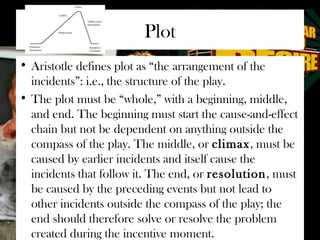
• Aristotle defines plot as “the arrangement of the 
incidents”: i.e., the structure of the play. 
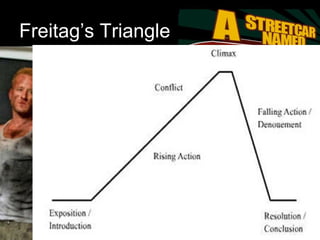
• The plot must be “whole,” with a beginning, middle, 
and end. The beginning must start the cause-and-effect 
chain but not be dependent on anything outside the 
compass of the play. The middle, or climax, must be 
caused by earlier incidents and itself cause the 
incidents that follow it. The end, or resolution, must 
be caused by the preceding events but not lead to 
other incidents outside the compass of the play; the 
end should therefore solve or resolve the problem 
created during the incentive moment.
Freitag’s Triangle
Qualities of the Plot 
• The plot must be “of a certain magnitude,” 
both quantitatively (length, complexity) and 
qualitatively (“seriousness” and universal 
significance). Aristotle argues that plots should 
not be too brief; the more incidents and 
themes that the playwright can bring together, 
the greater the artistic value and richness of 
the play. Also, the more universal and 
significant the meaning of the play, the more 
the playwright can catch and hold the 
emotions of the audience, the better the play 
will be.
Character 
• Character has the second place in 
importance. In a perfect tragedy, character will 
support plot. The protagonist should be renowned and 
prosperous, so his change of fortune can be from good 
to bad. This change “should come about as the result, 
not of vice, but of some great error or frailty in a 
character.” 
• The term Aristotle uses is hamartia, often translated 
“tragic flaw” is important in tragedy. In the ideal 
tragedy, claims Aristotle, the protagonist will 
mistakenly bring about his own downfall—not because 
he is sinful or morally weak, but because he does not 
know enough. The role of the hamartia in tragedy 
comes from the inevitability of its consequences.
Thought 
• Thought is third in importance, and is 
found “where something is proved to 
be or not to be.” Aristotle says little about 
thought, and most of what he has to say is 
associated with how speeches should reveal 
character. 
•However, we can link this character to the 
themes of a play.
Diction 
• Diction is fourth, and is “the expression of 
the meaning in words” which are proper and 
appropriate to the plot, characters, and end 
of the tragedy. 
• In this category, Aristotle discusses the stylistic 
elements of tragedy; he is particularly interested in 
metaphors: “But the greatest thing by far is to have a 
command of metaphor; . . . it is the mark of genius, for 
to make good metaphors implies an eye for 
resemblances”.
Song or Melody 
• Song, or melody, is fifth, and is the 
musical element of the chorus. 
• Aristotle argues that the Chorus should be fully 
integrated into the play like an actor; choral 
odes should not be “mere interludes,” but 
should contribute to the unity of the plot.
Spectacle 
• Spectacle is last, for it is least connected with 
literature; “the production of spectacular 
effects depends more on the art of the stage 
machinist than on that of the poet.” 
• Although Aristotle recognizes the emotional attraction 
of spectacle, he argues that superior poets rely on the 
inner structure of the play rather than spectacle to 
arouse pity and fear; those who rely heavily on 
spectacle “create a sense, not of the terrible, but only 
of the monstrous”.
What’s the difference?
Domestic Tragedy 
• In modern (particularly English) drama, a domestic 
tragedy is a play in which the tragic protagonists are 
ordinary middle-class or lower-class individuals. 
• Aristotle had argued that tragedy should concern only 
great individuals with great minds and souls, because 
their catastrophic downfall would be more emotionally 
powerful to the audience; only comedy should depict 
middle-class people. 
• Domestic tragedy breaks with Aristotle's precepts, 
taking as its subjects merchants or citizens whose lives 
have less consequence in the wider world.
Next Task 
Do you think the text is a domestic tragedy 
or a conventional tragedy? 
Agree/Disagree – stand in the room based 
on your position
Final Task 
Write a PEE paragraph in which you 
explain your reasons.
Your Task 
Read through the tragedy sheet and be 
ready to explain what you read (pp68-70)

Streetcar tragedy

  • 2.
    LO: Can Iconsider whether the play fits into the conventions of tragedy? What do you know about the genre of tragedy?
  • 3.
    History of Tragedy Greek Tragedy • Aristotle defined tragedy, in his Poetics, as "the imitation of an action that is serious and also as having magnitude, complete in itself." • He continues, "Tragedy is a form of drama exciting the emotions of pity and fear. Its action should be single and complete, presenting a reversal of fortune, involving persons renowned and of superior attainments, and it should be written in poetry embellished with every kind of artistic expression." • The writer presents "incidents arousing pity and fear, wherewith to interpret its catharsis of such emotions"
  • 4.
    Catharsis •Catharsis isthe purging or purification of pity and fear. The term in drama refers to a sudden emotional climax that evokes overwhelming feelings of great sorrow, pity, laughter or any other extreme change in emotion, resulting in restoration and renewal in members of the audience.
  • 5.
    The Six MainParts •“...Every Tragedy, therefore, must have six parts, which determine its quality—namely, Plot, Characters, Diction, Thought, Spectacle, Melody” according to Aristotle.
  • 6.
    Plot • Aristotledefines plot as “the arrangement of the incidents”: i.e., the structure of the play. • The plot must be “whole,” with a beginning, middle, and end. The beginning must start the cause-and-effect chain but not be dependent on anything outside the compass of the play. The middle, or climax, must be caused by earlier incidents and itself cause the incidents that follow it. The end, or resolution, must be caused by the preceding events but not lead to other incidents outside the compass of the play; the end should therefore solve or resolve the problem created during the incentive moment.
  • 7.
  • 8.
    Qualities of thePlot • The plot must be “of a certain magnitude,” both quantitatively (length, complexity) and qualitatively (“seriousness” and universal significance). Aristotle argues that plots should not be too brief; the more incidents and themes that the playwright can bring together, the greater the artistic value and richness of the play. Also, the more universal and significant the meaning of the play, the more the playwright can catch and hold the emotions of the audience, the better the play will be.
  • 9.
    Character • Characterhas the second place in importance. In a perfect tragedy, character will support plot. The protagonist should be renowned and prosperous, so his change of fortune can be from good to bad. This change “should come about as the result, not of vice, but of some great error or frailty in a character.” • The term Aristotle uses is hamartia, often translated “tragic flaw” is important in tragedy. In the ideal tragedy, claims Aristotle, the protagonist will mistakenly bring about his own downfall—not because he is sinful or morally weak, but because he does not know enough. The role of the hamartia in tragedy comes from the inevitability of its consequences.
  • 10.
    Thought • Thoughtis third in importance, and is found “where something is proved to be or not to be.” Aristotle says little about thought, and most of what he has to say is associated with how speeches should reveal character. •However, we can link this character to the themes of a play.
  • 11.
    Diction • Dictionis fourth, and is “the expression of the meaning in words” which are proper and appropriate to the plot, characters, and end of the tragedy. • In this category, Aristotle discusses the stylistic elements of tragedy; he is particularly interested in metaphors: “But the greatest thing by far is to have a command of metaphor; . . . it is the mark of genius, for to make good metaphors implies an eye for resemblances”.
  • 12.
    Song or Melody • Song, or melody, is fifth, and is the musical element of the chorus. • Aristotle argues that the Chorus should be fully integrated into the play like an actor; choral odes should not be “mere interludes,” but should contribute to the unity of the plot.
  • 13.
    Spectacle • Spectacleis last, for it is least connected with literature; “the production of spectacular effects depends more on the art of the stage machinist than on that of the poet.” • Although Aristotle recognizes the emotional attraction of spectacle, he argues that superior poets rely on the inner structure of the play rather than spectacle to arouse pity and fear; those who rely heavily on spectacle “create a sense, not of the terrible, but only of the monstrous”.
  • 14.
  • 15.
    Domestic Tragedy •In modern (particularly English) drama, a domestic tragedy is a play in which the tragic protagonists are ordinary middle-class or lower-class individuals. • Aristotle had argued that tragedy should concern only great individuals with great minds and souls, because their catastrophic downfall would be more emotionally powerful to the audience; only comedy should depict middle-class people. • Domestic tragedy breaks with Aristotle's precepts, taking as its subjects merchants or citizens whose lives have less consequence in the wider world.
  • 16.
    Next Task Doyou think the text is a domestic tragedy or a conventional tragedy? Agree/Disagree – stand in the room based on your position
  • 17.
    Final Task Writea PEE paragraph in which you explain your reasons.
  • 18.
    Your Task Readthrough the tragedy sheet and be ready to explain what you read (pp68-70)