Umm-e-Rooman Yaqoob
Roll # 3
B.S (English) 5th
Semester
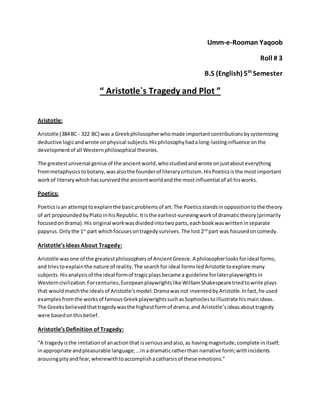
“ Aristotle`s Tragedy and Plot ”
Aristotle:
Aristotle (384BC - 322 BC) was a Greekphilosopherwhomade importantcontributionsbysystemizing
deductive logicandwrote onphysical subjects.His philosophyhadalong-lastinginfluence onthe
developmentof all Westernphilosophical theories.
The greatestuniversal geniusof the ancientworld,whostudiedandwrote onjustabouteverything
frommetaphysicstobotany,wasalsothe founderof literarycriticism.HisPoeticsisthe mostimportant
workof literarywhichhassurvivedthe ancientworldandthe mostinfluential of all hisworks.
Poetics:
Poeticsisan attempttoexplainthe basicproblemsof art.The Poetics standsinoppositiontothe theory
of art propoundedbyPlato inhisRepublic. Itisthe earliest-survivingworkof dramatictheory(primarily
focusedondrama).His original workwasdividedintotwoparts,eachbookwaswritteninseparate
papyrus.Onlythe 1st
part whichfocusesontragedysurvives.The lost2nd
part was focusedoncomedy.
Aristotle’s Ideas About Tragedy:
Aristotle wasone of the greatestphilosophersof AncientGreece.A philosopherlooksforideal forms,
and triestoexplainthe nature of reality.The searchfor ideal formsledAristotle toexplore many
subjects.Hisanalysisof the ideal formof tragicplaysbecame a guideline forlaterplaywrightsin
Westerncivilization.Forcenturies,Europeanplaywrightslike WilliamShakespearetriedtowrite plays
that wouldmatchthe idealsof Aristotle’smodel.Dramawasnot inventedbyAristotle.Infact,he used
examplesfromthe worksof famousGreekplaywrightssuchasSophoclestoillustrate hismainideas.
The Greeksbelievedthattragedywasthe highestformof drama,and Aristotle’sideasabouttragedy
were basedonthisbelief.
Aristotle’s Definition of Tragedy:
“A tragedyisthe imitationof anactionthat isseriousandalso,as havingmagnitude,complete initself;
inappropriate andpleasurable language;...in adramaticratherthan narrative form;withincidents
arousingpityandfear,wherewithtoaccomplishacatharsisof these emotions.”
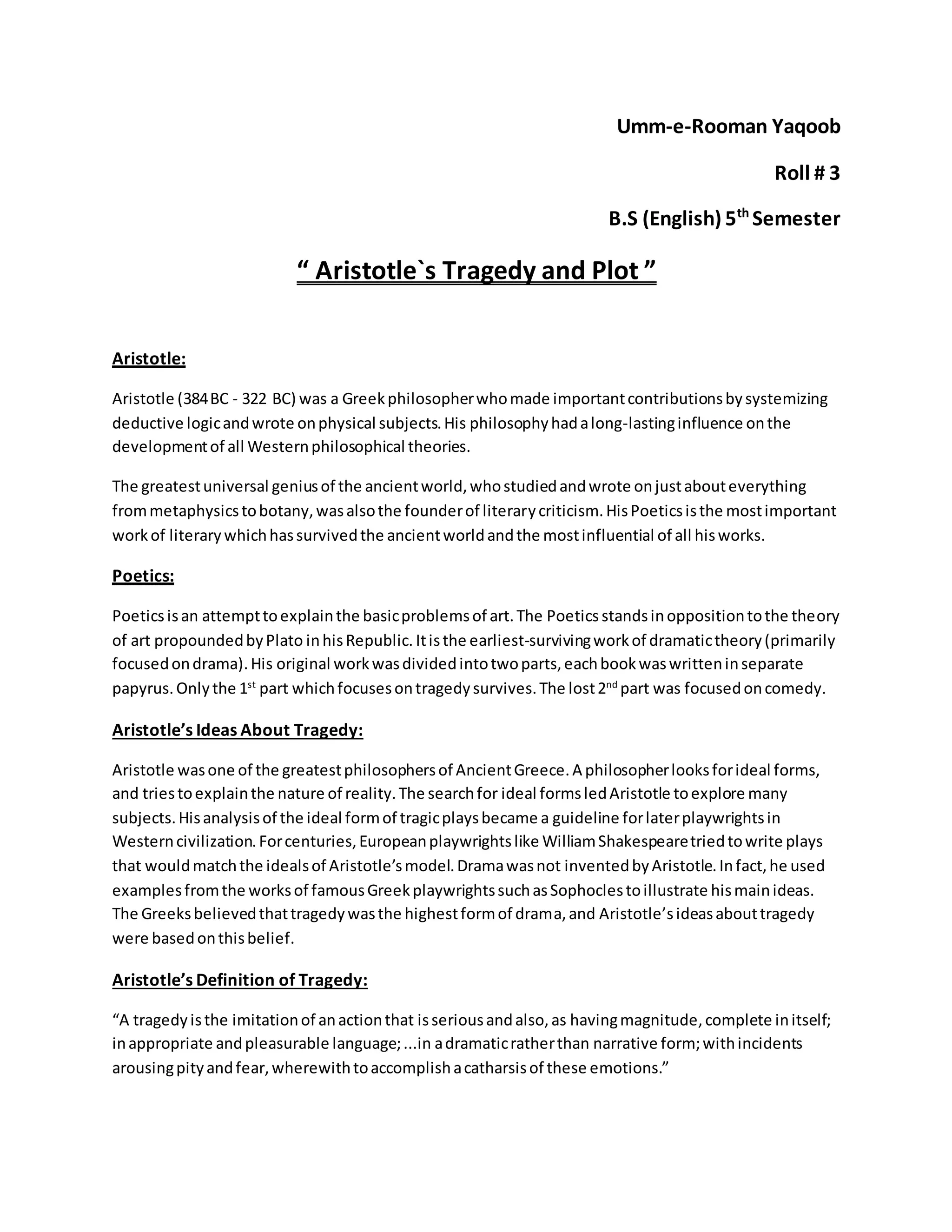
1. “The imitationof an action that is seriousand also, as havingmagnitude,complete initself” This
meansthat a good tragedydealswithone issue thatisvery“serious.”Youcan’t have a tragedyabout
somethingtrivial.“Magnitude”here meansgreatimportance.The issue hastobe seriousandvery
important.That’swhya lot of tragediesdeal withsomeone’sdeath.“Completeinitself”meansthatthe
playmuststick to the one issue;otherwise,the audience will getlostinthe plot.
2. “in appropriateandpleasurablelanguage” AncientGreektragedyhada choruswhose role wasto
commentonthe actionof the play.The chorussometimessangtheirpart.Aristotle saidthatthe
language shouldbe easytolistento.Itshouldhave rhythmandalso goodharmonyfor the linesthat
were sung.
3. “ina dramatic rather than narrative form” To narrate a story issimplytotell the story.In a play,the
storymust be dramatizedoracted out.
4. “with incidentsarousingpity and fear” In a tragedy,the eventsorepisodesinthe playshouldlead
the audience tofeel verysorryforthe maincharacter—the tragichero.The audience shouldalsofeel
afraidfor the heroas he movestowarda destructive end.
5. “wherewithtoaccomplisha catharsis of these emotions.” Asthe playmovesalong,the events
shouldbuildupthe emotionsof pityandfear.A catharsisis a purging,or cleansingof the emotions--a
release of tension.Ina tragedy,thisisoftenamomento f revelationwhenthe tragichero“fallsflaton
hisface,”and the audience canfinally“explode.”
Aristotle’s Elements of Tragedy:
Aristotle saidthattragedyhas six mainelementsof tragedy:
1. Plot;
2. Character;
3. Thought;
4. Diction;
5. Melody;
6. Spectacle.
The last fourelements(Thought,Diction,Melody,andSpectacle) are the leastimportant,butAristotle
felttheymustbe done well forthe playto succeed.
 Thought is the powerof sayingwhatever can besaid and should be said at each momentof the
plot.Do the linesspokenbythe actorsmake sense?Are theysayingwhat should besaid at each
particularmomentinthe play?
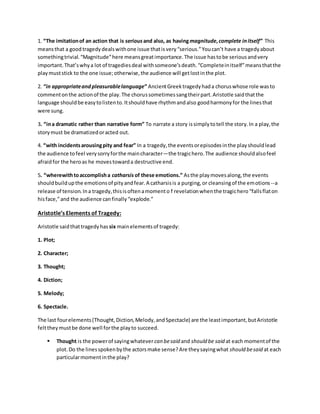
 Diction isthe actual compositionof the linesthatare recited.Thoughtdealswith whatissaid,
and dictiondealswith how itissaid.There are manywaysto say something.A goodplaywright
composeslinesthatsaysomethingextremelywell.Inagoodplay,some linesare sowell
constructedthatthe audience canleave the playquotingthe linesexactly.
 Melodyand Spectacle are accessories.The Greekssometimesusedmusical accompaniment.
Aristotle saidthe music(melody)hastoblendinwiththe playappropriately.Spectacle refers to
the presentationof the play.Again,aswithmelody,the spectacle shouldbe appropriatetothe
theme of the play.
 Character is the secondmostimportantelementof tragedy.Eachcharacterhas an essential
qualityornature that is revealedinthe plot.The moral purpose of eachcharactermust be clear
to the audience.The charactersshouldhave fourmainqualitiesthatare as follows:
1. No matterwhotheyare (heroor slave),the charactersmustbe goodin some way.
2. The characters shouldact appropriatelyfortheirgenderandpositioninlife.
3. The characters have to have believablepersonalities.
4. Each character must act consistentlythroughoutthe play.Inotherwords,nothingshouldbe
done or saidthat couldbe seenas “actingout of character.”
 Plot mustcontainelementsof astonishment,reversal (peripeteia),recognition,andsuffering.
Reversal isanironictwistor change by whichthe mainactionof the story comesfull-circle.
Recognition,meanwhile,isthe change fromignorance toknowledge,usuallyinvolvingpeople
comingto understandone another'strue identities.Sufferingisadestructive orpainful action,
whichisoftenthe resultof a reversal orrecognition.All three elementscoalesce tocreate
"catharsis,"whichisthe engendermentof fearandpityinthe audience:pityforthe tragichero's
plight,andfearthat hisfate mightbefall us..First,the heromustbe 'good,'and thusmanifest
moral purpose inhisspeech.Second,the heromusthave propriety,or'manlycourage.'Thirdly,
the heromust be 'true to life.'Andfinally,the heromustbe consistent.
1. There mustbe Unity ofPlot.This has alreadybee ndescribedinthe definitionwhichtalksabout“one
complete action.” Actionsmustalsobe probable orbelievable.
2. A good plothas Peripety or Discovery--sometimesboth. Peripetyisthe change from one state of
thingsat the beginningof the playtothe exactopposite state bythe endof the play.Thiscouldbe
somethinglikethe change frombeingrichtobeingpoor,or frombeingpowerful tobeingpowerless,or
frombeinga rulerto beinga beggar.The change that takesplace ina tragedyshouldtake the main
character (andpossiblyothercharacters) fromastate of happinesstoa state of misery. Discoveryisa
change from ignorance toknowledge.Thisoftenhappenstothe tragicherowho startsout “clueless”
and slowlylearnshowhe himself createdthe messhe endsupinat the endof the play.
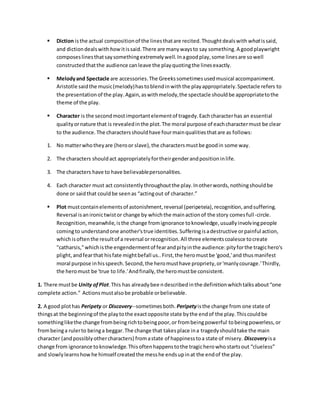
3. Change byitself isnotenough.The characterinvolvedinthe change musthave specificcharacteristics
to arouse the tragic emotionsof pityandfear.Therefore,Aristotlesaidthatthere are three formsof
plotthat shouldbe avoided.
 A totallygoodmanmust notpass fromhappinesstomisery.Thiswill make the audience angry
that bad thingshappenedtohim.Theywon’tpityhimsomuchas be angry for him.
 A bad manmust notpass frommiseryto happiness.Thiswon’tappeal tothe audience atall
because theywouldnotwantto see evil rewarded.
 A bad mancannot pass fromhappinesstomisery.The audience won’tfeel sorryforhimbecause
theywill believe he gotwhathe deserved.
4. The true tragichero cannotbe toogood or too bad,but he mustendup inmisery.
5. Aristotle concludedthatthe besttragedycentersona basicallygoodmanwho’sconditionchanges
fromhappinesstomiserybecause of somegreaterror.For example,he mighthave agoodquality,like
pride,thatgetsout of hand.
The plotof a tragedyalsoinvolvessomehorribleorevil deed.The tragicheroeitherdoesit consciously,
doesitout of ignorance,ormediatesit (makesiteasyfor the deedtohappen).Forthe audience tobe
horrifiedbythe evil deed,the evilhastobe done to someone importanttothe tragichero.If the hero
killshisenemy,the deedwon’tseemsobad.Onthe otherhand,if the herokillssomeone he doesn’t
care about,the audience won’tcare mucheither.Tomake it really horrible for the audience,Aristotle
suggestedthatthe evil deedshouldbe done toa family member.

Aristotle Tragedy and plot

  • 1.
    Umm-e-Rooman Yaqoob Roll #3 B.S (English) 5th Semester “ Aristotle`s Tragedy and Plot ” Aristotle: Aristotle (384BC - 322 BC) was a Greekphilosopherwhomade importantcontributionsbysystemizing deductive logicandwrote onphysical subjects.His philosophyhadalong-lastinginfluence onthe developmentof all Westernphilosophical theories. The greatestuniversal geniusof the ancientworld,whostudiedandwrote onjustabouteverything frommetaphysicstobotany,wasalsothe founderof literarycriticism.HisPoeticsisthe mostimportant workof literarywhichhassurvivedthe ancientworldandthe mostinfluential of all hisworks. Poetics: Poeticsisan attempttoexplainthe basicproblemsof art.The Poetics standsinoppositiontothe theory of art propoundedbyPlato inhisRepublic. Itisthe earliest-survivingworkof dramatictheory(primarily focusedondrama).His original workwasdividedintotwoparts,eachbookwaswritteninseparate papyrus.Onlythe 1st part whichfocusesontragedysurvives.The lost2nd part was focusedoncomedy. Aristotle’s Ideas About Tragedy: Aristotle wasone of the greatestphilosophersof AncientGreece.A philosopherlooksforideal forms, and triestoexplainthe nature of reality.The searchfor ideal formsledAristotle toexplore many subjects.Hisanalysisof the ideal formof tragicplaysbecame a guideline forlaterplaywrightsin Westerncivilization.Forcenturies,Europeanplaywrightslike WilliamShakespearetriedtowrite plays that wouldmatchthe idealsof Aristotle’smodel.Dramawasnot inventedbyAristotle.Infact,he used examplesfromthe worksof famousGreekplaywrightssuchasSophoclestoillustrate hismainideas. The Greeksbelievedthattragedywasthe highestformof drama,and Aristotle’sideasabouttragedy were basedonthisbelief. Aristotle’s Definition of Tragedy: “A tragedyisthe imitationof anactionthat isseriousandalso,as havingmagnitude,complete initself; inappropriate andpleasurable language;...in adramaticratherthan narrative form;withincidents arousingpityandfear,wherewithtoaccomplishacatharsisof these emotions.”
  • 2.
    1. “The imitationofan action that is seriousand also, as havingmagnitude,complete initself” This meansthat a good tragedydealswithone issue thatisvery“serious.”Youcan’t have a tragedyabout somethingtrivial.“Magnitude”here meansgreatimportance.The issue hastobe seriousandvery important.That’swhya lot of tragediesdeal withsomeone’sdeath.“Completeinitself”meansthatthe playmuststick to the one issue;otherwise,the audience will getlostinthe plot. 2. “in appropriateandpleasurablelanguage” AncientGreektragedyhada choruswhose role wasto commentonthe actionof the play.The chorussometimessangtheirpart.Aristotle saidthatthe language shouldbe easytolistento.Itshouldhave rhythmandalso goodharmonyfor the linesthat were sung. 3. “ina dramatic rather than narrative form” To narrate a story issimplytotell the story.In a play,the storymust be dramatizedoracted out. 4. “with incidentsarousingpity and fear” In a tragedy,the eventsorepisodesinthe playshouldlead the audience tofeel verysorryforthe maincharacter—the tragichero.The audience shouldalsofeel afraidfor the heroas he movestowarda destructive end. 5. “wherewithtoaccomplisha catharsis of these emotions.” Asthe playmovesalong,the events shouldbuildupthe emotionsof pityandfear.A catharsisis a purging,or cleansingof the emotions--a release of tension.Ina tragedy,thisisoftenamomento f revelationwhenthe tragichero“fallsflaton hisface,”and the audience canfinally“explode.” Aristotle’s Elements of Tragedy: Aristotle saidthattragedyhas six mainelementsof tragedy: 1. Plot; 2. Character; 3. Thought; 4. Diction; 5. Melody; 6. Spectacle. The last fourelements(Thought,Diction,Melody,andSpectacle) are the leastimportant,butAristotle felttheymustbe done well forthe playto succeed.  Thought is the powerof sayingwhatever can besaid and should be said at each momentof the plot.Do the linesspokenbythe actorsmake sense?Are theysayingwhat should besaid at each particularmomentinthe play?
  • 3.
     Diction istheactual compositionof the linesthatare recited.Thoughtdealswith whatissaid, and dictiondealswith how itissaid.There are manywaysto say something.A goodplaywright composeslinesthatsaysomethingextremelywell.Inagoodplay,some linesare sowell constructedthatthe audience canleave the playquotingthe linesexactly.  Melodyand Spectacle are accessories.The Greekssometimesusedmusical accompaniment. Aristotle saidthe music(melody)hastoblendinwiththe playappropriately.Spectacle refers to the presentationof the play.Again,aswithmelody,the spectacle shouldbe appropriatetothe theme of the play.  Character is the secondmostimportantelementof tragedy.Eachcharacterhas an essential qualityornature that is revealedinthe plot.The moral purpose of eachcharactermust be clear to the audience.The charactersshouldhave fourmainqualitiesthatare as follows: 1. No matterwhotheyare (heroor slave),the charactersmustbe goodin some way. 2. The characters shouldact appropriatelyfortheirgenderandpositioninlife. 3. The characters have to have believablepersonalities. 4. Each character must act consistentlythroughoutthe play.Inotherwords,nothingshouldbe done or saidthat couldbe seenas “actingout of character.”  Plot mustcontainelementsof astonishment,reversal (peripeteia),recognition,andsuffering. Reversal isanironictwistor change by whichthe mainactionof the story comesfull-circle. Recognition,meanwhile,isthe change fromignorance toknowledge,usuallyinvolvingpeople comingto understandone another'strue identities.Sufferingisadestructive orpainful action, whichisoftenthe resultof a reversal orrecognition.All three elementscoalesce tocreate "catharsis,"whichisthe engendermentof fearandpityinthe audience:pityforthe tragichero's plight,andfearthat hisfate mightbefall us..First,the heromustbe 'good,'and thusmanifest moral purpose inhisspeech.Second,the heromusthave propriety,or'manlycourage.'Thirdly, the heromust be 'true to life.'Andfinally,the heromustbe consistent. 1. There mustbe Unity ofPlot.This has alreadybee ndescribedinthe definitionwhichtalksabout“one complete action.” Actionsmustalsobe probable orbelievable. 2. A good plothas Peripety or Discovery--sometimesboth. Peripetyisthe change from one state of thingsat the beginningof the playtothe exactopposite state bythe endof the play.Thiscouldbe somethinglikethe change frombeingrichtobeingpoor,or frombeingpowerful tobeingpowerless,or frombeinga rulerto beinga beggar.The change that takesplace ina tragedyshouldtake the main character (andpossiblyothercharacters) fromastate of happinesstoa state of misery. Discoveryisa change from ignorance toknowledge.Thisoftenhappenstothe tragicherowho startsout “clueless” and slowlylearnshowhe himself createdthe messhe endsupinat the endof the play.
  • 4.
    3. Change byitselfisnotenough.The characterinvolvedinthe change musthave specificcharacteristics to arouse the tragic emotionsof pityandfear.Therefore,Aristotlesaidthatthere are three formsof plotthat shouldbe avoided.  A totallygoodmanmust notpass fromhappinesstomisery.Thiswill make the audience angry that bad thingshappenedtohim.Theywon’tpityhimsomuchas be angry for him.  A bad manmust notpass frommiseryto happiness.Thiswon’tappeal tothe audience atall because theywouldnotwantto see evil rewarded.  A bad mancannot pass fromhappinesstomisery.The audience won’tfeel sorryforhimbecause theywill believe he gotwhathe deserved. 4. The true tragichero cannotbe toogood or too bad,but he mustendup inmisery. 5. Aristotle concludedthatthe besttragedycentersona basicallygoodmanwho’sconditionchanges fromhappinesstomiserybecause of somegreaterror.For example,he mighthave agoodquality,like pride,thatgetsout of hand. The plotof a tragedyalsoinvolvessomehorribleorevil deed.The tragicheroeitherdoesit consciously, doesitout of ignorance,ormediatesit (makesiteasyfor the deedtohappen).Forthe audience tobe horrifiedbythe evil deed,the evilhastobe done to someone importanttothe tragichero.If the hero killshisenemy,the deedwon’tseemsobad.Onthe otherhand,if the herokillssomeone he doesn’t care about,the audience won’tcare mucheither.Tomake it really horrible for the audience,Aristotle suggestedthatthe evil deedshouldbe done toa family member.