From Aristotle’s Poetics
 “A tragedy is impossible without plot, but
there may be one without character.”
 Aristotle has considered plot as the “soul of
tragedy”
 is “Biological”
 He compares tragedy with a Living Organism
 “Skeleton”
 In Greek, the word ‘Poet’ means “maker”.
 Story General
 Plot Specific
 The Poet reduces the story into its essentials,
he sketches the general outline.
 The making of story into plot is called
episodizing.
 “… complete in itself, also having magnitude”
 Completeness=Proper/Logical Beginning
Proper/Logical Middle
Proper/Logical Ending
 Connected Incidents or Events
 Logical sequence
 It involves Size or the Length of the plot.
 The proper magnitude demands that the plot
be neither too short, nor too long.
 Beauty depends upon size.
 The length of the plot should be such that its
parts can be easily remembered in relation to
the whole.
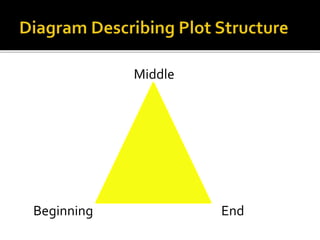
Middle
Beginning End
 Aristotle compares the action of a tragedy to
a living organism.
 Structural unity
 Plot must not be ‘Episodic’.
 The change from Happiness to Misery seems
more appropriate for the arousal of pity and
fear.
 Therefore, Aristotle seems to prefer the fatal
plot to a fortunate plot.
 Aristotle Prefers the complex plot as it is
having both Peripety and Anagnorisis for the
downfall of the hero.
 Peripety: Reversal of Situation
 Anagnorisis: Discovery ofTruth
 The best tragedy is the one which uses both
these techniques at one time.
 Peripety andAnagnorisis occurring
simultaneously heightens the tragic effect.
 However in all cases these must occur
according to the laws of probability and
necessity, and not arbitrarily.
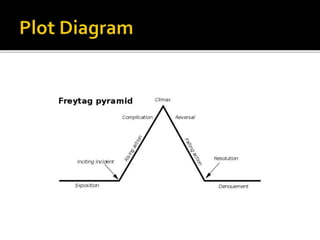
 Complication
It is that part of tragedy which extends
from the part where the turning point occurs.
 Denouement
It is that which extends from the turning
point to the end of tragedy
 The Denouement should be aimed towards a
SINGLE end, and not towards the ‘double-
end’ in which there are reward s for some of
the persons and punishment for other.
 Aristotle is against ‘poetic justice’ in tragedy.
 Also againstTragicomedy.
1) Unity of Place
2) Unity ofTime
3) Unity of Action
 There has to be a single action consisting of
episodes, which are logically connected and
casually related.

Aristotle's Concept regarding Plot

  • 1.
  • 2.
     “A tragedyis impossible without plot, but there may be one without character.”  Aristotle has considered plot as the “soul of tragedy”
  • 3.
     is “Biological” He compares tragedy with a Living Organism  “Skeleton”
  • 4.
     In Greek,the word ‘Poet’ means “maker”.  Story General  Plot Specific  The Poet reduces the story into its essentials, he sketches the general outline.  The making of story into plot is called episodizing.
  • 5.
     “… completein itself, also having magnitude”  Completeness=Proper/Logical Beginning Proper/Logical Middle Proper/Logical Ending  Connected Incidents or Events  Logical sequence
  • 6.
     It involvesSize or the Length of the plot.  The proper magnitude demands that the plot be neither too short, nor too long.  Beauty depends upon size.  The length of the plot should be such that its parts can be easily remembered in relation to the whole.
  • 7.
  • 8.
     Aristotle comparesthe action of a tragedy to a living organism.  Structural unity  Plot must not be ‘Episodic’.
  • 9.
     The changefrom Happiness to Misery seems more appropriate for the arousal of pity and fear.  Therefore, Aristotle seems to prefer the fatal plot to a fortunate plot.
  • 10.
     Aristotle Prefersthe complex plot as it is having both Peripety and Anagnorisis for the downfall of the hero.  Peripety: Reversal of Situation  Anagnorisis: Discovery ofTruth  The best tragedy is the one which uses both these techniques at one time.
  • 11.
     Peripety andAnagnorisisoccurring simultaneously heightens the tragic effect.  However in all cases these must occur according to the laws of probability and necessity, and not arbitrarily.
  • 12.
     Complication It isthat part of tragedy which extends from the part where the turning point occurs.  Denouement It is that which extends from the turning point to the end of tragedy
  • 14.
     The Denouementshould be aimed towards a SINGLE end, and not towards the ‘double- end’ in which there are reward s for some of the persons and punishment for other.  Aristotle is against ‘poetic justice’ in tragedy.  Also againstTragicomedy.
  • 15.
    1) Unity ofPlace 2) Unity ofTime 3) Unity of Action
  • 16.
     There hasto be a single action consisting of episodes, which are logically connected and casually related.