NET/SET Guidance Lectures
Paper-1 Unit-4
Communication
By
Komal Shahedadpuri
GSET (2018) & NET (2019)
Unit IV - Communication
● Communication: Meaning, types and characteristics
of communication.
● Effective communication: Verbal and Non-verbal,
Inter-Cultural and group communications, Classroom
communication.
● Barriers to effective communication.
● Mass-Media and Society.
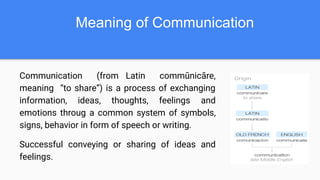
Communication (from Latin commūnicāre,
meaning “to share”) is a process of exchanging
information, ideas, thoughts, feelings and
emotions throug a common system of symbols,
signs, behavior in form of speech or writing.
Successful conveying or sharing of ideas and
feelings.
Meaning of Communication
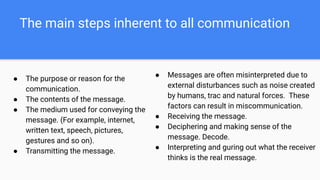
● The purpose or reason for the
communication.
● The contents of the message.
● The medium used for conveying the
message. (For example, internet,
written text, speech, pictures,
gestures and so on).
● Transmitting the message.
● Messages are often misinterpreted due to
external disturbances such as noise created
by humans, trac and natural forces. These
factors can result in miscommunication.
● Receiving the message.
● Deciphering and making sense of the
message. Decode.
● Interpreting and guring out what the receiver
thinks is the real message.
The main steps inherent to all communication
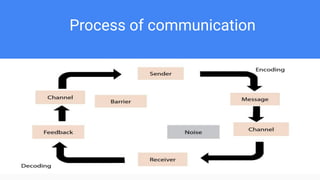
Process of communication
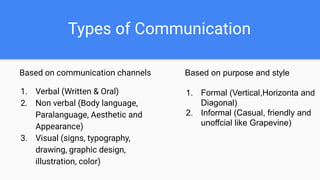
Types of Communication
Based on communication channels
1. Verbal (Written & Oral)
2. Non verbal (Body language,
Paralanguage, Aesthetic and
Appearance)
3. Visual (signs, typography,
drawing, graphic design,
illustration, color)
Based on purpose and style
1. Formal (Vertical,Horizonta and
Diagonal)
2. Informal (Casual, friendly and
unoffcial like Grapevine)
Intercultural Communication
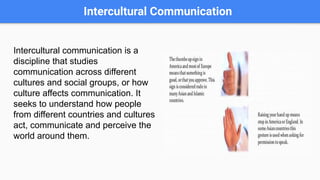
Intercultural communication is a
discipline that studies
communication across different
cultures and social groups, or how
culture affects communication. It
seeks to understand how people
from different countries and cultures
act, communicate and perceive the
world around them.
Group Communication
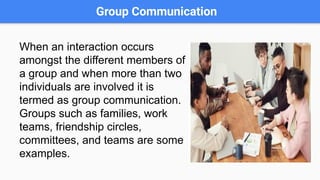
When an interaction occurs
amongst the different members of
a group and when more than two
individuals are involved it is
termed as group communication.
Groups such as families, work
teams, friendship circles,
committees, and teams are some
examples.
Classroom Communication
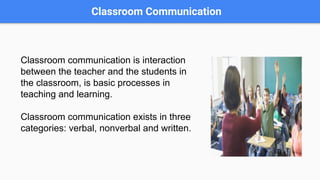
Classroom communication is interaction
between the teacher and the students in
the classroom, is basic processes in
teaching and learning.
Classroom communication exists in three
categories: verbal, nonverbal and written.
Barriers to effective communication
● Physical barriers (noise of traffic, gossips or natural)
● Language barriers (disability or language differences)
● Cultural barriers (cultural differences)
● Emotional barriers (anger, pride, fear, jealousy, anxiety)
● Atitude barriers (behaviours or perceptions)
● Physiological barriers (ill health, poor eyesight, hearing
diculties)
Mass media & Society
The mass media have an important role in a modern
democratic society as the main channel of communication.
The population relies on the news media as the main
source of information.
Popular mass media are Newspaper, Television, Radio,
Internet etc..
It also important mediums/Chanel of mass communication.
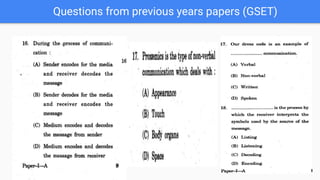
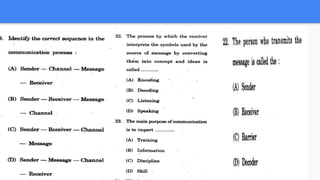
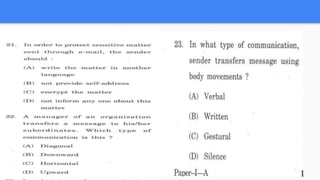
Questions from previous years papers (GSET)
Thank you
Any questions??

Communication net set

  • 1.
    NET/SET Guidance Lectures Paper-1Unit-4 Communication By Komal Shahedadpuri GSET (2018) & NET (2019)
  • 2.
    Unit IV -Communication ● Communication: Meaning, types and characteristics of communication. ● Effective communication: Verbal and Non-verbal, Inter-Cultural and group communications, Classroom communication. ● Barriers to effective communication. ● Mass-Media and Society.
  • 3.
    Communication (from Latincommūnicāre, meaning “to share”) is a process of exchanging information, ideas, thoughts, feelings and emotions throug a common system of symbols, signs, behavior in form of speech or writing. Successful conveying or sharing of ideas and feelings. Meaning of Communication
  • 4.
    ● The purposeor reason for the communication. ● The contents of the message. ● The medium used for conveying the message. (For example, internet, written text, speech, pictures, gestures and so on). ● Transmitting the message. ● Messages are often misinterpreted due to external disturbances such as noise created by humans, trac and natural forces. These factors can result in miscommunication. ● Receiving the message. ● Deciphering and making sense of the message. Decode. ● Interpreting and guring out what the receiver thinks is the real message. The main steps inherent to all communication
  • 5.
  • 6.
    Types of Communication Basedon communication channels 1. Verbal (Written & Oral) 2. Non verbal (Body language, Paralanguage, Aesthetic and Appearance) 3. Visual (signs, typography, drawing, graphic design, illustration, color) Based on purpose and style 1. Formal (Vertical,Horizonta and Diagonal) 2. Informal (Casual, friendly and unoffcial like Grapevine)
  • 8.
    Intercultural Communication Intercultural communicationis a discipline that studies communication across different cultures and social groups, or how culture affects communication. It seeks to understand how people from different countries and cultures act, communicate and perceive the world around them.
  • 9.
    Group Communication When aninteraction occurs amongst the different members of a group and when more than two individuals are involved it is termed as group communication. Groups such as families, work teams, friendship circles, committees, and teams are some examples.
  • 10.
    Classroom Communication Classroom communicationis interaction between the teacher and the students in the classroom, is basic processes in teaching and learning. Classroom communication exists in three categories: verbal, nonverbal and written.
  • 11.
    Barriers to effectivecommunication ● Physical barriers (noise of traffic, gossips or natural) ● Language barriers (disability or language differences) ● Cultural barriers (cultural differences) ● Emotional barriers (anger, pride, fear, jealousy, anxiety) ● Atitude barriers (behaviours or perceptions) ● Physiological barriers (ill health, poor eyesight, hearing diculties)
  • 12.
    Mass media &Society The mass media have an important role in a modern democratic society as the main channel of communication. The population relies on the news media as the main source of information. Popular mass media are Newspaper, Television, Radio, Internet etc.. It also important mediums/Chanel of mass communication.
  • 13.
    Questions from previousyears papers (GSET)
  • 16.