POLYMERS Fundamentals of Polymer Technology Thermoplastic Polymers Thermosetting Polymers Elastomers Guide to the Processing of Polymers
Polymer A compound consisting of long‑chain molecules, each molecule made up of repeating units connected together  There may be thousands, even millions of units in a single polymer molecule The word  polymer  is derived from the Greek words  poly , meaning many, and  meros  (reduced to  mer ), meaning part Most polymers are based on carbon and are therefore considered organic chemicals
Types of Polymers Polymers can be separated into plastics and rubbers  As engineering materials, it is appropriate to divide them into the following three categories:  Thermoplastic polymers Thermosetting polymers Elastomers where (1) and (2) are plastics and (3) are rubbers
Thermoplastic Polymers - Thermoplastics Solid materials at room temperature but viscous liquids when heated to temperatures of only a few hundred degrees This characteristic allows them to be easily and economically shaped into products They can be subjected to heating and cooling cycles repeatedly without significant degradation Symbolized by TP
Thermosetting Polymers - Thermosets Cannot tolerate repeated heating cycles as thermoplastics can When initially heated, they soften and flow for molding Elevated temperatures also produce a chemical reaction that hardens the material into an infusible solid  If reheated, thermosets degrade and char rather than soften  Symbolized by TS
Elastomers (Rubbers) Polymers that exhibit extreme elastic extensibility when subjected to relatively low mechanical stress Some elastomers can be stretched by a factor of 10 and yet completely recover to their original shape Although their properties are quite different from thermosets, they share a similar molecular structure that is different from the thermoplastics
Market Shares Thermoplastics are commercially the most important of the three types About 70% of the tonnage of all synthetic polymers produced  Thermosets and elastomers share the remaining 30% about evenly, with a slight edge for the former On a volumetric basis, current annual usage of polymers exceeds that of metals
Examples of Polymers Thermoplastics:  Polyethylene, polyvinylchloride, polypropylene, polystyrene, and nylon  Thermosets:  Phenolics, epoxies, and certain polyesters  Elastomers:  Natural rubber (vulcanized)  Synthetic rubbers, which exceed the tonnage of natural rubber
Reasons Why Polymers are Important  Plastics can be molded into intricate part shapes, usually with no further processing Very compatible with  net shape  processing   On a volumetric basis, polymers: Are cost competitive with metals Generally require less energy to produce than metals  Certain plastics are transparent, which makes them competitive with glass in some applications
General Properties of Polymers  Low density relative to metals and ceramics  Good strength‑to‑weight ratios for certain (but not all) polymers High corrosion resistance Low electrical and thermal conductivity
Limitations of Polymers Low strength relative to metals and ceramics Low modulus of elasticity (stiffness) Service temperatures are limited to only a few hundred degrees Viscoelastic properties, which can be a distinct limitation in load bearing applications  Some polymers degrade when subjected to sunlight and other forms of radiation
Synthesis of Polymers  Nearly all polymers used in engineering are synthetic  They are made by chemical processing Polymers are synthesized by joining many small molecules together into very large molecules, called  macromolecules , that possess a chain‑like structure The small units, called  monomers , are generally simple unsaturated organic molecules such as ethylene C 2 H 4
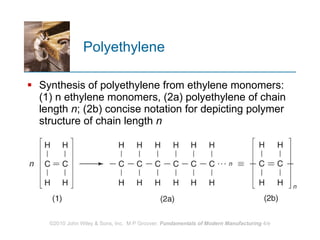
Polyethylene Synthesis of polyethylene from ethylene monomers: (1) n ethylene monomers, (2a) polyethylene of chain length  n ; (2b) concise notation for depicting polymer structure of chain length  n
Polymerization As a chemical process, the synthesis of polymers can occur by either of two methods:  Addition polymerization Step polymerization Production of a given polymer is generally associated with one method or the other
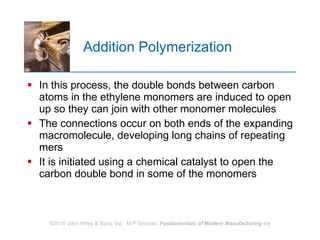
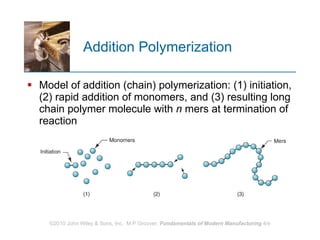
Addition Polymerization In this process, the double bonds between carbon atoms in the ethylene monomers are induced to open up so they can join with other monomer molecules  The connections occur on both ends of the expanding macromolecule, developing long chains of repeating mers  It is initiated using a chemical catalyst to open the carbon double bond in some of the monomers
Addition Polymerization Model of addition (chain) polymerization: (1) initiation, (2) rapid addition of monomers, and (3) resulting long chain polymer molecule with  n  mers at termination of reaction
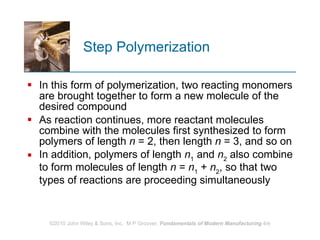
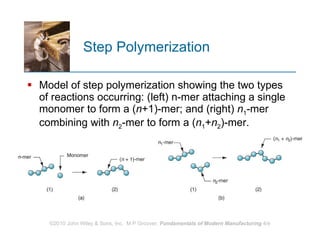
Step Polymerization In this form of polymerization, two reacting monomers are brought together to form a new molecule of the desired compound As reaction continues, more reactant molecules combine with the molecules first synthesized to form polymers of length  n  = 2, then length  n  = 3, and so on In addition, polymers of length  n 1  and  n 2  also combine to form molecules of length  n  =  n 1  +  n 2 , so that two types of reactions are proceeding simultaneously
Step Polymerization Model of step polymerization showing the two types of reactions occurring: (left) n‑mer attaching a single monomer to form a ( n +1)‑mer; and (right)  n 1 ‑mer combining with  n 2 ‑mer to form a ( n 1 + n 2 )‑mer.
Some Examples Polymers produced by addition polymerization:  Polyethylene, polypropylene, polyvinylchloride, polyisoprene Polymers produced by step polymerization:  Nylon, polycarbonate, phenol formaldehyde
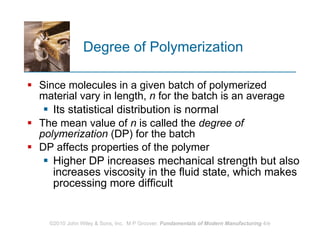
Degree of Polymerization Since molecules in a given batch of polymerized material vary in length,  n  for the batch is an average Its statistical distribution is normal  The mean value of  n  is called the  degree of polymerization  (DP) for the batch  DP affects properties of the polymer Higher DP increases mechanical strength but also increases viscosity in the fluid state, which makes processing more difficult
Molecular Weight  The sum of the molecular weights of the mers in the molecule  MW =  n  times the molecular weight of each repeating unit  Since  n  varies for different molecules in a batch, the molecular weight must be interpreted as an average
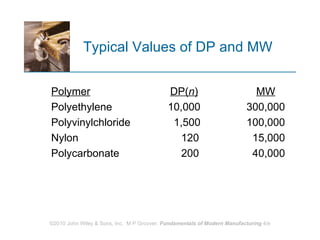
Typical Values of DP and MW MW 300,000 100,000 15,000 40,000 DP( n ) 10,000 1,500 120 200 Polymer Polyethylene Polyvinylchloride Nylon Polycarbonate
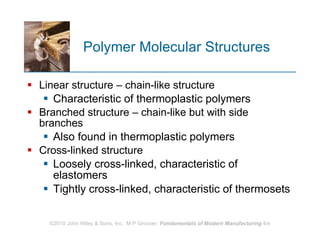
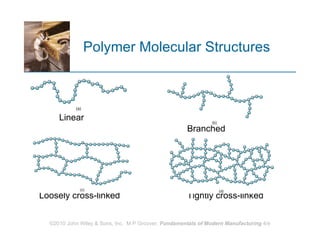
Polymer Molecular Structures Linear structure – chain-like structure  Characteristic of thermoplastic polymers Branched structure – chain-like but with side branches  Also found in thermoplastic polymers Cross-linked structure Loosely cross-linked, characteristic of  elastomers Tightly cross-linked, characteristic of thermosets
Polymer Molecular Structures Linear Branched Loosely cross-linked Tightly cross-linked
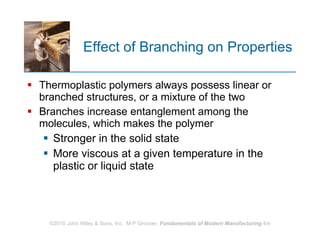
Effect of Branching on Properties Thermoplastic polymers always possess linear or branched structures, or a mixture of the two  Branches increase entanglement among the molecules, which makes the polymer Stronger in the solid state  More viscous at a given temperature in the plastic or liquid state
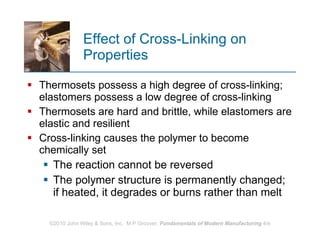
Effect of Cross-Linking on Properties Thermosets possess a high degree of cross‑linking; elastomers possess a low degree of cross‑linking Thermosets are hard and brittle, while elastomers are elastic and resilient Cross‑linking causes the polymer to become chemically set The reaction cannot be reversed  The polymer structure is permanently changed; if heated, it degrades or burns rather than melt
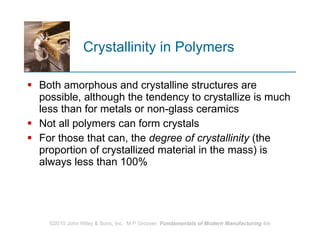
Crystallinity in Polymers Both amorphous and crystalline structures are possible, although the tendency to crystallize is much less than for metals or non‑glass ceramics  Not all polymers can form crystals  For those that can, the  degree of crystallinity  (the proportion of crystallized material in the mass) is always less than 100%
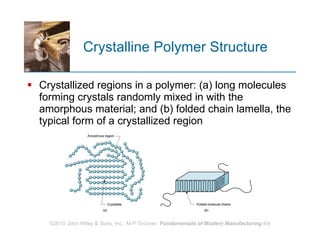
Crystalline Polymer Structure Crystallized regions in a polymer: (a) long molecules forming crystals randomly mixed in with the amorphous material; and (b) folded chain lamella, the typical form of a crystallized region
Crystallinity and Properties As crystallinity is increased in a polymer Density increases Stiffness, strength, and toughness increases Heat resistance increases  If the polymer is transparent in the amorphous state, it becomes opaque when partially crystallized
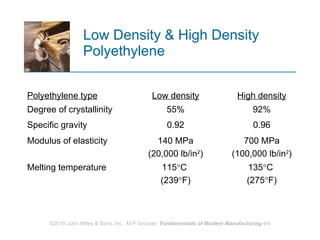
Low Density & High Density Polyethylene 135  C  (275  F) 115  C  (239  F) Melting temperature 700 MPa (100,000 lb/in 2 ) 140 MPa (20,000 lb/in 2 ) Modulus of elasticity 0.96 0.92 Specific gravity 92% 55% Degree of crystallinity High density Low density Polyethylene type
Some Observations About Crystallization Linear polymers consist of long molecules with thousands of repeated mers  Crystallization involves folding back and forth of the long chains upon themselves  The crystallized regions are called  crystallites Crystallites take the form of lamellae randomly mixed in with amorphous material  A crystallized polymer is a two‑phase system Crystallites interspersed in an amorphous matrix
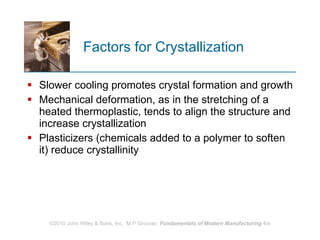
Factors for Crystallization Slower cooling promotes crystal formation and growth Mechanical deformation, as in the stretching of a heated thermoplastic, tends to align the structure and increase crystallization Plasticizers (chemicals added to a polymer to soften it) reduce crystallinity
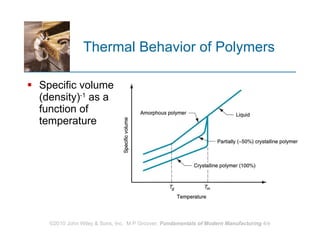
Thermal Behavior of Polymers Specific volume (density) -1  as a function of temperature
Additives  Properties of a polymer can often be beneficially changed by combining it with additives  Additives either alter the molecular structure or  Add a second phase, in effect transforming the polymer into a composite material
Types of Additives by Function Fillers – strengthen polymer or reduce cost Plasticizers – soften polymer and improve flow Colorants – pigments or dyes Lubricants – reduce friction and improve flow Flame retardents – reduce flammability of polymer Cross‑linking agents – for thermosets and elastomers Ultraviolet light absorbers – reduce degradation from sunlight Antioxidants – reduce oxidation damage
Thermoplastic Polymers (TP) Thermoplastic polymers can be heated from solid state to viscous liquid and then cooled back down to solid Heating and cooling can be repeated many times without degrading the polymer  Reason: TP polymers consist of linear and/or branched macromolecules that do not cross‑link upon heating Thermosets and elastomers change chemically when heated, which cross‑links their molecules and permanently sets these polymers
Mechanical Properties of Thermoplastics Low modulus of elasticity (stiffness) E  is much lower than metals and ceramics Low tensile strength TS  is about 10% of metal Much lower hardness than metals or ceramics  Greater ductility on average Tremendous range of values, from 1% elongation for polystyrene to 500% or more for polypropylene
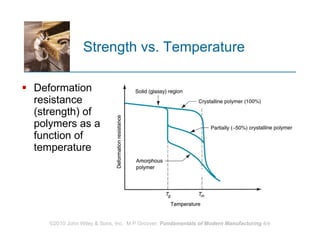
Strength vs. Temperature Deformation resistance (strength) of polymers as a function of temperature
Physical Properties of Thermoplastics Lower densities than metals or ceramics  Typical specific gravity for polymers are   1.2 (compared to ceramics (~ 2.5) and metals (~ 7) Much higher coefficient of thermal expansion  Roughly five times the value for metals and 10 times the value for ceramics Much lower melting temperatures Insulating electrical properties  Higher specific heats than metals and ceramics
Commercial Thermoplastic  Products and Raw Materials Thermoplastic products include  Molded and extruded items  Fibers and filaments Films and sheets  Packaging materials  Paints and varnishes  Starting plastic materials are normally supplied to the fabricator in the form of powders or pellets in bags, drums, or larger loads by truck or rail car
Thermosetting Polymers (TS) TS polymers are distinguished by their highly cross‑linked three‑dimensional, covalently‑bonded structure  Chemical reactions associated with cross‑linking are called  curing  or  setting In effect, formed part (e.g., pot handle, electrical switch cover, etc.) becomes a large macromolecule Always amorphous and exhibits no glass transition temperature
General Properties of Thermosets  Rigid - modulus of elasticity is two to three times greater than thermoplastics  Brittle, virtually no ductility Less soluble in common solvents than thermoplastics  Capable of higher service temperatures than thermoplastics  Cannot be remelted ‑ instead they degrade or burn
Cross-Linking in TS Polymers Three categories: Temperature‑activated systems  Catalyst‑activated systems  Mixing‑activated systems  Curing is accomplished at the fabrication plants that make the parts rather than the chemical plants that supply the starting materials to the fabricator
Temperature‑Activated Systems Curing caused by heat supplied during part shaping operation (e.g., molding) Starting material is a linear polymer in granular form supplied by the chemical plant As heat is added, material softens for molding, but continued heating causes cross‑linking  Most common TS systems  The term “thermoset" applies best to these polymers
Catalyst‑Activated Systems  Cross‑linking occurs when small amounts of a catalyst are added to the polymer, which is in liquid form Without the catalyst, the polymer remains stable and liquid Once combined with the catalyst it cures and changes into solid form
Mixing‑Activated Systems Mixing of two chemicals results in a reaction that forms a cross‑linked solid polymer Elevated temperatures are sometimes used to accelerate the reactions Most epoxies are examples of these systems
TS vs. TP Polymers TS plastics are not as widely used as the TP  One reason is the added processing costs and complications involved in curing  Largest market share of TS = phenolic resins with    6% of the total plastics market Compare polyethylene with    35% market share TS Products: countertops, plywood adhesives, paints, molded parts, printed circuit boards and other fiber reinforced plastics
Elastomers Polymers capable of large elastic deformation when subjected to relatively low stresses  Some can be extended 500% or more and still return to their original shape  Two categories:  Natural rubber - derived from biological plants  Synthetic polymers - produced by polymerization processes like those used for thermoplastic and thermosetting polymers
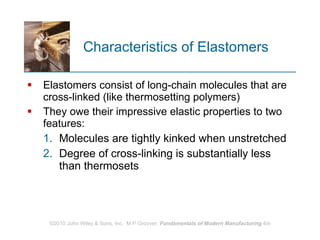
Characteristics of Elastomers Elastomers consist of long‑chain molecules that are cross‑linked (like thermosetting polymers)  They owe their impressive elastic properties to two features:  Molecules are tightly kinked when unstretched Degree of cross‑linking is substantially less than thermosets
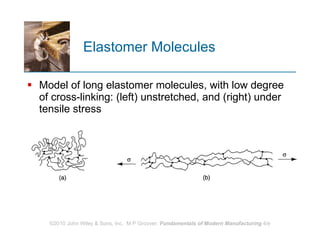
Elastomer Molecules Model of long elastomer molecules, with low degree of cross‑linking: (left) unstretched, and (right) under tensile stress
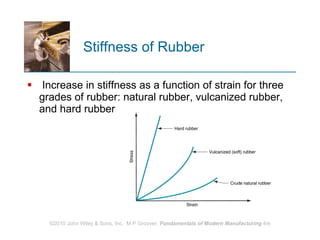
Elastic Behavior of Elastomer Molecule When stretched, the molecules are forced to uncoil and straighten Natural resistance to uncoiling provides the initial elastic modulus of the aggregate material  Under further strain, the covalent bonds of the cross‑linked molecules begin to play an increasing role in the modulus, and stiffness increases  With greater cross‑linking, the elastomer becomes stiffer and its modulus of elasticity is more linear
Stiffness of Rubber Increase in stiffness as a function of strain for three grades of rubber: natural rubber, vulcanized rubber, and hard rubber
Vulcanization Curing to cross‑link most elastomers Vulcanization  = the term for curing in the context of natural rubber (and certain synthetic rubbers) Typical cross‑linking in rubber is one to ten links per hundred carbon atoms in the linear polymer chain, depending on degree of stiffness desired  Considerable less than cross‑linking in thermosets
Natural Rubber (NR) NR = polyisoprene, a high molecular‑weight polymer of isoprene (C 5 H 8 )  It is derived from  latex , a milky substance produced by various plants, most important of which is the rubber tree that grows in tropical climates Latex is a water emulsion of polyisoprene (about 1/3 by weight), plus various other ingredients Rubber is extracted from latex by various methods that remove the water
Vulcanized Natural Rubber Properties: noted among elastomers for high tensile strength, tear strength, resilience (capacity to recover shape), and resistance to wear and fatigue  Weaknesses: degrades when subjected to heat, sunlight, oxygen, ozone, and oil  Some of these limitations can be reduced by additives Market share of NR    22% of total rubber volume (natural plus synthetic)
Natural Rubber Products Largest single market for NR is automotive tires Other products: shoe soles, bushings, seals, and shock absorbing components In tires,  carbon black  is an important additive It reinforces the rubber, serving to increase tensile strength and resistance to tear and abrasion  Other additives: clay, kaolin, silica, talc, and calcium carbonate, as well as chemicals that accelerate and promote vulcanization
Synthetic Rubbers Development of synthetic rubbers was motivated largely by world wars when NR was difficult to obtain  Tonnage of synthetic rubbers is now more than three times that of NR The most important synthetic rubber is styrene‑butadiene rubber (SBR), a copolymer of butadiene (C 4 H 6 ) and styrene (C 8 H 8 )  As with most other polymers, the main raw material for synthetic rubbers is petroleum
Thermoplastic Elastomers (TPE) A thermoplastic that behaves like an elastomer  Elastomeric properties not from chemical cross‑links, but from physical connections between soft and hard phases in the material  Cannot match conventional elastomers in elevated temperature strength and creep resistance  Products: footwear; rubber bands; extruded tubing, wire coating; molded automotive parts, but no tires
Guide to the  Processing of Polymers Polymers are nearly always shaped in a heated, highly plastic state  Common operations are extrusion and molding Molding of thermosets is more complicated because of cross‑linking  Thermoplastics are easier to mold and a greater variety of molding operations are available  Rubber processing has a longer history than plastics, and rubber industries are traditionally separated from plastics industry, even though processing is similar

Ch08

  • 1.
    POLYMERS Fundamentals ofPolymer Technology Thermoplastic Polymers Thermosetting Polymers Elastomers Guide to the Processing of Polymers
  • 2.
    Polymer A compoundconsisting of long‑chain molecules, each molecule made up of repeating units connected together There may be thousands, even millions of units in a single polymer molecule The word polymer is derived from the Greek words poly , meaning many, and meros (reduced to mer ), meaning part Most polymers are based on carbon and are therefore considered organic chemicals
  • 3.
    Types of PolymersPolymers can be separated into plastics and rubbers As engineering materials, it is appropriate to divide them into the following three categories: Thermoplastic polymers Thermosetting polymers Elastomers where (1) and (2) are plastics and (3) are rubbers
  • 4.
    Thermoplastic Polymers -Thermoplastics Solid materials at room temperature but viscous liquids when heated to temperatures of only a few hundred degrees This characteristic allows them to be easily and economically shaped into products They can be subjected to heating and cooling cycles repeatedly without significant degradation Symbolized by TP
  • 5.
    Thermosetting Polymers -Thermosets Cannot tolerate repeated heating cycles as thermoplastics can When initially heated, they soften and flow for molding Elevated temperatures also produce a chemical reaction that hardens the material into an infusible solid If reheated, thermosets degrade and char rather than soften Symbolized by TS
  • 6.
    Elastomers (Rubbers) Polymersthat exhibit extreme elastic extensibility when subjected to relatively low mechanical stress Some elastomers can be stretched by a factor of 10 and yet completely recover to their original shape Although their properties are quite different from thermosets, they share a similar molecular structure that is different from the thermoplastics
  • 7.
    Market Shares Thermoplasticsare commercially the most important of the three types About 70% of the tonnage of all synthetic polymers produced Thermosets and elastomers share the remaining 30% about evenly, with a slight edge for the former On a volumetric basis, current annual usage of polymers exceeds that of metals
  • 8.
    Examples of PolymersThermoplastics: Polyethylene, polyvinylchloride, polypropylene, polystyrene, and nylon Thermosets: Phenolics, epoxies, and certain polyesters Elastomers: Natural rubber (vulcanized) Synthetic rubbers, which exceed the tonnage of natural rubber
  • 9.
    Reasons Why Polymersare Important Plastics can be molded into intricate part shapes, usually with no further processing Very compatible with net shape processing On a volumetric basis, polymers: Are cost competitive with metals Generally require less energy to produce than metals Certain plastics are transparent, which makes them competitive with glass in some applications
  • 10.
    General Properties ofPolymers Low density relative to metals and ceramics Good strength‑to‑weight ratios for certain (but not all) polymers High corrosion resistance Low electrical and thermal conductivity
  • 11.
    Limitations of PolymersLow strength relative to metals and ceramics Low modulus of elasticity (stiffness) Service temperatures are limited to only a few hundred degrees Viscoelastic properties, which can be a distinct limitation in load bearing applications Some polymers degrade when subjected to sunlight and other forms of radiation
  • 12.
    Synthesis of Polymers Nearly all polymers used in engineering are synthetic They are made by chemical processing Polymers are synthesized by joining many small molecules together into very large molecules, called macromolecules , that possess a chain‑like structure The small units, called monomers , are generally simple unsaturated organic molecules such as ethylene C 2 H 4
  • 13.
    Polyethylene Synthesis ofpolyethylene from ethylene monomers: (1) n ethylene monomers, (2a) polyethylene of chain length n ; (2b) concise notation for depicting polymer structure of chain length n
  • 14.
    Polymerization As achemical process, the synthesis of polymers can occur by either of two methods: Addition polymerization Step polymerization Production of a given polymer is generally associated with one method or the other
  • 15.
    Addition Polymerization Inthis process, the double bonds between carbon atoms in the ethylene monomers are induced to open up so they can join with other monomer molecules The connections occur on both ends of the expanding macromolecule, developing long chains of repeating mers It is initiated using a chemical catalyst to open the carbon double bond in some of the monomers
  • 16.
    Addition Polymerization Modelof addition (chain) polymerization: (1) initiation, (2) rapid addition of monomers, and (3) resulting long chain polymer molecule with n mers at termination of reaction
  • 17.
    Step Polymerization Inthis form of polymerization, two reacting monomers are brought together to form a new molecule of the desired compound As reaction continues, more reactant molecules combine with the molecules first synthesized to form polymers of length n = 2, then length n = 3, and so on In addition, polymers of length n 1 and n 2 also combine to form molecules of length n = n 1 + n 2 , so that two types of reactions are proceeding simultaneously
  • 18.
    Step Polymerization Modelof step polymerization showing the two types of reactions occurring: (left) n‑mer attaching a single monomer to form a ( n +1)‑mer; and (right) n 1 ‑mer combining with n 2 ‑mer to form a ( n 1 + n 2 )‑mer.
  • 19.
    Some Examples Polymersproduced by addition polymerization: Polyethylene, polypropylene, polyvinylchloride, polyisoprene Polymers produced by step polymerization: Nylon, polycarbonate, phenol formaldehyde
  • 20.
    Degree of PolymerizationSince molecules in a given batch of polymerized material vary in length, n for the batch is an average Its statistical distribution is normal The mean value of n is called the degree of polymerization (DP) for the batch DP affects properties of the polymer Higher DP increases mechanical strength but also increases viscosity in the fluid state, which makes processing more difficult
  • 21.
    Molecular Weight The sum of the molecular weights of the mers in the molecule MW = n times the molecular weight of each repeating unit Since n varies for different molecules in a batch, the molecular weight must be interpreted as an average
  • 22.
    Typical Values ofDP and MW MW 300,000 100,000 15,000 40,000 DP( n ) 10,000 1,500 120 200 Polymer Polyethylene Polyvinylchloride Nylon Polycarbonate
  • 23.
    Polymer Molecular StructuresLinear structure – chain-like structure Characteristic of thermoplastic polymers Branched structure – chain-like but with side branches Also found in thermoplastic polymers Cross-linked structure Loosely cross-linked, characteristic of elastomers Tightly cross-linked, characteristic of thermosets
  • 24.
    Polymer Molecular StructuresLinear Branched Loosely cross-linked Tightly cross-linked
  • 25.
    Effect of Branchingon Properties Thermoplastic polymers always possess linear or branched structures, or a mixture of the two Branches increase entanglement among the molecules, which makes the polymer Stronger in the solid state More viscous at a given temperature in the plastic or liquid state
  • 26.
    Effect of Cross-Linkingon Properties Thermosets possess a high degree of cross‑linking; elastomers possess a low degree of cross‑linking Thermosets are hard and brittle, while elastomers are elastic and resilient Cross‑linking causes the polymer to become chemically set The reaction cannot be reversed The polymer structure is permanently changed; if heated, it degrades or burns rather than melt
  • 27.
    Crystallinity in PolymersBoth amorphous and crystalline structures are possible, although the tendency to crystallize is much less than for metals or non‑glass ceramics Not all polymers can form crystals For those that can, the degree of crystallinity (the proportion of crystallized material in the mass) is always less than 100%
  • 28.
    Crystalline Polymer StructureCrystallized regions in a polymer: (a) long molecules forming crystals randomly mixed in with the amorphous material; and (b) folded chain lamella, the typical form of a crystallized region
  • 29.
    Crystallinity and PropertiesAs crystallinity is increased in a polymer Density increases Stiffness, strength, and toughness increases Heat resistance increases If the polymer is transparent in the amorphous state, it becomes opaque when partially crystallized
  • 30.
    Low Density &High Density Polyethylene 135  C (275  F) 115  C (239  F) Melting temperature 700 MPa (100,000 lb/in 2 ) 140 MPa (20,000 lb/in 2 ) Modulus of elasticity 0.96 0.92 Specific gravity 92% 55% Degree of crystallinity High density Low density Polyethylene type
  • 31.
    Some Observations AboutCrystallization Linear polymers consist of long molecules with thousands of repeated mers Crystallization involves folding back and forth of the long chains upon themselves The crystallized regions are called crystallites Crystallites take the form of lamellae randomly mixed in with amorphous material A crystallized polymer is a two‑phase system Crystallites interspersed in an amorphous matrix
  • 32.
    Factors for CrystallizationSlower cooling promotes crystal formation and growth Mechanical deformation, as in the stretching of a heated thermoplastic, tends to align the structure and increase crystallization Plasticizers (chemicals added to a polymer to soften it) reduce crystallinity
  • 33.
    Thermal Behavior ofPolymers Specific volume (density) -1 as a function of temperature
  • 34.
    Additives Propertiesof a polymer can often be beneficially changed by combining it with additives Additives either alter the molecular structure or Add a second phase, in effect transforming the polymer into a composite material
  • 35.
    Types of Additivesby Function Fillers – strengthen polymer or reduce cost Plasticizers – soften polymer and improve flow Colorants – pigments or dyes Lubricants – reduce friction and improve flow Flame retardents – reduce flammability of polymer Cross‑linking agents – for thermosets and elastomers Ultraviolet light absorbers – reduce degradation from sunlight Antioxidants – reduce oxidation damage
  • 36.
    Thermoplastic Polymers (TP)Thermoplastic polymers can be heated from solid state to viscous liquid and then cooled back down to solid Heating and cooling can be repeated many times without degrading the polymer Reason: TP polymers consist of linear and/or branched macromolecules that do not cross‑link upon heating Thermosets and elastomers change chemically when heated, which cross‑links their molecules and permanently sets these polymers
  • 37.
    Mechanical Properties ofThermoplastics Low modulus of elasticity (stiffness) E is much lower than metals and ceramics Low tensile strength TS is about 10% of metal Much lower hardness than metals or ceramics Greater ductility on average Tremendous range of values, from 1% elongation for polystyrene to 500% or more for polypropylene
  • 38.
    Strength vs. TemperatureDeformation resistance (strength) of polymers as a function of temperature
  • 39.
    Physical Properties ofThermoplastics Lower densities than metals or ceramics Typical specific gravity for polymers are  1.2 (compared to ceramics (~ 2.5) and metals (~ 7) Much higher coefficient of thermal expansion Roughly five times the value for metals and 10 times the value for ceramics Much lower melting temperatures Insulating electrical properties Higher specific heats than metals and ceramics
  • 40.
    Commercial Thermoplastic Products and Raw Materials Thermoplastic products include Molded and extruded items Fibers and filaments Films and sheets Packaging materials Paints and varnishes Starting plastic materials are normally supplied to the fabricator in the form of powders or pellets in bags, drums, or larger loads by truck or rail car
  • 41.
    Thermosetting Polymers (TS)TS polymers are distinguished by their highly cross‑linked three‑dimensional, covalently‑bonded structure Chemical reactions associated with cross‑linking are called curing or setting In effect, formed part (e.g., pot handle, electrical switch cover, etc.) becomes a large macromolecule Always amorphous and exhibits no glass transition temperature
  • 42.
    General Properties ofThermosets Rigid - modulus of elasticity is two to three times greater than thermoplastics Brittle, virtually no ductility Less soluble in common solvents than thermoplastics Capable of higher service temperatures than thermoplastics Cannot be remelted ‑ instead they degrade or burn
  • 43.
    Cross-Linking in TSPolymers Three categories: Temperature‑activated systems Catalyst‑activated systems Mixing‑activated systems Curing is accomplished at the fabrication plants that make the parts rather than the chemical plants that supply the starting materials to the fabricator
  • 44.
    Temperature‑Activated Systems Curingcaused by heat supplied during part shaping operation (e.g., molding) Starting material is a linear polymer in granular form supplied by the chemical plant As heat is added, material softens for molding, but continued heating causes cross‑linking Most common TS systems The term “thermoset" applies best to these polymers
  • 45.
    Catalyst‑Activated Systems Cross‑linking occurs when small amounts of a catalyst are added to the polymer, which is in liquid form Without the catalyst, the polymer remains stable and liquid Once combined with the catalyst it cures and changes into solid form
  • 46.
    Mixing‑Activated Systems Mixingof two chemicals results in a reaction that forms a cross‑linked solid polymer Elevated temperatures are sometimes used to accelerate the reactions Most epoxies are examples of these systems
  • 47.
    TS vs. TPPolymers TS plastics are not as widely used as the TP One reason is the added processing costs and complications involved in curing Largest market share of TS = phenolic resins with  6% of the total plastics market Compare polyethylene with  35% market share TS Products: countertops, plywood adhesives, paints, molded parts, printed circuit boards and other fiber reinforced plastics
  • 48.
    Elastomers Polymers capableof large elastic deformation when subjected to relatively low stresses Some can be extended 500% or more and still return to their original shape Two categories: Natural rubber - derived from biological plants Synthetic polymers - produced by polymerization processes like those used for thermoplastic and thermosetting polymers
  • 49.
    Characteristics of ElastomersElastomers consist of long‑chain molecules that are cross‑linked (like thermosetting polymers) They owe their impressive elastic properties to two features: Molecules are tightly kinked when unstretched Degree of cross‑linking is substantially less than thermosets
  • 50.
    Elastomer Molecules Modelof long elastomer molecules, with low degree of cross‑linking: (left) unstretched, and (right) under tensile stress
  • 51.
    Elastic Behavior ofElastomer Molecule When stretched, the molecules are forced to uncoil and straighten Natural resistance to uncoiling provides the initial elastic modulus of the aggregate material Under further strain, the covalent bonds of the cross‑linked molecules begin to play an increasing role in the modulus, and stiffness increases With greater cross‑linking, the elastomer becomes stiffer and its modulus of elasticity is more linear
  • 52.
    Stiffness of RubberIncrease in stiffness as a function of strain for three grades of rubber: natural rubber, vulcanized rubber, and hard rubber
  • 53.
    Vulcanization Curing tocross‑link most elastomers Vulcanization = the term for curing in the context of natural rubber (and certain synthetic rubbers) Typical cross‑linking in rubber is one to ten links per hundred carbon atoms in the linear polymer chain, depending on degree of stiffness desired Considerable less than cross‑linking in thermosets
  • 54.
    Natural Rubber (NR)NR = polyisoprene, a high molecular‑weight polymer of isoprene (C 5 H 8 ) It is derived from latex , a milky substance produced by various plants, most important of which is the rubber tree that grows in tropical climates Latex is a water emulsion of polyisoprene (about 1/3 by weight), plus various other ingredients Rubber is extracted from latex by various methods that remove the water
  • 55.
    Vulcanized Natural RubberProperties: noted among elastomers for high tensile strength, tear strength, resilience (capacity to recover shape), and resistance to wear and fatigue Weaknesses: degrades when subjected to heat, sunlight, oxygen, ozone, and oil Some of these limitations can be reduced by additives Market share of NR  22% of total rubber volume (natural plus synthetic)
  • 56.
    Natural Rubber ProductsLargest single market for NR is automotive tires Other products: shoe soles, bushings, seals, and shock absorbing components In tires, carbon black is an important additive It reinforces the rubber, serving to increase tensile strength and resistance to tear and abrasion Other additives: clay, kaolin, silica, talc, and calcium carbonate, as well as chemicals that accelerate and promote vulcanization
  • 57.
    Synthetic Rubbers Developmentof synthetic rubbers was motivated largely by world wars when NR was difficult to obtain Tonnage of synthetic rubbers is now more than three times that of NR The most important synthetic rubber is styrene‑butadiene rubber (SBR), a copolymer of butadiene (C 4 H 6 ) and styrene (C 8 H 8 ) As with most other polymers, the main raw material for synthetic rubbers is petroleum
  • 58.
    Thermoplastic Elastomers (TPE)A thermoplastic that behaves like an elastomer Elastomeric properties not from chemical cross‑links, but from physical connections between soft and hard phases in the material Cannot match conventional elastomers in elevated temperature strength and creep resistance Products: footwear; rubber bands; extruded tubing, wire coating; molded automotive parts, but no tires
  • 59.
    Guide to the Processing of Polymers Polymers are nearly always shaped in a heated, highly plastic state Common operations are extrusion and molding Molding of thermosets is more complicated because of cross‑linking Thermoplastics are easier to mold and a greater variety of molding operations are available Rubber processing has a longer history than plastics, and rubber industries are traditionally separated from plastics industry, even though processing is similar