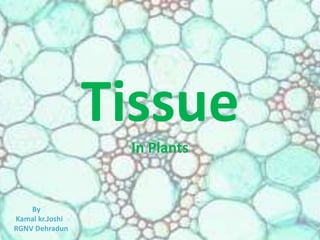

Tissue
In Plants
By
Kamal kr.Joshi
RGNV Dehradun
Learning Objectives
After completing this lesson ,students will be able to-
• Define tissue.
• List the types of plant tissue.
• Explain the structure and functions of plant tissues.
• Compare various types of plant tissues.
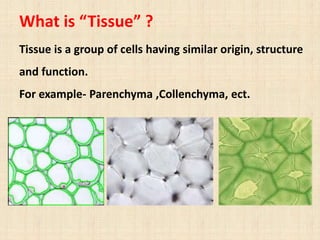
What is “Tissue” ?
Tissue is a group of cells having similar origin, structure
and function.
For example- Parenchyma ,Collenchyma, ect.
Properties of plant tissue
• Most of the plant parts are tissues with dead cells
because tissues provide mechanical strength to the
plant.
• Cells of some tissues are live.
• In plants ,growth takes place in some parts, so these
parts contains tissue having continuously dividing
cells.
Activity 1
Types of Plant tissues
In plants ,tissues are of two types as follows-
(click on button)
Meristematic tissues
Permanent Tissues
Go for Exercise
Meristematic tissues
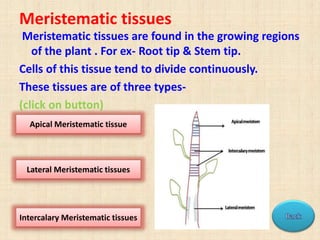
Meristematic tissues are found in the growing regions
of the plant . For ex- Root tip & Stem tip.
Cells of this tissue tend to divide continuously.
These tissues are of three types-
(click on button)
Apical Meristematic tissue
Lateral Meristematic tissues
Intercalary Meristematic tissues
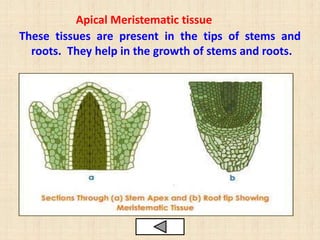
Apical Meristematic tissue
These tissues are present in the tips of stems and
roots. They help in the growth of stems and roots.
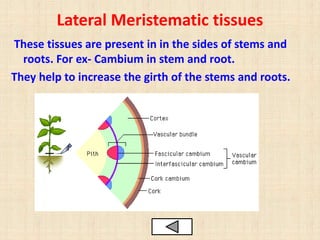
Lateral Meristematic tissues
These tissues are present in in the sides of stems and
roots. For ex- Cambium in stem and root.
They help to increase the girth of the stems and roots.
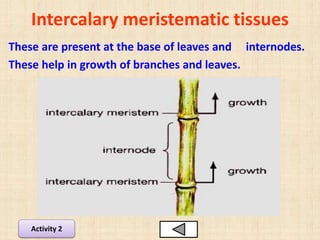
Intercalary meristematic tissues
These are present at the base of leaves and internodes.
These help in growth of branches and leaves.
Activity 2
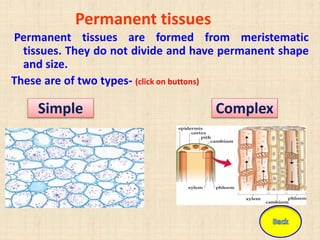
Permanent tissues
Permanent tissues are formed from meristematic
tissues. They do not divide and have permanent shape
and size.
These are of two types- (click on buttons)
Simple Complex
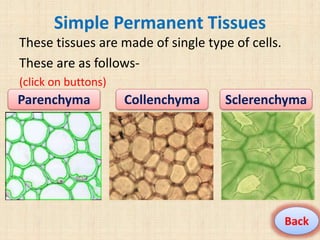
Simple Permanent Tissues
These tissues are made of single type of cells.
These are as follows-
(click on buttons)
Parenchyma Collenchyma Sclerenchyma
Back
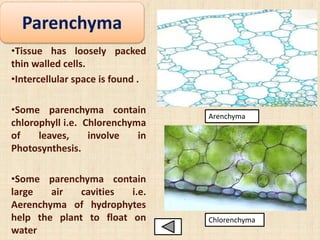
Parenchyma
•Tissue has loosely packed
thin walled cells.
•Intercellular space is found .
•Some parenchyma contain
chlorophyll i.e. Chlorenchyma
of leaves, involve in
Photosynthesis.
•Some parenchyma contain
large air cavities i.e.
Aerenchyma of hydrophytes
help the plant to float on
water
Arenchyma
Chlorenchyma
Collenchyma
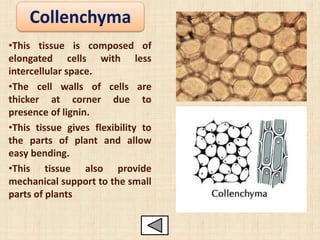
•This tissue is composed of
elongated cells with less
intercellular space.
•The cell walls of cells are
thicker at corner due to
presence of lignin.
•This tissue gives flexibility to
the parts of plant and allow
easy bending.
•This tissue also provide
mechanical support to the small
parts of plants
Sclenrenchyma
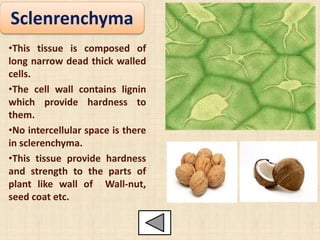
•This tissue is composed of
long narrow dead thick walled
cells.
•The cell wall contains lignin
which provide hardness to
them.
•No intercellular space is there
in sclerenchyma.
•This tissue provide hardness
and strength to the parts of
plant like wall of Wall-nut,
seed coat etc.
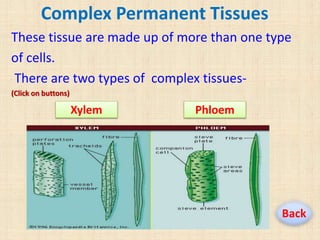
These tissue are made up of more than one type
of cells.
There are two types of complex tissues-
(Click on buttons)
Complex Permanent Tissues
Xylem Phloem
Back
Xylem
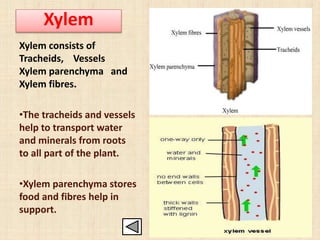
Xylem consists of
Tracheids, Vessels
Xylem parenchyma and
Xylem fibres.
•The tracheids and vessels
help to transport water
and minerals from roots
to all part of the plant.
•Xylem parenchyma stores
food and fibres help in
support.
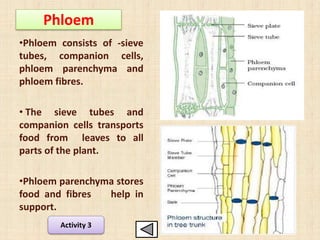
•Phloem consists of -sieve
tubes, companion cells,
phloem parenchyma and
phloem fibres.
• The sieve tubes and
companion cells transports
food from leaves to all
parts of the plant.
•Phloem parenchyma stores
food and fibres help in
support.
Phloem
Activity 3
Some sentences are given below. Identify correct and
incorrect sentences -
A. Tissue is a group of cell with similar functions.
A. All the plant tissue are made of live cells.
B. Plant tissues provide strength to plant body
T F
T
F
F
T
Find Answers
Some sentences are given below. Identify correct and
incorrect sentences -
A. Tissue is a group of cell with similar functions.
B. All the plant tissue are made of live cells.
C. Plant tissues provide strength to plant body
T F
T
F
F
T
Correct
Answer
Go back
Some sentences are given below. Identify correct and
incorrect sentences -
A. Tissue is a group of cell with similar functions.
B. All the plant tissue are made of live cells.
C. Plant tissues provide strength to plant body
T F
T
F
F
T
Oop’s
Find Correct Answer
Some sentences are given below. Identify correct and
incorrect sentences –
Answers-
A. Tissue is a group of cell with similar functions.
B. All the plant tissue are made of live cells.
C. Plant tissues provide strength to plant body
T F
T
F
F
T
Activity 2
Complete following sentences with suitable words.
a) Meristematic tissues are found in…………………regions of
plants.
b) At the tip of root,……………………meristematic tissue is found.
c) Cambium is an example of ………………………..meristem.
d) ………………………….meristem is present at the base of
branches ,nodes of plants.
Answers
Activity 2
Complete following sentences with suitable words.
a) Meristematic tissues are found inGrowingregions of plants.
b) At the tip of root, Apical meristematic tissue is found.
c) Cambium is an example of Lateral meristem.
d) Intercalary meristem is present at the base of branches
,nodes of plants.
Activity 3
Click on correct answer
Q1- Which is the simple permanent tissue in followings?
Parenchyma Xylem
Cambium Phloem
Q 2-Which is tissue present in coconut-husk?
Parenchyma Collenchyma
Sclerenchyma Xylem fibres
Q 3-What is the function of xylem in plants ?
Food conduction Water conduction
Photosynthesis Transpiration
Q 4-Arenchyma and chlorenchyma are modified ………….
Collenchyma Sclerenchyma
Parenchyma Xylem
a
c
b
d
a
c
b
d
a
c
b
d
a
c
b
d
Correct Answer
Activity 3
Click on correct answer
Q1- Which is the simple permanent tissue in followings?
Parenchyma Xylem
Cambium Phloem
Q 2-Which is tissue present in coconut-husk?
Parenchyma Collenchyma
Sclerenchyma Xylem fibres
Q 3-What is the function of xylem in plants ?
Food conduction Water conduction
Photosynthesis Transpiration
Q 4-Arenchyma and chlorenchyma are modified ………….
Collenchyma Sclerenchyma
Parenchyma Xylem
a
c
b
d
a
c
b
d
a
c
b
d
a
c
b
d
Correct
Answer
Activity 3
Click on correct answer
Q1- Which is the simple permanent tissue in followings?
Parenchyma Xylem
Cambium Phloem
Q 2-Which is tissue present in coconut-husk?
Parenchyma Collenchyma
Sclerenchyma Xylem fibres
Q 3-What is the function of xylem in plants ?
Food conduction Water conduction
Photosynthesis Transpiration
Q 4-Arenchyma and chlorenchyma are modified ………….
Collenchyma Sclerenchyma
Parenchyma Xylem
a
c
b
d
a
c
b
d
a
c
b
d
a
c
b
d
Oop’s
Find Correct Answer
Exercise
Q1- Define tissue.
Q2-Write the differences between Merstematic &
Permanent tissue.
Q3-List the components of “Xylem” and “Phloem”.
Q4-Give a brief description about followings-
a. Parenchyma
b. Collenchyma
c. Sclerenchyma
d. Arenchyma
e. Cholernchyma

Plant tissue

  • 1.
  • 2.
    Learning Objectives After completingthis lesson ,students will be able to- • Define tissue. • List the types of plant tissue. • Explain the structure and functions of plant tissues. • Compare various types of plant tissues.
  • 3.
    What is “Tissue”? Tissue is a group of cells having similar origin, structure and function. For example- Parenchyma ,Collenchyma, ect.
  • 4.
    Properties of planttissue • Most of the plant parts are tissues with dead cells because tissues provide mechanical strength to the plant. • Cells of some tissues are live. • In plants ,growth takes place in some parts, so these parts contains tissue having continuously dividing cells. Activity 1
  • 5.
    Types of Planttissues In plants ,tissues are of two types as follows- (click on button) Meristematic tissues Permanent Tissues Go for Exercise
  • 6.
    Meristematic tissues Meristematic tissuesare found in the growing regions of the plant . For ex- Root tip & Stem tip. Cells of this tissue tend to divide continuously. These tissues are of three types- (click on button) Apical Meristematic tissue Lateral Meristematic tissues Intercalary Meristematic tissues
  • 7.
    Apical Meristematic tissue Thesetissues are present in the tips of stems and roots. They help in the growth of stems and roots.
  • 8.
    Lateral Meristematic tissues Thesetissues are present in in the sides of stems and roots. For ex- Cambium in stem and root. They help to increase the girth of the stems and roots.
  • 9.
    Intercalary meristematic tissues Theseare present at the base of leaves and internodes. These help in growth of branches and leaves. Activity 2
  • 10.
    Permanent tissues Permanent tissuesare formed from meristematic tissues. They do not divide and have permanent shape and size. These are of two types- (click on buttons) Simple Complex
  • 11.
    Simple Permanent Tissues Thesetissues are made of single type of cells. These are as follows- (click on buttons) Parenchyma Collenchyma Sclerenchyma Back
  • 12.
    Parenchyma •Tissue has looselypacked thin walled cells. •Intercellular space is found . •Some parenchyma contain chlorophyll i.e. Chlorenchyma of leaves, involve in Photosynthesis. •Some parenchyma contain large air cavities i.e. Aerenchyma of hydrophytes help the plant to float on water Arenchyma Chlorenchyma
  • 13.
    Collenchyma •This tissue iscomposed of elongated cells with less intercellular space. •The cell walls of cells are thicker at corner due to presence of lignin. •This tissue gives flexibility to the parts of plant and allow easy bending. •This tissue also provide mechanical support to the small parts of plants
  • 14.
    Sclenrenchyma •This tissue iscomposed of long narrow dead thick walled cells. •The cell wall contains lignin which provide hardness to them. •No intercellular space is there in sclerenchyma. •This tissue provide hardness and strength to the parts of plant like wall of Wall-nut, seed coat etc.
  • 15.
    These tissue aremade up of more than one type of cells. There are two types of complex tissues- (Click on buttons) Complex Permanent Tissues Xylem Phloem Back
  • 16.
    Xylem Xylem consists of Tracheids,Vessels Xylem parenchyma and Xylem fibres. •The tracheids and vessels help to transport water and minerals from roots to all part of the plant. •Xylem parenchyma stores food and fibres help in support.
  • 17.
    •Phloem consists of-sieve tubes, companion cells, phloem parenchyma and phloem fibres. • The sieve tubes and companion cells transports food from leaves to all parts of the plant. •Phloem parenchyma stores food and fibres help in support. Phloem Activity 3
  • 18.
    Some sentences aregiven below. Identify correct and incorrect sentences - A. Tissue is a group of cell with similar functions. A. All the plant tissue are made of live cells. B. Plant tissues provide strength to plant body T F T F F T Find Answers
  • 19.
    Some sentences aregiven below. Identify correct and incorrect sentences - A. Tissue is a group of cell with similar functions. B. All the plant tissue are made of live cells. C. Plant tissues provide strength to plant body T F T F F T Correct Answer Go back
  • 20.
    Some sentences aregiven below. Identify correct and incorrect sentences - A. Tissue is a group of cell with similar functions. B. All the plant tissue are made of live cells. C. Plant tissues provide strength to plant body T F T F F T Oop’s Find Correct Answer
  • 21.
    Some sentences aregiven below. Identify correct and incorrect sentences – Answers- A. Tissue is a group of cell with similar functions. B. All the plant tissue are made of live cells. C. Plant tissues provide strength to plant body T F T F F T
  • 22.
    Activity 2 Complete followingsentences with suitable words. a) Meristematic tissues are found in…………………regions of plants. b) At the tip of root,……………………meristematic tissue is found. c) Cambium is an example of ………………………..meristem. d) ………………………….meristem is present at the base of branches ,nodes of plants. Answers
  • 23.
    Activity 2 Complete followingsentences with suitable words. a) Meristematic tissues are found inGrowingregions of plants. b) At the tip of root, Apical meristematic tissue is found. c) Cambium is an example of Lateral meristem. d) Intercalary meristem is present at the base of branches ,nodes of plants.
  • 24.
    Activity 3 Click oncorrect answer Q1- Which is the simple permanent tissue in followings? Parenchyma Xylem Cambium Phloem Q 2-Which is tissue present in coconut-husk? Parenchyma Collenchyma Sclerenchyma Xylem fibres Q 3-What is the function of xylem in plants ? Food conduction Water conduction Photosynthesis Transpiration Q 4-Arenchyma and chlorenchyma are modified …………. Collenchyma Sclerenchyma Parenchyma Xylem a c b d a c b d a c b d a c b d Correct Answer
  • 25.
    Activity 3 Click oncorrect answer Q1- Which is the simple permanent tissue in followings? Parenchyma Xylem Cambium Phloem Q 2-Which is tissue present in coconut-husk? Parenchyma Collenchyma Sclerenchyma Xylem fibres Q 3-What is the function of xylem in plants ? Food conduction Water conduction Photosynthesis Transpiration Q 4-Arenchyma and chlorenchyma are modified …………. Collenchyma Sclerenchyma Parenchyma Xylem a c b d a c b d a c b d a c b d Correct Answer
  • 26.
    Activity 3 Click oncorrect answer Q1- Which is the simple permanent tissue in followings? Parenchyma Xylem Cambium Phloem Q 2-Which is tissue present in coconut-husk? Parenchyma Collenchyma Sclerenchyma Xylem fibres Q 3-What is the function of xylem in plants ? Food conduction Water conduction Photosynthesis Transpiration Q 4-Arenchyma and chlorenchyma are modified …………. Collenchyma Sclerenchyma Parenchyma Xylem a c b d a c b d a c b d a c b d
  • 27.
  • 28.
    Exercise Q1- Define tissue. Q2-Writethe differences between Merstematic & Permanent tissue. Q3-List the components of “Xylem” and “Phloem”. Q4-Give a brief description about followings- a. Parenchyma b. Collenchyma c. Sclerenchyma d. Arenchyma e. Cholernchyma