FERMENTATION BIOTECHNOLOGY
DrKALAISELVIGOVINDAN
ANIMAL BIOTECHNOLOGY
TANUVAS, INDIA
Rumen Biotechnology
Application of knowledge of fore stomach
fermentation and the use and management
of both natural and recombinant
microorganisms to improve the efficiency
of digestion of fibrous feedstuffs by
ruminants.
Ruminants …?
A ruminant is any hooved animal that digests its
food in two steps-
a) By eating the raw material and regurgitating a
semi digested form known as cud
b) then eating the cud, a process called
ruminating
Ruminants share another common feature that
they all have an even number of toes.
Examples are: cattle, goat, sheep, camel, giraffe,
buffalo and dear etc.
RUMEN FERMENTATION
– Protein
• Digested to amino acids by rumen micro-organisms and resynthesized
into microbial protein.
• This is digested in the small intestine to amino acids which are absorbed
and used for growth (enzymes, immune proteins, muscle protein).
• Some amino acids can be used to make glucose for energy production in
specialized tissues such as brain and formation of rapid energy stores
(liver and muscle glycogen).
– Fibre (cellulose, hemicellulose, lignin).
• Only digested in the rumen by certain micro-organisms. What is
undigested is excreted in the faeces.
• Producing volatile fatty acids (VFAs) such as propionate and butyrate
which are absorbed in the small intestine and used for energy
production and fat synthesis.
– Starch, sugars
• Digested rapidly in the rumen to form lactate or acetate. Excess
fermentation of starch can cause acidosis, particularly in lotfed cattle
receiving grain.
RUMEN FERMENTATION
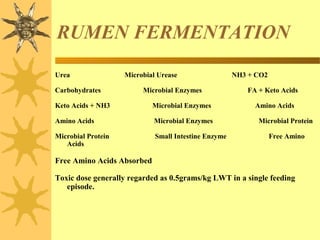
Urea Microbial Urease NH3 + CO2
Carbohydrates Microbial Enzymes FA + Keto Acids
Keto Acids + NH3 Microbial Enzymes Amino Acids
Amino Acids Microbial Enzymes Microbial Protein
Microbial Protein Small Intestine Enzyme Free Amino
Acids
Free Amino Acids Absorbed
Toxic dose generally regarded as 0.5grams/kg LWT in a single feeding
episode.
RUMEN FERMENTATION
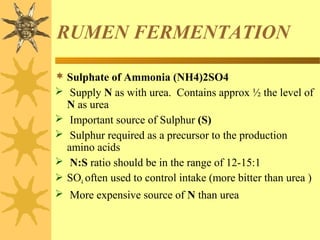
 Sulphate of Ammonia (NH4)2SO4
 Supply N as with urea. Contains approx ½ the level of
N as urea
 Important source of Sulphur (S)
 Sulphur required as a precursor to the production
amino acids
 N:S ratio should be in the range of 12-15:1
 SO4 often used to control intake (more bitter than urea )
 More expensive source of N than urea
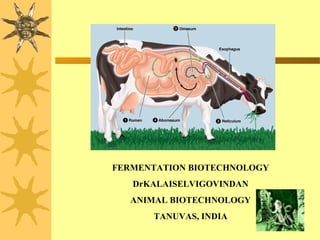
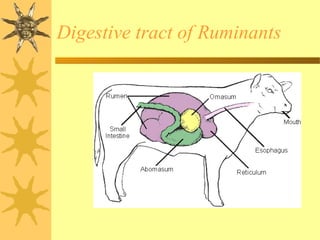
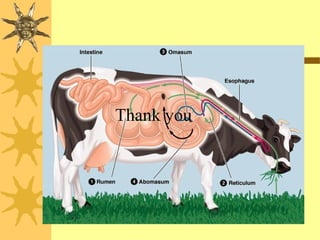
Digestive tract of Ruminants
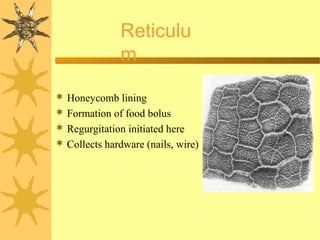
 Honeycomb lining
 Formation of food bolus
 Regurgitation initiated here
 Collects hardware (nails, wire)
Reticulu
m
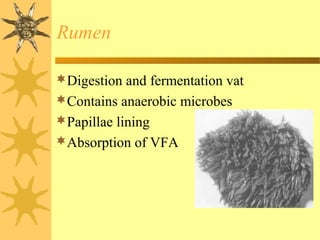
Digestion and fermentation vat
Contains anaerobic microbes
Papillae lining
Absorption of VFA
Rumen
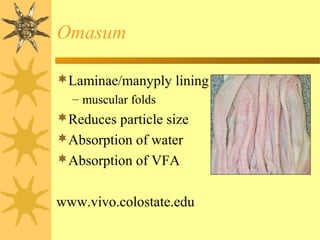
Laminae/manyply lining
– muscular folds
Reduces particle size
Absorption of water
Absorption of VFA
www.vivo.colostate.edu
Omasum
True gastric stomach
Proteolytic enzymes
Gastric digestion
Decreased pH from 6 to 2.5
– Denatures proteins
– Kills bacteria and pathogens
– Dissolves minerals (e.g., Ca3(PO4)2)
www.vivo.colostate.edu
Abomasum
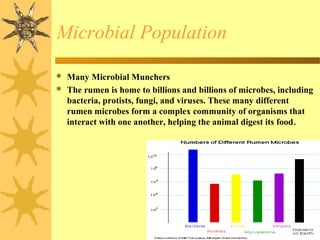
 Many Microbial Munchers
 The rumen is home to billions and billions of microbes, including
bacteria, protists, fungi, and viruses. These many different
rumen microbes form a complex community of organisms that
interact with one another, helping the animal digest its food.
Microbial Population
Fermentation in Ruminants
Rumen is a fermentation chamber filled with
microorganisms (Gregg, 1995).
Anaerobic process-thus host can absorb
energetic by-products from bacteria
fermentation.
Utilizes enzymes produced by rumen
microorganisms to digest the ingested material
.
Benefits two distinguished groups: host
(ruminant) and the microorganisms.
www.esl.ohio-state.edu
Rumen Microbes
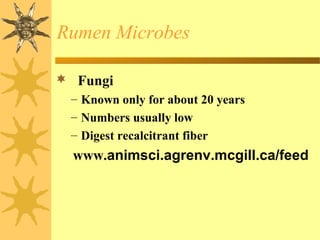
Protozoa
– Large (20-200 microns) unicellular organisms
– Ingest bacteria and feed particles
– Engulf feed particles and digest carbohydrates,
proteins and fats
– Numbers affected by diet
(Yokoyama and Johnson, 1988)
Entodinium (Rumen Protozoa)
 Fungi
– Known only for about 20 years
– Numbers usually low
– Digest recalcitrant fiber
www.animsci.agrenv.mcgill.ca/feed
Rumen Microbes
 Cellulolytic bacteria (fiber digesters)
– digest cellulose
– require pH 6-7
– utilize N in form of NH3
– require S for synthesis of sulfur-containing amino
acids (cysteine and methionine)
– produce acetate, propionate, little butyrate, CO2
– predominate from roughage diets
Bacterial Populations
Amylolytic bacteria (starch, sugar digesters)
– digest starch
– require pH 5-6
– utilize N as NH3 or peptides
– produce propionate, butyrate and lactate
– predominate from grain diets
– rapid change to grain diet causes lactic acidosis
(rapidly decreases pH)
Contd….
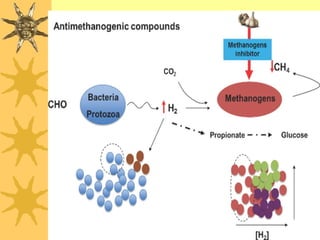
 Methane-producing bacteria
– produce methane (CH4)
– utilized by microbes for energy
– represent loss of energy to animal
– released by eructation
Contd…..
Improvement of Forage Quality
Pre-ingestive Methods
Post-ingestive Methods
Pre-ingestive Methods
Reducing lignin content and increasing
fermentable carbohydrate. Increasing
available proteins.
Reducing concentration of secondary
compounds. (Ulyatt, 1993).
Use of exogenous fibrolytic enzymes to
improve feed utilisation.
Post-ingestive Methods
Increasing fibre digestion.
Improving efficiency of nitrogen
metabolism.
Modification of ruminal ecosystems.
Recombinant ruminal Microorganisms.
Hoover and Stokes, 1991; McSweeny et al., 1994.
GI Microbes in livestock
development.
Microbial degradation of antinutritional
factors.
Tannins Toxic Non-protein amino acids.
Oxalates
Fluoroacetate
Pyrrolizidine
(Allison et al., 1985; Nelson et al., 1995)
GI Microbial enzymes In
Industry
Tannase in food, beverages, in preparation of
instant tea and as clarifier in fruit juices and beer.
Phytase as feed additives in monogastric’s foods
to increase phosphate utilisation.
Source of restriction enzymes for e.g.. Sru I and
Sru4DI from ruminal selenomonades
 Lactobacillus species for disease treatment as
probiotics.
(Cheng, 1999).
Future Prospect and Conclusion
Provide a natural barrier for controlling the
entry of enteric pathogens into the human
food chain.
Intensive livestock production in the
future.
In various industries apart from the
Livestock production
Easy and economical way to enhance
economy of developing countries.
Thank you

Rumen

  • 1.
  • 2.
    Rumen Biotechnology Application ofknowledge of fore stomach fermentation and the use and management of both natural and recombinant microorganisms to improve the efficiency of digestion of fibrous feedstuffs by ruminants.
  • 3.
    Ruminants …? A ruminantis any hooved animal that digests its food in two steps- a) By eating the raw material and regurgitating a semi digested form known as cud b) then eating the cud, a process called ruminating Ruminants share another common feature that they all have an even number of toes. Examples are: cattle, goat, sheep, camel, giraffe, buffalo and dear etc.
  • 4.
    RUMEN FERMENTATION – Protein •Digested to amino acids by rumen micro-organisms and resynthesized into microbial protein. • This is digested in the small intestine to amino acids which are absorbed and used for growth (enzymes, immune proteins, muscle protein). • Some amino acids can be used to make glucose for energy production in specialized tissues such as brain and formation of rapid energy stores (liver and muscle glycogen). – Fibre (cellulose, hemicellulose, lignin). • Only digested in the rumen by certain micro-organisms. What is undigested is excreted in the faeces. • Producing volatile fatty acids (VFAs) such as propionate and butyrate which are absorbed in the small intestine and used for energy production and fat synthesis. – Starch, sugars • Digested rapidly in the rumen to form lactate or acetate. Excess fermentation of starch can cause acidosis, particularly in lotfed cattle receiving grain.
  • 5.
    RUMEN FERMENTATION Urea MicrobialUrease NH3 + CO2 Carbohydrates Microbial Enzymes FA + Keto Acids Keto Acids + NH3 Microbial Enzymes Amino Acids Amino Acids Microbial Enzymes Microbial Protein Microbial Protein Small Intestine Enzyme Free Amino Acids Free Amino Acids Absorbed Toxic dose generally regarded as 0.5grams/kg LWT in a single feeding episode.
  • 6.
    RUMEN FERMENTATION  Sulphateof Ammonia (NH4)2SO4  Supply N as with urea. Contains approx ½ the level of N as urea  Important source of Sulphur (S)  Sulphur required as a precursor to the production amino acids  N:S ratio should be in the range of 12-15:1  SO4 often used to control intake (more bitter than urea )  More expensive source of N than urea
  • 7.
  • 8.
     Honeycomb lining Formation of food bolus  Regurgitation initiated here  Collects hardware (nails, wire) Reticulu m
  • 9.
    Digestion and fermentationvat Contains anaerobic microbes Papillae lining Absorption of VFA Rumen
  • 10.
    Laminae/manyply lining – muscularfolds Reduces particle size Absorption of water Absorption of VFA www.vivo.colostate.edu Omasum
  • 13.
    True gastric stomach Proteolyticenzymes Gastric digestion Decreased pH from 6 to 2.5 – Denatures proteins – Kills bacteria and pathogens – Dissolves minerals (e.g., Ca3(PO4)2) www.vivo.colostate.edu Abomasum
  • 14.
     Many MicrobialMunchers  The rumen is home to billions and billions of microbes, including bacteria, protists, fungi, and viruses. These many different rumen microbes form a complex community of organisms that interact with one another, helping the animal digest its food. Microbial Population
  • 15.
    Fermentation in Ruminants Rumenis a fermentation chamber filled with microorganisms (Gregg, 1995). Anaerobic process-thus host can absorb energetic by-products from bacteria fermentation. Utilizes enzymes produced by rumen microorganisms to digest the ingested material . Benefits two distinguished groups: host (ruminant) and the microorganisms. www.esl.ohio-state.edu
  • 16.
    Rumen Microbes Protozoa – Large(20-200 microns) unicellular organisms – Ingest bacteria and feed particles – Engulf feed particles and digest carbohydrates, proteins and fats – Numbers affected by diet (Yokoyama and Johnson, 1988)
  • 17.
  • 18.
     Fungi – Knownonly for about 20 years – Numbers usually low – Digest recalcitrant fiber www.animsci.agrenv.mcgill.ca/feed Rumen Microbes
  • 19.
     Cellulolytic bacteria(fiber digesters) – digest cellulose – require pH 6-7 – utilize N in form of NH3 – require S for synthesis of sulfur-containing amino acids (cysteine and methionine) – produce acetate, propionate, little butyrate, CO2 – predominate from roughage diets Bacterial Populations
  • 20.
    Amylolytic bacteria (starch,sugar digesters) – digest starch – require pH 5-6 – utilize N as NH3 or peptides – produce propionate, butyrate and lactate – predominate from grain diets – rapid change to grain diet causes lactic acidosis (rapidly decreases pH) Contd….
  • 21.
     Methane-producing bacteria –produce methane (CH4) – utilized by microbes for energy – represent loss of energy to animal – released by eructation Contd…..
  • 22.
    Improvement of ForageQuality Pre-ingestive Methods Post-ingestive Methods
  • 23.
    Pre-ingestive Methods Reducing lignincontent and increasing fermentable carbohydrate. Increasing available proteins. Reducing concentration of secondary compounds. (Ulyatt, 1993). Use of exogenous fibrolytic enzymes to improve feed utilisation.
  • 24.
    Post-ingestive Methods Increasing fibredigestion. Improving efficiency of nitrogen metabolism. Modification of ruminal ecosystems. Recombinant ruminal Microorganisms. Hoover and Stokes, 1991; McSweeny et al., 1994.
  • 25.
    GI Microbes inlivestock development. Microbial degradation of antinutritional factors. Tannins Toxic Non-protein amino acids. Oxalates Fluoroacetate Pyrrolizidine (Allison et al., 1985; Nelson et al., 1995)
  • 26.
    GI Microbial enzymesIn Industry Tannase in food, beverages, in preparation of instant tea and as clarifier in fruit juices and beer. Phytase as feed additives in monogastric’s foods to increase phosphate utilisation. Source of restriction enzymes for e.g.. Sru I and Sru4DI from ruminal selenomonades  Lactobacillus species for disease treatment as probiotics. (Cheng, 1999).
  • 27.
    Future Prospect andConclusion Provide a natural barrier for controlling the entry of enteric pathogens into the human food chain. Intensive livestock production in the future. In various industries apart from the Livestock production Easy and economical way to enhance economy of developing countries.
  • 28.