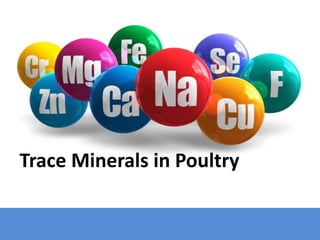
Trace Minerals in Poultry
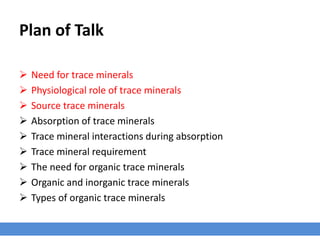
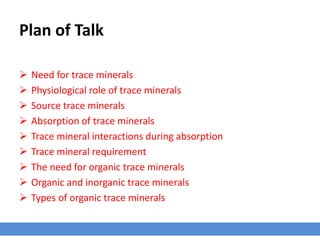
Plan of Talk
 Need for trace minerals
 Physiological role of trace minerals
 Source trace minerals
 Absorption of trace minerals
 Trace mineral interactions during absorption
 Trace mineral requirement
 The need for organic trace minerals
 Organic and inorganic trace minerals
 Types of organic trace minerals
Plan of Talk
 Need for trace minerals
 Physiological role of trace minerals
 Source trace minerals
 Absorption of trace minerals
 Trace mineral interactions during absorption
 Trace mineral requirement
 The need for organic trace minerals
 Organic and inorganic trace minerals
 Types of organic trace minerals
Need Of Trace Minerals
 Trace minerals play a vital role in various metabolic, enzymatic
and biochemical reactions leading to:
– Better growth rate
– Egg production
– Feed efficiency
 Trace minerals have a very important role in the mechanism
of nutrient circulation in the animal organism.
Cont. …
Deficiency or imbalance of any of these vital micronutrients
results in:
1. Deficiency disease
2. Metabolic disorders
3. Poor growth rate
4. Low egg production
5. Low hatchability
6. Low feed efficiency
Plan of Talk
 Need for trace minerals
 Physiological role of trace minerals
 Source trace minerals
 Absorption of trace minerals
 Trace mineral interactions during absorption
 Trace mineral requirement
 The need for organic trace minerals
 Organic and inorganic trace minerals
 Types of organic trace minerals
Physiological Role Of Trace Minerals
1. As part of larger organic molecules as;
– Iron is a part of hemoglobin and cytochrome.
– Iodine is a part of thyroxin.
2. As an essential accessory factors to enzymes;
– For example; copper, manganese, selenium, and zinc.
Cont. …
If any of these minerals is deficient, the
functional activity of the organic moiety
requiring the presence of the mineral will
be decreased.
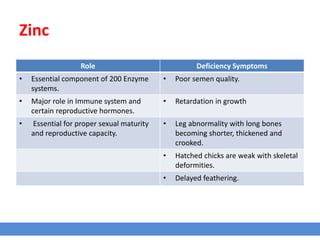
Zinc
Role Deficiency Symptoms
• Essential component of 200 Enzyme
systems.
• Poor semen quality.
• Major role in Immune system and
certain reproductive hormones.
• Retardation in growth
• Essential for proper sexual maturity
and reproductive capacity.
• Leg abnormality with long bones
becoming shorter, thickened and
crooked.
• Hatched chicks are weak with skeletal
deformities.
• Delayed feathering.
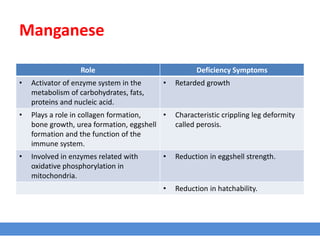
Manganese
Role Deficiency Symptoms
• Activator of enzyme system in the
metabolism of carbohydrates, fats,
proteins and nucleic acid.
• Retarded growth
• Plays a role in collagen formation,
bone growth, urea formation, eggshell
formation and the function of the
immune system.
• Characteristic crippling leg deformity
called perosis.
• Involved in enzymes related with
oxidative phosphorylation in
mitochondria.
• Reduction in eggshell strength.
• Reduction in hatchability.
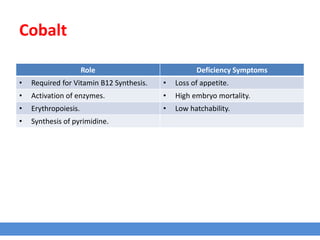
Cobalt
Role Deficiency Symptoms
• Required for Vitamin B12 Synthesis. • Loss of appetite.
• Activation of enzymes. • High embryo mortality.
• Erythropoiesis. • Low hatchability.
• Synthesis of pyrimidine.
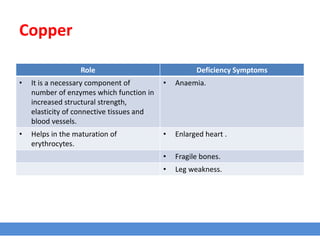
Copper
Role Deficiency Symptoms
• It is a necessary component of
number of enzymes which function in
increased structural strength,
elasticity of connective tissues and
blood vessels.
• Anaemia.
• Helps in the maturation of
erythrocytes.
• Enlarged heart .
• Fragile bones.
• Leg weakness.
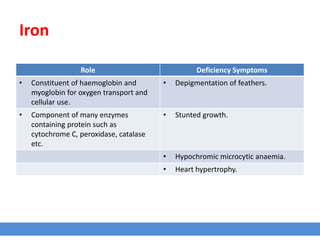
Iron
Role Deficiency Symptoms
• Constituent of haemoglobin and
myoglobin for oxygen transport and
cellular use.
• Depigmentation of feathers.
• Component of many enzymes
containing protein such as
cytochrome C, peroxidase, catalase
etc.
• Stunted growth.
• Hypochromic microcytic anaemia.
• Heart hypertrophy.
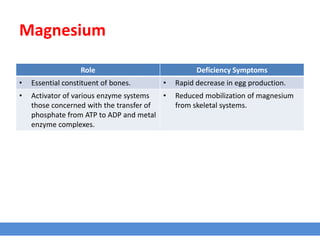
Magnesium
Role Deficiency Symptoms
• Essential constituent of bones. • Rapid decrease in egg production.
• Activator of various enzyme systems
those concerned with the transfer of
phosphate from ATP to ADP and metal
enzyme complexes.
• Reduced mobilization of magnesium
from skeletal systems.
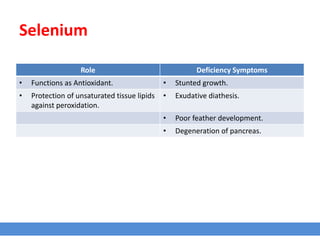
Selenium
Role Deficiency Symptoms
• Functions as Antioxidant. • Stunted growth.
• Protection of unsaturated tissue lipids
against peroxidation.
• Exudative diathesis.
• Poor feather development.
• Degeneration of pancreas.
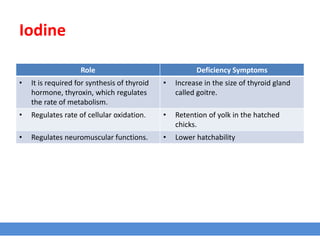
Iodine
Role Deficiency Symptoms
• It is required for synthesis of thyroid
hormone, thyroxin, which regulates
the rate of metabolism.
• Increase in the size of thyroid gland
called goitre.
• Regulates rate of cellular oxidation. • Retention of yolk in the hatched
chicks.
• Regulates neuromuscular functions. • Lower hatchability
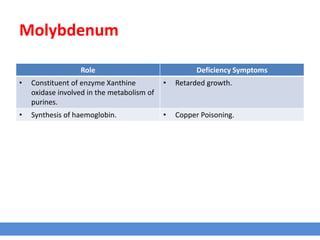
Molybdenum
Role Deficiency Symptoms
• Constituent of enzyme Xanthine
oxidase involved in the metabolism of
purines.
• Retarded growth.
• Synthesis of haemoglobin. • Copper Poisoning.
Plan of Talk
 Need for trace minerals
 Physiological role of trace minerals
 Source trace minerals
 Absorption of trace minerals
 Trace mineral interactions during absorption
 Trace mineral requirement
 The need for organic trace minerals
 Organic and inorganic trace minerals
 Types of organic trace minerals
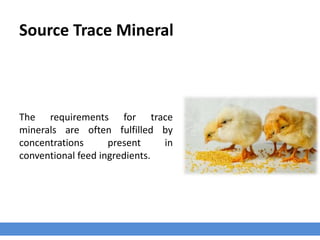
Source Trace Mineral
The requirements for trace
minerals are often fulfilled by
concentrations present in
conventional feed ingredients.
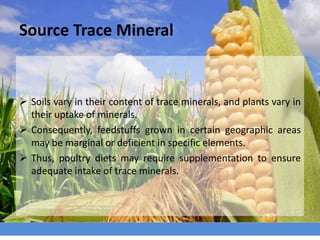
Source Trace Mineral
 Soils vary in their content of trace minerals, and plants vary in
their uptake of minerals.
 Consequently, feedstuffs grown in certain geographic areas
may be marginal or deficient in specific elements.
 Thus, poultry diets may require supplementation to ensure
adequate intake of trace minerals.
Plan of Talk
 Need for trace minerals
 Physiological role of trace minerals
 Source trace minerals
 Absorption of trace minerals
 Trace mineral interactions during absorption
 Trace mineral requirement
 The need for organic trace minerals
 Organic and inorganic trace minerals
 Types of organic trace minerals
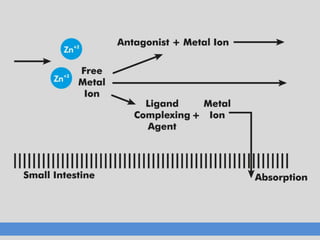
Absorption Of Trace Minerals
1. Trace minerals are usually supplemented in inorganic salts.
2. They get dissociated after entering the digestive system.
3. The free metal ion first gets attached to an organic molecule
or escort.
Cont. …
Trace minerals will not be absorbed in cases of:
1. Antagonistic reactions of ingredients in the animal digestive system.
2. If minerals are not able to find an escort, there are limited ligand
/escort availability.
 The unabsorbed minerals would be excreted.
Plan of Talk
 Need for trace minerals
 Physiological role of trace minerals
 Source trace minerals
 Absorption of trace minerals
 Trace mineral interactions during absorption
 Trace mineral requirement
 The need for organic trace minerals
 Organic and inorganic trace minerals
 Types of organic trace minerals
Trace Mineral Interactions
During Absorption
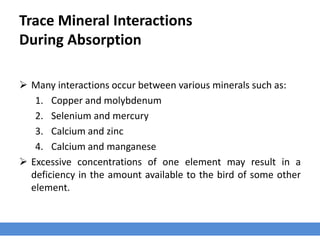
 Many interactions occur between various minerals such as:
1. Copper and molybdenum
2. Selenium and mercury
3. Calcium and zinc
4. Calcium and manganese
 Excessive concentrations of one element may result in a
deficiency in the amount available to the bird of some other
element.
Cont. …
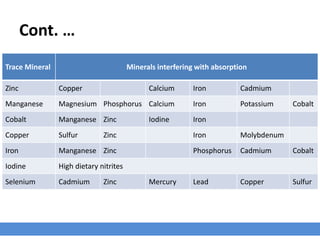
Trace Mineral Minerals interfering with absorption
Zinc Copper Calcium Iron Cadmium
Manganese Magnesium Phosphorus Calcium Iron Potassium Cobalt
Cobalt Manganese Zinc Iodine Iron
Copper Sulfur Zinc Iron Molybdenum
Iron Manganese Zinc Phosphorus Cadmium Cobalt
Iodine High dietary nitrites
Selenium Cadmium Zinc Mercury Lead Copper Sulfur
Cont. …
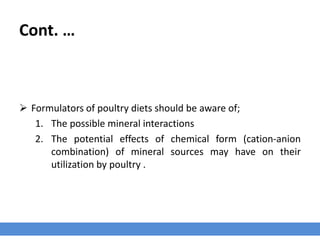
 Formulators of poultry diets should be aware of;
1. The possible mineral interactions
2. The potential effects of chemical form (cation-anion
combination) of mineral sources may have on their
utilization by poultry .
Cont. …
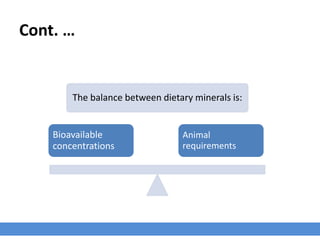
The balance between dietary minerals is:
Bioavailable
concentrations
Animal
requirements
Cont. …
 Supplementation of minerals to animals above the
requirements / needs is also a common practice as a safety
margin to prevent any likelihood of deficiencies.
Note
 If one mineral is supplemented in feed ingredients at levels
higher than the need of animal it may negatively affect the
availability of other minerals.
Plan of Talk
 Need for trace minerals
 Physiological role of trace minerals
 Source trace minerals
 Absorption of trace minerals
 Trace mineral interactions during absorption
 Trace mineral requirement
 The need for organic trace minerals
 Organic and inorganic trace minerals
 Types of organic trace minerals
Trace Mineral Requirement
 The requirement of micronutrients differs between broilers
and layers according to their activities;
– Broilers are expected to grow fast in a very short duration.
– Layers are slow growing birds with a productive lifespan of
72 weeks.
– Broilers are expected to put on weight rapidly.
– Layers are expected to remain lean to produce eggs.
Cont. …
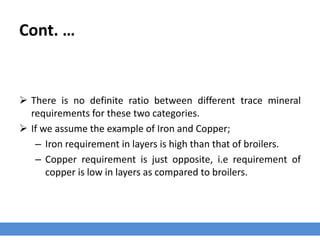
 There is no definite ratio between different trace mineral
requirements for these two categories.
 If we assume the example of Iron and Copper;
– Iron requirement in layers is high than that of broilers.
– Copper requirement is just opposite, i.e requirement of
copper is low in layers as compared to broilers.
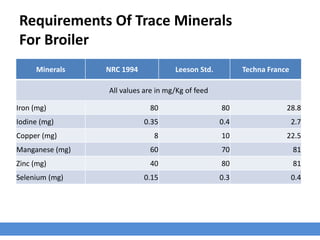
Requirements Of Trace Minerals
For Broiler
Minerals NRC 1994 Leeson Std. Techna France
All values are in mg/Kg of feed
Iron (mg) 80 80 28.8
Iodine (mg) 0.35 0.4 2.7
Copper (mg) 8 10 22.5
Manganese (mg) 60 70 81
Zinc (mg) 40 80 81
Selenium (mg) 0.15 0.3 0.4
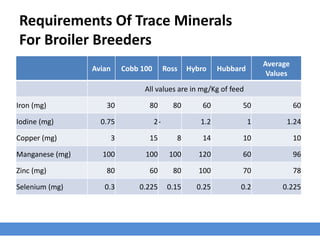
Requirements Of Trace Minerals
For Broiler Breeders
Avian Cobb 100 Ross Hybro Hubbard
Average
Values
All values are in mg/Kg of feed
Iron (mg) 30 80 80 60 50 60
Iodine (mg) 0.75 2- 1.2 1 1.24
Copper (mg) 3 15 8 14 10 10
Manganese (mg) 100 100 100 120 60 96
Zinc (mg) 80 60 80 100 70 78
Selenium (mg) 0.3 0.225 0.15 0.25 0.2 0.225
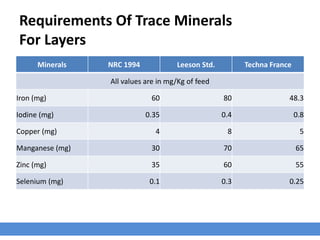
Requirements Of Trace Minerals
For Layers
Minerals NRC 1994 Leeson Std. Techna France
All values are in mg/Kg of feed
Iron (mg) 60 80 48.3
Iodine (mg) 0.35 0.4 0.8
Copper (mg) 4 8 5
Manganese (mg) 30 70 65
Zinc (mg) 35 60 55
Selenium (mg) 0.1 0.3 0.25
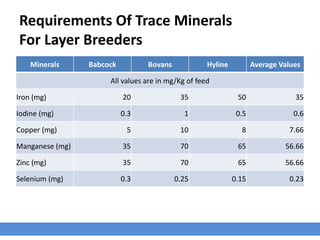
Requirements Of Trace Minerals
For Layer Breeders
Minerals Babcock Bovans Hyline Average Values
All values are in mg/Kg of feed
Iron (mg) 20 35 50 35
Iodine (mg) 0.3 1 0.5 0.6
Copper (mg) 5 10 8 7.66
Manganese (mg) 35 70 65 56.66
Zinc (mg) 35 70 65 56.66
Selenium (mg) 0.3 0.25 0.15 0.23
Plan of Talk
 Need for trace minerals
 Physiological role of trace minerals
 Source trace minerals
 Absorption of trace minerals
 Trace mineral interactions during absorption
 Trace mineral requirement
 The need for organic trace minerals
 Organic and inorganic trace minerals
 Types of organic trace minerals
The Need for Organic Trace Minerals
 Modern poultry production considers birds as a sophisticated
machine, expected to be highly performing.
 This extremely efficient performances require a close
examination of the nutritional profile of diets in which trace
minerals are of particular interest especially in high producing
animals.
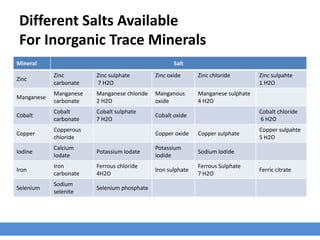
Different Salts Available
For Inorganic Trace Minerals
Mineral Salt
Zinc
Zinc
carbonate
Zinc sulphate
7 H2O
Zinc oxide Zinc chloride Zinc sulpahte
1 H2O
Manganese
Manganese
carbonate
Manganese chloride
2 H2O
Manganous
oxide
Manganese sulphate
4 H2O
Cobalt
Cobalt
carbonate
Cobalt sulphate
7 H2O
Cobalt oxide
Cobalt chloride
6 H2O
Copper
Copperous
chloride
Copper oxide Copper sulphate
Copper sulpahte
5 H2O
Iodine
Calcium
Iodate
Potassium Iodate
Potassium
Iodide
Sodium Iodide
Iron
Iron
carbonate
Ferrous chloride
4H2O
Iron sulphate
Ferrous Sulphate
7 H2O
Ferric citrate
Selenium
Sodium
selenite
Selenium phosphate
Plan of Talk
 Need for trace minerals
 Physiological role of trace minerals
 Source trace minerals
 Absorption of trace minerals
 Trace mineral interactions during absorption
 Trace mineral requirement
 The need for organic trace minerals
 Organic and inorganic trace minerals
 Types of organic trace minerals
Organic and Inorganic Trace Minerals
Inorganic sources of trace minerals are
efficiently absorbed and utilized up to
a point.
Beyond a certain level, inorganic
supplementation of trace minerals
does not evoke a positive response
and may in fact hamper performance.
Organic and Inorganic Trace Minerals
So, beyond a certain level of
supplementation, organic forms of the
essential trace minerals should be
incorporated in a ration in order to
maximize animal performance.
Cont. …
The beneficial effect of Organic Trace minerals over inorganic
was shown in a study in India conducted by Ganpule and Koshy,
2002;
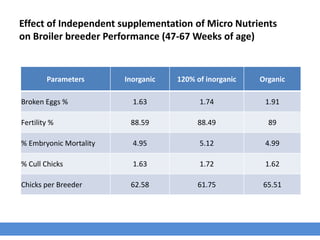
Effect of Independent supplementation of Micro Nutrients
on Broiler breeder Performance (47-67 Weeks of age)
Parameters Inorganic 120% of inorganic Organic
Broken Eggs % 1.63 1.74 1.91
Fertility % 88.59 88.49 89
% Embryonic Mortality 4.95 5.12 4.99
% Cull Chicks 1.63 1.72 1.62
Chicks per Breeder 62.58 61.75 65.51
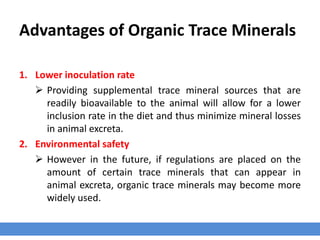
Advantages of Organic Trace Minerals
1. Lower inoculation rate
 Providing supplemental trace mineral sources that are
readily bioavailable to the animal will allow for a lower
inclusion rate in the diet and thus minimize mineral losses
in animal excreta.
2. Environmental safety
 However in the future, if regulations are placed on the
amount of certain trace minerals that can appear in
animal excreta, organic trace minerals may become more
widely used.
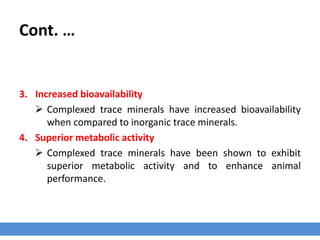
Cont. …
3. Increased bioavailability
 Complexed trace minerals have increased bioavailability
when compared to inorganic trace minerals.
4. Superior metabolic activity
 Complexed trace minerals have been shown to exhibit
superior metabolic activity and to enhance animal
performance.
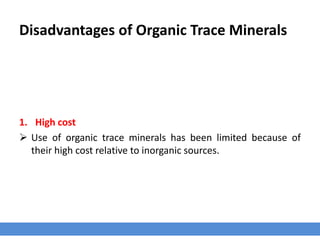
Disadvantages of Organic Trace Minerals
1. High cost
 Use of organic trace minerals has been limited because of
their high cost relative to inorganic sources.
Plan of Talk
 Need for trace minerals
 Physiological role of trace minerals
 Source trace minerals
 Absorption of trace minerals
 Trace mineral interactions during absorption
 Trace mineral requirement
 The need for organic trace minerals
 Organic and inorganic trace minerals
 Types of organic trace minerals
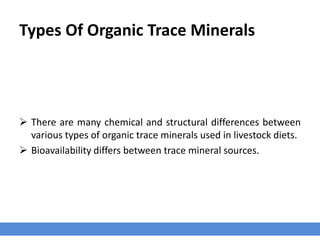
Types Of Organic Trace Minerals
 There are many chemical and structural differences between
various types of organic trace minerals used in livestock diets.
 Bioavailability differs between trace mineral sources.
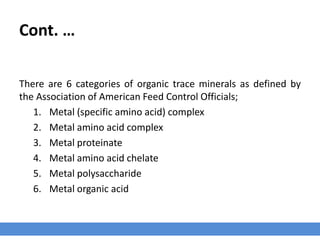
Cont. …
There are 6 categories of organic trace minerals as defined by
the Association of American Feed Control Officials;
1. Metal (specific amino acid) complex
2. Metal amino acid complex
3. Metal proteinate
4. Metal amino acid chelate
5. Metal polysaccharide
6. Metal organic acid
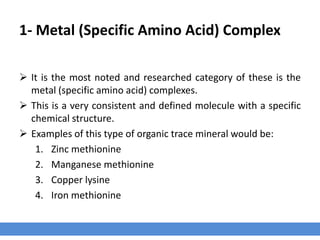
1- Metal (Specific Amino Acid) Complex
 It is the most noted and researched category of these is the
metal (specific amino acid) complexes.
 This is a very consistent and defined molecule with a specific
chemical structure.
 Examples of this type of organic trace mineral would be:
1. Zinc methionine
2. Manganese methionine
3. Copper lysine
4. Iron methionine
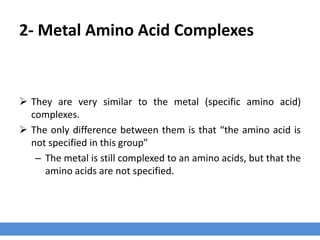
2- Metal Amino Acid Complexes
 They are very similar to the metal (specific amino acid)
complexes.
 The only difference between them is that “the amino acid is
not specified in this group”
– The metal is still complexed to an amino acids, but that the
amino acids are not specified.
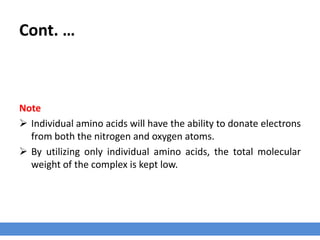
Cont. …
Note
 Individual amino acids will have the ability to donate electrons
from both the nitrogen and oxygen atoms.
 By utilizing only individual amino acids, the total molecular
weight of the complex is kept low.
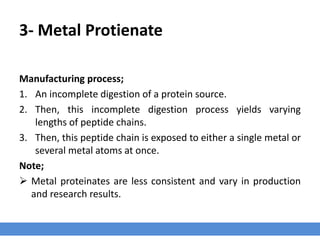
3- Metal Protienate
Manufacturing process;
1. An incomplete digestion of a protein source.
2. Then, this incomplete digestion process yields varying
lengths of peptide chains.
3. Then, this peptide chain is exposed to either a single metal or
several metal atoms at once.
Note;
 Metal proteinates are less consistent and vary in production
and research results.
4- Metal Chelates
 Metal chelates are the same as proteinates except that there
is a maximum molecular weight that is given to chelates, 800
daltons.
 The metal to amino acid ration is 1: 1 up to 1: 3
– Thus accounting for the increased molecular weight of
chelates compared to complexes.
– Increasing ligand size decreases bond strength and may
reduce absorption.
5- Metal Polysaccharides
 They result from mixing a soluble metal salt with a
polysaccharide solution.
 The polysaccharide matrix envelops the trace mineral and
may provide some physical protection from gut degradation.
6- Metal Organic Acid Salts
 They are highly soluble forms of organic acids.
 They dissolve and rapidly dissociate in the digestive tract of
the animal.
 They don’t offer any improvement over inorganic sources.

Trace_Minerals_In_Poultry

  • 1.
  • 2.
    Plan of Talk Need for trace minerals  Physiological role of trace minerals  Source trace minerals  Absorption of trace minerals  Trace mineral interactions during absorption  Trace mineral requirement  The need for organic trace minerals  Organic and inorganic trace minerals  Types of organic trace minerals
  • 3.
    Plan of Talk Need for trace minerals  Physiological role of trace minerals  Source trace minerals  Absorption of trace minerals  Trace mineral interactions during absorption  Trace mineral requirement  The need for organic trace minerals  Organic and inorganic trace minerals  Types of organic trace minerals
  • 4.
    Need Of TraceMinerals  Trace minerals play a vital role in various metabolic, enzymatic and biochemical reactions leading to: – Better growth rate – Egg production – Feed efficiency  Trace minerals have a very important role in the mechanism of nutrient circulation in the animal organism.
  • 5.
    Cont. … Deficiency orimbalance of any of these vital micronutrients results in: 1. Deficiency disease 2. Metabolic disorders 3. Poor growth rate 4. Low egg production 5. Low hatchability 6. Low feed efficiency
  • 6.
    Plan of Talk Need for trace minerals  Physiological role of trace minerals  Source trace minerals  Absorption of trace minerals  Trace mineral interactions during absorption  Trace mineral requirement  The need for organic trace minerals  Organic and inorganic trace minerals  Types of organic trace minerals
  • 7.
    Physiological Role OfTrace Minerals 1. As part of larger organic molecules as; – Iron is a part of hemoglobin and cytochrome. – Iodine is a part of thyroxin. 2. As an essential accessory factors to enzymes; – For example; copper, manganese, selenium, and zinc.
  • 8.
    Cont. … If anyof these minerals is deficient, the functional activity of the organic moiety requiring the presence of the mineral will be decreased.
  • 9.
    Zinc Role Deficiency Symptoms •Essential component of 200 Enzyme systems. • Poor semen quality. • Major role in Immune system and certain reproductive hormones. • Retardation in growth • Essential for proper sexual maturity and reproductive capacity. • Leg abnormality with long bones becoming shorter, thickened and crooked. • Hatched chicks are weak with skeletal deformities. • Delayed feathering.
  • 10.
    Manganese Role Deficiency Symptoms •Activator of enzyme system in the metabolism of carbohydrates, fats, proteins and nucleic acid. • Retarded growth • Plays a role in collagen formation, bone growth, urea formation, eggshell formation and the function of the immune system. • Characteristic crippling leg deformity called perosis. • Involved in enzymes related with oxidative phosphorylation in mitochondria. • Reduction in eggshell strength. • Reduction in hatchability.
  • 11.
    Cobalt Role Deficiency Symptoms •Required for Vitamin B12 Synthesis. • Loss of appetite. • Activation of enzymes. • High embryo mortality. • Erythropoiesis. • Low hatchability. • Synthesis of pyrimidine.
  • 12.
    Copper Role Deficiency Symptoms •It is a necessary component of number of enzymes which function in increased structural strength, elasticity of connective tissues and blood vessels. • Anaemia. • Helps in the maturation of erythrocytes. • Enlarged heart . • Fragile bones. • Leg weakness.
  • 13.
    Iron Role Deficiency Symptoms •Constituent of haemoglobin and myoglobin for oxygen transport and cellular use. • Depigmentation of feathers. • Component of many enzymes containing protein such as cytochrome C, peroxidase, catalase etc. • Stunted growth. • Hypochromic microcytic anaemia. • Heart hypertrophy.
  • 14.
    Magnesium Role Deficiency Symptoms •Essential constituent of bones. • Rapid decrease in egg production. • Activator of various enzyme systems those concerned with the transfer of phosphate from ATP to ADP and metal enzyme complexes. • Reduced mobilization of magnesium from skeletal systems.
  • 15.
    Selenium Role Deficiency Symptoms •Functions as Antioxidant. • Stunted growth. • Protection of unsaturated tissue lipids against peroxidation. • Exudative diathesis. • Poor feather development. • Degeneration of pancreas.
  • 16.
    Iodine Role Deficiency Symptoms •It is required for synthesis of thyroid hormone, thyroxin, which regulates the rate of metabolism. • Increase in the size of thyroid gland called goitre. • Regulates rate of cellular oxidation. • Retention of yolk in the hatched chicks. • Regulates neuromuscular functions. • Lower hatchability
  • 17.
    Molybdenum Role Deficiency Symptoms •Constituent of enzyme Xanthine oxidase involved in the metabolism of purines. • Retarded growth. • Synthesis of haemoglobin. • Copper Poisoning.
  • 18.
    Plan of Talk Need for trace minerals  Physiological role of trace minerals  Source trace minerals  Absorption of trace minerals  Trace mineral interactions during absorption  Trace mineral requirement  The need for organic trace minerals  Organic and inorganic trace minerals  Types of organic trace minerals
  • 19.
    Source Trace Mineral Therequirements for trace minerals are often fulfilled by concentrations present in conventional feed ingredients.
  • 20.
    Source Trace Mineral Soils vary in their content of trace minerals, and plants vary in their uptake of minerals.  Consequently, feedstuffs grown in certain geographic areas may be marginal or deficient in specific elements.  Thus, poultry diets may require supplementation to ensure adequate intake of trace minerals.
  • 21.
    Plan of Talk Need for trace minerals  Physiological role of trace minerals  Source trace minerals  Absorption of trace minerals  Trace mineral interactions during absorption  Trace mineral requirement  The need for organic trace minerals  Organic and inorganic trace minerals  Types of organic trace minerals
  • 22.
    Absorption Of TraceMinerals 1. Trace minerals are usually supplemented in inorganic salts. 2. They get dissociated after entering the digestive system. 3. The free metal ion first gets attached to an organic molecule or escort.
  • 23.
    Cont. … Trace mineralswill not be absorbed in cases of: 1. Antagonistic reactions of ingredients in the animal digestive system. 2. If minerals are not able to find an escort, there are limited ligand /escort availability.  The unabsorbed minerals would be excreted.
  • 25.
    Plan of Talk Need for trace minerals  Physiological role of trace minerals  Source trace minerals  Absorption of trace minerals  Trace mineral interactions during absorption  Trace mineral requirement  The need for organic trace minerals  Organic and inorganic trace minerals  Types of organic trace minerals
  • 26.
    Trace Mineral Interactions DuringAbsorption  Many interactions occur between various minerals such as: 1. Copper and molybdenum 2. Selenium and mercury 3. Calcium and zinc 4. Calcium and manganese  Excessive concentrations of one element may result in a deficiency in the amount available to the bird of some other element.
  • 27.
    Cont. … Trace MineralMinerals interfering with absorption Zinc Copper Calcium Iron Cadmium Manganese Magnesium Phosphorus Calcium Iron Potassium Cobalt Cobalt Manganese Zinc Iodine Iron Copper Sulfur Zinc Iron Molybdenum Iron Manganese Zinc Phosphorus Cadmium Cobalt Iodine High dietary nitrites Selenium Cadmium Zinc Mercury Lead Copper Sulfur
  • 28.
    Cont. …  Formulatorsof poultry diets should be aware of; 1. The possible mineral interactions 2. The potential effects of chemical form (cation-anion combination) of mineral sources may have on their utilization by poultry .
  • 29.
    Cont. … The balancebetween dietary minerals is: Bioavailable concentrations Animal requirements
  • 30.
    Cont. …  Supplementationof minerals to animals above the requirements / needs is also a common practice as a safety margin to prevent any likelihood of deficiencies. Note  If one mineral is supplemented in feed ingredients at levels higher than the need of animal it may negatively affect the availability of other minerals.
  • 31.
    Plan of Talk Need for trace minerals  Physiological role of trace minerals  Source trace minerals  Absorption of trace minerals  Trace mineral interactions during absorption  Trace mineral requirement  The need for organic trace minerals  Organic and inorganic trace minerals  Types of organic trace minerals
  • 32.
    Trace Mineral Requirement The requirement of micronutrients differs between broilers and layers according to their activities; – Broilers are expected to grow fast in a very short duration. – Layers are slow growing birds with a productive lifespan of 72 weeks. – Broilers are expected to put on weight rapidly. – Layers are expected to remain lean to produce eggs.
  • 33.
    Cont. …  Thereis no definite ratio between different trace mineral requirements for these two categories.  If we assume the example of Iron and Copper; – Iron requirement in layers is high than that of broilers. – Copper requirement is just opposite, i.e requirement of copper is low in layers as compared to broilers.
  • 34.
    Requirements Of TraceMinerals For Broiler Minerals NRC 1994 Leeson Std. Techna France All values are in mg/Kg of feed Iron (mg) 80 80 28.8 Iodine (mg) 0.35 0.4 2.7 Copper (mg) 8 10 22.5 Manganese (mg) 60 70 81 Zinc (mg) 40 80 81 Selenium (mg) 0.15 0.3 0.4
  • 35.
    Requirements Of TraceMinerals For Broiler Breeders Avian Cobb 100 Ross Hybro Hubbard Average Values All values are in mg/Kg of feed Iron (mg) 30 80 80 60 50 60 Iodine (mg) 0.75 2- 1.2 1 1.24 Copper (mg) 3 15 8 14 10 10 Manganese (mg) 100 100 100 120 60 96 Zinc (mg) 80 60 80 100 70 78 Selenium (mg) 0.3 0.225 0.15 0.25 0.2 0.225
  • 36.
    Requirements Of TraceMinerals For Layers Minerals NRC 1994 Leeson Std. Techna France All values are in mg/Kg of feed Iron (mg) 60 80 48.3 Iodine (mg) 0.35 0.4 0.8 Copper (mg) 4 8 5 Manganese (mg) 30 70 65 Zinc (mg) 35 60 55 Selenium (mg) 0.1 0.3 0.25
  • 37.
    Requirements Of TraceMinerals For Layer Breeders Minerals Babcock Bovans Hyline Average Values All values are in mg/Kg of feed Iron (mg) 20 35 50 35 Iodine (mg) 0.3 1 0.5 0.6 Copper (mg) 5 10 8 7.66 Manganese (mg) 35 70 65 56.66 Zinc (mg) 35 70 65 56.66 Selenium (mg) 0.3 0.25 0.15 0.23
  • 38.
    Plan of Talk Need for trace minerals  Physiological role of trace minerals  Source trace minerals  Absorption of trace minerals  Trace mineral interactions during absorption  Trace mineral requirement  The need for organic trace minerals  Organic and inorganic trace minerals  Types of organic trace minerals
  • 39.
    The Need forOrganic Trace Minerals  Modern poultry production considers birds as a sophisticated machine, expected to be highly performing.  This extremely efficient performances require a close examination of the nutritional profile of diets in which trace minerals are of particular interest especially in high producing animals.
  • 40.
    Different Salts Available ForInorganic Trace Minerals Mineral Salt Zinc Zinc carbonate Zinc sulphate 7 H2O Zinc oxide Zinc chloride Zinc sulpahte 1 H2O Manganese Manganese carbonate Manganese chloride 2 H2O Manganous oxide Manganese sulphate 4 H2O Cobalt Cobalt carbonate Cobalt sulphate 7 H2O Cobalt oxide Cobalt chloride 6 H2O Copper Copperous chloride Copper oxide Copper sulphate Copper sulpahte 5 H2O Iodine Calcium Iodate Potassium Iodate Potassium Iodide Sodium Iodide Iron Iron carbonate Ferrous chloride 4H2O Iron sulphate Ferrous Sulphate 7 H2O Ferric citrate Selenium Sodium selenite Selenium phosphate
  • 41.
    Plan of Talk Need for trace minerals  Physiological role of trace minerals  Source trace minerals  Absorption of trace minerals  Trace mineral interactions during absorption  Trace mineral requirement  The need for organic trace minerals  Organic and inorganic trace minerals  Types of organic trace minerals
  • 42.
    Organic and InorganicTrace Minerals Inorganic sources of trace minerals are efficiently absorbed and utilized up to a point. Beyond a certain level, inorganic supplementation of trace minerals does not evoke a positive response and may in fact hamper performance.
  • 43.
    Organic and InorganicTrace Minerals So, beyond a certain level of supplementation, organic forms of the essential trace minerals should be incorporated in a ration in order to maximize animal performance.
  • 44.
    Cont. … The beneficialeffect of Organic Trace minerals over inorganic was shown in a study in India conducted by Ganpule and Koshy, 2002;
  • 45.
    Effect of Independentsupplementation of Micro Nutrients on Broiler breeder Performance (47-67 Weeks of age) Parameters Inorganic 120% of inorganic Organic Broken Eggs % 1.63 1.74 1.91 Fertility % 88.59 88.49 89 % Embryonic Mortality 4.95 5.12 4.99 % Cull Chicks 1.63 1.72 1.62 Chicks per Breeder 62.58 61.75 65.51
  • 46.
    Advantages of OrganicTrace Minerals 1. Lower inoculation rate  Providing supplemental trace mineral sources that are readily bioavailable to the animal will allow for a lower inclusion rate in the diet and thus minimize mineral losses in animal excreta. 2. Environmental safety  However in the future, if regulations are placed on the amount of certain trace minerals that can appear in animal excreta, organic trace minerals may become more widely used.
  • 47.
    Cont. … 3. Increasedbioavailability  Complexed trace minerals have increased bioavailability when compared to inorganic trace minerals. 4. Superior metabolic activity  Complexed trace minerals have been shown to exhibit superior metabolic activity and to enhance animal performance.
  • 48.
    Disadvantages of OrganicTrace Minerals 1. High cost  Use of organic trace minerals has been limited because of their high cost relative to inorganic sources.
  • 49.
    Plan of Talk Need for trace minerals  Physiological role of trace minerals  Source trace minerals  Absorption of trace minerals  Trace mineral interactions during absorption  Trace mineral requirement  The need for organic trace minerals  Organic and inorganic trace minerals  Types of organic trace minerals
  • 50.
    Types Of OrganicTrace Minerals  There are many chemical and structural differences between various types of organic trace minerals used in livestock diets.  Bioavailability differs between trace mineral sources.
  • 51.
    Cont. … There are6 categories of organic trace minerals as defined by the Association of American Feed Control Officials; 1. Metal (specific amino acid) complex 2. Metal amino acid complex 3. Metal proteinate 4. Metal amino acid chelate 5. Metal polysaccharide 6. Metal organic acid
  • 52.
    1- Metal (SpecificAmino Acid) Complex  It is the most noted and researched category of these is the metal (specific amino acid) complexes.  This is a very consistent and defined molecule with a specific chemical structure.  Examples of this type of organic trace mineral would be: 1. Zinc methionine 2. Manganese methionine 3. Copper lysine 4. Iron methionine
  • 53.
    2- Metal AminoAcid Complexes  They are very similar to the metal (specific amino acid) complexes.  The only difference between them is that “the amino acid is not specified in this group” – The metal is still complexed to an amino acids, but that the amino acids are not specified.
  • 54.
    Cont. … Note  Individualamino acids will have the ability to donate electrons from both the nitrogen and oxygen atoms.  By utilizing only individual amino acids, the total molecular weight of the complex is kept low.
  • 55.
    3- Metal Protienate Manufacturingprocess; 1. An incomplete digestion of a protein source. 2. Then, this incomplete digestion process yields varying lengths of peptide chains. 3. Then, this peptide chain is exposed to either a single metal or several metal atoms at once. Note;  Metal proteinates are less consistent and vary in production and research results.
  • 56.
    4- Metal Chelates Metal chelates are the same as proteinates except that there is a maximum molecular weight that is given to chelates, 800 daltons.  The metal to amino acid ration is 1: 1 up to 1: 3 – Thus accounting for the increased molecular weight of chelates compared to complexes. – Increasing ligand size decreases bond strength and may reduce absorption.
  • 57.
    5- Metal Polysaccharides They result from mixing a soluble metal salt with a polysaccharide solution.  The polysaccharide matrix envelops the trace mineral and may provide some physical protection from gut degradation.
  • 58.
    6- Metal OrganicAcid Salts  They are highly soluble forms of organic acids.  They dissolve and rapidly dissociate in the digestive tract of the animal.  They don’t offer any improvement over inorganic sources.

Editor's Notes

  • #8 moiety … part of molecule
  • #9 moiety … part of molecule
  • #23 Trace Minerals are absorbed in the intestine in ionic forms.
  • #24 Trace Minerals are absorbed in the intestine in ionic forms.