NVMEandGPUaccelerates PostgreSQL beyondthelimitation
〜Our challenge to the 10GB/s for query execution performance〜
HeteroDB,Inc
Chief Architect & CEO
KaiGai Kohei <kaigai@heterodb.com>
Here are mysterious benchmark results
NVME and GPU accelerates PostgreSQL beyond the limitation - DB Tech Showcase Tokyo 20182
Benchmark conditions:
 By the PostgreSQL v11beta3 + PG-Strom v2.1devel on a single-node server system
 13 queries of Star-schema benchmark onto the 1055GB data set
0
2,000
4,000
6,000
8,000
10,000
12,000
14,000
Q1_1 Q1_2 Q1_3 Q2_1 Q2_2 Q2_3 Q3_1 Q3_2 Q3_3 Q3_4 Q4_1 Q4_2 Q4_3
QueryExecutionThroughput[MB/s]
Star Schema Benchmark for PostgreSQL 11beta3 + PG-Strom v2.1devel
PG-Strom v2.1devel
max 13.5GB/s in query execution throughput on single-node PostgreSQL
about HeteroDB,Inc
NVME and GPU accelerates PostgreSQL beyond the limitation - DB Tech Showcase Tokyo 20183
Corporate overview
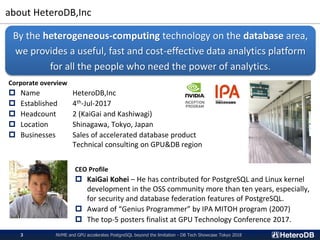
 Name HeteroDB,Inc
 Established 4th-Jul-2017
 Headcount 2 (KaiGai and Kashiwagi)
 Location Shinagawa, Tokyo, Japan
 Businesses Sales of accelerated database product
Technical consulting on GPU&DB region
By the heterogeneous-computing technology on the database area,
we provides a useful, fast and cost-effective data analytics platform
for all the people who need the power of analytics.
CEO Profile
 KaiGai Kohei – He has contributed for PostgreSQL and Linux kernel
development in the OSS community more than ten years, especially,
for security and database federation features of PostgreSQL.
 Award of “Genius Programmer” by IPA MITOH program (2007)
 The top-5 posters finalist at GPU Technology Conference 2017.
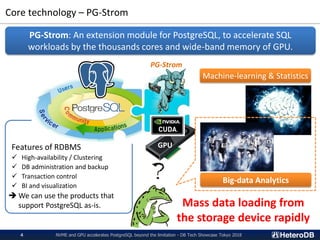
Features of RDBMS
 High-availability / Clustering
 DB administration and backup
 Transaction control
 BI and visualization
 We can use the products that
support PostgreSQL as-is.
Core technology – PG-Strom
PG-Strom: An extension module for PostgreSQL, to accelerate SQL
workloads by the thousands cores and wide-band memory of GPU.
GPU
Big-data Analytics
PG-Strom
NVME and GPU accelerates PostgreSQL beyond the limitation - DB Tech Showcase Tokyo 20184
Mass data loading from
the storage device rapidly
Machine-learning & Statistics
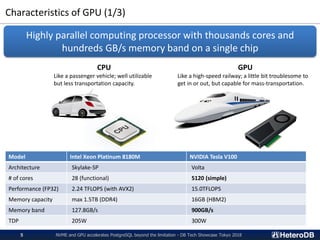
Characteristics of GPU (1/3)
Highly parallel computing processor with thousands cores and
hundreds GB/s memory band on a single chip
CPU
Like a passenger vehicle; well utilizable
but less transportation capacity.
GPU
Like a high-speed railway; a little bit troublesome to
get in or out, but capable for mass-transportation.
Model Intel Xeon Platinum 8180M NVIDIA Tesla V100
Architecture Skylake-SP Volta
# of cores 28 (functional) 5120 (simple)
Performance (FP32) 2.24 TFLOPS (with AVX2) 15.0TFLOPS
Memory capacity max 1.5TB (DDR4) 16GB (HBM2)
Memory band 127.8GB/s 900GB/s
TDP 205W 300W
NVME and GPU accelerates PostgreSQL beyond the limitation - DB Tech Showcase Tokyo 20185
Characteristics of GPU (2/3) – Reduction algorithm
●item[0]
step.1 step.2 step.4step.3
Calculation of the total
sum of an array by GPU
Σi=0...N-1item[i]
◆
●
▲ ■ ★
● ◆
●
● ◆ ▲
●
● ◆
●
● ◆ ▲ ■
●
● ◆
●
● ◆ ▲
●
● ◆
●
item[1]
item[2]
item[3]
item[4]
item[5]
item[6]
item[7]
item[8]
item[9]
item[10]
item[11]
item[12]
item[13]
item[14]
item[15]
Total sum of items[]
with log2N steps
Inter-cores synchronization with hardware support
SELECT count(X),
sum(Y),
avg(Z)
FROM my_table;
Same logic is internally used to
implement aggregate function.
DB Tech Showcase 2017 - GPU/SSD Accelerates PostgreSQL -6
Characteristics of GPU (3/3)
NVME and GPU accelerates PostgreSQL beyond the limitation - DB Tech Showcase Tokyo 20187
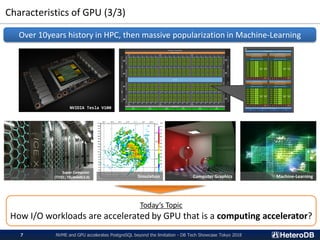
Over 10years history in HPC, then massive popularization in Machine-Learning
NVIDIA Tesla V100
Super Computer
(TITEC; TSUBAME3.0) Computer Graphics Machine-Learning
Today’s Topic
How I/O workloads are accelerated by GPU that is a computing accelerator?
Simulation
NVME and GPU accelerates PostgreSQL beyond the limitation - DB Tech Showcase Tokyo 20188
How PostgreSQL utilizes GPU?
〜Architecture of PG-Strom〜
Construction of query execution plan in PostgreSQL (1/2)
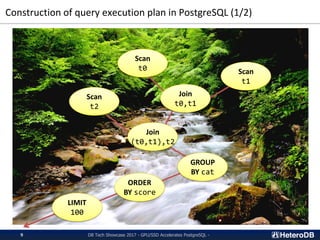
Scan
t0 Scan
t1
Scan
t2
Join
t0,t1
Join
(t0,t1),t2
GROUP
BY cat
ORDER
BY score
LIMIT
100
DB Tech Showcase 2017 - GPU/SSD Accelerates PostgreSQL -9
Construction of query execution plan in PostgreSQL (2/2)
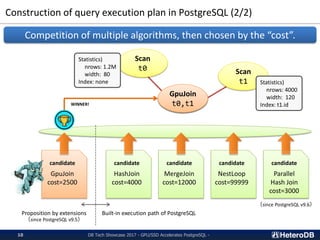
Scan
t0 Scan
t1
Join
t0,t1
Statistics)
nrows: 1.2M
width: 80
Index: none
candidate
HashJoin
cost=4000
candidate
MergeJoin
cost=12000
candidate
NestLoop
cost=99999
candidate
Parallel
Hash Join
cost=3000
candidate
GpuJoin
cost=2500
WINNER!
Built-in execution path of PostgreSQLProposition by extensions
(since PostgreSQL v9.5)
(since PostgreSQL v9.6)
GpuJoin
t0,t1
Statistics)
nrows: 4000
width: 120
Index: t1.id
Competition of multiple algorithms, then chosen by the “cost”.
DB Tech Showcase 2017 - GPU/SSD Accelerates PostgreSQL -10
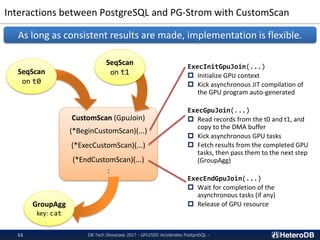
Interactions between PostgreSQL and PG-Strom with CustomScan
As long as consistent results are made, implementation is flexible.
CustomScan (GpuJoin)
(*BeginCustomScan)(...)
(*ExecCustomScan)(...)
(*EndCustomScan)(...)
:
SeqScan
on t0
SeqScan
on t1
GroupAgg
key: cat
ExecInitGpuJoin(...)
 Initialize GPU context
 Kick asynchronous JIT compilation of
the GPU program auto-generated
ExecGpuJoin(...)
 Read records from the t0 and t1, and
copy to the DMA buffer
 Kick asynchronous GPU tasks
 Fetch results from the completed GPU
tasks, then pass them to the next step
(GroupAgg)
ExecEndGpuJoin(...)
 Wait for completion of the
asynchronous tasks (if any)
 Release of GPU resource
DB Tech Showcase 2017 - GPU/SSD Accelerates PostgreSQL -11
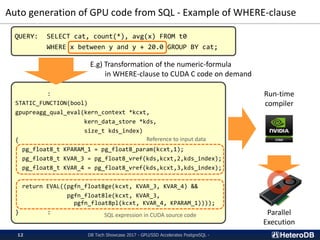
Auto generation of GPU code from SQL - Example of WHERE-clause
DB Tech Showcase 2017 - GPU/SSD Accelerates PostgreSQL -12
QUERY: SELECT cat, count(*), avg(x) FROM t0
WHERE x between y and y + 20.0 GROUP BY cat;
:
STATIC_FUNCTION(bool)
gpupreagg_qual_eval(kern_context *kcxt,
kern_data_store *kds,
size_t kds_index)
{
pg_float8_t KPARAM_1 = pg_float8_param(kcxt,1);
pg_float8_t KVAR_3 = pg_float8_vref(kds,kcxt,2,kds_index);
pg_float8_t KVAR_4 = pg_float8_vref(kds,kcxt,3,kds_index);
return EVAL((pgfn_float8ge(kcxt, KVAR_3, KVAR_4) &&
pgfn_float8le(kcxt, KVAR_3,
pgfn_float8pl(kcxt, KVAR_4, KPARAM_1))));
} :
E.g) Transformation of the numeric-formula
in WHERE-clause to CUDA C code on demand
Reference to input data
SQL expression in CUDA source code
Run-time
compiler
Parallel
Execution
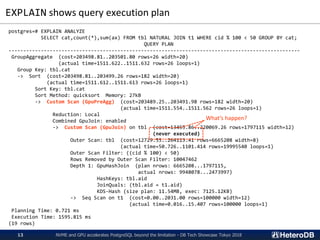
EXPLAIN shows query execution plan
NVME and GPU accelerates PostgreSQL beyond the limitation - DB Tech Showcase Tokyo 201813
postgres=# EXPLAIN ANALYZE
SELECT cat,count(*),sum(ax) FROM tbl NATURAL JOIN t1 WHERE cid % 100 < 50 GROUP BY cat;
QUERY PLAN
---------------------------------------------------------------------------------------------------
GroupAggregate (cost=203498.81..203501.80 rows=26 width=20)
(actual time=1511.622..1511.632 rows=26 loops=1)
Group Key: tbl.cat
-> Sort (cost=203498.81..203499.26 rows=182 width=20)
(actual time=1511.612..1511.613 rows=26 loops=1)
Sort Key: tbl.cat
Sort Method: quicksort Memory: 27kB
-> Custom Scan (GpuPreAgg) (cost=203489.25..203491.98 rows=182 width=20)
(actual time=1511.554..1511.562 rows=26 loops=1)
Reduction: Local
Combined GpuJoin: enabled
-> Custom Scan (GpuJoin) on tbl (cost=13455.86..220069.26 rows=1797115 width=12)
(never executed)
Outer Scan: tbl (cost=12729.55..264113.41 rows=6665208 width=8)
(actual time=50.726..1101.414 rows=19995540 loops=1)
Outer Scan Filter: ((cid % 100) < 50)
Rows Removed by Outer Scan Filter: 10047462
Depth 1: GpuHashJoin (plan nrows: 6665208...1797115,
actual nrows: 9948078...2473997)
HashKeys: tbl.aid
JoinQuals: (tbl.aid = t1.aid)
KDS-Hash (size plan: 11.54MB, exec: 7125.12KB)
-> Seq Scan on t1 (cost=0.00..2031.00 rows=100000 width=12)
(actual time=0.016..15.407 rows=100000 loops=1)
Planning Time: 0.721 ms
Execution Time: 1595.815 ms
(19 rows)
What’s happen?
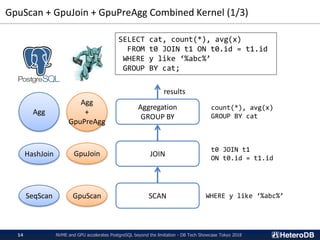
GpuScan + GpuJoin + GpuPreAgg Combined Kernel (1/3)
Aggregation
GROUP BY
JOIN
SCAN
SELECT cat, count(*), avg(x)
FROM t0 JOIN t1 ON t0.id = t1.id
WHERE y like ‘%abc%’
GROUP BY cat;
count(*), avg(x)
GROUP BY cat
t0 JOIN t1
ON t0.id = t1.id
WHERE y like ‘%abc%’
results
NVME and GPU accelerates PostgreSQL beyond the limitation - DB Tech Showcase Tokyo 201814
GpuScan
GpuJoin
Agg
+
GpuPreAgg
SeqScan
HashJoin
Agg
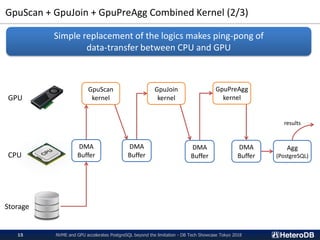
GpuScan + GpuJoin + GpuPreAgg Combined Kernel (2/3)
GpuScan
kernel
GpuJoin
kernel
GpuPreAgg
kernel
DMA
Buffer
GPU
CPU
Storage
Simple replacement of the logics makes ping-pong of
data-transfer between CPU and GPU
DMA
Buffer
DMA
Buffer
NVME and GPU accelerates PostgreSQL beyond the limitation - DB Tech Showcase Tokyo 201815
DMA
Buffer
Agg
(PostgreSQL)
results
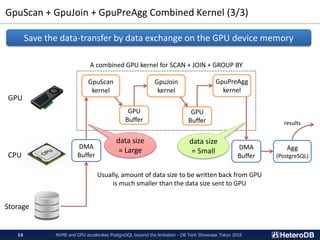
GpuScan + GpuJoin + GpuPreAgg Combined Kernel (3/3)
GpuScan
kernel
GpuJoin
kernel
GpuPreAgg
kernel
DMA
Buffer
GPU
CPU
Storage
Save the data-transfer by data exchange on the GPU device memory
GPU
Buffer
GPU
Buffer results
NVME and GPU accelerates PostgreSQL beyond the limitation - DB Tech Showcase Tokyo 201816
DMA
Buffer
Agg
(PostgreSQL)
A combined GPU kernel for SCAN + JOIN + GROUP BY
data size
= Large
data size
= Small
Usually, amount of data size to be written back from GPU
is much smaller than the data size sent to GPU
NVME and GPU accelerates PostgreSQL beyond the limitation - DB Tech Showcase Tokyo 201817
Re-definition of the GPU’s role
〜How GPU accelerates I/O workloads〜
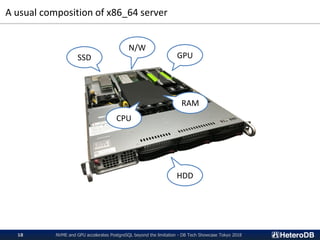
A usual composition of x86_64 server
GPUSSD
CPU
RAM
HDD
N/W
NVME and GPU accelerates PostgreSQL beyond the limitation - DB Tech Showcase Tokyo 201818
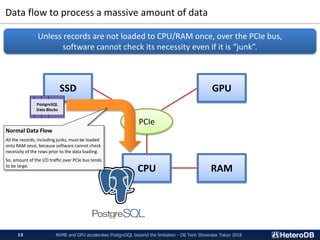
Data flow to process a massive amount of data
CPU RAM
SSD GPU
PCIe
PostgreSQL
Data Blocks
Normal Data Flow
All the records, including junks, must be loaded
onto RAM once, because software cannot check
necessity of the rows prior to the data loading.
So, amount of the I/O traffic over PCIe bus tends
to be large.
NVME and GPU accelerates PostgreSQL beyond the limitation - DB Tech Showcase Tokyo 201819
Unless records are not loaded to CPU/RAM once, over the PCIe bus,
software cannot check its necessity even if it is “junk”.
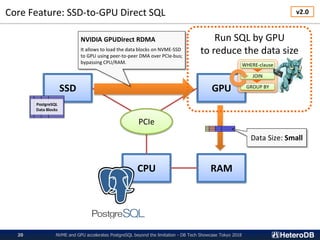
Core Feature: SSD-to-GPU Direct SQL
CPU RAM
SSD GPU
PCIe
PostgreSQL
Data Blocks
NVIDIA GPUDirect RDMA
It allows to load the data blocks on NVME-SSD
to GPU using peer-to-peer DMA over PCIe-bus;
bypassing CPU/RAM. WHERE-clause
JOIN
GROUP BY
Run SQL by GPU
to reduce the data size
Data Size: Small
NVME and GPU accelerates PostgreSQL beyond the limitation - DB Tech Showcase Tokyo 201820
v2.0
Benchmark Results – single-node version
NVME and GPU accelerates PostgreSQL beyond the limitation - DB Tech Showcase Tokyo 201821
2172.3 2159.6 2158.9 2086.0 2127.2 2104.3
1920.3
2023.4 2101.1 2126.9
1900.0 1960.3
2072.1
6149.4 6279.3 6282.5
5985.6 6055.3 6152.5
5479.3
6051.2 6061.5 6074.2
5813.7 5871.8 5800.1
0
1000
2000
3000
4000
5000
6000
7000
Q1_1 Q1_2 Q1_3 Q2_1 Q2_2 Q2_3 Q3_1 Q3_2 Q3_3 Q3_4 Q4_1 Q4_2 Q4_3
QueryProcessingThroughput[MB/sec]
Star Schema Benchmark on NVMe-SSD + md-raid0
PgSQL9.6(SSDx3) PGStrom2.0(SSDx3) H/W Spec (3xSSD)
SSD-to-GPU Direct SQL pulls out an awesome performance close to the H/W spec
 Measurement by the Star Schema Benchmark; which is a set of typical batch / reporting workloads.
 CPU: Intel Xeon E5-2650v4, RAM: 128GB, GPU: NVIDIA Tesla P40, SSD: Intel 750 (400GB; SeqRead 2.2GB/s)x3
 Size of dataset is 353GB (sf: 401), to ensure I/O bounds workload
Element technology - GPUDirect RDMA (1/2)
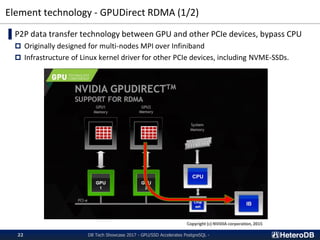
▌P2P data transfer technology between GPU and other PCIe devices, bypass CPU
 Originally designed for multi-nodes MPI over Infiniband
 Infrastructure of Linux kernel driver for other PCIe devices, including NVME-SSDs.
Copyright (c) NVIDIA corporation, 2015
DB Tech Showcase 2017 - GPU/SSD Accelerates PostgreSQL -22
Element technology - GPUDirect RDMA (2/2)
Physical
address space
PCIe BAR1 Area
GPU
device
memory
RAM
NVMe-SSD Infiniband
HBA
PCIe device
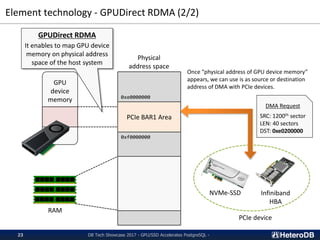
GPUDirect RDMA
It enables to map GPU device
memory on physical address
space of the host system
Once “physical address of GPU device memory”
appears, we can use is as source or destination
address of DMA with PCIe devices.
DB Tech Showcase 2017 - GPU/SSD Accelerates PostgreSQL -23
0xf0000000
0xe0000000
DMA Request
SRC: 1200th sector
LEN: 40 sectors
DST: 0xe0200000
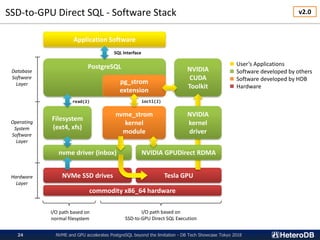
SSD-to-GPU Direct SQL - Software Stack
NVME and GPU accelerates PostgreSQL beyond the limitation - DB Tech Showcase Tokyo 201824
Tesla GPU
NVIDIA
CUDA
Toolkit
Filesystem
(ext4, xfs)
nvme driver (inbox)
nvme_strom
kernel
module
NVMe SSD drives
commodity x86_64 hardware
NVIDIA GPUDirect RDMA
NVIDIA
kernel
driver
PostgreSQL
pg_strom
extension
read(2) ioctl(2)
Hardware
Layer
Operating
System
Software
Layer
Database
Software
Layer
Application Software
SQL Interface
I/O path based on
normal filesystem
I/O path based on
SSD-to-GPU Direct SQL Execution
■ User’s Applications
■ Software developed by others
■ Software developed by HDB
■ Hardware
v2.0
Run faster, beyond the limitation
Approach① – Faster NVME-SSD (1/2)
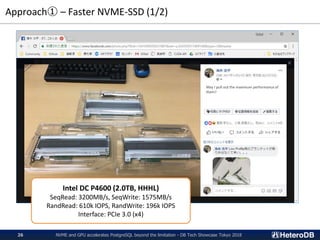
Intel DC P4600 (2.0TB, HHHL)
SeqRead: 3200MB/s, SeqWrite: 1575MB/s
RandRead: 610k IOPS, RandWrite: 196k IOPS
Interface: PCIe 3.0 (x4)
NVME and GPU accelerates PostgreSQL beyond the limitation - DB Tech Showcase Tokyo 201826
May I pull out the maximum performance of
them?
Approach① – Faster NVME-SSD (1/2)
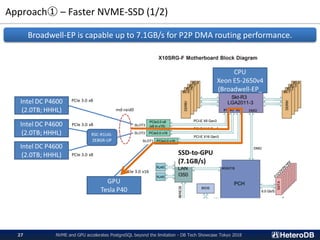
Broadwell-EP is capable up to 7.1GB/s for P2P DMA routing performance.
NVME and GPU accelerates PostgreSQL beyond the limitation - DB Tech Showcase Tokyo 201827
Approach② – The latest CPU generation
NVME and GPU accelerates PostgreSQL beyond the limitation - DB Tech Showcase Tokyo 201828
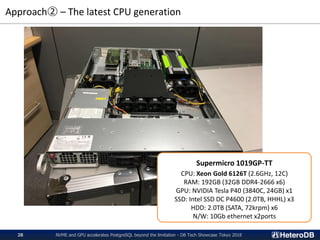
Supermicro 1019GP-TT
CPU: Xeon Gold 6126T (2.6GHz, 12C)
RAM: 192GB (32GB DDR4-2666 x6)
GPU: NVIDIA Tesla P40 (3840C, 24GB) x1
SSD: Intel SSD DC P4600 (2.0TB, HHHL) x3
HDD: 2.0TB (SATA, 72krpm) x6
N/W: 10Gb ethernet x2ports
Approach② – The latest CPU generation
NVME and GPU accelerates PostgreSQL beyond the limitation - DB Tech Showcase Tokyo 201829
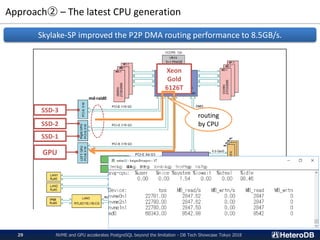
Skylake-SP improved the P2P DMA routing performance to 8.5GB/s.
GPU
SSD-1
SSD-2
SSD-3
md-raid0
Xeon
Gold
6126T
routing
by CPU
Consideration for the hardware configuration
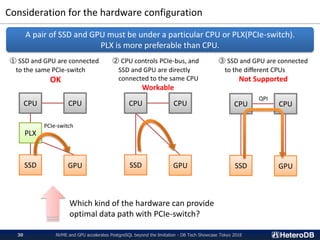
NVME and GPU accelerates PostgreSQL beyond the limitation - DB Tech Showcase Tokyo 201830
① SSD and GPU are connected
to the same PCIe-switch
OK
② CPU controls PCIe-bus, and
SSD and GPU are directly
connected to the same CPU
Workable
③ SSD and GPU are connected
to the different CPUs
Not Supported
CPU CPU
PLX
SSD GPU
PCIe-switch
CPU CPU
SSD GPU
CPU CPU
SSD GPU
QPI
A pair of SSD and GPU must be under a particular CPU or PLX(PCIe-switch).
PLX is more preferable than CPU.
Which kind of the hardware can provide
optimal data path with PCIe-switch?
Simple solution) HPC servers optimized for RDMA
NVME and GPU accelerates PostgreSQL beyond the limitation - DB Tech Showcase Tokyo 201831
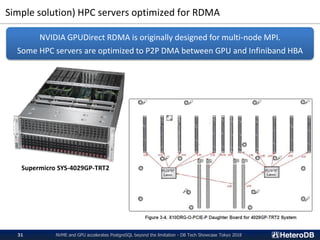
NVIDIA GPUDirect RDMA is originally designed for multi-node MPI.
Some HPC servers are optimized to P2P DMA between GPU and Infiniband HBA
Supermicro SYS-4029GP-TRT2
Practical solution) Utilization of I/O Expansion Box
NVME and GPU accelerates PostgreSQL beyond the limitation - DB Tech Showcase Tokyo 201832
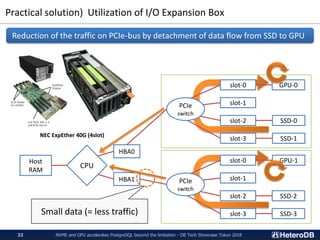
Reduction of the traffic on PCIe-bus by detachment of data flow from SSD to GPU
NEC ExpEther 40G (4slot)
slot-0
slot-1
slot-2
slot-3
PCIe
switch
slot-0
slot-1
slot-2
slot-3
PCIe
switch
GPU-0
GPU-1
SSD-0
SSD-1
SSD-2
SSD-3
Host
RAM
HBA0
HBA1
CPU
Small data (= less traffic)
NVME and GPU accelerates PostgreSQL beyond the limitation - DB Tech Showcase Tokyo 201833
Optimization of the Storage Path
with I/O Expansion Box
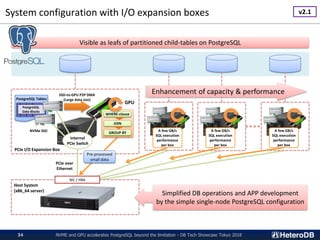
System configuration with I/O expansion boxes
NVME and GPU accelerates PostgreSQL beyond the limitation - DB Tech Showcase Tokyo 201834
PCIe I/O Expansion Box
Host System
(x86_64 server)
NVMe SSD
PostgreSQL Tables
PostgreSQL
Data Blocks
Internal
PCIe Switch
SSD-to-GPU P2P DMA
(Large data size)
GPU
WHERE-clause
JOIN
GROUP BY
PCIe over
Ethernet
Pre-processed
small data
A few GB/s
SQL execution
performance
per box
A few GB/s
SQL execution
performance
per box
A few GB/s
SQL execution
performance
per box
NIC / HBA
Simplified DB operations and APP development
by the simple single-node PostgreSQL configuration
Enhancement of capacity & performance
Visible as leafs of partitioned child-tables on PostgreSQL
v2.1
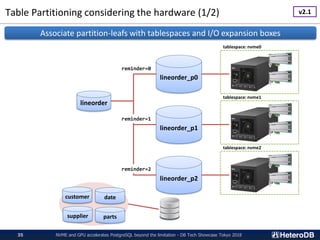
Table Partitioning considering the hardware (1/2)
NVME and GPU accelerates PostgreSQL beyond the limitation - DB Tech Showcase Tokyo 201835
lineorder
lineorder_p0
lineorder_p1
lineorder_p2
reminder=0
reminder=1
reminder=2
customer date
supplier parts
tablespace: nvme0
tablespace: nvme1
tablespace: nvme2
Associate partition-leafs with tablespaces and I/O expansion boxes
v2.1
Table Partitioning considering the hardware (2/2)
NVME and GPU accelerates PostgreSQL beyond the limitation - DB Tech Showcase Tokyo 201836
lineorder
lineorder_p0
lineorder_p1
lineorder_p2
reminder=0
reminder=1
reminder=2
customer date
supplier parts
tablespace: nvme0
tablespace: nvme1
tablespace: nvme2
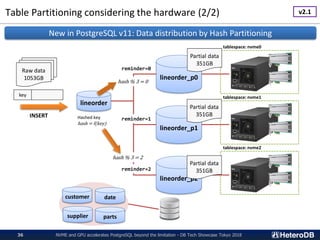
New in PostgreSQL v11: Data distribution by Hash Partitioning
key
INSERT Hashed key
hash = f(key)
hash % 3 = 2
hash % 3 = 0
Raw data
1053GB
Partial data
351GB
Partial data
351GB
Partial data
351GB
v2.1
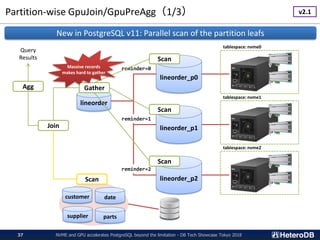
Partition-wise GpuJoin/GpuPreAgg(1/3)
NVME and GPU accelerates PostgreSQL beyond the limitation - DB Tech Showcase Tokyo 201837
lineorder
lineorder_p0
lineorder_p1
lineorder_p2
reminder=0
reminder=1
reminder=2
customer date
supplier parts
tablespace: nvme0
tablespace: nvme1
tablespace: nvme2
New in PostgreSQL v11: Parallel scan of the partition leafs
Scan
Scan
Scan
Gather
Join
Agg
Query
Results
Scan
Massive records
makes hard to gather
v2.1
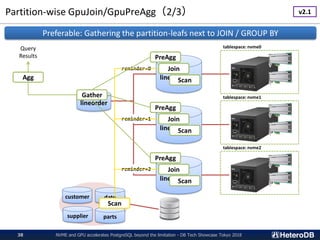
Partition-wise GpuJoin/GpuPreAgg(2/3)
NVME and GPU accelerates PostgreSQL beyond the limitation - DB Tech Showcase Tokyo 201838
lineorder
lineorder_p0
lineorder_p1
lineorder_p2
reminder=0
reminder=1
reminder=2
customer date
supplier parts
tablespace: nvme0
tablespace: nvme1
tablespace: nvme2
Preferable: Gathering the partition-leafs next to JOIN / GROUP BY
Join
Gather
Agg
Query
Results
Scan
Scan
PreAgg
Join
Scan
PreAgg
Join
Scan
PreAgg
v2.1
Partition-wise GpuJoin/GpuPreAgg(3/3)
NVME and GPU accelerates PostgreSQL beyond the limitation - DB Tech Showcase Tokyo 201839
ssbm =# EXPLAIN SELECT sum(lo_extendedprice*lo_discount) as revenue
FROM lineorder,date1
WHERE lo_orderdate = d_datekey
AND d_year = 1993
AND lo_discount between 1 and 3
AND lo_quantity < 25;
QUERY PLAN
------------------------------------------------------------------------------
Aggregate
-> Gather
Workers Planned: 9
-> Parallel Append
-> Parallel Custom Scan (GpuPreAgg)
Reduction: NoGroup
Combined GpuJoin: enabled
GPU Preference: GPU2 (Tesla P40)
-> Parallel Custom Scan (GpuJoin) on lineorder_p2
Outer Scan: lineorder_p2
Outer Scan Filter: ((lo_discount >= '1'::numeric) AND (lo_discount <= '3'::numeric)
AND (lo_quantity < '25'::numeric))
Depth 1: GpuHashJoin (nrows 102760469...45490403)
HashKeys: lineorder_p2.lo_orderdate
JoinQuals: (lineorder_p2.lo_orderdate = date1.d_datekey)
KDS-Hash (size: 66.03KB)
GPU Preference: GPU2 (Tesla P40)
NVMe-Strom: enabled
-> Seq Scan on date1
Filter: (d_year = 1993)
-> Parallel Custom Scan (GpuPreAgg)
Reduction: NoGroup
Combined GpuJoin: enabled
GPU Preference: GPU1 (Tesla P40)
:
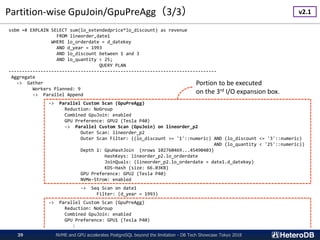
Portion to be executed
on the 3rd I/O expansion box.
v2.1
Distance between SSD and GPU (1/2)
NVME and GPU accelerates PostgreSQL beyond the limitation - DB Tech Showcase Tokyo 201840
lineorder
lineorder_p0
lineorder_p1
lineorder_p2
reminder=0
reminder=1
reminder=2
customer date
supplier parts
tablespace: nvme0
tablespace: nvme1
tablespace: nvme2
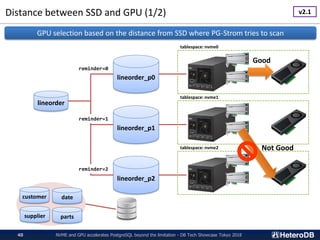
GPU selection based on the distance from SSD where PG-Strom tries to scan
Good
Not Good
v2.1
Distance between SSD and GPU (2/2)
NVME and GPU accelerates PostgreSQL beyond the limitation - DB Tech Showcase Tokyo 201841
$ pg_ctl restart
:
LOG: - PCIe[0000:80]
LOG: - PCIe(0000:80:02.0)
LOG: - PCIe(0000:83:00.0)
LOG: - PCIe(0000:84:00.0)
LOG: - PCIe(0000:85:00.0) nvme0 (INTEL SSDPEDKE020T7)
LOG: - PCIe(0000:84:01.0)
LOG: - PCIe(0000:86:00.0) GPU0 (Tesla P40)
LOG: - PCIe(0000:84:02.0)
LOG: - PCIe(0000:87:00.0) nvme1 (INTEL SSDPEDKE020T7)
LOG: - PCIe(0000:80:03.0)
LOG: - PCIe(0000:c0:00.0)
LOG: - PCIe(0000:c1:00.0)
LOG: - PCIe(0000:c2:00.0) nvme2 (INTEL SSDPEDKE020T7)
LOG: - PCIe(0000:c1:01.0)
LOG: - PCIe(0000:c3:00.0) GPU1 (Tesla P40)
LOG: - PCIe(0000:c1:02.0)
LOG: - PCIe(0000:c4:00.0) nvme3 (INTEL SSDPEDKE020T7)
LOG: - PCIe(0000:80:03.2)
LOG: - PCIe(0000:e0:00.0)
LOG: - PCIe(0000:e1:00.0)
LOG: - PCIe(0000:e2:00.0) nvme4 (INTEL SSDPEDKE020T7)
LOG: - PCIe(0000:e1:01.0)
LOG: - PCIe(0000:e3:00.0) GPU2 (Tesla P40)
LOG: - PCIe(0000:e1:02.0)
LOG: - PCIe(0000:e4:00.0) nvme5 (INTEL SSDPEDKE020T7)
LOG: GPU<->SSD Distance Matrix
LOG: GPU0 GPU1 GPU2
LOG: nvme0 ( 3) 7 7
LOG: nvme5 7 7 ( 3)
LOG: nvme4 7 7 ( 3)
LOG: nvme2 7 ( 3) 7
LOG: nvme1 ( 3) 7 7
LOG: nvme3 7 ( 3) 7
Auto selection of the optimal GPU according to
the distance between PCIe devices
v2.1
Benchmark (1/3) - System configuration
NVME and GPU accelerates PostgreSQL beyond the limitation - DB Tech Showcase Tokyo 201842
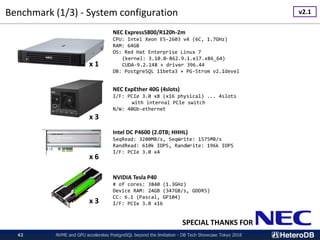
x 1
x 3
x 6
x 3
NEC Express5800/R120h-2m
CPU: Intel Xeon E5-2603 v4 (6C, 1.7GHz)
RAM: 64GB
OS: Red Hat Enterprise Linux 7
(kernel: 3.10.0-862.9.1.el7.x86_64)
CUDA-9.2.148 + driver 396.44
DB: PostgreSQL 11beta3 + PG-Strom v2.1devel
NEC ExpEther 40G (4slots)
I/F: PCIe 3.0 x8 (x16 physical) ... 4slots
with internal PCIe switch
N/W: 40Gb-ethernet
Intel DC P4600 (2.0TB; HHHL)
SeqRead: 3200MB/s, SeqWrite: 1575MB/s
RandRead: 610k IOPS, RandWrite: 196k IOPS
I/F: PCIe 3.0 x4
NVIDIA Tesla P40
# of cores: 3840 (1.3GHz)
Device RAM: 24GB (347GB/s, GDDR5)
CC: 6.1 (Pascal, GP104)
I/F: PCIe 3.0 x16
SPECIAL THANKS FOR
v2.1
Benchmark (2/3) - Result of query execution performance
NVME and GPU accelerates PostgreSQL beyond the limitation - DB Tech Showcase Tokyo 201843
 13 SSBM queries to 1055GB database in total (a.k.a 351GB per I/O expansion box)
 Raw I/O data transfer without SQL execution was up to 9GB/s.
In other words, SQL execution was faster than simple storage read with raw-I/O.
13,401 13,534 13,536 13,330
12,696
12,965
12,533
11,498
12,312 12,419 12,414 12,622 12,594
2,388 2,477 2,493 2,502 2,739 2,831
1,865
2,268 2,442 2,418
1,789 1,848
2,202
0
2,000
4,000
6,000
8,000
10,000
12,000
14,000
Q1_1 Q1_2 Q1_3 Q2_1 Q2_2 Q2_3 Q3_1 Q3_2 Q3_3 Q3_4 Q4_1 Q4_2 Q4_3
QueryExecutionThroughput[MB/s]
Star Schema Benchmark for PgSQL v11beta3 / PG-Strom v2.1devel on NEC ExpEther x3
PostgreSQL v11beta3 PG-Strom v2.1devel Raw I/O Limitation
max 13.5GB/s for query execution performance with 3x I/O expansion boxes!!
v2.1
Benchmark (3/3) - Density of I/O per expansion box
NVME and GPU accelerates PostgreSQL beyond the limitation - DB Tech Showcase Tokyo 201844
0
2000
4000
6000
8000
10000
12000
14000
16000
nvme0n1 nvme1n1 nvme2n1 nvme3n1 nvme4n1 nvme5n1
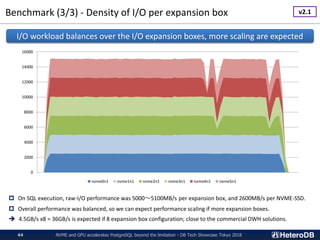
I/O workload balances over the I/O expansion boxes, more scaling are expected
 On SQL execution, raw-I/O performance was 5000〜5100MB/s per expansion box, and 2600MB/s per NVME-SSD.
 Overall performance was balanced, so we can expect performance scaling if more expansion boxes.
 4.5GB/s x8 = 36GB/s is expected if 8 expansion box configuration; close to the commercial DWH solutions.
v2.1
NVME and GPU accelerates PostgreSQL beyond the limitation - DB Tech Showcase Tokyo 201845
Conclusion
Expected usage – Log data processing and analysis
NVME and GPU accelerates PostgreSQL beyond the limitation - DB Tech Showcase Tokyo 201846
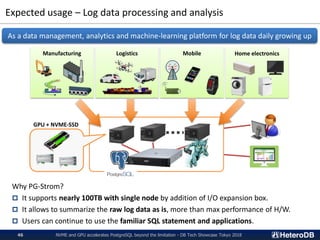
As a data management, analytics and machine-learning platform for log data daily growing up
Manufacturing Logistics Mobile Home electronics
GPU + NVME-SSD
Why PG-Strom?
 It supports nearly 100TB with single node by addition of I/O expansion box.
 It allows to summarize the raw log data as is, more than max performance of H/W.
 Users can continue to use the familiar SQL statement and applications.
Conclusion
NVME and GPU accelerates PostgreSQL beyond the limitation - DB Tech Showcase Tokyo 201847
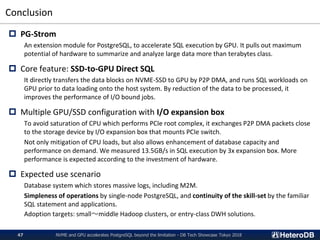
 PG-Strom
An extension module for PostgreSQL, to accelerate SQL execution by GPU. It pulls out maximum
potential of hardware to summarize and analyze large data more than terabytes class.
 Core feature: SSD-to-GPU Direct SQL
It directly transfers the data blocks on NVME-SSD to GPU by P2P DMA, and runs SQL workloads on
GPU prior to data loading onto the host system. By reduction of the data to be processed, it
improves the performance of I/O bound jobs.
 Multiple GPU/SSD configuration with I/O expansion box
To avoid saturation of CPU which performs PCIe root complex, it exchanges P2P DMA packets close
to the storage device by I/O expansion box that mounts PCIe switch.
Not only mitigation of CPU loads, but also allows enhancement of database capacity and
performance on demand. We measured 13.5GB/s in SQL execution by 3x expansion box. More
performance is expected according to the investment of hardware.
 Expected use scenario
Database system which stores massive logs, including M2M.
Simpleness of operations by single-node PostgreSQL, and continuity of the skill-set by the familiar
SQL statement and applications.
Adoption targets: small〜middle Hadoop clusters, or entry-class DWH solutions.
20180920_DBTS_PGStrom_EN

20180920_DBTS_PGStrom_EN

  • 1.
    NVMEandGPUaccelerates PostgreSQL beyondthelimitation 〜Ourchallenge to the 10GB/s for query execution performance〜 HeteroDB,Inc Chief Architect & CEO KaiGai Kohei <kaigai@heterodb.com>
  • 2.
    Here are mysteriousbenchmark results NVME and GPU accelerates PostgreSQL beyond the limitation - DB Tech Showcase Tokyo 20182 Benchmark conditions:  By the PostgreSQL v11beta3 + PG-Strom v2.1devel on a single-node server system  13 queries of Star-schema benchmark onto the 1055GB data set 0 2,000 4,000 6,000 8,000 10,000 12,000 14,000 Q1_1 Q1_2 Q1_3 Q2_1 Q2_2 Q2_3 Q3_1 Q3_2 Q3_3 Q3_4 Q4_1 Q4_2 Q4_3 QueryExecutionThroughput[MB/s] Star Schema Benchmark for PostgreSQL 11beta3 + PG-Strom v2.1devel PG-Strom v2.1devel max 13.5GB/s in query execution throughput on single-node PostgreSQL
  • 3.
    about HeteroDB,Inc NVME andGPU accelerates PostgreSQL beyond the limitation - DB Tech Showcase Tokyo 20183 Corporate overview  Name HeteroDB,Inc  Established 4th-Jul-2017  Headcount 2 (KaiGai and Kashiwagi)  Location Shinagawa, Tokyo, Japan  Businesses Sales of accelerated database product Technical consulting on GPU&DB region By the heterogeneous-computing technology on the database area, we provides a useful, fast and cost-effective data analytics platform for all the people who need the power of analytics. CEO Profile  KaiGai Kohei – He has contributed for PostgreSQL and Linux kernel development in the OSS community more than ten years, especially, for security and database federation features of PostgreSQL.  Award of “Genius Programmer” by IPA MITOH program (2007)  The top-5 posters finalist at GPU Technology Conference 2017.
  • 4.
    Features of RDBMS High-availability / Clustering  DB administration and backup  Transaction control  BI and visualization  We can use the products that support PostgreSQL as-is. Core technology – PG-Strom PG-Strom: An extension module for PostgreSQL, to accelerate SQL workloads by the thousands cores and wide-band memory of GPU. GPU Big-data Analytics PG-Strom NVME and GPU accelerates PostgreSQL beyond the limitation - DB Tech Showcase Tokyo 20184 Mass data loading from the storage device rapidly Machine-learning & Statistics
  • 5.
    Characteristics of GPU(1/3) Highly parallel computing processor with thousands cores and hundreds GB/s memory band on a single chip CPU Like a passenger vehicle; well utilizable but less transportation capacity. GPU Like a high-speed railway; a little bit troublesome to get in or out, but capable for mass-transportation. Model Intel Xeon Platinum 8180M NVIDIA Tesla V100 Architecture Skylake-SP Volta # of cores 28 (functional) 5120 (simple) Performance (FP32) 2.24 TFLOPS (with AVX2) 15.0TFLOPS Memory capacity max 1.5TB (DDR4) 16GB (HBM2) Memory band 127.8GB/s 900GB/s TDP 205W 300W NVME and GPU accelerates PostgreSQL beyond the limitation - DB Tech Showcase Tokyo 20185
  • 6.
    Characteristics of GPU(2/3) – Reduction algorithm ●item[0] step.1 step.2 step.4step.3 Calculation of the total sum of an array by GPU Σi=0...N-1item[i] ◆ ● ▲ ■ ★ ● ◆ ● ● ◆ ▲ ● ● ◆ ● ● ◆ ▲ ■ ● ● ◆ ● ● ◆ ▲ ● ● ◆ ● item[1] item[2] item[3] item[4] item[5] item[6] item[7] item[8] item[9] item[10] item[11] item[12] item[13] item[14] item[15] Total sum of items[] with log2N steps Inter-cores synchronization with hardware support SELECT count(X), sum(Y), avg(Z) FROM my_table; Same logic is internally used to implement aggregate function. DB Tech Showcase 2017 - GPU/SSD Accelerates PostgreSQL -6
  • 7.
    Characteristics of GPU(3/3) NVME and GPU accelerates PostgreSQL beyond the limitation - DB Tech Showcase Tokyo 20187 Over 10years history in HPC, then massive popularization in Machine-Learning NVIDIA Tesla V100 Super Computer (TITEC; TSUBAME3.0) Computer Graphics Machine-Learning Today’s Topic How I/O workloads are accelerated by GPU that is a computing accelerator? Simulation
  • 8.
    NVME and GPUaccelerates PostgreSQL beyond the limitation - DB Tech Showcase Tokyo 20188 How PostgreSQL utilizes GPU? 〜Architecture of PG-Strom〜
  • 9.
    Construction of queryexecution plan in PostgreSQL (1/2) Scan t0 Scan t1 Scan t2 Join t0,t1 Join (t0,t1),t2 GROUP BY cat ORDER BY score LIMIT 100 DB Tech Showcase 2017 - GPU/SSD Accelerates PostgreSQL -9
  • 10.
    Construction of queryexecution plan in PostgreSQL (2/2) Scan t0 Scan t1 Join t0,t1 Statistics) nrows: 1.2M width: 80 Index: none candidate HashJoin cost=4000 candidate MergeJoin cost=12000 candidate NestLoop cost=99999 candidate Parallel Hash Join cost=3000 candidate GpuJoin cost=2500 WINNER! Built-in execution path of PostgreSQLProposition by extensions (since PostgreSQL v9.5) (since PostgreSQL v9.6) GpuJoin t0,t1 Statistics) nrows: 4000 width: 120 Index: t1.id Competition of multiple algorithms, then chosen by the “cost”. DB Tech Showcase 2017 - GPU/SSD Accelerates PostgreSQL -10
  • 11.
    Interactions between PostgreSQLand PG-Strom with CustomScan As long as consistent results are made, implementation is flexible. CustomScan (GpuJoin) (*BeginCustomScan)(...) (*ExecCustomScan)(...) (*EndCustomScan)(...) : SeqScan on t0 SeqScan on t1 GroupAgg key: cat ExecInitGpuJoin(...)  Initialize GPU context  Kick asynchronous JIT compilation of the GPU program auto-generated ExecGpuJoin(...)  Read records from the t0 and t1, and copy to the DMA buffer  Kick asynchronous GPU tasks  Fetch results from the completed GPU tasks, then pass them to the next step (GroupAgg) ExecEndGpuJoin(...)  Wait for completion of the asynchronous tasks (if any)  Release of GPU resource DB Tech Showcase 2017 - GPU/SSD Accelerates PostgreSQL -11
  • 12.
    Auto generation ofGPU code from SQL - Example of WHERE-clause DB Tech Showcase 2017 - GPU/SSD Accelerates PostgreSQL -12 QUERY: SELECT cat, count(*), avg(x) FROM t0 WHERE x between y and y + 20.0 GROUP BY cat; : STATIC_FUNCTION(bool) gpupreagg_qual_eval(kern_context *kcxt, kern_data_store *kds, size_t kds_index) { pg_float8_t KPARAM_1 = pg_float8_param(kcxt,1); pg_float8_t KVAR_3 = pg_float8_vref(kds,kcxt,2,kds_index); pg_float8_t KVAR_4 = pg_float8_vref(kds,kcxt,3,kds_index); return EVAL((pgfn_float8ge(kcxt, KVAR_3, KVAR_4) && pgfn_float8le(kcxt, KVAR_3, pgfn_float8pl(kcxt, KVAR_4, KPARAM_1)))); } : E.g) Transformation of the numeric-formula in WHERE-clause to CUDA C code on demand Reference to input data SQL expression in CUDA source code Run-time compiler Parallel Execution
  • 13.
    EXPLAIN shows queryexecution plan NVME and GPU accelerates PostgreSQL beyond the limitation - DB Tech Showcase Tokyo 201813 postgres=# EXPLAIN ANALYZE SELECT cat,count(*),sum(ax) FROM tbl NATURAL JOIN t1 WHERE cid % 100 < 50 GROUP BY cat; QUERY PLAN --------------------------------------------------------------------------------------------------- GroupAggregate (cost=203498.81..203501.80 rows=26 width=20) (actual time=1511.622..1511.632 rows=26 loops=1) Group Key: tbl.cat -> Sort (cost=203498.81..203499.26 rows=182 width=20) (actual time=1511.612..1511.613 rows=26 loops=1) Sort Key: tbl.cat Sort Method: quicksort Memory: 27kB -> Custom Scan (GpuPreAgg) (cost=203489.25..203491.98 rows=182 width=20) (actual time=1511.554..1511.562 rows=26 loops=1) Reduction: Local Combined GpuJoin: enabled -> Custom Scan (GpuJoin) on tbl (cost=13455.86..220069.26 rows=1797115 width=12) (never executed) Outer Scan: tbl (cost=12729.55..264113.41 rows=6665208 width=8) (actual time=50.726..1101.414 rows=19995540 loops=1) Outer Scan Filter: ((cid % 100) < 50) Rows Removed by Outer Scan Filter: 10047462 Depth 1: GpuHashJoin (plan nrows: 6665208...1797115, actual nrows: 9948078...2473997) HashKeys: tbl.aid JoinQuals: (tbl.aid = t1.aid) KDS-Hash (size plan: 11.54MB, exec: 7125.12KB) -> Seq Scan on t1 (cost=0.00..2031.00 rows=100000 width=12) (actual time=0.016..15.407 rows=100000 loops=1) Planning Time: 0.721 ms Execution Time: 1595.815 ms (19 rows) What’s happen?
  • 14.
    GpuScan + GpuJoin+ GpuPreAgg Combined Kernel (1/3) Aggregation GROUP BY JOIN SCAN SELECT cat, count(*), avg(x) FROM t0 JOIN t1 ON t0.id = t1.id WHERE y like ‘%abc%’ GROUP BY cat; count(*), avg(x) GROUP BY cat t0 JOIN t1 ON t0.id = t1.id WHERE y like ‘%abc%’ results NVME and GPU accelerates PostgreSQL beyond the limitation - DB Tech Showcase Tokyo 201814 GpuScan GpuJoin Agg + GpuPreAgg SeqScan HashJoin Agg
  • 15.
    GpuScan + GpuJoin+ GpuPreAgg Combined Kernel (2/3) GpuScan kernel GpuJoin kernel GpuPreAgg kernel DMA Buffer GPU CPU Storage Simple replacement of the logics makes ping-pong of data-transfer between CPU and GPU DMA Buffer DMA Buffer NVME and GPU accelerates PostgreSQL beyond the limitation - DB Tech Showcase Tokyo 201815 DMA Buffer Agg (PostgreSQL) results
  • 16.
    GpuScan + GpuJoin+ GpuPreAgg Combined Kernel (3/3) GpuScan kernel GpuJoin kernel GpuPreAgg kernel DMA Buffer GPU CPU Storage Save the data-transfer by data exchange on the GPU device memory GPU Buffer GPU Buffer results NVME and GPU accelerates PostgreSQL beyond the limitation - DB Tech Showcase Tokyo 201816 DMA Buffer Agg (PostgreSQL) A combined GPU kernel for SCAN + JOIN + GROUP BY data size = Large data size = Small Usually, amount of data size to be written back from GPU is much smaller than the data size sent to GPU
  • 17.
    NVME and GPUaccelerates PostgreSQL beyond the limitation - DB Tech Showcase Tokyo 201817 Re-definition of the GPU’s role 〜How GPU accelerates I/O workloads〜
  • 18.
    A usual compositionof x86_64 server GPUSSD CPU RAM HDD N/W NVME and GPU accelerates PostgreSQL beyond the limitation - DB Tech Showcase Tokyo 201818
  • 19.
    Data flow toprocess a massive amount of data CPU RAM SSD GPU PCIe PostgreSQL Data Blocks Normal Data Flow All the records, including junks, must be loaded onto RAM once, because software cannot check necessity of the rows prior to the data loading. So, amount of the I/O traffic over PCIe bus tends to be large. NVME and GPU accelerates PostgreSQL beyond the limitation - DB Tech Showcase Tokyo 201819 Unless records are not loaded to CPU/RAM once, over the PCIe bus, software cannot check its necessity even if it is “junk”.
  • 20.
    Core Feature: SSD-to-GPUDirect SQL CPU RAM SSD GPU PCIe PostgreSQL Data Blocks NVIDIA GPUDirect RDMA It allows to load the data blocks on NVME-SSD to GPU using peer-to-peer DMA over PCIe-bus; bypassing CPU/RAM. WHERE-clause JOIN GROUP BY Run SQL by GPU to reduce the data size Data Size: Small NVME and GPU accelerates PostgreSQL beyond the limitation - DB Tech Showcase Tokyo 201820 v2.0
  • 21.
    Benchmark Results –single-node version NVME and GPU accelerates PostgreSQL beyond the limitation - DB Tech Showcase Tokyo 201821 2172.3 2159.6 2158.9 2086.0 2127.2 2104.3 1920.3 2023.4 2101.1 2126.9 1900.0 1960.3 2072.1 6149.4 6279.3 6282.5 5985.6 6055.3 6152.5 5479.3 6051.2 6061.5 6074.2 5813.7 5871.8 5800.1 0 1000 2000 3000 4000 5000 6000 7000 Q1_1 Q1_2 Q1_3 Q2_1 Q2_2 Q2_3 Q3_1 Q3_2 Q3_3 Q3_4 Q4_1 Q4_2 Q4_3 QueryProcessingThroughput[MB/sec] Star Schema Benchmark on NVMe-SSD + md-raid0 PgSQL9.6(SSDx3) PGStrom2.0(SSDx3) H/W Spec (3xSSD) SSD-to-GPU Direct SQL pulls out an awesome performance close to the H/W spec  Measurement by the Star Schema Benchmark; which is a set of typical batch / reporting workloads.  CPU: Intel Xeon E5-2650v4, RAM: 128GB, GPU: NVIDIA Tesla P40, SSD: Intel 750 (400GB; SeqRead 2.2GB/s)x3  Size of dataset is 353GB (sf: 401), to ensure I/O bounds workload
  • 22.
    Element technology -GPUDirect RDMA (1/2) ▌P2P data transfer technology between GPU and other PCIe devices, bypass CPU  Originally designed for multi-nodes MPI over Infiniband  Infrastructure of Linux kernel driver for other PCIe devices, including NVME-SSDs. Copyright (c) NVIDIA corporation, 2015 DB Tech Showcase 2017 - GPU/SSD Accelerates PostgreSQL -22
  • 23.
    Element technology -GPUDirect RDMA (2/2) Physical address space PCIe BAR1 Area GPU device memory RAM NVMe-SSD Infiniband HBA PCIe device GPUDirect RDMA It enables to map GPU device memory on physical address space of the host system Once “physical address of GPU device memory” appears, we can use is as source or destination address of DMA with PCIe devices. DB Tech Showcase 2017 - GPU/SSD Accelerates PostgreSQL -23 0xf0000000 0xe0000000 DMA Request SRC: 1200th sector LEN: 40 sectors DST: 0xe0200000
  • 24.
    SSD-to-GPU Direct SQL- Software Stack NVME and GPU accelerates PostgreSQL beyond the limitation - DB Tech Showcase Tokyo 201824 Tesla GPU NVIDIA CUDA Toolkit Filesystem (ext4, xfs) nvme driver (inbox) nvme_strom kernel module NVMe SSD drives commodity x86_64 hardware NVIDIA GPUDirect RDMA NVIDIA kernel driver PostgreSQL pg_strom extension read(2) ioctl(2) Hardware Layer Operating System Software Layer Database Software Layer Application Software SQL Interface I/O path based on normal filesystem I/O path based on SSD-to-GPU Direct SQL Execution ■ User’s Applications ■ Software developed by others ■ Software developed by HDB ■ Hardware v2.0
  • 25.
    Run faster, beyondthe limitation
  • 26.
    Approach① – FasterNVME-SSD (1/2) Intel DC P4600 (2.0TB, HHHL) SeqRead: 3200MB/s, SeqWrite: 1575MB/s RandRead: 610k IOPS, RandWrite: 196k IOPS Interface: PCIe 3.0 (x4) NVME and GPU accelerates PostgreSQL beyond the limitation - DB Tech Showcase Tokyo 201826 May I pull out the maximum performance of them?
  • 27.
    Approach① – FasterNVME-SSD (1/2) Broadwell-EP is capable up to 7.1GB/s for P2P DMA routing performance. NVME and GPU accelerates PostgreSQL beyond the limitation - DB Tech Showcase Tokyo 201827
  • 28.
    Approach② – Thelatest CPU generation NVME and GPU accelerates PostgreSQL beyond the limitation - DB Tech Showcase Tokyo 201828 Supermicro 1019GP-TT CPU: Xeon Gold 6126T (2.6GHz, 12C) RAM: 192GB (32GB DDR4-2666 x6) GPU: NVIDIA Tesla P40 (3840C, 24GB) x1 SSD: Intel SSD DC P4600 (2.0TB, HHHL) x3 HDD: 2.0TB (SATA, 72krpm) x6 N/W: 10Gb ethernet x2ports
  • 29.
    Approach② – Thelatest CPU generation NVME and GPU accelerates PostgreSQL beyond the limitation - DB Tech Showcase Tokyo 201829 Skylake-SP improved the P2P DMA routing performance to 8.5GB/s. GPU SSD-1 SSD-2 SSD-3 md-raid0 Xeon Gold 6126T routing by CPU
  • 30.
    Consideration for thehardware configuration NVME and GPU accelerates PostgreSQL beyond the limitation - DB Tech Showcase Tokyo 201830 ① SSD and GPU are connected to the same PCIe-switch OK ② CPU controls PCIe-bus, and SSD and GPU are directly connected to the same CPU Workable ③ SSD and GPU are connected to the different CPUs Not Supported CPU CPU PLX SSD GPU PCIe-switch CPU CPU SSD GPU CPU CPU SSD GPU QPI A pair of SSD and GPU must be under a particular CPU or PLX(PCIe-switch). PLX is more preferable than CPU. Which kind of the hardware can provide optimal data path with PCIe-switch?
  • 31.
    Simple solution) HPCservers optimized for RDMA NVME and GPU accelerates PostgreSQL beyond the limitation - DB Tech Showcase Tokyo 201831 NVIDIA GPUDirect RDMA is originally designed for multi-node MPI. Some HPC servers are optimized to P2P DMA between GPU and Infiniband HBA Supermicro SYS-4029GP-TRT2
  • 32.
    Practical solution) Utilizationof I/O Expansion Box NVME and GPU accelerates PostgreSQL beyond the limitation - DB Tech Showcase Tokyo 201832 Reduction of the traffic on PCIe-bus by detachment of data flow from SSD to GPU NEC ExpEther 40G (4slot) slot-0 slot-1 slot-2 slot-3 PCIe switch slot-0 slot-1 slot-2 slot-3 PCIe switch GPU-0 GPU-1 SSD-0 SSD-1 SSD-2 SSD-3 Host RAM HBA0 HBA1 CPU Small data (= less traffic)
  • 33.
    NVME and GPUaccelerates PostgreSQL beyond the limitation - DB Tech Showcase Tokyo 201833 Optimization of the Storage Path with I/O Expansion Box
  • 34.
    System configuration withI/O expansion boxes NVME and GPU accelerates PostgreSQL beyond the limitation - DB Tech Showcase Tokyo 201834 PCIe I/O Expansion Box Host System (x86_64 server) NVMe SSD PostgreSQL Tables PostgreSQL Data Blocks Internal PCIe Switch SSD-to-GPU P2P DMA (Large data size) GPU WHERE-clause JOIN GROUP BY PCIe over Ethernet Pre-processed small data A few GB/s SQL execution performance per box A few GB/s SQL execution performance per box A few GB/s SQL execution performance per box NIC / HBA Simplified DB operations and APP development by the simple single-node PostgreSQL configuration Enhancement of capacity & performance Visible as leafs of partitioned child-tables on PostgreSQL v2.1
  • 35.
    Table Partitioning consideringthe hardware (1/2) NVME and GPU accelerates PostgreSQL beyond the limitation - DB Tech Showcase Tokyo 201835 lineorder lineorder_p0 lineorder_p1 lineorder_p2 reminder=0 reminder=1 reminder=2 customer date supplier parts tablespace: nvme0 tablespace: nvme1 tablespace: nvme2 Associate partition-leafs with tablespaces and I/O expansion boxes v2.1
  • 36.
    Table Partitioning consideringthe hardware (2/2) NVME and GPU accelerates PostgreSQL beyond the limitation - DB Tech Showcase Tokyo 201836 lineorder lineorder_p0 lineorder_p1 lineorder_p2 reminder=0 reminder=1 reminder=2 customer date supplier parts tablespace: nvme0 tablespace: nvme1 tablespace: nvme2 New in PostgreSQL v11: Data distribution by Hash Partitioning key INSERT Hashed key hash = f(key) hash % 3 = 2 hash % 3 = 0 Raw data 1053GB Partial data 351GB Partial data 351GB Partial data 351GB v2.1
  • 37.
    Partition-wise GpuJoin/GpuPreAgg(1/3) NVME andGPU accelerates PostgreSQL beyond the limitation - DB Tech Showcase Tokyo 201837 lineorder lineorder_p0 lineorder_p1 lineorder_p2 reminder=0 reminder=1 reminder=2 customer date supplier parts tablespace: nvme0 tablespace: nvme1 tablespace: nvme2 New in PostgreSQL v11: Parallel scan of the partition leafs Scan Scan Scan Gather Join Agg Query Results Scan Massive records makes hard to gather v2.1
  • 38.
    Partition-wise GpuJoin/GpuPreAgg(2/3) NVME andGPU accelerates PostgreSQL beyond the limitation - DB Tech Showcase Tokyo 201838 lineorder lineorder_p0 lineorder_p1 lineorder_p2 reminder=0 reminder=1 reminder=2 customer date supplier parts tablespace: nvme0 tablespace: nvme1 tablespace: nvme2 Preferable: Gathering the partition-leafs next to JOIN / GROUP BY Join Gather Agg Query Results Scan Scan PreAgg Join Scan PreAgg Join Scan PreAgg v2.1
  • 39.
    Partition-wise GpuJoin/GpuPreAgg(3/3) NVME andGPU accelerates PostgreSQL beyond the limitation - DB Tech Showcase Tokyo 201839 ssbm =# EXPLAIN SELECT sum(lo_extendedprice*lo_discount) as revenue FROM lineorder,date1 WHERE lo_orderdate = d_datekey AND d_year = 1993 AND lo_discount between 1 and 3 AND lo_quantity < 25; QUERY PLAN ------------------------------------------------------------------------------ Aggregate -> Gather Workers Planned: 9 -> Parallel Append -> Parallel Custom Scan (GpuPreAgg) Reduction: NoGroup Combined GpuJoin: enabled GPU Preference: GPU2 (Tesla P40) -> Parallel Custom Scan (GpuJoin) on lineorder_p2 Outer Scan: lineorder_p2 Outer Scan Filter: ((lo_discount >= '1'::numeric) AND (lo_discount <= '3'::numeric) AND (lo_quantity < '25'::numeric)) Depth 1: GpuHashJoin (nrows 102760469...45490403) HashKeys: lineorder_p2.lo_orderdate JoinQuals: (lineorder_p2.lo_orderdate = date1.d_datekey) KDS-Hash (size: 66.03KB) GPU Preference: GPU2 (Tesla P40) NVMe-Strom: enabled -> Seq Scan on date1 Filter: (d_year = 1993) -> Parallel Custom Scan (GpuPreAgg) Reduction: NoGroup Combined GpuJoin: enabled GPU Preference: GPU1 (Tesla P40) : Portion to be executed on the 3rd I/O expansion box. v2.1
  • 40.
    Distance between SSDand GPU (1/2) NVME and GPU accelerates PostgreSQL beyond the limitation - DB Tech Showcase Tokyo 201840 lineorder lineorder_p0 lineorder_p1 lineorder_p2 reminder=0 reminder=1 reminder=2 customer date supplier parts tablespace: nvme0 tablespace: nvme1 tablespace: nvme2 GPU selection based on the distance from SSD where PG-Strom tries to scan Good Not Good v2.1
  • 41.
    Distance between SSDand GPU (2/2) NVME and GPU accelerates PostgreSQL beyond the limitation - DB Tech Showcase Tokyo 201841 $ pg_ctl restart : LOG: - PCIe[0000:80] LOG: - PCIe(0000:80:02.0) LOG: - PCIe(0000:83:00.0) LOG: - PCIe(0000:84:00.0) LOG: - PCIe(0000:85:00.0) nvme0 (INTEL SSDPEDKE020T7) LOG: - PCIe(0000:84:01.0) LOG: - PCIe(0000:86:00.0) GPU0 (Tesla P40) LOG: - PCIe(0000:84:02.0) LOG: - PCIe(0000:87:00.0) nvme1 (INTEL SSDPEDKE020T7) LOG: - PCIe(0000:80:03.0) LOG: - PCIe(0000:c0:00.0) LOG: - PCIe(0000:c1:00.0) LOG: - PCIe(0000:c2:00.0) nvme2 (INTEL SSDPEDKE020T7) LOG: - PCIe(0000:c1:01.0) LOG: - PCIe(0000:c3:00.0) GPU1 (Tesla P40) LOG: - PCIe(0000:c1:02.0) LOG: - PCIe(0000:c4:00.0) nvme3 (INTEL SSDPEDKE020T7) LOG: - PCIe(0000:80:03.2) LOG: - PCIe(0000:e0:00.0) LOG: - PCIe(0000:e1:00.0) LOG: - PCIe(0000:e2:00.0) nvme4 (INTEL SSDPEDKE020T7) LOG: - PCIe(0000:e1:01.0) LOG: - PCIe(0000:e3:00.0) GPU2 (Tesla P40) LOG: - PCIe(0000:e1:02.0) LOG: - PCIe(0000:e4:00.0) nvme5 (INTEL SSDPEDKE020T7) LOG: GPU<->SSD Distance Matrix LOG: GPU0 GPU1 GPU2 LOG: nvme0 ( 3) 7 7 LOG: nvme5 7 7 ( 3) LOG: nvme4 7 7 ( 3) LOG: nvme2 7 ( 3) 7 LOG: nvme1 ( 3) 7 7 LOG: nvme3 7 ( 3) 7 Auto selection of the optimal GPU according to the distance between PCIe devices v2.1
  • 42.
    Benchmark (1/3) -System configuration NVME and GPU accelerates PostgreSQL beyond the limitation - DB Tech Showcase Tokyo 201842 x 1 x 3 x 6 x 3 NEC Express5800/R120h-2m CPU: Intel Xeon E5-2603 v4 (6C, 1.7GHz) RAM: 64GB OS: Red Hat Enterprise Linux 7 (kernel: 3.10.0-862.9.1.el7.x86_64) CUDA-9.2.148 + driver 396.44 DB: PostgreSQL 11beta3 + PG-Strom v2.1devel NEC ExpEther 40G (4slots) I/F: PCIe 3.0 x8 (x16 physical) ... 4slots with internal PCIe switch N/W: 40Gb-ethernet Intel DC P4600 (2.0TB; HHHL) SeqRead: 3200MB/s, SeqWrite: 1575MB/s RandRead: 610k IOPS, RandWrite: 196k IOPS I/F: PCIe 3.0 x4 NVIDIA Tesla P40 # of cores: 3840 (1.3GHz) Device RAM: 24GB (347GB/s, GDDR5) CC: 6.1 (Pascal, GP104) I/F: PCIe 3.0 x16 SPECIAL THANKS FOR v2.1
  • 43.
    Benchmark (2/3) -Result of query execution performance NVME and GPU accelerates PostgreSQL beyond the limitation - DB Tech Showcase Tokyo 201843  13 SSBM queries to 1055GB database in total (a.k.a 351GB per I/O expansion box)  Raw I/O data transfer without SQL execution was up to 9GB/s. In other words, SQL execution was faster than simple storage read with raw-I/O. 13,401 13,534 13,536 13,330 12,696 12,965 12,533 11,498 12,312 12,419 12,414 12,622 12,594 2,388 2,477 2,493 2,502 2,739 2,831 1,865 2,268 2,442 2,418 1,789 1,848 2,202 0 2,000 4,000 6,000 8,000 10,000 12,000 14,000 Q1_1 Q1_2 Q1_3 Q2_1 Q2_2 Q2_3 Q3_1 Q3_2 Q3_3 Q3_4 Q4_1 Q4_2 Q4_3 QueryExecutionThroughput[MB/s] Star Schema Benchmark for PgSQL v11beta3 / PG-Strom v2.1devel on NEC ExpEther x3 PostgreSQL v11beta3 PG-Strom v2.1devel Raw I/O Limitation max 13.5GB/s for query execution performance with 3x I/O expansion boxes!! v2.1
  • 44.
    Benchmark (3/3) -Density of I/O per expansion box NVME and GPU accelerates PostgreSQL beyond the limitation - DB Tech Showcase Tokyo 201844 0 2000 4000 6000 8000 10000 12000 14000 16000 nvme0n1 nvme1n1 nvme2n1 nvme3n1 nvme4n1 nvme5n1 I/O workload balances over the I/O expansion boxes, more scaling are expected  On SQL execution, raw-I/O performance was 5000〜5100MB/s per expansion box, and 2600MB/s per NVME-SSD.  Overall performance was balanced, so we can expect performance scaling if more expansion boxes.  4.5GB/s x8 = 36GB/s is expected if 8 expansion box configuration; close to the commercial DWH solutions. v2.1
  • 45.
    NVME and GPUaccelerates PostgreSQL beyond the limitation - DB Tech Showcase Tokyo 201845 Conclusion
  • 46.
    Expected usage –Log data processing and analysis NVME and GPU accelerates PostgreSQL beyond the limitation - DB Tech Showcase Tokyo 201846 As a data management, analytics and machine-learning platform for log data daily growing up Manufacturing Logistics Mobile Home electronics GPU + NVME-SSD Why PG-Strom?  It supports nearly 100TB with single node by addition of I/O expansion box.  It allows to summarize the raw log data as is, more than max performance of H/W.  Users can continue to use the familiar SQL statement and applications.
  • 47.
    Conclusion NVME and GPUaccelerates PostgreSQL beyond the limitation - DB Tech Showcase Tokyo 201847  PG-Strom An extension module for PostgreSQL, to accelerate SQL execution by GPU. It pulls out maximum potential of hardware to summarize and analyze large data more than terabytes class.  Core feature: SSD-to-GPU Direct SQL It directly transfers the data blocks on NVME-SSD to GPU by P2P DMA, and runs SQL workloads on GPU prior to data loading onto the host system. By reduction of the data to be processed, it improves the performance of I/O bound jobs.  Multiple GPU/SSD configuration with I/O expansion box To avoid saturation of CPU which performs PCIe root complex, it exchanges P2P DMA packets close to the storage device by I/O expansion box that mounts PCIe switch. Not only mitigation of CPU loads, but also allows enhancement of database capacity and performance on demand. We measured 13.5GB/s in SQL execution by 3x expansion box. More performance is expected according to the investment of hardware.  Expected use scenario Database system which stores massive logs, including M2M. Simpleness of operations by single-node PostgreSQL, and continuity of the skill-set by the familiar SQL statement and applications. Adoption targets: small〜middle Hadoop clusters, or entry-class DWH solutions.