
John Zedlewski, Director, RAPIDS @ NVIDIA
Corey Nolet, Principal Engineer, RAPIDS @ NVIDIA
GPU-Accelerated Data Science
From ETL to ML and beyond
2
Outline
● What is RAPIDS?
(+Getting started with app.blazingsql.com)
● RAPIDS ETL / cuDF basics
(+Demos!)
● RAPIDS and XGBoost for machine learning
(+Demos!)
● Additional RAPIDS libraries and integrations
● Hands-on exercise
3
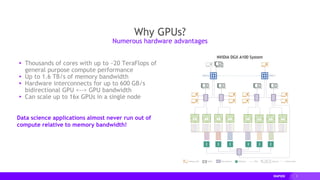
▸ Thousands of cores with up to ~20 TeraFlops of
general purpose compute performance
▸ Up to 1.6 TB/s of memory bandwidth
▸ Hardware interconnects for up to 600 GB/s
bidirectional GPU <--> GPU bandwidth
▸ Can scale up to 16x GPUs in a single node
Data science applications almost never run out of
compute relative to memory bandwidth!
Why GPUs?
Numerous hardware advantages
4
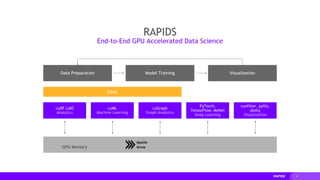
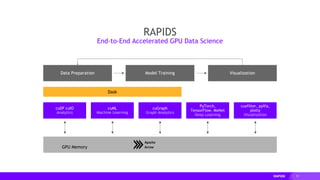
cuDF cuIO
Analytics
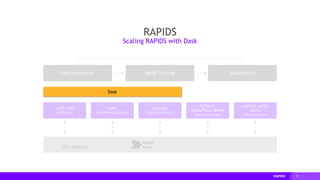
Data Preparation VisualizationModel Training
cuML
Machine Learning
cuGraph
Graph Analytics
PyTorch,
TensorFlow, MxNet
Deep Learning
cuxfilter, pyViz,
plotly
Visualization
Dask
GPU Memory
RAPIDS
End-to-End GPU Accelerated Data Science
5
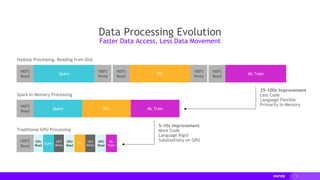
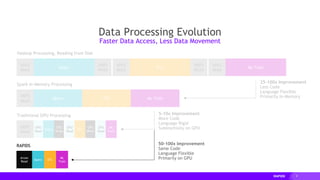
25-100x Improvement
Less Code
Language Flexible
Primarily In-Memory
HDFS
Read
HDFS
Write
HDFS
Read
HDFS
Write
HDFS
Read
Query ETL ML Train
HDFS
Read
Query ETL ML Train
HDFS
Read
GPU
Read
Query
CPU
Write
GPU
Read
ETL
CPU
Write
GPU
Read
ML
Train
5-10x Improvement
More Code
Language Rigid
Substantially on GPU
Traditional GPU Processing
Hadoop Processing, Reading from Disk
Spark In-Memory Processing
Data Processing Evolution
Faster Data Access, Less Data Movement
6
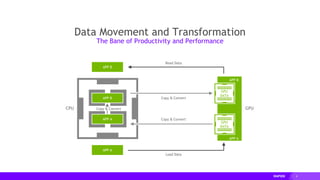
Data Movement and Transformation
The Bane of Productivity and Performance
CPU
Copy & Convert
Copy & Convert
Copy & Convert
APP A
APP B
Read Data
Load Data
APP B
APP A
GPU
GPU
DATA
GPU
DATA
APP A
APP B
7
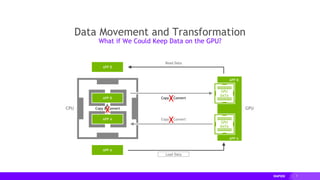
Data Movement and Transformation
What if We Could Keep Data on the GPU?
CPU
Copy & Convert
Copy & Convert
Copy & Convert
APP A
APP B
Read Data
Load Data
APP B
APP A
GPU
GPU
DATA
GPU
DATA
APP A
APP B
X
X
X
8
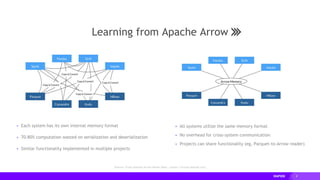
▸ Each system has its own internal memory format
▸ 70-80% computation wasted on serialization and deserialization
▸ Similar functionality implemented in multiple projects
▸ All systems utilize the same memory format
▸ No overhead for cross-system communication
▸ Projects can share functionality (eg, Parquet-to-Arrow reader)
Source: From Apache Arrow Home Page - https://arrow.apache.org/
Learning from Apache Arrow
9
25-100x Improvement
Less Code
Language Flexible
Primarily In-Memory
HDFS
Read
HDFS
Write
HDFS
Read
HDFS
Write
HDFS
Read
Query ETL ML Train
HDFS
Read
Query ETL ML Train
HDFS
Read
GPU
Read
Query
CPU
Write
GPU
Read
ETL
CPU
Write
GPU
Read
ML
Train
5-10x Improvement
More Code
Language Rigid
Substantially on GPU
Traditional GPU Processing
Hadoop Processing, Reading from Disk
Spark In-Memory Processing
Data Processing Evolution
Faster Data Access, Less Data Movement
RAPIDS
Arrow
Read
ETL
ML
Train
Query
50-100x Improvement
Same Code
Language Flexible
Primarily on GPU
10
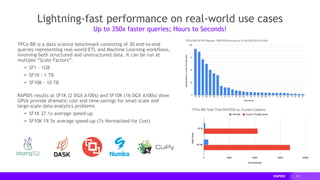
Lightning-fast performance on real-world use cases
Up to 350x faster queries; Hours to Seconds!
TPCx-BB is a data science benchmark consisting of 30 end-to-end
queries representing real-world ETL and Machine Learning workflows,
involving both structured and unstructured data. It can be run at
multiple “Scale Factors”.
▸ SF1 - 1GB
▸ SF1K - 1 TB
▸ SF10K - 10 TB
RAPIDS results at SF1K (2 DGX A100s) and SF10K (16 DGX A100s) show
GPUs provide dramatic cost and time-savings for small scale and
large-scale data analytics problems
▸ SF1K 37.1x average speed-up
▸ SF10K 19.5x average speed-up (7x Normalized for Cost)
11
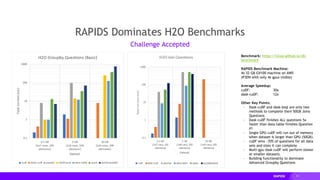
RAPIDS Dominates H2O Benchmarks
Challenge Accepted
Benchmark: https://h2oai.github.io/db-
benchmark
RAPIDS Benchmark Machine:
4x 32 GB GV100 machine on AWS
(P3DN with only 4x gpus visible)
Average Speedup:
cuDF: 30x
dask-cuDF: 12x
Other Key Points:
- Dask-cuDF and dask-bsql are only two
methods to complete their 50GB Joins
Questions
- Dask-cuDF finishes ALL questions 5x
faster than data.table finishes Question
#1
- Single GPU cuDF will run out of memory
when dataset is larger than GPU (50GB).
- cuDF wins ~70% of questions for all data
sets and sizes it can complete
- Multi-gpu dask-cuDF will perform slower
at smaller datasets.
- Building functionality to dominate
Advanced Groupby Questions
13
RAPIDS Core
14
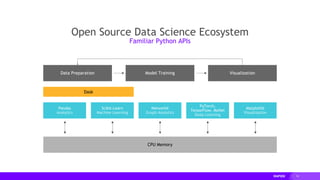
Pandas
Analytics
CPU Memory
Data Preparation VisualizationModel Training
Scikit-Learn
Machine Learning
NetworkX
Graph Analytics
PyTorch,
TensorFlow, MxNet
Deep Learning
Matplotlib
Visualization
Dask
Open Source Data Science Ecosystem
Familiar Python APIs
15
cuDF cuIO
Analytics
GPU Memory
Data Preparation VisualizationModel Training
cuML
Machine Learning
cuGraph
Graph Analytics
PyTorch,
TensorFlow, MxNet
Deep Learning
cuxfilter, pyViz,
plotly
Visualization
Dask
RAPIDS
End-to-End Accelerated GPU Data Science
16
▸ BlazingSQL is an open source, GPU-accelerated SQL engine built
on top of RAPIDS core libraries
▸ The BlazingSQL company has created app.blazingsql.com with
free, GPU-backed instances running Jupyter
▸ Log in for free with any Google credentials at
https://app.blazingsql.com
▸ Start by downloading our session notebook with:
!git clone https://github.com/JohnZed/odsc-
west-2020.git
Getting started: app.blazingsql.com
Free access to GPUs and Jupyter
17
cuDF
ETL and Dataframes
18
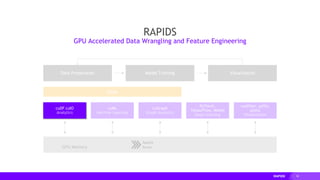
Dask
GPU Memory
Data Preparation VisualizationModel Training
cuML
Machine Learning
cuGraph
Graph Analytics
PyTorch,
TensorFlow, MxNet
Deep Learning
cuxfilter, pyViz,
plotly
Visualization
RAPIDS
GPU Accelerated Data Wrangling and Feature Engineering
cuDF cuIO
Analytics
19
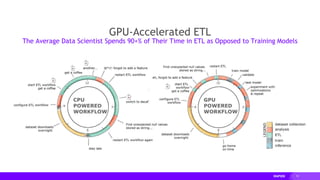
GPU-Accelerated ETL
The Average Data Scientist Spends 90+% of Their Time in ETL as Opposed to Training Models
20
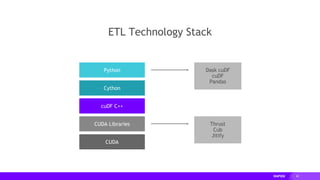
Dask cuDF
cuDF
Pandas
Thrust
Cub
Jitify
Python
Cython
cuDF C++
CUDA Libraries
CUDA
ETL Technology Stack
21
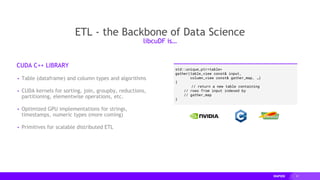
ETL - the Backbone of Data Science
CUDA C++ LIBRARY
▸ Table (dataframe) and column types and algorithms
▸ CUDA kernels for sorting, join, groupby, reductions,
partitioning, elementwise operations, etc.
▸ Optimized GPU implementations for strings,
timestamps, numeric types (more coming)
▸ Primitives for scalable distributed ETL
libcuDF is…
std::unique_ptr<table>
gather(table_view const& input,
column_view const& gather_map, …)
{
// return a new table containing
// rows from input indexed by
// gather_map
}
22
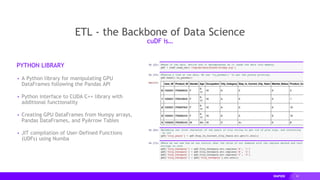
ETL - the Backbone of Data Science
PYTHON LIBRARY
▸ A Python library for manipulating GPU
DataFrames following the Pandas API
▸ Python interface to CUDA C++ library with
additional functionality
▸ Creating GPU DataFrames from Numpy arrays,
Pandas DataFrames, and PyArrow Tables
▸ JIT compilation of User-Defined Functions
(UDFs) using Numba
cuDF is…
23
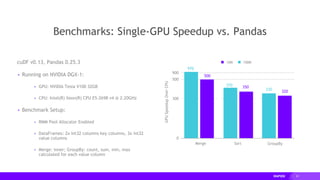
Benchmarks: Single-GPU Speedup vs. Pandas
cuDF v0.13, Pandas 0.25.3
▸ Running on NVIDIA DGX-1:
▸ GPU: NVIDIA Tesla V100 32GB
▸ CPU: Intel(R) Xeon(R) CPU E5-2698 v4 @ 2.20GHz
▸ Benchmark Setup:
▸ RMM Pool Allocator Enabled
▸ DataFrames: 2x int32 columns key columns, 3x int32
value columns
▸ Merge: inner; GroupBy: count, sum, min, max
calculated for each value column
300
900
500
0
Merge Sort GroupBy
GPUSpeedupOverCPU
10M 100M
970
500
370 350
330 320
24
Dask
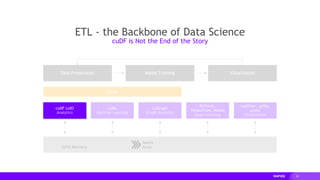
GPU Memory
Data Preparation VisualizationModel Training
cuML
Machine Learning
cuGraph
Graph Analytics
PyTorch,
TensorFlow, MxNet
Deep Learning
cuxfilter, pyViz,
plotly
Visualization
ETL - the Backbone of Data Science
cuDF is Not the End of the Story
cuDF cuIO
Analytics
25
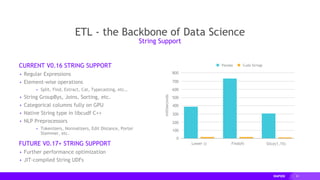
ETL - the Backbone of Data Science
CURRENT V0.16 STRING SUPPORT
▸ Regular Expressions
▸ Element-wise operations
▸ Split, Find, Extract, Cat, Typecasting, etc…
▸ String GroupBys, Joins, Sorting, etc.
▸ Categorical columns fully on GPU
▸ Native String type in libcudf C++
▸ NLP Preprocessors
▸ Tokenizers, Normalizers, Edit Distance, Porter
Stemmer, etc.
FUTURE V0.17+ STRING SUPPORT
▸ Further performance optimization
▸ JIT-compiled String UDFs
String Support
800
700
600
400
300
200
0
Lower () Find(#) Slice(1,15)
milliseconds
Pandas Cuda Strings
500
100
26
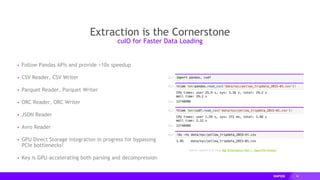
Extraction is the Cornerstone
▸ Follow Pandas APIs and provide >10x speedup
▸ CSV Reader, CSV Writer
▸ Parquet Reader, Parquet Writer
▸ ORC Reader, ORC Writer
▸ JSON Reader
▸ Avro Reader
▸ GPU Direct Storage integration in progress for bypassing
PCIe bottlenecks!
▸ Key is GPU-accelerating both parsing and decompression
cuIO for Faster Data Loading
Source: Apache Crail blog: SQL Performance: Part 1 - Input File Formats
27
ETL is Not Just DataFrames!
28
Dask
cuDF cuIO
Analytics
GPU Memory
Data Preparation VisualizationModel Training
cuML
Machine Learning
cuGraph
Graph Analytics
cuxfilter, pyViz,
plotly
Visualization
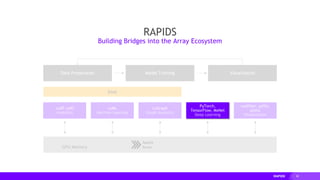
RAPIDS
Building Bridges into the Array Ecosystem
PyTorch,
TensorFlow, MxNet
Deep Learning
29
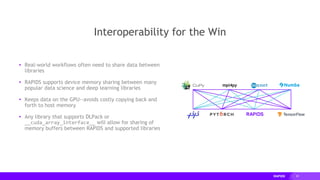
Interoperability for the Win
mpi4py
▸ Real-world workflows often need to share data between
libraries
▸ RAPIDS supports device memory sharing between many
popular data science and deep learning libraries
▸ Keeps data on the GPU--avoids costly copying back and
forth to host memory
▸ Any library that supports DLPack or
__cuda_array_interface__ will allow for sharing of
memory buffers between RAPIDS and supported libraries
30
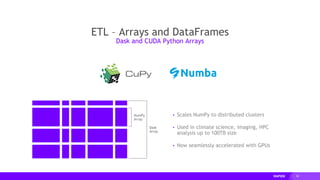
ETL – Arrays and DataFrames
Dask and CUDA Python Arrays
NumPy
Array
Dask
Array
▸ Scales NumPy to distributed clusters
▸ Used in climate science, imaging, HPC
analysis up to 100TB size
▸ Now seamlessly accelerated with GPUs
31
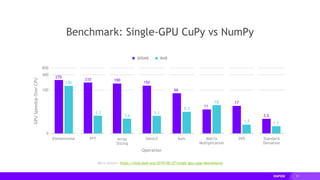
More details: https://blog.dask.org/2019/06/27/single-gpu-cupy-benchmarks
Benchmark: Single-GPU CuPy vs NumPy
800
400
0
Elementwise
GPUSpeedupOverCPU
Operation
800MB 8MB
150
270
5.3
210
3.6
190
5.1
150
8.3
66
18
11
1.5
17
1.1
3.5
FFT Array
Slicing
Stencil Sum Matrix
Multiplication
SVD Standard
Deviation
100
33
(Demo 1)
34
User-Defined Functions
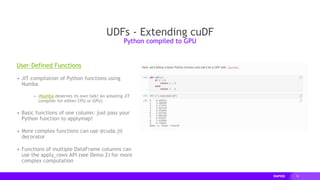
▸ JIT compilation of Python functions using
Numba
▸ (Numba deserves its own talk! An amazing JIT
compiler for either CPU or GPU)
▸ Basic functions of one column: just pass your
Python function to applymap!
▸ More complex functions can use @cuda.jit
decorator
▸ Functions of multiple DataFrame columns can
use the apply_rows API (see Demo 2) for more
complex computation
UDFs - Extending cuDF
Python compiled to GPU
35
cuML and XGBoost
36
PyTorch,
TensorFlow, MxNet
Deep Learning
Dask
cuDF cuIO
Analytics
GPU Memory
Data Preparation VisualizationModel Training
cuGraph
Graph Analytics
cuxfilter, pyViz,
plotly
Visualization
Machine Learning
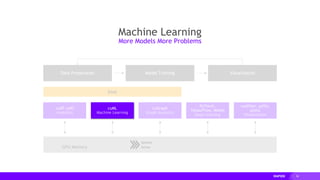
More Models More Problems
cuML
Machine Learning
37
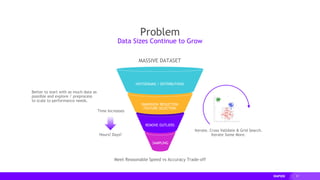
SAMPLING
HISTOGRAMS / DISTRIBUTIONS
DIMENSION REDUCTION
FEATURE SELECTION
REMOVE OUTLIERS
MASSIVE DATASET
Meet Reasonable Speed vs Accuracy Trade-off
Better to start with as much data as
possible and explore / preprocess
to scale to performance needs.
Iterate. Cross Validate & Grid Search.
Iterate Some More.Hours? Days?
Time Increases
Problem
Data Sizes Continue to Grow
38
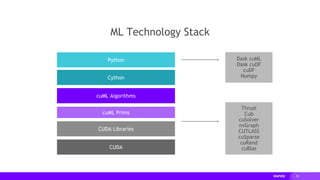
Dask cuML
Dask cuDF
cuDF
Numpy
Python
Thrust
Cub
cuSolver
nvGraph
CUTLASS
cuSparse
cuRand
cuBlas
Cython
cuML Algorithms
cuML Prims
CUDA Libraries
CUDA
ML Technology Stack
39
RAPIDS Matches Common Python APIs
CPU-based Clustering
from sklearn.datasets import make_moons
import pandas
X, y = make_moons(n_samples=int(1e2),
noise=0.05, random_state=0)
X = pandas.DataFrame({'fea%d'%i: X[:, i]
for i in range(X.shape[1])})
from sklearn.cluster import DBSCAN
dbscan = DBSCAN(eps = 0.3, min_samples = 5)
dbscan.fit(X)
y_hat = dbscan.predict(X)
40
from sklearn.datasets import make_moons
import cudf
X, y = make_moons(n_samples=int(1e2),
noise=0.05, random_state=0)
X = cudf.DataFrame({'fea%d'%i: X[:, i]
for i in range(X.shape[1])})
from cuml import DBSCAN
dbscan = DBSCAN(eps = 0.3, min_samples = 5)
dbscan.fit(X)
y_hat = dbscan.predict(X)
RAPIDS Matches Common Python APIs
GPU-accelerated Clustering
41
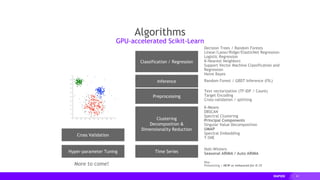
Decision Trees / Random Forests
Linear/Lasso/Ridge/ElasticNet Regression
Logistic Regression
K-Nearest Neighbors
Support Vector Machine Classification and
Regression
Naive Bayes
K-Means
DBSCAN
Spectral Clustering
Principal Components
Singular Value Decomposition
UMAP
Spectral Embedding
T-SNE
Holt-Winters
Seasonal ARIMA / Auto ARIMA
More to come!
Random Forest / GBDT Inference (FIL)
Time Series
Clustering
Decomposition &
Dimensionality Reduction
Preprocessing
Inference
Classification / Regression
Hyper-parameter Tuning
Cross Validation
Key:
Preexisting | NEW or enhanced for 0.15
Algorithms
GPU-accelerated Scikit-Learn
Text vectorization (TF-IDF / Count)
Target Encoding
Cross-validation / splitting
42
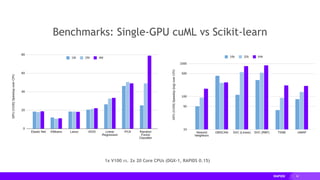
Benchmarks: Single-GPU cuML vs Scikit-learn
1x V100 vs. 2x 20 Core CPUs (DGX-1, RAPIDS 0.15)
43
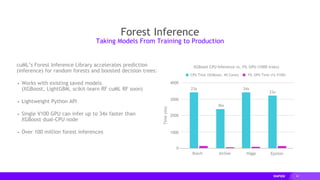
Forest Inference
cuML’s Forest Inference Library accelerates prediction
(inference) for random forests and boosted decision trees:
▸ Works with existing saved models
(XGBoost, LightGBM, scikit-learn RF cuML RF soon)
▸ Lightweight Python API
▸ Single V100 GPU can infer up to 34x faster than
XGBoost dual-CPU node
▸ Over 100 million forest inferences
Taking Models From Training to Production
4000
3000
2000
1000
0
Bosch Airline Epsilon
Time(ms)
CPU Time (XGBoost, 40 Cores) FIL GPU Time (1x V100)
Higgs
XGBoost CPU Inference vs. FIL GPU (1000 trees)
23x
36x
34x
23x
44
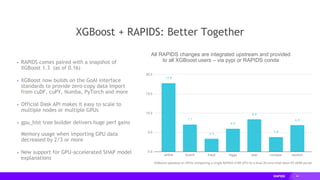
XGBoost + RAPIDS: Better Together
▸ RAPIDS comes paired with a snapshot of
XGBoost 1.3 (as of 0.16)
▸ XGBoost now builds on the GoAI interface
standards to provide zero-copy data import
from cuDF, cuPY, Numba, PyTorch and more
▸ Official Dask API makes it easy to scale to
multiple nodes or multiple GPUs
▸ gpu_hist tree builder delivers huge perf gains
Memory usage when importing GPU data
decreased by 2/3 or more
▸ New support for GPU-accelerated SHAP model
explanations
All RAPIDS changes are integrated upstream and provided
to all XGBoost users – via pypi or RAPIDS conda
45
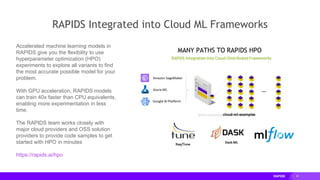
RAPIDS Integrated into Cloud ML Frameworks
Accelerated machine learning models in
RAPIDS give you the flexibility to use
hyperparameter optimization (HPO)
experiments to explore all variants to find
the most accurate possible model for your
problem.
With GPU acceleration, RAPIDS models
can train 40x faster than CPU equivalents,
enabling more experimentation in less
time.
The RAPIDS team works closely with
major cloud providers and OSS solution
providers to provide code samples to get
started with HPO in minutes
https://rapids.ai/hpo
46
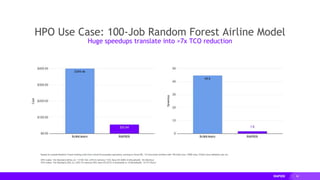
HPO Use Case: 100-Job Random Forest Airline Model
Huge speedups translate into >7x TCO reduction
Based on sample Random Forest training code from cloud-ml-examples repository, running on Azure ML. 10 concurrent workers with 100 total runs, 100M rows, 5-fold cross-validation per run.
GPU nodes: 10x Standard_NC6s_v3, 1 V100 16G, vCPU 6 memory 112G, Xeon E5-2690 v4 (Broadwell) - $3.366/hour
CPU nodes: 10x Standard_DS5_v2, vCPU 16 memory 56G, Xeon E5-2673 v3 (Haswell) or v4 (Broadwell) - $1.017/hour"
Cost
Speedup
47
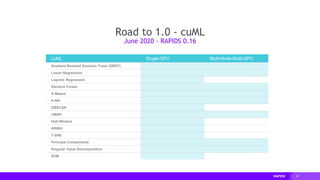
cuML Single-GPU Multi-Node-Multi-GPU
Gradient Boosted Decision Trees (GBDT)
Linear Regression
Logistic Regression
Random Forest
K-Means
K-NN
DBSCAN
UMAP
Holt-Winters
ARIMA
T-SNE
Principal Components
Singular Value Decomposition
SVM
Road to 1.0 - cuML
June 2020 - RAPIDS 0.16
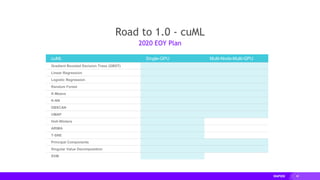
48
Road to 1.0 - cuML
2020 EOY Plan
cuML Single-GPU Multi-Node-Multi-GPU
Gradient Boosted Decision Trees (GBDT)
Linear Regression
Logistic Regression
Random Forest
K-Means
K-NN
DBSCAN
UMAP
Holt-Winters
ARIMA
T-SNE
Principal Components
Singular Value Decomposition
SVM
49
(Demo 3: ML)
50
Dask
51
cuDF cuIO
Analytics
GPU Memory
Data Preparation VisualizationModel Training
cuML
Machine Learning
cuGraph
Graph Analytics
PyTorch,
TensorFlow, MxNet
Deep Learning
cuxfilter, pyViz,
plotly
Visualization
RAPIDS
Scaling RAPIDS with Dask
Dask
52
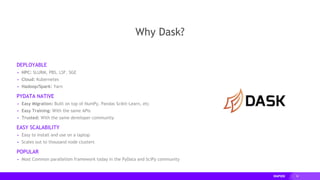
Why Dask?
DEPLOYABLE
▸ HPC: SLURM, PBS, LSF, SGE
▸ Cloud: Kubernetes
▸ Hadoop/Spark: Yarn
PYDATA NATIVE
▸ Easy Migration: Built on top of NumPy, Pandas Scikit-Learn, etc
▸ Easy Training: With the same APIs
▸ Trusted: With the same developer community
EASY SCALABILITY
▸ Easy to install and use on a laptop
▸ Scales out to thousand node clusters
POPULAR
▸ Most Common parallelism framework today in the PyData and SciPy community
53
▸ TCP sockets are slow!
▸ UCX provides uniform access to transports (TCP, InfiniBand,
shared memory, NVLink)
▸ Python bindings for UCX (ucx-py)
▸ Will provide best communication performance, to Dask
based on available hardware on nodes/cluster
Why OpenUCX?
Bringing Hardware Accelerated Communications to Dask
conda install -c conda-forge -c rapidsai 
cudatoolkit=<CUDA version> ucx-proc=*=gpu ucx ucx-py
54
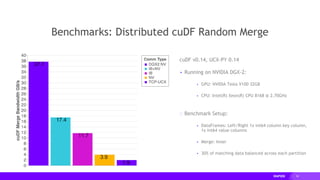
cuDF v0.14, UCX-PY 0.14
▸ Running on NVIDIA DGX-2:
▸ GPU: NVIDIA Tesla V100 32GB
▸ CPU: Intel(R) Xeon(R) CPU 8168 @ 2.70GHz
� Benchmark Setup:
▸ DataFrames: Left/Right 1x int64 column key column,
1x int64 value columns
▸ Merge: Inner
▸ 30% of matching data balanced across each partition
Benchmarks: Distributed cuDF Random Merge
55
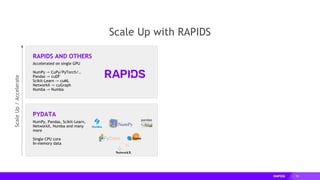
Accelerated on single GPU
NumPy -> CuPy/PyTorch/..
Pandas -> cuDF
Scikit-Learn -> cuML
NetworkX -> cuGraph
Numba -> Numba
RAPIDS AND OTHERS
NumPy, Pandas, Scikit-Learn,
NetworkX, Numba and many
more
Single CPU core
In-memory data
PYDATA
ScaleUp/Accelerate
Scale Up with RAPIDS
56
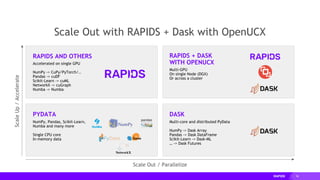
Accelerated on single GPU
NumPy -> CuPy/PyTorch/..
Pandas -> cuDF
Scikit-Learn -> cuML
NetworkX -> cuGraph
Numba -> Numba
RAPIDS AND OTHERS
Multi-GPU
On single Node (DGX)
Or across a cluster
RAPIDS + DASK
WITH OPENUCX
NumPy, Pandas, Scikit-Learn,
Numba and many more
Single CPU core
In-memory data
PYDATA
Multi-core and distributed PyData
NumPy -> Dask Array
Pandas -> Dask DataFrame
Scikit-Learn -> Dask-ML
… -> Dask Futures
DASK
ScaleUp/Accelerate
Scale Out / Parallelize
Scale Out with RAPIDS + Dask with OpenUCX
57
(Mini-demo 4: Dask)
58
cuGraph, cuSpatial, cuSignal,
and more
59
cuML
Machine Learning
PyTorch,
TensorFlow, MxNet
Deep Learning
Dask
cuDF cuIO
Analytics
GPU Memory
Data Preparation VisualizationModel Training
cuxfilter, pyViz,
plotly
Visualization
Graph Analytics
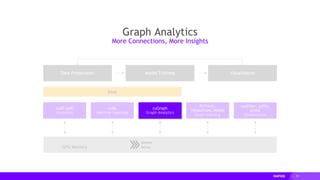
More Connections, More Insights
cuGraph
Graph Analytics
60
Goals and Benefits of cuGraph
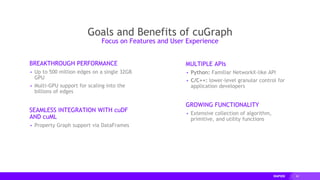
BREAKTHROUGH PERFORMANCE
▸ Up to 500 million edges on a single 32GB
GPU
▸ Multi-GPU support for scaling into the
billions of edges
SEAMLESS INTEGRATION WITH cuDF
AND cuML
▸ Property Graph support via DataFrames
Focus on Features and User Experience
MULTIPLE APIs
▸ Python: Familiar NetworkX-like API
▸ C/C++: lower-level granular control for
application developers
GROWING FUNCTIONALITY
▸ Extensive collection of algorithm,
primitive, and utility functions
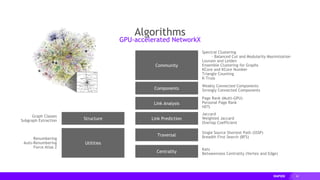
62
Spectral Clustering
- Balanced Cut and Modularity Maximization
Louvain and Leiden
Ensemble Clustering for Graphs
KCore and KCore Number
Triangle Counting
K-Truss
Jaccard
Weighted Jaccard
Overlap Coefficient
Single Source Shortest Path (SSSP)
Breadth First Search (BFS)
Katz
Betweenness Centrality (Vertex and Edge)
Weakly Connected Components
Strongly Connected Components
Page Rank (Multi-GPU)
Personal Page Rank
HITS
Renumbering
Auto-Renumbering
Force Atlas 2
Centrality
Traversal
Link Prediction
Link Analysis
Components
Community
Utilities
Structure
GPU-accelerated NetworkX
Algorithms
Graph Classes
Subgraph Extraction
63
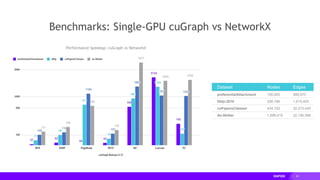
Benchmarks: Single-GPU cuGraph vs NetworkX
Dataset Nodes Edges
preferentialAttachment 100,000 999,970
Dblp-2010 326,186 1,615,400
coPapersCiteseer 434,102 32,073,440
As-Skitter 1,696,415 22,190,596
Performance Speedup: cuGraph vs NetworkX
69
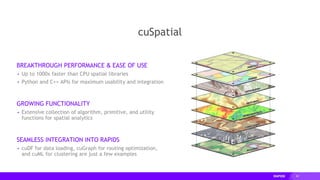
cuSpatial
BREAKTHROUGH PERFORMANCE & EASE OF USE
▸ Up to 1000x faster than CPU spatial libraries
▸ Python and C++ APIs for maximum usability and integration
GROWING FUNCTIONALITY
▸ Extensive collection of algorithm, primitive, and utility
functions for spatial analytics
SEAMLESS INTEGRATION INTO RAPIDS
▸ cuDF for data loading, cuGraph for routing optimization,
and cuML for clustering are just a few examples
70
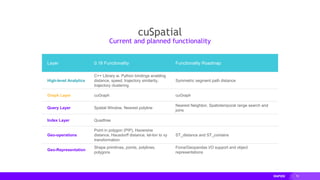
Layer 0.16 Functionality Functionality Roadmap
High-level Analytics
C++ Library w. Python bindings enabling
distance, speed, trajectory similarity,
trajectory clustering
Symmetric segment path distance
Graph Layer cuGraph cuGraph
Query Layer Spatial Window, Nearest polyline
Nearest Neighbor, Spatiotemporal range search and
joins
Index Layer Quadtree
Geo-operations
Point in polygon (PIP), Haversine
distance, Hausdorff distance, lat-lon to xy
transformation
ST_distance and ST_contains
Geo-Representation
Shape primitives, points, polylines,
polygons
Fiona/Geopandas I/O support and object
representations
cuSpatial
Current and planned functionality
71
cuSpatial
Performance at a Glance
cuSpatial Operation Input Data cuSpatial Runtime Reference Runtime Speedup
Point-in-Polygon
Test
1.3+ million vehicle point
locations and 27 Region
of Interests
1.11 ms (C++)
1.50 ms (Python)
[Nvidia Titan V]
334 ms (C++, optimized serial)
130468.2 ms (python Shapely
API, serial)
[Intel i7-7800X]
301X (C++)
86,978X (Python)
Haversine Distance
Computation
13+ million Monthly NYC
taxi trip pickup and drop-
off locations
7.61 ms (Python)
[Nvidia T4]
416.9 ms (Numba)
[Nvidia T4]
54.7X (Python)
Hausdorff Distance
Computation
(for clustering)
52,800 trajectories with
1.3+ million points
13.5s
[Quadro V100]
19227.5s (Python SciPy API,
serial)
[Intel i7-6700K]
1,400X (Python)
74
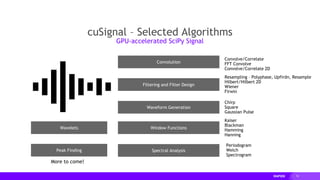
Convolution
Filtering and Filter Design
Waveform Generation
Window Functions
Spectral Analysis
Convolve/Correlate
FFT Convolve
Convolve/Correlate 2D
Resampling – Polyphase, Upfirdn, Resample
Hilbert/Hilbert 2D
Wiener
Firwin
Chirp
Square
Gaussian Pulse
Kaiser
Blackman
Hamming
Hanning
Periodogram
Welch
Spectrogram
Wavelets
More to come!
Peak Finding
cuSignal – Selected Algorithms
GPU-accelerated SciPy Signal
75
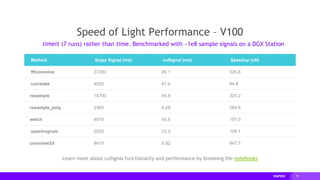
Method Scipy Signal (ms) cuSignal (ms) Speedup (xN)
fftconvolve 27300 85.1 320.8
correlate 4020 47.4 84.8
resample 14700 45.9 320.2
resample_poly 2360 8.29 284.6
welch 4870 45.5 107.0
spectrogram 2520 23.3 108.1
convolve2d 8410 9.92 847.7
Learn more about cuSignal functionality and performance by browsing the notebooks
Speed of Light Performance – V100
timeit (7 runs) rather than time. Benchmarked with ~1e8 sample signals on a DGX Station
78
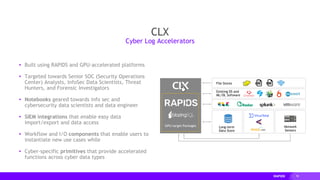
CLX
▸ Built using RAPIDS and GPU-accelerated platforms
▸ Targeted towards Senior SOC (Security Operations
Center) Analysts, InfoSec Data Scientists, Threat
Hunters, and Forensic Investigators
▸ Notebooks geared towards info sec and
cybersecurity data scientists and data engineer
▸ SIEM integrations that enable easy data
import/export and data access
▸ Workflow and I/O components that enable users to
instantiate new use cases while
▸ Cyber-specific primitives that provide accelerated
functions across cyber data types
Cyber Log Accelerators
File Stores
Existing DS and
ML/DL Software
Long-term
Data Store
Network
Sensors
GPU-target Packages
85
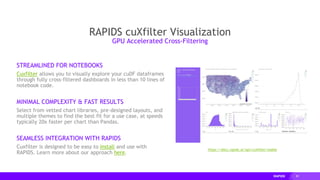
RAPIDS cuXfilter Visualization
GPU Accelerated Cross-Filtering
STREAMLINED FOR NOTEBOOKS
Cuxfilter allows you to visually explore your cuDF dataframes
through fully cross-filtered dashboards in less than 10 lines of
notebook code.
MINIMAL COMPLEXITY & FAST RESULTS
Select from vetted chart libraries, pre-designed layouts, and
multiple themes to find the best fit for a use case, at speeds
typically 20x faster per chart than Pandas.
SEAMLESS INTEGRATION WITH RAPIDS
Cuxfilter is designed to be easy to install and use with
RAPIDS. Learn more about our approach here.
https://docs.rapids.ai/api/cuxfilter/stable
86
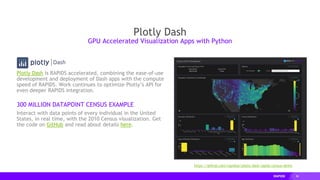
Plotly Dash
GPU Accelerated Visualization Apps with Python
Plotly Dash is RAPIDS accelerated, combining the ease-of-use
development and deployment of Dash apps with the compute
speed of RAPIDS. Work continues to optimize Plotly’s API for
even deeper RAPIDS integration.
300 MILLION DATAPOINT CENSUS EXAMPLE
Interact with data points of every individual in the United
States, in real time, with the 2010 Census visualization. Get
the code on GitHub and read about details here.
https://github.com/rapidsai/plotly-dash-rapids-census-demo
88
Community
89
OPEN SOURCE
CONTRIBUTORS
ADOPTERS
Ecosystem Partners
90
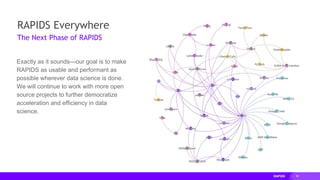
Exactly as it sounds—our goal is to make
RAPIDS as usable and performant as
possible wherever data science is done.
We will continue to work with more open
source projects to further democratize
acceleration and efficiency in data
science.
RAPIDS Everywhere
The Next Phase of RAPIDS
91
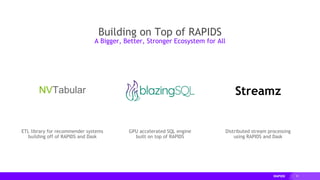
GPU accelerated SQL engine
built on top of RAPIDS
Distributed stream processing
using RAPIDS and Dask
ETL library for recommender systems
building off of RAPIDS and Dask
Streamz
Building on Top of RAPIDS
A Bigger, Better, Stronger Ecosystem for All
NVTabular
92
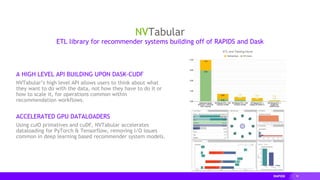
NVTabular
ETL library for recommender systems building off of RAPIDS and Dask
A HIGH LEVEL API BUILDING UPON DASK-CUDF
NVTabular’s high level API allows users to think about what
they want to do with the data, not how they have to do it or
how to scale it, for operations common within
recommendation workflows.
ACCELERATED GPU DATALOADERS
Using cuIO primatives and cuDF, NVTabular accelerates
dataloading for PyTorch & Tensorflow, removing I/O issues
common in deep learning based recommender system models.
93
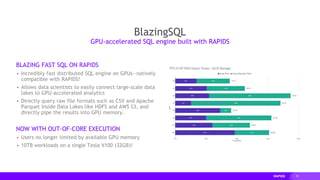
BlazingSQL
GPU-accelerated SQL engine built with RAPIDS
BLAZING FAST SQL ON RAPIDS
▸ Incredibly fast distributed SQL engine on GPUs--natively
compatible with RAPIDS!
▸ Allows data scientists to easily connect large-scale data
lakes to GPU-accelerated analytics
▸ Directly query raw file formats such as CSV and Apache
Parquet inside Data Lakes like HDFS and AWS S3, and
directly pipe the results into GPU memory.
NOW WITH OUT-OF-CORE EXECUTION
▸ Users no longer limited by available GPU memory
▸ 10TB workloads on a single Tesla V100 (32GB)!
94
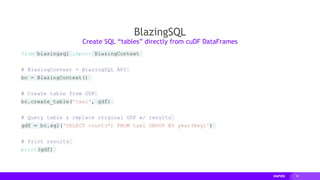
BlazingSQL
Create SQL “tables” directly from cuDF DataFrames
from blazingsql import BlazingContext
# BlazingContext = BlazingSQL API
bc = BlazingContext()
# Create table from GDF
bc.create_table('taxi', gdf)
# Query table & replace original GDF w/ results
gdf = bc.sql('SELECT count(*) FROM taxi GROUP BY year(key)')
# Print results
print(gdf)
95
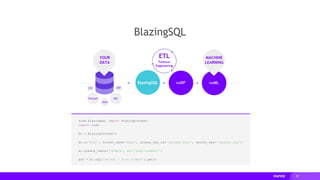
from blazingsql import BlazingContext
import cudf
bc = BlazingContext()
bc.s('bsql', bucket_name='bsql', access_key_id='<access_key>', secret_key='<secret_key')
bc.create_table('orders', s3://bsql/orders/')
gdf = bc.sql('select * from orders').get()
BlazingSQL
CSV GDF
ORCParquet
JSON
ETL
Feature
Engineering
cuMLcuDFBlazingSQL
YOUR
DATA
MACHINE
LEARNING
97
GOOGLE GROUPS STACK OVERFLOW
https://groups.google.com/
forum/#!forum/rapidsai
DOCKER HUB SLACK CHANNEL
https://hub.docker.com/
r/rapidsai/rapidsai
https://rapids-goai.slack.com/join https://stackoverflow.com
/tags/rapids
Join the Conversation
98
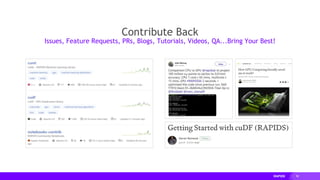
Contribute Back
Issues, Feature Requests, PRs, Blogs, Tutorials, Videos, QA...Bring Your Best!
99
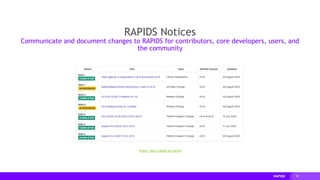
RAPIDS Notices
Communicate and document changes to RAPIDS for contributors, core developers, users, and
the community
https://docs.rapids.ai/notices
100
Getting Started
101
1. Install RAPIDS on Docker, Conda, deploy in your favorite cloud instance, or quick start with
app.blazingsql.com.
2. Explore our walk through videos, blog content, our github, the tutorial notebooks, and our example
workflows.
3. Build your own data science workflows.
4. Join our community conversations on Slack, Google, and Twitter.
5. Contribute back. Don't forget to ask and answer questions on Stack Overflow.
5 Steps to Getting Started with RAPIDS
102
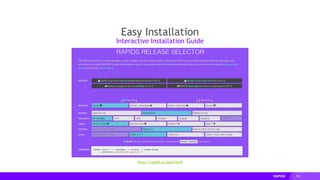
Easy Installation
Interactive Installation Guide
https://rapids.ai/start.html
103
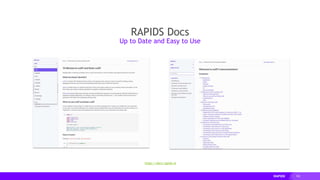
https://docs.rapids.ai
RAPIDS Docs
Up to Date and Easy to Use
104
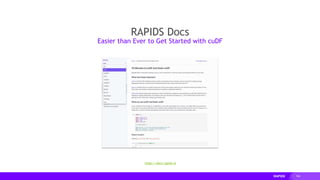
RAPIDS Docs
Easier than Ever to Get Started with cuDF
https://docs.rapids.ai
105
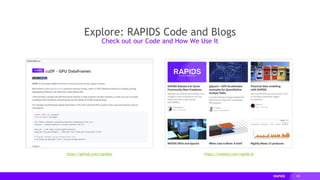
https://github.com/rapidsai https://medium.com/rapids-ai
Explore: RAPIDS Code and Blogs
Check out our Code and How We Use It
106
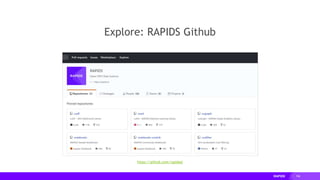
Explore: RAPIDS Github
https://github.com/rapidsai
107
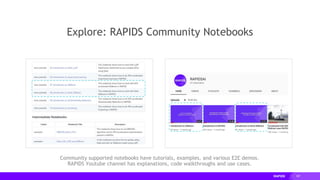
Explore: RAPIDS Community Notebooks
Community supported notebooks have tutorials, examples, and various E2E demos.
RAPIDS Youtube channel has explanations, code walkthroughs and use cases.
108
GITHUB DOCKER
https://github.com/rapidsai
ANACONDA NGC
https://anaconda.org/rapidsai/ https://ngc.nvidia.com/registry/
nvidia-rapidsai-rapidsai
https://hub.docker.com/r/
rapidsai/rapidsai/
RAPIDS
How Do I Get the Software?
109
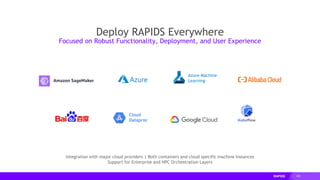
Integration with major cloud providers | Both containers and cloud specific machine instances
Support for Enterprise and HPC Orchestration Layers
Cloud
Dataproc
Azure Machine
Learning
Deploy RAPIDS Everywhere
Focused on Robust Functionality, Deployment, and User Experience
110
Integrations, feedback, documentation support, pull requests, new issues, or code donations welcomed!
APACHE ARROW
GPU OPEN ANALYTICS
INITIATIVE
https://arrow.apache.org/
@ApacheArrow
http://gpuopenanalytics.com/
@GPUOAI
RAPIDS
https://rapids.ai
@RAPIDSAI
DASK
https://dask.org
@Dask_dev
Join the Movement
Everyone Can Help!
THANK YOU
Joshua Patterson
joshuap@nvidia.com
@datametrician

GPU Accelerated Data Science with RAPIDS - ODSC West 2020

  • 1.
    John Zedlewski, Director,RAPIDS @ NVIDIA Corey Nolet, Principal Engineer, RAPIDS @ NVIDIA GPU-Accelerated Data Science From ETL to ML and beyond
  • 2.
    2 Outline ● What isRAPIDS? (+Getting started with app.blazingsql.com) ● RAPIDS ETL / cuDF basics (+Demos!) ● RAPIDS and XGBoost for machine learning (+Demos!) ● Additional RAPIDS libraries and integrations ● Hands-on exercise
  • 3.
    3 ▸ Thousands ofcores with up to ~20 TeraFlops of general purpose compute performance ▸ Up to 1.6 TB/s of memory bandwidth ▸ Hardware interconnects for up to 600 GB/s bidirectional GPU <--> GPU bandwidth ▸ Can scale up to 16x GPUs in a single node Data science applications almost never run out of compute relative to memory bandwidth! Why GPUs? Numerous hardware advantages
  • 4.
    4 cuDF cuIO Analytics Data PreparationVisualizationModel Training cuML Machine Learning cuGraph Graph Analytics PyTorch, TensorFlow, MxNet Deep Learning cuxfilter, pyViz, plotly Visualization Dask GPU Memory RAPIDS End-to-End GPU Accelerated Data Science
  • 5.
    5 25-100x Improvement Less Code LanguageFlexible Primarily In-Memory HDFS Read HDFS Write HDFS Read HDFS Write HDFS Read Query ETL ML Train HDFS Read Query ETL ML Train HDFS Read GPU Read Query CPU Write GPU Read ETL CPU Write GPU Read ML Train 5-10x Improvement More Code Language Rigid Substantially on GPU Traditional GPU Processing Hadoop Processing, Reading from Disk Spark In-Memory Processing Data Processing Evolution Faster Data Access, Less Data Movement
  • 6.
    6 Data Movement andTransformation The Bane of Productivity and Performance CPU Copy & Convert Copy & Convert Copy & Convert APP A APP B Read Data Load Data APP B APP A GPU GPU DATA GPU DATA APP A APP B
  • 7.
    7 Data Movement andTransformation What if We Could Keep Data on the GPU? CPU Copy & Convert Copy & Convert Copy & Convert APP A APP B Read Data Load Data APP B APP A GPU GPU DATA GPU DATA APP A APP B X X X
  • 8.
    8 ▸ Each systemhas its own internal memory format ▸ 70-80% computation wasted on serialization and deserialization ▸ Similar functionality implemented in multiple projects ▸ All systems utilize the same memory format ▸ No overhead for cross-system communication ▸ Projects can share functionality (eg, Parquet-to-Arrow reader) Source: From Apache Arrow Home Page - https://arrow.apache.org/ Learning from Apache Arrow
  • 9.
    9 25-100x Improvement Less Code LanguageFlexible Primarily In-Memory HDFS Read HDFS Write HDFS Read HDFS Write HDFS Read Query ETL ML Train HDFS Read Query ETL ML Train HDFS Read GPU Read Query CPU Write GPU Read ETL CPU Write GPU Read ML Train 5-10x Improvement More Code Language Rigid Substantially on GPU Traditional GPU Processing Hadoop Processing, Reading from Disk Spark In-Memory Processing Data Processing Evolution Faster Data Access, Less Data Movement RAPIDS Arrow Read ETL ML Train Query 50-100x Improvement Same Code Language Flexible Primarily on GPU
  • 10.
    10 Lightning-fast performance onreal-world use cases Up to 350x faster queries; Hours to Seconds! TPCx-BB is a data science benchmark consisting of 30 end-to-end queries representing real-world ETL and Machine Learning workflows, involving both structured and unstructured data. It can be run at multiple “Scale Factors”. ▸ SF1 - 1GB ▸ SF1K - 1 TB ▸ SF10K - 10 TB RAPIDS results at SF1K (2 DGX A100s) and SF10K (16 DGX A100s) show GPUs provide dramatic cost and time-savings for small scale and large-scale data analytics problems ▸ SF1K 37.1x average speed-up ▸ SF10K 19.5x average speed-up (7x Normalized for Cost)
  • 11.
    11 RAPIDS Dominates H2OBenchmarks Challenge Accepted Benchmark: https://h2oai.github.io/db- benchmark RAPIDS Benchmark Machine: 4x 32 GB GV100 machine on AWS (P3DN with only 4x gpus visible) Average Speedup: cuDF: 30x dask-cuDF: 12x Other Key Points: - Dask-cuDF and dask-bsql are only two methods to complete their 50GB Joins Questions - Dask-cuDF finishes ALL questions 5x faster than data.table finishes Question #1 - Single GPU cuDF will run out of memory when dataset is larger than GPU (50GB). - cuDF wins ~70% of questions for all data sets and sizes it can complete - Multi-gpu dask-cuDF will perform slower at smaller datasets. - Building functionality to dominate Advanced Groupby Questions
  • 12.
  • 13.
    14 Pandas Analytics CPU Memory Data PreparationVisualizationModel Training Scikit-Learn Machine Learning NetworkX Graph Analytics PyTorch, TensorFlow, MxNet Deep Learning Matplotlib Visualization Dask Open Source Data Science Ecosystem Familiar Python APIs
  • 14.
    15 cuDF cuIO Analytics GPU Memory DataPreparation VisualizationModel Training cuML Machine Learning cuGraph Graph Analytics PyTorch, TensorFlow, MxNet Deep Learning cuxfilter, pyViz, plotly Visualization Dask RAPIDS End-to-End Accelerated GPU Data Science
  • 15.
    16 ▸ BlazingSQL isan open source, GPU-accelerated SQL engine built on top of RAPIDS core libraries ▸ The BlazingSQL company has created app.blazingsql.com with free, GPU-backed instances running Jupyter ▸ Log in for free with any Google credentials at https://app.blazingsql.com ▸ Start by downloading our session notebook with: !git clone https://github.com/JohnZed/odsc- west-2020.git Getting started: app.blazingsql.com Free access to GPUs and Jupyter
  • 16.
  • 17.
    18 Dask GPU Memory Data PreparationVisualizationModel Training cuML Machine Learning cuGraph Graph Analytics PyTorch, TensorFlow, MxNet Deep Learning cuxfilter, pyViz, plotly Visualization RAPIDS GPU Accelerated Data Wrangling and Feature Engineering cuDF cuIO Analytics
  • 18.
    19 GPU-Accelerated ETL The AverageData Scientist Spends 90+% of Their Time in ETL as Opposed to Training Models
  • 19.
  • 20.
    21 ETL - theBackbone of Data Science CUDA C++ LIBRARY ▸ Table (dataframe) and column types and algorithms ▸ CUDA kernels for sorting, join, groupby, reductions, partitioning, elementwise operations, etc. ▸ Optimized GPU implementations for strings, timestamps, numeric types (more coming) ▸ Primitives for scalable distributed ETL libcuDF is… std::unique_ptr<table> gather(table_view const& input, column_view const& gather_map, …) { // return a new table containing // rows from input indexed by // gather_map }
  • 21.
    22 ETL - theBackbone of Data Science PYTHON LIBRARY ▸ A Python library for manipulating GPU DataFrames following the Pandas API ▸ Python interface to CUDA C++ library with additional functionality ▸ Creating GPU DataFrames from Numpy arrays, Pandas DataFrames, and PyArrow Tables ▸ JIT compilation of User-Defined Functions (UDFs) using Numba cuDF is…
  • 22.
    23 Benchmarks: Single-GPU Speedupvs. Pandas cuDF v0.13, Pandas 0.25.3 ▸ Running on NVIDIA DGX-1: ▸ GPU: NVIDIA Tesla V100 32GB ▸ CPU: Intel(R) Xeon(R) CPU E5-2698 v4 @ 2.20GHz ▸ Benchmark Setup: ▸ RMM Pool Allocator Enabled ▸ DataFrames: 2x int32 columns key columns, 3x int32 value columns ▸ Merge: inner; GroupBy: count, sum, min, max calculated for each value column 300 900 500 0 Merge Sort GroupBy GPUSpeedupOverCPU 10M 100M 970 500 370 350 330 320
  • 23.
    24 Dask GPU Memory Data PreparationVisualizationModel Training cuML Machine Learning cuGraph Graph Analytics PyTorch, TensorFlow, MxNet Deep Learning cuxfilter, pyViz, plotly Visualization ETL - the Backbone of Data Science cuDF is Not the End of the Story cuDF cuIO Analytics
  • 24.
    25 ETL - theBackbone of Data Science CURRENT V0.16 STRING SUPPORT ▸ Regular Expressions ▸ Element-wise operations ▸ Split, Find, Extract, Cat, Typecasting, etc… ▸ String GroupBys, Joins, Sorting, etc. ▸ Categorical columns fully on GPU ▸ Native String type in libcudf C++ ▸ NLP Preprocessors ▸ Tokenizers, Normalizers, Edit Distance, Porter Stemmer, etc. FUTURE V0.17+ STRING SUPPORT ▸ Further performance optimization ▸ JIT-compiled String UDFs String Support 800 700 600 400 300 200 0 Lower () Find(#) Slice(1,15) milliseconds Pandas Cuda Strings 500 100
  • 25.
    26 Extraction is theCornerstone ▸ Follow Pandas APIs and provide >10x speedup ▸ CSV Reader, CSV Writer ▸ Parquet Reader, Parquet Writer ▸ ORC Reader, ORC Writer ▸ JSON Reader ▸ Avro Reader ▸ GPU Direct Storage integration in progress for bypassing PCIe bottlenecks! ▸ Key is GPU-accelerating both parsing and decompression cuIO for Faster Data Loading Source: Apache Crail blog: SQL Performance: Part 1 - Input File Formats
  • 26.
    27 ETL is NotJust DataFrames!
  • 27.
    28 Dask cuDF cuIO Analytics GPU Memory DataPreparation VisualizationModel Training cuML Machine Learning cuGraph Graph Analytics cuxfilter, pyViz, plotly Visualization RAPIDS Building Bridges into the Array Ecosystem PyTorch, TensorFlow, MxNet Deep Learning
  • 28.
    29 Interoperability for theWin mpi4py ▸ Real-world workflows often need to share data between libraries ▸ RAPIDS supports device memory sharing between many popular data science and deep learning libraries ▸ Keeps data on the GPU--avoids costly copying back and forth to host memory ▸ Any library that supports DLPack or __cuda_array_interface__ will allow for sharing of memory buffers between RAPIDS and supported libraries
  • 29.
    30 ETL – Arraysand DataFrames Dask and CUDA Python Arrays NumPy Array Dask Array ▸ Scales NumPy to distributed clusters ▸ Used in climate science, imaging, HPC analysis up to 100TB size ▸ Now seamlessly accelerated with GPUs
  • 30.
    31 More details: https://blog.dask.org/2019/06/27/single-gpu-cupy-benchmarks Benchmark:Single-GPU CuPy vs NumPy 800 400 0 Elementwise GPUSpeedupOverCPU Operation 800MB 8MB 150 270 5.3 210 3.6 190 5.1 150 8.3 66 18 11 1.5 17 1.1 3.5 FFT Array Slicing Stencil Sum Matrix Multiplication SVD Standard Deviation 100
  • 31.
  • 32.
    34 User-Defined Functions ▸ JITcompilation of Python functions using Numba ▸ (Numba deserves its own talk! An amazing JIT compiler for either CPU or GPU) ▸ Basic functions of one column: just pass your Python function to applymap! ▸ More complex functions can use @cuda.jit decorator ▸ Functions of multiple DataFrame columns can use the apply_rows API (see Demo 2) for more complex computation UDFs - Extending cuDF Python compiled to GPU
  • 33.
  • 34.
    36 PyTorch, TensorFlow, MxNet Deep Learning Dask cuDFcuIO Analytics GPU Memory Data Preparation VisualizationModel Training cuGraph Graph Analytics cuxfilter, pyViz, plotly Visualization Machine Learning More Models More Problems cuML Machine Learning
  • 35.
    37 SAMPLING HISTOGRAMS / DISTRIBUTIONS DIMENSIONREDUCTION FEATURE SELECTION REMOVE OUTLIERS MASSIVE DATASET Meet Reasonable Speed vs Accuracy Trade-off Better to start with as much data as possible and explore / preprocess to scale to performance needs. Iterate. Cross Validate & Grid Search. Iterate Some More.Hours? Days? Time Increases Problem Data Sizes Continue to Grow
  • 36.
  • 37.
    39 RAPIDS Matches CommonPython APIs CPU-based Clustering from sklearn.datasets import make_moons import pandas X, y = make_moons(n_samples=int(1e2), noise=0.05, random_state=0) X = pandas.DataFrame({'fea%d'%i: X[:, i] for i in range(X.shape[1])}) from sklearn.cluster import DBSCAN dbscan = DBSCAN(eps = 0.3, min_samples = 5) dbscan.fit(X) y_hat = dbscan.predict(X)
  • 38.
    40 from sklearn.datasets importmake_moons import cudf X, y = make_moons(n_samples=int(1e2), noise=0.05, random_state=0) X = cudf.DataFrame({'fea%d'%i: X[:, i] for i in range(X.shape[1])}) from cuml import DBSCAN dbscan = DBSCAN(eps = 0.3, min_samples = 5) dbscan.fit(X) y_hat = dbscan.predict(X) RAPIDS Matches Common Python APIs GPU-accelerated Clustering
  • 39.
    41 Decision Trees /Random Forests Linear/Lasso/Ridge/ElasticNet Regression Logistic Regression K-Nearest Neighbors Support Vector Machine Classification and Regression Naive Bayes K-Means DBSCAN Spectral Clustering Principal Components Singular Value Decomposition UMAP Spectral Embedding T-SNE Holt-Winters Seasonal ARIMA / Auto ARIMA More to come! Random Forest / GBDT Inference (FIL) Time Series Clustering Decomposition & Dimensionality Reduction Preprocessing Inference Classification / Regression Hyper-parameter Tuning Cross Validation Key: Preexisting | NEW or enhanced for 0.15 Algorithms GPU-accelerated Scikit-Learn Text vectorization (TF-IDF / Count) Target Encoding Cross-validation / splitting
  • 40.
    42 Benchmarks: Single-GPU cuMLvs Scikit-learn 1x V100 vs. 2x 20 Core CPUs (DGX-1, RAPIDS 0.15)
  • 41.
    43 Forest Inference cuML’s ForestInference Library accelerates prediction (inference) for random forests and boosted decision trees: ▸ Works with existing saved models (XGBoost, LightGBM, scikit-learn RF cuML RF soon) ▸ Lightweight Python API ▸ Single V100 GPU can infer up to 34x faster than XGBoost dual-CPU node ▸ Over 100 million forest inferences Taking Models From Training to Production 4000 3000 2000 1000 0 Bosch Airline Epsilon Time(ms) CPU Time (XGBoost, 40 Cores) FIL GPU Time (1x V100) Higgs XGBoost CPU Inference vs. FIL GPU (1000 trees) 23x 36x 34x 23x
  • 42.
    44 XGBoost + RAPIDS:Better Together ▸ RAPIDS comes paired with a snapshot of XGBoost 1.3 (as of 0.16) ▸ XGBoost now builds on the GoAI interface standards to provide zero-copy data import from cuDF, cuPY, Numba, PyTorch and more ▸ Official Dask API makes it easy to scale to multiple nodes or multiple GPUs ▸ gpu_hist tree builder delivers huge perf gains Memory usage when importing GPU data decreased by 2/3 or more ▸ New support for GPU-accelerated SHAP model explanations All RAPIDS changes are integrated upstream and provided to all XGBoost users – via pypi or RAPIDS conda
  • 43.
    45 RAPIDS Integrated intoCloud ML Frameworks Accelerated machine learning models in RAPIDS give you the flexibility to use hyperparameter optimization (HPO) experiments to explore all variants to find the most accurate possible model for your problem. With GPU acceleration, RAPIDS models can train 40x faster than CPU equivalents, enabling more experimentation in less time. The RAPIDS team works closely with major cloud providers and OSS solution providers to provide code samples to get started with HPO in minutes https://rapids.ai/hpo
  • 44.
    46 HPO Use Case:100-Job Random Forest Airline Model Huge speedups translate into >7x TCO reduction Based on sample Random Forest training code from cloud-ml-examples repository, running on Azure ML. 10 concurrent workers with 100 total runs, 100M rows, 5-fold cross-validation per run. GPU nodes: 10x Standard_NC6s_v3, 1 V100 16G, vCPU 6 memory 112G, Xeon E5-2690 v4 (Broadwell) - $3.366/hour CPU nodes: 10x Standard_DS5_v2, vCPU 16 memory 56G, Xeon E5-2673 v3 (Haswell) or v4 (Broadwell) - $1.017/hour" Cost Speedup
  • 45.
    47 cuML Single-GPU Multi-Node-Multi-GPU GradientBoosted Decision Trees (GBDT) Linear Regression Logistic Regression Random Forest K-Means K-NN DBSCAN UMAP Holt-Winters ARIMA T-SNE Principal Components Singular Value Decomposition SVM Road to 1.0 - cuML June 2020 - RAPIDS 0.16
  • 46.
    48 Road to 1.0- cuML 2020 EOY Plan cuML Single-GPU Multi-Node-Multi-GPU Gradient Boosted Decision Trees (GBDT) Linear Regression Logistic Regression Random Forest K-Means K-NN DBSCAN UMAP Holt-Winters ARIMA T-SNE Principal Components Singular Value Decomposition SVM
  • 47.
  • 48.
  • 49.
    51 cuDF cuIO Analytics GPU Memory DataPreparation VisualizationModel Training cuML Machine Learning cuGraph Graph Analytics PyTorch, TensorFlow, MxNet Deep Learning cuxfilter, pyViz, plotly Visualization RAPIDS Scaling RAPIDS with Dask Dask
  • 50.
    52 Why Dask? DEPLOYABLE ▸ HPC:SLURM, PBS, LSF, SGE ▸ Cloud: Kubernetes ▸ Hadoop/Spark: Yarn PYDATA NATIVE ▸ Easy Migration: Built on top of NumPy, Pandas Scikit-Learn, etc ▸ Easy Training: With the same APIs ▸ Trusted: With the same developer community EASY SCALABILITY ▸ Easy to install and use on a laptop ▸ Scales out to thousand node clusters POPULAR ▸ Most Common parallelism framework today in the PyData and SciPy community
  • 51.
    53 ▸ TCP socketsare slow! ▸ UCX provides uniform access to transports (TCP, InfiniBand, shared memory, NVLink) ▸ Python bindings for UCX (ucx-py) ▸ Will provide best communication performance, to Dask based on available hardware on nodes/cluster Why OpenUCX? Bringing Hardware Accelerated Communications to Dask conda install -c conda-forge -c rapidsai cudatoolkit=<CUDA version> ucx-proc=*=gpu ucx ucx-py
  • 52.
    54 cuDF v0.14, UCX-PY0.14 ▸ Running on NVIDIA DGX-2: ▸ GPU: NVIDIA Tesla V100 32GB ▸ CPU: Intel(R) Xeon(R) CPU 8168 @ 2.70GHz � Benchmark Setup: ▸ DataFrames: Left/Right 1x int64 column key column, 1x int64 value columns ▸ Merge: Inner ▸ 30% of matching data balanced across each partition Benchmarks: Distributed cuDF Random Merge
  • 53.
    55 Accelerated on singleGPU NumPy -> CuPy/PyTorch/.. Pandas -> cuDF Scikit-Learn -> cuML NetworkX -> cuGraph Numba -> Numba RAPIDS AND OTHERS NumPy, Pandas, Scikit-Learn, NetworkX, Numba and many more Single CPU core In-memory data PYDATA ScaleUp/Accelerate Scale Up with RAPIDS
  • 54.
    56 Accelerated on singleGPU NumPy -> CuPy/PyTorch/.. Pandas -> cuDF Scikit-Learn -> cuML NetworkX -> cuGraph Numba -> Numba RAPIDS AND OTHERS Multi-GPU On single Node (DGX) Or across a cluster RAPIDS + DASK WITH OPENUCX NumPy, Pandas, Scikit-Learn, Numba and many more Single CPU core In-memory data PYDATA Multi-core and distributed PyData NumPy -> Dask Array Pandas -> Dask DataFrame Scikit-Learn -> Dask-ML … -> Dask Futures DASK ScaleUp/Accelerate Scale Out / Parallelize Scale Out with RAPIDS + Dask with OpenUCX
  • 55.
  • 56.
  • 57.
    59 cuML Machine Learning PyTorch, TensorFlow, MxNet DeepLearning Dask cuDF cuIO Analytics GPU Memory Data Preparation VisualizationModel Training cuxfilter, pyViz, plotly Visualization Graph Analytics More Connections, More Insights cuGraph Graph Analytics
  • 58.
    60 Goals and Benefitsof cuGraph BREAKTHROUGH PERFORMANCE ▸ Up to 500 million edges on a single 32GB GPU ▸ Multi-GPU support for scaling into the billions of edges SEAMLESS INTEGRATION WITH cuDF AND cuML ▸ Property Graph support via DataFrames Focus on Features and User Experience MULTIPLE APIs ▸ Python: Familiar NetworkX-like API ▸ C/C++: lower-level granular control for application developers GROWING FUNCTIONALITY ▸ Extensive collection of algorithm, primitive, and utility functions
  • 59.
    62 Spectral Clustering - BalancedCut and Modularity Maximization Louvain and Leiden Ensemble Clustering for Graphs KCore and KCore Number Triangle Counting K-Truss Jaccard Weighted Jaccard Overlap Coefficient Single Source Shortest Path (SSSP) Breadth First Search (BFS) Katz Betweenness Centrality (Vertex and Edge) Weakly Connected Components Strongly Connected Components Page Rank (Multi-GPU) Personal Page Rank HITS Renumbering Auto-Renumbering Force Atlas 2 Centrality Traversal Link Prediction Link Analysis Components Community Utilities Structure GPU-accelerated NetworkX Algorithms Graph Classes Subgraph Extraction
  • 60.
    63 Benchmarks: Single-GPU cuGraphvs NetworkX Dataset Nodes Edges preferentialAttachment 100,000 999,970 Dblp-2010 326,186 1,615,400 coPapersCiteseer 434,102 32,073,440 As-Skitter 1,696,415 22,190,596 Performance Speedup: cuGraph vs NetworkX
  • 61.
    69 cuSpatial BREAKTHROUGH PERFORMANCE &EASE OF USE ▸ Up to 1000x faster than CPU spatial libraries ▸ Python and C++ APIs for maximum usability and integration GROWING FUNCTIONALITY ▸ Extensive collection of algorithm, primitive, and utility functions for spatial analytics SEAMLESS INTEGRATION INTO RAPIDS ▸ cuDF for data loading, cuGraph for routing optimization, and cuML for clustering are just a few examples
  • 62.
    70 Layer 0.16 FunctionalityFunctionality Roadmap High-level Analytics C++ Library w. Python bindings enabling distance, speed, trajectory similarity, trajectory clustering Symmetric segment path distance Graph Layer cuGraph cuGraph Query Layer Spatial Window, Nearest polyline Nearest Neighbor, Spatiotemporal range search and joins Index Layer Quadtree Geo-operations Point in polygon (PIP), Haversine distance, Hausdorff distance, lat-lon to xy transformation ST_distance and ST_contains Geo-Representation Shape primitives, points, polylines, polygons Fiona/Geopandas I/O support and object representations cuSpatial Current and planned functionality
  • 63.
    71 cuSpatial Performance at aGlance cuSpatial Operation Input Data cuSpatial Runtime Reference Runtime Speedup Point-in-Polygon Test 1.3+ million vehicle point locations and 27 Region of Interests 1.11 ms (C++) 1.50 ms (Python) [Nvidia Titan V] 334 ms (C++, optimized serial) 130468.2 ms (python Shapely API, serial) [Intel i7-7800X] 301X (C++) 86,978X (Python) Haversine Distance Computation 13+ million Monthly NYC taxi trip pickup and drop- off locations 7.61 ms (Python) [Nvidia T4] 416.9 ms (Numba) [Nvidia T4] 54.7X (Python) Hausdorff Distance Computation (for clustering) 52,800 trajectories with 1.3+ million points 13.5s [Quadro V100] 19227.5s (Python SciPy API, serial) [Intel i7-6700K] 1,400X (Python)
  • 64.
    74 Convolution Filtering and FilterDesign Waveform Generation Window Functions Spectral Analysis Convolve/Correlate FFT Convolve Convolve/Correlate 2D Resampling – Polyphase, Upfirdn, Resample Hilbert/Hilbert 2D Wiener Firwin Chirp Square Gaussian Pulse Kaiser Blackman Hamming Hanning Periodogram Welch Spectrogram Wavelets More to come! Peak Finding cuSignal – Selected Algorithms GPU-accelerated SciPy Signal
  • 65.
    75 Method Scipy Signal(ms) cuSignal (ms) Speedup (xN) fftconvolve 27300 85.1 320.8 correlate 4020 47.4 84.8 resample 14700 45.9 320.2 resample_poly 2360 8.29 284.6 welch 4870 45.5 107.0 spectrogram 2520 23.3 108.1 convolve2d 8410 9.92 847.7 Learn more about cuSignal functionality and performance by browsing the notebooks Speed of Light Performance – V100 timeit (7 runs) rather than time. Benchmarked with ~1e8 sample signals on a DGX Station
  • 66.
    78 CLX ▸ Built usingRAPIDS and GPU-accelerated platforms ▸ Targeted towards Senior SOC (Security Operations Center) Analysts, InfoSec Data Scientists, Threat Hunters, and Forensic Investigators ▸ Notebooks geared towards info sec and cybersecurity data scientists and data engineer ▸ SIEM integrations that enable easy data import/export and data access ▸ Workflow and I/O components that enable users to instantiate new use cases while ▸ Cyber-specific primitives that provide accelerated functions across cyber data types Cyber Log Accelerators File Stores Existing DS and ML/DL Software Long-term Data Store Network Sensors GPU-target Packages
  • 67.
    85 RAPIDS cuXfilter Visualization GPUAccelerated Cross-Filtering STREAMLINED FOR NOTEBOOKS Cuxfilter allows you to visually explore your cuDF dataframes through fully cross-filtered dashboards in less than 10 lines of notebook code. MINIMAL COMPLEXITY & FAST RESULTS Select from vetted chart libraries, pre-designed layouts, and multiple themes to find the best fit for a use case, at speeds typically 20x faster per chart than Pandas. SEAMLESS INTEGRATION WITH RAPIDS Cuxfilter is designed to be easy to install and use with RAPIDS. Learn more about our approach here. https://docs.rapids.ai/api/cuxfilter/stable
  • 68.
    86 Plotly Dash GPU AcceleratedVisualization Apps with Python Plotly Dash is RAPIDS accelerated, combining the ease-of-use development and deployment of Dash apps with the compute speed of RAPIDS. Work continues to optimize Plotly’s API for even deeper RAPIDS integration. 300 MILLION DATAPOINT CENSUS EXAMPLE Interact with data points of every individual in the United States, in real time, with the 2010 Census visualization. Get the code on GitHub and read about details here. https://github.com/rapidsai/plotly-dash-rapids-census-demo
  • 69.
  • 70.
  • 71.
    90 Exactly as itsounds—our goal is to make RAPIDS as usable and performant as possible wherever data science is done. We will continue to work with more open source projects to further democratize acceleration and efficiency in data science. RAPIDS Everywhere The Next Phase of RAPIDS
  • 72.
    91 GPU accelerated SQLengine built on top of RAPIDS Distributed stream processing using RAPIDS and Dask ETL library for recommender systems building off of RAPIDS and Dask Streamz Building on Top of RAPIDS A Bigger, Better, Stronger Ecosystem for All NVTabular
  • 73.
    92 NVTabular ETL library forrecommender systems building off of RAPIDS and Dask A HIGH LEVEL API BUILDING UPON DASK-CUDF NVTabular’s high level API allows users to think about what they want to do with the data, not how they have to do it or how to scale it, for operations common within recommendation workflows. ACCELERATED GPU DATALOADERS Using cuIO primatives and cuDF, NVTabular accelerates dataloading for PyTorch & Tensorflow, removing I/O issues common in deep learning based recommender system models.
  • 74.
    93 BlazingSQL GPU-accelerated SQL enginebuilt with RAPIDS BLAZING FAST SQL ON RAPIDS ▸ Incredibly fast distributed SQL engine on GPUs--natively compatible with RAPIDS! ▸ Allows data scientists to easily connect large-scale data lakes to GPU-accelerated analytics ▸ Directly query raw file formats such as CSV and Apache Parquet inside Data Lakes like HDFS and AWS S3, and directly pipe the results into GPU memory. NOW WITH OUT-OF-CORE EXECUTION ▸ Users no longer limited by available GPU memory ▸ 10TB workloads on a single Tesla V100 (32GB)!
  • 75.
    94 BlazingSQL Create SQL “tables”directly from cuDF DataFrames from blazingsql import BlazingContext # BlazingContext = BlazingSQL API bc = BlazingContext() # Create table from GDF bc.create_table('taxi', gdf) # Query table & replace original GDF w/ results gdf = bc.sql('SELECT count(*) FROM taxi GROUP BY year(key)') # Print results print(gdf)
  • 76.
    95 from blazingsql importBlazingContext import cudf bc = BlazingContext() bc.s('bsql', bucket_name='bsql', access_key_id='<access_key>', secret_key='<secret_key') bc.create_table('orders', s3://bsql/orders/') gdf = bc.sql('select * from orders').get() BlazingSQL CSV GDF ORCParquet JSON ETL Feature Engineering cuMLcuDFBlazingSQL YOUR DATA MACHINE LEARNING
  • 77.
    97 GOOGLE GROUPS STACKOVERFLOW https://groups.google.com/ forum/#!forum/rapidsai DOCKER HUB SLACK CHANNEL https://hub.docker.com/ r/rapidsai/rapidsai https://rapids-goai.slack.com/join https://stackoverflow.com /tags/rapids Join the Conversation
  • 78.
    98 Contribute Back Issues, FeatureRequests, PRs, Blogs, Tutorials, Videos, QA...Bring Your Best!
  • 79.
    99 RAPIDS Notices Communicate anddocument changes to RAPIDS for contributors, core developers, users, and the community https://docs.rapids.ai/notices
  • 80.
  • 81.
    101 1. Install RAPIDSon Docker, Conda, deploy in your favorite cloud instance, or quick start with app.blazingsql.com. 2. Explore our walk through videos, blog content, our github, the tutorial notebooks, and our example workflows. 3. Build your own data science workflows. 4. Join our community conversations on Slack, Google, and Twitter. 5. Contribute back. Don't forget to ask and answer questions on Stack Overflow. 5 Steps to Getting Started with RAPIDS
  • 82.
    102 Easy Installation Interactive InstallationGuide https://rapids.ai/start.html
  • 83.
  • 84.
    104 RAPIDS Docs Easier thanEver to Get Started with cuDF https://docs.rapids.ai
  • 85.
    105 https://github.com/rapidsai https://medium.com/rapids-ai Explore: RAPIDSCode and Blogs Check out our Code and How We Use It
  • 86.
  • 87.
    107 Explore: RAPIDS CommunityNotebooks Community supported notebooks have tutorials, examples, and various E2E demos. RAPIDS Youtube channel has explanations, code walkthroughs and use cases.
  • 88.
    108 GITHUB DOCKER https://github.com/rapidsai ANACONDA NGC https://anaconda.org/rapidsai/https://ngc.nvidia.com/registry/ nvidia-rapidsai-rapidsai https://hub.docker.com/r/ rapidsai/rapidsai/ RAPIDS How Do I Get the Software?
  • 89.
    109 Integration with majorcloud providers | Both containers and cloud specific machine instances Support for Enterprise and HPC Orchestration Layers Cloud Dataproc Azure Machine Learning Deploy RAPIDS Everywhere Focused on Robust Functionality, Deployment, and User Experience
  • 90.
    110 Integrations, feedback, documentationsupport, pull requests, new issues, or code donations welcomed! APACHE ARROW GPU OPEN ANALYTICS INITIATIVE https://arrow.apache.org/ @ApacheArrow http://gpuopenanalytics.com/ @GPUOAI RAPIDS https://rapids.ai @RAPIDSAI DASK https://dask.org @Dask_dev Join the Movement Everyone Can Help!
  • 91.