FUELS
Where do we get energy from? We get
energy from the food we eat. A substance
that produces energy on burning is called
a fuel.
Hence , food can be thought of as a fuel
for our body.
TYPES OF FUELS
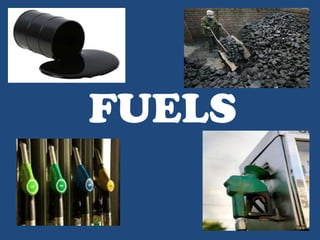
 Fuels are available in solid , liquid or gaseous
  form.
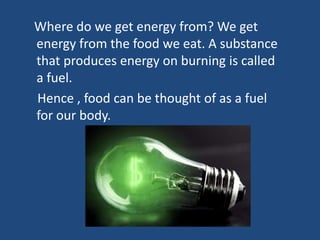
 Wood , coal , coke and cowdung cakes are
  some examples of solid fuels.
 Liquefied Petroleum Gas (LPG), Compressed
  Natural Gas (CNG) and biogas are examples of
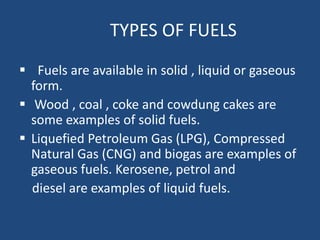
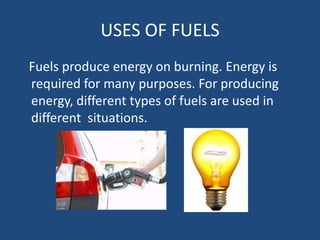
  gaseous fuels. Kerosene, petrol and
  diesel are examples of liquid fuels.
USES OF FUELS
Fuels produce energy on burning. Energy is
required for many purposes. For producing
energy, different types of fuels are used in
different situations.
DOMESTIC FUELS
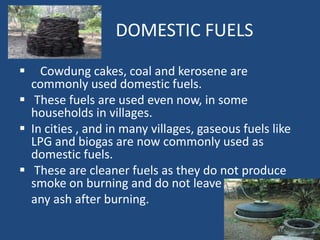
   Cowdung cakes, coal and kerosene are
  commonly used domestic fuels.
 These fuels are used even now, in some
  households in villages.
 In cities , and in many villages, gaseous fuels like
  LPG and biogas are now commonly used as
  domestic fuels.
 These are cleaner fuels as they do not produce
  smoke on burning and do not leave
  any ash after burning.
FUELS FOR TRANSPORTATION AND ELECTRICITY
              GENERATION
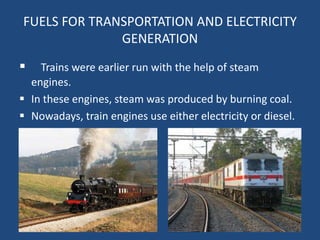
   Trains were earlier run with the help of steam
  engines.
 In these engines, steam was produced by burning coal.
 Nowadays, train engines use either electricity or diesel.
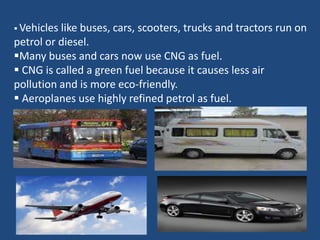
 Vehicleslike buses, cars, scooters, trucks and tractors run on
petrol or diesel.
Many buses and cars now use CNG as fuel.
 CNG is called a green fuel because it causes less air
pollution and is more eco-friendly.
 Aeroplanes use highly refined petrol as fuel.
DO YOU KNOW?
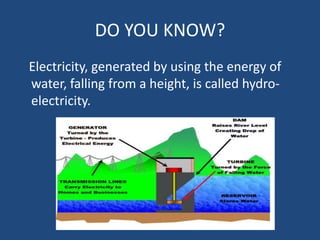
Electricity, generated by using the energy of
water, falling from a height, is called hydro-
electricity.
FUELS AND MACHINES
• Earlier, household works like washing clothes,
  spinning, weaving, and so on were done
  manually. This was time consuming, slow and
  tiring.
• Hand-operated machines were then
  developed to help us. Later on, machines
  working through steam were invented.
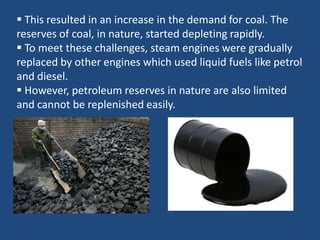
 This resulted in an increase in the demand for coal. The
reserves of coal, in nature, started depleting rapidly.
 To meet these challenges, steam engines were gradually
replaced by other engines which used liquid fuels like petrol
and diesel.
 However, petroleum reserves in nature are also limited
and cannot be replenished easily.
FOSSIL FUELS
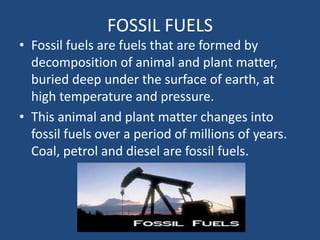
• Fossil fuels are fuels that are formed by
  decomposition of animal and plant matter,
  buried deep under the surface of earth, at
  high temperature and pressure.
• This animal and plant matter changes into
  fossil fuels over a period of millions of years.
  Coal, petrol and diesel are fossil fuels.
RENEWABLE AND NON-RENEWABLE
       SOURCES OF ENERGY.
• Sources of energy, which once used, cannot be readily
  replenished are called non-renewable sources of energy. Coal
  and petroleum are non-renewable sources of energy.
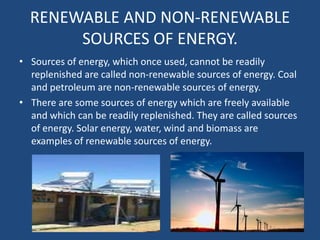
• There are some sources of energy which are freely available
  and which can be readily replenished. They are called sources
  of energy. Solar energy, water, wind and biomass are
  examples of renewable sources of energy.
Prepared by
Arushi Sharma
    V-A

Fuels

  • 1.
  • 2.
    Where do weget energy from? We get energy from the food we eat. A substance that produces energy on burning is called a fuel. Hence , food can be thought of as a fuel for our body.
  • 3.
    TYPES OF FUELS Fuels are available in solid , liquid or gaseous form.  Wood , coal , coke and cowdung cakes are some examples of solid fuels.  Liquefied Petroleum Gas (LPG), Compressed Natural Gas (CNG) and biogas are examples of gaseous fuels. Kerosene, petrol and diesel are examples of liquid fuels.
  • 4.
    USES OF FUELS Fuelsproduce energy on burning. Energy is required for many purposes. For producing energy, different types of fuels are used in different situations.
  • 5.
    DOMESTIC FUELS  Cowdung cakes, coal and kerosene are commonly used domestic fuels.  These fuels are used even now, in some households in villages.  In cities , and in many villages, gaseous fuels like LPG and biogas are now commonly used as domestic fuels.  These are cleaner fuels as they do not produce smoke on burning and do not leave any ash after burning.
  • 6.
    FUELS FOR TRANSPORTATIONAND ELECTRICITY GENERATION  Trains were earlier run with the help of steam engines.  In these engines, steam was produced by burning coal.  Nowadays, train engines use either electricity or diesel.
  • 7.
     Vehicleslike buses,cars, scooters, trucks and tractors run on petrol or diesel. Many buses and cars now use CNG as fuel.  CNG is called a green fuel because it causes less air pollution and is more eco-friendly.  Aeroplanes use highly refined petrol as fuel.
  • 8.
    DO YOU KNOW? Electricity,generated by using the energy of water, falling from a height, is called hydro- electricity.
  • 9.
    FUELS AND MACHINES •Earlier, household works like washing clothes, spinning, weaving, and so on were done manually. This was time consuming, slow and tiring. • Hand-operated machines were then developed to help us. Later on, machines working through steam were invented.
  • 10.
     This resultedin an increase in the demand for coal. The reserves of coal, in nature, started depleting rapidly.  To meet these challenges, steam engines were gradually replaced by other engines which used liquid fuels like petrol and diesel.  However, petroleum reserves in nature are also limited and cannot be replenished easily.
  • 11.
    FOSSIL FUELS • Fossilfuels are fuels that are formed by decomposition of animal and plant matter, buried deep under the surface of earth, at high temperature and pressure. • This animal and plant matter changes into fossil fuels over a period of millions of years. Coal, petrol and diesel are fossil fuels.
  • 12.
    RENEWABLE AND NON-RENEWABLE SOURCES OF ENERGY. • Sources of energy, which once used, cannot be readily replenished are called non-renewable sources of energy. Coal and petroleum are non-renewable sources of energy. • There are some sources of energy which are freely available and which can be readily replenished. They are called sources of energy. Solar energy, water, wind and biomass are examples of renewable sources of energy.
  • 13.