THE FIRST CONDITIONAL
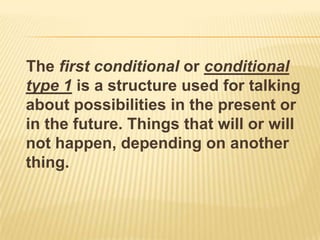
 The first conditional or conditional type 1 is a structure used for talking about possibilities in the present or in the future. Things that will or will not happen, depending on another thing.
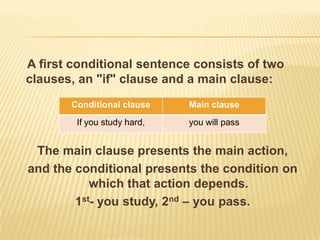
A first conditional sentence consists of two clauses, an "if" clause and a main clause:The main clause presents the main action,              and the conditional presents the condition on which that action depends.1st- you study, 2nd – you pass.
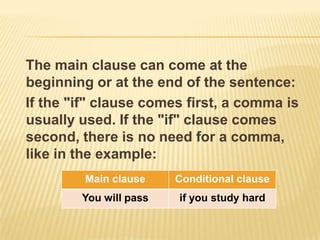
Themainclause can come at thebeginningor at theend of thesentence:   If the "if" clause comes first, a comma is usually used. If the "if" clause comes second, there is no need for a comma, like in the example:
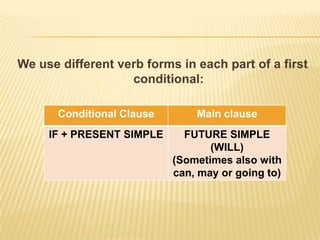
We use different verb forms in each part of a first conditional:
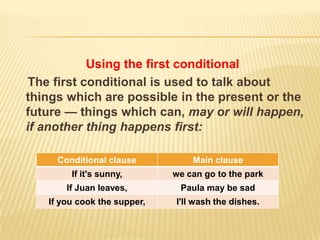
Using the first conditional    The first conditional is used to talk about things which are possible in the present or the future — things which can, may or will happen, if another thing happens first:
THE END

The first conditional

  • 1.
  • 2.
    The first conditional orconditional type 1 is a structure used for talking about possibilities in the present or in the future. Things that will or will not happen, depending on another thing.
  • 3.
    A first conditionalsentence consists of two clauses, an "if" clause and a main clause:The main clause presents the main action, and the conditional presents the condition on which that action depends.1st- you study, 2nd – you pass.
  • 4.
    Themainclause can comeat thebeginningor at theend of thesentence: If the "if" clause comes first, a comma is usually used. If the "if" clause comes second, there is no need for a comma, like in the example:
  • 5.
    We use differentverb forms in each part of a first conditional:
  • 6.
    Using the firstconditional The first conditional is used to talk about things which are possible in the present or the future — things which can, may or will happen, if another thing happens first:
  • 7.